[The Iron Survey: A Sovereign Veteran’s War for Three Hundred Acres of Southern Pine]
CHAPTER 1: THE COLD LINE
The fluorescent orange plastic ribbon flapped against the damp bark of the red oak. It wasn’t my ribbon.
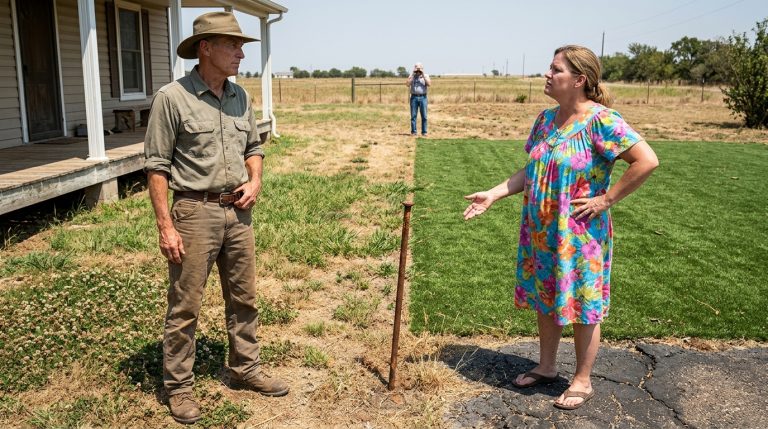
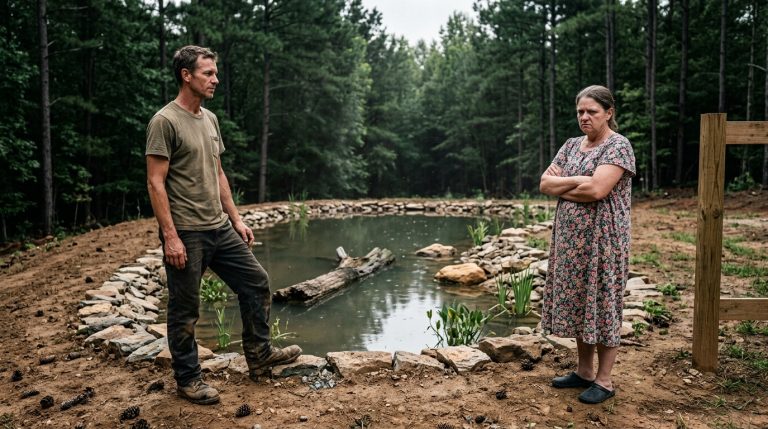
I stood twenty feet inside the timberline, the heel of my boot resting on the moss-covered granite marker my grandfather set in 1952. The ribbon was fresh. The knot was tight, tied with the hasty precision of a paid contractor who didn’t care whose bark he notched. Across the gurgling grey silt of Miller’s Creek, a pink pastel pantsuit pushed through the wild rhododendrons.
“You’re standing in a restricted remediation zone, Mr. Thorne,” Karen said. She didn’t slow down until her white orthopedic sneakers hit the muddy edge of my bank. She clutched a heavy black vinyl binder to her sternum like body armor. “Article Seven, Section B. The Whispering Pines HOA board issued the citation three days ago.”
I didn’t answer. I reached into my coat pocket, my fingers wrapping around the cold, six-ounce brass survey weight I’d pulled from my father’s workbench that morning. I rolled the heavy brass cylinder over my knuckles. Smooth. Cold. Heavy enough to drop a line straight through twelve feet of wind.
“You’re trespassing,” I said. My voice didn’t carry past the rush of the water. It didn’t need to.
“This buffer is designated common property under our master development plan,” she said, tapping the binder with a manicured nail. The plastic click sounded like a dry-fire in the quiet timber. “Unmanaged underbrush creates a fire hazard and lowers the aesthetic baseline for Phase One. You have fourteen days to clear the brush, or our contractor will do it at your expense. A hundred-dollar fine has already posted to your parcel record.”
“My deed sits in the county vault in Raleigh,” I said. My thumb pressed into the cold brass edge of the weight, crushing a speck of dried red dirt from the knurling. “Page forty-two, Book 308. This bank is two hundred feet west of your phase line.”
“Prior records are superseded by the consolidated master plat filed with the planning commission,” she replied without blinking. Her mouth was a thin, dry line. “Mr. Harris’s legal team vetted every foot. The creek is our natural water feature. You don’t own the water, Mr. Thorne.”
“I own the dirt under it,” I said.
She took one step closer, the toe of her sneaker breaking a clump of damp fern roots. “Pay the fine. Clear the brambles. Or we slap a lien on the deed before the month is out. You don’t have the leverage to fight a master plan, Sergeant.”
I dropped the brass weight back into my canvas pocket. It hit the heavy fabric with a dull, solid thud against my thigh.
“Step back across the water, Karen.”
She hesitated, her eyes dropping to the pocket where the brass rested. The air between us smelled of wet pine needles and diesel exhaust drifting from the bulldozers idling three hundred yards away on her side of the ridge. She turned on her heel, her sneakers tearing a chunk of moss off the granite header as she scrambled back toward the clear-cut timber of her development.
I didn’t watch her reach the golf cart waiting on the gravel apron. I turned toward the oak, hooked my thumb under the orange ribbon, and snapped the cheap plastic with a single jerk.
CHAPTER 2: THE PAPER TRAIL
The orange plastic tore like brittle paper. I let the scraps fall onto the wet granite marker, watching the HOA golf cart’s fat turf tires spin through the red clay thirty yards out. Karen didn’t look back. The blue fumes of her two-stroke engine hung low over the creek, trapped under the canopy of damp pine needles.
I didn’t give her five minutes to reach her driveway. I turned and walked back up the slope toward the farmhouse, my work boots sinking two inches into the pine straw with every stride. My thumb was still stained with the grey lichen from the red oak, but my hand stayed deep in my canvas coat, rolling the six-ounce brass survey weight against my thigh.
Inside the kitchen, Sarah didn’t ask what Karen wanted. She stood by the sink, a half-peeled apple in one hand and the paring knife motionless in the other. Her eyes tracked the mud on my boots.
“She brought a paper,” I said.
“What kind of paper?”
“The kind that thinks it can rewrite seventy years of deed tax,” I replied. I pulled the folded, mud-smudged citation from my pocket and laid it on the oilcloth table. “She’s calling Miller’s Creek a community water feature. Gave us fourteen days to clear the underbrush or pay for their contractor.”
Sarah set the knife down. The blade made a soft clink against the enamel. “Mark. They have money. Developers like Harris don’t build fifty houses without a bank full of lawyers behind them.”
“Lawyers buy paper, Sarah. They don’t buy the dirt under it.” I picked up my truck keys from the peg by the door. “I’m going to the register of deeds.”
“The county office closes at four.”
“Then I’ve got two hours to see what kind of map Harris bought.”
The drive into the county seat took twenty-two minutes along Route 9. The rust on my Ford’s quarter panel vibrated against the frame every time I hit fifty, a steady, low rattle that kept my mind locked on the road. The pine trees gave way to silt-fences, then to clear-cut red dirt, and finally to the concrete block box of the county administration building.
Inside, the register of deeds office smelled of old paper, floor wax, and dry air from an ancient radiator in the corner. Behind the heavy oak counter sat Mrs. Gable, a woman who had filed every property transfer in this district since my father was in high school.
“Mark,” she said, squinting through bifocals on a beaded chain. “You look like your grandfather when he came in here after the fifty-two survey.”
“I need the plat maps for Phase One of Whispering Pines,” I said. “And the consolidated master plan filed by Harris Development.”
She didn’t ask why. She pulled two thick, cloth-bound ledger books from the lower shelving units and laid them flat on the counter. The heavy paper groaned as she turned the pages.
“Filed eighteen months ago,” she said, running a spotted finger down the index. “Book of Maps 2018, Page 114.”
I leaned over the counter. The map was drawn in crisp, black CAD lines, crisp and stark against the yellowed paper of the ledger. My eyes went straight to the western line—the boundary that should have run straight as a rifle barrel two hundred feet east of Miller’s Creek.
The line didn’t run straight. On Harris’s map, the boundary swung west in a tight, artificial curve, swallowing the entire creek bed and fifty yards of my timber before snapping back east at my southern corner pin.
I pulled my brass weight out and set it on the parchment. The brass covered three square inches of what should have been my family’s property.
“Look at the surveyor’s seal,” I muttered.
The seal stamped at the bottom corner was clean—too clean. It bore the name of a regional firm out of Charlotte, but the embossed seal lacked the raised iron bite that older county deeds carried. Next to the signature block, a tiny printed notation caught my eye: Drainage Easement allocated to Phase One Basin.
Phase One Basin. Harris hadn’t just misdrawn a fence line to give his buyers a prettier view of the trout stream. He needed the physical square footage of my creek bed to balance the water runoff calculations for his entire development. Without Miller’s Creek on his blueprint, his drainage permits were short by forty acres.
“Mrs. Gable,” I said quietly. “Who signed off on the county planning approval for this map?”
“The commission board,” she said, leaning in. “Signed off in executive session last November. Mr. Harris brought his own legal counsel.”
“Did they cross-reference my 1952 deed?”
She hesitated, her lips pressing tight together. “Mark… when a master developer submits a certified plat from a licensed surveyor, the clerk’s office doesn’t re-run historical boundaries unless there’s an active dispute on file.”
“There is one now,” I said.
I pulled my phone from my pocket and took four clear, high-resolution photographs of the map, focusing on the fraudulent curve around the creek and the tiny notation for the Phase One Basin. Then I turned to the ledger index.
“I need Arthur Abernathy’s direct line,” I said.
Mrs. Gable looked at me for a long second, then pulled a small, laminated business card from under her blotter. “Arthur doesn’t take small-claims land disputes, Mark. He only takes cases where somebody tried to steal something big.”
“They didn’t just try,” I said, putting my phone back in my pocket and picking up the cold brass weight. “They stamped it.”
Thirty minutes later, I was sitting in a second-floor office three blocks from the courthouse. The room smelled of leather and stale pipe tobacco. Arthur Abernathy sat behind a desk made from a solid slab of cured walnut, holding my brass survey weight in one hand and turning my phone around with the other to look at the photos of the plat map.
He was a man nearing seventy, with white hair cut close like a retired officer’s and eyes that moved slow, taking in everything without rushing.
“This notation,” Abernathy said, his thumbnail tapping the screen over the words Phase One Basin. “That’s not an aesthetic choice. If Harris doesn’t have this creek buffer on his filed map, his entire storm runoff calculation fails DEQ standards. He can’t pour concrete for Phase Two.”
“So he stole two hundred feet of my woods to make his math work,” I said.
“He borrowed it, assuming you wouldn’t spend twenty thousand dollars in legal fees to stop him,” Abernathy corrected. He set the brass weight down on his blotter with a heavy, deliberate thud. “He counted on you being a tired veteran who’d take a five-hundred-dollar settlement or get worn down by HOA fines.”
“What’s the counter?”
Abernathy leaned back, his chair creaking under his weight. “We don’t file a quiet title suit yet. That takes eighteen months and lets him keep building. Tomorrow morning, I file a Lis Pendens against the entire Whispering Pines master parcel.”
I looked at him. “Meaning?”
“Meaning a legal cloud sits on every single lot Harris owns,” Abernathy said, a cold, sharp smile touching the corners of his mouth. “He can’t sell a house. He can’t refinance his construction loan. He can’t close on Phase Two. Every bank holding his paper will get an automated red flag before noon.”
“How long does that take to hit his desk?”
“About four hours after the clerk stamps it,” Abernathy said. He pushed the brass weight back across the desk toward me. “Go home, Mark. Put up your posting signs. When Karen brings her maintenance crew on Monday, don’t raise your voice. Let her put one foot across that granite marker while the sheriff is watching.”
“She’s bringing chainsaws,” I said.
“Good,” Abernathy said softly. “I hope they’re gas-powered. Makes a better audio recording for the judge.”
I picked up the brass weight, the metal taking the warmth of my palm, and walked out into the cooling evening air.
CHAPTER 3: THE BORDERLINE
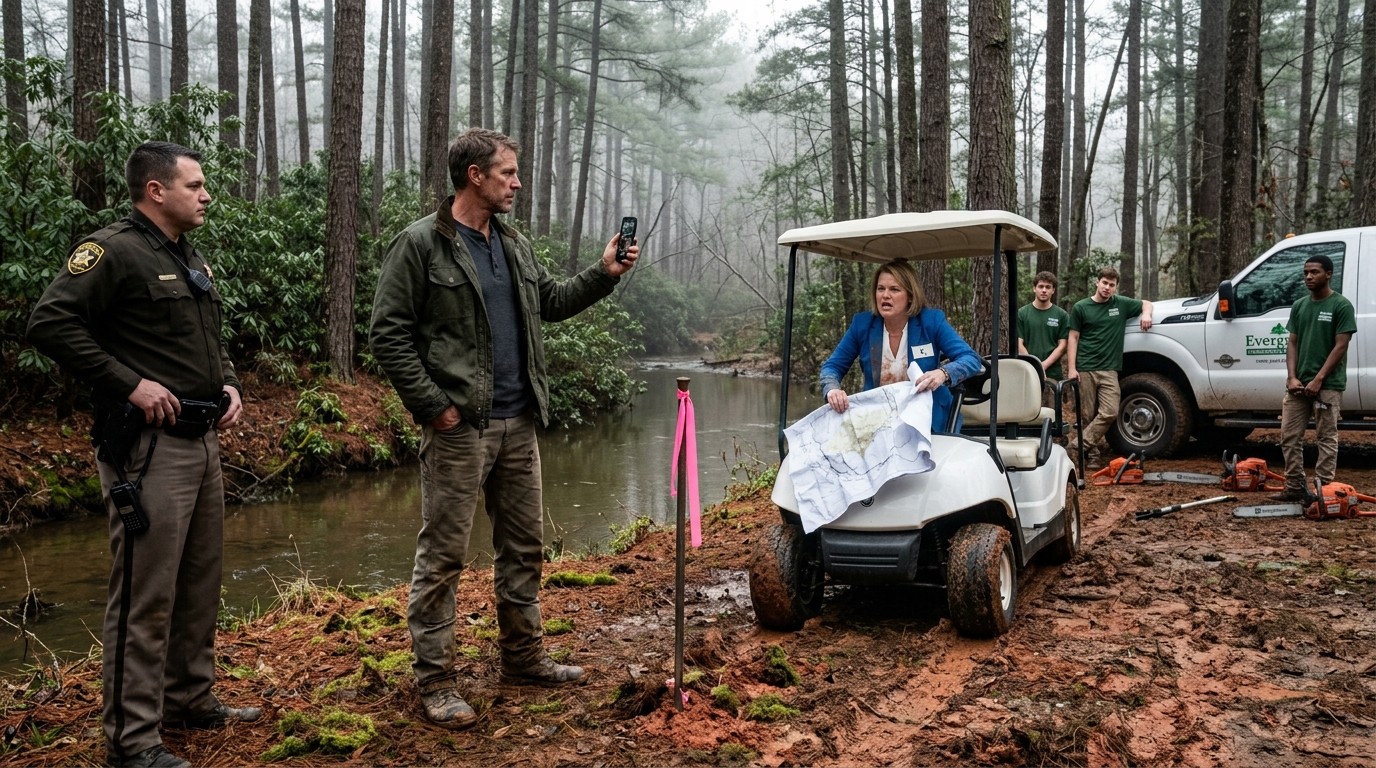
The iron pin went into the earth with a dull, ringing thud. Tom brought the five-pound sledge down three more times, sinking the ribbed steel collar flush with the damp granite silt. The shockwave echoed off the pine trunks, rattling through the misty air hanging over Miller’s Creek.
Standing five feet behind him, Deputy Miller adjusted his gun belt. His radio crackled once with static before he turned it down, his eyes fixed on the treeline across the water.
“You’re sure about this mark, Sergeant?” Miller asked, his thumb hooked over his belt buckle. “If she turns up with a court injunction, I can’t enforce a civil fence line.”
“She won’t have an injunction,” I said, my voice low. I didn’t take my hand out of my coat pocket. My knuckles pressed against the six-ounce brass weight, grounding my posture against the damp chill. “She has a fake map and a pair of bolt cutters. Abernathy filed the Lis Pendens at eight-fifteen.”
Across the bank, the underbrush crashed.
It wasn’t a court officer. It was a pristine white Ford F-250 with Evergreen Commercial Landscaping painted on the door panel, its diesel engine chugging hard as it pushed through the wild mountain laurel. Behind it came a second vehicle—a neon-pink golf cart bouncing violently over the fresh tractor ruts.
Karen cut the cart’s wheel hard, coming to a halt twenty yards inside my timberline on the east side of the bank. She was out of the seat before the engine died, her vibrant blue suit jacket open, revealing a white blouse already stained with clay dust at the hem. Behind her, four young men in green work shirts climbed out of the pickup bed. Two of them carried commercial Husqvarna chainsaws; the other two held pole saws and steel clearing axes.
“Stop right there!” Karen screamed. Her voice cracked on the last word, carrying across the running water like a torn sheet. “Deputy! I am demanding you arrest these men immediately for criminal destruction of HOA property!”
Deputy Miller didn’t rush. He took three deliberate steps forward, stopping right beside the newly driven iron pin with its fluttering tail of pink surveyor’s ribbon.
“Morning, Mrs. Vance,” Miller said calmly. “No one’s destroying property.”
“He’s driving iron spikes into a designated common area!” She marched right down to the water’s edge, pointing a manicured, shaking finger at Tom, who didn’t even stop adjusting his tripod sight. “We issued a formal notice of remediation! That brush is slated for clearing under Section Seven!”
“The section seven notice applies to land owned by Whispering Pines,” I said, stepping up beside Miller. The mud beneath my boots held firm, anchoring me to the western bank. “This pin sits two hundred feet west of your legal boundary. You’re standing on private timberland, Karen.”
“I have the plat!” She pulled a folded white blueprint from her leather binder and slapped it open against the hood of her golf cart. “Look at it! The creek is our feature! Harris Development deeded this line to the board six months ago!”
“And Harris Development lied to you,” I replied. I pulled my phone from my breast pocket, tapping the screen once to record her face, the crew behind her, and the idling chainsaws. “Your surveyor altered the county boundaries to pad your drainage requirements for the Phase One Basin. The Lis Pendens was recorded an hour ago. Every lot in your subdivision is legally frozen until a judge clears this border.”
Karen’s face went from flushed pink to an ugly, mottled white. Her mouth worked silently for three seconds, opening and closing like a landed trout.
“That’s… that’s a lie,” she stammered, stepping across a dry log toward the creek. Her sneaker skidded on a patch of wet red clay, sending a spray of dirt into the water. “You can’t freeze Phase One! We have six closings scheduled for Friday!”
“Then I suggest you call Mr. Harris,” Deputy Miller said, his tone shifting into something harder, cold and official. “Ma’am, I am instructing you and your contractors to step back across that flag line. Mr. Thorne has presented certified county survey records and an active civil filing. If those chainsaws cross this water, I will personally process every man in those green shirts for trespass and felony destruction of timber.”
The four landscapers didn’t wait for Karen to answer. The boy holding the lead Husqvarna set his saw down on the tailgate, wiped his muddy palms on his jeans, and shook his head.
“We ain’t getting locked up over a fence dispute, lady,” he muttered, reaching in to cut the truck’s ignition. The diesel rumble died instantly, leaving only the rushing sound of Miller’s Creek and Karen’s ragged breathing.
“You cowards!” she shrieked, turning on the crew. “I am the board president! You’re under contract!”
“They’re under state law,” Miller said quietly.
Karen turned back to us, her hands trembling as she tried to refold her blueprint. The paper tore along the center crease, flapping uselessly in the cold morning draft coming off the water. She glared across the creek, her eyes locking onto my phone lens, then onto the cold, unyielding iron pin Tom had just set into the granite silt.
“You think you’re smart, Sergeant,” she hissed, her voice dropping into a raspy whisper. “You think you can stop a twenty-million-dollar project with an old deed and a deputy friend. Harris will crush you in chancery court before the week is out.”
“Tell him to bring his surveyor,” I said. “I’ll be right here.”
She slammed her hand against the steering wheel of the golf cart, spun it around in a jagged arc that chewed deep ruts into the moss, and tore off toward the beige roofs of Whispering Pines. The landscaping truck backed down the rough trail right behind her, leaving a cloud of gray exhaust hanging in the branches.
Tom didn’t look up from his scope. He tapped the iron pin with his toe, checking its balance. “Line’s true, Mark. Next pin is sixty yards south, right through those red oaks.”
I put my phone back in my pocket and took a slow breath of the pine-scented air. The immediate threat was gone, but as I looked down at the mud where Karen’s golf cart had turned, something caught my eye.
In the deep rut left by her fat rear tires, the topsoil had been churned away, exposing a thick seam of wet, unnatural gray sludge oozing up from beneath the red clay. It wasn’t creek silt. It smelled faintly of iron, sulfur, and stagnant chemical wash.
I knelt down, touching the edge of the gray ooze with the tip of a pine stick. It didn’t wash away in the trickle of groundwater. It clung to the wood like grease.
CHAPTER 4: CISTERN CODE NINE
The pine stick snapped in two under my thumb. The break made a dry crack that barely carried over the steady gurgle of Miller’s Creek, but the black, greasy residue clung to the splintered end like axle grease. I wiped my thumb on a handful of wet pine needles. It didn’t lift. The faint smell of rotten eggs and metal shavings drifted up from the rut.
“Tom,” I said, my voice barely above a whisper. “Hold your rig.”
Tom paused ten yards down the bank, the heavy iron surveyor’s rod balanced across his shoulder. He looked back over his glasses, his boots squelching in the damp silt. “What you got, Mark?”
“A buried pipe line,” I said.
I didn’t wait for his answer. I reached into my coat pocket, pulled out the brass survey weight, and used its sharp knurled edge to scrape away three inches of churned topsoil where Karen’s golf cart tires had gouged the earth. The brass hit metal with a dull, iron clank.
Not a pipe. A flange.
A ten-inch cast-iron manifold cover sat flush with the granite shelf, hidden beneath six inches of rotting oak leaves and illegally dumped gravel. The bolts securing the faceplate were fresh—blackened steel, unrusted, slathered in industrial grease to prevent seizing. Stenciled across the pitted iron face in faded white enamel were three words and a code: PHASE ONE BASIN — CISTERN CODE 9.
My thumb dragged across the cold lettering, coming away black with the same greasy Red Clay Leachate that was bleeding out into the creek bed.
“Deputy,” I called out, staying on one knee.
Deputy Miller walked down the embankment slowly, his hand resting lightly on his belt holster to balance himself against the loose shale. He squatted beside me, his nose wrinkling the moment he broke the line of brush.
“What is that?” Miller asked, leaning closer without touching the iron plate. “Harris don’t have a county permit for a discharge line out here. All the storm runoff for Phase One is supposed to drain east into the municipal culvert.”
“He doesn’t have a discharge permit because this isn’t storm water,” I said.
I hooked my fingers under the edge of the iron manifold cover. It weighed forty pounds, raw cast iron cold enough to bite through the skin of my palms. I gritted my teeth, drove my heels into the wet clay, and heaved. The seal broke with a wet pop, and the smell hit us instantly—a thick, suffocating wave of stale diesel, iron rust, and chemical solvent.
Miller recoiled, slapping a hand over his nose and mouth as he scrambled back two paces up the slope. “Jesus, Mark!”
Below the cover lay a four-foot concrete sump pit. A corrugated PVC pipe fed into the north wall, dripping a steady, dark stream of Red Clay Leachate directly into an unlined gravel trench that sloped downward, straight into the water table feeding Miller’s Creek.
“He didn’t just steal the land to pass his acreage math,” I said, my breath coming short as I stared down into the pit. “Harris built Phase One over the old county industrial dump. The whole western quadrant is leaking.”
“He’s bypassing the containment field,” Miller wheezed through his sleeve, his eyes watering from the fumes. “He plumbed Cistern Code 9 straight through your woodlot so the county inspectors wouldn’t catch the overflow in his retention pond.”
I pulled my phone out with my left hand while my right held the forty-pound iron lid off its seat. The camera shutter clicked three times—first the stenciled code on the lid, then the dripping PVC bypass, and finally the black film floating on the surface of the creek ten feet downstream.
“Abernathy needs to see this,” I said. “Right now.”
I let the iron lid drop back into place. The heavy slab hit the lip with a metallic bang that echoed down the ravine, sending a flock of crows screaming out of the red oaks overhead.
“I’m calling the State Department of Environmental Quality,” Miller said, his phone already out as he climbed back toward his cruiser. “This ain’t just a boundary dispute anymore, Mark. This is a hazmat crime.”
“Call them,” I said, standing up and dusting the black grease onto my canvas trousers. “But don’t expect Harris to sit on his hands when the state trooper shows up.”
I turned back to Tom, who stood frozen by his surveyor’s tripod, holding the sight rod like a spear. “Pack the gear, Tom. We’re done staking for today.”
“Where are you going?” Tom asked.
“To town,” I said, rolling my brass weight back into my pocket until the metal settled against my thigh. “Harris has six house closings scheduled for Friday. He’s going to try and bury this pit before sunrise.”
I didn’t take the truck back to the farmhouse. I drove straight down Route 9, the Ford’s engine whining high as I pushed sixty-five through the pine corridors. The sun was dipping behind the ridge, casting long, bruised shadows across the freshly graded red earth of Whispering Pines Phase Two.
I pulled off onto the shoulder opposite the main sales office—a modular trailer wrapped in white vinyl lattice with a pristine banner fluttering from the porch: WHISPERING PINES — LUXURY COUNTRY LIVING.
Inside the trailer’s tinted glass windows, two silhouettes were visible under the harsh overhead fluorescent lights. One was Harris—tall, silver-haired, dressed in a tailored navy blazer, pacing the length of the carpeted floor with a phone pressed to his ear. The other was Karen. She sat in a folding chair, her head down, her hands buried in her lap while Harris gestured violently with his free arm.
I slammed the truck door shut and crossed the gravel parking lot, my boots leaving gray silt tracks across their manicured welcome mat.
I didn’t knock. I turned the brass knob and pushed the door open.
The air conditioning inside was cold enough to freeze grease. Harris cut his sentence mid-word, lowering his phone as his eyes locked onto my mud-stained coat and the black grease smeared across my right forearm.
“You’re trespassing on private commercial property, Thorne,” Harris said, his voice smooth, controlled, and dripping with rehearsed legal ice. “I have two attorneys drafting an emergency motion to dissolve your Lis Pendens right now. You have ten seconds to get off my lot.”
“Cistern Code 9,” I said.
The word hung in the cold trailer air like an iron weight.
Karen’s head snapped up. Her face went completely blank, the red splotches on her cheeks draining instantly into a waxy yellow. Harris didn’t move a muscle, but his left thumb twitched involuntarily against the side of his phone, dragging across the glass casing.
“I don’t know what you’re talking about,” Harris said softly.
“The manifold cover under the red oaks,” I said, taking two slow steps toward his desk until the smell of the chemical leachate on my boots filled the small office. “The ten-inch line draining the Phase One Basin straight into Miller’s Creek. Deputy Miller is on with the DEQ right now.”
Harris stared at me for three long seconds. The smooth, country-club composure didn’t break, but his eyes narrowed into two slits of cold, calculated arithmetic.
“Arthur Abernathy won’t save you from a counter-countersuit, Thorne,” Harris said, his voice dropping an octave. “You think you can prove who laid that pipe?”
“I don’t have to prove who laid it,” I said, reaching into my pocket and pulling out the brass survey weight. I set it on his polished glass desk with a sharp, heavy clack that rattled his pen holder. “It sits on my land. Which means tomorrow morning, I’m bringing a backhoe out to cap it with five yards of solid concrete.”
Harris’s mouth tightened into a hard, white line. “If you block that drainage line, Phase One floods by midnight.”
“Then you better start swimming,” I said.
CHAPTER 5: THE SUBURBAN RECKONING
The brass weight rested on the glass desk, a six-ounce pillar of cold metal sitting between Harris’s white knuckles. The A/C unit in the window rattled, blowing a draft that smelled of wet carpet and cheap air freshener over the three of us.
“You have until nine tomorrow morning,” I said, my hand leaving the glass without leaving a mark. “Then the concrete truck backs up to the culvert.”
Harris didn’t answer. His right hand went to his breast pocket, pulling out a silver pen, but he didn’t click it. His eyes stayed glued to the black smudge of Red Clay Leachate drying on my leather work boot.
Karen made a small, choked noise in the back of her throat, her hands twisting the handles of her vinyl binder until the plastic seams groaned. “Mr. Harris… the board… if the county inspector sees a backhoe on the creek—”
“Quiet, Karen,” Harris said, his voice flat as a iron board. He didn’t look at her. He kept his eyes on mine. “Mr. Thorne thinks he’s playing a tactical game. He thinks because he spent twenty years in the infantry he understands leverage.”
“I understand structural failure,” I said, stepping back toward the glass door. “And your whole west quadrant is sitting on an unpermitted sinkhole.”
I pushed the door open, the humid evening air hitting my face like a warm wet rag as I stepped out onto the gravel apron. Behind me, the lock clicked shut with a sharp, mechanical snap.
Twelve hours later, the Whispering Pines clubhouse looked less like a community center and more like a court room.
Arthur Abernathy sat at the head of the long oak conference table, his tweed jacket unbuttoned, his leather briefcase open beside him like a doctor’s bag. To his right sat Commissioner Gable, her gray hair pulled back in a tight bun, her reading glasses propped on her nose as she flipped through the three-inch binder Arthur had handed her ten minutes prior.
At the far end of the table sat Harris, flanked by two attorneys in dark wool suits. Their briefcases were shut. Their laptops were closed. Harris sat with his chin resting on his interlaced fingers, staring straight ahead at the wall map showing Phase One.
Karen sat three seats down from Harris, completely alone. She wasn’t wearing her pink suit. She wore a plain navy cardigan, her hair unlacquered, her hands flat on the veneer table in front of an empty yellow legal pad.
Twenty residents filled the back row of folding chairs—Dave standing in the back corner by the water cooler, his arms crossed over his chest, his eyes catching mine with a brief, grim nod as I took my seat next to Abernathy.
“This session is convened under County Code Section Fourteen,” Commissioner Gable said, her voice dropping the room into absolute silence. “We are reviewing the environmental compliance and boundary filings for Whispering Pines Phase One and Phase Two. Mr. Abernathy, you have the floor.”
Abernathy didn’t stand up. He didn’t raise his voice. He reached into his briefcase and laid three items on the oak table, side by side.
First, the original 1952 parchment deed bearing my grandfather’s signature.
Second, the sworn affidavit from Harris’s own surveyor, stamped and notarized at seven-thirty that morning.
Third, a glass mason jar filled with six inches of murky water and a floating layer of thick, iridescent black sludge.
“For eighteen months,” Abernathy said, his finger resting on the mason jar, “Harris Development represented to this commission that Phase One contained forty-two acres of natural watershed buffer. They used that acreage to secure their DEQ construction permits.”
Harris’s lead attorney leaned forward, his mouth opening. “Madam Commissioner, this is an administrative review, not a criminal hearing—”
“Let him finish, Counsel,” Gable snapped, not looking up from the surveyor’s affidavit.
“The forty-two acres,” Abernathy continued, his thumb tapping the glass jar with a soft clink, “do not belong to Harris Development. They belong to Mr. Mark Thorne. To conceal that theft, Harris filed a altered plat map with the register of deeds. And to handle the illegal toxic runoff coming from the unpermitted burial site under the western quadrant, they plumbed an overflow line directly into Miller’s Creek.”
He pointed to the glass jar.
“This sample was pulled four hours ago from the discharge valve at Cistern Code 9, three feet inside Mr. Thorne’s property line. The DEQ field report is attached to page twelve of your folder, Commissioner.”
Gable turned to page twelve. Her face didn’t change color, but her jaw muscles tightened until her skin turned pale around her mouth. She looked across the table at Harris.
“Mr. Harris,” Gable said quietly. “Is this your discharge manifold?”
Harris didn’t look at the jar. He leaned toward his attorney, whispered three short words, and then sat back up.
“Our engineers designed the storm infrastructure based on the master site plan provided by the surveying contractor,” his attorney said, his voice stripped of all its previous confidence. “If there were discrepancies in the boundary line or the discharge routing, my client was unaware of the technical execution.”
“He paid the surveyor twenty thousand dollars in cash to sign the altered map,” Abernathy said, pulling a second sheet of paper from his coat pocket and sliding it across the table. “That’s page four of the affidavit. The bank transfer logs are attached.”
The room went dead quiet. Behind us, one of the residents in the back row let out a low, slow whistle.
Karen’s head sank two inches lower toward her yellow pad. She turned to Harris, her voice cracking as she spoke across the empty chairs. “You… you told me the land was ours, Mr. Harris. You told me the board had the right to enforce the buffer.”
Harris didn’t even turn his head to look at her. “You should have stayed out of the woods, Karen.”
“That’s enough,” Commissioner Gable said, slamming her folder shut with a sound like a pistol shot. She stood up, her eyes locking onto Harris like two iron sights. “Mr. Harris, as of this second, all building permits for Phase One and Phase Two are suspended indefinitely. The county attorney will be filing criminal fraud charges against your firm before the courthouse closes today.”
She looked at Abernathy. “Mr. Abernathy, your client’s boundary is recognized as stated in the 1952 deed. The county will bear the full cost of correcting the plat registry.”
Abernathy bowed his head once. “Thank you, Commissioner.”
As Gable pulled her papers into her bag and walked out the side door, the room dissolved into a dull murmur of shocked voices. Harris’s attorneys were already packing their laptops, talking fast in low tones to their client, who stood up slowly, his face devoid of all expression.
He pulled his leather briefcase off the floor, adjusted his tie, and stepped toward the center aisle. He stopped right beside my chair.
“You think you won something, Thorne?” Harris said, his voice so quiet only Abernathy and I could hear it. “You’re going to sit on three hundred acres of dirt surrounded by bankrupt, half-built houses and a poisoned creek.”
I stood up. I was two inches taller than him, and the smell of wet earth on my canvas coat pushed past his expensive cologne.
“The creek can be cleaned, Harris,” I said, my hand going into my coat and pulling out the brass survey weight. I held it in my palm, right at his eye level. “The boundary stays right where my grandfather put it.”
He looked at the brass weight, then at my eyes, turned on his heel, and walked out into the bright noon sun.
CHAPTER 6: THE PERMANENT LINE
The oak door clicked into its brass latch, the sound cutting through the low hum of the clubhouse. Outside, the gravel pit rattled as Harris’s Lincoln backed out blind, its tires throwing loose stone against the white vinyl skirt of the sales trailer before tearing off toward Route 9.
I didn’t watch him leave. I rolled the brass weight over my knuckles, feeling the sharp knurled diamond pattern bite into my callouses, then dropped it into my canvas coat.
Abernathy snapped his leather briefcase shut. The brass locks popped like dry twigs. “The state attorney’s office will serve the formal freeze on the Phase One Basin by four o’clock, Mark. The DEQ team is already en route with soil augers.”
“What about the pipe?” I asked, my thumb hooked into my belt loop.
“The county takes possession of the easement for hazmat remediation tomorrow,” Abernathy said, sliding his fountain pen into his breast pocket. “Every drop of Red Clay Leachate coming out of that pit gets pumped into tanker trucks at Harris’s expense. The court-appointed receiver will strip his corporate accounts to pay for it.”
Dave walked over from the back row, his boots making a soft, steady thud on the commercial carpet. He held out a hand, his palm rough and scarred from thirty years of motor-pool maintenance.
“The board held an emergency vote in the hall while Gable was signing her order,” Dave said, his grip firm and dry. “Karen resigned. Didn’t even take her binders out of the office closet. We’re petitioning the county to dissolve the original bylaws by Monday.”
“Good,” I said. “Keep the fence line clear.”
“It’s clear,” Dave said. “And it’s staying clear.”
I walked out into the bright noon air, crossing the gravel apron where Karen’s golf cart ruts were already drying into hard, jagged troughs. The smell of diesel exhaust had cleared out, replaced by the clean, sharp tang of crushed pine needles and wet granite silt blowing off the ridge.
By three o’clock, the fencing crew’s flatbed truck was idling along the western boundary line.
Four workers in heavy canvas coats moved down the two-hundred-foot offset, carrying six-foot black aluminum fence panels that clanked together like heavy armor. A post-hole digger chugged in the background, its steel auger biting deep into the red soil, spitting out damp clods of earth that smelled of ancient oak roots and river stone.
I stood by my grandfather’s 1952 granite marker, my hand resting on the top of a newly set steel post. The concrete in the hole was fresh, thick and gray, curing fast under the cool autumn sun.
Tom, the surveyor, was setting his final iron pin into the granite shelf right beside the creek bed. He pulled his sledge hammer back and brought it down one last time—clang. The ribbed steel pin sank flush with the rock, holding the pink surveyor’s ribbon perfectly straight against the current.
“That pin’s not moving for a hundred years, Mark,” Tom said, wiping his fogged glasses on his sleeve.
“It doesn’t need to move,” I said. “It just needs to stay right where it is.”
An hour later, the work noise died down. The flatbed backed down the trail, its engine fading into the distance, leaving only the steady, unhurried gurgle of Miller’s Creek running over the smooth stones below.
I walked back up the slope toward the farmhouse. The sun was dipping below the ridge, throwing long, dark bars of shadow across the fresh aluminum fence. The black metal didn’t glare in the fading light; it stood quiet and heavy, a sharp, unbroken boundary separating three hundred acres of timberland from the quieted streets of Whispering Pines.
Inside the workshop, the air was still and smelled of linseed oil, dry cedar, and motor grease.
I took off my heavy canvas coat and laid it across the workbench. I reached into the pocket, pulled out the six-ounce brass survey weight, and set it down on the oil-stained oak table next to my grandfather’s original parchment deed and my father’s hand-drawn property maps.
The brass had a scuff on its lower ring where it had hit the cast-iron manifold lid at Cistern Code 9.
I picked up a piece of fine steel wool and a tin of metal polish from the shelf. Sitting down on the wooden stool, I began to work the polish into the metal, moving my thumb in small, deliberate circles. The grey oxide lifted slowly, coming off on the wool until the raw, bright yellow brass showed through underneath.
The house was quiet. Through the window, I could see Sarah on the porch, wrapped in her wool sweater, watching the shadows stretch across the pasture toward the timberline. The kids were down by the fence line, their boots crunching softly on the dry oak leaves as they walked the perimeter, tracing the black metal rails with their fingers.
I wiped the last trace of black polish from the knurled grip. The brass weight sat bright and solid in the center of the workbench, heavy enough to hold a map flat against any wind that blew down off the mountain.
The creek ran clear below the granite header. The line was marked. The land was held.