The Weight of the Water: A Veteran’s Stand on the Dusty Perimeter of Cypress Creek Estates
CHAPTER 1: THE FLORAL MUUMUU AND THE FIRST SALVO
The humidity sat heavy in the Georgia pines, thick enough to taste, but it was nothing compared to the self-righteous certainty radiating off Karen Miller’s floral print muumuu.
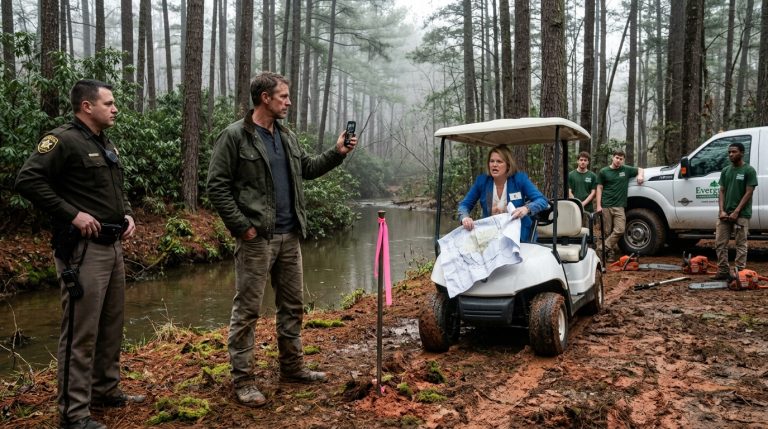
She stood planted firmly at the edge of the property line, her boots sinking half an inch into the soft loam of the ten acres Sarah and I had spent two years searching to find. Her arms were locked across her chest, a general inspecting a conquered trench. A federal crime scene, she called it. She said it with the kind of greasy satisfaction a man usually reserves for striking oil.
I didn’t blink. Twenty-two years as an Army combat engineer clearing mines and shoring up bridges in places where mistakes meant a sudden, loud finality tend to calibrate your nervous system differently. You don’t jump when a civilian in a golf cart raises her voice. You measure the terrain, you calculate the angles, and you look for the blind spots.
“That’s not a pond, Sergeant,” she said again, her voice dropping into that syrupy, patronizing cadence she used when she wanted to remind the neighborhood who held the keys to the kingdom. “That’s an unauthorized modification of a protected watershed. I’ve already filed the paperwork with the Savannah District.”
I looked past her, down the slope of newly graded earth toward the half-acre kidney bean-shaped basin. The water, fed by an underground spring I had spent six months uncovering and channeling, was clear as gin. Dragonflies with wings like stained glass hovered over the native stone lining the banks. A bullfrog sounded a deep, resonant note from beneath a rotting log. It was a living, breathing ecosystem designed to hold water and heal the drainage, built with county permits signed, sealed, and stamped in a three-inch binder sitting on my kitchen table.
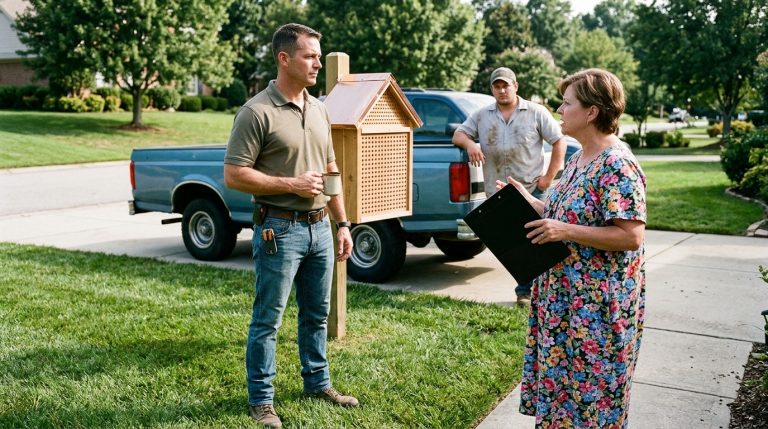
“Karen,” I said, keeping my voice level, the register flat and dry as sun-baked timber. “The county planning office inspected this excavation twice. The deed specifies wildlife management exemptions. You’re standing on private property.”
“For now,” she snapped, her eyes narrowing as she scanned the perimeter like a surveyor measuring lumber for a salvage yard. She turned her golf cart around with a sharp crunch of gravel, the electric motor whining as she headed back down the long drive toward the beige uniformity of Cypress Creek Estates.
She thought she had called in an airstrike on my position. She thought the letters from the Army Corps of Engineers would arrive like mortar fire, forcing us to fill in the basin, tear up the stone, and restore the muddy, mosquito-infested scrubland she preferred as her northern buffer.
I turned back toward the house. Sarah was standing on the back porch, a white ceramic coffee mug cradled in both hands, her eyes fixed on my face. She didn’t have to ask what happened. She could read the shift in my posture—the slight drop of the shoulders, the tightening of the jaw, the cold, rhythmic hum of a problem that needed a solution.
“She pulled the feds in,” I said as I climbed the wooden steps, the weathered boards groaning under my boots.
Sarah took a slow sip, her gaze drifting out over the water where a painted turtle slipped silently off a sun-warmed rock. “Can they make us fill it in, Marcus?”
I reached out, taking the mug from her hands and setting it on the railing. My fingers brushed hers; they were steady, but cold. “Only if the ground beneath us isn’t what we mapped. But we did our homework.”
Inside the house, the three-inch binder sat on the kitchen table like an old field manual. I opened it to the geological survey maps and the state environmental protection division classifications for Cypress Creek—the small, unassuming priority waterway that marked the rear boundary of both our property and Karen’s.
My eye caught a small handwritten note I’d jotted down during my initial research: Priority watershed designation applies strictly to direct, unmonitored discharge.
The silence in the room stretched, heavy and still, broken only by the hum of the refrigerator. Karen had brought the full weight of federal bureaucracy down on our fence line, confident in her rules and her paperwork. But as I stared at the topographical map of the creek separating our land from hers, a cold, quiet realization settled into my bones.
She had spent months memorizing every ordinance in the subdivision handbook, but she had never once looked across the water to see what was draining out of her own backyard.
CHAPTER 2: THE WEIGHT OF THE BINDER AND THE MEMORY OF MINES
The kitchen table was clean oak, scarred by a deep gouge from an old camping chest I’d dropped years ago. It made a solid surface for paperwork, steady enough to lean your weight into when the numbers started crossing your eyes.
I sat down, pulled the three-inch white binder toward me, and flipped the cover back. The plastic rings gave a dull, plastic snap. Inside was everything Karen claimed didn’t exist: county permits for land disturbance, hydrological surveys certified by a licensed engineer out of Macon, state Department of Natural Resources documentation for native aquatic plantings, and a signed receipt from the county planning commission dating back six months.
It was a fortress made of paper. Twenty-two years in the Corps taught me that paper won’t stop a 155mm round, but it’ll stop a bureaucrat if you stack it high enough.
In Kandahar, we used to map every square meter of a route before we rolled the vehicles out of the wire. You don’t guess where the pressure plates are buried. You look for the subtle discoloration in the dust, the slight depression where the roadbed has been disturbed, the asymmetry of the local foot traffic. Karen operated on the exact same tactical level, except her improvised explosive devices were municipal bylaws and petty citations printed on crisp cardstock.
My mind slipped sideways for a second—a brief, intrusive phantom of an old dirt track outside Sangin, the sun beating down on my helmet until the Kevlar felt like a heated skillet, sweat stinging the corners of my eyes while I waited for the probe to hit metal. I blinked it away, grounding myself in the rough grain of the oak table and the faint, familiar smell of cedar and dry ink.
Sarah appeared at the edge of the kitchen, her shadow stretching long across the floorboards. She didn’t say anything right away. She watched me turn a page, her hand resting on the doorframe.
“She won’t let it drop, Marcus,” Sarah said softly. Her voice wasn’t panicked; it had that steady, resilient timbre that had kept us anchored through three overseas deployments and four different states. “Karen doesn’t know how to lose a skirmish. If the county backed us, she’ll find another angle.”
“She already did,” I murmured, tapping a finger against the section of the binder containing state environmental codes. “She called the Savannah District of the Army Corps of Engineers. That’s federal oversight. She thinks she’s brought up heavy artillery.”
“And?”
“And heavy artillery requires a clear line of sight,” I said, looking up to meet her eyes. “If you call an airstrike on a grid coordinate, you better be certain your own troops aren’t dug in right next to the target.”
I closed the binder with a solid thud that rattled the ceramic sugar bowl. The tactical map of Cypress Creek was clear in my head. The small, unassuming stream running behind our properties wasn’t just a drainage ditch; it fed directly into the Chattahoochee basin. Any unmonitored outflow entering that stream from a residential parcel wasn’t a local HOA dispute anymore. It was a state-level liability.
I reached for the landline phone on the wall, my hand moving without hesitation. If Karen wanted to play by federal rules, we’d give her a masterclass in logistics.
CHAPTER 3: ART DONALDSONS PORCH AND THE HISTORY OF TYRANNY
The gravel driveway crunched beneath the tires of my old Ford truck as I rolled it down the quarter-mile stretch toward the outer perimeter. I didn’t rush. Rushing burns fuel and muddies your read on the terrain. Out here, the dust settled slow, coating the fenders in a fine, rust-colored powder that smelled of dry earth and late-season sumac.
Halfway down, I killed the engine. The silence rushed in immediately, thick and heavy with the hum of cicadas.
I needed a sounding board. Not Sarah—she had enough to carry without me dragging her deeper into the administrative trenches—but someone who knew the baseline geology of this land before the developers moved in with their surveyor stakes and their uniform blue prints. That meant Art Donaldson.
Art lived three lots down, past the stand of overgrown water oaks where the county right-of-way narrowed into a private gravel track. He’d been here thirty years. Long before Cypress Creek Estates was a glossy brochure or a collection of identical beige boxes with manicured lawns. Long before Karen Miller ever bought a golf cart and appointed herself the general of the homeowner association.
I shifted the truck back into gear, rolled another hundred yards, and parked by the edge of Art’s split-rail fence. The wood was weathered silver, gray as an old army blanket, split and checked by decades of Georgia sun.
Art was on his back porch. He didn’t look up when the truck door slammed; he was sitting in a low-slung wicker chair with a pair of nickel-plated pruning shears in one hand, meticulously clipping dead growth off a potted tea rose. His fingers were thick, knotted at the knuckles like old roots, but they moved with absolute precision.
I walked up the wooden steps, the boards giving a familiar, hollow groan under my boots.
“You’ve got that look,” Art said quietly, still not looking up from the stem. “The one engineers get right before they decide whether to shore up a bridge or drop a charge under the footings.”
I pulled out the spare chair opposite him, sitting down and letting the afternoon heat press against my shoulders. A sudden gust of wind swept across the yard, carrying the dry, metallic scent of iron and red clay, kicking up a small swirl of dust against the base of the porch steps.
“Karen filed with the Savannah District,” I said.
Art stopped the shears. The steel blades locked shut with a faint, clean click. He finally raised his head, his eyes pale and sharp behind wire-rimmed glasses that had seen too much weather.
“The Army Corps,” he muttered, a dry, gravelly sound rising in his throat. “Good lord. The woman has the tactical instincts of a raccoon in a pantry. She thinks a piece of heavy equipment on a creek bank is an act of war, but she hasn’t got the sense to look at what’s running out of her own back door.”
“That’s why I’m here,” I leaned forward, resting my forearms on my knees. “You’ve lived along this creek longer than anyone else on the ridge. That pipe behind her property line—the one sticking out of the bank near the alder bushes—how long has that been there?”
Art set the shears down on the small cedar table beside his iced tea glass. He reached into his shirt pocket, pulled out a worn tortoiseshell case, and extracted a toothpick, sliding it into the corner of his mouth before he spoke.
“Since she put that in-ground pool in four years ago,” Art said, his voice dropping an octave. ” contractor she hired cut corners on the municipal hookup. Didn’t want to pay the county impact fee for a proper sanitary line tie-in. So they ran a direct PVC bypass straight down the bank into the state-protected channel. She thought nobody would check because the brush grew over it.”
“Chlorine,” I said.
“Pure, unfiltered pool chemicals dumped straight into a priority watershed,” Art nodded slowly, a grim satisfaction touching the corners of his mouth. “Every time she backwashes her filter, she kills half the macroinvertebrates for a quarter mile downstream. She’s been running an illegal discharge pipe right under the noses of the county inspectors because she spent all her time terrorizing people over the height of their mailboxes.”
I felt the tension in my shoulders lock tight, the old combat-engineer calculation clicking into place. We weren’t fighting a defensive action anymore. The enemy had fortified a position with a glaring structural flaw right in the middle of their own perimeter.
“She thinks she’s holding the high ground,” I said softly, staring out past the porch rail toward the distant line of pines where our properties met.
“She’s standing on a dry-stacked bridge with a sledgehammer,” Art corrected me, leaning back into the wicker. “And she doesn’t even hear the timber cracking. You got your permits in order, Marcus?”
“Three-inch binder. County stamped, state reviewed, geology signed off.”
“Then let her call the feds,” Art said, lifting his iced tea glass in a quiet, solemn toast. “Sometimes the best thing you can do when an adversary tries to overrun your position is step aside and let them run straight into their own minefield.”
CHAPTER 4: THE ARRIVAL OF THE FEDERAL INSPECTOR
The white government-issue sedan didn’t belong on our gravel road. Its tires ground against the loose stone with a heavy, distinct mechanical drag, entirely different from the light rattle of local pickup trucks or the whine of Karen’s electric golf cart.
I stood on the front porch, my boots planted on the weathered oak boards, watching the sedan nose its way around the bend of the drive. The dust kicked up behind it in a long, pale plume that caught the slanted afternoon light like a smoke screen. It stopped right at the base of the front steps.
The driver’s side door pushed open with a solid metallic thunk. A man in his late forties stepped out, adjusting a lightweight utility jacket against the lingering humidity. His face was etched with the weary, procedural lines of someone who spent his life reviewing flood maps, runoff logs, and regional zoning infractions. Behind him, a younger woman stepped out on the passenger side, carrying a waterproof field clipboard and a canvas case strapped tight with aluminum buckles.
Mr. Henderson—as his business card would later read—didn’t look around with the sweeping, theatrical contempt Karen had displayed a week prior. He looked at the ground, tracing the natural slope of the terrain, assessing the drainage patterns where the woods met the cleared lawn.
I walked down the steps to meet them, my hands loose at my sides. There was no need for tension. Preparation is its own armor.
“Mr. Henderson?” I asked, keeping my voice level and deliberate.
The compliance officer stopped, his eyes flicking up to assess my stance, my worn canvas work jacket, the way I held my balance on the uneven grade. A flicker of professional recognition crossed his features—the brief, silent acknowledgment between two men who understood what it meant to follow an established chain of command.
“Sergeant Thorne?” Henderson said, extending a hand. His grip was dry, firm, and brief. “I’m with the Savannah District compliance office. This is Dr. Evans, our regional aquatic biologist. We received a formal citizen complaint regarding unauthorized fill activity within a protected wetland corridor on this parcel.”
“I’m aware,” I said, turning to gesture toward the front door. “Before we go down to the water, I have a complete documentation package set up inside. County permits, geological surveys, pre-construction elevation charts, and state environmental exemption filings. Step inside out of the sun; I’ve got coffee brewing.”
Henderson exchanged a brief, sidelong glance with Dr. Evans. You could tell they were used to belligerent landowners, men who met federal oversight with shouting matches and locked gates. My measured, tactical calm caught them off guard.
“That’s irregular, Sergeant,” Henderson said, though his tone had already softened from bureaucratic stiffness to professional engagement. “Usually, we go straight to the site.”
“The site will still be there in twenty minutes,” I replied, holding my ground. “And my paperwork will give you the exact coordinates, soil composition logs, and historical baseline data before you put a boot in the mud. It saves you time, and it saves me from repeating what’s already legally recorded.”
Dr. Evans adjusted the strap of her clipboard, her interest visibly piqued. “Let’s look at the baseline surveys,” she said quietly to Henderson. “If he has pre-construction topographical data, it’ll tell us immediately whether he altered an existing springhead or expanded an artificial basin.”
“Lead the way, Sergeant,” Henderson said.
We walked back up the wooden steps and into the cool shade of the kitchen. The three-inch white binder sat on the oak table exactly where I left it, its spine square to the edge, waiting for the inspection. As I flipped open the cover to reveal the meticulous tabs and stamped seals, the distant hum of a lawnmower drifted across the property line from somewhere down the subdivision road—a faint, persistent reminder that the world outside our fence was still spinning on its narrow, rigid axis, completely unaware of the pressure building beneath the surface.
CHAPTER 5: WALKING THE PERIMETER AND THE FIRST CORE SAMPLE
Mr. Henderson didn’t speak for a long stretch. His thumb traced the edge of a laminated GIS map insert while Dr. Evans leaned over his shoulder, her eyes tracking the precise property coordinates we’d pulled from the county clerk’s office three months back.
“You’ve got the historical flow paths mapped right down to the seasonal water table fluctuations,” Henderson noted, his voice dropping into a professional murmur. He looked up, his gaze meeting mine across the scarred oak. “Most homeowners hand us a sketch on a napkin and get defensive when we ask for elevation data.”
“Most homeowners haven’t spent two decades coordinating civil engineering projects where missing a single drainage gradient means flooding a command post,” I replied, closing the binder with a firm click. “The terrain doesn’t care about opinions. It only cares about gravity.”
Dr. Evans offered a faint, approving nod. “Let’s go look at the gravity, then.”
We stepped off the front porch and walked down the gentle slope toward the rear of the property. The morning air carried a crisp edge, smelling sharply of pine needles and damp red clay. As we cleared the final line of towering Georgia pines, the half-acre kidney bean-shaped pond opened up before us, its surface sparkling like hammered silver under the morning sun.
For a brief, unbidden second, my mind flickered back to an old drainage ditch outside a forward operating base—the wet, heavy weight of mud clinging to boots, the constant vigilance required to ensure structural integrity under pressure. I pushed the phantom away, keeping my focus entirely on the physical reality of the ground beneath our feet.
Dr. Evans knelt near the shallows, pulling a narrow core-sampling tube from her canvas kit. Without a word, she pressed the stainless-steel cylinder into the soft soil near the water’s edge, applying steady, downward pressure with her boot. The metal bit into the layers of historic sediment, capturing the strata of sand, clay, and decomposed organic matter.
“Notice the root structures here,” she said, holding up the extracted core sample for Henderson to inspect. The cylindrical plug of earth showed a thick, tangled mat of native reeds and sedges, completely undisturbed beneath the top layer of fresh excavation. “He didn’t bulldoze a thriving wetland ecosystem. He excavated the stagnant, silted basin of an existing springhead and shaped it into a functional retention pool. The natural filtration capacity has actually doubled.”
Henderson checked his clipboard, jotting down a series of notes with a mechanical pencil. “In compliance with Section 404 guidelines for minor land improvements,” he said, reading off a mental checklist. “No unpermitted fill brought in from off-site. No destruction of protected flora.” He straightened up, his face breaking into the faintest hint of a dry smile. “Looks like your federal crime scene is a textbook environmental benefit, Sergeant.”
“That’s what the permits said,” I noted quietly.
As Henderson turned to pack his equipment back into the case, a flash of garish color caught my eye through the dense brush near the eastern property boundary. A floral print muumuu stood stark against the dark green foliage. Karen Miller was crouched behind a cluster of water oaks, a pair of black binoculars pressed tight to her face, attempting and failing to blend into the underbrush like a stranded flamingo.
Henderson followed my line of sight. He stopped, his expression hardening into a look of profound, bureaucratic exhaustion.
“Is that our complainant?” he asked, his voice flat.
“That’s her,” I said. “Karen Miller. President of the Cypress Creek Homeowners Association.”
Henderson let out a long, slow breath through his nose, slinging his canvas kit over one shoulder. “Let’s go walk the boundary line, Sergeant. I think it’s time we inspected the rest of this watershed.”
CHAPTER 6: THE HIDDEN PVC PIPE AND THE SCENT OF CHLORINE
We moved as a small, deliberate unit down the gentle slope of the property line toward the narrow, shallow channel of Cypress Creek. The red clay beneath our boots was firm, stamped down by years of natural drainage and my own careful grading. Henderson led the way, his eyes scanning the tree line where Karen had vanished into the underbrush a moment earlier. Dr. Evans followed closely behind, her metal-clipped board tucked under one arm, ready to log whatever physical evidence the terrain offered up.
The creek itself was low, its current slipping over smooth gray stones and exposed cypress roots with a quiet, murmuring friction. On our side, the bank was clean, blanketed in native ferns and deep-green moss that soaked up the runoff naturally. But as we neared the boundary line separating our ten acres from the manicured perimeter of the Cypress Creek subdivision lots, the character of the environment shifted abruptly.
A tangle of overgrown briars and wild privet choked the eastern bank, forming a natural screen that shielded whatever lay behind it from casual view. Henderson pushed a heavy, thorn-laden branch aside with the barrel of his rolled-up clipboard.
“Look there,” he said, his voice dropping into a flat, professional register.
Protruding from the opposite bank—squarely on the subdivision side of the property line—was a four-inch white PVC pipe. It had been driven into the earthen wall at a sharp downward angle, partially obscured by dead leaves and creeping vines. A steady, unremitting trickle of water wept from its mouth, splashing onto a cluster of rocks below.
The water wasn’t clear. It left a faint, grayish plume in the current, diluting slowly as it merged with the stream. But it wasn’t the turbidity that caught my attention first. It was the smell.
A sharp, chemical tang caught the back of my throat—a sudden, biting olfactory ghost that briefly tightened my chest before resolving into its true, mundane identity. For a fraction of a second, the harsh bite felt like old diesel exhaust and burnt wiring from a forward outpost, but the raw reality of the scent cut through the memory: heavy, industrial-grade swimming pool chlorine.
Dr. Evans knelt instantly at the water’s edge, her knees sinking into the damp mud of the bank. She pulled a small glass collection vial from her canvas kit, uncapped it with practiced dexterity, and dipped it into the outflow stream.
“Strong,” she murmured, lifting the vial to eye level. A faint, chemical shimmer distorted the light passing through the liquid. “That’s not normal runoff. That’s a direct, unmonitored discharge.”
Henderson unclipped a small testing kit from his utility belt, extracting a reagent strip and dipping it into the sample. The reaction was instantaneous. The white paper strip flared a brilliant, unmistakable shade of magenta the moment it touched the moisture.
“Off the charts,” Henderson said, shaking his head slowly as he stared across the creek toward the manicured expanse of Karen’s emerald-green lawn. Beyond the rolling turf, rising like an incongruous blue jewel in the center of her backyard, sat her large, pristine in-ground swimming pool. “That’s raw backwash. High-concentration chlorine and algaecides dumped directly into a state-protected priority waterway.”
I stood silently beside them, feeling the heavy, steady weight of iron and dry earth under my boots. The irony wasn’t just poetic; it was structurally perfect. Karen had spent months weaponizing every municipal code and federal guideline she could pull from a filing cabinet, convinced she was the ultimate guardian of the watershed. In doing so, she had practically led the regulatory authorities straight to a flagrant, multi-year environmental violation sitting fifty feet from her own patio.
Dr. Evans capped the sample vial with a sharp click, sliding it securely into a padded compartment. “This violates Section 301 of the Clean Water Act,” she said, her tone clinical and absolute. “It’s an ongoing, willful discharge into a classified basin.”
Henderson stood up, brushing a speck of dirt from his utility jacket. He looked across the shallow creek, his eyes tracing the path from the PVC pipe up the immaculate slope of Karen’s lawn toward the back door of her house.
“Well, Sergeant Thorne,” Henderson said, a dry, humorless edge touching his voice. “It appears our inspection today just expanded its mandate.”
CHAPTER 7: THE CONFRONTATION ON THE LAWN AND THE SHIFT IN POWER
We didn’t rush. Tactical movement across an adversary’s perimeter requires a steady, deliberate pace that telegraphs complete control of the ground. Henderson walked first, his utility jacket unzipped at the collar, carrying the magenta-stained water sample vial in a padded side pouch. Dr. Evans followed closely, her boots pressing silently into the immaculate, chemical-green turf of Karen’s backyard. I brought up the rear, keeping my eyes fixed on the patio ahead.
Karen was no longer hiding behind binoculars or pacing near her golf cart. She stood squarely in the center of her paved stone patio, flanked by the heavy wrought-iron legs of a patio table. Her arms were locked across her chest in that familiar, defensive posture of absolute authority, but her face had lost its flush of triumphant satisfaction. The skin beneath her eyes was tight, her mouth set in a hard, thin line as she watched the federal inspectors march straight up her lawn.
“Mr. Henderson,” Karen said, her voice rising in pitch before he even reached the first paving stone. “I demand to know what kind of trespassing you and this individual are conducting on Cypress Creek Association property. I called your office to report an illegal wetland destruction, not to watch you fraternize with a rule-breaker.”
Henderson stopped ten feet from the patio edge. He didn’t blink. He reached into his vest pocket, pulled out a small leather-bound identification folder, and flipped it open just enough to show the metallic seal without theatricality.
“Mrs. Miller,” Henderson said, his tone flat, cold, and devoid of regional warmth. “My name is Special Compliance Officer Henderson, U.S. Army Corps of Engineers, Savannah District. We did inspect the property belonging to Sergeant Thorne. His water feature is fully compliant with state and federal guidelines—a documented environmental enhancement.”
Karen’s jaw tightened. “That’s impossible. I filed the complaint myself—”
“You filed a complaint regarding wetland alterations,” Henderson interrupted, his voice dropping an octave, carrying the weight of institutional authority. “And in the course of our required site assessment along the shared boundary channel, our biologist identified an active, unpermitted discharge pipe originating directly from your pool filtration system.”
Dr. Evans stepped forward, unzipping her canvas kit and withdrawing the clear glass sample vial. She held it up so the afternoon sun caught the liquid. The chemical reagent remained a brilliant, unmistakable shade of magenta.
“Section 301 of the Clean Water Act, Mrs. Miller,” Dr. Evans stated plainly. “High-concentration chlorine and algaecide backwash being pumped straight into a state-protected priority waterway. We have GPS coordinates, photographic logs, and chemical samples.”
For a long, suspended moment, the only sound was the distant hum of traffic from the main highway a mile away. Karen stared at the glowing pink liquid in the glass vial as if it were a venomous snake coil ready to strike. Her absolute certainty—the rigid, paper-thin armor she had used to terrorize mailboxes, flower beds, and playground equipment for years—fractured down the center.
Her hands uncrossed. She reached out, her fingers trembling slightly as she gripped the edge of the iron patio table for physical support. Her gaze darted past Henderson, landing squarely on me standing at the edge of the grass. The sheer bewilderment in her eyes was total; she had launched an airstrike on a civilian position and watched the ordnance detonate directly inside her own command bunker.
“This… this is an administrative error,” Karen stammered, her voice losing its sharp edge, dropping into a frantic, reedy defensive pitch. “The contractor who installed the pool years ago—they handled the drainage routing. It has nothing to do with me. I am the president of this association; I protect the community standards.”
“An administrative error doesn’t leave a four-inch PVC pipe weeping chemical waste into a public watershed for four consecutive years,” Henderson replied coldly. He reached into his portfolio, drew out a crisp, heavy-stock document, and stepped forward to lay it flat on the center of her patio table. “That is a formal notice of federal violation. You have thirty days to submit a certified remediation and engineering plan, or face daily statutory penalties.”
He didn’t wait for her to answer. Henderson turned on his heel, signaled Dr. Evans with a short nod, and walked back across the manicured lawn toward the creek crossing, leaving Karen standing alone on her stone patio.
I lingered for a single heartbeat, watching the absolute deflation of her posture. She looked down at the official document on the table as if it were a death sentence. The general had lost her army, and the ground beneath her feet was finally giving way.
CHAPTER 8: THE RUMOR MILL AND THE ASSEMBLY OF GRIEVANCES
The news didn’t travel down the subdivision road; it detonated. Out on the rural perimeter, the wind picked up, a dry autumn draft that rattled the tin numbers on the property markers and set the metal mailboxes down the lane clanging in a loose, rhythmic sequence.
By mid-afternoon, the phone on the kitchen wall had rung four times. The first call was from Art Donaldson, whose dry chuckle crackled over the copper wire like dry brush underfoot. The second and third were from neighbors two lots down—families I barely knew, names attached to mailboxes I passed on my morning walks, people who had spent two years keeping their heads down while Karen’s golf cart patrolled the asphalt.
“Is it true?” Mrs. Gable asked on the third call. Her voice was thin, reedy with an old, suppressed terror. “Did the federal inspectors actually ticket her pool?”
“They logged an unpermitted discharge into the creek,” I told her, keeping my voice steady and low. “She has thirty days to file a remediation plan.”
The silence on the other end of the line was heavy, pregnant with the weight of a hundred petty grievances long buried under fear of fines and retaliatory citations.
“Good,” Mrs. Gable whispered before the line went dead.
By evening, the tactical landscape had shifted entirely. A quiet, informal assembly was taking shape, not in the sterile, beige-carpeted clubhouse governed by Karen’s strict bylaws, but out on Art Donaldson’s wide wooden porch under the amber glow of a single bug-light. I walked down the gravel track just before dusk, my boots crunching rhythmically against the stone.
Art was waiting by the railing with a legal pad resting on his knee and a heavy brass-bound pen in his hand. Around him sat half a dozen residents—the young couple from lot twelve who had been cited for an unapproved door color, an elderly widower whose mailbox post was allegedly two inches too high, and two other estate owners whose property lines had been subjected to Karen’s endless bureaucratic micro-management.
They looked up as I stepped onto the porch. The tension in the air was palpable—not the nervous hesitation of subordinates facing an authority figure, but the tense, focused energy of a platoon preparing to consolidate gains after breaking an enemy line.
“Marcus,” Art said, gesturing to an empty folding chair near the steps. “Pull up. We’re compiling the ledger.”
“The ledger?” I asked, taking a seat and resting my forearms on my knees.
“Karen spent four years building an empire out of laminated violation notices and petty fines,” Art said, tapping the heavy pen against his legal pad. “She thought she was running an absolute monarchy. But bullies don’t build real loyalty; they just build a backlog of resentment. Every fine she levied, every absurd citation for garden gnomes and natural mulch, every threat of a lien on a family’s home—we’re writing them down.”
He slid the legal pad toward me. The pages were covered in neat, precise columns of dates, names, citation numbers, and dollar amounts. It was a comprehensive catalogue of abuse, compiled with the cold, methodical precision of a trained corporate lawyer who had spent decades reviewing breach-of-contract claims.
“Why now?” I asked, looking around the circle of quiet faces.
“Because the federal violation cracked the foundation,” a young voice spoke up from the shadows near the porch screen. It was the husband from lot twelve, his hands clenched tight in his lap. “For four years, we thought she was untouchable because she knew every rule in the book backward and forward. But if the person enforcing the rules is committing federal crimes in her own backyard, the whole system she built is a fraud.”
I leaned back, feeling the rough, weathered grain of the wooden chair against my spine. The air smelled of dry pine needles and the cool dampness rising from the creek below. They weren’t just looking for retribution; they were looking for a mechanism to dismantle the tyranny once and for all.
“A petition for a special recall meeting,” Art said quietly, meeting my eyes across the pad. “Two-thirds of the property owners’ signatures. Under the original estate covenants, that’s enough to force a board vote of no confidence and strip her of the presidency. But we need a clean, unassailable case. We use her own weapon against her—procedural compliance.”
I nodded slowly, the familiar, rhythmic logic of mission planning falling into place in my mind. Karen had chosen the terrain, established the rules, and brought in outside arbiters. Now, the terrain was shifting beneath her feet, and every obstacle she had placed in our path was about to become a liability she couldn’t outmaneuver.
CHAPTER 9: THE CLUBHOUSE TRIBUNAL AND THE WEIGHT OF FACTS
The fluorescent lights of the Cypress Creek community clubhouse hummed with a harsh, sterile vibration that smelled faintly of industrial carpet cleaner and old floor wax. It was a beige box of a room, completely devoid of character, designed for routine property association business and polite, uneventful consensus. Tonight, the air was dense with an entirely different kind of pressure.
Every folding chair in the hall was occupied. Homeowners stood three-deep along the rear perimeter wall, their coats still damp from a light mist outside, their faces fixed toward the front folding table where the interim board members sat in stiff, reluctant silence.
I sat midway back, my boots flat against the industrial tile, watching the entrance.
When Karen Miller walked through the double doors, she didn’t look like a general inspecting a perimeter. She looked isolated. Flanked by her husband and a single remaining board loyalist who looked as though he wished he were anywhere else in Georgia, she marched down the center aisle with her jaw set in a rigid, brittle scowl. She tried to project the old authority—the sharp, defensive posture of a woman accustomed to holding the gavel—but her eyes darted constantly across the room, registering the cold, silent stares of the people she had governed through intimidation for years.
Tom, the mild-mannered accountant who had been thrust into the interim presidency, cleared his throat. The sound scraped through the microphone with an uncomfortable screech of feedback.
“We have a quorum,” Tom said, his hands resting flat on the folding table, trembling ever so slightly. “This special meeting has been called pursuant to Section 8 of the estate covenants, based on a formal petition signed by over two-thirds of the property owners. The agenda is a single motion: a vote of no confidence and the immediate recall of association president Karen Miller.”
Before Tom could finish, Karen stepped forward, planting her palms on the edge of the table and leaning over the microphone.
“This is an illegal proceeding,” Karen announced, her voice rising in a sharp, defensive register that bounced off the cinderblock walls. “A targeted, vindictive conspiracy orchestrated by disgruntled residents who refuse to abide by community standards. For four years, I have protected the property values of this development against chaos and decay. And now, because a disgruntled former military engineer decides to construct an unapproved, hazardous retention basin on his lot—”
“Mrs. Miller,” Art Donaldson’s voice cut across the room with the smooth, immovable gravity of a judicial decree.
Art didn’t shout. He stood up slowly from his seat near the front, buttoning his wool sport coat with deliberate slowness. He walked down the center aisle, his cane tapping a rhythmic, hollow cadence against the tile floor until he stood ten feet from the front table.
“This isn’t about an unapproved water feature,” Art said, his pale eyes fixing squarely on Karen. He reached into his leather portfolio and laid a single, heavy document flat on the table right in front of her. “The Savannah District of the U.S. Army Corps of Engineers inspected that pond three weeks ago. They certified it as a fully compliant, environmentally beneficial wetland enhancement. The file is closed. No fines, no violations.”
A low murmur rippled through the standing-room crowd at the rear of the hall.
Karen’s face drained of color. She stared down at the document as if it were burning a hole through the wood. “That… that was an administrative oversight by incompetent field officers—”
“What wasn’t an oversight,” Art continued, his voice never wavering, “was Section 301 of the Clean Water Act.”
He pulled a second set of stapled pages from his case—the official federal notice of violation detailing the four-inch PVC drainage pipe running straight from her pool backwash into the state-protected creek.
“While you were busy issuing citations for mailboxes, lawn mulch, and garden gnomes,” Art said, his voice dropping into a razor-sharp cadence, “you were pumping high-concentration chlorine and chemical waste directly into a priority watershed that feeds the regional drinking supply. The federal penalty is twenty-seven thousand five hundred dollars per day of violation. The community didn’t create this crisis, Karen. You did.”
For a long, agonizing moment, the room fell entirely dead silent. The fluorescent hum overhead felt heavy, pressing down on the cinderblock walls like the weight of an oncoming storm. Karen opened her mouth to speak, but no sound came out. The absolute, unassailable armor of her administrative rules had shattered, leaving nothing behind but the cold, naked inventory of her own hypocrisy.
Tom picked up a small wooden gavel, his hand steadying as he brought it down once against the folding table. The dry, sharp crack echoed through the hall.
“We will now proceed with the written ballot,” Tom said quietly.
CHAPTER 10: THE EXCAVATION OF THE TRENCH AND THE PRICE OF IRON
The heavy rumble of caterpillar tracks broke the morning quiet two weeks after the clubhouse vote. I stood on our back porch, holding a ceramic mug of black coffee, watching the diesel exhaust drift across the property line in a thick, gray-blue haze.
Karen’s pristine, award-winning lawn was gone.
In its place, a commercial excavating rig sat straddling the turf, its iron bucket gouging a deep, jagged trench right through the center of her emerald-green grass. The engineering firm she had been forced to hire under the federal remediation mandate didn’t work cheap. The first estimate alone had cleared fifty thousand dollars, requiring the removal of the direct PVC drainage pipe, the installation of subterranean holding tanks, and a massive dry well designed for deep soil percolation.
Every stroke of the excavator’s bucket tore up another section of sod, exposing the damp, dark red clay underneath. It sounded like tearing metal—a heavy, relentless grinding of iron against stone and root.
A rusted flat-head shovel and a heavy iron pipe wrench lay discarded on the raw earth near the edge of her patio, left behind by the contractors when they broke for lunch. The contrast between her meticulously curated world of beige siding and manicured perfection and the raw, muddy reality of a federal remediation site was absolute.
I set my coffee mug down on the wooden railing, the sound sharp in the quiet air, and walked down the steps toward our own back boundary. The pond was mirror-flat, reflecting the pale morning sky and the towering green pines. A pair of dragonflies skimmed the surface, their stained-glass wings catching the sunlight without a single disturbance from the chaos fifty yards away.
Karen wasn’t on her patio. She hadn’t been seen on her golf cart since the night of the clubhouse tribunal. Her husband had spent the morning supervising the contractors with a tense, defeated posture, his hands jammed deep into his pockets, refusing to look toward our property line. They were prisoners of their own engineering failure, trapped by the weight of rules they had weaponized against everyone else until the weapon misfired.
I crouched down near the edge of our spring-fed basin, my fingers brushing against the cool, native stone we had laid months ago. Every boulder had been placed by hand, every yard of dirt moved with deliberate purpose and respect for the terrain. There was no artifice here, no hidden pipes, no desperate attempt to control what couldn’t be mastered.
The ground out here didn’t care about titles or association bylaws. It only answered to gravity, water, and time. And as I watched the heavy iron bucket of the excavator bite once more into Karen’s lawn, I knew the balance had finally been restored.
CHAPTER 11: THE FOR SALE SIGN AND THE FADING GOLF CART
The wooden stake of the real estate sign went into the ground with a dull, heavy thud. A man in a sharp gray suit pushed his weight down onto the metal crossbar, burying the point deep into the clay right beside Karen’s driveway. The white lettering on the red placard spelled out a single word in bold, uncompromising capital letters: SOLD.
I watched from the edge of our gravel drive, leaning against the fender of my truck. The process had taken six months of legal attrition, financial strain, and public unraveling. The fifty-thousand-dollar engineering bill for the pool remediation system had broken their savings, and the public stigma attached to the federal violation had made the property toxic on the market. In the end, they had unloaded the estate to a commercial developer at a devastating loss.
The electric golf cart—once the polished, undisputed flagship of neighborhood patrols—sat abandoned in the open garage bay. Its tires were flat, the white fiberglass body coated in a fine layer of yellow pine pollen and dust. No one drove it anymore. The new board of directors, led by Art Donaldson and a slate of residents committed to common sense, had systematically stripped the restrictive covenants of their punitive clauses. The door color regulations were gone; the garden gnome restrictions were a dead joke. The subdivision was breathing again.
As I stood there watching, the front door of Karen’s house creaked open.
Karen stepped out onto the concrete porch for the final time. She didn’t look like an association president. She wore a faded gray cardigan, her shoulders slightly hunched, her movements stripped of that rigid, deliberate sense of entitlement that had defined her presence for years. She looked smaller, weathered by the relentless exposure of a truth she had spent a decade trying to outrun.
She paused at the top of the steps, her gaze sweeping across the torn expanse of her former lawn—now a lumpy field of recovering weeds and gravel patches—before her eyes drifted across the property line toward our ten acres.
For a brief, quiet second, our eyes met across the space where the PVC pipe had once wept chlorine into the creek. There was no anger left in her expression, no flash of defiance, only the hollow, exhausted realization of a person who had fought a war against reality and lost every single yard of ground.
She turned away without a word, climbed into the passenger seat of a dusty sedan driven by her husband, and the car rolled slowly down the drive, crunching over the loose gravel before disappearing around the bend toward the main highway.
They vanished as quietly as a puff of gray smoke, leaving behind a neighborhood that had finally reclaimed its peace. I pushed off from the truck fender, the rough metal cool beneath my palm, and turned my steps down toward the pond.
CHAPTER 12: THE SILVER PATH ON THE WATER AND THE FINAL STAND DOWN
The descent down the gentle slope to the pond took only a minute, my boots finding the familiar, packed contour of the earth. The air here was always a few degrees cooler, carrying the damp, clean scent of pine needles, wet clay, and fresh water.
I stopped at the edge of the stone-lined basin. The surface was an absolute mirror, undisturbed by wind or ripple, reflecting the deep indigo of the early evening sky as the first stars began to prick through the upper atmosphere. A great blue heron stood motionless in the shallows near the eastern bank, its long neck curved like a spring, its gray feathers silhouetted against the dark line of the woods.
For years after leaving the service, the hyper-vigilance had stayed with me—that constant, exhausting scan of the horizon for hidden threats, the mental calibration of every sound and shadow. But as I stood there in the quiet gathering dusk, I realized the scanning had stopped somewhere along the way. The friction of the conflict had burned away, leaving only the steady, living pulse of the ecosystem we had carved out of the wilderness.
Footsteps sounded softly behind me on the path. Sarah stepped up beside me, carrying two heavy ceramic mugs of coffee, the steam curling up into the cool air. She didn’t say anything at first; she simply handed me one of the mugs, her fingers brushing mine. They were warm and steady.
She leaned her shoulder against my arm, looking out over the water where the moon was beginning to cast a brilliant, unbroken silver path across the glass-smooth surface.
“She’s gone, isn’t she?” Sarah asked softly, her voice blending with the low, resonant baritone of a bullfrog calling from beneath a rotting log near the springhead.
“They sold the house this morning,” I replied, taking a slow sip of the coffee. The heat grounded me, sharp and clean. “The new developer is planning to split the lot. The golf cart is rusting out in the garage.”
Sarah let out a long, quiet breath, the tension of the past months finally easing completely from her posture. “In a strange way, Marcus, I think we owe her a debt. She pushed this community until the structure failed. But when it broke, it didn’t shatter—it connected. People are talking to each other now. They look out for one another.”
I looked down at the coffee mug in my hands, then out across the pond where a small turtle slid silently off a flat rock, leaving a faint, V-shaped ripple that faded quickly into the dark water. She was right. We hadn’t sought the fight, and we hadn’t asked for the federal inspectors or the clubhouse tribunals. But we had met the challenge with discipline, preparation, and an unshakeable refusal to yield ground on our own land.
I reached down to the wooden bench I had built near the water’s edge weeks ago, my palm resting against the grain of the pine plank where a slight knot had loosened from the weather. I pulled a small brass screw from my pocket and a handheld driver, kneeling down to tighten the joint where the seat met the leg. The metal turned smoothly, biting deep into the seasoned wood until the wobble vanished entirely. Symbolic closure. A minor repair to a piece of property that had weathered the storm.
I stood back up, sliding the driver into my jacket pocket, and put my arm around Sarah’s waist. We stood together in the gathering silence, watching the fireflies begin to blink across the dark surface of the basin. There were no more threatening letters waiting in the box, no more golf carts patrolling the perimeter, no more manufactured crises. There was only the quiet, breathing peace of the land.
The mission was complete. I had come to these ten acres looking for a place to stand down, and as the moonlight washed over the silver water of our sanctuary, I knew with a certainty that settled deep into my bones that we were finally home.