The Broken Joint: How A Weary Instructor Taught An Entitled Marine The Price Of Force
CHAPTER 1: THE COLD MAT
The fluorescent bulbs overhead buzzed with the high, irritating hum of a dying transformer. Thirty recruits stood in a crooked line across the sweat-slicked mat, their heavy boots squeaking like wet rubber every time someone shifted their weight. The air in the joint training bay tasted of salt, old floor wax, and the raw humidity of thirty young men trying too hard to look dangerous.
I pulled the canvas strap of my sling two inches tighter across my left shoulder, feeling the coarse weave bite into my collarbone. Under the black cloth, my right arm sat dead and heavy in its plastic brace, the nerve damage from a bad day in the dust burning like cold iron whenever the air turned humid. I picked up a piece of white chalk with my left hand, thumbs tracing the smooth, powdery side until the edges wore flat.
“Force is loud,” I said, keeping my voice down in the lower register where it didn’t have to fight the ceiling fans. I drew a single angled line on the green chalkboard mounted to the concrete wall. “Control doesn’t make a sound. You don’t bench-press a two-hundred-pound man when he’s coming at you. You just convince his knee that it wants to sit down.”
A heavy cough broke the rhythm from the far edge of the mat. Sergeant Mason Briggs stepped out of the shadow of the pull-up rigs, his thick neck bulging over the collar of his utility jacket like a roll of wet canvas. He was six-foot-two of corn-fed arrogance, his boots planted so wide he took up three feet of floor space. He didn’t look at the board; he looked directly at the black sling pinned to my chest.
“Didn’t know the Navy was sending us damaged goods to teach hand-to-hand,” Briggs said, his voice carrying clearly across the silent floor. He leaned toward the front row of recruits, his jaw working on a piece of stale gum. “Look sharp, boys. The Commander brought her syllabus and her arm-chair.”
A thin, nervous ripple of laughter passed through the front rank. It wasn’t mean yet—just the contagious, uneasy noise young men make when an elder authority gets mocked by a bigger dog. I didn’t drop the chalk. I didn’t turn my head to meet his eyes. I just pressed the chalk against the board until it snapped cleanly in half, leaving a neat white dot at the apex of the line.
“Sergeant,” I said softly, dropping the broken piece into my pocket alongside a small, brass tally-counter whose metal casing had long since been rubbed raw by my thumb. “Step onto the canvas.”
Briggs smirked, tossing his cover onto a folding chair by the door. He walked with that heavy, rolling gait of a man who believed his weight was a weapon the world owed him interest on. “Just don’t want these boys thinking a paper syllabus saves you when someone actually grabs your shirt, ma’am.”
“Grabs are just bad geometry,” I said, stepping into the center of the white ring painted on the floor. I kept my left hand low, open, fingers relaxed like I was reaching for a mug. “Show them.”
He didn’t hesitate. Briggs lunged forward, not with a formal training technique, but with the heavy, forward-leaning shove of a bar-room bully trying to drive a smaller opponent into the wall. His big, calloused right hand shot out, targeting the front of my utility jacket.
I didn’t step back. Stepping back gives a heavy man speed. Instead, I pivoted three inches on the ball of my left heel, letting his knuckles brush the front of my zip without finding fabric. As his momentum carried his chest past my shoulder, I brought my left palm up, placing the heel of my hand lightly against the inside of his right wrist.
I didn’t push. I just stopped his wrist from turning back toward his center.
Briggs’s own weight did the work. His back foot skidded on the polished rubber, his center of gravity tilting past his toes. He tried to catch himself, but his right knee buckled under his own forward momentum, and he hit the mat with a flat, thunderous thwack that rattled the fluorescent light housings overhead.
The bay went dead silent. The recruits didn’t laugh this time. Thirty pairs of eyes flicked from Briggs, lying flat on his stomach with his face pressed into the rubber, to my left hand, which was already back at my side, resting near the pocket where the brass counter sat.
“Timing,” I said to the class, my breath even, my voice carrying no triumph, only the flat cadence of an inventory check. “He gave me his weight. I just gave it back.”
Briggs didn’t stay down. He scrambled up, his face flushed dark red under his crew-cut, his jaw tight enough to crack a tooth. He didn’t look at the recruits; he locked his eyes on my face, his chest heaving under his green undershirt like a bellows.
“You slipped me,” he grunted, wiping a smear of mat-dirt from his chin with the back of his forearm. “Do it again without the trick.”
“Class dismissed for water,” I replied, turning my back on him to face the chalkboard. “Reset in five minutes.”
CHAPTER 2: THE FRACTURE POINT
The afternoon sun hit the high windows of the empty training bay, turning the air into a haze of floating rubber dust. The recruits were at chow, leaving the facility eerily still except for the intermittent, rhythmic slap of leather gloves against an abandoned heavy bag at the far end of the floor.
I stepped through the side doors, my boots making no sound on the bare concrete perimeter. I was headed for the equipment locker to sign off on the morning’s chalk supply, my left hand carrying the clipboard while my right arm hung heavy, locked in its rigid canvas-and-plastic cradle. I didn’t see the shadow detach itself from the pull-up rig until the metal door behind me clicked shut on its spring hinge.
“No recruits around to clean up your spills now, Commander,” Sergeant Briggs said.
He didn’t have his jacket on. His black undershirt was dark with sweat, his massive shoulders rolling as he stepped into the gap between me and the exit. He held a pair of black leather sparring gloves in his left hand, slapping them against his thigh with a dull, wet sound.
“The log is closed for the day, Sergeant,” I said. I didn’t step back, but I shifted my weight onto my left heel, letting my thumb find the worn brass casing in my jacket pocket. “If you need extra mat time, put it on the board for tomorrow morning.”
“I don’t need mat time,” Briggs said, closing the distance until I could smell the stale tobacco and energy drink on his breath. “I need to know what kind of game the Navy is playing, sending a cripple to teach Marines how to survive a street fight. You got them boys thinking they can soft-touch their way out of a grapple.”
“I taught them that force wastes time,” I answered quietly. “You’re wasting yours.”
“Let’s test the theory.”
He dropped the gloves. He didn’t offer a stance, and he didn’t give a verbal warning. Briggs lunged across the two feet of open concrete, his massive right arm coming around in a sweeping, unauthorized hook meant to trap my head.
I dipped under the arc, my left foot pivoting smoothly on the smooth floor. But I wasn’t dealing with a recruit who stopped when he lost his balance. Briggs drove his hip directly into my chest, using his two hundred and thirty pounds to pin me against the steel edge of the gear locker.
The metal groaned behind my spine. Before I could slip the angle, his thick, calloused left hand reached out and grabbed the black canvas strap of my sling.
“Let’s see how much leverage you got when the bad arm has to work,” he growled.
He didn’t just pull. Briggs twisted his wrist, yanking the black brace upward at an unnatural forty-five-degree angle against the locked shoulder joint.
A sound like a dry branch snapping echoed off the corrugated steel walls of the bay. A sharp, violent pop ripped through my collarbone, the nerve damage instantly igniting into a blinding white sheet of heat that washed out my vision.
My body wanted to drop. My knees gave an inch, every instinct screaming to collapse and take the weight off the tearing soft tissue.
Instead, I took one slow breath through my nose. I forced my jaw to lock, keeping my teeth from grinding together. I didn’t scream. I didn’t yell for the duty officer down the hall. I didn’t even pull my left hand out of my pocket.
I just stood there, pinned against the cold steel locker, my face inches from his. I looked directly into his eyes—not with anger, but with the cold, flat calculation of a mechanic looking at a stripped bolt.
Click.
Inside my pocket, my thumb pressed the brass lever of the tally-counter once.
Briggs froze. The grin on his face faltered, his fingers slackening slightly on the twisted canvas strap. He had expected a scream, a slap, or a desperate plea to pull rank. He got an unblinking, silent wall.
“That’ll be enough,” I said softly. My voice didn’t tremble. It was flat, dry, and entirely devoid of blood.
He let go as if the black canvas had suddenly turned red-hot. He backed off two steps, his own chest heaving, his eyes wide as he looked at my shoulder, which sat an inch lower than it had ten seconds ago under the dark fabric.
“You… you backed into the locker,” Briggs stammered, his voice suddenly losing its booming authority, shifting into the defensive whine of a man realizing he’d crossed a line with no witnesses. “You slipped. I was just demonstrating a grab.”
I didn’t answer him. I used my left hand to carefully reach across my chest, gripping the black sling, and pulled the main strap two notches tighter, forcing the dislocated joint back into alignment with a dull, wet thud that made my back sweat.
I turned my body, stepped past him, and picked up my clipboard from the floor where it had fallen.
“Reflex evaluation, twenty-one hundred hours tonight,” I said to the doorframe as I pushed it open. “No exemptions requested.”
CHAPTER 3: THE UNSIGNED LOG
The ink sank into the yellowed paper of the logbook, thick and permanent. I didn’t write a grievance. I didn’t file an incident report for command to file away in an administrative tray. I simply wrote: 2100 Hours. Reflex Bay Live. Open Evaluation.
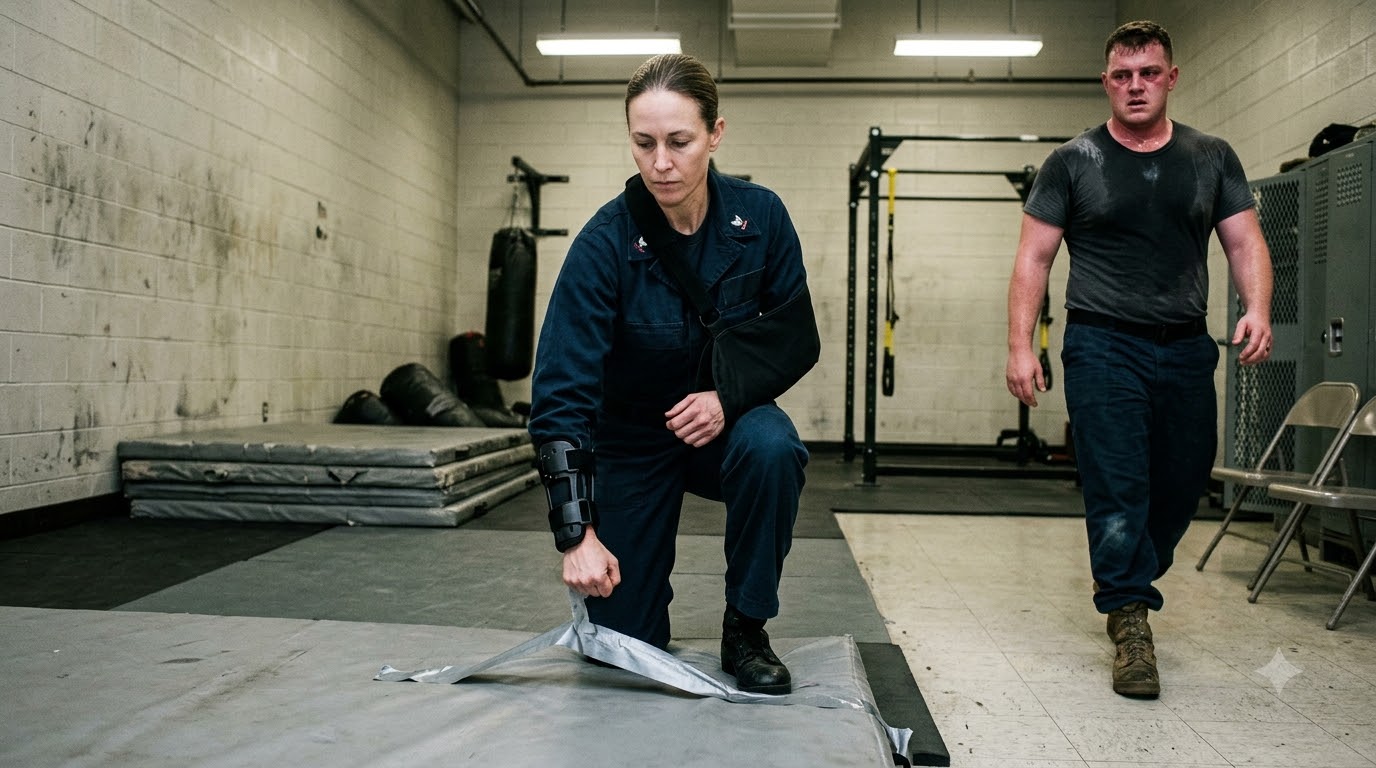
The door behind me swung shut with a low hydraulic hiss. By five minutes past eight, word had filtered through the barracks. A few off-duty instructors stood in the corridor, leaning against the cinderblock wall with paper coffee cups in their hands, watching me through the double-pane reinforced window of the bay. They didn’t ask questions. You don’t ask a woman with a locked shoulder why she’s taping down rubber mats at nine at night unless you want an answer that makes you uncomfortable.
I knelt on the floor, using my left fist to press down a seam of gray duct tape that had peeled back from the mat’s edge. Every time I drove my weight down, a sharp, cold jab radiated from my collarbone straight to my teeth. I ignored it. Pain is just information; it tells you where the limits are so you don’t waste energy pushing past them.
The latch clicked, and the heavy door opened. Sergeant Briggs walked in, his broad frame blocking the hall light for a second before he let the door slam. He had changed into fresh utilities, but his eyes were bloodshot around the edges, his jaw set in that tight, rigid line men wear when they realize they’ve backed themselves into a corner with no side exits.
“You think this scares me, Carter?” Briggs asked, stepping onto the perimeter tiles, his boots making a hard, hollow slap against the floor. “You think putting your name on a public log means I’m going to soft-pedal it?”
I didn’t stand up immediately. I finished pressing the tape smooth, letting the adhesive catch before I wiped my palm on my trousers and rose slowly.
“There are no rank exemptions on a live-eval mat, Sergeant,” I said, keeping my voice level. “No officers, no non-coms, no administrative complaints. Just physics and recorded time.”
“You’re broken,” he sneered, though his hand twitched twice against his belt buckle—an involuntary, nervous reflex he couldn’t hide. “Your shoulder’s hanging an inch low. Everyone in the barracks knows you got pulled off deployment because you couldn’t hold your gear.”
I reached into my pocket, my fingers brushing the scarred brass casing of the tally-counter. I pulled it out, setting the small, heavy cylinder down on the edge of the official scorer’s desk right next to the digital timer. The metal scraped against the laminate surface with a sharp, clear ring.
“My gear held fine,” I said softly, my eyes locking onto his. “It was the ground in Kandahar that gave out.”
Briggs looked at the brass counter, then back at my face. He didn’t know what the counter meant, but the absolute lack of heat in my eyes made his chest heave once, heavy and uncertain. He opened his mouth to deliver another loud jab, but the corridor door swung open again.
Three Marine recruits stepped in, their faces grim, stepping silently onto the edge of the mat to take their places as required evaluators. The clock on the wall ticked over to 2058.
“Get on the line, Sergeant,” I told him, turning my back to face the floor. “Let’s see if your weight holds up when the paper stops talking.”
CHAPTER 4: THE GEOMETRY OF YIELD
Alvarez didn’t hesitate. He came in fast, his young face tight with the sudden adrenaline of being watched by twenty people lining the observation glass. He lunged for my left collar, throwing his weight forward to snap my posture down.
I didn’t block his arms. I stepped forty-five degrees to my left, letting his fingers graze my utility shirt without finding a hold. As his shoulders overextended, my open left palm touched the soft fabric beneath his right elbow, guiding his momentum two inches past his balance line.
His left knee buckled against the mat. His body folded forward into the empty space I’d created, and his hand slapped the mat twice in quick succession.
“Tap,” Alvarez grunted, catching his breath on his knees.
Four seconds.
“Reset,” I said, my voice barely lifting above the hum of the wall clock. “Lance Corporal Dean.”
Dean stepped out next, moving lower to the ground. He had watched Alvarez overshoot, so he tried to bridge the distance with a double-leg drive, targeting my hips to force a raw wrestling match.
My right arm stayed frozen inside its black canvas sling, locked tight against my ribs where every vibration from the mat sent a dull throb through my collarbone. I didn’t step back. I dropped my center of mass by bending my left knee, placing my left forearm flat against the nape of Dean’s neck as he drove in.
I didn’t push against his head. I just anchored my elbow to my own torso, turning my hips like a heavy door on a brass hinge.
Dean’s momentum swept his legs out from under him. He spun across the rubber surface, hitting his side with a flat thump that knocked the air out of his lungs. His hand slapped my boot heel twice.
“Tap,” he gasped.
Six seconds.
Sergeant Rivas was third. He was older, cautious, his elbows tucked tightly into his ribs as he shuffled forward inch by inch. He wasn’t going to give me momentum to redirect. He wanted to crowd my left side, pin my open hand, and force me to use my dead right arm to defend.
We circled in the silence of the bay for three seconds. He reached out with a slow, probing jab toward my lead shoulder.
I didn’t pull away. I offered my left wrist, letting his fingers wrap around my skin. The moment his grip tightened, I relaxed my arm completely, letting my elbow drop into his chest line while my thumb rotated into the weak gap between his index finger and thumb.
I turned my hips a quarter-inch to the right. The sudden loss of resistance pulled Rivas forward by his own forearm. His balance snapped, his shoulder dipping toward the rubber floor before he could register that I hadn’t used a single pound of force.
He hit the floor sideways, tapping three times fast before his shoulder even settled.
Seven seconds.
Three Marines. Three attempts to use force. Three taps on cold rubber.
I turned my back on the evaluators, stepping slowly toward the scorer’s desk where the small brass counter sat beside the digital timer. I didn’t pick up the counter. I just looked at the red numbers glowing on the wall: 00:17 Total Engagement Time.
“Sergeant Briggs,” I said, my left hand hanging loose at my thigh as I turned to face the edge of the mat. “The floor is clear.”
Briggs stepped over the red boundary line. His teeth were bared, his eyes fixed on the black sling pinned across my chest like a target.
CHAPTER 5: THE TRAP OF MASS
Briggs didn’t fake high or probe with a jab. He drove straight down the center line, his massive hands reaching out like iron tongs to pin my good arm and drive his weight across my broken shoulder. He wanted to crush me under two hundred and thirty pounds of muscle and noise before I could find an angle.
I didn’t step back. The mat behind me offered no leverage, but his momentum gave me everything I needed.
As his knuckles grazed my left sleeve, I dipped my center two inches, bending my left knee into a rigid strut. I didn’t reach for his hands. Instead, I let his chest slam into my left shoulder, absorbing the raw impact through my core while my left hand guided his right wrist in a tight, downward spiral toward his own lead knee.
The sudden shift in vector caught him completely off balance. Briggs’s boots skidded against the rubber mat, his heavy torso tipping forward past his toes like a collapsing wall.
“You think you can trip me, woman?” Briggs roared, his face flushed dark with rage as he tried to force his way back up by raw muscle.
Instead of fighting his rise, he hooked his thick fingers around the canvas strap of my sling, using my bad arm as a handle to drag me down with him. A white-hot blade of pain shot through my collarbone, the dislocated joint grinding viciously under the strain.
I didn’t try to pull away. I stepped directly into his line of force, closing the distance so his leverage vanished.
My left forearm slid up beneath his chin, not to choke him, but to seal his collarbone against his jawline. I pivoted on my left heel, sweeping my hip behind his knee while keeping my posture completely upright.
Briggs’s own weight did the rest.
His feet left the floor with a heavy, wet scrape, and he hit the canvas flat on his back with a sound like a rifle shot echoing through the concrete bay. The impact knocked every drop of air from his lungs in a ragged gasp.
Before he could roll or throw a blow, I dropped my left knee onto the mat beside his neck, locking his right wrist underneath my left forearm. I didn’t use strength; I used geometry. His arm was trapped at an angle where his shoulder could not rotate without pulling his own chest off the mat.
“Tap,” I said quietly, my face inches from his. My voice was a flat line in the silent room.
Briggs thrashing wildly, his face turning purple as he tried to buck his hips and roll me off. But every time he drove his weight up, the leverage tightened, anchoring him tighter to the floor.
“Tap out, Sergeant,” Corporal Alvarez called out from the edge of the mat, his voice trembling slightly as he stepped forward. “She’s got the lock.”
Briggs glared up at me, his eyes wide, bloodshot, and burning with unadulterated fury. He didn’t tap. He slammed his left fist uselessly against the rubber mat, his jaw grinding as he refused to admit that his weight had been stolen.
“You cheated,” Briggs choked out through his teeth, his fingers clawing at the mat as he realized twenty recruits were watching him pinned beneath a one-armed instructor. “You pulled my sling! You used a banned hold!”
“There are no banned holds in physics, Sergeant,” I said, holding the joint lock completely steady while the wall timer ticked past zero. “Just weight, angles, and choices.”
CHAPTER 6: THE QUIET LINE
I held the pressure for three seconds after his shoulder stopped twitching. Then I eased my weight back, unpinning his elbow, and stepped off the mat without looking back at him.
Briggs lay there on his back, staring up at the buzzing fluorescent tubes, his chest heaving like a dry pump. He didn’t jump up to yell, and he didn’t try to grab my boots. The silence in the room had settled like fine dust over every surface, heavy and impossible to push aside.
“Get up, Sergeant,” Corporal Alvarez said quietly from the boundary line, holding out a single, unhurried hand.
Briggs ignored the hand. He pushed himself up onto his knees, his jaw tight, his broad shoulders slouched forward as he reached for his cover on the folding chair. He didn’t look at the recruits, and he didn’t look at the wall mirror. He just walked out the double doors, his boots making a dull, heavy drag on the concrete corridor until the sound faded completely.
The three recruits didn’t cheer or gossip. They quietly rolled the white tape off their wrists, tossed the scraps into the metal bin by the door, and filed out one by one with a level nod toward the desk.
I walked over to the scorer’s laminate table. My right shoulder throbbed with a slow, steady pulse where the dislocated joint sat stiffly inside the black canvas brace, a permanent souvenir from an Afghan landing zone where I had traded my mobility so four boys could get onto a chopper.
I picked up the scarred brass tally-counter, my thumb tracing the worn lever that had clicked three times tonight. I slipped it into my trousers pocket alongside the half-piece of white chalk.
I picked up the dry-erase towel and wiped the chalkboard clean, erasing the single angled line until nothing remained on the dark surface except a fine layer of white powder.
I stepped off the mat, reached for the breaker panel by the exit, and clicked the overhead lights off one row at a time. The bay dropped into the soft, gray light of the night perimeter, quiet, still, and completely at peace.