The Old Legend in the Corner Booth Teaches an Arrogant Young Officer an Unforgettable Lesson
CHAPTER 1: THE WARRIORS TABLE
Lieutenant Jax Miller leaned over the scarred pine table, his shadow blotting out the dim neon light above the booth. “You hearing me, old-timer? Or is that hearing aid turned off?”
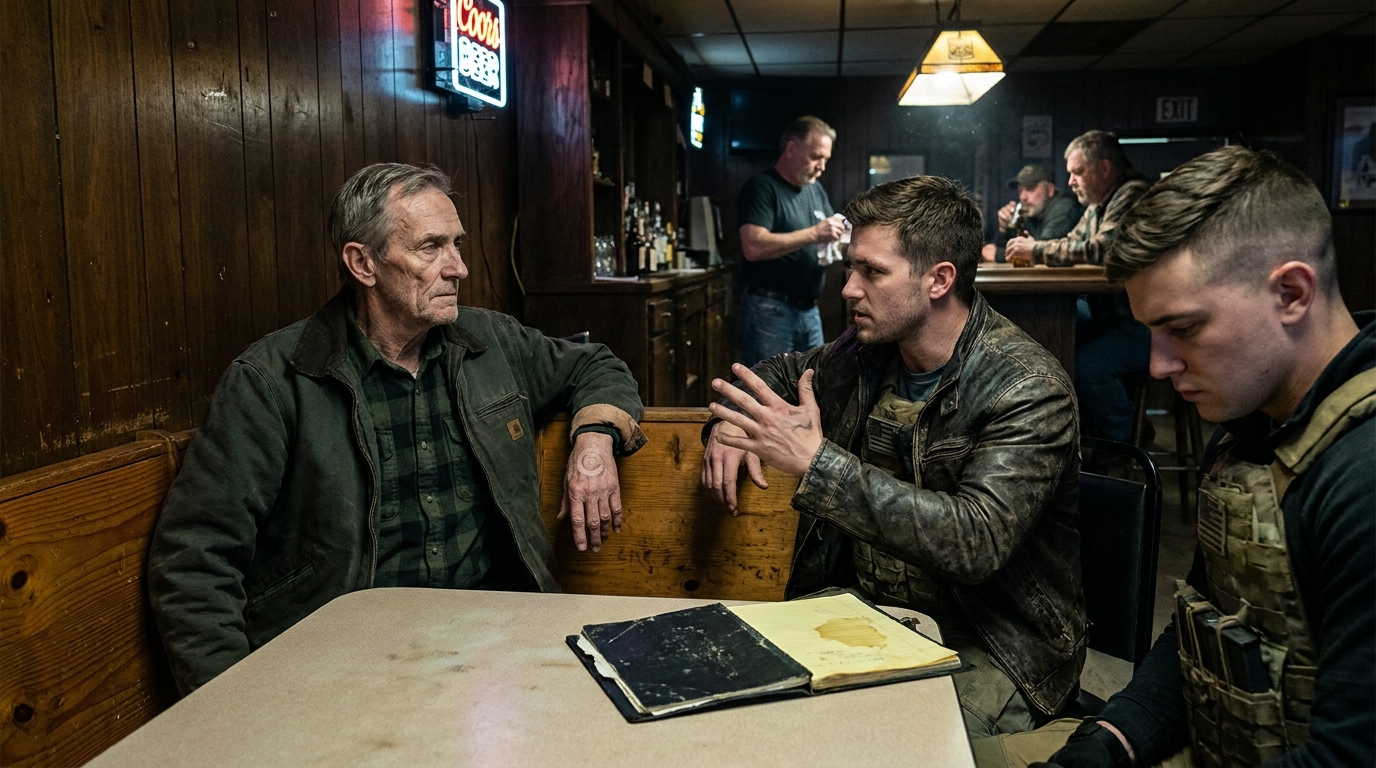
Mark Douglas didn’t lift his head. He kept his palms flat on the cold formica, his thumbs resting against a pale wooden toothpick. At seventy-two, his knuckles were swollen like oak knots, but they didn’t shake. He watched the amber liquor in his shot glass reflect the buzzing beer sign overhead.
“I said, are you deaf?” Miller pressed, shifting his weight forward until his leather jacket crowded Mark’s personal space. Behind him, three young men in clean tactical haircuts chuckled on cue. “We need this booth. Active duty only. The senior center is down the road.”
Mark slowly rolled the toothpick between two fingers. He brought the shot glass to his mouth, took a measured sip of the cheap rye, and set the glass back down with a tiny, sharp clink.
“I’m fine right here, son,” Mark said. His voice sounded like dry gravel dragging across stone.
Miller laughed, a flat, barking sound meant for his squad. “You don’t get it. We just wrapped a six-month deployment. We’re the tip of the spear, old man. You’re taking up real estate. So unless you’ve got a trident pinned under that flannel, grab your cane and move along.”
The dive bar went dead quiet. Sully, behind the counter, stopped wiping a glass with his rag, his hands freezing over the wooden bar top. Mark didn’t flinch. He simply aligned the toothpick parallel to the edge of the table, his gray eyes locking onto Miller with the weight of a dropped anchor.
CHAPTER 2: THE WEIGHT OF SILENCE
“You think sitting here looking like a statue makes you tough?” Miller leaned closer, his breath sour with draft beer and unearned confidence. He tapped a heavy index finger directly onto the wood, a inch from Mark’s thumb. “In the teams, we earn our space. I’m Viper. Sledge is behind me. We have names bought with sweat. What’s yours, old man? Private Paper-Pusher?”
Mark didn’t pull his hands back. He didn’t blink. He reached into his canvas jacket with a slow, deliberate rhythm, letting his cuff ride up just enough to expose the pale, circular brand scarred into the skin of his right wrist.
Miller flinched—a tiny, instinctive jerk of his shoulder before he caught himself. Realizing he had just braced against a seventy-year-old man reaching for an inside pocket, the lieutenant’s face burned dark crimson.
Mark pulled out a battered black leather notebook, its edges frayed down to the cloth backing. He laid it flat beside the toothpick.
“You want a history lesson, son?” Mark asked softly. “Or are you just trying to prove something to the boys standing behind you?”
Davis stepped up beside Miller, his boots thudding against the floorboards. “Look at him, Jax. Probably spent ’75 counting socks in San Diego. Hey, Grandpa, did you scrub the heads with a toothbrush or just complain the whole time?”
The squad laughed, but the sound was thin, bouncing off the dark wood paneling of the Rusty Anchor. Behind the bar, Sully didn’t join in. He kept his eyes locked on the circular mark on Mark’s wrist, his grip tightening around his glass rag until his knuckles turned white.
Sully knew that mark. Anyone who had spent twenty years in the corps had heard the rumors about the men who wore the circle—the ones whose files didn’t exist in navy records, the ones who went into the Delta alone and came back without unit patches.
Sully didn’t say a word. He stepped back from the tap, reached under the counter, and picked up the heavy brass bell used for calling order, setting it down with a muted thud on the wooden ledge.
“I paid for my rye,” Mark said, his voice dropping into a register that made the young lieutenant’s jaw tighten. “I’ll drink it in peace.”
“You don’t command anything here,” Miller snapped, his patience evaporating under the silent stares of the local regulars watching from the surrounding tables. “I gave you a choice. Now I’m giving you an order. Stand up and clear the booth.”
Miller reached out, his heavy hand clamping onto Mark’s shoulder to physically drag him out of the vinyl seat.
Mark didn’t brace against the grab. He let his frame absorb the contact, his gray eyes sliding up to meet Miller’s with a cold, absolute stillness that froze the officer’s arm mid-pull.
“That,” Mark whispered, “was a mistake.”
CHAPTER 3: THE UNRAVELING LEVERAGE
Mark didn’t pull away from the grip. With his free right hand, he flipped the black notebook open on the table, tapping a stained yellow page with the flat of his thumb.
“Lieutenant Jax Miller,” Mark read aloud, his gravelly voice cutting cleanly through the silent bar. “Assigned to SEAL Team 3, Unit Bravo. Currently off-duty during a mandatory 72-hour readiness window.”
Miller stiffened, his fingers slackening on Mark’s shoulder. “Where did you get that? That’s restricted base business.”
“You came in here blowing hot air about active-duty priority,” Mark said, turning the notebook toward Miller so the dense, hand-written columns were visible under the dim overhead light. “Except your unit isn’t cleared for alcohol consumption tonight. Page four has the local base patrol log entries. Sully keeps them by the register for the town council.”
Davis squinted over Miller’s shoulder, his cocky smirk vanishing as his eyes tracked the dated entries. “Jax… what is that?”
“Shut up, Davis,” Miller snapped, a bead of sweat breaking across his hairline and ruining his hardened expression. He glared back down at Mark, his jaw working violently. “You think some old local bar ledger scares me? You’re a nobody hiding behind a drink.”
“I don’t need to scare you, son,” Mark replied, his voice dropping into a quiet, absolute register. “I spent thirty years watching boys like you think rank was armor. You brought four junior officers into a civilian establishment, threatened a patron, and breached off-duty protocol. The Shore Patrol precinct is two doors down. And Sully’s landline works just fine.”
Miller’s face turned white, then a mottled purple. The audacity of being backed into a corner by a quiet old man in a frayed coat shattered his composure.
“You don’t make the calls here, old man,” Miller spat, his voice cracking as he slammed his hand onto the table, rattling Mark’s shot glass. “You think you can ruin my team over a booth? I’ll tear this place apart before I let some washed-up relic dictate orders to me.”
CHAPTER 4: THE QUIET EXIT
Miller lunged forward, grabbing the edge of the black notebook to rip it off the table.
Mark’s forearm moved two inches, catching Miller’s wrist in a vise-like grip that pinned the lieutenant’s hand flat against the wood. The impact sounded like a heavy pistol shot in the silent bar.
“You’re going to pull your hand back, Lieutenant,” Mark said, his gray eyes locking into Miller’s blown-out pupils. “You’re going to take your squad outside. And you’re going to explain to your commanding officer why you broke readiness protocol in a registered veteran establishment.”
Miller tried to yank his arm free, but Mark’s grip didn’t give an inch. Sweat poured down Miller’s neck, soaking his collar as his breath came in short, desperate hitches. The three SEALs behind him shifted back toward the door, their brave grins completely gone.
“Jax, man… drop it,” Davis muttered, reaching out to tug Miller’s jacket. “Look at the wall behind the counter. Look at the ledger.”
Sully stood holding the landline receiver, his thumb resting over the dial pad. Beside him on the wall hung a faded black-and-white unit photograph from 1968. In the center stood a young man with the exact same circular scar branded into his wrist, holding a reconnaissance logbook.
The sudden realization hit Miller like a physical blow. The old man wasn’t a civilian paper-pusher. He was the standard his own instructors had talked about in whispers during training.
Mark slowly released his grip. Miller pulled his hand back, cradling his wrist as if he’d just grabbed hot iron. His jaw trembled, but no words came out.
“Sully,” Mark called out without looking away from Miller. “How much do I owe you for the rye?”
“Four dollars, Mark,” Sully answered softly, setting the receiver down. “It’s on the house tonight.”
“I pay my way,” Mark said. He pulled a crisp ten-dollar bill from his jacket pocket and slid it across the table, smoothing it flat next to his wooden toothpick. “Keep the change for the door.”
Mark stood up slowly, his knees popping in the quiet room. He buttoned his canvas jacket against the draft, picked up his worn black notebook, and slipped it into his inner pocket.
Miller and his three men scrambled backward, clearing a wide path as Mark slid out of the booth. None of them dared make eye contact. The arrogance that had filled the room ten minutes ago was entirely spent, replaced by the heavy, suffocating weight of self-inflicted humiliation.
Mark walked toward the heavy oak door, his worn work boots thudding softly against the floorboards. The regulars at the counter bowed their heads in silent respect as he passed.
He pushed the door open, stepping out into the crisp, quiet night air. The neon sign above the Rusty Anchor buzzed softly in the dark. Mark reached into his pocket, pulled out a fresh wooden toothpick, and placed it between his lips as he walked down the empty sidewalk toward home.