A Legacy of Wind and Mirage: Searching for the Human Soul Within the Digital Horizon
CHAPTER 1: THE WEIGHT OF THE EMPTY LANE
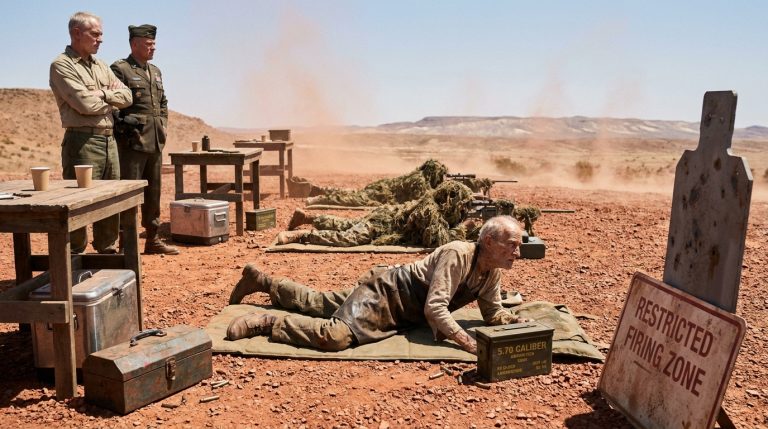
The silence on Lane 12 was no longer empty; it was heavy, pressing against the eardrums like deep water. Sergeant Kenji Finch stood exactly where the old man had been, his boots crunching into the same layer of disturbed grit. Beside him, Corporal Eva Rosta was uncharacteristically still, her hands resting on the side of her equipment crate, though she didn’t seem to see the high-tech sensors or the glowing tablet screen. She was looking at the horizon, squinting, trying to see the invisible river of air that Alistair had navigated with such haunting ease.
Finch reached down and picked up the single brass casing. It was cool, despite the relentless Nevada heat, and it felt unnervingly solid. He turned it over, the base stamped with faded markings he barely recognized. It wasn’t just a spent round; it was a testament to a way of living that made his own multi-million dollar ballistic suite feel like a child’s toy.
“He left it,” Rosta whispered, her voice barely rising above the low moan of the wind whipping through the ravines. “He didn’t even take his brass.”
“He didn’t need to,” Finch replied. His voice was quieter than usual, stripped of the bravado that had defined his morning. He looked down at the rectangular canvas mat. It was frayed at the edges, a testament to years of tactical patience. He looked at the spot where the old man’s forehead had rested, a slight depression in the dust that the wind was already beginning to erase.
Finch’s heart hammered against his ribs—a rhythm out of sync with his usual steady, calculated pulse. He realized then that he hadn’t just witnessed a shot; he had witnessed the end of a world. The technology he championed, the software he trusted to bridge the gap between intent and impact, had been rendered completely irrelevant by a man who used a thumb-sized pencil and an antique optic.
He looked at the notebook in his hand. He had reached out to grab it just as the old man had turned to leave, and Alistair had handed it over with a look that wasn’t dismissive, but expectant. It felt warm, as if it had been absorbing the very heat of the man’s skin.
“Finch,” Rosta said, stepping closer. “Look at the edge of the cover.”
He followed her gaze. There was a jagged tear in the leather near the binding. He flipped it open. The pages were a symphony of hand-drawn maps and wind-drift notations, but as he moved his thumb across the back, he froze. The final page was gone. Not clipped, not removed with a blade, but torn out with a jagged, desperate force that left a fringe of paper hanging from the spine.
“Why would he leave the book but take the last page?” Rosta asked, her eyes searching the vast, shimmering desert.
Finch didn’t answer. He turned his eyes to the distance, toward the shimmering ridges that hid a thousand variables he had spent his career trying to define. He didn’t just feel the professional sting of being outclassed; he felt a sudden, sharp clarity about the man he had called ‘Grandpa.’ The old man hadn’t just been shooting. He had been checking his own work, testing to see if the world—and the people in it—were still capable of seeing the truth through the haze.
He closed the notebook, the leather creaking like old wood. “We aren’t leaving yet,” Finch said, his gaze fixed on the dust clouds swirling toward the distant highway. “We have to find him.”
“Finch, we have orders, we have a timeline—”
“Forget the timeline,” he interrupted, his voice dropping into a register she had never heard him use—one that didn’t rely on algorithms. “That man didn’t just teach us a lesson about wind. He left us something. And I think he’s running out of time.”
He turned, the notebook clutched tight against his chest, and began to walk toward their vehicle, his eyes already scanning the horizon for the ghost of a blue work shirt in the desert glare.
CHAPTER 2: THE HUNTERS DILEMMA
The Nevada air was a dry, abrasive heat that tasted of alkaline dust and sun-baked concrete. Finch didn’t get into the truck immediately. Instead, he stood in the shadow of the open door, his thumb tracing the jagged, uneven edge of the paper where the final page had been ripped from the notebook. It was a violent, erratic tear. Someone hadn’t just removed a page; they had purged a piece of evidence.
“Finch, we need to move,” Rosta said, sliding into the driver’s seat. She tapped the steering wheel, her eyes flicking toward the road that stretched out into the shimmering haze like a discarded ribbon. “If we’re going to find him, we need to hit the local intersections before he goes completely off-grid. He’s in that old truck, probably doing forty miles an hour. We’re losing the gap.”
Finch climbed in, the leather of the seat warm enough to prickle his skin. He placed the notebook on his lap, closed it, and felt a strange, cold shiver beneath his vest. “He isn’t driving like a man running away, Eva. Did you notice his hands? He was cleaning the rifle like he had all the time in the world.”
“Maybe he did,” Rosta muttered, shifting the vehicle into gear. “Or maybe he just didn’t care if we followed him.”
As the truck lurched forward, kicking up a rooster tail of gravel, Finch’s mind flicked back to the sound of the old man’s shot—the deep, resonant boom that had seemed to vibrate in the very marrow of his bones. Then, a phantom sound cut through the whine of their own engine. It wasn’t the wind. It was the high-pitched, insistent drone of an aircraft engine—the specific, throaty roar of a twin-prop transport. For a heartbeat, the smell of the dry Nevada scrub was replaced by a cloying, heavy scent of wet rot and mud, and he felt a sudden, inexplicable tightening in his chest, as if he were crouching in a hole that was slowly filling with water.
He blinked, the sensation vanishing as quickly as it had arrived. He wiped a hand across his forehead, realizing he was sweating.
“You okay?” Rosta asked, not looking away from the road.
“Fine,” Finch lied. He looked down at the notebook. The faded blue cover felt too heavy, too significant. “He told us to learn to read the world. I don’t think he was talking about marksmanship.”
They found the diner forty minutes later—a low, cinder-block structure huddled against the base of a jagged ridge, its neon sign stuttering in the harsh daylight. Alistair’s truck was parked near the back, looking like a rusted relic abandoned in a sea of modern sedans. Finch stepped out, the heat hitting him like a physical blow. He didn’t walk toward the truck; he walked toward the door, his hand instinctively gravitating toward the notebook in his pocket.
Inside, the light was dim, colored by the yellowing plastic of the window shades. It smelled of scorched coffee and grease. Alistair was sitting at the counter, a plate of untouched toast in front of him. He wasn’t looking at the door; he was staring at the salt shaker, his movements so still he might have been a carving.
Finch stopped, his pulse quickening. As he approached, he saw the old man’s hand twitch—a subtle, involuntary tremor that was quickly suppressed. Alistair’s gaze drifted to the counter surface, where he was using a spoon to draw faint, complex patterns in a thin layer of spilled sugar.
“Sir,” Finch said, his voice softer than he intended.
Alistair looked up. The pale blue of his eyes seemed washed out, reflecting the dim interior of the diner. For a second, he looked through Finch, past him, toward a point somewhere in the distant past. Then, the focus snapped back, sharp and sudden.
“You’re missing a page, Sergeant,” Alistair said. His voice wasn’t accusing; it was tired.
Finch pulled the notebook out and laid it on the Formica counter. The tear in the binding looked even worse under the buzzing fluorescent lights. “Why would you leave this, but rip that out? It’s not just a log, is it?”
Alistair didn’t touch the book. He pushed the plate of toast away, the ceramic scraping against the counter with a sound that made Finch’s teeth ache. “That page contained the map of the air. The currents don’t stay the same, Finch. They change. They decay. Just like everything else.”
Alistair stood up, his joints popping, his back arching with a familiar, weary rigidity. He looked toward the window, at the vast, uncaring expanse of the desert outside. “You think you’ve come here for an answer. But the question is changing under your feet.”
“I want to understand,” Finch said, leaning in. “I want to know how you saw what you saw. And I want to know why you’re here, alone, in a place where no one remembers the B-52s.”
Alistair turned, a ghost of a smile playing on his lips—a look of profound, aching pity. “You’re looking for a hero, Sergeant. You’re looking for a legend to anchor your own confusion. But the B-52s weren’t phantoms. We were just people who realized that if we didn’t hold the line, the world would forget the people we were trying to save.”
He picked up his hat, his hands steadying as he braced them against the counter. “I’m not here to be found. I’m here to finish the log.”
Finch felt the weight of the moment—the fragility of the old man’s frame, the way his shadow seemed to stretch long and thin across the linoleum floor. He knew, with a sudden, sinking dread, that the secret he was hunting wasn’t a tactical advantage. It was a memory, and it was slipping away, grain by grain, just like the sand Alistair had been reading out on the range.
“Then let me help you finish it,” Finch said, his voice firm.
Alistair looked at him for a long, silent moment, the air between them thick with the clatter of cutlery and the low hum of the refrigerator. “The desert doesn’t need help,” he whispered. “It needs a witness.”
CHAPTER 3: THE ANATOMY OF A GHOST
The heat in the parking lot felt like a physical weight, pressing against the lungs and dulling the senses. Alistair walked toward his truck with that same steady, economical gait—a man who had spent decades conserving energy in places where calories were a luxury. He reached for the handle of his battered door, but his fingers fumbled, brushing against the metal twice before finding purchase.
Finch watched the movement, his eyes narrowing. It wasn’t the tremor of age; it was a momentary disconnection, a flicker of uncertainty in a man whose entire life had been defined by absolute, rock-solid precision.
“You’re not going to just drive off, are you?” Finch asked, stepping into the old man’s peripheral vision.
Alistair didn’t look at him. He gripped the door handle, his knuckles white against the sun-faded paint. “I have a route,” he said. His voice was steady, but it held a brittle quality, like dry leaves ready to shatter. “The wind is shifting toward the north range. There are things there that need to be seen.”
“What things?” Rosta stepped out from behind the truck, her expression guarded. She was looking at the vehicle with the eyes of a technician, her gaze scanning the rusted bodywork, the over-engineered suspension, and the thick, reinforced plating on the rear window.
Alistair finally turned to face them. The pale blue of his eyes seemed to capture the vast, empty sky, reflecting an intensity that was almost painful to witness. “The B-52s weren’t just shooters, Sergeant. We were observers. We logged the topography of conflict. We noted the way water moved through enemy lines, the way the climate shifted in response to the fire, the way a landscape mourns after it’s been torn apart.”
Finch felt a chill despite the stifling heat. He stepped closer, his gaze drifting to the truck’s dashboard. As Alistair shifted his body, Finch caught a glimpse of something beneath the steering column—a secondary, heavy-duty ignition switch, wired into the dash with professional-grade loom and reinforced clamps. It wasn’t a repair; it was an override, a bypass designed for a vehicle that had lived in places where the primary electrical system couldn’t be trusted.
“You’re going to the north range,” Finch said, his voice dropping into a low, transactional tone. “The military closed that sector three years ago. There’s nothing there but unexploded ordnance and dead sensors.”
“Exactly,” Alistair said. He opened the door, the hinges groaning in protest. “The sensors are dead. That’s why it’s the only place where the truth hasn’t been overwritten by a digital filter.”
Rosta exchanged a look with Finch. The skepticism was still there, etched into the lines around her mouth, but it was losing ground to a deeper, more primal curiosity. They were trained to trust the data, but the data had failed them back on the range, and this man—this relic—was the only variable they couldn’t calculate.
“We’re going with you,” Finch said. It wasn’t a request; it was a decision.
Alistair didn’t argue. He simply slid into the driver’s seat, his movements once again fluid and deliberate. He didn’t look back at them as he waited for them to scramble into their own truck.
As they followed him out of the parking lot, the asphalt giving way to the corrugated, washboard surface of the desert trail, Finch kept his eyes locked on the rear of the old truck. It bounced over the uneven ground with a jarring rhythm, kicking up a plume of gray dust that hung in the air like a ghost.
“Look at the way he’s driving,” Rosta said, tapping the dashboard of their own vehicle. “He’s not following the trail. He’s following the contours of the drainage. He’s anticipating the slope before the ground even rises.”
“He’s not reading the road,” Finch agreed, his grip on the steering wheel tightening. “He’s reading the land.”
The journey felt endless, a slow, grueling crawl through a landscape that looked identical in every direction, yet Alistair navigated it with the ease of a man walking through his own living room. Every turn, every dip in the terrain, felt calculated, a deliberate move on a board they couldn’t see. Finch felt the frustration beginning to mount—the same frustration from the range, the feeling of being an outsider in a world that had its own hidden, ancient logic.
“Why are we doing this, Finch?” Rosta asked, her voice quiet. “Even if he has records, even if he’s telling the truth about the B-52s… why now? Why lead us out here?”
Finch looked down at the notebook still resting in the passenger seat. He traced the ragged edge of the torn page with his thumb. “Because he can’t carry it anymore,” he whispered. “He’s not trying to teach us how to shoot. He’s trying to hand off a map before he forgets where the lines are.”
He looked up just as Alistair’s truck crested a small, rounded hill and disappeared from sight. Finch floored the accelerator, the engine whining in protest as they surged forward, desperate not to lose the only anchor they had left in a world that was rapidly unraveling.
CHAPTER 4: THE KINTSUGI OF STEEL
They had stopped in the middle of a dry wash, the banks rising like crumbling ramparts of clay and sun-bleached rock on either side. Alistair’s truck was tilted at a sharp angle, the chassis creaking as he worked on the underside of the heavy-duty rack mounted to the tailgate. The air here was cooler, shadowed by the ridge, and it smelled of ancient minerals and stagnant time.
Finch stood a few feet back, holding a portable work light while Rosta hovered near the truck’s rear, watching the old man’s hands. Alistair was trying to secure a mount that had vibrated loose during the grueling trek over the washboard terrain. His movements were precise, but there was a stiffness in his shoulders, a deliberate, slow-motion quality to how he angled the wrench.
“Hold it there,” Alistair instructed, his voice barely audible over the sudden gust of wind that whistled through the rocks.
Finch adjusted the light. He watched Alistair’s fingers—calloused, stained with a mix of grease and desert dust—manipulate a small, stubborn bolt. It was a tedious, minute task, yet Alistair treated it with the same reverence he had shown his rifle. He wasn’t just fixing a rack; he was stabilizing a platform.
“You’ve been doing this for a long time,” Rosta remarked, her voice gentle, lacking the edge of professional suspicion that had defined their meeting at the range. “This truck. The rifle. Everything is… customized. It feels like you’ve been preparing this gear for a very specific set of variables.”
Alistair didn’t look up. He tightened the bolt, the metal biting home with a satisfying click. “Tools are an extension of the intent, Corporal. If the intent is to preserve something, the tool must be built to withstand the passage of time. Most people buy things that are meant to be replaced. I buy things that are meant to be mended.”
He sat back, wiped his hands on a rag, and looked at the rack. It was a sturdy, ugly piece of equipment, scarred by years of use, but it was rock-solid now. He reached out and touched a weld near the base, a jagged, imperfect bead of metal. “I fixed that one in a village in the highlands,” he said, his gaze distant. “My gear was failing. Their world was failing. We both needed to hold together just a little longer.”
Finch felt a surge of empathy that caught him off guard. He looked at the rack, then at the notebook tucked away in his own jacket pocket. The B-52s—the observers. He realized then that Alistair wasn’t just talking about hardware. He was talking about the people he had kept records of, the ones he had watched over, and the way he had essentially acted as a human anchor in a storm that had swept everyone else away.
“Is that what’s in the notebook?” Finch asked, his voice low. “The people you tried to hold together?”
Alistair looked at him, and for a fleeting second, the pale blue of his eyes seemed to lose its sharp focus. A shadow passed over his face, a flicker of profound, quiet grief that had nothing to do with the desert or the mission. He reached out to lean against the truck, his breath hitching slightly.
“The records,” Alistair started, then paused, his brow furrowing as if he were hunting for a word that had migrated just out of reach. “The records are the evidence of existence. When you’re… when you’re deep in the wash, when the air is thick with fire, it’s easy for people to become shadows. I just… I needed to make sure they remained real.”
He shook his head, the movement sudden, and the clarity snapped back into place. He stood up, though he moved more slowly now, his legs looking heavy. “It’s not just about the past, Sergeant. It’s about the fact that if no one remembers the geography of the survival, then the future will just keep making the same mistakes. You’re looking for a secret. I’m just trying to leave a trail.”
Rosta stepped forward, her hand reaching out as if to steady him, then pulling back. “You’re tired, Alistair. We have water, we have food. Let us help you.”
Alistair turned away, looking out toward the jagged horizon where the heat shimmer was beginning to boil, turning the world into a fractured, liquid image. “The wind is going to drop in an hour,” he said, his voice regaining its calm, detached authority. “When it does, the mirage will settle. You’ll be able to see the ridge clearly. That’s when we’ll know if the cache is still there.”
“Cache?” Finch asked, his heart quickening.
“The B-52 archives,” Alistair said simply. “The final maps. They’re buried in a place where the wind doesn’t blow. I just need to make sure I still know how to find the entrance.”
He moved to the driver’s side door, his hand finding the latch with ease, though Finch noted the slight hitch in his gait. The old man was a structure himself—a building held together by sheer willpower and habit, slowly succumbing to the weight of his own history. As he climbed into the cab, the smell of diesel and dry, ancient dust seemed to intensify, clinging to him like a second skin.
Finch looked at Rosta. She was watching Alistair with an expression of dawning realization. The “hero” narrative was dissolving, replaced by something much more poignant and much more fragile. They weren’t just chasing a mystery; they were guarding a legacy that was currently being erased by time itself.
“Get your gear,” Finch said, his voice resolute. “We’re going to the ridge.”
As he climbed back into their vehicle, the metal seat felt colder, the engine’s idle sounding like a rhythmic, metallic heartbeat. He looked at the notebook again, then back at Alistair’s truck, which had already begun to move, crawling slowly into the deepening shadows of the canyon. He felt the weight of the responsibility settling into his chest, a gravity that demanded he see this through, not for the sake of the mission, but for the sake of the man who had spent his life mending the world, one piece of rusted steel at a time.
CHAPTER 5: THE SHIFTING RIDGE
The climb to the ridge was an exercise in diminishing returns. The ground, once solid and predictable, turned into a treacherous slope of loose scree and fractured limestone that slid under their boots with every step. Finch led the way, his eyes fixed on the back of Alistair’s blue shirt, which seemed to lose its color in the deepening purple of the desert dusk.
Alistair’s pace had slowed. He didn’t use the walking stick he had pulled from the back of his truck to leverage his weight; he held it like a rifle, his grip tight and unyielding. Every few minutes, he would stop, look at the sky, and then consult his leather-bound notebook—not to read it, but to stare at the pages as if he were trying to recall the language they were written in.
“Alistair,” Rosta called out, her voice straining against the sudden, unnatural silence of the ridge. “We’ve been climbing for an hour. The coordinates you gave us… the GPS is reading dead zones everywhere. There’s too much iron in the rock.”
Alistair didn’t look back. “The iron is what makes it a vault,” he muttered, his voice sounding thin, detached from the reality of the mountain. “It shields the signal. Keeps the ghosts quiet.”
Finch crested a jagged rise and stopped dead. He expected to see a cave entrance, a hidden structure, or at least a landmark. Instead, there was only a wide, flat shelf of rock overlooking a canyon that dropped into absolute blackness. There was nothing here. No cache. No archives. Just the desolate, wind-scoured bones of the Nevada landscape.
“Where is it?” Finch asked, his voice echoing off the canyon wall.
Alistair stood at the edge, his silhouette stark against the fading embers of the sun. He looked down at the notebook in his hands, his thumbs running over the leather binding. He opened it, flipped to the back, and then hesitated. The look on his face shifted—a sudden, violent confusion, as if the ground beneath him had turned to liquid.
“It was here,” Alistair whispered, his voice trembling. “The heat shimmer… it flowed right over this shelf. The archive was beneath the secondary thermal layer. I put it… I put it under the stone with the fracture in the middle.”
Finch walked over to him, his boots scraping loudly against the silence. He looked at the shelf. There was no stone with a fracture. There was only solid, wind-polished basalt.
Suddenly, a sound tore through the air—a low, rhythmic thumping that sounded like the distant, rolling drumfire of heavy artillery. Finch froze, his hand dropping to the holster at his hip. He looked at Rosta, but she was looking at the horizon, her eyes wide, unseeing.
“Do you hear that?” Finch asked, his voice tight.
“Hear what?” Rosta replied, her hand hovering near her equipment harness. “Finch, it’s silent. There’s nothing out here.”
The thumping grew louder, filling the space between his ears until it drowned out the wind. It was the sound of a transport plane, the engines roaring in a sky that was empty, the vibration rattling his teeth. His skin crawled with the phantom sensation of mud and humidity, the suffocating claustrophobia of a trench he had never dug. He saw, for a split second, a flash of white-hot light on the ridge opposite them, and a face—a young, terrified man in a mud-caked uniform—peering at him from behind a pile of rocks.
Finch lurched forward, grabbing the edge of a rock to steady himself. The hallucination snapped like a dry twig. The ridge was empty. The silence was absolute.
“Finch!” Rosta’s voice was sharp, concerned. She caught his arm. “You’re shaking. What is it?”
He turned, his gaze meeting hers. She looked scared—not of the desert, but of him. “I thought… I thought we were under fire.”
He looked back at Alistair. The old man was on his knees, his hands pressed flat against the cold, hard rock of the shelf. He was weeping, but there was no sound. He was simply staring at his palms, his eyes wide and vacant.
“It’s gone,” Alistair said, his voice a hollow, broken thing. “I can’t find the map. I can’t… I can’t remember the way in.”
Finch felt a cold, jagged shard of reality pierce through his confusion. It wasn’t that the cache was hidden. It was that Alistair had reached the limit of his own internal archive. The “secret” wasn’t a physical location; it was the man himself, and the map he had been carrying in his mind for fifty years was finally, tragically, succumbing to the erosion of time.
He knelt beside the old man, his hand hovering over Alistair’s shoulder. He didn’t dare touch him. To acknowledge the break was to make it final.
“We’re going to find it, Alistair,” Finch said, even as his own heart betrayed him with the knowledge that he was lying. “We’re going to look again. When the light changes, we’ll see it.”
Alistair looked up, and for a moment, the fog cleared. He stared at Finch with a look of such raw, agonizing clarity that Finch had to look away. “You don’t understand, Sergeant. The archives… the names, the coordinates, the lives… they aren’t in the book. They’re in here.” He tapped his temple, his fingers trembling. “And if I can’t find the way in, they’re going to disappear. All of them. Forever.”
Finch stood up, his legs feeling like lead. He looked at the notebook, then at the vast, uncaring darkness of the canyon. The mission had shifted. They weren’t hunting for a cache of steel and paper anymore. They were engaged in a desperate, last-ditch effort to anchor a ghost before he faded entirely into the shadows of the range.
“Rosta,” Finch said, his voice brittle. “We need to set up a perimeter. We aren’t going anywhere until he remembers.”
“Finch,” she whispered, “look at him. He’s not remembering. He’s leaving.”
Finch looked back. Alistair was sitting on the ground, his back against the rock, his eyes fixed on the stars beginning to puncture the violet sky. He was humming a low, wordless melody—a sound that felt like the wind moving through long, dry grass. He had already moved on, and as Finch watched, he felt the terrifying, absolute weight of their failure beginning to crush them both.
CHAPTER 6: THE ARCHIVE OF DUST
Finch stood motionless, the biting cold of the desert night seeping through his jacket. Beside him, Rosta was pacing in tight, agitated circles, her flashlight cutting a nervous, frantic path through the darkness. The light beams caught nothing but the indifference of the rocks and the swirling, particulate grit of the high altitude wind.
“He’s not answering,” Rosta said, her voice strained. “Finch, we need to get him down. He’s hypothermic, or worse. The cognitive slip… it’s accelerating.”
Finch looked back at Alistair. The old man was still huddled against the rock, his eyes fixed on a constellation that didn’t seem to hold any meaning for him. He was no longer humming; he was silent, his lips slightly parted, his breathing shallow. The notebook lay discarded in the dirt beside him, a forgotten relic of a mission that no longer had a destination.
Finch stepped forward, his boots crunching against the grit. He knelt down, reaching out to place a hand on Alistair’s shoulder. He expected the resistance of a man guarding his last secret, but Alistair’s body felt light, almost insubstantial, as if he were already halfway to being a ghost.
“Alistair,” Finch said, keeping his voice steady. “The B-52s. You said they were observers. If there’s no cache, if there’s no archive… what were you observing?”
Alistair’s eyes slowly shifted to Finch. For a moment, the vacancy disappeared, replaced by a lucidity so sharp it was unnerving. “The resilience,” he whispered. “I wasn’t keeping the records to prove the war happened. I was keeping them to prove that we didn’t lose our humanity while we were in it. The cache… the archive… it wasn’t a place, Sergeant. It was the collective memory of the people who survived.”
He reached out and clawed at the dirt beside him, his fingers digging into the hard, packed earth. “I wrote it down so I wouldn’t have to carry it alone. But the burden… it’s too heavy for one man to hold. Once the memory is recorded, the mind… it decides it doesn’t need to keep the weight anymore. It lets go.”
Finch stared at the ground. He realized then that the physical cache was a myth Alistair had constructed to convince himself that his life’s work had a physical, tangible legacy. He had been so obsessed with the idea of ‘holding the line’ that he had turned his own life into a monument, and now that the monument was crumbling, he was terrified of being buried in the rubble.
“Where is it, Alistair?” Finch asked, his voice raw. “The records. If they aren’t in a box, where are they?”
Alistair looked at the notebook, then at Finch’s hands. A slow, sad smile spread across his face. “You’re holding it, Sergeant. The notebook. It’s not a map of the desert. It’s a map of the connections. The names. The coordinates where people were, the moments they held onto. It’s all there.”
Rosta stopped pacing and walked over, her flashlight beam illuminating the discarded book. She picked it up carefully, brushing the dust from the cover. She opened it to the middle, flipping past the wind charts, the ballistic data, the technical jargon. She stopped, her finger hovering over a page that wasn’t a diagram at all. It was a list—a long, meticulous list of names, dates, and locations.
“These aren’t ballistic logs,” she whispered, her voice breaking. “These are… testimonials.”
Finch felt a surge of cold dread. If the notebook was the archive, then Alistair hadn’t been searching for a hidden cache all day. He had been conducting a final, ritualistic tour of his own life’s work, a pilgrimage to the places that had defined his soul. And now that he had reached the end of the road, he was prepared to let the notebook go, and with it, the memory of everyone he had ever tried to save.
“We have to get him to a medical facility,” Rosta said, her voice urgent. “Finch, look at his vitals. His breathing is becoming erratic.”
“No,” Alistair said, his voice stronger than it had been all night. He grabbed Finch’s wrist with a strength that belied his frailty. “No hospitals. No sterile rooms. I didn’t come this far to end in a box. I came here to see the stars one last time, away from the hum of the machines.”
He looked at the ridge, at the way the starlight caught the jagged, crystalline edges of the rocks. “You asked me how to read the world, Sergeant. Now you know. You read it by recognizing the lives that were lived in it. Don’t look for the cache. Look for the connections.”
His hand slipped from Finch’s wrist, and he slumped back against the rock, his eyes closing. The silence that followed was absolute, a void that seemed to pull the very heat from the air. Finch looked at Rosta, her face pale in the harsh glare of the flashlight. They were in the middle of nowhere, miles from civilization, with a man who was slipping away and a notebook that contained the only evidence that a lifetime of heroism had ever existed.
The wind picked up, a high, lonely whistle that sounded like a dirge. Finch realized that the “fail-safe” he had been looking for—the plan to secure the legacy—wasn’t a set of instructions. It was an inheritance. Alistair was handing them the burden, and the weight of it was suddenly, terrifyingly real.
“We stay,” Finch said, his voice flat. “We stay until the dawn. We keep him warm, we keep him stable, and we make sure he doesn’t have to face this alone.”
Rosta nodded, her eyes wet. She turned off the flashlight, plunging them into the deep, velvet dark of the desert night. They sat in the silence, two modern soldiers guarding the last of the phantoms, listening to the labored, rhythmic breathing of a man who was slowly drifting into a history they were only just beginning to understand.
CHAPTER 7: THE DRIFT OF MEMORY
The change was not gradual. One moment, the desert air was merely cool; the next, the wind shifted, screaming down from the peaks with a violence that made the rocks themselves seem to vibrate. Finch lunged for Alistair, catching the old man just as he buckled under the first icy blast.
“Get him inside!” Rosta shouted, her voice torn away by the gale. She was already pushing toward the dark, jagged maw of an old mining entrance they had passed earlier—a hollow, unstable scar in the side of the ridge.
Finch hauled Alistair up. The old man was dead weight, his eyes unfocused, his skin leaching heat at a terrifying rate. Every step toward the drift was a battle against the gale, which felt like a solid wall pushing them back. The snow—a thin, stinging powder—blinded them, turning the night into a disorienting, white-out chaos.
They tumbled into the mine entrance, the abrupt cessation of the wind creating a ringing in Finch’s ears that was almost as loud as the storm. He fumbled for his flashlight, the beam cutting through the darkness to reveal a narrow, timber-shored tunnel that smelled of damp rot and crushed ore.
“Drop your packs,” Finch commanded, his voice sounding harsh in the confined space. He lowered Alistair to the ground, pulling his own jacket off to wrap around the old man’s shivering frame. “Rosta, check his core temp. We need to stabilize him, now.”
Rosta moved quickly, her hands sure and efficient, but as she peeled back Alistair’s coat, her face went white. She wasn’t just looking for hypothermia. She was looking at a series of small, brass tags pinned to the inside of Alistair’s undershirt. Each one was etched with a name, a date, and a set of coordinates.
“Finch,” she whispered, her hands hovering over the tags. “These aren’t military issue. These… these are the names from the notebook. He’s been wearing them. He’s been carrying the archive.”
Finch looked down. Alistair’s eyes were fluttering open, his gaze locking onto Finch’s face with a sudden, painful intensity. He reached up, his fingers clawing at the collar of his shirt, his touch trembling.
“They… they don’t have a place,” Alistair gasped, his words coming out in uneven, jagged bursts. “The maps were never the point. The point was to keep them close. To keep the weight… where I could feel it.”
Finch felt a surge of panic. The old man was failing. The adrenaline of the storm had been the only thing holding the fractured mosaic of his mind together, and now that the pressure had eased, the pieces were falling away.
“Alistair, listen to me,” Finch said, leaning in until their faces were inches apart. “You survived. You kept them safe. But you don’t have to carry them anymore. You can give them to us. We’ll be the archive.”
Alistair looked at him, and for a moment, the agony in his eyes softened. He reached into his pocket and pulled out a small, heavy object—a brass key, tarnished and worn smooth by years of handling. He pressed it into Finch’s palm, his grip unexpectedly strong.
“The drift,” Alistair whispered, his voice fading into the sound of the wind outside. “The last one. It’s not in the canyon. It’s… it’s underneath the house. Where I… where I started.”
“What house?” Finch asked, but Alistair’s eyes had drifted back to the darkness of the mine.
“The one with the porch that faces the east,” Alistair murmured, his head rolling to the side. “The wind… it always hit the wood just right. Like a heartbeat.”
He fell silent, his chest rising and falling in a rhythm that was becoming dangerously slow. Finch felt a cold dread that had nothing to do with the freezing temperatures outside. The “archive” wasn’t a physical cache at the end of the road. It was a destination, a final point of return. And they weren’t going to find it in the desert.
“He’s going into shock,” Rosta said, her voice shaking. “Finch, we have to move him. If we stay here, he won’t make it to dawn.”
Finch looked at the key in his hand. It was cold, biting into his palm. He looked at the old man, whose life was flickering like a dying candle, and then he looked at the entrance of the drift, where the storm continued to scream. The realization hit him with the force of a physical blow: they were not here to observe history. They were here to be the final witness to the closing of a door that had been open for fifty years.
“We keep him warm,” Finch said, his voice hard. “We wait for the storm to break. And then we go to the house. Whatever the cost.”
He pulled the notebook from Rosta’s pack and opened it one last time. There, tucked inside the back cover, was a photograph he hadn’t noticed before. It was a picture of a small, wooden house in a valley he didn’t recognize, the light hitting the porch with a gentle, fading warmth. It wasn’t a location from a war zone. It was a home.
Finch tucked the photo away, his decision made. He sat back, watching the shadows dance on the rough-hewn timber of the mine, his mind already mapping the route to a place he had never been, for a man who could no longer tell him the way, but who had finally given him the key.
CHAPTER 8: THE LAST ECHO OF THE WIND
The house sat in a quiet depression between two hills, shielded from the worst of the storm that had battered the ridge. It was small, weathered to the color of bone, with a porch that groaned under Finch’s boots. The brass key slid into the lock with a familiar, mechanical precision, the tumbler turning with a soft, final click that echoed through the empty hallway.
Behind them, Rosta carefully maneuvered the back of the truck, helping Alistair out. He was awake now, though his eyes were clouded with the exhaustion of the long night. As he stepped onto the porch, his hand moved instinctively to the wall, his fingertips tracing the grain of the wood. A faint, knowing smile touched his lips.
“The east side,” Alistair whispered. “The wind still hits it just right.”
They moved inside. The air was dry, smelling of cedar and old paper. The main room was sparse—a cot, a small table, and shelves lined with hundreds of small, labeled boxes. Finch moved toward the shelves, realizing these were the real archive. He opened one, revealing not documents, but small, personal mementos: a child’s toy, a rusted military button, a dried leaf from a distant forest. These were the connections. These were the names.
Alistair walked to the center of the room and knelt by a section of loose floorboards. He took the key from Finch and inserted it into a hidden slot, pulling back the wood to reveal a simple, metal-lined compartment. Inside lay a single, thick leather binder—the real B-52 archive.
“The Project,” Alistair said, his voice regaining its clarity. “We were observers of the human cost. When the intelligence agencies wanted kill counts, we sent them reports on the refugees, the families, the people who were caught in the crossfire. We were the conscience they didn’t know they had.”
He slumped back, his strength finally deserting him. “The ‘cache’ wasn’t a tactical weapon, Sergeant. It was the proof that those people existed. It was the only thing standing between them and total erasure.”
Finch sat beside him, carefully opening the binder. It was all there: the names of the families, the stories of the villages, the coordinates of the places he had protected. It was a staggering, overwhelming weight of humanity. He looked at Alistair, whose breathing had quieted, his face finally losing the sharp, jagged lines of a man at war with his own mind.
“I can’t hold it anymore,” Alistair said softly. His gaze drifted to the window, where the sun was beginning to touch the tops of the hills. “The memory… it’s tired. But the truth… the truth has a place to go now.”
Rosta knelt on the other side, her hands gently covering Alistair’s. She didn’t speak; she simply held the space, her presence a quiet, human anchor in the vast, fading architecture of the old man’s life.
Alistair looked at Finch one last time. “You have the archive now. You don’t need to read the numbers. You just need to keep the connections.”
He took a long, slow breath, his eyes closing. The tension that had held him upright for decades finally drained away, replaced by a profound, atmospheric peace. The room settled into the quiet, rhythmic sounds of the early morning—the birds beginning to stir, the wind brushing against the porch, the soft, steady ticking of a clock somewhere in the house.
Alistair was gone, but the room didn’t feel empty. It felt held.
Finch stood, the heavy binder in his arms. He walked to the window and looked out at the valley, the light washing over the landscape and revealing every detail with a clarity that felt like a benediction. The desert wasn’t just a place of grit and iron; it was a vast, open book, and he was finally ready to read the story written across its face.
He picked up a small, weathered tool from the workbench—a metal file—and, with a steady hand, repaired the loose, splintered edge of the porch railing he had noticed earlier. It was a small thing, a simple act of maintenance in a world of complex, digital noise.
As he stepped back, Rosta joined him on the porch. She looked at the valley, her eyes bright. “What now?”
Finch looked at the binder, then at the house, then at the horizon that stretched out before them, no longer a mystery to be solved but a journey to be continued. “We preserve the connections,” he said.
He leaned against the railing, feeling the wood vibrate with the passage of the wind—a soft, pulsing heartbeat that reminded him that the past wasn’t something to be outrun. It was something to be mended, cared for, and carried forward, one name at a time. The desert was quiet, the sky wide and clear, and for the first time in his life, Finch felt the weight of his own future, and found it was something he was perfectly prepared to hold.