The Hollow Echo: A Relentless Pursuit Through the Shadows of a Forgotten Sister’s Last Secret
CHAPTER 1: THE WEIGHT OF SILVER
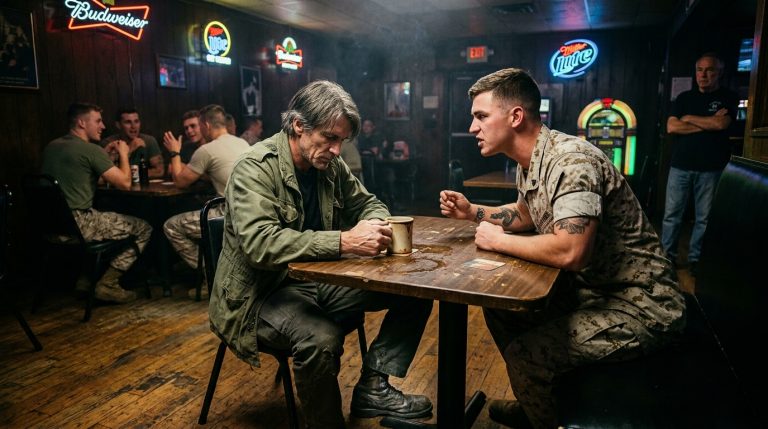
The air in the bar tasted of stale hops and the sharp, metallic tang of the coming storm. Hank sat at the corner table, the ring pressed into his palm until the sharp edge of the cross bit into his skin. The silence in the room was absolute, a sudden, suffocating vacuum left behind by the children. Ella’s wet footprints had already begun to evaporate into the floorboards, leaving only ghosts of where she had stood, pointing the way toward a life he had failed to protect.
He turned the silver band over. The scratch along the edge was jagged, a miniature canyon of failed promises. Eleven years. He had spent that time convincing himself that Sharon was better off without him, that his life—the bike, the club, the heavy, oil-stained machinery of his existence—was too poisonous for a sister trying to build something clean. He had been wrong. He hadn’t been protecting her; he had been leaving her to fight the dark alone.
“You’re going to think about it until the metal leaves a mark,” Connor’s voice was low, cutting through the hum of the cooling compressors.
Hank didn’t look up. He felt the weight of the men around the bar—Jake, Garrett, the others. They were static, frozen in the orange light, their own lives momentarily paused to observe the wreckage he had just pulled from the rain. They weren’t waiting for orders. They were waiting for him to decide if this was a job, or if it was a reckoning.
“She left this,” Hank said, his voice grating against the quiet. “Deliberately. She didn’t want me to just remember her. She wanted me to have the tool.”
“It’s not just jewelry, Hank,” Jake said from the bar, his hands resting on the edge of the wood, his eyes scanning the windows. The rain slapped against the glass, a rhythmic, frantic percussion. “A kid like that doesn’t walk into a place like this with a relic unless she was told exactly what it unlocked. What are you missing?”
Hank stood, his knees protesting the damp cold. He walked to the window, peering out into the early autumn dark. The parking lot was empty, the gravel shining like obsidian under the pale orange security light. His bike sat under the awning, a dormant beast of steel and rubber.
He didn’t need to ask himself what was missing. He needed to ask what he had been ignoring. The binder. The names with dates. The fact that Marcus hadn’t had a bag. The logic was a trap—a simple, elegant, lethal mechanism. If the binder was the “what,” the ring was the “why.”
He stepped back, his boots crunching on a fragment of glass from a broken pint. The sound seemed amplified, a gunshot in a tomb. He looked at the ring again, then at the door.
“Tyler,” Hank said, not turning around. “Lock the gate. Nobody in, nobody out until the morning crew takes over.”
“And you?” Tyler asked, his rag pausing over a spot on the bar.
Hank shoved the ring into his vest pocket, right against his chest. “I’m going to see if Sharon left a breadcrumb trail.”
He reached for his jacket, but the door rattled—a slow, rhythmic, deliberate knock. Not the frantic tapping of a child, but the heavy, measured strike of someone who expected the door to yield.
CHAPTER 2: THE AUDIT
The man standing on the other side of the glass was not someone Hank recognized from the valley. He wore a coat that was too clean, the fabric charcoal-gray and devoid of the road dust that clung to everyone else in this part of town. He didn’t look like an envoy; he looked like an accountant who had lost his way. But the way he stood—shoulders squared, eyes scanning the room with the clinical detachment of a man checking inventory—made Hank’s skin crawl.
“We’re closed,” Hank said, not moving to unlock the deadbolt.
The man smiled, but it didn’t reach his eyes. Through the glass, he looked like a silhouette cut out of the storm. “I’m not looking for a drink, Hank. I’m looking for the girl.”
Hank’s hand drifted to the pocket where the ring sat. The silver cross felt like a branding iron. The man’s focus flickered, a micro-second of intent directed at Hank’s vest pocket, then back to his face. He knew.
“She’s gone,” Hank replied, his voice dropping into the low, gravelly register that usually kept trouble at bay. “And you’re trespassing.”
“Am I?” The man stepped back, the orange light of the bar sign catching the wet sheen of his shoes. “You’re playing a game you don’t understand, Hank. You’re looking for a sister. I’m looking for property that was misplaced. Don’t confuse the two.”
He turned on his heel before Hank could respond, walking toward a sedan idling at the edge of the gravel. Its lights were extinguished, blending perfectly into the drowning dark of the autumn night.
Hank didn’t wait. He didn’t bother with the front door. He moved to the back, past Tyler, who was already holding the heavy industrial bolt of the rear exit.
“Jake, Connor,” Hank barked as he stepped out into the deluge. The rain was coming down in sheets now, a physical wall of cold that turned the parking lot into a blur of gray light and black shadow.
The wind shrieked, tearing at the gravel. The sedan’s brake lights flared, then vanished as the car surged toward the main road.
“They’re moving,” Jake said, already kicking his engine over. The Harley roared, a guttural defiance of the storm.
Hank swung onto his own bike. The leather of the seat was slick with water. He didn’t think about the risk; he thought about the binder and the man’s eyes. The stranger hadn’t been an accountant. He had been an auditor—someone who checked to see if the assets were still in their boxes.
They tore out of the lot, tires spitting wet gravel. The sedan was a ghost ahead of them, turning hard toward the downtown district, toward the old industrial corridor where the shell firms liked to hide.
The chase was a chaotic, sliding dance of chrome and wet asphalt. The storm had turned the road into a slick, unpredictable surface. Hank felt the rear tire of his bike jitter as he pushed through a turn, the bike fishtailing before he wrestled it back into a straight line. The sedan hit a deep puddle, throwing a spray of black water into the air, and for a moment, the world was nothing but noise and the blinding flash of lightning.
Then, the sedan swerved. Instead of heading for the highway, it cut sharp into the narrow alleyway behind the old municipal library—a shortcut that led to the city’s labyrinthine parking garages.
“He’s going for the maze,” Connor shouted over the wind.
Hank gritted his teeth. The alley was tight, barely wide enough for two vehicles. If the man knew the layout, he was trying to lose them in the narrow concrete corridors where the bikes couldn’t keep their speed.
They slammed into the alley, the exhaust echoing off the brick walls like gunfire. The sedan ahead surged, then braked hard, its tail swinging out. It was a feint. The car wasn’t trying to lose them; it was trying to block them. It skidded sideways, tires screeching, and slammed into a dumpster, wedging itself across the path.
Hank saw the driver’s door open. He didn’t pull over; he throttled down, swerving into the narrow gap between the sedan’s hood and the crumbling brick wall. His handlebar scraped the car’s paint, a sharp, shrieking sound of metal against metal that vibrated through his entire arm.
He didn’t look back. He leaned into the turn, his heart hammering against his ribs in time with the pistons. The target wasn’t the man in the suit. The target was the office he had just come from. If the man was an auditor, he had a workspace. And if Sharon had left that ring, she had left a trail that began somewhere inside that office.
They broke out of the alley and into the light of the downtown square. The sedan was gone, abandoned. The man had slipped into the crowd, or into the building behind them. Hank killed his engine in front of a sterile, glass-fronted office building—a place that sold “Strategic Logistics.”
The sign above the door was new. The glass was polished. It was the complete opposite of the world Hank lived in.
“This is where they keep the books?” Connor asked, looking at the sterile lobby.
Hank dismounted, his boots hitting the pavement with a heavy, final thud. He felt the ring in his pocket, a steady, pulsing weight. “This is where they keep the kids,” Hank said, stepping toward the glass door. “And it’s time we did an audit of our own.”
The glass didn’t budge. Hank looked at his reflection—wet, wild-eyed, and dangerous. He didn’t wait for a key. He raised his boot, ready to shatter the veneer of their carefully constructed reality.
CHAPTER 3: THE GHOST PAPER
Hank’s boot met the glass with a force that sent a spiderweb of white fractures spreading from the point of impact. The lobby lights flickered in response, buzzing with an angry, electrical frequency that set his teeth on edge. He didn’t wait for the glass to shatter. He drove his shoulder into the pane, the structure giving way with a jagged, crystalline roar that was instantly swallowed by the internal hum of the building’s security system.
“Inside,” he growled to Connor, who was already stepping through the jagged gap, his hand hovering near his jacket pocket.
The lobby was a cathedral of clinical indifference. Polished granite floors reflected the harsh, overhead LEDs, and the air smelled of ozone and lemon-scented industrial solvent. It was a space designed to intimidate—wide, hollow, and devoid of personality. But as Hank stepped toward the directory board mounted on the far wall, he noticed the discrepancy.
The board was a sleek, brushed-aluminum panel with names etched in bold, sans-serif font. But beneath the list of legitimate-sounding firms—’Apex Consulting,’ ‘Global Asset Management,’ ‘Strategic Logistics’—there was a faint, ghosted residue of adhesive. Someone had recently peeled away a decal. A long, rectangular patch of darker metal remained, the size of a shipping manifest or a regulatory filing.
“Look at this,” Hank said, pointing a calloused finger at the blank space.
Connor leaned in, his brow furrowing. “A ghost label. Why scrub it now? Unless they knew we were coming.”
“They didn’t know we were coming to the bar,” Hank muttered, his mind churning through the sequence of the night. “They knew the girl was at the bar. They’re not tracking us; they’re tracking the loose ends.”
A sudden, sharp ping resonated through the lobby—a terminal near the reception desk waking up. The screen glowed, a harsh white light that bathed the room in a sterile glare. A single prompt blinked in the center of the display: AUTHORIZATION REQUIRED.
Hank moved to the desk, his boots sounding like hammer blows on the granite. He leaned over, scanning the surface. There was no keyboard, just a sleek, silver biometric scanner embedded in the stone. He looked at his own hand—cracked, stained with oil, scarred by years of wrenching and riding—and then back at the directory board.
He didn’t need a fingerprint. He needed a key.
“Connor, cover the elevators. If anyone comes down, don’t ask questions.”
He turned back to the desk, his fingers brushing against a loose piece of cardstock wedged beneath the monitor base. It was a standard-issue visitor badge, but the ink on the back was smudged. He flipped it over. A set of numbers, hastily scribbled in a handwriting that felt terrifyingly familiar.
It wasn’t a code. It was a date. The same date circled in Walter’s binder.
The weight of it hit him harder than a physical blow. Sharon hadn’t just been a victim of this system; she had been a part of its architecture, perhaps trying to tear it down from the inside before she vanished. The realization was a cold, sharp blade to his gut. He hadn’t just lost his sister to the dark; he had been oblivious to her war.
He gripped the badge, the edges biting into his skin. The lobby alarm continued its rhythmic, low-frequency pulse, a digital taunt. He looked at the directory board again, specifically at the place where the ghost label had been. He realized then that the office wasn’t empty. The sound of a heavy, metal-on-metal sliding door echoed from the basement level, muffled but distinct.
A freight elevator.
He moved toward the back corridor, his pulse syncing with the thrumming of the building. The walls here were painted a light, depressing shade of gray, the corners filled with shadows that seemed to lengthen as he approached. He found the elevator access panel, but the buttons were dead. He looked at the badge again, then at the small, narrow gap beneath the control panel.
With a grunt of exertion, he pried the plastic casing loose with his knife, the metal screeching in the quiet. He reached inside, his fingers finding the tangle of wires behind the faceplate. He didn’t know the electronics, but he knew the logic of things that were meant to stay closed. He twisted two copper wires together, a spark jumping between them like a dying star.
The elevator shuddered, a heavy, tectonic groan vibrating through the floorboards. It began to rise.
“Hank,” Connor’s voice came from the lobby, sharp and urgent. “Two vans just pulled up out front. They aren’t local. And they aren’t police.”
Hank didn’t look back. The elevator doors began to part, revealing a dark, cavernous shaft. He stood at the edge, the cold draft of the basement rising to meet him. He felt the ring in his pocket, a steady, grounding weight against his chest. If Sharon had fought this war, she had left the map, and he was finally ready to read it.
He stepped into the dark, the doors sliding shut behind him, cutting him off from the lobby, the danger, and the life he had known only an hour ago. He was alone now, descending into the heart of the machine. The elevator dropped, the speed increasing, a plummet toward the truth he had been avoiding for a decade. He watched the floor indicators pass—L1, B1, B2—the light from the buttons the only thing breaking the suffocating black. When it stopped, the doors opened into a room that didn’t look like an office. It looked like a vault.
CHAPTER 4: THE PREDATORS PAUSE
The vault was not a room of paper. It was a room of light—rows of server racks, their blue status LEDs blinking in a rhythmic, serpentine pulse that felt less like machinery and more like a collective breath. The floor was raised grating, the kind that vibrated with the heavy, constant drone of liquid cooling systems. Hank stepped off the elevator, his boots clanging softly against the metal. The sound was swallowed instantly by the vast, high-ceilinged space.
He didn’t move toward the racks. He moved to the shadows at the perimeter, his hand hovering instinctively over the hilt of his knife, though he had nothing to fight but the hum.
In the center of the room, a glass-walled office overlooked the server floor. It was lit from within by the glow of a dozen monitors. He saw a figure inside—a man in a charcoal-gray coat, the same one he had encountered at the bar. The auditor. He was sitting at a desk, his fingers moving across a keyboard with a steady, metronomic grace.
Hank shifted, his boot catching on a loose wire. He froze. The auditor didn’t turn. He just kept typing, the light from the monitors casting a cadaverous, flickering sheen across his face. He was looking at a spreadsheet, but the columns weren’t names or dates. They were timestamps and coordinates.
He’s not checking the kids, Hank realized, his breath hitching. He’s checking the traffic.
Hank edged closer, keeping the rows of servers between him and the glass office. He saw a printed document sitting on the edge of the auditor’s desk. It wasn’t a child’s record. It was a topographic map of the valley, and pinned to it was a photograph—a blurry, night-vision shot of a woman with her hair pulled back, standing near the very bar where Hank had spent his entire adult life.
Sharon. She looked exhausted, her face a map of hidden intent, but she was alive.
The auditor paused. He stood up and reached for a headset, his movements sharp and efficient. He started talking, his voice a low, melodic murmur that barely carried over the server drone.
“The assets are being relocated,” the man said. “The diversion in the valley has been… engaged. Keep the connection open.”
Hank felt a surge of rage so pure it nearly blinded him. The rescue at the house on Granger Street—it hadn’t been a victory. It had been a controlled burn. They had allowed him to ‘save’ those children because it served their logistics, because it cleared the board for something else.
He moved to the next row of servers, his eyes scanning for a terminal. He found one—a slim, wall-mounted unit that appeared to be a backup node. He didn’t know how to access the files, but he knew the ring. He took it from his pocket, the silver band cool and solid. He looked at the biometric scanner on the terminal’s side. It was a physical keyhole, disguised behind a sensor.
He jammed the ring into the narrow slot.
The terminal chirped, a high-pitched sound that seemed to slice through the room like a razor. The auditor stopped mid-sentence. His head tilted, a predator sensing a shift in the wind.
Hank ducked low as the server lights turned a violent, strobe-like red. The entire room began to wail, a dissonant, screeching siren that sent the auditor running from his office.
Hank scrambled back toward the elevator, but the doors were already sealed. He was trapped. He turned, pressing his back against the cold, vibrating metal of a server rack, his eyes tracking the man in the charcoal coat as he exited the office. The auditor wasn’t running. He was walking with the calm, terrifying poise of a man who held all the cards.
“You really shouldn’t have come down here, Hank,” the man said, his voice carrying clearly over the siren. He held a small, black device in his hand—a remote kill-switch for the room’s air supply. “Your sister worked very hard to keep you out of this. She thought you were the one thing the syndicate couldn’t account for. She was wrong.”
Hank didn’t answer. He watched the man’s feet—the way he balanced his weight, the way his hands stayed loose. He wasn’t a fighter. He was a thinker. And thinkers always had a blind spot.
Hank’s gaze drifted to the row of cooling pipes running along the ceiling, the condensation dripping steadily onto the exposed circuitry of the servers. A simple, stupid piece of infrastructure.
He didn’t run for the door. He kicked the server rack. The weight of it was immense, but the leverage was perfect. The rack lurched, tearing free from the raised floor, and slammed into the neighboring row. The crash was deafening, a cascade of metal and glass.
The auditor stumbled, his concentration broken.
Hank lunged. He didn’t aim for the man; he aimed for the overhead pipe. He struck the main coupling with the butt of his knife. The metal groaned, and then the line burst, a torrent of freezing, pressurized coolant spraying across the room, turning the air into a fog of ice and chemical vapor.
The auditor screamed, the gas hitting his eyes, and dropped the kill-switch. Hank didn’t look back to see if he was down. He dived through the freezing mist, his lungs burning, and scrambled for the only thing he knew for sure: the ring was still in the terminal, and the screen was starting to download.
He didn’t need to finish the download. He grabbed the drive, ripped it free, and bolted into the white-out, the sound of the auditor’s frantic coughing his only guide through the freezing fog. He reached the emergency service ladder at the far end of the room, climbing into the ventilation shaft just as the main power died, plunging the vault into absolute, tomb-like darkness.
CHAPTER 5: THE STATIC
The shaft was a tomb of rusted galvanized steel, vibrating with the immense energy of the floor below. Hank crawled, his shoulders scraping against the rivets, every movement requiring a deliberate, agonizing exertion. Behind him, the darkness of the server room felt like a physical weight, pulsing with that high-pitched, electronic warning. He kept his eyes fixed on the sliver of dim, yellow light ahead—the only indicator that the duct led to a service access point outside the main vault.
His hands were raw, the skin torn from the scramble through the server room. He shifted his weight, his knee striking a junction where two ducts met. The sound was a hollow thrum that reverberated through the entire building. He froze.
He saw her face—Sharon’s face—not as she was in the blurry photograph, but as she had been the last winter she spent in the valley. She had been sitting on the porch, nursing a coffee that had gone cold, her eyes fixed on the horizon with a terrifying, absolute clarity. “They don’t look for the truth, Hank,” she had said, her voice a low, steady hum. “They look for the deviation. If you aren’t exactly where they put you, you’re the anomaly. And anomalies get scrubbed.”
He had laughed it off. He had called it paranoia, the result of bad company and late nights. Now, crawling through a ventilation shaft beneath a firm that trafficked children under the guise of an audit, he realized she hadn’t been paranoid. She had been a scout.
The duct narrowed. He squeezed through, his tactical vest snagging on a protruding bolt. He tugged, the fabric tearing with a sharp, sickening rip. He didn’t stop. He pushed forward, emerging into a narrow, vertical service chase that smelled of wet concrete and industrial oil. He descended the ladder, the metal rungs slick with condensation, and pushed open a heavy maintenance door.
He stumbled out into a basement corridor—an auxiliary utility level, far from the polished granite of the lobby. He was out, but the alarm wasn’t silent. The building was screaming, a rhythmic, deep-bass pulse that he felt in his marrow.
He didn’t head for the front. He moved toward the rear, toward the loading bay where Jake and Connor were supposed to be. If the building was going into lockdown, the loading bays were the most vulnerable point, the place where the logistical “assets” were moved under the cover of night.
He turned a corner, his boots silent on the concrete, and stopped.
The corridor was blocked. A heavy, hydraulic gate, normally used to separate the utility rooms, was sliding shut with glacial, unstoppable force. He saw two men in charcoal coats standing on the other side, holding portable security hubs. They weren’t fighting. They were waiting. They watched him approach with the cold, bored expressions of men who knew the layout better than he ever could.
“Hank,” one of them said. His voice was projected through a small, portable speaker, smooth and amplified. “You’re an interesting variable. But you’re an outdated one. You’re playing with a toolkit from a decade ago.”
Hank didn’t stop. He pulled his knife, the blade catching the dim overhead light. He reached the gate, the gap already narrowing to less than three feet. He didn’t try to climb it. He didn’t try to stop it. He threw his entire weight into a roll, sliding beneath the closing mass of steel just as it slammed against the floor with the force of a falling anvil.
He was in the bay, but he wasn’t alone.
The floor was a vast concrete slab, empty except for a single transport van—the same one he had seen from the road at the house on Granger Street. It was idling, the exhaust fumes filling the enclosed space with a thick, acrid haze.
He didn’t hesitate. He charged the driver’s side door, his hand slamming against the glass. The door opened—not because he forced it, but because it had been unlocked the entire time.
The driver was gone. The engine was running, the transmission set to neutral. And in the back, visible through the partition window, wasn’t a cargo of children. It was a rack of high-end, heavy-duty server hardware—the missing ledger.
He climbed in, his heart rate spiking as he saw the center console. A laptop was hardwired into the vehicle’s diagnostic port, the screen displaying a scrolling wall of code that mirrored the files he had seen in the vault. He realized then that the vault hadn’t been the destination. The vault had been the bait.
The van wasn’t just a vehicle. It was a mobile hub, designed to offload data onto a satellite uplink. And it was already connected.
He reached for the kill switch, but the laptop screen flickered. A face appeared—the Auditor, his voice distorted, metallic, and cold.
“You didn’t steal the ledger, Hank,” the voice said, the pixels shifting into a terrifyingly clear image of his own face, distorted by the van’s dash-cam. “You just finished the synchronization. The audit is complete. Thank you for your cooperation.”
The van’s doors slammed shut. The automatic locks clicked—a resonant, final sound that filled the cargo bay. The engine revved, not to drive, but to engage a secondary ignition sequence. The van began to accelerate, not toward the bay door, but toward the reinforced exterior wall.
Hank grabbed the steering wheel, his knuckles white, but the controls were unresponsive, overridden by the remote signal. He looked at the dash, the countdown timer ticking down—five seconds to impact. He looked at the ring, the silver cross staring back at him in the dashboard light, and he understood. He hadn’t come here to rescue anyone. He had come here to act as the final, necessary piece of the machine.
He braced himself against the passenger door, his boots digging into the floor mat, and prepared for the wall.
CHAPTER 6: THE DECOY
Hank threw his shoulder into the passenger door, but the frame groaned—locked. The van didn’t hit the wall head-on. The steering override jerked the wheels to the left, sending the vehicle into a screaming, sideways slide that scraped the entire length of the loading bay. Metal tore against metal, a shriek of tortured steel that set his teeth on edge. The van slammed into a concrete pillar at a shallow angle, the impact jarring the breath from his lungs and sending him sprawling across the floorboards.
The van died instantly. The silence that followed was thick with the smell of scorched rubber and ozone.
Hank gasped, his head spinning. He looked at the dashboard. The laptop was smashed, the screen a web of dead pixels, but the hard drive—the portable node he had ripped from the server—was still tucked securely into his vest.
He didn’t wait to see if the building’s security teams were coming. He kicked the passenger door. It gave a fraction of an inch, then stuck. He braced his feet against the center console and pushed, his muscles screaming in protest. With a metallic pop, the hinges finally gave way, and the door swung outward into the wreckage of the loading bay.
He tumbled out, hitting the concrete hard. His ears were ringing, but he could hear the distinct, rhythmic clack-clack of heavy boots on the floor above—the security detail. He looked up at the ceiling. The ventilation shaft he had crawled through was still gaping open, a dark mouth in the concrete, but he wasn’t going back. He saw the fire exit, a red-lit rectangle glowing at the far end of the bay.
He sprinted, his legs feeling like lead. As he reached the exit, he saw it—a small, nondescript black sedan parked in the shadows of the dumpster area, its driver watching the bay entrance with cold, predatory patience.
It was the auditor.
Hank ducked behind a stack of shipping pallets, his heart hammering against his ribs. The man wasn’t calling for backup. He was waiting, watching the wreckage of the van with a look of mild, detached annoyance. He tapped a finger against the steering wheel, waiting for something to happen.
He’s not waiting for me, Hank realized. He’s waiting for the data to confirm it’s destroyed.
Hank looked at the hard drive in his hand. If they thought the drive was destroyed in the crash, they would stop hunting him. If he could keep it, he had the only leverage that mattered.
He moved silently, keeping the shadows of the warehouse between him and the sedan. He found the secondary drain pipe that ran along the exterior wall—a rusted, wide-bore conduit he had used years ago to bypass the warehouse’s perimeter fence. He squeezed into the opening, the cold, wet slime of the drain soaking through his shirt, and scrambled toward the outer perimeter of the facility.
He emerged into the alleyway three blocks away, breathless and covered in grease. He didn’t stop until he reached the cover of the old residential district. He leaned against a brick wall, his chest heaving, and pulled the hard drive from his vest.
It was warm—too warm. He turned it over and saw a tiny, blinking red light embedded in the casing.
A tracker.
His stomach dropped. The entire chase, the warehouse, the vault—it was all a staged extraction. They hadn’t wanted to stop him; they had wanted him to carry this drive out of the secure zone. He had done their work for them, acting as the courier to bypass the building’s own internal firewalls.
He looked at the device, the red light pulsing like a heartbeat. He wanted to smash it, to throw it into the gutter, but he heard the sound of tires on asphalt—two, maybe three cars, moving slowly down the street. They were closing in.
He looked around, his mind racing. He had to be the anomaly.
He saw a delivery truck idling at the curb of a grocery store, the back doors unlatched. Without a second thought, he tossed the drive into the back of the truck, slamming the door shut. He turned and sprinted in the opposite direction, toward the city’s industrial rail yards, leaving the red light behind to lure them away.
He climbed the chain-link fence of the rail yard, his breath coming in ragged gasps, and dropped into the dark, tangled maze of rusted freight cars. He was safe for now, but he was empty-handed. He had the ring, but the drive—the truth—was currently moving toward the other side of the city on a delivery schedule he didn’t control.
He sat on the damp gravel between two tracks, the silence of the rail yard a stark contrast to the violence of the last hour. He felt the weight of the ring against his chest, the faint, jagged scratch. He realized then that he had made a mistake. He had treated the situation as a fight for possession, when it was actually a fight for time.
He looked at his hands, stained with the grime of the warehouse and the oil of the van. He wasn’t the hunter. He was the bait. And if he was the bait, he needed to find out who was holding the rod.
CHAPTER 7: THE CLOSING CIRCLE
The rail yard was a graveyard of industrial ambition. Rusted hulks of freight cars sat silent under the pale, flickering wash of distant sodium lights. Hank moved through the maze, his lungs burning with every inhalation of the cold, metallic air. He was exposed, and he knew it. The syndicate wouldn’t let an “anomaly” like him wander the tracks for long.
He stopped behind a bulk-carrier, the steel casing radiating a biting, winter-grade chill. He pulled the silver ring from his pocket. It had been the key, the symbol, and the mistake. He looked at the faint, jagged scratch along the edge—the same mark that had defined eleven years of his life.
“If you aren’t exactly where they put you, you’re the anomaly.” Sharon’s voice, a ghost in the static of his own memory, echoed in the silence of the yard.
He didn’t just have to escape. He had to be the thing they couldn’t calculate. He crouched, his eyes scanning the yard. A spotlight swept over the rusted cars, the beam slicing through the haze of the night. He saw movement—not the disorganized patrol of a security guard, but the sharp, tactical cadence of professionals. They weren’t searching; they were cordoning off the exits.
He turned toward the edge of the yard, where the tracks dipped toward the river. There was a service road there, barely a path, leading to the old drainage maintenance shack. It was the only way out that wasn’t covered by the spotlight’s arc.
He moved, his boots finding purchase on the slick, oil-stained ties. His movement was a calculated rhythm—a sprint, a freeze, a scan. He was the predator now, the man who knew the terrain, but the syndicate had the infrastructure. Every few seconds, the ground would tremble, the deep, low-frequency hum of a heavy vehicle—an armored transport—tracking his position through the vibrations in the iron rails.
He reached the maintenance shack just as a beam of white light cut through the gloom behind him, illuminating the spot where he had been standing ten seconds earlier. He threw his weight against the rotting wooden door. It held. He kicked the latch, the wood splintering, and tumbled into the damp, lightless interior.
The shack was filled with the smell of wet earth and ancient, long-forgotten chemicals. He scrambled into the crawlspace beneath the floorboards, pulling a pile of discarded industrial canvas over himself just as the first boot hit the threshold.
“He’s in the sector,” a voice said, low and devoid of humanity. “Seal the perimeter. Use thermal.”
Hank held his breath. He pressed the ring against his chest, the metal biting into his skin. He realized the truth of the “ledger” they had tried to feed him—it was a beacon, yes, but it was also a filter. They were testing his reach, testing his connections, waiting for him to lead them to the person who had given him the ring in the first place.
They weren’t looking for him. They were looking for the trail he was leaving to Sharon.
The floorboards groaned above his head. He heard the metallic snick of a weapon—a suppressor being threaded onto a barrel. The syndicate wasn’t here to capture him anymore. They were here to sanitize the site.
He looked through a knot in the wood, watching the dust motes dance in the harsh glare of a tactical flashlight. The man who stood in the shack was dressed in a standard-issue tactical shell, his face obscured by a low-profile visor. He was looking at the floor, his boot resting near the very board Hank was hiding beneath.
Hank felt the surge of adrenaline, the primal need to strike, to burst from beneath the floor and end the silence. But he stayed still. He calculated the distance, the angle, the weight of the man’s equipment. If he moved now, he would be buried in this yard with the rest of the secrets.
He had to be the anomaly.
He reached into his pocket and found the only other thing he had—the small, sharp shard of glass from the lobby door that had lodged itself in the lining of his coat. He pulled it out, his fingers steady, and flicked it across the room, into the opposite corner.
The sound was a faint tink against a metal tool chest.
The man swung the light, his body pivoting with the weapon already raised. “Contact,” he hissed into his radio. “Sector four, clearing.”
As the man moved toward the far corner, Hank eased his way out from beneath the shack’s rear wall, the wet earth clinging to his clothes. He was out in the open, the spotlights now fixed on the shack. He saw the gap—the drainage maintenance fence, left partially open for the transport.
He ran. He didn’t look back at the shack, he didn’t look back at the lights. He hit the fence and vaulted over, his hands tearing on the jagged chain-link, and landed on the other side, the dark of the riverbank swallowing him whole.
He had escaped the circle, but he was left with the weight of the realization: he had been the lure, and by escaping, he had just confirmed to the syndicate that Sharon was not in the yard, not in the building, and not in the house. She was somewhere else entirely, and they were now going to stop looking for him and start burning the world to find her.
The next hour was a blur of movement. He stayed off the roads, using the riverbank as his guide, the cold water washing the oil and dust from his skin. He needed a place to regroup, a place that wasn’t marked on any map, a place where the syndicate couldn’t track the vibrations of his arrival.
He headed toward the only place left: the old orchard outside the valley, where he and Sharon had hidden as children, the one place he had never told anyone about, not even the club. He arrived just as the first gray light of dawn began to bleed into the sky, the trees looming like specters in the mist.
He stopped, his heart stopping with him. There was a light on in the old, collapsed farmhouse at the center of the trees—a faint, flickering amber glow, like a candle being held in a window.
He wasn’t alone.
CHAPTER 8: THE RESOLUTION
She didn’t look like a ghost. She looked like a woman who had lived ten years of hell and won. She was hunched over the low, stone hearth, feeding scraps of dry kindling into a fire that was struggling against the damp. When she heard the floorboard, she didn’t jump. She just rested her hand on the heavy, metal latch of the small fire-safe sitting on the floor beside her.
“I knew you’d come,” she said. Her voice was raspy, the sound of someone who hadn’t spoken much, but the rhythm was exactly as he remembered—composed, steady, and utterly void of apology.
Hank stood in the doorway, his hand still gripping the silver ring he had pulled from his pocket. The farmhouse was a shell, the roof sagging, the walls weeping with condensation, but the fire in the center of the room was fierce.
“You left the ring,” Hank said, his voice raw. “You left the kids. You let me believe you were gone.”
Sharon finally turned. She looked older, the lines around her eyes etched deep by stress and sunlight, but the clarity remained. She stood up, her movements fluid and practiced. “I didn’t leave them, Hank. I hid them. Walter and his firm weren’t running a charity; they were running a clearinghouse for information. They trafficked the children into ‘placements’ where their lives were harvested for digital data—identities, backgrounds, secrets. They were building a ledger of leverage that could bring down the entire district.”
She pointed to the safe. “The ring wasn’t just a key to a drive. It was the only hardware-encrypted bypass that could read the ledger’s master branch. I couldn’t carry it. If I had it, they would have erased me. I needed someone they didn’t know how to track.”
Hank took a step forward, the floorboards groaning. “You made me the target.”
“I made you the bait,” she corrected, her tone sharp. “And it worked. You led them straight to the van, straight to the synchronization point, and straight into the trap I set. The syndicate isn’t just the firm in the city, Hank. It’s the entire infrastructure of the valley.”
The floorboards outside the farmhouse suddenly thundered—the sound of vehicles arriving, not with sirens, but with the heavy, disciplined tread of a tactical squad. But it wasn’t the syndicate. He saw the flash of badges in the window—Deputy Nash, flanked by a regional task force.
Sharon picked up the safe and held it out to him. “The drive in the van was the decoy, just like I planned. This is the truth.”
The farmhouse door burst open. Nash stood there, his hand on his sidearm, but his expression wasn’t hostile—it was wary. He looked at Sharon, then at the safe. “Sharon Mills,” he said, his voice flat. “We’ve been looking for you for a long time.”
“You’ve been looking for a ghost,” she replied. She looked at Hank, a rare, fleeting softness touching her features. “I couldn’t trust the police, Hank. Not until I had the ledger. Not until the entire structure was compromised so deeply they had to act.”
Hank stepped between Nash and his sister, his posture rigid. He realized then that the “5-Pillar Catharsis” he had been hunting for wasn’t a fight—it was this: the act of surrender. He set the ring on the table, the silver band clattering against the wood, and took the safe from Sharon’s hands. He walked to the window and opened it, signaling the men waiting outside.
The payoff was immediate. He watched from the porch as Nash’s team moved into the orchard, not to clear it, but to secure it. He saw the syndicate’s own transport vans arriving at the edge of the property, not realizing they were driving into a containment zone established by the regional task force. It was poetic justice; they were defeated by the very leverage they had tried to steal.
The cooldown lasted for hours. The orchard, once a place of silent secrets, became a center of calm, methodical justice. The syndicate’s infrastructure was dismantled in real-time, the ledger providing the names, the dates, and the corruption that bound every level of the local government to the firm.
In the late afternoon, Hank found Sharon sitting on the porch, watching the sun dip behind the valley trees. The damp had dried, and the farmhouse felt less like a tomb and more like a bridge. He reached into his pocket and pulled out the ring. He took her hand—her skin was rough, calloused from years of working in the dark—and placed the silver band back onto her palm.
“I’m sorry,” he said, the words simple and hard to say.
“Don’t be,” she said, closing her fingers over the silver. “You did exactly what I needed you to do.”
He sat beside her, the weight of the last decade finally settling into the wood of the porch. They didn’t speak for a long time. There was no need. The valley was changing, the iron and rust of the old ways being stripped away, and for the first time in eleven years, the silence didn’t feel like an absence. It felt like a start.
He leaned back, watching the light fade, and for the first time, he didn’t look at the shadows. He looked at the horizon.