The Old Mess Hall Cook Who Silenced Arrogant Snipers Was Actually the Legendary Ghost of the Valley
CHAPTER 1: THE FAILING RANGE
The wind didn’t just blow across the red dust of the firing range; it hammered the ridge with malicious intent.
Captain Miller threw her black operational cap hard into the dirt, her face flushing a deep, angry crimson under the blistering sun.
“The target is two thousand five hundred meters out with a ten-knot crosswind,” Miller barked, her voice shaking with accumulated frustration. “It is physically impossible to hit with this platform!”
Beside her, three elite marksmen lay prone in their stifling ghillie suits, sweat pooling around their optics.
They had burned twenty rounds of specialized ammunition between them without leaving a single scuff on the distant steel silhouette.
General Sterling stood a few paces back, his arms locked tight across his chest, his expression carved from gray granite.
He didn’t care about the wind charts or the complex atmospheric drag tables Miller was frantically flipping through.
“Impossible is just a word used by men who miss,” Sterling said, his voice dropping into a register that cut straight through the crosswind. “Reset the bolts. Do it again.”
A faint, rhythmic squeak cut through the tense silence of the firing line.
A rusted metal cart bumped over the uneven gravel, pushed by a man who looked like he had been part of the landscape long before the concrete range was poured.
Saul gripped the cold iron handles, his slightly hunched shoulders covered by a white apron permanently stained with grease and tomato paste.
He moved with an unhurried, agonizingly quiet shuffle, keeping his eyes lowered toward the ground.
He brought paper cups and a heavy insulated cooler of ice water for officers who were too busy failing to remember hydration.
“Water, sers,” Saul rasped, his voice sounding like dry autumn leaves crushed beneath heavy boots.
Miller spun around on her heel, her eyes locking onto the old cook as if he were the sole source of her professional humiliation.
“Not now, Saul,” she snapped, stepping directly into his path to block the cart. “Can’t you see we are in the middle of a live tactical crisis? Get that tin trap out of the firing line before you ruin someone’s focus.”
Saul didn’t flinch, nor did he take a step backward.
His calloused hands, warped and gnarled by decades of manual labor, carefully placed a single paper cup onto the wooden prep table.
His gaze drifted past the furious captain, fixing instead on the shimmering heat waves rising off the distant canyon ridge.
“Wind ain’t ten knots,” Saul muttered softly, almost talking to the grease stains on his apron. “It’s swirling down in the draw. Fourteen knots. Maybe fifteen at the apex.”
Miller let out a sharp, incredulous laugh that drew snickers from the prone snipers on the mats.
“Did the soup fumes finally get to your brain, old man?” Miller scoffed, leaning down to stare into his weathered face. “You are telling me how to read an advanced ballistic wind trace? Go back to peeling potatoes.”
Saul kept his breathing slow, his thumb unconsciously rubbing the edge of the wooden ladle tucked into his belt pouch.
“I’m just saying,” Saul replied, his tone entirely flat, stripped of all ego or anger. “You’re aiming for where the wind is here. You need to aim for where the wind is there. Two mills left, one up for the humidity.”
Miller’s face twisted into an ugly sneer as she waved a hand toward the rear.
“Get him out of my sight, Sergeant. He’s completely senile.”
Before the guard could step forward, General Sterling raised a heavy hand, halting everyone in their tracks.
“Hold,” Sterling commanded, his eyes narrowing as he finally looked past the grease stains and the rumpled apron.
CHAPTER 2: THE COOKS CORRECTION
“Did the soup fumes finally get to your brain, old man?” Captain Miller scoffed, her voice sharp enough to cut glass as she leaned down to tower over the weathered cook.
Saul didn’t blink, keeping his posture grounded with his feet planted shoulder-width apart in the red dust.
“I’m just saying,” Saul replied, his tone remaining flat and stripped of any defensive heat. “You’re aiming for where the wind is here. You need to aim for where the wind is there. Two mills left, one up for the humidity.”
Miller’s face twisted into an ugly, dismissive sneer as she gestured wildly toward the rear guard.
“Get him out of my sight, Sergeant—he’s completely senile and tracking grease instead of ballistics.”
A sharp, metallic clink echoed across the firing line as Saul gently set another paper cup down on the wooden planks without spilling a single drop.
Before the guard could step forward to grab the old man’s arm, General Sterling raised a heavy, gloved hand to freeze the entire platoon.
“Hold,” Sterling commanded, his eyes narrowing as he finally looked past the grease stains and the rumpled apron to study the cook’s posture.
The general stepped forward, his boots crunching heavily into the gravel, ignoring Miller’s sudden look of profound confusion.
“You think you can make that call, Cook?” Sterling asked, his voice low and testing.
“I think physics is physics, General,” Saul replied, meeting the three-star officer’s intense gaze with eyes that were startlingly clear and entirely unafraid. “Bullet don’t care who pulls the trigger. It only cares about the math.”
A heavy, suffocating silence descended over the firing range, broken only by the distant whistling of the canyon crosswind against the steel target.
Miller stepped between them, her face flushing a mottled red as she tried to salvage her command authority.
“Sir, you can’t possibly take this seriously—that rifle is a classified tactical prototype, and the recoil alone would dislocate his fragile shoulder.”
“It’s an order, Captain,” Sterling said, cutting her off with absolute finality. “If he misses, he’s fired and banned from the range. If he hits it, well, then you have a lot of explaining to do.”
Saul didn’t celebrate, nor did he offer a sarcastic smile; he simply wiped his calloused hands on the dirty fabric of his apron, leaving a faint white smear of flour across the grease.
He walked slowly toward the abandoned shooting mat, his movements carrying the deliberate, agonizing stiffness of a man whose joints had paid a heavy toll for history.
One of the prone snipers muttered a dry laugh into the dust, shaking his head at the absurdity of the spectacle.
Saul ignored the cheap mockery entirely, lowering his frail frame onto the rough mat with a slow, mechanical precision.
CHAPTER 3: THE IMPOSSIBLE SHOT
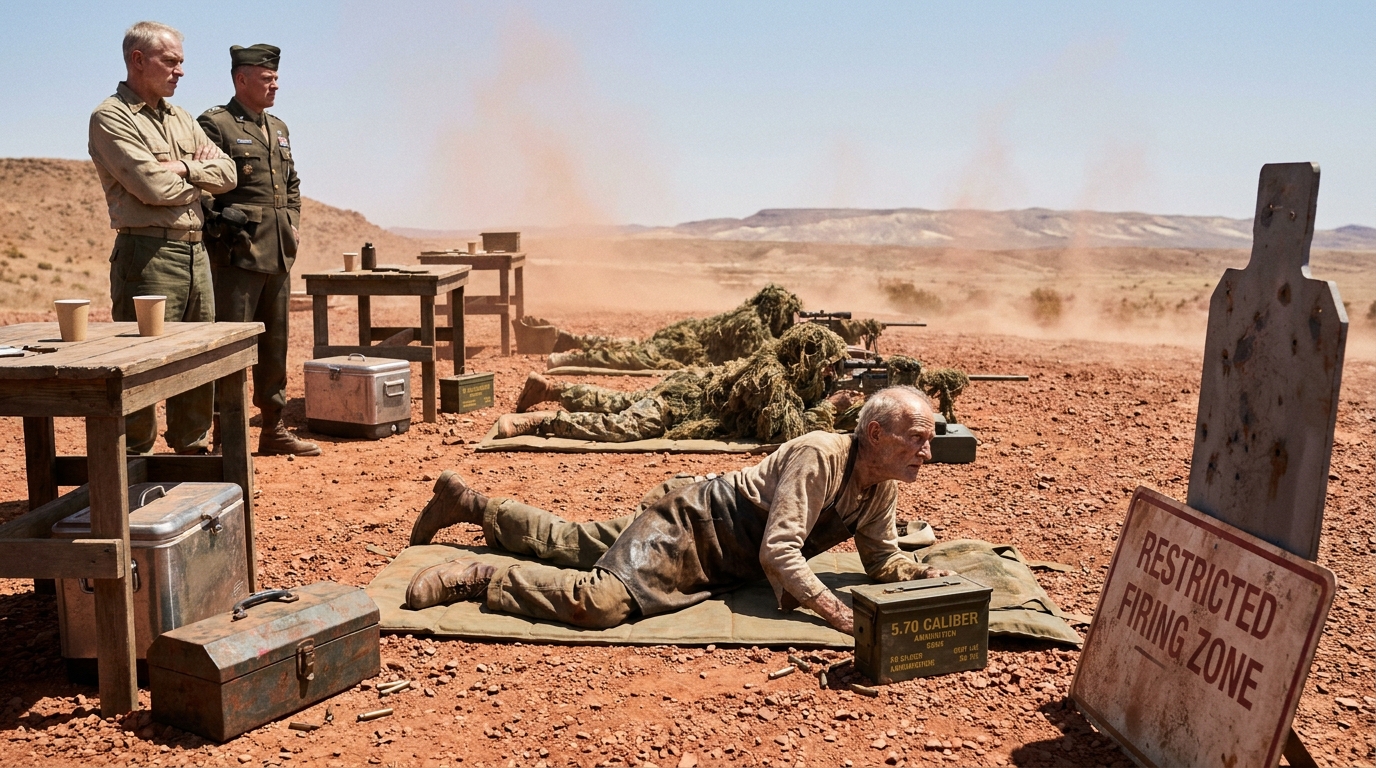
The rifle weighed twelve pounds of cold composite and steel, but it felt weightless once the stock locked into the hollow of Saul’s shoulder.
He didn’t bother checking the digital elevation screen or the advanced wind telemetry glowing softly on the side rail.
“Need a pillow for your knees, Grandpa?” one of the snipers muttered from the dust behind the line.
Saul didn’t dignify the remark with a glance, his breathing already settling into a slow, rhythmic cadence that matched the distant howling of the canyon breeze.
His right hand reached up with mechanical precision, his thumb and forefinger clicking the turret dials without hesitation.
Click. Click. Click.
Two mills left, one up for the heavy desert humidity.
Captain Miller crossed her arms tight across her chest, her face pale with mounting anxiety as she stared at the distant ridge two miles away.
“He’s going to throw a round into the dirt and damage the feed ramp,” Miller snapped, looking toward General Sterling for validation.
Sterling didn’t answer, his eyes locked entirely on the old cook’s motionless silhouette against the firing mat.
Saul chambered a round with a sharp, metallic shove that echoed cleanly over the gravel, the action smooth and practiced through decades of muscle memory.
He didn’t pull the trigger in a hurried burst of panic; instead, he watched the heat mirage dance across the valley floor, waiting for the momentary drop in thermal turbulence.
Five seconds dragged by like an hour under the relentless sun.
His trigger finger took up the slack with a microscopic, deliberate pressure that betrayed zero hesitation.
The heavy chassis roared, kicking up a sudden cloud of red dust and loose gravel around the old man’s boots.
The sound rolled down the deep valley like an approaching storm, rattling the empty water cups on the wooden table.
Every head turned instantly toward the spotting monitors downrange, holding their breath as the multi-second flight time ticked away in absolute silence.
“Impact,” the spotter called out, his voice cracking with sheer disbelief as his eyes bulged behind the lens. “Target destroyed. Center mass. Dead center.”
CHAPTER 4: THE SCAR REVEALED
The general’s hand hovered inches from the weathered forearm, his fingers trembling slightly as the harsh desert light hit the raised, discolored tissue.
“Where did you get that?” Sterling asked, his voice dropping into a tight, strained whisper that barely carried over the warm canyon draft.
Saul yanked his arm back abruptly, shoving the coarse fabric of his uniform shirt down to bury the skin from view.
“Kitchen accident, sir,” Saul muttered, keeping his gaze fixed firmly on the dusty ground between his boots. “Hot grease. Happens all the time down in the mess.”
Sterling didn’t move, his eyes locked onto the spot where the scar had just been exposed with a dawning, terrifying realization.
He looked back and forth from the distant steel target to the old cook’s rigid, defensive posture, his mind rapidly assembling the impossible pieces of military history.
“Operation Silent Thunder,” Sterling whispered, the name dropping like a heavy iron weight onto the gravel.
Saul froze mid-motion, his fingers tightening around the wooden handle of his cart until his knuckles turned bone-white.
“I don’t know what you’re talking about, General,” Saul replied, his tone chillingly flat and devoid of any warmth.
“There was a sniper,” Sterling continued, raising his voice so it echoed across the entire stunned platoon standing at attention. “A ghost. They said he could hit a target from a different zip code, that he held off an entire battalion for three days to cover a retreat.”
Captain Miller stepped forward, her face draining of all color as she stared at the unassuming mess hall cook in absolute horror.
“He never came home,” Sterling said, locking his eyes onto Saul’s weary face. “He was listed missing in action, presumed dead. His call sign was the ghost of the valley.”
The general reached out with sudden, unyielding authority, gripping Saul’s wrist before the old man could pull away.
Sterling shoved the sleeve back up past the elbow once more, exposing the jagged star-shaped shrapnel burn for every single soldier to witness.
“Sergeant Major Saul Burkowitz,” Sterling breathed out, snapping his hand up to his brow in a crisp, flawless salute. “My father was in that retreat. He told me the story every night. He survived because a ghost watched over them.”
CHAPTER 5: THE LEGEND ACKNOWLEDGED
The absolute silence of the range felt heavier than any ballistic load, pressing down on the shoulders of every single officer standing in the dust.
Captain Miller could not bring herself to lift her gaze from the gravel, her chest rising and falling in shallow, rapid breaths as the reality of her arrogant dismissal collapsed around her.
“I thought you were a myth,” Sterling said, his arm remaining locked in that razor-sharp salute, honoring a ghost he had only ever heard of in bedtime stories.
Saul slowly pulled his arm back down, his expression remaining entirely neutral as he smoothed the crumpled white fabric of his grease-stained apron.
“Legends are just stories people tell when they’re too tired to look at the math, General,” Saul muttered, his voice dry and weary.
Around them, the elite snipers who had mocked him minutes earlier stood frozen, their eyes averted in profound humiliation as they realized they had spent the morning insulting the author of their tactical manuals.
Miller forced her lips to move, her professional pride shattering into jagged pieces against the hard pavement of truth.
“I—I didn’t know,” Miller stammered, her voice cracking under the weight of the glaring mistake. “I told you to go back to flipping burgers.”
Saul turned his weathered face toward the younger officer, his eyes carrying neither malice nor triumph, only the deep exhaustion of a man who had left the war behind decades ago.
“I like flipping burgers, Captain,” Saul said quietly, shifting his weight onto his sore heels. “The onions don’t shoot back, and nobody pretends to know the wind when they’re just guessing.”
Sterling lowered his hand slowly, his expression hardening as he turned his attention back to the disgraced platoon standing in formation.
“You want to be elite?” Sterling barked, his voice snapping like a whip across the open range. “You want to wear the patch? Then you learn from him.”
The general gestured sharply toward the old cook, making it clear that rank on a collar meant nothing compared to competence in the soul.
“From this moment on, Saul doesn’t push the cart out here anymore,” Sterling ordered, his eyes sweeping over the silent soldiers. “He runs this range. Is that understood?”
“Yes, sir!” the entire platoon shouted in unison, the volume rattling the metal plates of the distant target two miles away.
CHAPTER 6: THE APRON STAYS
The white apron hung heavy around his neck, stained with years of grease and tomato paste that no military commendation could ever wash clean.
Captain Miller remained frozen by the edge of the mat, her eyes fixed on the dirt as she tried to process the collapse of her entire professional worldview.
“I’ll help him run the range, General,” Miller offered, her voice tight and stripped of its former arrogance. “But I’m keeping my rank.”
General Sterling ignored her plea entirely, stepping past the disgraced captain to walk alongside the old cook.
“You don’t have to push that cart anymore, Sergeant Major,” Sterling said quietly, his tone softening with deep, earned respect. “The Pentagon can find a place for you in advisory command. You’ve done enough.”
Saul stopped the cart, the squeaking wheels falling silent as he turned to face the three-star officer.
“I told you, General, I like flipping burgers,” Saul replied, his weathered face breaking into a small, tired smile. “The onions don’t shoot back, and nobody pretends they know the wind when they’re just guessing.”
Sterling let out a low sigh, recognizing the immovable boundary of a man who had already made peace with his ghosts.
“Keep the apron then,” Sterling conceded, offering a final, respectful nod. “Just make sure my snipers learn how to read the canyon.”
Saul turned back to the cart, wrapping his gnarled fingers firmly around the cold iron handle.
He didn’t look back at the officers or the silent platoon as he pushed the cart forward down the dusty path toward the mess hall.
The weight of the past was buried deep beneath years of routine, simple cooking, and quiet mornings.
The steel range grew smaller in the distance, leaving behind a profound lesson in humility and the quiet power of real competence.
Inside the small kitchen, the stove hummed a steady, familiar tune, waiting for the onions to be sliced and the broth to simmer.
Saul unhooked his wooden ladle, hung it securely by the prep table, and let out a long, easy breath.
Peace wasn’t found in medals or uniform ribbons, but in the simple, honest work of a day well done.