A Legacy of Grease and Glory: One Master Sergeant’s Silent Return to the Skies Above the Storm
CHAPTER 1: The Weight of the Broom
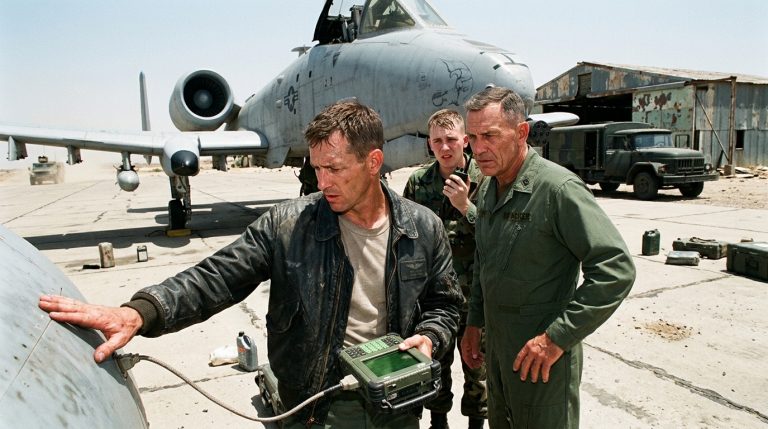
The air in Hangar 7 tasted like stale jet fuel and failure. It was a sharp, biting scent that Daniel Torres had breathed in for thirty years, though these days, he inhaled it through a mask of invisibility. His hands, gnarled and mapped with thin, white scars, gripped the handle of his mop with a familiar, rhythmic pressure.
He moved in slow, deliberate arcs across the polished concrete. The squeak of the mop bucket’s wheel was the only sound he dared to contribute to the frantic symphony of alarms and cursing currently surrounding the AH-64E Guardian. To the technicians and the Boeing engineers, Torres was nothing more than a ghost—a janitor whose job was to ensure the floor remained as sterile as the egos of the men in charge.
Fourteen hours. The bird had been grounded for fourteen hours.
Torres didn’t look up, but he didn’t need to. He could hear the desperate, erratic tapping of diagnostic keys and the rising pitch of Lieutenant Colonel Keller’s voice. Keller was a man who measured success in glowing pixels and uptime percentages. He was currently failing, and the heat radiating from his frustration was palpable.
Torres paused near a workbench. He kept his head bowed, his eyes cast toward the scuffed toes of his boots, but his peripheral vision was locked on the Apache. There it sat—a $72 million bird, dead on the tarmac. To the technicians, it was a complex puzzle of digital nodes and logic gates. To Torres, it was a living thing that had simply stopped catching its breath.
He wiped a smear of hydraulic fluid from the workbench, his fingers lingering on the cool, oily metal. It felt like an old friend. He could feel the slight tilt of the fuselage, the subtle, agonizing strain in the tail rotor housing that the modern sensors were completely ignoring. It was a whisper in a storm of digital noise.
“Run it again!” Keller’s voice snapped, cutting through the hangar like a jagged blade.
Torres felt his heart skip a rhythm, not from fear, but from a deep, aching frustration. They were looking at screens, looking at code, looking at everything except the machine itself. They were trying to talk to a bird in a language it didn’t speak, while ignoring the obvious, physical truth of its distress.
He leaned into his mop, the wood of the handle biting into his calloused palm. He was Master Sergeant Daniel Torres, retired. He was a veteran of Fallujah. He was a man who had brought birds back from the dead while the world burned around him. And here, he was sweeping up the debris of other men’s incompetence.
The weight of the mop was heavy, but the weight of the silence he was forced to keep was heavier still. He took a slow breath, the scent of grease anchoring him to his own internal resolve. He had promised himself he would stay invisible, but as he watched the frantic, failing hands of the young mechanics, he felt the old, rusted instinct beginning to pulse beneath his skin.
He had come here to keep his distance, to simply pay his rent and exist in the shadows of the machines he loved. But looking at that broken Apache, Torres knew he was standing on the edge of a precipice. He could keep his head down and finish his shift, or he could step into the light and risk everything to bring a dying bird back to life.
He glanced at his utility belt, tucked beneath his jumpsuit. The cold iron of his old torque wrench pressed against his hip, a silent, heavy reminder of who he used to be. The hangar lights flickered, a sudden, sharp glitch in the overhead grid, and for a fleeting second, the entire room went dark. In that sliver of shadow, Torres saw it—a tiny, metallic twitch in the tail assembly that shouldn’t have been there.
It wasn’t a digital fault. It was something much older. And it was screaming for attention.
CHAPTER 2: The Ghost in the Gears
The darkness did not last long, but in those few seconds of total, suffocating blackness, the hangar transformed. The sterile, fluorescent hum of Fort Carson vanished, replaced by the blistering, dry heat of an Iraqi wind, and the smell of ozone gave way to the sharp, metallic tang of blood and hydraulic fluid. For a heartbeat, Torres wasn’t a janitor in a faded green jumpsuit. He was Wrench, kneeling in the sand, fingers bleeding as he worked to save a squadron of men who didn’t even know he was there.
The lights buzzed back to life with a stuttering pop, blinding and white.
Torres blinked, his pulse thumping a rapid, uneven rhythm against his ribs. He was still standing by his mop bucket. Lieutenant Colonel Keller was still shouting at the Boeing engineers, his face a mask of escalating panic. But the memory didn’t retreat; it clung to Torres, a phantom limb that demanded he look again at the Apache’s tail rotor.
He stepped forward, his boots making no sound on the oil-stained concrete. The discrepancy he had seen in that flicker of shadow was still there—a micro-fraction of an inch in the housing alignment. To anyone else, it was a manufacturing tolerance. To a man who had spent three decades learning the language of metal and gravity, it was a confession.
“It’s not in the code,” he whispered to the empty, echoing space around him.
The voice was so quiet that even he barely caught it. He realized with a jolt that he had moved closer to the aircraft than he had any right to be. He was now within the restricted perimeter, hovering in the periphery of the technicians’ vision.
“Hey!”
The bark came from Sergeant Davis. The mechanic was crouched near the main turbine, his face smeared with grease, his eyes darting toward Torres with a mixture of annoyance and exhaustion. “You’re off-limits, janitor. Get that bucket back to the maintenance bay. We don’t need you tripping over the power cables.”
Torres froze. The instinct to retreat—to bow his head, mutter an apology, and slip back into the comfortable, invisible life he had built—was a powerful, gravitational pull. It was the safe choice. It was the choice he had made every day for three years. But his hand twitched at his side, his fingers instinctively curling into the shape of a wrench, remembering the grip of the tool tucked into his belt.
“I saw something,” Torres said, his voice level, stripped of the subservience he usually wore like a second skin.
Davis laughed, a hollow sound. “Yeah, I’m sure you did. You saw the same thing we’ve been staring at for fourteen hours. A machine that’s decided to stop being a machine. Go.”
Torres didn’t move. He looked past Davis, toward the tail section. He noticed the way the hydraulic line leading to the auxiliary control unit was pulled taut—not enough to snap, but enough to create a vibration under load that no sensor would register as a fault. It was a phantom stress point.
“The thermal bypass,” Torres muttered, more to himself than to the sergeant. “You checked the primary ignition relay. You checked the fuel pressure. But you didn’t check if the system is trying to compensate for a ghost-loop in the auxiliary line.”
Davis stopped laughing. He stood up, wiping his hands on a rag, his brow furrowing. “A ghost-loop? The automated system handles the secondary lines, old man. It does a full diagnostic check every ten minutes. If there was a loop, we’d see the error code.”
“The system only sees what it expects to see,” Torres countered, taking another step closer. The floor under his feet felt different here—vibrations, subtle and rhythmic, emanating from the fuselage. It was the bird humming in its sleep, a sound of profound mechanical distress. “If the bypass was field-modified—maybe years ago—the new software wouldn’t even have the protocol to scan for it. It would just register the loss of pressure as a hardware failure and shut the system down to protect the components.”
The hangar went quiet. The argument between Keller and the engineers had stalled, and for a brief, electric moment, the focus of the entire room shifted. Keller turned, his eyes narrowing as he spotted the man in the faded green jumpsuit standing where he shouldn’t be.
“You,” Keller said, his voice dropping to a dangerous, low register. He began to walk toward them, his boots echoing with the precision of a metronome. “I told you to get out of the hanger. Do you have trouble understanding basic instructions, or do you just enjoy being a nuisance?”
Torres stood his ground. He didn’t look at the Colonel’s insignia; he looked at the Apache. The machine needed him, and for the first time in three years, the shame of his current position was outweighed by the necessity of his craft.
“I’m not a nuisance, sir,” Torres said, his voice steady. “I’m the only one in this room who knows why that bird is dead.”
Keller stopped ten feet away. The silence that followed was heavy, pressurized, and absolute. The Boeing engineers stopped their typing. Sergeant Davis held his breath. Torres felt the cold, hard weight of his hidden wrench against his hip, a secret that felt heavier with every passing second.
CHAPTER 3: The Wall of Ego
The hangar’s silence felt brittle, like thin ice over a deep, dark pool. Lieutenant Colonel Keller stood frozen in the middle of a stride, his face a bruised shade of crimson, but the expected explosion—the shout, the order to have Torres removed—didn’t come. Instead, there was only the sound of heavy, rhythmic breathing from the mechanics and the distant, lonely drip of condensation hitting the concrete floor.
Torres remained motionless, his hand still resting on the cool, textured metal of the Apache’s fuselage. He knew that for the next few seconds, every pair of eyes in the hangar was measuring him. He was no longer just the man with the mop; he was a variable, an unknown factor in an equation that had been failing them for fourteen hours.
“You’re telling me,” Keller said, his voice stripped of its earlier bluster and replaced by a cold, surgical precision, “that this machine is smarter than its own diagnostic software? That it’s failing because of a modification that doesn’t officially exist?”
Torres didn’t flinch. “I’m telling you that software only knows what it’s been taught to look for, sir. Mechanics know what the metal is actually doing.”
He took a slow, measured step toward the tail section, his eyes scanning the housing. It was here, in the dark, recessed corner of the assembly, that the truth lived. As he reached out to steady himself, his thumb brushed against the edge of a small, custom-machined clamp holding the auxiliary line in place. He felt a sharp, irregular notch in the metal—a serial number, hand-etched, not factory-stamped.
It was a ghost in the machine. A remnant of a field repair, performed in the dirt of a war zone years ago, and it had been sitting there, camouflaged by modern upgrades, waiting for someone who knew how to speak its language. He didn’t say anything yet. To speak it now would be to draw the wrong kind of attention. He needed them to want him to fix it, to grant him the access without the burden of their suspicion.
Sergeant Davis walked over, his eyes darting between Torres and the Colonel. “Sir, if the man is right about a field mod, then the system wouldn’t be flagging it as a fault. It would be flagging it as a standard state of operation, even while it’s causing a pressure differential.”
Keller looked at the Apache, his frustration manifesting as a tight, repetitive clenching of his jaw. He was a man accustomed to control, to command, to the comforting rigidity of the chain of command. Torres was an insult to that rigidity—a reminder that there was a world of problems that couldn’t be solved with a digital dashboard.
“Fix it,” Keller muttered, the words sounding like he was swallowing broken glass. “But if you touch that bird and make this situation any worse than it already is, Torres, I’ll have your career in this hangar over before you can put your mop down.”
Torres nodded, a single, sharp motion. He reached for his belt and unclipped the old, electrical-tape-wrapped wrench.
As he knelt down—the grit of the floor grinding against his knees—he felt the shift in the room. The technicians backed away, forming a loose, watchful circle. They were waiting for him to fail, to prove that he was just a relic, a man out of time clinging to outmoded tools.
Torres ignored them. He focused entirely on the tactile sensation of the work. He ran his fingers over the hydraulic housing, feeling for the subtle warmth of friction. The machine was “breathing” differently now; he could feel the slight shudder of the auxiliary line, the way it pulsed against his fingertips like a trapped heartbeat.
He didn’t need the diagnostic screens. He didn’t need the Boeing engineers’ input. He needed only the resistance of the metal and the silence of the machine. He positioned the wrench, the weight of it perfectly balanced in his hand. It was an extension of his own body, a connection to the man he had been two decades ago.
“Davis,” Torres said, not looking up. “Hold the lead line steady. Don’t force it. Let the pressure tell you where it wants to go.”
Davis hesitated, then moved in, his expression one of profound skepticism. “Like this?”
“Gently,” Torres cautioned.
He felt the resistance of the bolt—rusted, stubborn, resisting the turn. He applied slow, calculated pressure, closing his eyes to visualize the internal mechanics of the valve. He was no longer in Fort Carson. He was back in the desert, under fire, with the smell of sand in his teeth and the sound of distant rotors fading into the night.
He felt the bolt give—a tiny, imperceptible click.
Torres held his breath. He had broken the seal, but he hadn’t yet found the source of the pressure lock. He looked closer at the etchings on the clamp, seeing the faded ink of a marking pen he had used himself, years ago, in a different life. A sudden, cold realization washed over him: this wasn’t just a generic field mod. He had been the one to authorize it. He had been the one to sign off on this specific repair, on a bird that had been supposed to be retired years ago.
The weight of the past didn’t just feel like a memory anymore; it felt like a physical burden on his shoulders. He reached for the secondary bypass valve, his fingers steady, his focus absolute. He was working in the dark, in the middle of a room filled with people who wouldn’t understand the repair even if he explained it to them.
He was the only one who could hear the machine speaking, and he was the only one who could answer it. He reached for the next bolt, the tension in the room reaching a breaking point.
CHAPTER 4: The Commanders Glimpse
The silence in Hangar 7 had morphed into something heavy, a physical weight pressing against Torres’s shoulders as he knelt in the grease-stained dust. The bolt he had loosened was only the first layer. Beneath it, the thermal bypass assembly was fused with decades of oxidation and the high-heat grit of desert operations, a stubborn legacy of the very war he had served in.
He worked with agonizing care, his hands moving with the deliberate, unhurried rhythm of a surgeon. Around him, the circle of technicians remained unbroken, their faces illuminated by the harsh, unflattering glare of the overhead floodlights. Every movement he made was a lecture in a language they were only just beginning to learn.
“The alloy in these older bypass valves,” Torres murmured, his voice barely audible over the distant, metallic creak of the hangar frame, “they don’t react to the automated diagnostic pulses like the new ones do. If you pulse them with a high-frequency signal, the internal reed switch doesn’t open. It vibrates, creating a micro-arc. That’s why your screens keep showing fluctuating codes.”
Sergeant Davis, crouched nearby, leaned in close. His skepticism had begun to bleed away, replaced by an intense, hungry focus. “We’ve been running 400-hertz diagnostic sweeps, Master Sergeant. You’re saying the bypass valve is oscillating?”
Torres didn’t answer immediately. He was busy carefully scraping a microscopic layer of calcified sludge from the seal of the valve. The metal beneath it was bright, untarnished, and stubbornly held by the structural pressure of the bypass assembly. He realized then that he couldn’t force it; the butterfly detour of this particular repair was the tension itself. If he broke the valve housing, the Apache would be grounded for weeks—a failure that would be his own.
“I’m saying this machine wasn’t built to be read by a computer,” Torres replied, his tone neither arrogant nor instructional; it was simply factual. “It was built to endure. And until you accept that, you’re just going to keep breaking parts that aren’t broken.”
He felt the sudden, sharp shift in the room’s atmosphere before he saw it. The collective posture of the mechanics changed—the stiff, defensive shoulders relaxing into a lean of genuine curiosity. Behind them, the sharp, authoritative click of heels on concrete echoed from the hangar entrance.
Colonel Patricia Hayes had returned.
Torres didn’t look up, but he felt her presence move through the circle of men. She didn’t announce herself. She simply watched, her gaze moving from the open maintenance panel to Torres’s hands, and finally, to the old, taped-up wrench he used with such unsettling precision.
“Status, Colonel Keller,” Hayes said. Her voice was cool, stripped of the earlier urgency, but beneath it lay a razor-sharp expectation.
Keller, standing a few feet back, cleared his throat. He looked at Torres—the man he had spent the last several hours trying to silence—and then at the open assembly. “The Master Sergeant believes he’s located a mechanical conflict with an older thermal bypass, ma’am. He’s currently… bypassing the bypass.”
Hayes stepped into the circle, her eyes fixed on Torres. She didn’t look at the engineers or the diagnostic tablets. She looked at the man who had been invisible for three years. For a moment, the world of rank and protocol seemed to dissolve, leaving only the reality of a machine that had to fly and the man who was currently holding its life in his hands.
Torres finished clearing the seal and reached for a set of long-nose pliers, his movements fluid. He felt the weight of her gaze, but he didn’t falter. He had been an invisible man for a long time, but right now, he was a technician performing a task he had perfected in the crucible of combat. The pressure of the moment was a known quantity; the fragility of the valve was a known quantity. The Colonel was just another part of the environment.
“It’s loose,” Torres announced quietly. He adjusted the clamp, his fingers deftly routing the pressure line away from the oscillation point. He felt the subtle, firm click of the valve reseating into a position that would bypass the electronic interference.
He stood up, his knees popping, and stepped back to wipe his grease-covered hands on a clean rag. The air in the hangar felt thinner, as if everyone was waiting for the exhale. Hayes looked at the Apache, then back at Torres. She still didn’t recognize him, not as a name or a service history, but she recognized the quiet, absolute authority in the way he stood.
“Does it need to be calibrated?” Hayes asked.
“No, ma’am,” Torres said, meeting her eyes for the first time. “It needs to be tested. The machine knows what it’s doing now.”
He turned toward his janitor’s cart, the squeaky wheel sounding like a lonely, defiant birdsong in the sudden quiet of the hangar. He had done his part. The rest was up to the ones with the rank and the ignition keys. He watched as Keller gestured to Sergeant Davis, a subtle, reluctant nod that signaled the end of the skepticism.
The weight of the past lingered in the space between his ribs—the realization that he had worked on this bird before, under different stars, in a different life. He had been the architect of its survival then, and now, he was its unseen savior once more. But as he looked at the Apache, he realized that the repair wasn’t the end of his journey; it was merely the moment the silence began to break.
CHAPTER 5: The Threshold
Torres stepped back, his boots crunching on a scattering of loose metal shavings. His back felt like a bowstring pulled to its limit, each vertebrae protesting the long hours spent hunched over the Apache’s tail assembly. He watched as Sergeant Davis climbed into the cockpit, the canopy glass reflecting the overhead floodlights like a sterile, unblinking eye.
“Everything’s clear, Master Sergeant,” Davis called out, his voice ringing through the hangar. “Bypass is locked. The housing is sealed.”
Torres nodded, though his eyes remained fixed on the tail rotor. He felt a phantom tremor in the air—or perhaps it was just the residual vibration of his own exhausted nerves. The psychological phantom of Fallujah was growing stronger, the heat of that long-ago desert bleeding into the climate-controlled chill of the hangar. He felt a sudden, sharp vertigo; the rows of equipment and the faces of the engineers began to blur, shifting into the hazy, dust-choked silhouettes of his old unit.
He was at a threshold. The repair was done, but the machine was still, in a sense, waiting for him to authorize its return to the skies. He realized then that he hadn’t just fixed a hydraulic valve; he had challenged the entire logic of the base’s command structure. If the bird started, he was a hero—or at least, a necessity. If it failed, he was the man who had tampered with a seventy-two-million-dollar asset under the nose of a base commander.
“Master Sergeant?” Davis prompted from the cockpit, his hand hovering over the ignition switch.
Torres blinked, forcing the desert heat to recede. He focused on the present: the slick, cold texture of his wrench, the smell of jet fuel, and the silent, expectant gaze of Colonel Hayes, who stood at the edge of the maintenance bay. She was waiting for the answer, not from her officers, but from the man who had been invisible for three years.
“Proceed with the start-up sequence,” Torres said, his voice firm, shedding the last remnants of his janitorial shadow.
The sequence began. It wasn’t the clean, digital hum of a modern diagnostic start; it was a rough, kinetic awakening. The turbines whined, a high-pitched, piercing sound that set the hangar floor vibrating. Torres gripped the handle of his mop cart for stability, feeling the power of the Apache returning to its limbs.
But then, the alarm triggered.
It wasn’t a mechanical fault; it was a software override. The system, still blind to the physical bypass, sensed the abnormal flow of the auxiliary line as a critical system error. A cacophony of sirens erupted, bathing the hangar in a strobing, rhythmic red light. On the main diagnostic screen, a cascade of crimson error codes scrolled past—SYSTEM REJECTION: ILLEGAL BYPASS DETECTED. AUTO-SHUTDOWN IN T-MINUS TEN SECONDS.
“It’s kicking out!” Davis shouted, his hands frantically tapping at the flight-control interface. “The override is hard-coded into the central processor! I can’t stop the shutdown!”
Lieutenant Colonel Keller moved forward, his face a mask of predatory triumph. “I told you! I told you to leave it alone, Torres! You’ve triggered a system-wide lock!”
Torres didn’t move. He watched the screen. The machine was doing exactly what it was programmed to do—it was prioritizing the safety of its own logic over the reality of its own function. He felt the cold, hard weight of reality settling in. The decoy secret—the idea that the fault was just a simple, physical fix—was shattering before his eyes. The true barrier wasn’t the machine; it was the arrogance of the system that controlled it.
“Colonel,” Torres said, his voice cutting through the rising wail of the sirens. He stepped toward the cockpit, his eyes locked on Davis. “The system is trying to save itself. If you let it finish the cycle, the diagnostic override will purge the memory cache. We lose the bird.”
“We’re losing it already!” Keller retorted, pointing at the countdown. T-MINUS SIX.
Torres looked at the Apache’s tail. He knew what he had to do. The bypass was perfect, but the software didn’t have the “eyes” to see it. He had to bridge the gap—not with a wrench, but with a physical intervention that would force the digital system to acknowledge the mechanical reality. It was an act of reckless, desperate logic.
“Davis!” Torres shouted, his voice echoing off the vaulted ceiling. “The manual override switch, under the seat—toggle it once, then cut the primary diagnostic loop from the relay box! Now!”
Davis didn’t hesitate. He dived for the manual switch as Torres lunged for the relay box at the base of the main rotor, his old wrench swinging like a pendulum. The hangar was a blur of red light and screaming electronics, the sound of failure closing in from all sides. He didn’t care about the consequences anymore. He didn’t care about the janitor’s uniform, the three years of invisibility, or the Colonel’s threats. He cared about the machine.
He struck the relay box casing, the metal giving way under the force of the strike. He reached inside, his fingers finding the delicate, braided wires of the diagnostic loop. The air felt charged, as if the very atoms of the hangar were waiting to see if he would succeed or tear the whole thing apart.
T-MINUS TWO.
Torres pulled.
CHAPTER 6: The Anatomy of the Bird
The pull was clean. The wires snapped back with the distinct, satisfying tension of copper under duress, and then, the hangar fell into a silence so profound it felt like the world had stopped turning. The strobing red of the diagnostic alarms died instantly, leaving the Apache in a wash of dim, sickly yellow emergency lighting.
Torres didn’t exhale. He stayed crouched in the dark under the tail rotor, his lungs burning, his fingers still gripping the jagged ends of the wiring harness. His heart was hammering a frantic rhythm against his ribs—a bird trapped in a cage of his own making. He waited for the explosion, the shout, the sound of security boots racing across the concrete to arrest the man who had just dismantled a multi-million-dollar piece of military hardware.
“Master Sergeant?”
Davis’s voice came from the cockpit, thin and trembling with a cocktail of terror and awe. “The board… it’s dead. The whole diagnostic array is dark. What did you do?”
Torres slowly stood up. His knees protested, a sharp, grinding pain that mirrored the state of the machine. He stepped out from beneath the tail housing, his eyes meeting Colonel Hayes’s across the distance of the hangar. She hadn’t moved. She stood like a statue, her arms crossed, her expression unreadable in the low light. Lieutenant Colonel Keller, however, looked ready to implode, his face a mask of shock that was rapidly hardening into pure, unadulterated rage.
“You idiot!” Keller roared, his voice bouncing off the high, metal ceiling. “You just severed the central processing link! That bird is a paperweight! Sergeant, get him away from that aircraft!”
Torres didn’t wait for Davis. He turned, the heavy silence of the hangar providing a sudden, stark clarity. He looked at the machine. It wasn’t dead. He could feel it. The Apache had been stripped of its digital arrogance, but the bones were still there—the hydraulic lines he had repaired, the bypass valve he had reset, the mechanical alignment he had restored.
“It’s not dead,” Torres said, his voice quiet, carrying through the vast space with the weight of a command. “It’s just quiet. It’s waiting.”
He stepped toward the cockpit, ignoring the way Keller moved to intercept him. He didn’t look at the Colonel. He didn’t look at the engineers. He looked at the machine. “Sergeant Davis, the manual override—the one you toggled. Don’t use the automated sequence. Use the auxiliary start. The one we used in the field when the fire-control computers went dark.”
“That’s a manual ignition, sir,” Davis whispered, his voice catching. “That bypasses the safety locks entirely. If the turbine isn’t balanced, it’ll rip the housing apart.”
“It’s balanced,” Torres said. He felt the cold iron of his wrench in his pocket, a steadying, heavy reminder of the truth he had known for twenty years: a machine is only as good as the hand that guides it. “I’ve checked the alignment. I’ve checked the bypass. Trust the metal, not the code.”
Davis stared at him for a heartbeat, then, with a strange, shaky breath, he reached for the manual ignition.
Keller surged forward, his hand grabbing Torres by the shoulder, his face inches from his. “If this fails, Torres, you are done. You’re done in this army, and you’re done in this world.”
Torres didn’t blink. He felt the heat of Keller’s anger, the desperate, fearful ego of a man who couldn’t exist in a world he didn’t fully control. Torres just smiled—a thin, tired, knowing line. “If this fails, Colonel, it’s just another bird on the ground. But if it flies, it’s because it finally remembered what it was meant to do.”
Davis pulled the ignition.
There was no whine of a computer, no flickering of screens, no cascade of digital warnings. There was only a low, guttural chug, a deep, mechanical groan that seemed to come from the very marrow of the Apache’s frame. Then, a shudder—a massive, singular spasm that shook the concrete under their feet.
The engine caught.
It wasn’t a digital start; it was a roar of primitive, unadulterated power. The rotors, motionless for fourteen hours, began to rotate. At first, it was slow, a heavy, rhythmic beat that sounded like a giant’s pulse, and then, it accelerated. The air in the hangar began to swirl, picking up dust and loose shavings. The roar grew, an all-consuming thunder that drowned out the shouting, the alarms, and the very air they breathed.
Torres stepped back, his chest expanding with the sheer, overwhelming resonance of the sound. He saw the Boeing engineers clutching their ears, their faces illuminated by a sudden, frantic joy. He saw Sergeant Davis, his face bathed in the reflected glow of the rotor blades, laughing, a wild, breathless sound.
He looked at Colonel Hayes. She wasn’t looking at the machine anymore. She was looking at him.
The machine was alive. It was vibrating with a life that had nothing to do with sensors or code. It was the life of a bird that had been neglected, discarded, and finally, returned to the truth of its own design. Torres felt a sudden, sharp ache in his chest—a ghost of the pain he had carried for three years, the pain of being forgotten, of being rendered obsolete by a world that valued convenience over craft.
The Apache leveled out, its engines singing a perfect, flawless song. It didn’t stutter. It didn’t hesitate. It was ready.
CHAPTER 7: The Roar of Validation
The sound was no longer a machine; it was a physical force, a wall of wind and noise that turned the hangar into a pressurized chamber of chaos. Torres was still braced against the relay box, his knuckles white against the metal, feeling the vibration travel up his arms and into his very bones. The Apache hovered inches above the concrete, its belly-lights casting long, frantic shadows against the back wall.
“She’s holding!” Davis shouted from the cockpit, his voice barely cutting through the roar. “The pressure levels are leveling out! I’ve got full control!”
But the triumph was short-lived. A sudden, sharp chirp of an alarm sounded—different this time. It wasn’t the rhythmic pulsing of the diagnostic system; it was a high-frequency, piercing signal that seemed to bypass the speakers and vibrate directly in Torres’s teeth. He looked up at the main monitor, where the dark screen suddenly flickered with a surge of glowing, blue-green code. It wasn’t a failure code. It was a remote uplink signal.
Someone was trying to override the manual lockout.
Torres felt a cold spike of clarity that had nothing to do with the machine. It wasn’t just a ghost in the gears; there was an active, external hand trying to kill the flight before it could leave the ground. The base command, the Boeing engineers, the entire digital infrastructure of Fort Carson—it was all tied to an automated flight-safety server that considered the Apache’s manual operation a “catastrophic unauthorized state.”
“Davis, disconnect the external port!” Torres yelled, lunging toward the side of the fuselage. “They’re trying to cycle the system from the ground station!”
“I can’t!” Davis yelled back, his face pale as he grappled with the flight stick. “The lockouts are active! If I cut power now, the turbines will seize mid-spin!”
Torres didn’t think. He didn’t weigh the danger. He scrambled beneath the main rotor, the wind pulling at his jumpsuit, the sheer force of the downwash threatening to slam him into the concrete. He reached the external junction box, his hands moving by instinct, by the memory of thousands of hours spent in the dust of war. He didn’t have his wrench anymore—it was still buried in the relay assembly—so he used his bare hands, his fingers clawing at the hardened plastic housing of the data-uplink port.
It was hot, searingly hot. The internal processors were dumping their load, fighting for control of the bird. Torres felt the skin on his palms blister, but he didn’t pull back. He jammed his thumb into the locking mechanism of the port, the metal biting into his flesh, and twisted with every ounce of strength he had left.
The hangar floor was shaking. Through the roar of the engine, he could hear Keller screaming something, but it was lost in the wind. The world had narrowed down to the junction box and the humming, violent heart of the Apache above him.
Click.
The plastic casing shattered, sending a spray of fragments into his face. He grabbed the heavy, armored data-cable and wrenched it free.
The effect was instantaneous. The high-frequency alarm cut off with a sickening pop, and the blue-green code on the monitor vanished, replaced by a steady, calm, amber light. The Apache’s rotors transitioned from a chaotic, thrashing roar to a smooth, deep, guttural thrum that vibrated perfectly in tune with the hangar’s own frame.
The bird was no longer fighting itself. It was waiting for a pilot.
Torres slumped against the side of the chassis, his chest heaving, his hands raw and trembling. He looked up to see Davis staring at him through the canopy, the sergeant’s eyes wide, reflecting the sudden, eerie calm of the machine. The hangar was still filled with the roar, but it was a controlled, purposeful sound—the sound of a bird that knew where it was going.
Colonel Hayes stepped through the whirlwind of dust and debris, her face hardened by the shock of what she had just witnessed. She looked at the torn junction box, the ruined relay assembly, and then at Torres, slumped in the grease, his hands bloodied and burnt.
She didn’t speak. She didn’t need to. She turned to the hangar doors, which were already grinding open to reveal the darkening, stormy horizon of the mountains.
The Apache didn’t wait for a command. Davis eased the stick forward, and with a grace that defied its massive, mechanical bulk, the bird lifted, rising from the floor as if it had been waiting for this moment for twenty years. It rose through the gap in the doors and vanished into the gray, swirling clouds of the storm, leaving the hangar in a silence so sudden and absolute that it felt like a void.
Torres stayed on the ground, his eyes fixed on the empty space where the Apache had been. His hands were shaking, but for the first time in three years, the trembling wasn’t from fear or shame. It was the residual hum of the machine, still echoing in his skin. He stood up, slowly, his back protesting, and wiped his face with a shred of his jumpsuit.
The battle wasn’t over. The people on the mountain were still waiting. But as he watched the distant, blinking light of the Apache disappear into the storm, Torres knew he hadn’t just saved a machine. He had reminded them—he had reminded everyone—that there was a difference between a machine that runs and a machine that flies.
CHAPTER 8: The Full Circle
The hangar didn’t just feel empty; it felt hollowed out, as if the departure of the machine had taken the very oxygen from the room. Torres remained exactly where the Apache had left him, his feet planted firmly on the oil-stained concrete. He felt the cold air rushing through the open hangar doors, a biting, mountain-born wind that smelled of pine needles and coming snow.
Colonel Hayes was the first to move. She walked toward him, her stride measured, the sharp click of her heels the only sound in the vast, echoing space. She stopped a few feet away, looking not at the ruin of the junction box or the discarded wrench, but directly at Torres. Her expression had softened—the hard lines of command were still there, but beneath them, there was something else. A flicker of recognition.
“I remember you,” she said, her voice dropping into the quiet space. It wasn’t a question. “Fallujah. 2004. You were the one who kept the birds in the air when the sky was raining fire. We all heard the reports, but after the medals were handed out, the story just… faded.”
Torres looked at her. He didn’t offer a salute. He didn’t need to. “I didn’t fade, Colonel. I just stayed in the hangar. The machines don’t care about medals. They only care if you know how to talk to them.”
“You were right,” she continued, gesturing to the open doors. “The diagnostic system reported a critical failure the moment the bird hit altitude, but it held. It’s holding steady. You saved those people, Torres. Not the software, not the engineers, not the Colonel. You.”
At the mention of the Colonel, Torres’s gaze shifted. Lieutenant Colonel Keller stood near the workbench, his arms folded, his face a ghostly, sickly gray. The collapse of his authority was absolute. He looked at the floor, his pride dismantled along with his digital protocols. Torres felt no rush of vindication, no heat of anger. There was only the calm, cooling realization that the arrogance of the system was its own undoing. Keller hadn’t been defeated by Torres; he had been defeated by the simple, immutable fact that he had forgotten how to listen to the machine.
General Reeves, who had been watching from the observation deck, emerged from the shadows of the catwalk. He moved with the slow, deliberate gravity of a man who had seen too much history and was grateful for every moment of peace. He approached Torres, and for a moment, the distance between the General and the janitor vanished.
“You knew,” Reeves said, his voice resonant. “You knew when you heard the diagnostic reports that it wasn’t a digital fault. You knew the ghost was in the bypass.”
“It wasn’t a ghost,” Torres corrected softly. He reached into his pocket and pulled out his old, tape-wrapped wrench. It was greasy, pitted with age, and looked utterly useless compared to the high-tech diagnostic suites surrounding them. “It was just a piece of metal that had been forgotten. People like to think that if they build something complex enough, they can stop caring about the basics. They think the code replaces the craft. But the metal always remembers, General. It doesn’t care about the version number.”
Reeves nodded, a slow, solemn motion. He gestured to the hanger, to the young mechanics who were now slowly emerging from the corners, their faces a mixture of confusion and profound respect. “They need you back, Wrench. The ones who don’t know how to look past the screens. They need to see that the human hand is the ultimate diagnostic tool.”
Torres looked down at his wrench, then at the empty patch of concrete where the Apache had stood just moments before. He felt a sudden, profound sense of closure. The loop was complete. He had spent three years believing he was invisible, believing that his skills were relics, but the machine had proven him wrong. He wasn’t a shadow; he was the foundation.
He walked over to the workbench, picked up a clean rag, and began to wipe the grease from his wrench, the movement slow and rhythmic. He didn’t need to be a Master Sergeant again. He didn’t need the stripes or the pay grade. He just needed to be where the machines were.
“I’ll stay,” Torres said, his voice clear. “But not to consult. I’ll stay to teach. If they want to learn, they’ll have to learn to look at the bird first and the screen second.”
Reeves smiled, a genuine, tired expression of relief. “Then that’s exactly what they’ll do.”
As the General turned to leave, and Hayes followed, their silhouettes fading into the golden light of the afternoon, Torres remained alone in the hangar. The air was still, the wind had died down, and for the first time in twenty years, he didn’t feel the weight of his age. He walked over to his janitor’s cart, tucked the clean, polished wrench into his belt, and began to push the cart back toward the supply room.
He didn’t move like a man who had finished a job. He moved like a man who had finally come home. The hangar was vast, cold, and filled with millions of dollars of sophisticated, fragile hardware, but it wasn’t a graveyard anymore. It was a workshop. And as he walked into the deepening shadows, he began to hum a low, steady tune—the same sound the Apache had made when it finally found its own heartbeat.
He was no longer waiting for the moment the world remembered him. He was the one who would show the world how to remember itself.