The Forgotten Ghost of Camp Pendleton: How a Disheveled Veteran Taught an Arrogant Squad the True Cost of Honor
CHAPTER 1: THE BROKEN LINE
The brass cartridge casings hit the concrete floor with a sharp, rhythmic clatter. Sergeant Victor Reyes watched the targets downrange, his jaw tightening into a hard line. Another clean miss. The paper silhouette fifty yards out remained pristine, mocking the squad’s collective pride.
Around him, the young Marines of second squad third platoon stared at their rifles in stunned disbelief. They had qualified as experts just months ago, yet today every single round drifted wildly to the left. The wind was dead calm, the sunlight clear, but the physics of their shots felt fundamentally broken.
Reyes dragged a hand across his stubbled face, the exhaustion of a failed quarterly evaluation settling heavy in his shoulders. He didn’t have time for equipment failures, and he certainly didn’t have time to explain this mess to the battalion commander. He signaled a halt, waving his arm toward the transport van parked near the perimeter fence.
“Pack it up,” Reyes muttered, his voice gravelly and low. “We’re taking a two-hour break while the safety officers check the armory logs. Move out.”
They piled into the van without the usual banter, the silence thick with bruised egos. Five minutes later, the vehicle rattled to a halt outside the Copper Kettle, a worn-out local institution just beyond the base gates. The coffee shop smelled of stale roast, old paper, and decades of military sweat.
Reyes dropped into a booth near the back, wrapping his calloused hands around a chipped ceramic mug. Across from him, Lance Corporal Morrison glared into his lukewarm brew, his knuckles white against the handle.
“I’m telling you, Sergeant, it’s not us,” Morrison muttered, his voice tight with defensive frustration. “I had a textbook sight picture, perfect trigger squeeze, and the rounds just drifted. The weapons are cursed.”
Private First Class Torres stirred her coffee with a spoon, her eyes narrowed in bitter reflection. “It’s not just the rifles. Chen missed high by four feet. That’s not a scope adjustment issue. That’s a ghost in the machine.”
Reyes didn’t answer, letting the low hum of the cafe drown out their complaints. He kept his eyes fixed on the condensation sliding down his mug, calculating how to fix a problem he couldn’t even see.
CHAPTER 2: THE UNSEEN OBSERVER
“I’ve qualified expert on three different deployment rotations,” Morrison muttered, his voice dropping an octave as he glared into the dark liquid. “I didn’t suddenly forget how to squeeze a trigger.”
“Nobody’s saying you forgot, kid,” Reyes replied, his eyes scanning the grease-stained menu propped against the napkin dispenser.
The low murmur of the coffee shop hummed around them, filled with the clatter of ceramic plates and the steady hiss of the espresso machine behind the counter. None of them paid attention to the corner booth where the layers of worn fabric huddled against the drafty wall.
Private First Class Torres leaned forward, her elbows braced on the laminate. “Then explain why the crosshairs felt like they were floating in molasses out there. It wasn’t the wind. The wind was dead.”
A faint, metallic scraping sound cut through the cafe noise from the dark corner behind Reyes. A scarred thumb turned a heavy, unpolished brass lighter over and over against a calloused knuckle, the rhythmic click echoing softly in the small space.
The old man sitting alone in the shadows didn’t look up from his lukewarm cup of black coffee. His beard was overgrown, his jacket frayed at the cuffs with yellowed electrical tape holding the hem together.
“You’re fighting the recoil before the round even seats,” the old man said quietly. His voice carried an uncanny clarity that sliced straight through the platoon’s private frustration.
Morrison stiffened, his head snapping toward the corner booth with a sharp scowl. “Excuse me, old man? Did anyone ask for your input?”
The old man finally lifted his head, revealing eyes that looked straight through the anger, seeing right down to the bruised pride beneath. “When the temperature in the armory is twenty degrees colder than the open range, the metal contracts inside the housing,” he said, ignoring the hostility entirely. “Your turrets slip three clicks under the first heavy kick. You’re chasing a ghost.”
Reyes turned slowly in his seat, his gaze narrowing as he studied the battered stranger. The language was precise, technical, and entirely too accurate for someone wearing clothes salvaged from a dumpster.
“You talk like an armorer,” Reyes said, his voice flat and guarded. “Or someone who spends entirely too much time staring at weapon specs.”
“I spent some time on a range,” the old man answered simply, his thumb resuming its slow, steady rotation against the brass lighter. “And I’ve seen good Marines chase bad physics all the way back to the barracks.”
Morrison let out a sharp, derisive laugh, shaking his head as he leaned back against the vinyl booth. “Listen, Pops, we’ve got enough problems today without a street philosopher trying to fix our kit.”
Torres didn’t laugh; she kept her eyes locked on the old man’s hands, noticing the unnatural steadiness in fingers that should have been trembling with age or hardship.
CHAPTER 3: THE FIRING LINE TEST
Sergeant Reyes watched the tattered fabric shift toward the exit, his boots scraping against the concrete as he made his final choice.
“Hold on a second, old-timer,” Reyes called out, pushing himself up from the vinyl booth.
The squad stared at their sergeant in collective disbelief, Morrison throwing his hands up in absolute exasperation.
“Boss, you can’t be serious,” Morrison groaned, his voice cracking with defensive irritation. “We’re going to drag a civilian back onto an active base range because some vagrant claims our gear is cold-soaked?”
“We missed every target for two hours straight, Morrison,” Reyes fired back, his jaw tightening into an immovable line. “I’ll take a homeless armorer over a row of empty paper silhouettes any day of the week.”
They piled back into the transport van with heavy skepticism hanging in the air like exhaust fumes. The drive back through the Camp Pendleton gates took less than ten minutes, the silence inside the vehicle dense with unspoken judgment.
Reyes waved the van past the security checkpoint, spinning a thin excuse about a civilian consultant for the range safety officer on duty. The guard eyed the battered stranger in the passenger seat with deep suspicion, but waved them through anyway.
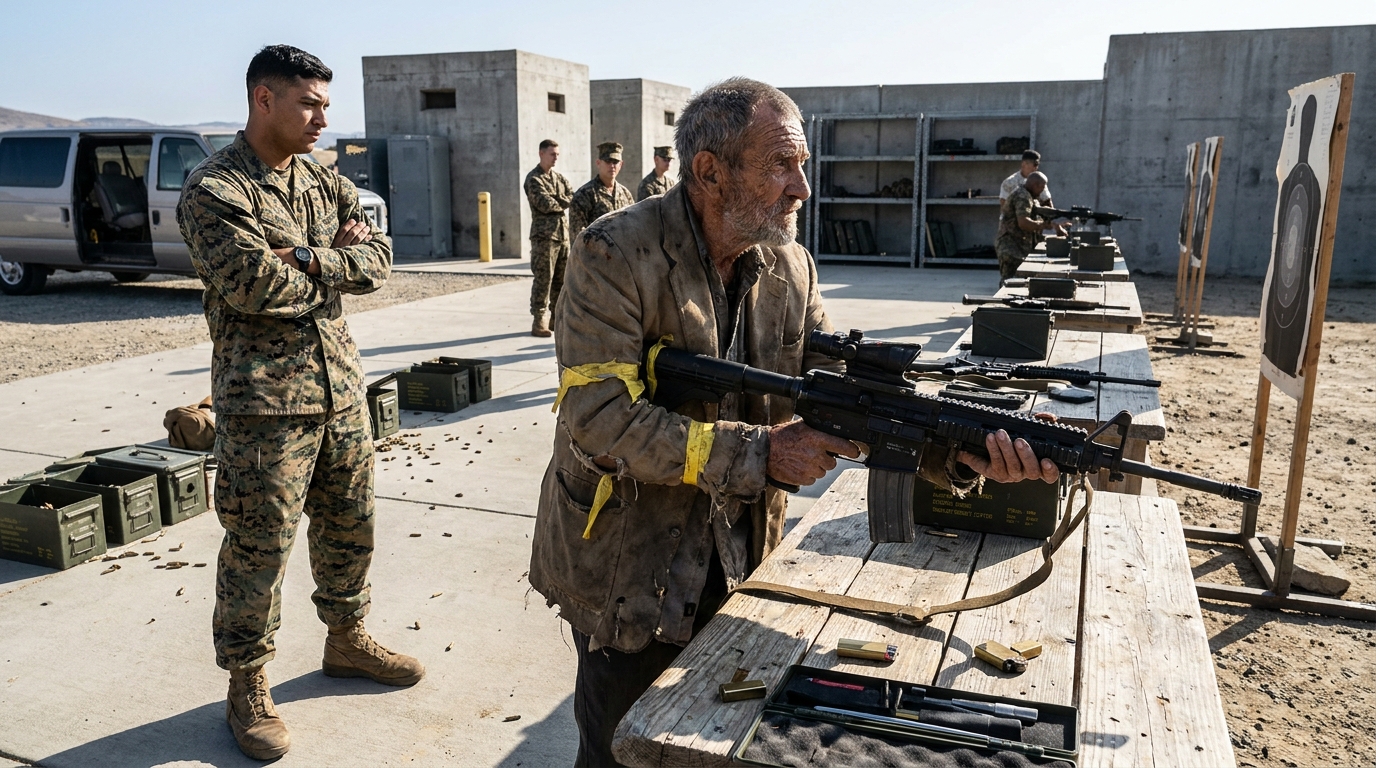
The firing lanes stretched out flat and silent under the glaring afternoon sun, the paper targets still bearing the ragged witness of their morning failure.
“Grab an M27 off the rack,” Reyes instructed, gesturing toward the wooden shooting bench.
The old man stepped up to the line, his movements slow and measured as he picked up the rifle. The weight of the weapon settled into his shoulder with an eerie, seamless familiarity that made Morrison swallow hard.
“Two hundred yards,” Reyes said, his voice dropping as he handed over the ear protection. “Ten rounds. Let’s see what you’ve got.”
The old man didn’t waste breath on an answer. He simply settled his weight into the concrete, his breathing slowing down until his entire frame became unnaturally still.
CHAPTER 4: THE TOWER WITNESS
The dry snap of the firing pin broke the heavy afternoon air. Downrange, two hundred yards out, the paper silhouette shuddered as a neat, perfect hole punched straight through the center of the target mass.
Morrison stopped breathing, his eyes widening as he stared through his field binoculars.
“Dead center,” Morrison whispered, the arrogance entirely draining from his voice.
The old man didn’t pause to admire the work. He worked the bolt with fluid, mechanical efficiency, his breath steady and slow against the steel.
Crack.
Another hole appeared a fraction of an inch from the first. Then a third, a fourth, stacking so tightly together that the paper began to shred around a single central void.
Sergeant Reyes watched in grim silence, feeling the absolute weight of his own earlier doubts settling into his ribs. This wasn’t luck or coincidence. This was muscle memory forged in a furnace the younger generation had never seen.
Heavy boots stomped loudly on the metal stairs of the range observation tower behind them.
“Sweet mother of God,” a voice bellowed down, ringing with sheer disbelief. “Is that who I think it is?”
Master Gunnery Sergeant Porter descended the metal rungs three at a time, his weathered face locked in an expression of profound shock. He didn’t look at Reyes, and he didn’t look at the trembling squad. His eyes were fixed entirely on the old man behind the rifle.
Porter stopped ten feet short of the firing bench, his chest rising and falling as if he had just run a mile uphill.
“Staff Sergeant Thomas Avery,” Porter said, his voice dropping to a low, reverent hum. “Call sign Ghost. Three tours in Vietnam, confirmed kills in triple digits.”
The name hit the concrete range like a live wire. Morrison turned his head sharply toward Porter, his jaw dropping open.
Porter shook his head slowly, looking at the frayed layers of clothing and the electrical tape holding the old man’s boots together. “You held the Marine Corps distance record for seventeen years. I studied your shot placements at Khe Sanh when I was an enlistee. You’re a living legend, Sergeant. What in God’s name are you doing on my range looking like this?”
Thomas lowered the M27 slowly, resting the barrel against the wooden bench with infinite care. He didn’t smile, and he didn’t offer a proud salute.
“Living,” Thomas said quietly, his gaze drifting back toward the empty horizon. “Same as anyone.”
CHAPTER 5: THE WEIGHT OF SILENCE
Porter crossed the concrete apron with a heavy, deliberate stride, his eyes locked on the frayed jacket and patched trousers of the old man standing before him.
“Forty years,” Porter muttered, his voice tightening as he stopped mere feet from the bench. “The entire battalion thought you vanished into the mist back in seventy-two.”
Thomas didn’t flinch under the intense scrutiny, his weathered fingers curling lightly around the edge of the wooden stock. “The mist stays with you,” Thomas said, his tone flat and unyielding. “You just learn how to walk through it alone.”
Sergeant Reyes stepped forward, the realization of what nearly happened in the coffee shop twisting uncomfortably in his gut. He had almost chased away a living piece of Marine Corps history because of a dirty coat and torn boots.
“The VA files,” Reyes said, his voice dropping as he looked between Porter and the old veteran. “They lost track of you?”
“They didn’t lose track,” Thomas replied, his gaze sharp and cold. “They just stopped looking when the war stopped making headlines.”
Porter let out a rough breath, shaking his head as the brutal reality of institutional abandonment settled over the range. “That ends today,” Porter declared, his hand coming up to grip his collar. “We’re pulling those records out of the archive before sundown.”
Thomas pulled his hand back from the rifle, his expression tightening into a stubborn line of resistance. “I didn’t come here for paperwork, Gunny. I came here because these kids didn’t know why their rounds were drifting.”
“You carried the standard for this corps when half of us were still in elementary school,” Porter snapped back, his voice rising with fierce, unyielding pride. “You don’t get to crawl back into a hole just because the world forgot how to read your name.”
CHAPTER 6: THE RESTORED LEGACY
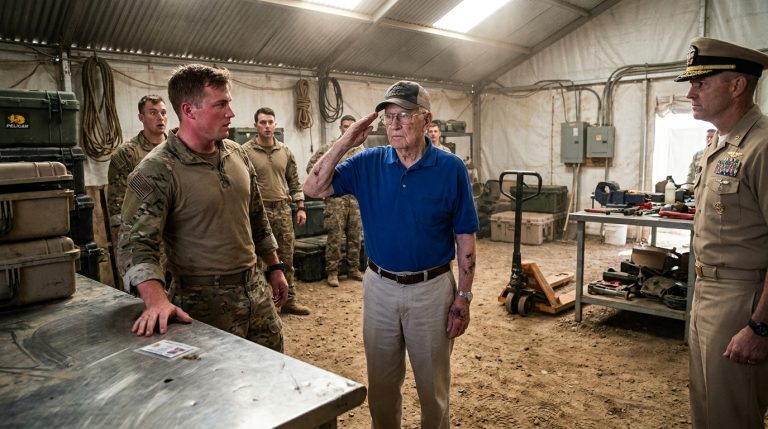
The autumn sun cut long amber shadows across the Camp Pendleton parade ground. Rows of crisp dress uniforms stood at rigid attention, brass buttons catching the sharp afternoon light.
Staff Sergeant Thomas Avery stood front and center, the heavy silver and bronze stars pinned securely to a fresh uniform jacket that finally fit his shoulders. His boots were clean, free of electrical tape and street dust.
Master Gunnery Sergeant Porter stepped back after adjusting the lapel medal with careful reverence. Around them, the young Marines of second squad watched in absolute silence, their earlier arrogance replaced by a quiet, unbreakable respect.
Lance Corporal Morrison stepped out of the formation ranks, his face sober and steady as he offered a crisp, flawless salute.
“Thank you for looking again, Sergeant,” Morrison said, his voice carrying clearly across the quiet concrete.
Thomas returned the salute with the effortless grace of a man who had spent a lifetime speaking the language of precision. “You kept your eyes open when it mattered, kid,” Thomas replied, his voice raspy but steady. “That’s all anyone can ask.”
Months later, the noise of the base faded into a quiet, sunlit apartment near the coastline. The rent was covered, the medical charts were finally closed, and the ghost of the jungle had found a place to rest its boots.
Thomas sat in a worn armchair by the window, his scarred fingers resting quietly on the armrest without a lighter to turn. Outside, the Pacific breeze rolled gently against the glass, carrying the distant, faint crack of a rifle range miles away. He closed his eyes, his breathing slow and deep, carrying a legacy that would never fade.