The Weight of Silence: A Master Chief’s Lesson on the True Meaning of Strength and Service
CHAPTER 1: The Threshold of Arrogance
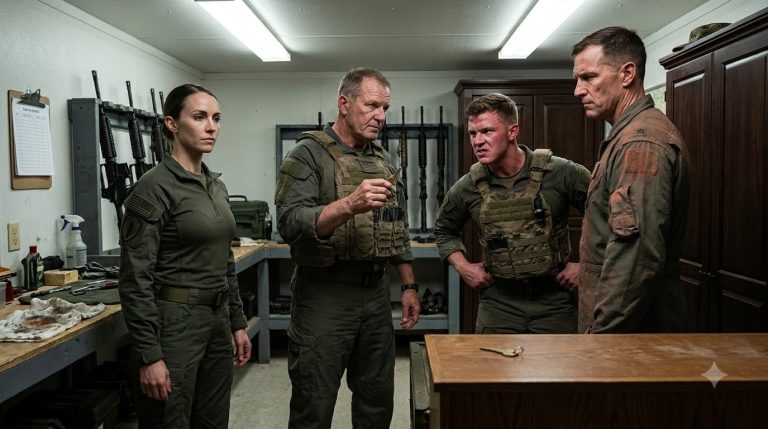
The logistic supply tent was a cavern of stale, recycled air and the metallic tang of shipping crates. Lieutenant Marcus Miller lounged against a stack of Pelican cases, his posture a calculated display of casual dominance. To his squad, he was the apex—the elite operator—but in this moment, he was simply a man looking for a target for his boredom.
His eyes landed on the intake counter. There, standing in a sea of drab tactical gear, was a jagged anomaly. An old man. Eighty-two if he was a day, wearing a royal blue polo shirt tucked neatly into beige slacks. He looked like he had wandered off a bus tour and taken a wrong turn into the heart of the base’s most restricted logistics zone.
“Hey, old-timer,” Miller called out, his voice sharp and laced with the casual cruelty of the young. “Did you get lost on the way to the bingo hall?”
The other SEALs chuckled. It was a nervous, practiced sound, born of habit rather than genuine humor. They watched to see how the old man would break.
Philip Weston didn’t break. He didn’t even twitch. His hands, mapped with the intricate wrinkles of age, rested on the counter. His thumbs traced the brim of a weathered baseball cap in a slow, rhythmic motion—a steady, tactile pulse against the frenetic energy of the room.
Miller pushed off the cases, his boots heavy on the packed dirt. He enjoyed the way the air in the tent seemed to thin as he closed the distance. He invaded the old man’s space, standing close enough to smell the faint, clean scent of cedar and old paper. “I asked you a question, sir,” Miller said, his tone shifting from mockery to cold demand. “Do you know where you are? This is a restricted area. Civilians aren’t allowed past the checkpoint.”
Philip finally turned. His eyes were a pale, watery blue, magnified behind thick lenses, but they held a stillness that Miller found unnerving. It wasn’t the stillness of fear; it was the stillness of a mountain watching the wind.
“I am waiting for the quartermaster,” Philip said. His voice was soft, like dry leaves brushing against concrete, yet it held a strange, resonant clarity that made the ambient hum of the industrial fans feel distant.
Miller barked a laugh, glancing back at his men to ensure they were still watching the performance. “Chief Henderson is busy handling gear for actual operators, not handing out souvenirs to tourists. The museum is three miles east. Maybe they can find a place for you there.”
Philip didn’t respond. He simply turned back to the counter, his focus shifting to a small, folded piece of paper he had placed on the metal surface. The dismissal hit Miller like a physical blow. He wasn’t accustomed to being ghosted. He leaned his elbow on the counter, forcing his way back into the old man’s field of vision.
“Look, Pop, I’m trying to help you before the MPs haul you off,” Miller whispered, his voice dripping with condescending concern. “Which war were you in? The Civil War?”
This time, the laughter from the squad was louder, more confident. Miller felt the rush of the win, the satisfaction of the insult landing square. But then, Philip’s gaze drifted downward. His eyes landed on the skull-and-crossbones morale patch on Miller’s shoulder. He stared at it for a long, silent moment, his expression entirely unreadable.
“I was in the one,” Philip said quietly, his voice devoid of anger, “that let you stand here and talk like that.”
The laughter didn’t just fade; it vanished, replaced by a vacuum of sound so absolute that the sudden, sharp clatter of a crate in the back of the tent sounded like a gunshot. Miller felt his face flush a deep, hot crimson. He reached out, his hand hovering inches from the old man’s shoulder, ready to force the issue. “Let me see your ID,” Miller commanded, his voice dropping an octave into a low, dangerous warning. “Or I’m putting you on the ground.”
Philip moved with a glacial, agonizing slowness. He reached into his shirt pocket and produced a worn leather wallet. He slid a laminated card onto the counter. Miller snatched it up, ready to mock the outdated format, but as he looked at the name—Philip James Weston—and the missing expiration date, the confident sneer on his face faltered. Something was wrong. The air, already stale, suddenly felt far too thin to breathe.
CHAPTER 2: The Admirals Shadow
The silence in the logistics tent had transformed into something thick and suffocating. Miller stared at the card. It was a relic, a piece of paper that didn’t belong in the high-tech, sanitized world of modern warfare. It felt fragile in his grip, yet it carried an inexplicable gravity. He looked up, expecting to see the old man smirking, or perhaps trembling, but Philip Weston was doing neither. He was simply waiting, his thumbs still tracing the brim of his hat in that rhythmic, infuriatingly slow pulse.
“Code Z4,” the supply clerk whispered again, his voice cracking. He had retreated a step, his eyes darting between the lieutenant and the old man as if he were watching a bomb with a live fuse. “Sir, the system… it’s locked. It’s a legacy protocol. I can’t clear it.”
Miller felt a cold spike of adrenaline work its way down his spine. The confidence he had carried into the tent—the armor of his rank, his ribbons, his status as a SEAL—suddenly felt like a costume made of paper. He reached for his radio, his movements jerky. “This is Miller. I have a situation at the logistics depot. Need security, immediate.”
“Lieutenant.”
The voice didn’t come from the radio. It came from the rear entrance of the tent.
The heavy, reinforced canvas flap was shoved aside with a suddenness that made everyone in the room flinch. The base sergeant major stepped in first, his face a mask of iron, but he wasn’t the one who held the room’s gravity. Behind him, moving with a controlled, predatory grace, was Admiral Vance.
The temperature in the tent seemed to plummet. The low, industrial hum of the fans was swallowed by the sudden, dead quiet. Every SEAL in the vicinity, including Miller’s own team, snapped to attention so sharply it was as if they were moved by a single, invisible string.
Miller froze. His hand was still on his radio, his arm half-extended. The Admiral’s gaze didn’t scan the room; it locked onto the counter, bypassing the soldiers and the equipment to rest solely on the man in the blue polo. Miller felt the blood drain from his face, leaving his skin clammy. He tried to lower his hand, to smooth his posture into a salute, but his muscles felt sluggish, uncooperative.
Vance marched forward, his boots rhythmic and deliberate against the concrete floor. He didn’t look at Miller. He didn’t look at the sergeant major. He moved with the focused intent of a man approaching an altar.
“Unhand that man immediately,” Vance barked. The order wasn’t directed at the room; it was a surgical strike aimed directly at Miller.
Miller felt the weight of his own grip on Philip’s bicep. He hadn’t realized he was still holding the man until the Admiral spoke. He released Philip as if the fabric were searing hot, stumbling back a step. His world was tilting; the familiar boundaries of his life—where he was the hunter, the superior, the man in charge—were being rewritten in real-time.
“Admiral, sir,” Miller stammered, his salute rigid, his fingers trembling at his brow. “This civilian was trespassing. He refused to provide valid identification.”
Vance didn’t stop. He walked past Miller, his presence so dense that Miller felt the air displaced by his wake. The Admiral came to a halt in front of Philip Weston. The sight that followed was one Miller would never be able to erase from his mind.
Admiral Vance, a man known for his rigid, uncompromising standard, a man who commanded the respect of the entire base with a single glance, broke his posture. He didn’t just stand at attention; he softened. He leaned slightly forward, his eyes searching Philip’s, and then, with a slow, agonizing degree of reverence, he raised his hand in a salute. It wasn’t the crisp, perfunctory salute of a subordinate to an officer. It was a slow, heavy gesture of profound, historical acknowledgement.
“Master Chief,” Vance said, his voice thick, stripped of its usual command authority and replaced by the tone of a man addressing a ghost. “I apologize for the delay. And for this.”
Miller’s jaw went slack. Master Chief? The rank didn’t compute. He looked at the old man, really looked at him this time. He saw the way the shoulders sat, even under a cheap polo—square, set, and permanent. He saw the subtle, jagged scar running up the old man’s forearm, a mark of something far older and far more violent than any training exercise.
Philip Weston didn’t look triumphant. He didn’t look vindicated. He simply stood there, his posture subtly shifting, the ‘old man’ facade shedding like a dry skin. He returned the salute. The movement was instant—a snap of muscle and bone that was cleaner, faster, and more precise than anything Miller had ever seen in a training facility.
“At ease, Admiral,” Philip said. The raspy quality of his voice was gone, replaced by a clarity that cut through the room like cold steel.
Miller felt the ground beneath him turn to sand. He was being erased. The hierarchy he had clung to, the belief that he was the apex of this food chain, was being dismantled. He looked at his own team, the other SEALs, and saw in their faces the same dawning, sickening realization: they had spent their entire careers standing on the shoulders of men like this, and they hadn’t even known what they were standing on.
Vance finally turned to Miller. The Admiral’s face was a study in controlled, glacial fury. “Lieutenant Miller,” Vance said, his voice a low, terrifying rumble that carried into every corner of the tent. “Do you know who this is?”
Miller tried to speak, but the words stuck in his throat. He looked from the Admiral to Philip, then down at his own hand—the hand that had reached out to intimidate a legend. The truth began to settle in, not as a thought, but as a crushing, physical weight: he hadn’t just insulted a civilian. He had betrayed the very foundation of the life he claimed to lead.
CHAPTER 3: The Fragile Table
The walk to the base commissary was a descent into a new kind of isolation. Every turn in the corridor felt like navigating a space he didn’t own anymore. Before today, Lieutenant Marcus Miller had walked these halls with the swagger of a man who knew exactly where the boundaries were drawn. Now, the walls felt closer, the fluorescent lights humming with a frequency that set his teeth on edge.
He had been relieved of duty until the morning’s disciplinary review. The command was absolute, a silent severance from the unit he had spent years crafting into his identity.
He pushed through the double doors of the commissary. The mess hall was mostly empty at this hour, a cavernous space of stainless steel and off-white tile. The smell was distinct—an aggressive, clinical mixture of bleach and institutional coffee. And there, near the windows, sat the anomaly. Philip Weston. The man in the royal blue polo sat alone at a four-top table, his back to the room, a tray of coffee and a simple sandwich before him.
Miller’s feet moved against his will. He had tried to steer toward the exit, to head back to the barracks and hide in the dark, but the momentum of the day was pulling him toward that singular point of calm. He didn’t want to do this. He wanted to maintain the lie of his own invulnerability, but the memory of the Admiral’s salute was a tether he couldn’t cut.
He approached the table. His footsteps were too loud, echoing with a hollow, guilty resonance. Philip didn’t look up, but his hand—the same hand that had gripped the brim of his hat in the tent—rested calmly beside his coffee.
“Master Chief,” Miller said. His voice sounded thin, stripped of the bravado that usually armored his words.
Philip turned. He didn’t look surprised. He didn’t look like a man who had just been recognized as a foundational legend of modern warfare. He looked like an eighty-two-year-old man having a quiet lunch. He gestured to the empty chair across from him. “Lieutenant. Sit.”
The order was soft, but the weight of it was absolute. Miller sat. The metal chair screeched against the floor, a jarring sound that made him wince. He clasped his hands on the table, trying to hide the fact that they were shaking.
“I… I don’t know what to say,” Miller started, then stopped. The apology felt pathetic, a hollow shell against the depth of the history this man carried. “The Admiral… he told us who you are. What you did.”
Philip took a slow, deliberate sip of his coffee. The cup was chipped at the rim, a stark, faded texture that contrasted sharply with the high-tech, pristine gear Miller was accustomed to. “He talks too much,” Philip said, his voice raspy but steady. “The Admiral was a green recruit once. He remembers things the way he wants to, not necessarily the way they happened.”
“He said you wrote the manuals,” Miller pressed, unable to stop the flow of questions. “He said you were there at the beginning. If I’d known—”
“If you had known, you would have treated me differently?” Philip leaned forward. His eyes, pale and watery, suddenly looked sharp, as if they were cutting through the surface of Miller’s ego to see the confusion beneath. “That is a dangerous way to live, son. If you only show respect to the people you know are ‘great,’ you’ll spend your whole life walking past the heroes and treating them like garbage.”
The words struck with the precision of a scalpel. Miller felt the defensive walls he’d spent his entire career building—the arrogance, the elitism—cracking. It wasn’t just that he had been wrong; it was that he had been empty. He had been so obsessed with the performance of being a leader that he had forgotten how to actually observe, how to actually see the world around him.
“I’m done,” Miller whispered. “They’re reviewing me tomorrow. I’m stripped of the team.”
Philip didn’t offer pity. He didn’t offer empty reassurances. He simply stared at the coffee cup for a moment, tracing a circle on the table with his index finger. “Good.”
Miller blinked, stunned. “Good?”
“You were a liability,” Philip said, his tone conversational, as if discussing the weather. “Not because you weren’t capable. You’re clearly trained. But you were a liability because you were a glass house. You were so convinced of your own strength that you didn’t have the room to grow. You have to break, Lieutenant. You have to be shattered before you can be repaired.”
Philip reached into his pocket and pulled out a small, metallic object. He set it on the table. It was a pocket watch, battered and scratched, the surface dull with age. It looked like it had been salvaged from the bottom of the ocean.
“I lost this forty years ago,” Philip said, his gaze lingering on the metal. “I thought it was gone. Buried in the mud. But they found it. They brought it back.” He pushed the watch toward the center of the table. “Everything has a price, Miller. Everything you lose, every mistake you make—it’s all part of the gear. If you can’t look at your own failures without wanting to hide, you’ll never be able to hold the line.”
Miller looked at the watch. It was a piece of junk to any outsider, a rusted, damaged object. But the way Philip looked at it… the way the old man held his hands near it… Miller finally understood. The strength wasn’t in the shiny new gear or the high-speed tactics. It was in the damage. It was in the ability to carry the broken pieces and keep moving.
“I don’t know how to do that,” Miller confessed, his voice barely audible. “I don’t know how to move forward when I’ve lost everything.”
“You haven’t lost everything,” Philip said, standing up. He left the watch on the table, a weight of iron and history sitting between them. “You’ve just lost your mask. That’s a start.”
Philip turned and walked toward the exit, his limp rhythmic and steady, leaving Miller alone in the fluorescent-lit silence. Miller looked down at the watch. It was cold, tactile, and heavy. He reached out and touched it, his fingers tracing the rusted scratches. The air in the commissary felt different now—not empty, but waiting.
CHAPTER 4: The Horizon of Quiet Men
The transition from the sterile, bleached interior of the commissary to the expansive, sun-drenched parking lot was abrupt. Miller stood by the automatic doors, his fingers still curled around the pocket watch Philip Weston had left behind. The metal was cold against his skin, a stark, grounding sensation that cut through the lingering haze of his own self-doubt.
He didn’t move immediately. He watched as the old man, a solitary figure in a royal blue polo, navigated the sea of parked trucks and sedans. There was no grandeur in Philip’s gait—just the measured, economical motion of a man who had spent a lifetime learning how to save his strength for the moments when it truly mattered. Miller saw a security guard near the gate—a young kid, barely out of basic—snap to attention as Philip passed. The old man nodded, a brief, imperceptible gesture, and continued toward his battered, weathered pickup.
The realization hit Miller with the force of a physical blow: the power hadn’t been in the spectacle. It was in the endurance.
Miller took a breath, the air tasting of hot asphalt and desert dust. He wasn’t the man he had been this morning. The armor of his ego—the Trident, the rank, the performative intensity—had been stripped away, and in its place, he felt something far more durable. He realized now that the “Master Chief” wasn’t a rank or a title; it was a baseline of character. It was the ability to carry the heavy, silent weight of one’s own history without demanding that the world notice.
He looked down at the watch again. He saw the scratches, the deep gouges in the casing that represented decades of exposure to salt, mud, and the crushing pressure of the deep water. He walked toward the edge of the lot, his pace slow, his mind clear. He didn’t rush to intercept Philip. He didn’t feel the need to chase the glory of a conversation. He simply wanted to be in the proximity of that quiet truth for a moment longer.
As Philip reached his truck, he stopped. He didn’t turn around, but he held his hand up, a simple, open gesture. He wasn’t waiting for Miller; he was acknowledging the shared space of the moment. Miller stopped ten feet away.
“The watch,” Miller said, his voice steady. “You left it.”
Philip turned. He stood by the driver-side door, the sunlight catching the grey of his hair and the pale, unwavering focus of his eyes. “I didn’t leave it, Lieutenant. I passed it.”
The words hung in the warm air, simple and devastating. Miller felt a tightness in his throat—not of grief, but of profound, transformative relief. He walked forward and placed the watch into Philip’s palm. As their hands touched, the transfer was complete. There was no need for a speech, no need for the “villain’s monologue” Miller had been conditioned to expect from the movies, the books, and the culture he had been raised in.
“It’s not just a tool,” Philip said, his voice raspy and kind. “It’s a reminder. When the noise gets too loud, when the pressure feels like it’s going to collapse your lungs—you look at the time. You realize that every second is earned. Every second is a piece of the mission.”
Miller nodded. “I understand, Master Chief.”
“I think you’re starting to,” Philip said. He opened the truck door, the hinge creaking with the protest of age. “Go face the board tomorrow. Don’t defend yourself. Don’t explain. Just own the mistake. That’s the first step in building a new foundation.”
Philip climbed into the truck, the engine turning over with a steady, deep rumble that seemed to vibrate through the pavement and into Miller’s boots. He watched as the truck pulled away, moving toward the main gate with the same unhurried, purposeful pace that defined everything the old man did.
Miller stood in the parking lot for a long time after the dust from the truck had settled. He didn’t have the Trident pin on his chest anymore—he had removed it before coming to the commissary, a small, private act of contrition. He looked at his own hands, calloused, scarred, and capable. He was still a warrior. He was still a man who would be deployed into the dark. But the ‘why’ had changed.
The silence around him felt different. It was no longer an empty space to be filled with his own noise; it was a canvas, a place where he could finally see the truth. He looked toward the horizon, where the heat waves danced above the base perimeter. He wouldn’t be the loudest man in the room anymore. He wouldn’t be the man who demanded acknowledgment. He would be the man who stood in the quiet, the man who held the line, the man who understood that the deadliest, most significant things in the world look like nothing at all until it’s time to move.
He turned back toward the barracks, his stride measured and soft. The lesson wasn’t just about the past; it was about the path forward. He had been a glass house, fragile and transparent in his arrogance. Now, he felt like iron—forged, tempered, and ready to be used. As he walked, he didn’t check his watch. He didn’t need to. He knew exactly how much time he had, and he was finally ready to make every second count. The sun dipped lower, casting long, steady shadows across the base, and for the first time in his life, Miller felt like he was finally standing in the light.