The Quiet Strength of an Aged Soldier and the Estranged Son Who Found His Way Back
CHAPTER 1: CRACKED CHROME AND BROKEN SILENCE
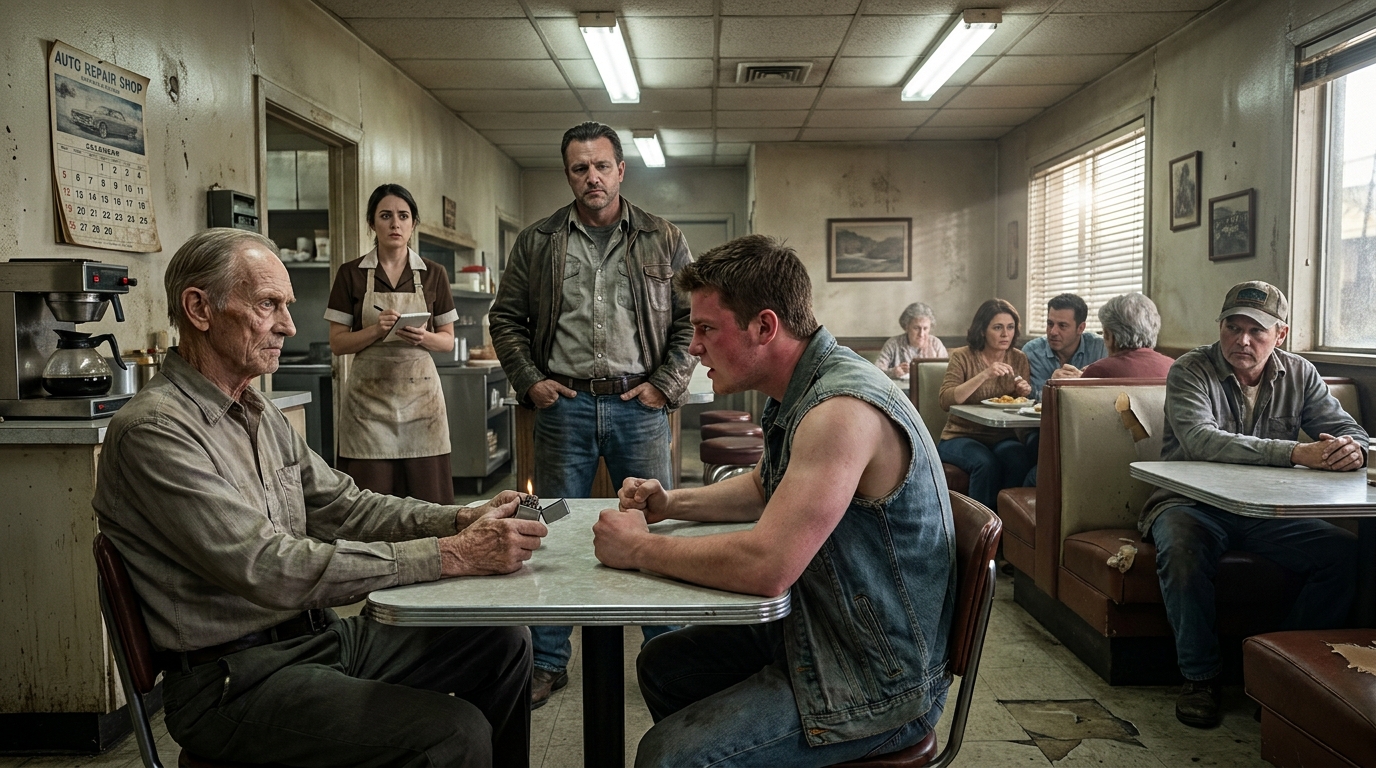
Sunlight caught the worn chrome trim of corner booth four, highlighting the faint scratches on the Formica tabletop.
I rested my thumb against the cool, tarnished casing of my stainless-steel Zippo, turning the metal over slowly between my calloused fingers.
The brass hinge clicked with a soft, steady rhythm, matching the steady drip of the coffee machine behind the counter.
At eighty-one, mornings were simple.
A thick ceramic mug, two eggs over easy, and the quiet comfort of being known as Mr. Branson.
The bell above the heavy front door rattled as a young man in a stained jacket slammed his hand against the register counter.
“I told you four times, lady, I ain’t paying for the side of bacon I didn’t ask for!”
His voice carried a sharp, grating edge that rattled the glass salt shakers on my table.
Clara, the morning waitress whose hands always carried the faint scent of lemon detergent, shrank back against the order window.
“It came with the breakfast special, sir,” she whispered, her fingers clutching her notepad like a shield.
“I don’t care about your special,” he snapped, leaning his broad shoulders over the counter until Clara stepped backward into the kitchen doorway.
I set my Zippo flat on the table, the small emblem of my old infantry unit pressing into my palm.
My gaze shifted toward the counter, steady and silent, taking in the kid’s twitching jaw and tight fists.
He spun around on his heel, his eyes locking directly onto mine.
“What are you looking at, old man?”
I didn’t answer; I simply met his glare with the same level focus I had used sixty years ago in the frozen mud of Chosin.
“You think that’s funny?” he growled, closing the space between the counter and my booth in three heavy strides.
His boots kicked against the base of the table, sending a sharp jolt through the wood that spilled black coffee over the rim of my cup.
“Answer me!”
Before I could raise a hand or shift my weight, his open palm struck the left side of my face with a dry, cracking impact.
My head snapped sideways, hitting the vinyl backing of the booth as my ears filled with a high, metallic ringing.
Forks dropped onto ceramic plates across the room, followed by the sound of someone gasping near the entrance.
I pressed my hand against my burning cheekbone, feeling the heat spreading fast under my weathered skin.
I didn’t reach for my napkin, nor did I shout.
I picked up the dented Zippo from the wet laminate, closed my fingers tightly around the cold steel, and looked straight into his bloodshot eyes.
CHAPTER 2: THE WEIGHT OF UNSPOKEN YEARS
The kid leaned over the table, his breath sour with stale onions and unwashed coffee.
“What’s the matter, old man?” he sneered, his chest heaving under his dingy denim vest. “Lost your tongue?”
I didn’t blink, nor did I flinch when his knuckle rapped hard against the edge of my Formica table.
Across the room, the diner bell chimed—a single, thin ring that sliced cleanly through the suffocating silence.
A lone figure stepped through the threshold, catching the heavy glass door on his elbow before it could slam.
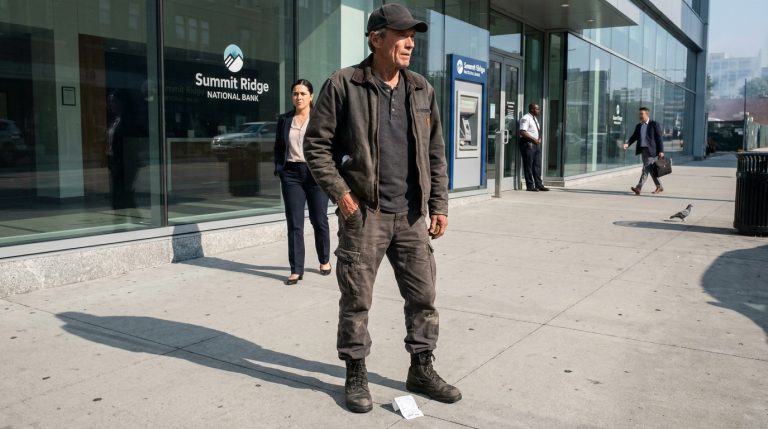
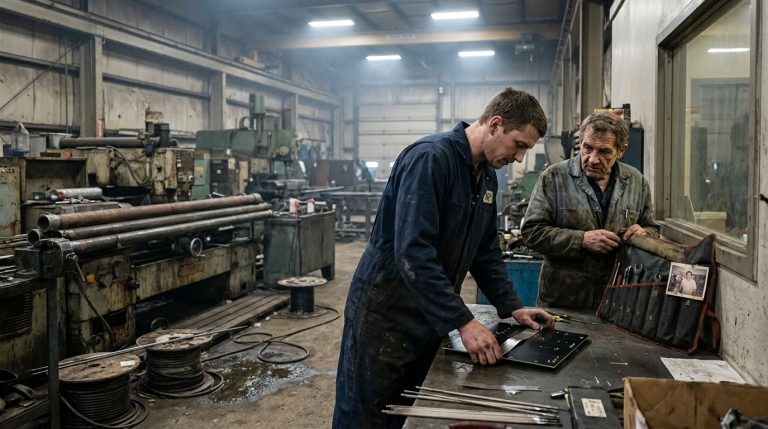
He didn’t wear a gang cut, and no motor rumbled outside; he wore a faded leather work jacket with grease dark beneath the cuffs, his boots scuffed from long shifts on concrete shop floors.
It was Thomas.
His eyes swept the room in a single, practiced second, taking in Clara trembling by the kitchen pass, the frozen patrons staring into their cold plates, and the heavy, red mark swelling across my jawline.
Thomas didn’t shout, and he didn’t charge.
He walked forward with a slow, heavy gait, every step measured and quiet, his broad frame blocking out the glare of the morning sun through the front window.
The young man spun around, annoyed by the interruption, his elbows flared out like a rooster looking for a fight.
“Place is closed, pal,” the kid snapped, planting his hands on his hips. “Take a walk.”
Thomas stopped three feet away, his arms hanging loose at his sides, his thumbs hooked casually into the belt loops of his jeans.
He looked down at the kid, then slowly shifted his focus past his shoulder to meet my gaze.
For five long years, the only thing between us had been silence—years of missed calls, unreturned holiday cards, and rumors that he had thrown his life away to drift aimlessly along the highway.
Yet as Thomas stood there, the familiar set of his jaw revealed the truth of his exhaustion; he was a man worn down not by lawlessness, but by relentless, unyielding labor.
A thick, grease-stained ledger envelope protruded slightly from the inner pocket of his heavy jacket, its corner dog-eared and dark from handling.
“I asked you a question, grease-monkey,” the kid barked, taking a sharp step toward Thomas and thrusting a finger against his chest.
Thomas didn’t sway an inch; he simply looked down at the finger resting against his leather jacket, his eyes cold and calm.
“You’re standing in my father’s light,” Thomas said, his voice a low, gravelly rasp that carried to every corner of the room.
CHAPTER 3: STANDING IN THE QUIET FIRE
The kid sneered, shoving his hand forward to push Thomas back, but Thomas didn’t budge an inch.
“Your father?” the kid spat, casting a quick glance over his shoulder toward the door to see if any gang members were filing in behind him.
When the threshold remained empty, a surge of false courage puffed his chest back out.
“I don’t see no army coming to help you, big man. Just you in a greasy jacket.”
“I don’t need an army to handle a bully who hits eighty-year-old men,” Thomas said, his tone flat and immovable as a granite slab.
He didn’t reach for a weapon, nor did he raise a fist.
Instead, Thomas unzipped his work jacket with a deliberate, slow pull of the brass teeth, revealing the sweat-stained gray shirt underneath.
He reached into the inner pocket and pulled out the thick, grease-marked ledger envelope, holding it casually between two grease-stained fingers.
The kid’s eyes darted down to the paper, his brow furrowing in temporary confusion as he tried to figure out the play.
“That man sat in this booth before you were born,” Thomas continued, stepping forward so that the kid was forced to take a hesitant step backward toward the counter. “He served three years overseas so you could stand here flinging tantrums over a three-dollar side of bacon.”
“He was staring at me!” the kid shouted, his voice cracking slightly as he looked around at the other patrons, desperate for someone to validate his rage.
Nobody moved; even Clara stopped wiping the counter, her eyes fixed on the envelope in Thomas’s hand.
Thomas didn’t raise his voice; he simply leaned in close enough for the kid to smell the motor oil and iron on his clothes.
“You hit a man who wouldn’t hit you back because you thought nobody was watching,” Thomas said softly. “Well, I’m watching now.”
The kid’s posture stiffened, his knuckles whitening as he balled his hands into tight fists, his chin trembling with a volatile mix of embarrassment and unearned arrogance.
He backed up until his spine bumped against the edge of the register counter, cornered not by fists, but by the quiet, overwhelming weight of a son who refused to step aside.
CHAPTER 4: THE ANCHOR RESTORED
“You’re all crazy,” the kid muttered, his breath coming in shallow, jagged gasps as he shoved past Thomas toward the exit. “This whole place is nuts!”
He slammed his hand against the door frame, sending the bell overhead into a frantic, chaotic chime before he bolted out into the bright morning sun.
The heavy glass door swung shut behind him, sealing out the noise of the highway and leaving the diner in sudden, profound quiet.
Clara let out a long, trembling breath from behind the order window, setting down her notepad on the counter with a soft tap.
Thomas didn’t watch the kid run; he simply turned around and walked over to booth four, pulling out the worn vinyl bench opposite me.
He slid his heavy frame into the seat, placing the grease-stained ledger envelope flat on the Formica tabletop between my spilled coffee and my Zippo.
“You ought to put some ice on that cheek, Pop,” Thomas said softly, his rough hand resting on the table, knuckles dark with engine oil.
I set the brass lighter down beside the paper, looking past the faded red ink on the envelope to meet my son’s eyes.
“What’s this?” I asked, my voice raspy from disuse.
“It’s the final receipt from St. Jude’s,” Thomas replied, sliding the envelope an inch closer to my side of the table. “Mom’s hospital bills are cleared. Every cent.”
I stared at the worn paper, the truth dropping into my chest like a lead weight—five years of double shifts, late nights at the diesel shop, and silent absence, all so my pension would stay untouched.
“You didn’t run out on us,” I whispered, the dull throb in my jaw fading beneath a far heavier warmth.
“I had work to do,” Thomas said, a faint, weary smile touching the corners of his mouth as he picked up my Zippo and flipped the top open with a familiar, crisp snap. “Couldn’t let you carry it alone.”
He set the lighter back down, its tarnished brass reflecting the morning light pouring through the clean glass window.
Outside, traffic hummed steadily along the highway, but inside booth four, the long, silent winter between us was finally over.