The Unsung Mechanics Who Risked Everything to Fuel the Front Lines and Keep the Patton Tanks Rolling
CHAPTER 1: THE SILENT MOTORPOOL
The heavy trucks sat dead in the mud, their axles buried deep in French clay.
Around them, the motorpool was choked with paperwork that nobody had time to read.
Every requisition slip marked red was a platoon running on fumes three miles east.
I dropped the scarred crescent wrench onto the workbench with a flat clack.
It rolled twice against an oily rag before coming to a dead stop.
Outside the canvas tent, the rain kept beating a steady, indifferent rhythm against the tarps.
Lieutenant Miller walked past without looking up from his clipboard.
His boots squelched in the gray slurry between the parked half-tracks.
“HQ says the main supply column is bogged down at the river crossing,” he said, his voice flat with fatigue.
“Ten-ton haulers won’t clear the bridge until morning.”
“The bridge isn’t the problem,” I said, wiping my thumb across my greasy coveralls.
“The weight is. Those heavy rigs are digging their own graves out there.”
Miller didn’t answer.
He didn’t have to.
We both knew what was waiting at the front.
Five Sherman tanks sitting still in an open clearing, their radios dead and their turrets frozen.
Targets waiting for a match.
The standard supply manuals sat on the shelf behind me, pristine and entirely useless.
They told us to wait for reinforced roads.
They told us to wait for clearance.
The enemy wasn’t waiting.
I picked up the wrench again, feeling the cold iron bite into my calluses.
The heavy transport fleet was locked tight in red tape, and every minute we spent following procedure was another gallon of gas gone into the dirt.
The yard outside was quiet, save for the wind dragging across the canvas.
I looked past the useless 10-ton haulers toward the corner of the compound.
Parked behind a stack of spare treads was a small, dusty utility truck with single rear wheels.
It didn’t have armor.
It didn’t have a winch.
It looked like something meant for hauling mail bags across a flat farm road.
Miller stopped walking and turned his head slowly toward the back lot.
“Don’t even think about it,” he muttered.
“The regulations are explicit. Improvised transport of volatile fuel is a court-martial.”
“Regulations don’t burn,” I said, my voice dropping an octave as I stared at the light frame of the little truck.
“And silence at the front is a hell of a lot louder than a court-martial.”
CHAPTER 2: THE FORBIDDEN BUILD
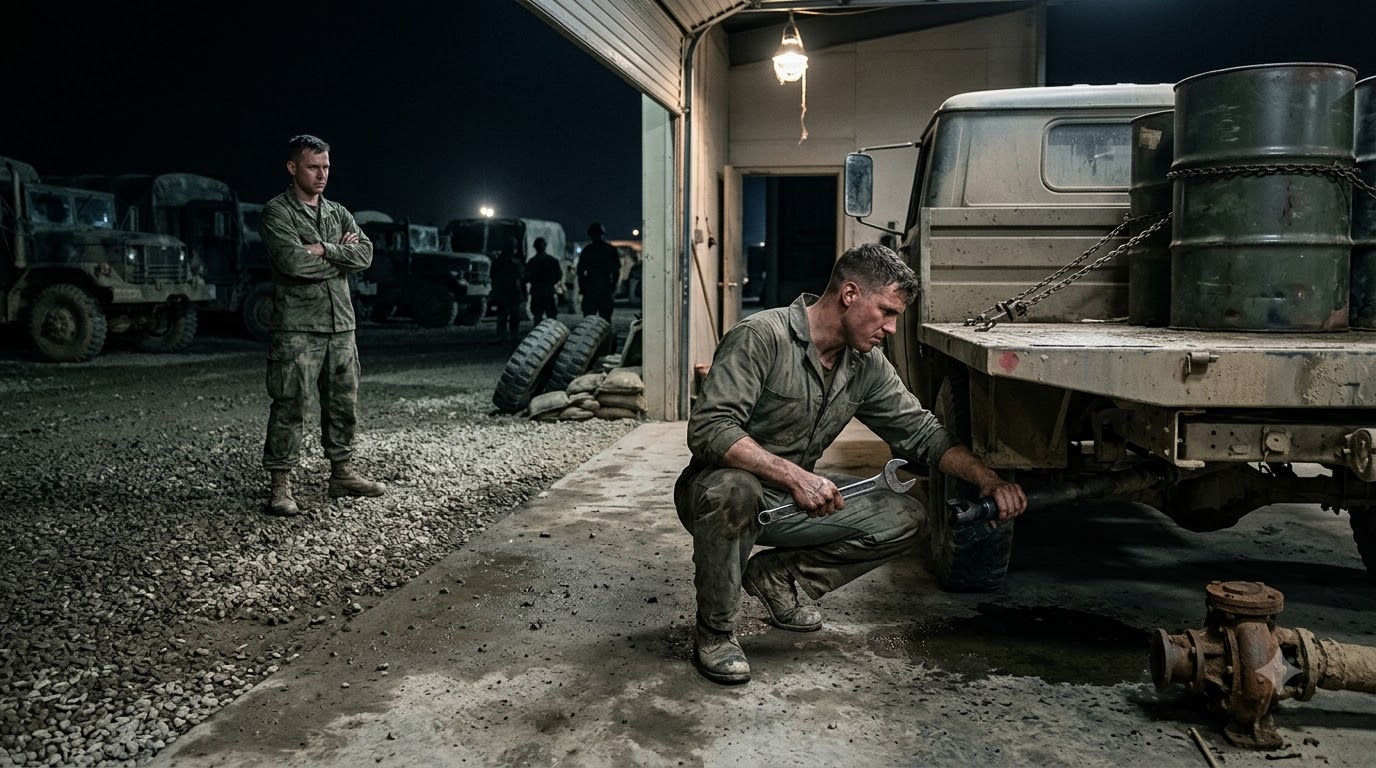
The garage was pitch-black except for the swinging drop light dangling from a frayed cord overhead.
Miller stood by the open bay door, his boots shifting restlessly in the damp gravel outside.
“If command catches wind of a rigged fuel rig on this base, we’re both spending the rest of the war breaking rocks in Algiers,” he muttered, keeping his voice low.
“Let them try catching us when the tanks are rolling,” I said, sliding the second standard-issue drum into place beside the first.
The drums weren’t designed to be chained down on a light flatbed, let alone pressurized for a field run.
They shifted with a dull, liquid thud, the heavy fuel sloshing against the thin steel walls with every shove of my shoulder.
A sharp, chemical tang hung in the stagnant air, burning the back of my throat.
Down near the rear axle, a dark puddle of high-octane fuel was already beginning to pool slowly on the concrete floor from a weeping gasket.
I ignored it, grabbing the rusted water pump scavenged from the burned-out command car three days ago.
It was heavy, caked in dried mud, and entirely unrated for volatile petroleum.
If the drive shaft threw a bearing at high speed, the friction alone would turn the truck bed into an instantaneous torch.
I dropped to one knee beneath the chassis, guiding the custom-cut drive shaft into the power takeoff housing.
It didn’t slide home clean; it caught on a burr of raw steel with a metallic screech that echoed off the concrete walls.
“Keep your voice down,” Miller hissed, glancing out at the dark motorpool.
“You’re making enough noise to wake up the whole battalion.”
“The gear’s misaligned because nothing on this base fits anything else,” I muttered back, yanking the wrench hard until the bolt seated with a bone-jarring pop.
I wiped my forearm across my forehead, smearing black grease across my skin.
The truck groaned on its narrow springs as I cinched the final retaining chain tight across the top of the drums.
It wasn’t elegant, and it certainly wasn’t authorized by any manual in the supply office.
It was a rolling bomb held together by common sense and stubborn desperation.
The engine block under the hood ticked quietly as the metal cooled in the damp night air.
I tossed the grease-stained wrench onto the passenger seat and pulled the choke.
“Open the gate, Miller,” I said, my hand resting on the cold iron of the gear shift.
“We’re running out of night.”
CHAPTER 3: THE MIDNIGHT RUN
The front wheels slipped off the edge of the gravel and plunged straight into a water-filled rut.
The steering wheel kicked hard against my palms, wrenching my wrists as the narrow tires lost their bite in the sucking clay.
Behind the cab, the four steel drums shifted in unison, the massive weight of the fuel throwing off the vehicle’s center of gravity with a sickening sway.
Metal rang against metal as the lashings strained under the sudden lateral force.
I kept my foot steady on the throttle, letting the tread claw for traction beneath the surface.
It felt less like driving a machine and more like trying to steer an unexploded shell rolling down a jagged hillside.
Every minor bump in the ruined farm track sent the fluid surging backward and forward like a rogue wave.
The memory of the motorpool briefing flashed briefly through my head—the neat little arrows drawn on clean paper by men who had never felt real mud beneath a tire.
Out here, papers didn’t pull you out of a ditch.
A sharp smell of raw gasoline drifted through the open side window as another wave of fuel sloshed against the lip of the unsecured drums.
I eased back slightly on the gas pedal, feeling the engine stutter under the heavy strain of the makeshift pump belt.
If the transmission locked up out here in the pitch-black fields, there was no recovery crew coming to pull us out.
We were entirely on our own between the lines.
The track narrowed sharply as it cut through a dense patch of overgrown blackthorn brush.
Low-hanging branches scraped violently across the canvas roof with a harsh, tearing sound like fingernails across slate.
I kept my eyes fixed on the pale gray ribbon of mud winding ahead through the darkness.
There were no headlights, no guide markers, and no margin for error.
Just the steady, deafening rattle of four steel barrels threatening to tear themselves free with every yard we gained toward the front.
CHAPTER 4: THE PHANTOM ENCOUNTER
I froze over the steering wheel, my palms sticking slightly to the worn bakelite ring.
Through the dense tangle of pine branches just fifty yards off our left fender, a heavy metallic clank cut through the night air.
It wasn’t the rhythmic purr of an American Sherman engine.
It was the grinding, high-pitch screech of German tracks turning over gravel.
Miller held his breath beside me in the passenger seat, his knuckles pressed hard against the dashboard as if he could physically push the utility truck deeper into the shadows.
The heavy diesel roar grew louder, vibrating straight up through the floorboards and rattling the loose grease gun behind our seats.
If they swung their turret toward this track, they wouldn’t even need an armor-piercing shell; a single tracer round hitting our bed would turn the four barrels into an instantaneous fireball.
The low rumble of the enemy tracks paused right at the edge of the tree line.
A sharp beam of white light swept across the upper branches of the oaks, illuminating the drifting vapor of raw gasoline hanging thick around our truck bed.
My thumb hovered over the starter button, though I knew starting the engine now would be signing our own death warrant.
We sat completely motionless in the dark, swallowed by the suffocating smell of petroleum and the cold sweat running down our necks.
The hostile engine surged again, coughing a plume of black smoke before the grinding noise slowly began to fade away down the parallel road.
I let out a long, slow breath through my teeth, my fingers aching from how hard I had been gripping the wheel.
“They’re moving toward the crossroads,” Miller whispered, his voice dry and strained.
“They don’t know we’re here,” I said, sliding my hand back down to the ignition key.
“Not yet.”
CHAPTER 5: THE DESPERATE TRANSFER
A bullet cracked through the wooden sideboards of the truck bed, showering splintered pine across my back as I leaned over the vibrating pump housing.
Another round punched a clean, hissing hole straight through the side of the second fuel drum.
Gasoline sprayed out in a fine, pressurized mist, instantly soaking my canvas jacket and turning the hot exhaust pipe inches below into a ticking hazard.
“The line’s holding!” I shouted over the high-pitched mechanical shriek of the scavenged water pump.
“Keep the hose steady!” Miller wrestled the stiff rubber intake line against the side hatch of the lead Sherman, his boots slipping in the widening puddle of leaked fuel pooling beneath the truck.
From the tree line fifty yards back, muzzle flashes blinked in the dark like dying stars.
The tank commander inside the steel turret slammed the engine deck hatch shut, shouting an order that was swallowed instantly by the deafening roar of the heavy diesel starting up.
I didn’t look back at the woods.
I kept my hand locked hard on the rusted toggle valve, feeling the heavy vibration of high-octane fuel surging through the mismatched hoses.
The drum beside me shuddered and went light as the last gallons drained into the armored hull.
“We’re empty on this one!” Miller yelled, yanking the delivery nozzle free just as a third bullet clipped the metal lip of the barrel.
“Get us out of here!” I slammed the transmission into reverse, the tires spinning wildly in the mud before catching traction against a buried rock.
The little utility truck lurched backward out of the clearing, leaving behind a scarred trail of leaking fuel and a pair of American tanks swinging their massive turrets toward the tree line.
CHAPTER 6: THE IRON SPINE
The front tires ground to a halt against the wet gravel of the compound, the engine dying with a dry, metallic shudder.
I sat still behind the steering wheel, my fingers locked into the cracked bakelite while the smell of burned oil and raw petroleum hung thick in the morning mist.
Miller stepped out from the passenger side, his boots splashing into the puddles without a word as he unlatched the battered tailgate.
The four steel drums rattled loosely in the back, scarred by rifle rounds and stained black with leaked fuel.
They weren’t pretty, and they sure weren’t recorded in any official supply ledger sitting on the commander’s desk back at headquarters.
Lieutenant Miller crossed his arms against the cold dawn breeze, staring down at the shredded rubber of the pump belt dangling beneath the chassis.
“HQ’s morning report says Patton’s vanguard broke through the ridge at dawn,” he said, his voice flat and expressionless.
“No mention of how the tanks got their gas.”
“They don’t need to mention it,” I said, cutting the ignition and letting the silence settle back over the yard.
“Tanks don’t care about paperwork; they just need a spine to keep moving.”
The rigid rules of the supply manuals still sat pristine on the office shelf, untouched and utterly useless for a war that moved faster than bureaucracy.
We left the improvised truck where it stopped, leaking its last drops of fuel into the gray French mud before the mechanics came by to strip it for spare metal.
There were no citations given out, no medals pinned to our grease-stained coveralls, and no official record of the night run.
Out east, the dull thud of heavy armor pushing forward was the only answer that mattered.
I picked up the scarred crescent wrench from the dashboard, wiping a final smear of soot from the grip before dropping it back into the toolbox with a clean, solid clack.