The Frozen Compass: A Cold Highway Vindication of a Hidden Child
CHAPTER 1: THE COLD PRAIRIE STOP
The neon sign for the Prairie Star Travel Mart hummed a low, buzzing pitch that rattled inside my teeth. Midnight on Highway 2 outside Sundown Junction meant minus fourteen degrees, the kind of North Dakota cold that turned diesel slush into iron under your boots. I set the pump nozzle back into its holster, wiped a smear of road salt off my sleeve, and turned toward the glass doors to buy a hot cup of black coffee.
That was when the metal clicked.
It wasn’t the wind. The wind screamed through the steel structural beams of the gas canopy, but this was a rhythmic, faint scraping—tap, tap, pause—coming from the shadows behind the green waste dumpster. I shifted my weight, turning my boots carefully over the ice, and rounded the cinderblock enclosure. The smell of rotting grease and frozen diesel hit my nose instantly.
A small body was wedged into the four-inch gap between the dumpster’s corrugated base and the concrete wall.
“Hey,” I said, dropping low onto one knee, the denim over my kneecap stiffening instantly against the frost. “Look at me, buddy.”
The boy didn’t jump. He couldn’t. A water-logged cardboard box was draped over his shoulders like a stiff board, and his hood was pulled low, but not low enough to hide the bruised, violent purple ring running along his upper lip. His left foot had a torn sneaker with a split rubber sole that exposed a soaked, grey sock frozen solid to the concrete. He was shivering, but the tremors were slow, thick, like his blood was turning to slush inside his veins.
“Please,” the boy whispered. The word barely carried over the wind. His fingers twitched, pulling a tiny brass compass on a frayed cord against his wet chest. “Don’t call him. He’ll smile… and they’ll believe him.”
I didn’t ask who ‘he’ was. I slid my gloved fingers under the boy’s armpits, checking his weight. He felt like a bundle of hollow dry sticks. I scooped him up, tucking his face into the heavy wool lining of my coat to block the wind, and turned the corner toward the bright yellow light of the storefront.
The automatic doors slid open with a pleasant, warm chime. Warm air washed over my face, carrying the thick stench of burnt hot dogs and old fryer oil. Behind the high Formica counter, a kid in a faded red beanie was staring at his phone, a half-eaten bag of corn chips balanced on his stomach.
“Get off the phone and call 911,” I said, stepping straight toward the plastic bench beside the floor heater. My voice wasn’t raised, but it hit the glass counter hard enough to make the kid jump. “Tell them you have an eight-year-old with severe hypothermia.”
The cashier blinked, his eyes darting from my salt-stained coat down to the blue lips of the child in my arms. “Uh… keyholder said we can’t have loiterers behind the bins. If he’s a runaway, security said—”
“Call them now,” I said, setting the boy down gently on the wooden slats. I reached into my coat pocket, pulled out a cold brass lighter, and rolled the heavy casing between my thumb and forefinger to keep my hands from shaking. I didn’t point it at him; I just held it tight, my eyes locked onto his until his fingers finally scrambled for the black landline handset.
“Yeah… Prairie Star,” the cashier stammered into the receiver, his voice dropping an octave. “I need an ambulance. Right now.”
I knelt by the bench, peeling my dry wool scarf off and wrapping it around the boy’s bare ankles. His dark brown eyes flicked to mine, glassy and unanchored, but his tiny fingers remained locked around that brass compass like it was the only heavy object keeping him on the face of the earth.
CHAPTER 2: HOSPITAL WALL
The automatic doors of the emergency bay hissed open, letting in a swirl of frozen exhaust and the sharp, chemical smell of floor disinfectant. The EMTs wheeled the gurney in fast, their rubber soles squeaking on the linoleum.
“Eight-year-old male, severe environmental hypothermia,” the lead paramedic called out, her voice hard and efficient. “Core temp ninety point nine. Blood pressure ninety over sixty. Cold exposure estimated over three hours.”
Dr. Priya Anand met us at the double doors. She didn’t waste time on questions. She took one look at Mason’s face—at the raw purple skin around his mouth and the dark circles sunk deep into his skull—and her jaw locked tight.
“Trauma Bay Two,” Dr. Anand crisp, cutting through the chatter of the night shift. “Get the forced-air warming blanket now. Set up a warmed saline drip.”
I walked beside the gurney, keeping my hand firm on the steel side rail where Mason could see me. His fingers twitched under the thin silver foil blanket, reaching up toward mine. He didn’t say a word, but the grip he had on that scratched brass compass was so tight his knuckles were pure white.
Inside the bay, two nurses moved with practiced speed, cutting away the soaked denim and the filthy rag of a hoodie. I stepped back against the cold tile wall, out of their way, but I didn’t take my eyes off the boy.
When the shirt came off, the room got very quiet.
Ribs showed under his skin like thin pine slats. Across his forearm was a yellowing ring bruise—the exact width of an adult hand that had grabbed him and twisted. His small toes were swollen and white at the tips, already showing the waxy sheen of early frostbite.
Dr. Anand pulled the stethoscope from her ears and looked across the table at the head nurse. Her face was totally flat, the kind of stillness that only comes when a doctor is trying hard to keep their temper behind their teeth.
“This didn’t happen tonight,” Dr. Anand said quietly. “This is weeks of exposure. Chronic malnutrition.”
She turned toward me, wiping her hands on a paper towel. “Who are you?”
“Atlas Monroe,” I said, my voice low. “Found him behind the Prairie Star dumpster on Highway 2. Cashier said he didn’t know how long the kid had been back there.”
“He’s lucky you stopped,” she said, checking Mason’s pupils with a penlight. “Another twenty minutes in that alley and his heart would have slipped into an arrhythmia. We’re on a razor’s edge here.”
Mason’s eyelids fluttered. He turned his head toward me, his breathing shallow and rapid. “They’re gonna call,” he whispered, the sound caught in his throat. “He… he monitors the police scanner.”
“Who, Mason?” I asked, taking half a step closer. “Your uncle Caleb?”
“He has the papers,” Mason choked out, a single tear cutting through the dried salt on his cheek. “He tells people I run away. He tells them I’m sick in the head.”
Dr. Anand looked from the boy to me, her dark eyes narrowing. “If a legal guardian shows up with discharge authority, my hands are tied unless county services issues an emergency hold.”
“Then get county services on the phone,” I said. “Because that boy isn’t leaving this room with the man who did that to his wrists.”
“It takes time, Mr. Monroe,” Dr. Anand sighed, stepping over to the computer terminal. “The on-call social worker is in Fargo. It could take two hours.”
I rolled the brass lighter in my palm, feeling the cold weight of it. Two hours was an eternity on a dark highway. I didn’t have a crew backing me up, no wall of leather to stand in the hallway and block the door. It was just me, a weary doctor, and an eight-year-old boy holding a broken compass.
“Then we buy two hours,” I said.
I stepped out into the quiet alcove near the ER entrance, pulling my phone from my pocket. I didn’t call a gang. I dialed the direct desk line for Sheriff Lyall Keenan at the county dispatch—a man I’d done honest mechanical work for three winters back.
“Keenan,” the radio-rough voice rasped through the speaker.
“Lyall. It’s Atlas Monroe,” I said, keeping my eyes fixed on the sliding glass doors at the end of the hall. “I’m at St. Bridget. I’ve got an eight-year-old child in Bay Two with a ninety-degree core temp and defensive marks on his wrists. The guardian is named Caleb Ror.”
There was a long pause on the line, the sound of papers shifting over a desk. “Caleb Ror? Out on County Road 12?”
“That’s the one,” I said. “Dr. Anand is filing the medical hold right now, but Ror is going to show up here before the ink dries. I need an officer in this hallway to verify the child’s statement before anyone tries to walk him out.”
“Caleb’s a prominent guy out there, Atlas,” Keenan said cautiously. “Donates to the school district. Runs that local youth forestry program.”
“He locks an eight-year-old in the freezing cold, Lyall,” I cut in, my voice dead calm. “Come look at the boy’s feet yourself. Then tell me about his donations.”
Keenan let out a heavy breath that crackled through the small speaker. “I’m sending Deputy Holt. She’s five minutes out.”
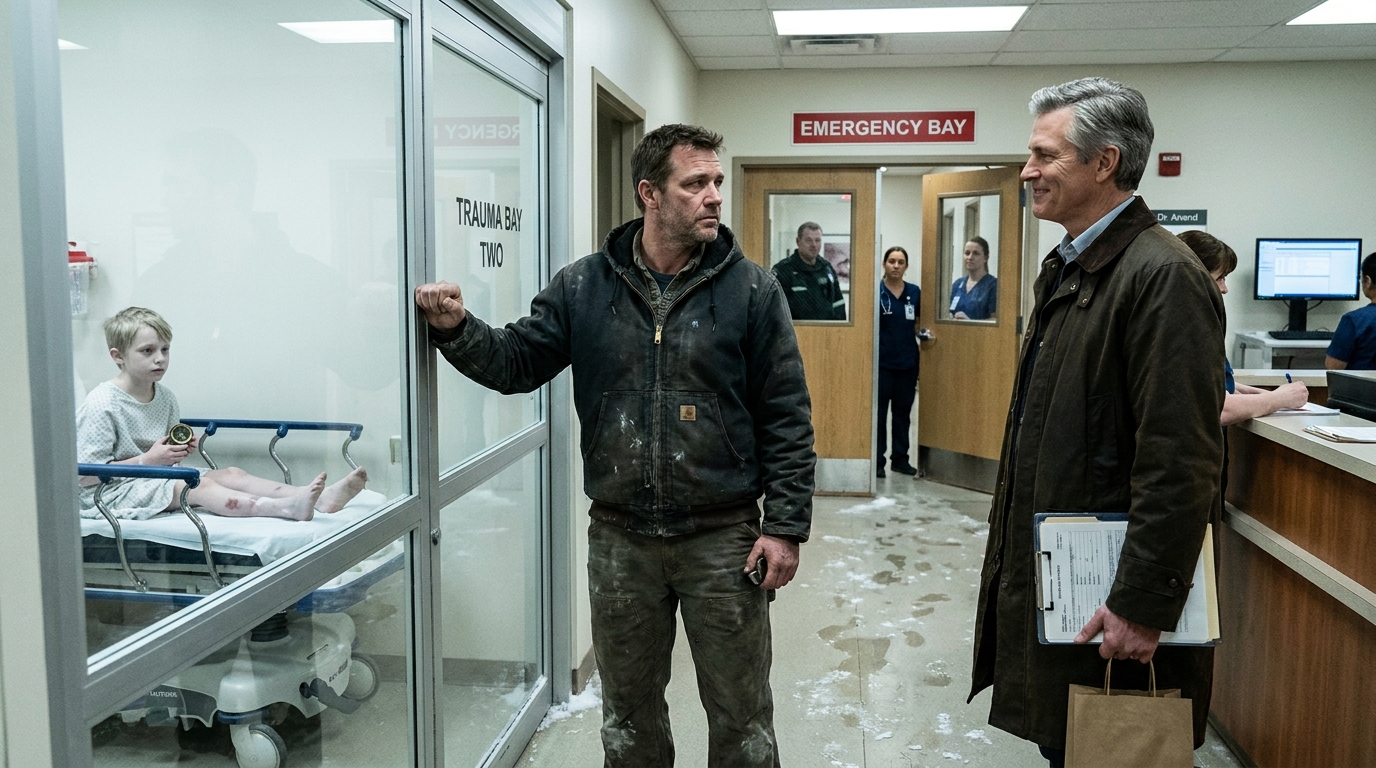
I hung up and slipped the phone back into my pocket. As I turned back toward Trauma Bay Two, a pair of bright halogen headlights cut through the frosted glass of the front entrance.
A silver late-model pickup pulled right into the ambulance loading zone, its engine idling with a smooth, expensive purr. The driver’s door swung open, and a tall man in a tailored oilskin coat stepped out into the swirling snow, holding a brown paper bag like he was dropping off breakfast.
He had neat, combed grey hair and a warm, practiced smile already pinned to his face.
CHAPTER 3: THE ABUSER SMILES
“Morning, folks,” Caleb said, his voice deep, warm, and smooth as melted butter. “I heard my boy got confused and wandered off again. Brought him some hot donuts from town.”
He turned toward me, his blue eyes bright, clear, and utterly unbothered. He held out a broad, calloused hand like we were two neighbors meeting at a Sunday tailgate.
“Caleb Ror,” he said, stepping into my space with the effortless confidence of a man who owned half the township. “You must be the gentleman who picked Mason up. Can’t thank you enough. Kid has sleepwalking episodes—dramatizes things when he gets cold.”
I kept my hands in my jacket pockets, my right thumb pressed flat against the cool steel latch of my Zippo. I didn’t take his hand.
Caleb’s smile didn’t break. It just tightened half a millimeter at the corners, his fingers curling back into a relaxed fist before dropping to his side.
“He’s not sleepwalking, Mr. Ror,” I said, my voice dead air in the bright hallway. “He’s got a core temp of ninety degrees and defensive ring bruises on both forearms.”
Caleb let out a short, soft chuckle, shaking his head with a tired, long-suffering sigh.
“Ah, man,” Caleb said, looking at the ceiling tiles like I’d just told a poor joke. “He told you the wrist story, huh? The boy’s eight, mister. He hates his chores. You grab a kid by the arm to keep him from running into traffic, and suddenly you’re the bad guy. I’ve been doing my absolute best with him since my poor brother passed.”
Dr. Anand stepped out of Bay Two, her tablet clutched tightly against her white coat. “Mr. Ror, the child is under an active medical hold. He is not being discharged into your care tonight.”
Caleb’s eyes flicked to Dr. Anand. The polite warmth in his expression didn’t vanish—it weaponized. He took half a step toward her terminal, pulling a laminated folder from inside his coat.
“Doctor, with all due respect, I hold legal, court-appointed guardianship,” Caleb said, his tone dripping with gentle, patronizing concern. “I have the county papers right here. If you keep my nephew against my written consent, you’re looking at civil liability. I know you’re just doing your job, but let’s not make a circus out of a boy who needs his own bed.”
“His own bed is a cot in an unheated garage, isn’t it?” I asked.
Caleb turned his head slowly, his jaw flexing once. The smooth mask slipped just enough for me to see the cold, calculating stone underneath.
“You’re a civilian contractor who hauls scrap metal, aren’t you, Monroe?” Caleb murmured, keeping his voice down so the reception nurse couldn’t hear. “I know who you are. You ride around on a noisy machine and think you’re a hero. You don’t have a badge. You don’t have a warrant. You’re trespassing on a family matter.”
The automatic glass doors slid open behind us with a cold blast of air. Deputy Holt walked in, her radio crackling softly on her shoulder, snow melting on her brimmed hat.
“Caleb,” Deputy Holt said, her hand resting casually on her utility belt. “Sheriff wants you to stay right here while we verify the medical report.”
Caleb didn’t flinch. He turned to Holt with that same bright, harmless smile, spreading his hands open in total surrender.
“Reena, thank goodness,” Caleb said cheerfully. “Tell this doctor I’ve been looking for Mason since ten p.m. The boy sneaks out. You know how hard I work to keep him straight.”
I reached past Caleb, tapped the glass window of Bay Two, and pointed inside. Mason was sitting upright under the space heater blankets, his tiny face pale, his dark eyes locked on his uncle through the glass.
The kid didn’t scream. He didn’t cry. He just shrank back against the plastic mattress, his knuckles bloodless as he crushed that brass compass against his chest.
“Look at the boy, Reena,” I said to the deputy. “Does he look like a kid who’s glad his uncle found him?”
Caleb’s smile finally died.
CHAPTER 4: THE GARAGE DOOR DEADBOLT
The driveway at 611 County Road 12 was choked with three feet of hard-packed grey drift. The wind swept across the open prairie, biting through denim and boots as Sheriff Keenan slapped the side of his cruiser door shut.
“Search warrant is signed for premises, outbuildings, and detached structures,” Keenan said, his voice clipped as he handed Deputy Holt a copy. “We look for evidence of unlawful restraint, safety hazards, and financial records.”
I stepped out behind them, my work boots crunching into the frozen slush. I didn’t have a badge, but Keenan had logged me as the reporting witness. I stayed two paces back, my thumb resting over the cool casing of my Zippo lighter, watching the ordinary ranch house sit quiet against the pale grey sky.
From the outside, it looked like every other homestead on County Road 12. A neat porch, clean white siding, and a pair of decorative wreaths still hanging beside the front door.
Deputy Holt hit the wooden steps first, knocking three sharp times on the doorframe.
Caleb opened it himself. He was wearing flannel pajama pants and a clean wool sweater, holding a metal spatula in his right hand. The smell of frying bacon and butter spilled out into the sub-zero air.
“Morning again, Sheriff,” Caleb said, his voice entirely unbothered as he leaned against the door casing. “I see we’re still running with this dramatic little misunderstanding.”
“Step back inside, Caleb,” Keenan said, stepping past the threshold without offering a hand. “Body cams are rolling. We’re executing the signed order.”
Caleb backed up two steps, chuckling softly as he set the spatula down on a kitchen counter that glistened with clean granite. “Search away, Lyall. I’ve got nothing to hide. Mason has his own room down the hall.”
“We’ll start with the garage,” I said.
Caleb’s eyes snapped to mine, the warmth draining out of his face so fast it looked like a shutter closing. “You’re a civilian, Monroe. You step one foot out of line on my property and I’ll have your license revoked.”
“I’m staying right behind the deputy,” I replied, my voice steady as I followed Holt down the back utility hallway.
At the far end of the service corridor, right past the pantry, stood a heavy metal door leading into the detached garage.
A fresh, brass deadbolt was mounted on the hall side of the frame—locking the door completely from the outside.
Deputy Holt reached out, sliding the deadbolt back with a loud, metallic clack. She pulled the heavy door open.
A blast of stale, freezing air hit us immediately. The room beyond wasn’t a garage; it was a narrow, windowless laundry alcove built against the concrete foundation.
On the concrete floor sat a rusted iron cot covered in a single thin fleece blanket. The window above it had been fitted with two wooden boards screwed straight into the frame, blocking out all sunlight. An electric space heater sat three feet away, its black cord coiled up and completely unplugged from the wall outlet.
“He sneaks food,” Caleb called out from the kitchen, his voice rising in pitch. “The kid sneaks out in the middle of the night! I lock the door so he doesn’t hurt himself!”
I walked over to the small wooden desk wedged into the corner of the hallway. My eye caught a red dry-erase marker resting on top of a heavy desk calendar.
December and January were covered in thick red circles.
Every single date from the first of the month to January third had a heavy red line drawn straight through it. Around January third, three tight circles were drawn with a handwritten note in the margin: After court. Funds clear.
Deputy Holt pulled out her digital camera, the flash popping white against the dark concrete walls.
I leaned closer to the desk, noticing a thick manila folder tucked halfway under the blotter. I pulled it back just enough to read the faded tab sticking out from the side.
It didn’t say Reed.
In faded blue ink, the handwritten label read: Markham, Tyler – Probate 2023.
CHAPTER 5: TRACING THE PAPER TRAIL
The manila folder was heavy, its edges frayed and darkened by dust. Inside, tucked behind bank statements for the Reed Family Trust, was an older, brittle stapled packet stamped with a county seal from three years ago.
Markham, Tyler. Age 7. Cause of Death: Accidental Environmental Exposure.
Below the coroner’s signature sat a claim form for a fifty-thousand-dollar life insurance policy payout. The sole named beneficiary was Caleb Ror.
“Sheriff,” I called out, my voice flat as I held the open file toward the hallway. “You need to see this.”
Sheriff Keenan walked down the service corridor, his heavy boots echoing off the concrete baseboards. He took the file from my hand, his thumb tracing the name Tyler Markham. His jaw hardened as his eyes scanned the payout confirmation.
“Tyler was a foster placement Caleb took in back in 2023,” Keenan murmured, his voice dropping into a harsh rasp. “Died out in a ditch during the November blizzard. We ruled it a tragic wanderer case.”
“It wasn’t a wanderer case, Lyall,” I said, stepping closer to the desk and tapping the red dry-erase calendar. “Look at the pattern. Caleb takes the kid, gets appointed guardian, locks them out of the house, and waits for the cold to do the heavy lifting while he collects the checks.”
Deputy Holt pulled a stack of printed bank slips from the main drawer. “Sheriff, look at these transfer receipts. The Reed trust started at three hundred and ten thousand dollars sixteen months ago when Mason’s parents died.”
“How much is left?” Keenan asked.
“Less than eighty grand,” Holt said, her finger tracing down a column of wire transfers. “Twenty-two thousand drawn out in cash last month alone. Management fees paid directly to a private LLC owned by Caleb. Recurring charges from a casino in Fargo, and a down payment on a 2025 snowmobile.”
Caleb stepped into the doorway of the utility room. The relaxed posture was gone. A thin bead of sweat was breaking through the fine powder on his forehead, glistening under the bare fluorescent bulb overhead.
“You’re going through private personal documents without specific cause,” Caleb snapped, his voice losing its polished tone and turning raspy, harsh. “Those are legitimate administrative expenses for raising a high-needs orphan. You can’t prove a single thing from numbers on a ledger.”
“I don’t have to prove it, Caleb,” I said, pointing to the desk monitor resting beside the files. “The screen’s still warm.”
Open on the browser was an email thread titled Homeschool Attendance Override. The latest reply from a district administrator sat highlighted on the glass: Donation for the athletic scoreboard received. Attendance flag cleared. Mark compliant.
“You bought off the school supervisor with Mason’s own trust money,” I said, stepping between him and the desk. “You paid them off so nobody would ask why an eight-year-old stopped showing up to class in October.”
Caleb took a sharp breath, his fingers twitching violently against his thigh. He didn’t have a witty answer. He didn’t have a charming smile left.
“That’s my money,” Caleb growled, his eyes darting toward the open door leading out to the snow-covered driveway. “I earned every dime taking care of those ungrateful brats.”
Sheriff Keenan pulled his cuffs from his belt with a sharp, heavy clack.
“Caleb Ror,” Keenan said, his voice echoing through the dark laundry alcove. “You’re under arrest.”
CHAPTER 6: THE TRAP COLLAPSES
“Hands behind your back, Caleb,” Sheriff Keenan said, taking a deliberate step forward across the dark laundry floor.
Caleb’s eyes widened, his head whipping toward the open door that led to the garage. “You can’t do this! I have an emergency custody order on file! You’re taking the word of a scrap-hauler and a delinquent eight-year-old over a registered township donor!”
“The paper trail doesn’t lie, Caleb,” Deputy Holt said, stepping in from his left to cut off the doorway. “We’ve got the trust withdrawals, the scoreboard donation email, and the Markham file.”
Caleb’s shoulder slammed hard against the wooden casing as he tried to twist away from Holt’s grip. “Tyler Markham was an accident! The county cleared me three years ago! You can’t reopen a settled case because this vagrant found a kid hiding behind a dumpster!”
“You put a padlocked chain on the refrigerator, Caleb,” I said, stepping right into his line of sight, blocking his path to the front porch. “You locked an eight-year-old in a freezing garage alcove and marked the calendar down to the day the trust cleared.”
Caleb’s mask split completely wide open. He didn’t try to smile. He didn’t try to look like a grieving uncle. He bared his teeth, his face flushing dark red as his throat strain showed through his collar.
“I fed him!” Caleb shouted, his voice cracking against the low basement ceiling. “I gave him a roof! His parents left a pile of money to a brat who couldn’t even keep his shoes tied! I earned every single cent of that management fee!”
“Get his wrists, Reena,” Keenan ordered, grabbing Caleb’s right elbow and twisting it firmly behind his back.
Caleb lunged forward with his weight, trying to throw Keenan off balance toward the heavy desk, but Holt caught his left shoulder, driving him down onto one knee against the cold concrete. The metal cuffs snapped shut over his wrists with two heavy, definitive clicks.
“Caleb Ror, you are under arrest for felony child neglect, unlawful imprisonment, and grand larceny,” Keenan rasped, pulling Caleb up by his collar.
Caleb strained against the steel links, his chest heaving as he glared at me over Keenan’s shoulder. “You think you won something, Monroe? You think the county’s going to let you keep him? I’ll be out on bail before dinner!”
“You won’t be out by dinner, Caleb,” I said, picking up the yellowed Markham file and tucking it securely under my arm. “Because the prosecutor isn’t just looking at a run-away case anymore. They’re looking at a pattern.”
Keenan marched Caleb out through the kitchen, past the cooling frying pan and the smell of butter, straight out onto the snowy porch where the cruiser’s red and blue lights threw long, cold shadows across the drifts.
Deputy Holt opened the back door of the patrol car and shoved Caleb inside. Caleb slammed his boots against the floorboards, screaming curses through the plexiglass partition until the door slammed shut and cut the noise down to a muffled thud.
I stood on the porch step, pulling my Zippo from my pocket. I flicked the wheel once. The small yellow flame held steady against the North Dakota wind, warming my thumb for three seconds before I snapped the lid shut.
“We need to get to the county court house,” Keenan said, stepping up beside me, wiping his cold forehead with the back of his glove. “The prosecutor’s waiting for the affidavits.”
“I’ll meet you there,” I said. “There are three people in town who need to sign their names on the record before Caleb’s lawyer gets a chance to call them.”
CHAPTER 7: CONFESSIONS OF THE BYSTANDERS
State Prosecutor Karen Vance didn’t look up immediately. She adjusted her reading glasses, her finger tracing the blue ink signatures on three separate affidavits sitting under the desk lamp.
Evan Klene, the cashier from the Prairie Star Travel Mart, sat on the hard bench in the second row. His hands were tucked deep between his knees, his red beanie pulled down so far it nearly covered his eyebrows.
“Mr. Klene,” Vance said, her voice dry, crisp, and echoing off the high plaster ceiling. “State your statement for the preliminary record.”
Evan swallowed hard, his throat bobbing behind his zipped collar. “I… I saw the boy by the pumps at nine p.m.,” he stammered, his eyes fixed on the hardwood floorboards. “His lips were blue. I told myself he was waiting for his dad. I told myself if I called the cops and was wrong, I’d get fired by the night manager.”
He pressed his palms over his face, his voice cracking. “I looked away because it was easier than making a scene.”
Beside him, Janice Garrison adjusted her woolen shawl. Her voice didn’t tremble, but her fingers twisted her leather purse strap into tight knots.
“I live half a mile down County Road 12,” Janice testified, her eyes flicking toward the holding cell door. “I heard crying behind Caleb’s garage three months ago. I called county services. A worker drove out, spoke to Caleb on the porch for ten minutes, and left. Caleb came to my fence the next day and told me if I kept meddling, he’d file a trespassing order.”
She wiped a tear from her cheek with a pale thumb. “I stopped calling because I thought… if the county didn’t care, what difference was my voice going to make?”
Prosecutor Vance turned the page, her pen making a sharp, scratchy sound as she highlighted a paragraph in the third document.
Lorie Feldman, the third-grade teacher from Maple Ridge Elementary, sat straight-backed on the edge of her seat. Her hands were folded so tightly in her lap her knuckles showed white.
“I filed two internal safety flags in September,” Lorie said, her voice tight with suppressed fury. “Mason came to school with empty lunchboxes three days in a row. When I brought it to the principal, I was told Caleb was a major donor for the new scoreboard and a respected community volunteer. A week later, Caleb pulled Mason out for ‘homeschooling,’ and the administration closed the file.”
Vance capped her pen with a loud, metallic snap.
She turned to look at Sheriff Keenan and me. “We have the bank records. We have the padlocked refrigerator photos. We have the three witness statements proving systemic isolation.”
“And the Markham file?” I asked, leaning my hip against the railing.
VANCE looked down at the yellowed folder sitting beside her laptop. “State investigators reopened Tyler Markham’s case two hours ago. The former coroner who signed off on the exposure ruling without a full audit has been suspended pending a grand jury subpoena.”
The side door swung open, and two armed bailiffs led Caleb Ror into the courtroom in orange scrubs, his wrists cuffed to a heavy leather waist belt.
His hair was uncombed, his face grey in the harsh fluorescent lighting, but his head was still held high, his jaw set in stubborn, arrogant denial.
“This is a witch hunt!” Caleb snarled toward the prosecutor’s table, his voice echoing off the oak paneling. “You’re building a case on gossip from neighbors and a scrap-metal driver!”
Prosecutor Vance didn’t even raise her voice. She simply picked up her paper stack, tapped it neat on the wood desk, and faced the judge’s bench.
“Your Honor,” Vance said as Judge Marleene Oaks entered the courtroom. “The State requests bail be set at five hundred thousand dollars cash, with immediate termination of all guardianship authority.”
Caleb’s eyes bulged as Judge Oaks brought her gavel down with a sharp, heavy thwack.
CHAPTER 8: SAFE GROUND
The glass face of the compass was polished clean, free of the deep scratches that had marred it when I found him behind the dumpster. Inside, the brass needle floated smooth and steady, swinging slightly before settling dead north.
Samantha Calder poured three mugs of hot cocoa at the stove, setting one in front of Mason, one in front of me, and holding her own with both hands to catch the steam.
“The county clerk called ten minutes ago,” Samantha said softly, sitting down across from the boy. “The bank froze Caleb’s personal accounts. The remaining eighty thousand from the trust is locked safe under court guardianship until you’re eighteen, Mason.”
Mason didn’t look up from the needle. His small thumb traced the crude J + L initials carved into the back of the casing, but his shoulders weren’t hunched anymore. He wore a clean blue fleece hoodie that actually fit his arms, and a fresh pair of wool socks covered his feet.
“He tried to say the compass was broken,” Mason whispered, his voice clear and quiet in the warm kitchen. “He said if the needle didn’t point north, it meant I was lost.”
“It wasn’t broken, buddy,” I said, leaning forward to rest my elbows on the table. “The casing was just pinched tight from the cold. All it needed was someone to take the casing apart and reset the pin.”
The front doorbell chimed twice—a soft, gentle tone.
Samantha stood up and opened the door. Sheriff Keenan stepped onto the porch rug, shaking the light dusting of snow off his brimmed hat. He didn’t come inside with boots on; he left them right on the rubber mat.
“Thought I’d drop these off in person,” Keenan said, holding out a sealed manila envelope to Samantha. “Final protective order signed by Judge Oaks. Caleb received seventeen years at the state penitentiary this morning. No parole eligibility for ten. Standing no-contact order for life.”
Samantha took the envelope, her throat working as she gave Keenan a tight nod. “Thank you, Lyall.”
“Don’t thank me,” Keenan replied, his eyes turning toward me at the table. “Thank the man who stopped his truck when everybody else was driving past.”
Keenan tipped his hat toward Mason and pulled the front door shut, the latch clicking solid and true into the frame.
Mason set the compass flat on the formica table. The needle wobbled once, then locked firmly toward the window facing north.
He reached out, took a slow sip from his mug, and looked up at me with dark, clear eyes that were no longer searching the shadows for headlights.
I pulled my Zippo from my pocket, laid it flat on the table beside his compass, and let my hands rest still on the warm wood.