The Weight of the Patch: A Veteran’s Quiet Siege Against the Apathy of a Broken Town
CHAPTER 1: The Impact of the Handlebar
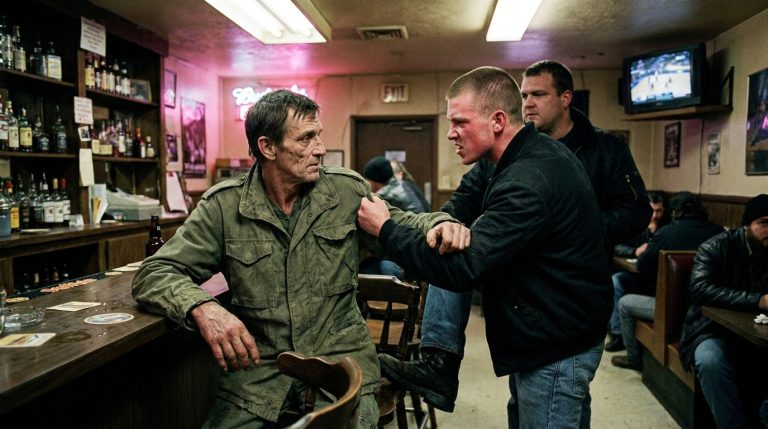
The strike came before he could even apologize. It wasn’t a shove; it was a calibrated, stinging slap that carried the weight of a man who needed to feel powerful at someone else’s expense. Walter Briggs hit the sidewalk, his cane skittering away like a discarded toy, the sound of it clattering against the concrete swallowed by the roar of nearby idling engines.
His paper bag tore open. A loaf of bread—fresh, soft, and completely oblivious to the chaos—tumbled into the oily gutter, speckled with urban grit.
Walter didn’t cry out. He didn’t search for a witness. He pushed himself up, his bones protesting the shift in gravity. The world tilted, the brick walls of the bar pulsating with a dull, aggressive heat. He stared at the bread. It was a stupid, mundane thing to focus on, but the sight of the crust soaking up the black, iridescent puddle in the gutter grounded him. It was a breach of order. It was a failure of the day’s design.
Around him, the street life continued with terrifying, rhythmic indifference. A woman in a sharp blazer stepped around his legs, her gaze fixed firmly on her phone, her heels clicking a steady beat against the stone. She didn’t glance down. She didn’t slow her pace. To her, Walter was merely an obstruction, a wrinkle in the fabric of the sidewalk.
He felt the burning at the corner of his mouth, the metallic tang of blood coating his tongue. He reached up, his fingers trembling not with fear, but with an old, cold familiar anger. He had been a mechanic in Hugh City, stripping down burning jeeps under fire, but he had never felt quite this invisible.
“Didn’t mean to,” he whispered to the air, his voice raspy.
The tallest biker, a man with a jaw like a heavy-duty bolt, spit onto the pavement near Walter’s boot. The man laughed, a harsh, jagged sound that cut through the muffled street noise. He looked at his bike—the chrome hardly scratched—and then back at Walter, his eyes devoid of anything resembling empathy. He was bored. He was untouchable. He was waiting for Walter to react so he could finish the job.
Walter didn’t give him the satisfaction. He leaned down, his knee screaming in protest, and retrieved the torn bag. He placed the dust-covered loaf back inside with the methodical precision of a man packing a kit.
He moved to the bus bench, his movements slow and deliberate, every inch a tactical withdrawal. He sat, spine straight as a rifle barrel, despite the throbbing in his cheek. He reached into his inner pocket, his hand hovering over the worn, cracked screen of his phone.
He didn’t look at the bikers. He didn’t look at the passersby. He looked at the horizon, waiting for the vibration, for the shift in the atmosphere that he knew—by habit and by memory—would inevitably follow a transgression of this magnitude. He tapped a single contact, the screen flickering in the harsh sunlight: Eagle 6.
The air in the street suddenly felt thin, charged with a static pressure that made the hair on his arms stand up. In the distance, a low thrum began—not the rumble of a motorcycle, but the deep, bone-shaking pulse of something much larger, much faster, and currently moving directly toward them.
Walter exhaled, a small, grim satisfaction tightening his eyes. The biker was still laughing, oblivious to the change in the sky, still focused on his own reflection in the chrome. He didn’t know yet that the silence he was creating was about to be shattered by a force he couldn’t possibly negotiate with.
CHAPTER 2: The Sound of the Pulse
The vibration wasn’t in his ears; it was in his tailbone. Walter sat on the cold metal slats of the bus bench, his hands resting on the curved top of his cane. He didn’t look at the sky, but he knew the frequency. It was a rhythmic, guttural thrum that belonged to heavy iron and precision engineering—the sound of an arrival that didn’t ask for permission.
Beside him, the street continued to behave as if the world were still turning on its normal axis. A stray cat darted under a dumpster, its ears flattened against the sudden, sub-audible pressure.
Walter’s gaze remained fixed on the biker, Kyle. The man was currently flicking the ash of his cigarette toward the gutter, his boots resting on the footpegs of his machine. He was laughing, his shoulders shaking with a loose, arrogant rhythm.
A flash of heat spiked behind Walter’s eyes, sharper than the sting on his cheek. It wasn’t anger at the slap—that was transactional, a minor injury in the scope of a long life. It was the smell. A drift of burnt oil and scorching rubber wafted from a passing car, and suddenly, he wasn’t sitting on a bus bench. He was back in 1970, outside Hugh City, the air thick with the acrid, choking scent of a burning jeep. He could hear the screams, feel the searing heat against his knuckles as he hauled a young private out of the wreckage, the boy’s uniform fusing to the upholstery.
Stay focused, Briggs, he told himself. The memory was an intrusive phantom, a ghost of the man he used to be. He forced his breathing to slow, his chest tightening as he reined in the panic. He was not in the jungle; he was in a city that had forgotten how to look at its own citizens.
The biker leaned back, his sunglasses glinting as he caught Walter staring. He sneered, a slow, predatory tightening of the lips. “Still there, old man? Thought you’d have found a nursing home by now. Or a bus that actually goes somewhere.”
Walter didn’t respond. He didn’t even blink. He felt the vibration in the pavement intensify, the deep, rhythmic thrumming now audible to those with the sense to listen. The bartender at the establishment across the way paused in the middle of wiping down a glass, his head tilting toward the horizon.
The silence on the street became heavy, a tangible weight that pressed down on the chatter of the crowd.
“What’s that noise?” one of the other bikers asked, dropping his cigarette to the ground and stomping it out. He wasn’t laughing anymore. He squinted toward the treeline where the city’s skyline met the hazy, industrial gray of the suburbs.
Walter felt the first real sting of vindication, not as a victory, but as a calibration. The math of the situation was perfect. He had provided the coordinates of his existence, and the system was now moving to correct the error. His knuckles whitened around the handle of his cane. The pain in his jaw pulsed in time with the rising mechanical roar.
The Blackhawk emerged from behind the distant buildings, a dark, jagged silhouette that seemed to swallow the midday sun. It was low—recklessly low—its rotors whipping the stagnant air into a frenzy. Pedestrians began to stop, heads turning, phones rising like shields against the sudden arrival.
Kyle, the man who had struck him, stood up fully now, his bravado replaced by a confused, twitching alertness. He looked at his bike, then at the sky, his hands hovering uncertainly near his vest. He didn’t know yet that the machine in the air was a beacon, a focused beam of consequence converging on this exact slice of pavement.
Walter stood. It took effort—his knee locked and groaned—but he rose with a deliberate, slow grace. He didn’t rush. He didn’t draw attention to himself. He simply stood, a fixed point in a world that was suddenly accelerating into chaos. He adjusted his olive jacket, the old fabric straining against his shoulders, and waited for the wind from the rotors to start picking up the trash from the gutter, swirling the dust and the torn pieces of his bread bag into a frantic, chaotic dance.
The time for waiting was over. The time for the record to be set straight had arrived. He looked at Kyle, who was backing away from his bike, his eyes wide behind the darkened lenses of his glasses, and Walter felt nothing but a cool, detached clarity. The game was no longer being played by the rules of the sidewalk. It was being played by the rules of the unit.
CHAPTER 3: The Cold Bench
The air became a physical weight, thick with the smell of unburnt fuel and the dry, gritty dust of the street. Walter remained on the bus bench, his posture unchanged, though he could feel the vibrations of the rotors humming through the metal slats into his spine. He wasn’t looking at the sky; he was watching the bikers.
Kyle had stopped backing up. He was frozen, his hands half-raised in a gesture that was no longer a threat but a reflex of pure, unadulterated shock. Behind him, his friends had scattered, leaning against the brickwork of the bar as if trying to merge with the architecture itself. The laughter that had defined the afternoon was dead, replaced by the flat, mechanical pulse of the descending aircraft.
Then, the SUV screeched to a halt at the edge of the curb. It was a matte black machine, devoid of any chrome or vanity, its tires gripping the asphalt with a squeal that sounded like a serrated blade across glass. The doors opened in a single, synchronized motion.
They were not shouting. They were not wielding weapons. They moved with a terrifyingly efficient silence, boots hitting the pavement in a rhythm that felt rehearsed, absolute. A dozen figures spilled out, clad in tactical gear—unmarked, nondescript, and cold as winter steel. They formed a perimeter around the block, their heads turning in steady, mechanical arcs, eyes shielded by high-impact lenses that reflected the scene back at itself.
Walter’s son, Commander Briggs, stepped out of the lead vehicle. He was younger, stronger, and carried a stillness that made the surrounding atmosphere feel frantic by comparison. He didn’t look at the crowd. He didn’t look at the law enforcement sirens that were beginning to wail in the far, distant reaches of the city. He looked only at the bench.
He walked past the bikers without a word. He didn’t acknowledge them, didn’t threaten them, didn’t even slow down to inspect the man who had struck his father. To the Commander, they were simply an obstacle that had been cleared. He approached the bench, his movements sharp and precise, and knelt in the dirty, oil-streaked gutter.
“Dad,” he said, his voice quiet, carrying easily through the diminishing roar of the rotors. One of his hands, gloved in dark, textured material, reached out to brush a speck of dried blood from Walter’s cheek. It was a gesture of such intimate, focused care that it felt like an intrusion in the middle of such a cold, tactical environment. “I got here as fast as I could.”
Walter looked at him, blinking once. The intensity of the past few minutes began to bleed out of his shoulders. He reached out and touched his son’s shoulder—not as a dependent, but as a recognition of the weight his son had chosen to carry. “I’m still here,” Walter said, his voice raspy but steady.
The bikers were starting to stir, the confusion beginning to warp into a panicked, desperate defiance. One of them, a man with a tattoo that crawled up his neck like a shadow, reached for his belt, his eyes darting toward the street. He didn’t get far. A pair of tactical officers were on him in an instant, not with violence, but with a calculated, crushing presence that pinned the man against the wall.
Kyle stared at the patch on the Commander’s shoulder. His face, once smug and reddened by the noon sun, was now pale, the skin pulled taut over his cheekbones. He was seeing the machine, the tactical efficiency, and the cold, unyielding reality of a power he had not realized existed in his small, insulated world.
Walter watched him. He saw the shift in the man’s posture—the way his bravado collapsed, the way his shoulders slumped—and he felt a cold, jagged spike of sympathy that he quickly suppressed. He knew that look. He had seen it in the eyes of soldiers who realized too late that they had misunderstood the terrain.
“They were laughing, son,” Walter said, his eyes tracing the line of Kyle’s trembling hands.
“I know, Dad,” the Commander replied, standing slowly. He didn’t move away. He stood between Walter and the street, a living shield that was currently locking down the entire block. He gestured toward his men, and the formation tightened, the semicircle closing in until the bar’s entrance was effectively swallowed by their presence.
The waitress who had peered through the window earlier was now pressing her face against the glass, her eyes wide, her phone held to her chest like a prayer book. The street had transformed. It was no longer a place of casual indifference; it was a theater of consequence.
Walter felt the cold air biting at the inside of his lungs. He felt the weight of his own existence—the deployments, the citations, the years of quiet, invisible survival—and he realized that he had not been waiting for a rescue. He had been waiting for the world to finally look at what it was doing.
“We aren’t going to make a scene,” the Commander said, his voice calm, directed at the room rather than the individuals. “We are simply going to ensure that the rules of engagement are understood.”
Kyle looked up, his voice cracking. “It was just an accident. He bumped the bike. I didn’t mean to—”
The Commander turned, his gaze slow, deliberate, and entirely empty of emotion. He didn’t speak. He just looked at Kyle, and the silence that followed was louder than the helicopter had ever been. It was the silence of a man who had seen everything, a man who knew exactly what the cost of indifference was, and a man who was done explaining the math.
Walter sat back on the bench, his hands resting on his cane. He felt the cold, hard surface beneath him and the shadow of the Blackhawk looming over the buildings. He was tired—deeper than he had been in decades—but for the first time, he wasn’t alone. He was, at last, an observer in his own life, watching as the pieces he had spent years trying to maintain finally fell into a terrifying, perfect alignment.
CHAPTER 4: The Tactical Vacuum
The Commander remained standing in the center of the sidewalk, a figure of absolute, unmoving intent. Around him, the tactical team worked in a series of silent, coordinated pulses. They weren’t just securing the bikers; they were securing the atmosphere. One of the men in matte black gear knelt where Walter had fallen. He wasn’t looking for a weapon. He was looking at the debris—the torn remains of the paper bag and the dust-caked loaf of bread lying in the gutter.
He picked it up, sealing it into a sterile evidence bag with the same care one might accord a high-value piece of intelligence.
Walter watched this from the bench, his hands resting on his cane. He felt a sudden, sharp pang of disorientation. He had called for help because he was tired of being invisible, but he hadn’t asked for a forensic operation. He realized then that his son wasn’t just here because of a slap. There was a precision to the Commander’s movements, a lack of surprise, as if this specific street corner had been on a tactical map for months.
“Dad,” the Commander said, turning back to him. He didn’t look at the bikers, who were now being systematically herded toward the back of the SUV, their faces reflecting a mixture of confusion and genuine fear. “The local precinct is ten minutes out. They’ll take the statement. We’ll take care of the rest.”
“What rest?” Walter asked. His voice was steady, but he felt the weight of the question. He looked at his son—at the rigid lines of his jaw, the depth of his eyes that had seen too many missions—and he felt a flicker of the old suspicion he’d held during his own service. He’d spent years in the dirt, keeping his head down, doing the job without asking the “why.”
“There’s a pattern here, Walter,” the Commander said, using his first name, a reminder that they were no longer just father and son, but two veterans evaluating a hostile environment. “This group wasn’t just idling. They were positioning. We’ve been watching the movement in this sector for weeks. They’re part of a broader, organized effort to destabilize local public spaces. The fact that they chose this street—your street—is not a coincidence.”
Walter felt the blood in his veins turn cold. He looked at the bar, the windows now reflecting the tactical gear of the soldiers patrolling the perimeter. The “decoy” was beginning to peel away. The bikers weren’t just bullies; they were a symptom. And he, the old man who had walked this route for twelve years without a second glance, had been standing right in the middle of a conflict he hadn’t even known existed.
“I just wanted to buy bread,” Walter muttered, the absurdity of the situation pressing down on him.
“And you found a war,” his son replied, his tone neither harsh nor pitying, simply factual. “The public thinks this is a story about respect. We’re going to let them keep thinking that. It’s the perfect cover for the real work.”
He signaled to one of the tactical officers, who stepped forward with a notebook. “When the police arrive, you tell them exactly what happened. You were walking, you bumped the bike, they assaulted you. Keep it simple. Keep it focused on the slap. Don’t mention the helicopter, don’t mention the unit, and don’t mention the SUV. Let them see an old man who was wronged.”
Walter looked at his son’s hands, resting on the fabric of his combat trousers. They were steady. They were the hands of a man who knew how to balance the truth against the mission. “You’re using me,” Walter said, not with anger, but with a profound, hollow realization.
The Commander’s expression didn’t shift. “I’m protecting you. And I’m closing a gap that has been left open for too long. But you’re right, Dad. It is a tool. Everything in this world is a tool. The question is whether you’re going to be the hammer or the anvil.”
Walter looked away, toward the empty gutter where his bread had been. He thought of his grandson at the academy, the boy he had wanted to visit, the boy who was currently being trained to think exactly like the man standing in front of him. Was this the legacy? A chain of men who saw the world as a tactical problem to be solved, piece by piece, sacrifice by sacrifice?
He felt a deep, aching guilt—not for the slap, but for the silence he had maintained throughout his life. He had been a mechanic, a support element, a man who fixed the machines that allowed others to fight. He had prided himself on his detachment, on his ability to remain outside the core of the violence. But looking at the tactical sweep occurring on the street corner, he realized that there was no such thing as being outside the war. You were either the one fighting, or you were the one being used to provide the justification for the fight.
“They’ll be here soon,” the Commander said, checking his watch. “I’m going to disappear into the perimeter. Stay on the bench. Wait for the patrol car. Be the man who was slapped.”
He turned and walked toward the SUV, his movements fluid, vanishing into the shadows of the building line before the first police siren even crested the distant ridge.
Walter sat alone. The tactical team had vanished, the Blackhawk had lifted off in a silent, vertical climb behind the treeline, and the street was beginning to return to its mundane, gray rhythm. But the world felt different. The sharp edges of the buildings seemed to lean closer, and the sound of the approaching sirens felt like the opening bars of a much larger, darker symphony. He reached into his pocket, his fingers finding nothing but the cold, empty air. The bread was gone. The invisibility was gone. And he was left, for the first time in his life, wondering if he was on the side of the shield or the side of the chaos.
CHAPTER 5: The Fragile Statement
The cruiser swung around the corner, its tires biting into the asphalt with a squeal that lacked the calculated precision of the Commander’s vehicles. Lights strobed against the storefronts, turning the street into a rhythmic, disorienting loop of color. Walter remained on the bench, his hands gripped tight around his cane. The tactical presence had evaporated, leaving behind a vacuum that felt heavy, loaded with the implications of what had just transpired.
Two patrol officers emerged from the cruiser, their hands hovering near their belts. They didn’t look like soldiers. They looked tired, their uniforms slightly rumpled, their faces etched with the weary annoyance of a shift that had gone wrong.
“Everything alright here?” the lead officer asked, his gaze flicking to the empty space where the SUV had been, then settling on Walter. He didn’t see a veteran; he saw a call on the dispatch log.
“I’m fine,” Walter said, his voice flat. He felt the weight of his son’s instruction: Be the man who was slapped. He realized, with a sudden, sinking clarity, that he was now playing a part in a script he hadn’t written. He had to perform the “victim” to cover the “operation.”
“We got a report of a disturbance,” the second officer said, looking at the bar. The doors were closed, the occupants inside watching through the slats of the blinds. “Witnesses said there was some kind of confrontation with a group on bikes.”
“There was,” Walter said. He looked at the gutter where the bread had been. It was gone now, collected by the tactical team, a piece of evidence that existed in a realm beyond these local cops. “They were parked in the way. I bumped a handlebar. The man hit me.”
The officer frowned, scribbling in a notepad. “Did you get a name?”
“No.”
“Did you see where they went?”
Walter hesitated. He knew exactly where they were going—to a processing center far beyond the jurisdiction of this local squad—but he couldn’t say that. “They left,” he said simply. “They just… disappeared.”
The officer’s frown deepened. He looked at his partner, then back at Walter. There was a flicker of skepticism in his eyes—a realization that the scene didn’t add up. The air still smelled of jet fuel and ozone, a scent that didn’t belong on a neighborhood street. “Strange,” the officer muttered. “Dispatch said there were reports of noise. People calling about low-flying aircraft. You see anything like that?”
Walter felt his pulse quicken. He held the officer’s gaze, keeping his expression neutral, practicing the “veteran stillness” he had mastered over decades. “I’m an old man,” he said, his voice cracking just enough to be believable. “I don’t hear as well as I used to. And I keep my head down.”
The officer sighed, the frustration evident in the slump of his shoulders. He was caught between a mountain of weird, unexplained data and the mundane reality of an 84-year-old man on a bench. He chose the path of least resistance. He closed his notebook. “All right. We’ll file the report. But if you see those guys again, don’t confront them. Call us.”
As the officers walked back to their cruiser, Walter felt a sudden, sharp surge of frustration. He wasn’t a pawn. He wasn’t a tool to be used by the military or ignored by the police. He was the man who had pulled three soldiers out of a burning jeep in Hugh City, and he was being reduced to a bystander in his own life.
He stood up, his cane tapping rhythmically on the concrete. He didn’t wait for the cruiser to pull away. He began the walk home, his pace slow, deliberate, and aching. Each step was a confrontation with his own body, with the reality of his age, and with the growing realization that his son’s “operation” was pulling him into a shadow war he was ill-equipped to survive.
He passed the alleyway behind the diner. A flickering streetlight bathed the brickwork in a sickly, yellow haze. He stopped. Tucked into the shadows, a discarded patch lay in the dirt—not from a biker’s vest, but a small, black-and-tan insignia he recognized from his own unit’s archives. It had been left behind. A mistake? Or a signal?
He reached down to pick it up, his fingers brushing the rough, embroidered edges. It was cold, damp with the evening dew. He tucked it into his jacket pocket, the weight of it suddenly transforming the garment from a piece of clothing into a liability. He wasn’t just Walter Briggs anymore. He was a piece of the puzzle, and the puzzle was moving.
He didn’t look back at the street. He didn’t look back at the bar. He kept walking, the rhythmic tap of his cane the only sound in the deepening dark. He had to reach the academy. He had to see his grandson. If the “broader effort” his son spoke of was real, the boy was already in the crosshairs. And Walter, for all his invisibility, was the only one who knew where the battle line was actually drawn.
CHAPTER 6: The Shadow in the Pocket
The walk home was a slow, agonizing crawl through a city that felt like it had been repainted in shades of charcoal and ash. Every streetlamp Walter passed cast long, distorted shadows that seemed to track his progress with the cold scrutiny of a sniper. He didn’t turn back, but he stopped twice, his cane anchoring him to the concrete as he waited to see if the rhythm of his own pulse would drown out the phantom footfalls behind him.
His house was a small, frame structure at the end of a quiet cul-de-sac. It was a place of ghosts—a silent kitchen, a living room filled with photos of a life that felt increasingly like a stranger’s biography. He climbed the porch steps, the wood creaking in a familiar, mournful protest. Inside, the air was stagnant, smelling of old paper and the lingering scent of stale coffee.
He didn’t turn on the lights. He moved by the familiar geometry of his own existence, his hand sliding along the wall until he reached the kitchen table. He sat, the heavy wood of the chair solid beneath him, and finally reached into his pocket to retrieve the patch.
He placed it on the table. In the dim, ambient light filtering through the window, the embroidered threads seemed to vibrate. It was a unit patch, one that hadn’t seen active service in years, yet it was clean—far too clean for something found in the dirt behind a bar. It was a marker, a calling card left behind by design, not by accident.
Someone wanted me to have this, he thought. The realization hit him with the force of a physical blow. He wasn’t just a bystander; he was being signaled.
His phone, a relic of a simpler era, hummed on the tabletop. He jumped, his heart hammering against his ribs like a trapped bird. The screen glowed with a single, unlisted number. He didn’t answer. He waited, his breathing shallow, his eyes fixed on the device as if it might detonate. It went to silent, then buzzed again, a persistent, rhythmic demand.
He picked it up. “Briggs,” he said, his voice dropping into the hard, gravelly tone he hadn’t used since the seventies.
“You’re holding onto evidence, Sergeant,” a voice responded. It was flat, synthesized, and entirely devoid of human inflection. “The patch wasn’t left for your protection. It was left to see if you still knew how to recognize a threat.”
“Who is this?” Walter demanded, his hand hovering over the patch.
“Someone who knows exactly what happened in Hugh City in 1970,” the voice replied.
The room seemed to shrink. Walter’s throat went dry. The fire—the searing, blinding white heat of the jeep, the smell of burning rubber, the sight of the young private’s face as he pulled him from the wreckage—it all came rushing back with a vivid, terrifying clarity. He had kept that memory buried for decades, a secret he had guarded with the same intensity he had guarded his own life.
“That’s a lie,” Walter whispered, though he knew it wasn’t.
“You left a man behind, Walter,” the voice continued, smooth as oiled steel. “You didn’t pull three soldiers out. You pulled two. The third one? The one you couldn’t reach? His blood is on your hands, and for fifty years, you’ve built your entire identity on the lie that you were a hero. We’re going to show the world what happens when the ‘quiet shield’ finally breaks.”
The call terminated with a sharp, digital click.
Walter sat in the darkness, the silence of the house pressing in on him. The patch on the table seemed to expand, a black hole of history threatening to consume the room. He felt the familiar, crushing weight of the guilt he had spent half a century suppressing, the faces of the soldiers he couldn’t save drifting through the dark like smoke.
He realized now why the Commander had been so precise, why the operation had been so clean. It wasn’t just about the bikers. It was about the Briggs legacy—the idea of the ‘hero’ that his son had modeled his entire life after. If the world knew the truth about Hugh City, it wouldn’t just destroy Walter. It would destroy the very foundation of the man his son had become.
He stood, his hands shaking as he reached for the old, olive-drab jacket hanging on the back of the chair. He wasn’t going to wait for the next call. He wasn’t going to be the anvil. He looked at the patch one last time, then swept it off the table and shoved it back into his pocket. He had to get to the academy. He had to see his grandson, not to visit, but to pull him out. If the shadow war was coming for the Briggs name, he would not let the boy be the final, broken piece of the sacrifice.
He stepped out into the night, the cold air hitting his face like a warning. The street was empty, but he could feel them now—the observers, the shadows, the ones who held the keys to his past. He started to walk, the tap of his cane rhythmic, urgent, and focused. He was no longer playing the part of the victim. He was a man with a dying legacy to protect, and for the first time in fifty years, he was going to walk straight into the fire.
CHAPTER 7: The Perimeter of Truth
The Academy gates were not built for privacy; they were built for deterrence. Tall, chain-link fences topped with spiraling razor wire cut through the night, reflecting the harsh, sodium-vapor glare of the floodlights. Walter stood on the gravel shoulder of the access road, his breath hitching in the cold air. He could see the silhouettes of the cadets moving in the distance, a rhythmic, synchronized flow of motion that mirrored the precision of the tactical team that had descended on Main Street.
He reached into his pocket, his fingers wrapping around the patch. The rough embroidery snagged on his skin, a small, biting pain that kept him tethered to the present. He wasn’t here to be a ghost; he was here to intercept the future.
He moved toward the main gate, his pace steady despite the growing ache in his hip. A guard shack sat near the entrance, its windows dark. As he approached, the light inside flickered, then died.
“Sergeant Briggs,” a voice called out. It wasn’t the synthesized monotone from the phone call; it was a voice he recognized. It was the voice of the Commander, his son, standing in the shadows of the gatehouse.
Walter stopped. He didn’t reach for his cane as a weapon, but he tightened his grip, his knuckles white. “I’m here for the boy,” Walter said, his voice hard, projecting through the dark.
“He’s in the middle of a rotation, Dad,” the Commander said, stepping into the spill of the gate light. He looked exhausted, the lines around his eyes deepened by the strain of the last several hours. “You can’t just walk in here and pull a cadet from his training.”
“I can when the entire training program is a recruitment ground for a shadow war,” Walter shot back. He reached into his pocket and pulled out the patch, holding it out toward his son like a piece of burning iron. “I know about Hugh City. I know why this unit is really here.”
The Commander looked at the patch. He didn’t flinch. He didn’t look surprised. He looked at his father with a terrifying, hollow disappointment. “You think you’re protecting him by digging up the past? If that information goes public, it doesn’t just destroy the unit. It destroys the only thing you have left. The Briggs name isn’t just a label, Dad. It’s a clearance. And it’s the only thing keeping that boy safe in a world that is already turning on him.”
“It’s a lie,” Walter whispered. The memory of the fire flared again—the heat, the smell of the melting jeep, the face of the soldier he couldn’t pull out. “I left him there. The third soldier. I left him in the fire.”
“You made a tactical decision,” the Commander said, his voice dropping to a low, intense rasp. “You saved two lives by sacrificing one. That’s what we do. That’s what the Briggs men have always done. You call it a lie, I call it the burden of the shield.”
Walter felt the air leave his lungs. The reality of the legacy wasn’t just a series of missions; it was a cycle of rationalized abandonment. He looked toward the training field, where his grandson was currently running a drill, unaware that his own family history was being used to forge his future.
“I won’t let him do it,” Walter said, his voice growing stronger. “I’m going to tell him.”
“If you move one step past this gate, Sergeant,” the Commander said, his tone shifting from son to operator, “you won’t be reaching the boy. You’ll be reaching the end of the line. The system is designed to protect its own, and right now, you are the threat.”
The Commander gestured toward the shadows behind the gatehouse. Two figures emerged—men in the same nondescript, matte-black tactical gear from earlier. They didn’t have weapons drawn, but their posture was unmistakable. They were the fixers. The ones who cleaned the mess that the tactical operations left behind.
Walter looked at the gate, then at his son, then at the men closing the distance. He felt the patch in his hand, a small, cold scrap of history that was the only thing standing between him and the erasure of his own truth. He realized then that he couldn’t win this by fighting. He couldn’t outrun the unit, and he couldn’t fight the man he had helped create.
He turned toward the gravel road, his cane digging into the dirt. He wasn’t retreating; he was choosing his own battleground. He had one more card to play—the only thing that wasn’t part of the tactical equation: the truth, delivered on his own terms, outside the reach of the Academy’s fences.
“The truth doesn’t need a mission,” Walter said, turning to look one last time at his son. “It just needs a witness.”
He started to walk away, his silhouette fading into the darkness of the access road. He knew they were watching him—the men, the shadows, the system—but for the first time in fifty years, he wasn’t afraid. He was going to find a way to break the cycle, even if it meant becoming the casualty he had managed to avoid for so long.
CHAPTER 8: The Weight of the Shield
Walter didn’t reach the academy gates. He didn’t have to. The road beneath his feet ended abruptly at a secondary access point—an old, overgrown service path that cut through the woods and circled back toward the main training facility. He stopped, his cane sinking into the soft mud of the forest floor, his breath coming in ragged, shallow bursts.
Standing in the center of the path was not a tactical team, not a shadow, but a man. He was older, his face mapped with the deep, jagged scars of a life spent in the dirt. He wore a simple, weathered jacket, and he leaned on a cane that looked like a mirror image of Walter’s own.
Walter stared, the blood draining from his face. It was the man from Hugh City. The one he had told the world he couldn’t save.
“You didn’t leave me, Walter,” the man said, his voice raspy and devoid of malice. “You were pulled away by the fire. I survived, crawled out, and spent the rest of my life watching the story you told everyone else. I watched you become the hero, while I stayed in the dark.”
The world tilted. The “Core Truth” Walter had hidden—his own cowardice, his rationalized decision—wasn’t the truth at all. The real truth was something far more devastating: he hadn’t left a man to die; he had left a witness to his own imperfection, and that witness had been watching him perform the role of the hero for half a century.
“Why now?” Walter asked, his voice a broken reed.
“Because your son is about to commit the same sin,” the man replied. “He’s building a unit of men who believe that the mission is more important than the man. He thinks he’s following your legacy, Walter. He thinks he’s becoming the ‘shield’. But if he doesn’t know the cost, he’s just going to be another fire you can’t reach.”
The revelation was a physical weight, pressing into Walter’s chest. The “Five Pillar Catharsis” began to unfold, not through grand gestures, but through the brutal, quiet intimacy of the encounter. Walter realized the antagonist wasn’t his son, nor the system, nor the past—it was his own fear of being seen as broken.
He reached into his pocket and pulled out the patch. He walked forward, his gait slow, his every movement a surrender of the persona he had cultivated. He stood in front of the man, and with a hand that no longer shook, he handed over the patch.
“I didn’t want to be a hero,” Walter said, the admission finally cracking the dam of his pride. “I just wanted to be forgotten. I wanted the fire to stop.”
The man took the patch, his eyes softening. There was no rage, no desire for revenge—only the quiet understanding of two men who had spent their lives carrying the same trauma. The justice wasn’t in a court or a confrontation; it was in the simple, devastating act of being known.
In the distance, the sirens finally faded. The training facility, the academy, the shadow war—it all seemed to settle into a cold, atmospheric peace. The system that had relied on the myth of Walter Briggs had been dismantled by the presence of a man who was never supposed to exist.
Walter turned away, his movements slow and deliberate. He walked toward the woods, his cane tapping against the roots and the stones. He felt the weight in his chest lift, a terrifying, empty lightness that left him feeling exposed but finally, completely, real.
Back at the house, he found his old workbench. He spent the next hour carefully disassembling the broken hinge of his front door—a minor, physical repair he had neglected for years. The metal groaned, the screws bit, and the door finally swung open with a smooth, silent grace.
His son stood on the porch, his tactical gear removed, his face pale and stripped of the Commander’s resolve. He watched his father, the silence between them thick with the history of everything that had been left unsaid.
Walter didn’t reach for a speech. He simply moved aside, allowing the door to remain open. He looked at his son—not as a superior, not as an asset, not as a reflection of his own desire for honor—but as a man who was also terrified.
“The fire is out,” Walter said, his voice barely a whisper.
He walked into the living room, leaving the door open to the night air. He sat in his chair, the house finally feeling like his own. For the first time in his life, he didn’t need to be the shield, the mechanic, or the hero. He was just a man who had survived the dark, and for now, that was enough.