A Soldier’s Burden: Navigating the Intersection of Sacred Tradition and the Harsh Reality of Duty
CHAPTER 1: The Click of Iron
The cold was not a weather pattern; it was a physical occupation. Lucas Hayes moved with the calculated, mechanical efficiency of a clockwork automaton, his boots striking the plaza with a resonance that felt less like a salute and more like a warning. Twenty-one steps. Pause. Pivot. The movement was a negotiation with gravity, a series of micro-adjustments designed to suppress the tremor that lived permanently in his left hand—the hand that had shoved Sergeant Cole into the dirt four years ago.
The plaza was desaturated, a palette of grays and muted blues. The November mist clung to the stone, smelling of iron and damp earth. Every interaction, every breath, was a risk. He knew the fallout was already moving through the chain of command, a slow, inevitable tide of reprimands and reassessments. They didn’t like it when the monument moved. They didn’t like it when the symbol became a person.
He reached the end of the mat and began the return sequence. His eyes, trained to scan for structural irregularities in the crowd, locked onto the base of the Tomb. Amidst the swirling debris of a dying autumn, his gaze caught a glint of oxidized brass. It wasn’t the Bronze Star from yesterday—that was gone, returned to Danny. This was something older. A jagged, metal scrap half-buried in the mortar joint where the plaza met the base.
He didn’t break formation. He couldn’t. But as he executed the pivot, he shifted his weight, allowing his peripheral vision to sharpen. It was a unit patch, eroded by decades of rain and neglect, the colors bled out into a uniform, rusted brown. It looked like it had been there for a generation, ignored by the sweeping brooms and the precise, heavy boots of a thousand shifts.
The realization hit him with the force of a blunt object: the Tomb wasn’t just a site of memory. It was a site of accumulation. Things were left behind, and things were forgotten, and the system was too rigid to account for the detritus of service.
The crowd’s murmur was a low, abrasive vibration in the air. A child pointed at him, then pulled back, intimidated by the stillness. Lucas felt the weight of his M14. It was no longer just a weapon of ceremonial display; it was a barrier. He was standing on a foundation that was crumbling, grain by grain, and he was the only one currently occupying the space to notice.
He reached the end of his turn and stopped. For a fleeting second, his eyes met the gaze of a man in the front row—a man who looked as exhausted as Lucas felt, eyes hollowed by the same relentless, internal grind. The man wasn’t watching the ceremony. He was watching the rust.
Lucas held his breath, the cold burning his lungs. His next step had to be perfect. The friction between his boots and the stone felt significant, a desperate clawing for purchase. He understood now why Vance was so angry. The breach yesterday wasn’t just a broken rule; it was a reminder that the surface they stood on wasn’t solid. It was hollow, and it was full of things that refused to stay buried.
He took the first step of the next count. The click was sharp, echoing off the marble face of the Tomb, a sound that seemed to shatter the thin, fragile peace of the morning. The truth was beginning to surface, and he was standing right in its path.
CHAPTER 2: The Office of Granite
The transition from the plaza to the administrative wing of Fort Myer was a shift from the biting, open-air cold to a suffocating, climate-controlled silence. Every step down the sterile hallway felt like walking through layers of institutional insulation, designed to muffle the sound of any truth that might attempt to break the surface.
Lucas didn’t remove his white gloves. He kept them on, the synthetic fabric stiff against his skin. His M14 felt heavy, an inconvenient appendage now that he was inside the belly of the beast. He had been summoned. The word “requested” would have been a lie, and the military did not deal in lies—only in varying degrees of reality.
He reached the door marked 304. The wood was polished, dark, and utterly devoid of texture. It was a surface that admitted nothing. He knocked—three deliberate raps, the same cadence he used to mark the rhythm of his watch.
“Enter,” Vance’s voice came from behind the mahogany. It was a sound like grinding stone.
Lucas pushed the door open. Captain Vance sat behind a desk that seemed constructed of the same granite as the monuments outside. There were no family photos here, no personal mementos that didn’t serve a tactical or professional purpose. The office smelled of floor wax and expensive, dry paper.
“Sergeant Hayes,” Vance said, not looking up from a thick folder. “I’ve spent the last twenty-four hours reviewing the optics of your… performance yesterday. The social media fallout is, frankly, an administrative nightmare. It has transformed a sacred, silent ritual into a spectator sport for the digital age.”
Vance finally looked up. His eyes were hard, devoid of the warmth that Lucas had seen in the eyes of the veterans at the VFW. They were the eyes of a man who calculated the world in terms of variables and acceptable losses.
“Sir, the veteran—”
“The veteran is an irrelevant variable in the context of the regiment’s mandate,” Vance interrupted, his voice dropping into that dangerous, weaponized calm. “You broke the formation. You invited the chaos of the outside world into a space that exists precisely because it is separated from that chaos. Do you understand the mechanical failure you triggered, Hayes?”
Lucas felt the floor shift beneath him. He closed his eyes for a split second, and the sterile smell of the office vanished, replaced by the acrid, metallic tang of burning rubber and diesel in the Iraqi heat. He was back in the Humvee, watching Sergeant Cole’s hand press him into the dirt, the vibration of the world ending all around them. The memory was a sudden, violent phantom, a reminder that the “chaos” Vance feared was exactly what Lucas had survived.
He forced himself back into the room, grounding his heels into the carpet. “The veteran was mourning, sir. The system isn’t just about the silence; it’s about the people the silence is meant to represent.”
Vance stood up, his movements fluid and precise, like a machine being calibrated. He walked to the window, looking out toward the distant, gray horizon of the cemetery. “You talk about representation, but you see only the surface. You found that trinket on the plaza, didn’t you? That corroded badge?”
Lucas went still. He hadn’t reported it yet. He hadn’t even had the chance.
“It’s not a mystery, Sergeant,” Vance said, his back still to Lucas. “It’s waste. Every piece of history that doesn’t fit the approved narrative is eventually discarded by the weight of time. Your job—my job—is to maintain the dignity of the whole, not to salvage the parts that have been deemed irreparable.”
Vance turned around, and for the first time, Lucas saw the crack in the captain’s composure. It was small—a tension in the jaw, a slight tremor in the hand resting on the desk—but it was there. Vance wasn’t just defending a manual; he was terrified of what would happen if the public realized the Tomb was as hollow and broken as the people it supposedly honored.
“You are to take a week of administrative leave,” Vance said, his tone final. “You will not post online. You will not discuss the incident with your squad. You will stay off the plaza until I am convinced you understand that your primary duty is to the institution, not the individual.”
Lucas stood at attention, his posture perfect, his mind a whirlwind of implications. He had been sent to the perimeter. But the more Vance tried to quarantine him, the more Lucas realized that the breach he had caused was already irreparable. The institutional neglect wasn’t just a failure of maintenance; it was a strategy of erasure.
“Is that all, sir?” Lucas asked, his voice steady, masking the fire that had begun to burn behind his ribs.
“For now,” Vance said, turning back to his files. “Don’t mistake this for a reprieve, Hayes. The ground you stand on is thinner than you think. Try not to fall through it.”
Lucas stepped out of the office and into the hallway. The silence of the building felt different now. It wasn’t the silence of sanctity; it was the silence of a secret being kept under high pressure. He reached into his pocket, his fingers brushing the sharp, rusted edge of the patch he had retrieved from the plaza earlier. The rust felt warm, alive, and profoundly honest.
He began the walk back to the barracks, every step a deliberate, calculated movement. The, “Click. Click. Click.” of his boots against the floorboards was no longer a ritual. It was a cadence of defiance.
CHAPTER 3: The Dusty Archives
The air in the sub-basement archives was stale, tasting of trapped time and deteriorating paper. It was a subterranean pocket of the world that the regiment’s pristine exterior never touched. Here, the polished marble of the Tomb was a world away, replaced by rows of metal shelving that groaned under the weight of decades of unread reports, requisition forms, and duty logs.
Lucas kept his flashlight low, the beam cutting through the thick, floating particulate that danced in the stagnant air. He hadn’t been cleared for this, but his leave was a forced stillness, a cage he couldn’t occupy. He had to know if the patch he’d found on the plaza was an anomaly or a symptom.
His boots, usually so precise, scuffed against the concrete floor. The silence here was different from the plaza; it wasn’t a reverent, curated silence, but a neglected one. It felt heavy, like it was pressing in to ensure that whatever was hidden remained lost.
He stopped at shelf row 14-B—Logistical Overlays, 1968-1975. The metal tabs were rusted, the paint peeling away to reveal the raw, oxidized steel beneath. He pulled a file, the plastic cover brittle and cracked. It slid out with a sound like dry skin tearing.
As he scanned the entries, the light of his torch flickered, reflecting off the corrugated metal of the ceiling. The pages were a monotonous litany of protocol, yet between the lines of standard reporting, he found the cracks. There were references to “unauthorized debris removal” and “expedited disposal of non-combat decorations.” It was clinical, cold language for a deliberate process: the systematic erasure of anything that didn’t fit the singular, polished narrative of the Unknown.
A sudden, sharp metallic groan echoed through the aisle. Lucas went rigid, his hand instinctively dropping to his side, though he carried no weapon here. The flashlight beam swept the dark space. Nothing moved. Just the building settling—or perhaps, the archives groaning under the weight of their own suppression.
He moved to the next set of files, his fingers tracing the edges of the documents. He felt the grit of decades-old dust on his skin, a stark contrast to the white-glove sterility of his post. He pulled a ledger from 1968, the year Danny and Tommy had been in the mud of Khe Sanh.
His heart hammered against his ribs. He found it. A requisition order for “cleaning and maintenance” of the plaza, filed the week after a major memorial service. It explicitly authorized the removal of “non-standard personal items” found at the base of the Tomb. It wasn’t just occasional cleaning; it was a policy. The regiment hadn’t just been ignoring the offerings; they had been purging them, treating the personal expressions of grief as administrative clutter to be cleared away before the next shift.
The realization sat in his gut like cold lead. Captain Vance wasn’t just protecting a tradition; he was the primary architect of a forgetting machine.
He turned the page, and his light caught a name logged in the marginalia of a disposal form: Vance, R. – Junior Lieutenant, 1991.
Vance hadn’t inherited this policy. He had grown up inside it. The Captain’s obsession with the “purity” of the Tomb was a lifetime of scrubbing away the human cost until only the stone remained. Lucas realized then that the badge he had found wasn’t just a dropped item—it was a survivor. It had slipped through the cracks of a system that was designed to be airtight.
He heard a heavy thud from the floor above—the sound of a door being locked.
Lucas didn’t wait to investigate. He shoved the ledger into his tactical jacket, the sharp corners biting into his side. The urgency was immediate, a cold, sharp need to be gone. He turned and navigated the narrow aisles, his movements now stripped of the ritualistic grace of the guard. He was moving with the pragmatism of a man who had seen the gears of the machine and knew he had been caught in them.
He climbed the maintenance stairs, the metal treads vibrating under his boots. Every sound was an accusation. He reached the heavy steel fire door that led to the ground floor and pressed his ear against it, listening. Silence. Only the hum of the HVAC system, a constant, artificial respiration.
He pushed through the door into the dimly lit hallway. He needed to get back to his quarters, to secure the proof, and to figure out how to bridge this gap between the reality of the service and the myth of the monument. He wasn’t just a soldier anymore; he was a custodian of the things the system wanted to bury. And for the first time since Iraq, he felt the heavy, singular purpose that Sergeant Cole had died trying to preserve: Keep them alive, Hayes. That’s the job.
He moved into the shadows, the ledger burning against his ribs, his eyes scanning the corridors for any sign of Vance’s security. The game had shifted. The protocol was no longer his master; it was his target.
CHAPTER 4: The Friction of Honor
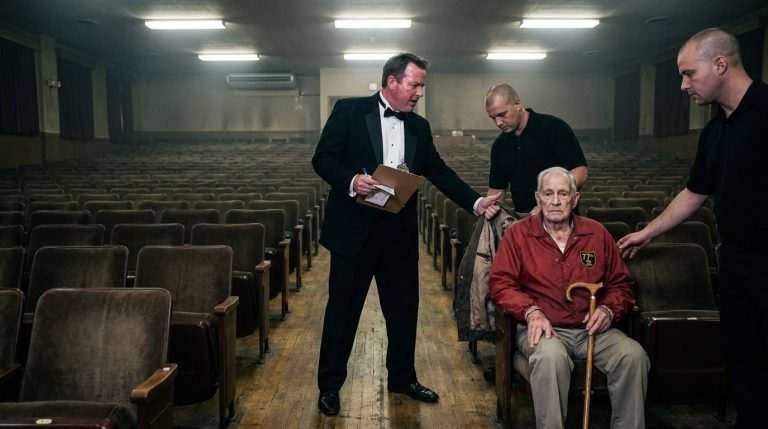
The air in the Arlington VFW post was thick, a dense atmosphere of stale beer, wood smoke, and the heavy, lingering scent of old uniforms stored in humid closets. It was a place where history wasn’t preserved behind glass; it was worn thin by the people who lived it. Lucas pushed the heavy door open, his eyes adjusting to the dim, amber light. He felt an intruder here, not because of his uniform, but because of what he now carried in his jacket.
Danny was in the back corner, hunched over a scarred wooden table. The Bronze Star, which Lucas had returned to him only days ago, sat on the table like a lead weight, its edges glinting dully under the low-hanging lamps. Danny was nursing a glass of dark liquid, his hands—wrinkled, arthritic, and trembling—resting near the medal.
Lucas approached slowly, his boots muffled by the threadbare carpet. He felt the ledger against his side, a dangerous, paper-bound truth that contradicted everything the men in this room held dear about the sanctity of their service. He sat down opposite Danny.
“You shouldn’t have come here, son,” Danny said, his voice raspy, as if his throat were filled with the dust of the jungles he’d left behind fifty years ago. He didn’t look up. “This place is for forgetting. We come here so we don’t have to carry it out there, in the world that wants to keep it all clean.”
“I found something,” Lucas said, his voice barely a whisper, pitched to be heard only by the man across from him. He didn’t pull the ledger out, not yet. “In the archives. There’s a pattern, Danny. It wasn’t just your medal that got swept away. It’s been happening for decades.”
Danny finally looked up, and the sight was unsettling. The man’s eyes weren’t just weary; they were hollow, glazed over with a deep, defensive cynicism. “You think you’re the first to find the cracks? You’re a guard, Lucas. You’re paid to stand in the gap, not to tear it open. Every time someone like you tries to make the system honest, they just build a bigger wall.”
“It’s not just a wall,” Lucas countered, his pragmatism hardening. “It’s a machine. They aren’t trying to protect the honor of the soldiers. They’re trying to bury the reality of what they lost.”
“And what good does digging do?” Danny pushed the glass away, the clink of the ice sharp against the wood. “You expose it, and what happens? The public gets a headline. The media gets a story. And we? We get a new set of rules to keep us quiet. You broke the ritual to give me that medal back, and I’m grateful—but look at me. I’m a national news segment now. My friend’s life is a debate topic on a cable channel. That wasn’t a win, Lucas. That was a violation.”
The friction of the room intensified. Lucas realized then that Danny didn’t want the truth exposed if it meant the final degradation of his memories. He was protecting the mystery of Tommy’s sacrifice because the truth—the bureaucratic, cold, logistical truth—was something he couldn’t afford to acknowledge.
Lucas felt a tremor of doubt. Was his pursuit of the ‘truth’ actually a form of violence? Was he stripping away the only comfort these men had left, even if that comfort was built on a foundation of systemic erasure?
“I’m not looking for a headline,” Lucas said, reaching into his jacket. He withdrew the ledger and slid it across the scarred table. “I’m looking for the men who haven’t been remembered yet. Vance is scrubbing the record, Danny. He’s deleting people. If we don’t stop it, there won’t be a single thread left to pull.”
Danny stared at the ledger, his fingers hovering over the spine. He looked at Lucas, and for a moment, the cynicism flickered, replaced by a raw, jagged hunger for vindication. But then, he pulled his hand back as if the book were burning.
“You’re playing a game you’ve already lost, kid,” Danny said, his voice trembling. “The moment you brought that metal back to me, you stepped off the mat. You’re not a guard anymore. You’re just a target.”
The door of the VFW opened, and a group of younger veterans—Iraq and Afghanistan returnees—poured in, their laughter boisterous and discordant. They didn’t see the tension at the back table. They were the next generation of the machine, still believing in the narrative, still trusting the polish of the boots and the weight of the medals.
Lucas watched them, realizing that he was the only one in the room who could see the rust. He felt isolated, his internal compass spinning. He needed allies, but he had offered them a burden, not a remedy. The ledger was no longer just proof; it was an ultimatum. And as he stood up to leave, the weight of it felt heavier than the rifle he’d carried for years. He had stepped off the mat, but he hadn’t yet found a place to land.
CHAPTER 5: The Boards Verdict
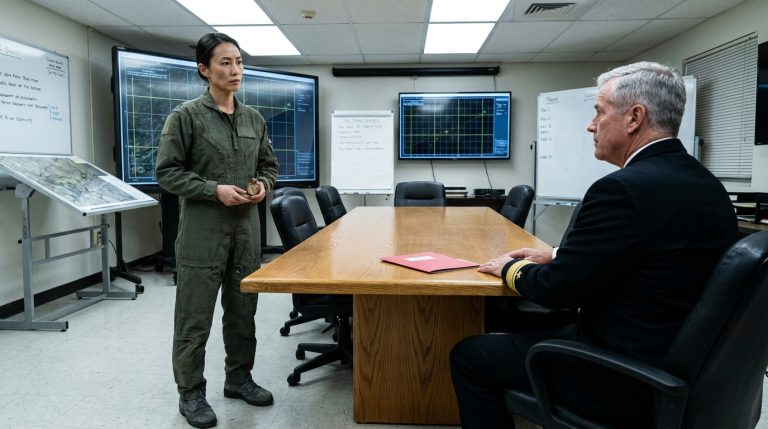
The hearing room was a vacuum of sound. Located in the deepest, most secure corridor of the Fort Myer administration building, the room was panelled in dark, matte wood that absorbed the light rather than reflecting it. Captain Vance sat at the center of a long table, his face a mask of granite, flanked by three senior officers whose uniforms were heavy with the weight of decades of institutional adherence.
Lucas stood at the center of the room. He didn’t feel the nervousness he expected. Instead, he felt a strange, cold clarity. The ledger, now tucked securely within his jacket, felt like a physical extension of his own body. He had spent the previous forty-eight hours verifying the discrepancies he’d found. He had accessed his own digital personnel file only to find it riddled with “administrative corrections”—redactions made in the last forty-eight hours that effectively neutered his previous commendations. They weren’t just firing him; they were systematically erasing his legitimacy.
“Sergeant Hayes,” Vance began, his voice flat, devoid of any personal inflection. “You stand accused of dereliction of duty, breach of security protocols, and unauthorized access to classified archival materials. Do you understand the charges?”
“I understand them, sir,” Lucas replied. His voice was steady, the cadence measured. “But I also understand that these charges are a structural necessity for you.”
The officers at the table shifted, their expressions sharpening. Vance didn’t blink. “You are not here to debate the nature of the regiment, Sergeant. You are here to account for your violation of it.”
“The violation happened long before I stepped off the mat,” Lucas said, his eyes locking onto Vance’s. “The violation is the policy of discarding the memories of the men who served. I have the records, Captain. I have the disposal orders from ’68, ’84, ’99—every decade, the same pattern of sanitizing the plaza to ensure the ‘Unknown’ remains an abstraction, rather than a collection of human lives.”
The room went deathly still. The silence wasn’t the silence of respect; it was the suffocating silence of an institution bracing for impact. Vance leaned forward, his hands flat against the table. The grain of the wood was intricate, old, and scarred, much like the history he was trying to hide.
“You have nothing,” Vance said, his voice dropping into a dangerous, low pitch. “Anything you think you have is the detritus of a system that manages thousands of soldiers. You are a single, rogue element, Hayes. You think you’re exposing a truth, but you’re only exposing your own inability to function within the parameters of your oath.”
“My oath is to the soldiers,” Lucas corrected. “Not to the stone. And the soldiers don’t want to be forgotten. They don’t want to be cleaned away like grit off a plaza.”
He pulled the ledger from his jacket and placed it on the table. It looked small, fragile, and utterly out of place on the polished surface. The officers didn’t look at it. They looked at Vance.
Vance stood up. He didn’t look at the book. “This board finds your behavior consistent with a catastrophic breakdown of discipline. Your record, as it stands before us, indicates a pattern of instability that predates your assignment to the Tomb. Sergeant, you are relieved of duty, effective immediately. You will surrender your sidearm, your badge, and your uniform. You are to vacate the premises within the hour.”
“And the records?” Lucas asked, his voice cutting through the finality of the verdict. “What happens to the names you’ve been scrubbing?”
“They are part of the collective history of the United States Infantry,” Vance said, walking toward the door. “They do not require your stewardship.”
As the officers stood and began to file out, Lucas remained at the center of the room. He realized that Vance had been prepared for this—the tampered files, the swiftness of the hearing, the complete exclusion of the ledger as legitimate evidence. The machine was designed to turn every accusation of systemic rot into an issue of individual failure. He had been labeled “unstable” so effectively that anything he said, anything he revealed, would be viewed through the lens of his own presumed psychological collapse.
He looked down at the ledger on the table. Vance had left it there, dismissing it as if it were a toy. But as Lucas picked it up, he noticed the way the Captain’s hand had hovered near it—a brief, involuntary hesitation. Vance was terrified of the book, not because it was classified, but because it was real.
Lucas walked out of the room, his gait stiff. He had lost the badge, the uniform, and the status. He had lost the structure that had held his life together since the day he’d returned from Iraq. But as he stepped out into the biting November air, he felt a strange, terrifying lightness. The institution had stripped him of his armor, but in doing so, it had finally freed him from the ritual.
He didn’t look back at the administration building. He looked toward the parking lot where his car sat—a rusted, unassuming machine that now felt like his only remaining outpost. The struggle wasn’t over, but the theater of it had changed. He wasn’t guarding a tomb anymore; he was guarding the truth, and for the first time in his life, he didn’t need the permission of a Captain to do it.
CHAPTER 6: The Final March
Lucas didn’t head for the media. He didn’t head for the gates. He headed for the only place where the weight of his actions could be measured against the scale of the past: the amphitheater shadows overlooking the plaza. He walked with a heavy, deliberate pace, his civilian clothes feeling alien and thin against the biting November air. He wasn’t a guard anymore, but he had never felt more like one.
He reached the observation point just as the relief was beginning. Below, he saw the new guard—a young, rigid figure—begin the twenty-one steps. The precision was hypnotic, the sound of the boots striking the stone a rhythmic, hollow heartbeat. He watched Captain Vance standing near the memorial base, his posture a reflection of the marble’s own unyielding stillness. Vance was there to ensure the ritual remained untouched, to supervise the performance of the lie.
Lucas stepped out of the shadows. He didn’t call out. He simply walked down the path toward the plaza. When Vance spotted him, the Captain’s face curdled into a mask of controlled fury. Vance moved to intercept him, his stride heavy and purposeful.
“You have no authorization to be here, Hayes,” Vance said, his voice a low, grating rasp. “Turn around, or I will have you removed.”
Lucas stopped, his hand resting on the ledger he had brought with him. He didn’t look at the guard; he looked at the stone. “The authorization ended when I realized what you were protecting, Captain. You aren’t guarding the Unknown. You’re guarding a lack of memory. You’re guarding the void.”
“I am guarding the peace,” Vance replied, his eyes scanning the surrounding area, ensuring the crowd was kept at a distance. “The system provides a container for the grief that would otherwise destroy this country. If we let the history bleed out—if we acknowledge every lost medal, every forgotten name—the ritual loses its gravity. It becomes just another tragedy in a sea of them.”
“It is a tragedy,” Lucas said. “And the ritual is a sedative. You aren’t helping them grieve, Vance. You’re helping them forget.”
Vance reached for his radio, his movements sharp. “You’ve spent your life learning the steps of the march, Sergeant. You should know that the march doesn’t stop for the truth.”
“It stops for the silence,” Lucas countered. He pulled the ledger out, but he didn’t hand it to Vance. He opened it to the page listing the disposal orders. He held it up so the wind could catch the pages, the rust-stained paper fluttering like a dying bird. “I’ve seen the orders. You didn’t just manage the waste. You created it.”
Vance stopped. His face, usually so composed, fractured. The “Cornered Beast” tension in his posture was palpable; his hand drifted away from the radio, his gaze fixed on the ledger with a visceral, terrified recognition. He realized that the document wasn’t just a ledger—it was an indictment, a catalog of decades of institutional failure that he had personally authorized.
“You think this is justice?” Vance hissed, taking a step closer, his voice cracking. “This is just another layer of destruction. You expose this, and you don’t just take me down—you pull the floor out from under every family who believes their loved ones are resting in a place of perfect honor.”
“They are resting in honor,” Lucas said, his voice steady, carrying the weight of the years. “But they deserve the truth, not the polish.”
Lucas walked past him, moving toward the plaza. He didn’t stop for the protocol. He reached the base of the Tomb, the place where he had found the first badge. He placed the ledger on the stone. He then took his own service pins—the ones he had been told to surrender—and laid them on top of the rusted, corroded badges he had collected from the archives.
It was a quiet, almost domestic act of repair. He wasn’t breaking the tomb; he was filling it with the things that had been systematically stripped away.
Vance stood behind him, trembling. The guards stopped, the ritual shattered by the presence of a man who refused to move. The crowd fell silent, their collective attention shifting to the man who was no longer a symbol, but a witness.
Vance didn’t move to stop him. He couldn’t. The weight of his own long-held secret, combined with the presence of the ledger, seemed to drain the authority from his frame. The antagonist’s collapse was quiet, a slow sinking of the shoulders as the realization dawned that his “sacred wall” was no longer protecting anything.
Lucas stood up. He looked at the young guard, who was frozen in a salute that held no direction. He looked at Danny, who had appeared at the edge of the crowd, his hat in his hands. Lucas didn’t speak. He simply stood there until the cold became a part of him.
After a long, slow time, he turned and walked away. He passed Vance without a glance. He walked to the edge of the cemetery, his gait no longer a military march, but the steady, rhythmic walk of a man walking home.
He stopped by the gate, where the first heavy frost of the winter had started to settle on the iron. He reached out and brushed the rust away with his thumb, the gritty, orange residue staining his skin. He took a deep breath, the air clean and sharp. The tomb remained, as it had for a century, but the silence around it had changed. It was no longer the silence of denial. It was the silence of a promise finally acknowledged.
He had no medal, no uniform, and no rank. But as he looked back at the distant, gray silhouette of the amphitheater, he felt the heavy, quiet peace of a man who had finally put the past to rest. He turned and kept walking, the road ahead gray and uncertain, but for the first time, entirely his own.