Whispers in the Wet Leaves: The Unyielding Stand at the Matanikau Seam
CHAPTER 1: THE MUD AND THE DISMISSAL
Colonel William Whailing adjusted his grip on the scratched brass binoculars, feeling the cold, oxidized metal bite into the damp skin of his palm. Across the makeshift plywood table, Major Vance didn’t look up from his ledger. The major’s pen scratched methodically against grease-stained paper, recording another shipment of spoiled rations that had arrived at the iron pier two nights ago.
“You don’t have a command, William,” Vance said, his voice flat, drained of heat by three weeks of dysentery and salt-pork broth. “The Division commander signed the relief orders at dawn. You’re staff now. You audit casualty manifests and check perimeter wire.”
“Give me forty men,” Whailing said. He didn’t raise his voice. He reached into his coat pocket and pulled out a heavy pair of cracked brass binoculars, setting them on the edge of the major’s ledger with a dull thud. “No radios. No extra rations. Just the country boys who brought their own hunting habits from the hills. The ones who know how to sit in a wet ditch until the rot hits their ankles without shifting an inch.”
Vance stopped writing. His eyes drifted to the cracked left lens of the optics, where a line of dried river silt was embedded deep into the brass casing. “You want to pull elite marksmanship talent out of standard rifle platoons that are already operating at sixty percent strength? The Japanese are pushing three regiments toward the Matanikau riverbed right now. Captain Miller lost twelve men yesterday just checking a water hole.”
“Miller lost twelve men because his point man was whistling through his teeth and stomping through dry bamboo like a mule,” Whailing replied, leaning forward until his knuckles pressed into the raw pine grain of the table. “You send a company forward, you make enough noise to wake the dead. The Japanese sit high in the banyan roots, pick off your squad leaders, and wait for your mortars to drop short in the canopy. Give me the men who hunt by sight. I’ll clear the river seam before your main line even buckles.”
Vance stared at Whailing for five long seconds. Outside, the dull thunk of an engine block turning over in the mud echoed from the motor pool, followed by the wet sloshing of boots dragging through standing water.
“Take your pick from the third battalion’s rest camp,” Vance said softly, dragging his pen back to the paper. “The ones too shaken to hold a bayonet in a line trench. If you get cut off past the river, don’t ask for a runner. Division isn’t sending a squad to pull your body out of the roots.”
Whailing didn’t thank him. He grabbed the brass binoculars by the strap, turned on his heel, and pushed through the soaked canvas flap into the gray downpour of Guadalcanal.
Twenty minutes later, Whailing stood under the dripping awning of a supply lean-to, watching seven men line up in the mud. They didn’t look like an elite detachment. Their utilities were bleached pale by salt water and sun, the knees torn out and patched with canvas scraps. Marine Corporal Miller—a skinny kid from the Ozarks with yellowed fingers from cheap tobacco—stood at the end, carefully wiping the bolt assembly of his Springfield rifle with a greasy rag.
Whailing walked down the line, stopping directly in front of Miller. He didn’t look at the kid’s face; he looked at his hands. The fingernails were short, scrubbed raw, and the skin around the thumb joint was calloused hard from years of cycling bolt actions in cold woods.
“No radios out there, Corporal,” Whailing said, his voice cutting through the steady patter of rain on the jungle canopy overhead. “No battery packs to drag through the swamp. If you see something that needs killing, you don’t call a battery three miles back to drop iron on it. You take the shot, you shift ten yards in the mud, and you wait for the next officer to step into your glass. We move as pairs. Hand signals only. If you lose your partner, you don’t yell. You find his bootprints and you follow them until you hit blood or the river.”
Miller wiped a drop of rainwater off the Springfield’s receiver with his thumb, his face completely devoid of expression. “Is the river deep today, Colonel?”
“Deep enough to drown a man if he’s wearing too much iron,” Whailing said. “Leave your pack frames here. Take four bands of thirty-caliber, two canteens, and a dry pair of socks wrapped in oilskin. We cross the Matanikau before the sun hits the ridge.”
CHAPTER 2: CROSSING THE SEAM
The mud west of the Matanikau didn’t just cling to rubber soles; it pulled at a man’s knees like wet cement. Whailing moved through the ferns without taking his eyes off the thick overhang of wild sugarcane twenty yards ahead. Every breath tasted like rotting vegetation and iron.
Behind him, Miller’s boots made almost no sound, stepping precisely into the shallow impressions Whailing left in the moss. The six other Marines fanned out into three tight pairs, invisible in the green shadows, moving on a parallel line thirty paces to the left.
Whailing raised his left hand, fist closed. The line froze instantly.
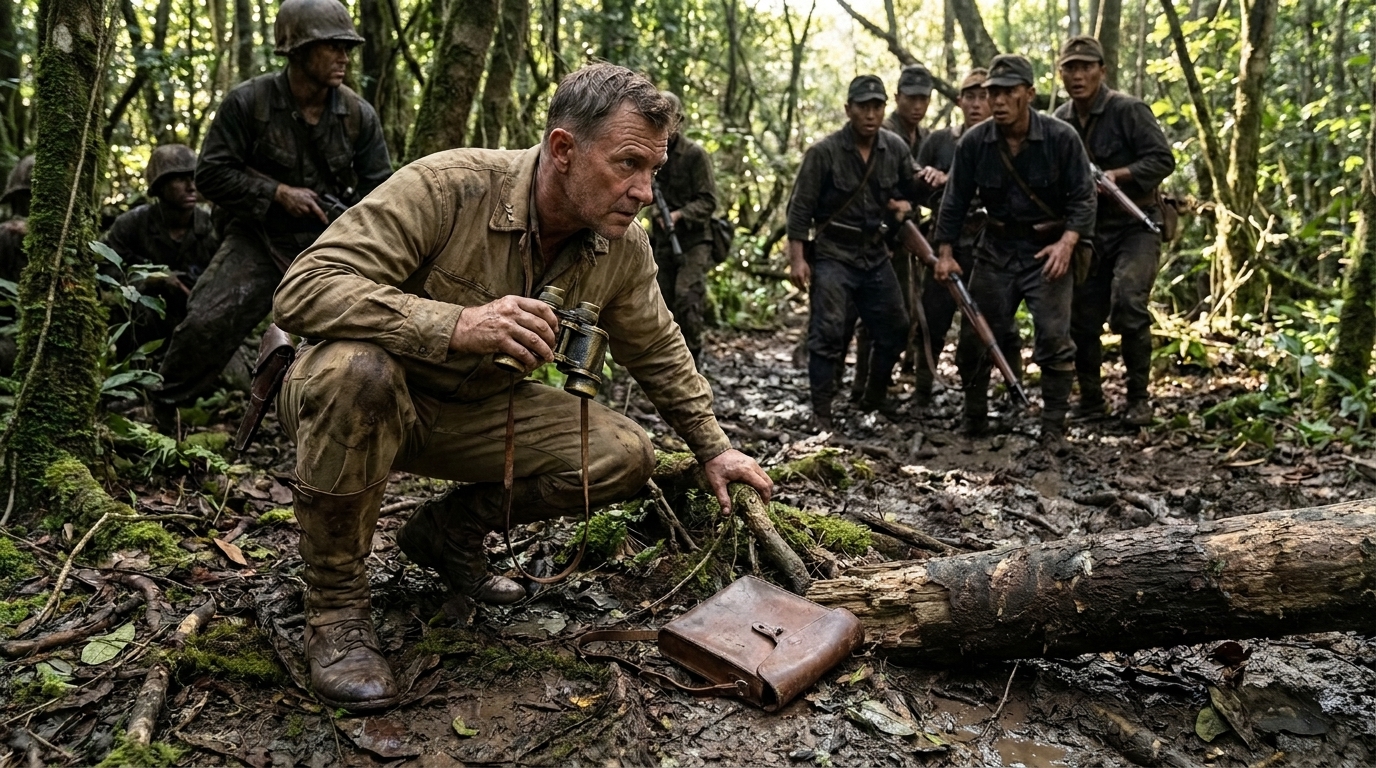
Miller dropped to one knee, his Springfield brought up in a smooth, practiced arc, the iron sights trained on a gap between two ironwood trunks. Whailing raised the brass binoculars, pressing his right eye to the intact right lens while ignoring the blurred gray haze from the cracked left side.
Fifty yards out, where the high ridge sloped down into the river’s muddy delta, a thin sapling quivered. There was no wind. The heavy air sat flat and dead over the swamp.
Through the clear glass, Whailing caught a flash of darkened cotton cloth, saturated with sweat and trail dust. A Japanese scout, crouched low near a rotting root, was carefully scraping mud off his calf with the spine of a bayonet. Behind him, spaced three feet apart along the natural depression of a dry creek bed, sat a dozen more figures in full field kit.
They weren’t resting. They were waiting for a signal.
Whailing slowly lowered the glass, his thumb resting against the cool metal body. He didn’t reach for a map case or search his pockets for a notebook. Without radio gear on their backs, there was no brass operator to whisper coordinates back to the battery commanders near the airfield. There was only the distance, the wind direction, and eight men with heavy barrels.
He looked back at Miller. Whailing held up two fingers, tapped his own collarbone twice, then pointed toward the dense growth on the far side of the creek bed.
Miller nodded once. He understood the language of mountain hunters: kill the man who gives the orders first, or spend the next hour digging your own grave out of the mud.
Whailing carefully shifted his weight, feeling a root press hard against his left knee. He raised the optics once more, bringing the man with the bayonet into focus. On the man’s lap rested a leather map case, pristine and unspotted by the river slime that covered the rest of his gear.
Something didn’t fit. A frontline scout unit carried bare-minimum kit, stripped clean for quiet movement through the brush. A man carrying a clean, dry dispatch case on a forward reconnaissance probe was either lost, or he was holding the blueprint for the entire ridge.
Whailing didn’t pull his pistol. He tapped Miller’s shoulder, pointing directly at the man with the clean leather case.
Miller adjusted his cheek weld against the walnut stock, his breath catching in his chest as his finger found the curve of the trigger.
CHAPTER 3: THE FIRST COLD CUT
The sharp crack of Miller’s Springfield sliced through the jungle hum, the sound deadening almost immediately in the thick canopy. Fifty yards out, the man with the clean leather dispatch case buckled forward, his legs collapsing in the mud before his arms could catch him.
Silence hung over the creek bed for two heartbeats—that brittle, terrifying pause where disciplined soldiers try to process the impossible.
Whailing didn’t wait for them to figure it out. He slapped his hand against a nearby cedar trunk, a quick double-strike that echoed like a breaking bough. Ten yards to his left, two separate rifle cracks erupted in near-unison.
The Japanese NCO reaching for the fallen dispatch case pitched sideways into the brush. Beside him, an observer carrying a heavy tripod stumbled back, his weapon dropping flat into the silt.
“Shift!” Whailing barked, his voice low and raspy as he grabbed Miller’s belt webbing and yanked him backward three steps into a thick patch of wild ginger.
The creek bed erupted. A spray of automatic fire tore through the upper leaves exactly where Miller had been kneeling a moment before, showering them with shredded bark and wet moss.
Miller scrambled onto his stomach, his hands moving with blind, practiced speed as he stripped a fresh five-round clip from his belt, slapped it into the receiver, and drove the bolt forward with the heel of his hand. “They don’t know where it came from,” Miller hissed, wiping a splatter of mud off his chin. “They’re shooting at the sound.”
Through the gap in the ginger stalk, Whailing raised his brass binoculars with his right hand, keeping his head flush with the wet soil. The intact lens captured the chaos below: the enemy column had compressed inward, a dozen soldiers crouching shoulder-to-shoulder behind a single mossy log, staring wildly into the tree line.
Without an officer shouting directions or an observer pointing out targets, the column had lost its brain. They were well-armed, well-trained, and entirely paralyzed by a threat they couldn’t see.
“They’re going to pull back into the gully,” Miller murmured, eyeing the bunching line. “If they get behind that ridge, we lose ’em.”
“They aren’t pulling back,” Whailing said softly, his thumb tracing the cracked glass rim. “They’re protecting that case.”
Whailing raised his left hand and signaled three quick fingers to the shadows on his left flank. A second later, a single shot echoed from fifty yards away, driving the remaining machine gun crew down into the mud.
Whailing pushed himself up onto his knees, his jaw tight. “Cover me, Corporal. I’m taking that pouch.”
CHAPTER 4: THE MAP IN THE MUD
His fingers closed around the cold brass latch. A single pop freed the flap, and Whailing pulled out a thick, folded sheaf of oiled oilskin paper, slick with fresh rain.
Miller kept his Springfield pinned against his shoulder, scanning the ridge line while Whailing unfolded the map across his knee.
It wasn’t a standard field sketch. It was a pristine, factory-new map grid overlay—crisp, dry, and marked in heavy red grease pencil.
Whailing’s eye followed the red arc tracing the Matanikau River. Across the western sector where they currently stood, a massive three-pronged advance was drawn in meticulous detail, converging directly on the airfield’s exposed flank.
Then Whailing saw the anomaly.
In the lower right corner, where the Division seal was stamped, the Matanikau riverbend—the exact seam his eight men were holding—was completely shaded over in black hatch marks. Above the shading, typed in clean typewriter print, were two words: IMPASSABLE CLIFF.
Whailing froze. He looked up at the muddy, gentle incline rising twenty yards in front of them. There was no cliff. There was only an open, wide-open backdoor straight to Henderson Field.
“Colonel?” Miller whispered, shifting his boots in the gravel without lowering his rifle. “What’s on it?”
Whailing smoothed the paper against his wet trousers, his thumb pressing down over the fresh grease pencil marks. “Division mapped this whole sector out as a wall, Corporal. They think the river protects the flank.”
Miller turned his head slightly, his brow furrowing. “If Division thinks it’s a wall, there ain’t no reserves behind us.”
“There aren’t,” Whailing said. “The staff officers drew what they wanted to see so they wouldn’t have to string wire down here. The Japanese know it. They’re moving a full regiment through this gap, and nobody at headquarters knows the door is unlocked.”
Without radio gear to send a flash report back to Vance’s desk, the piece of paper in his hand was worthless unless they used it to anchor their own barrels.
Whailing folded the map tightly, shoving it inside his breast pocket before grabbing his brass binoculars. He tapped the cracked glass frame against his palm twice.
“We aren’t falling back to tell ’em, Miller,” Whailing said, his voice dropping into a cold, flat register. “If we run back to hand Vance a map, that regiment will be on the airfield before the ink dries. We close the door right here.”
Miller looked at the dense brush along the ridge, then back at Whailing. “Eight of us against a regiment, Colonel?”
“They can’t see how many of us there are,” Whailing replied, rising slowly into a crouch. “And as long as they don’t see us, we own the river.”
CHAPTER 5: THE TRAP AT THE RIDGE
Whailing’s hand snapped down, two fingers extended toward the narrow spine of rock that spanned the ravine’s choke point.
Fifty yards below, the main body of the Japanese regiment entered the funnel. They were moving in tight column formation, packs low, bayonets fixed, pressing forward with the heavy, unhurried confidence of men who believed their flank was entirely unobserved.
Miller didn’t ask for permission. His cheek slammed against the Springfield’s cheek piece, and his first round took the lead point officer straight through the shoulder harness.
Before the echoes cleared, Whailing signaled the paired team tucked into the banyan roots thirty yards to the left. A second shot cracked—deliberate, cold, precise—dropping the deputy leader who had reached for the dropped iron whistle.
“Keep ’em bunched!” Whailing rasped, shifting his posture behind a moss-slick boulder. He grabbed a runner by the sleeve—a pale corporal named Dennis—and shoved a scrap of ripped paper into his palm. “Take this to the right team. Tell ’em no broad volleys. Single shots at the men carrying wire or optics. Make them think they’re walking into a battalion perimeter.”
Dennis nodded once, his face slick with rain, and slid backward through the ferns like a water snake.
Below, the enemy column collapsed inward. Deprived of immediate leadership and unable to locate the source of the fire through the dense canopy, the lead company crowded into the muddy depression of the draw.
A sergeant tried to wave the men forward with a sidearm. Miller’s second round cut his shout off mid-word.
Whailing raised his brass binoculars, his right thumb tracing the cracked left rim while he calculated the geometric choke. Without radio-guided artillery to pulverize the draw, every yard of dirt had to be bought with patience and iron.
The Japanese rear guard began pouring blind machine-gun fire high into the leaves, the heavy rounds chewing through vine and bark, showering Whailing’s neck with wet debris.
Whailing didn’t flinch. He watched the enemy force—three hundred men strong—freeze in place, paralyzed by four unseen pairs of eyes holding the only dry exit out of the Matanikau seam.
Miller cleared his chamber, catching the hot brass shell in his left palm before it hit the mud. “They’re fixing bayonets, Colonel. They know we’re small.”
“They don’t know a thing,” Whailing said, his voice level and hard as flint. “They’re just getting desperate.”
CHAPTER 6: THE QUIET AFTERMATH
The firing stopped not with a whistle or a order, but with the slow, dripping silence of wet bamboo returning to its natural state.
Down in the draw, what remained of the Japanese regiment pulled back across the shallow bend, leaving the muddy approach strewn with discarded gear, empty ammo crates, and over seven hundred fallen men who would never cross the Matanikau.
Miller lowered his Springfield, his breath coming in jagged, wheezing hitches as he rested his forehead against the barrel’s warm steel frame. His shoulders shook once from raw biological exhaustion, but his hands stayed firmly wrapped around the walnut stock.
Dennis crawled back through the ferns, dropping two spent stripper clips onto the moss before sitting back against a tree trunk. “They’re gone, Colonel. Shifted west toward the coast. They aren’t coming back up this seam.”
Whailing didn’t answer right away. He reached into his breast pocket, pulled out the pristine, folded oilskin map with its clean red grease marks and the typed IMPASSABLE CLIFF label, and held it out over the rock shelf.
Without a word, he let go. The map fluttered twice in the humid air before landing in a stagnant, mud-clouded puddle five feet below.
Whailing turned back toward the ridge path leading back to division headquarters. His boots made a sharp, wet suction noise as he stepped off the rock shelf, his right hand keeping a firm grip on the scratched brass binoculars.
“Pack it up, Miller,” Whailing said, his voice quiet, flat, and stripped of all drama. “We have to go show Major Vance where his cliff used to be.”
Miller wiped the sweat and river grit off his brow with his sleeve, picked up his spent brass, and fell into step three paces behind the colonel, his boots moving in rhythm through the deep, wet mud.
Whailing unbuttoned his top coat pocket, slid the heavy brass binoculars inside, and snapped the brass fastener shut, feeling the solid, silent weight rest square against his chest.