The Iron Perimeter: How One Stubborn Acre of Wildflowers and Rust Broke a Suburban Empire
CHAPTER 1: THE IRON PERIMETER
The sun had barely cleared the aluminum rooflines of Whispering Pines when the click of the shutter cut through the dry morning air.
I did not look up from the damp earth where I was turning over the soil around the tomato roots. I didn’t need to. The cadence was as familiar as the grinding of the old tractor gears out in the back pasture before the developers paved it over. Two short clicks, the mechanical hum of a digital zoom, and then the scrape of soft-soled walking shoes sliding backward over manicured Kentucky bluegrass.
Brenda was at her post.
Between my side yard and her property line stood a six-foot wall of sunflowers, heavy-headed and burning yellow against the pale, identical beige siding of her house. They were supposed to block her view, but they only seemed to magnify her obsession. Every morning at precisely six o’clock, she patrolled the perimeter with a clipboard tucked under her arm like an accountant auditing a sinking ledger.
I straightened up slowly, wiping the damp loam from my hands onto the thigh of my canvas work pants. The air smelled of crushed stem, dry dust, and the faint, bitter scent of iron rot rising from the old hand-forged gate latch my grandfather had bolted to the oak post back in nineteen-forty-something.
“You’re missing a weed by the foundation, Brenda,” I said, my voice carrying flatly across the narrow strip of gravel separating our worlds.
The footsteps stopped. A silhouette froze against the bright morning glare reflecting off her picture window. Brenda did not turn around immediately; she adjusted the strap of her leather purse over her shoulder—even when walking her own lawn in slippers, she dressed like she was heading to a municipal court hearing—and finally pivoted with practiced stiffness.
“Property values are a collective responsibility, Nathan,” she said, her voice thin and sharp as a sheet of tin. “That unpaved patch by your meter is a vector for local neglect. The association has provisions for unregistered brush.”
“It’s a patch of dirt, Brenda. Dirt tends to grow things if you leave it alone long enough,” I replied, leaning my weight against the handle of the garden fork. The metal was cool, pitting slightly with age where the red paint had chipped away to reveal gray steel underneath.
She lifted the clipboard, tapping a yellow legal pad with a manicured fingernail. “I documented the noise levels from your little gathering last night, too. Laughter after ten o’clock violates municipal ordinance four-point-two. I’ve already flagged it for the committee.”
I watched her eyes. They weren’t angry; they were dead and mechanical, scanning my property for a fracture, a loose shingle, a blade of grass standing half an inch too tall. She needed this perimeter tight. She needed every house on the block to reflect the exact same shade of lifeless beige so she could pretend the world outside her fence wasn’t constantly eroding.
“We weren’t breaking ordinances,” I said quietly. “We were having a birthday dinner.”
“Rules do not bend for birthdays,” she snapped, turning sharply on her heel and marching back toward her back door, her clipboard clutched to her chest like a shield.
I watched her go, my gaze dropping past her retreating form to the exact spot where our property line met the association’s asphalt. Something caught my eye—a small, orange plastic surveyor’s flag stuck deep into the soil right inside my boundary line, a foot past where the old stone marker had sat for decades.
My stomach tightened. Someone had crossed the line while I was sleeping.
CHAPTER 2: THE BRIGHT ORANGE LINE
The bright orange stake remained locked in my line of sight, a synthetic intrusion vibrating against the quiet, sun-baked dust of the yard.
I left the tomato fork leaning against the oak post and walked over to the property edge, my boots crunching over dried clover and fallen twigs. The plastic marker wasn’t just stuck into the ground; it was driven deep, angled slightly toward my old apple tree as if staking a claim in a game of territorial chess. Ten inches inside my boundary. Ten inches of dirt that had belonged to my grandfather before Whispering Pines was anything more than a dry stretch of grazing land and scrub oak.
The air smelled of baked dust and stale irrigation water. Down the block, a lawn sprinkler kicked on with a rhythmic, mechanical chuff-chuff-chuff, spraying a fine mist over a stretch of grass so uniformly green it looked painted.
I crouched down, wrapping my fingers around the base of the plastic stake. The ground was hard-packed, baked by a July sun that showed no mercy to anything unwatered by a timed underground system. I pulled. It didn’t budge. Whoever had hammered it in had used a mallet, sinking the jagged tip past the topsoil and into the heavy clay underneath.
“Looking for a new property line, Nathan?”
The voice came from across the gravel strip. Brenda was standing on her back patio now, a stainless steel watering can dangling from her fingers. She wasn’t looking at me; she was staring down at her own manicured hostas, inspecting every leaf for blemishes, but her words were pitched to carry across the narrow gap.
I didn’t answer right away. I straightened up, wiping my palm against my jeans, and looked across at her. Her back was stiff, her shoulders squared into an invisible harness.
“This stake is ten inches onto my side of the stone marker, Brenda,” I said, keeping my voice level, the sound flat and heavy against the ambient hum of the neighborhood.
She turned slowly, setting the watering can down with a dull metallic clink on the paving stones. “The association’s master plat was updated last month by certified surveyors. Old boundary markers placed prior to development integration are subject to municipal recalculation. If your fence line encroaches on the association’s drainage easement, it will have to be addressed.”
There it was. Not a mistake, but a calculated pivot. When the sunflowers hadn’t worked, when the neighborhood gossip hadn’t driven me out, she had simply decided to redraw the map.
“There is no drainage easement here,” I said, stepping closer to the rusted wire fence that separated our properties. “My grandfather’s deed explicitly excludes this acre from the Whispering Pines subdivision plat. You know that. The county registry has the original paper stamped in sixty-two.”
Brenda’s jaw tightened. A faint, twitching muscle flickered just beneath her ear, the only sign of the high-tension machinery running under her composed exterior. “Paperwork from the nineteen-sixties holds very little weight against modern municipal zoning codes, Nathan. Standards evolve. Communities require uniformity to maintain stability.”
“Stability,” I repeated, the word tasting like dry iron.
“People invest their life savings into this neighborhood,” she said, her voice rising slightly, losing its polished edge for a fraction of a second before she reined it back in. “They expect a certain standard of living. When one property refuses to conform—when it sits there like an unrepaired scar—it pulls everything down with it.”
She wasn’t talking about drainage easements or property values anymore. The raw panic behind her legalistic jargon was palpable, masked only by layers of passive-aggressive protocol. If my unyielding acre proved that the system had a blind spot, that the perfect beige walls of Whispering Pines could be bypassed by a single stubborn patch of wildflowers, then the entire illusion she had spent a decade building would start to crack.
I reached down, grasped the orange plastic stake with both hands, and wrenched it upward with a sharp, heavy twist. The clay gave way with a wet sucking sound, and I pulled the marker free, tossing it casually onto the gravel at her feet. It clattered against the stones, rolling slightly before coming to a stop against the toe of her immaculate walking shoe.
Brenda stared down at the bright plastic, then slowly raised her eyes to meet mine. Her face went pale, her lips pressing into a thin, white line.
“That is destruction of official association property,” she whispered, her voice trembling with cold fury.
“It’s trash on my land,” I said, turning my back on her and walking back toward the garden fork.
As I picked up the tool, the distant hum of the neighborhood traffic seemed to fade, leaving only the sound of my own steady breathing against the quiet background of the old homestead. I knew this wasn’t the end of it. The stake was just a probe. The real battle wouldn’t be fought over plastic markers in the dirt; it would be fought behind closed doors at the county archives, where the yellowed paper records of nineteen-sixty-two were waiting to be pulled out of the dark.
CHAPTER 3: THE COUNTY ARCHIVES
The dull clatter of the orange plastic stake rolling against Brenda’s shoe still echoed in the dry heat as I turned my back and walked toward the weathered boards of the porch.
I didn’t look back to see if she picked it up. Instead, I unlatched the heavy wooden screen door—its spring groaning with a dry, familiar squeak—and stepped into the kitchen. The air inside was several degrees cooler, smelling faintly of dried mint, old timber, and cast-iron seasoning. On the counter sat the canvas satchel my grandfather had used to carry hardware receipts and land titles back when the county seat was nothing more than a brick courthouse surrounded by gravel roads.
If Brenda wanted to play a game of municipal engineering, shouting across the fence with yellow legal pads and plastic markers, then it was time to move the board away from the sun-baked lawn and into the basement of the municipal building.
I picked up the satchel, dropped a heavy brass keyring inside, and walked back out through the front door. My truck—a faded blue ninety-four Ford with a rusted tailgate and a dented bumper—sat parked in the gravel drive, entirely out of place among the pristine, two-car garages and hybrid sedans lining Whispering Pines. The engine turned over with a rough, rattling cough that brought a face to a window three doors down, a curtain twitching just enough to let a pair of eyes check the perimeter.
The drive to the county annex took fifteen minutes through the grid of suburban expansions that had swallowed the old county map whole. Every turn revealed another block of identical two-story boxes, their roofs sharp and uniform under the glaring afternoon sun.
When I pulled into the asphalt lot behind the county records department, the heat shimmered off the blacktop. Inside, the building smelled of old paper, floor wax, and the hum of fluorescent lighting that buzzed with a low, tooth-aching frequency.
The archivist, an elderly man named Miller whose desk looked like it had survived three different structural renovations without ever being dusted, didn’t look up immediately when I set the brass key ring on his counter.
“Looking for current subdivision plats?” Miller asked, his voice dry as parchment. “Front counter handles new builds and zoning permits for Whispering Pines.”
“No,” I said, leaning my palms against the cool laminate wood of the counter. “I’m looking for the nineteen-sixty-two annexation exceptions for the old Miller homestead. Parcel twenty-four dash b.”
Miller stopped typing. His fingers hovered over the keyboard for a second before he slowly raised his head, peering at me over the rim of bifocals held together at the bridge by a strip of yellowed tape. “Nineteen-sixty-two? That predates the entire Whispering Pines master covenant. Most of those old farming partitions were microfilmed twenty years ago.”
“My grandfather kept the hard copy in a tin box,” I said, setting a weathered leather folder on the counter. “I just need the county’s parallel record. The one that proves the developers signed off on the exclusion before they poured the first slab of concrete.”
Miller adjusted his glasses, his expression shifting from bored indifference to quiet professional curiosity. He pulled a heavy metal drawer out from beneath his desk, the bearings grinding with a metallic rattle, and began flipping through tabbed manila folders yellowed at the edges.
The minutes stretched in the quiet room, broken only by the distant hum of an air conditioner laboring against the July heat. I watched the dust motes drift through a shaft of sunlight cutting across the floor, thinking of Brenda’s clipboard, her rigid posture, and the desperate panic in her voice when she talked about collective property values. She thought the neighborhood was a closed system, an absolute kingdom where rules flowed downward from her porch.
“Here it is,” Miller muttered, pulling a large, onion-skin sheet from a sleeve and flattening it carefully on the desk. He anchored the corners with two heavy brass paperweights. “Parcel twenty-four dash b. Excluded from master development rights by court-ordered stipulation, October fourteenth, nineteen-sixty-two. Signed by the county board and the original development syndicate.”
I leaned in, running my eyes down the faded typewriter text until I hit the handwritten addendum initialed in dark blue ink. The property was legally, permanently carved out of the surrounding grid. No HOA jurisdiction. No municipal setback enforcement tied to the association’s bylaws.
“Well,” Miller murmured, tracing a wrinkled finger along the boundary line. “Looks like whoever owns this parcel doesn’t just have an exemption; they have a permanent covenant block. If the association tried to enforce a lien or slap a fine on this land, it wouldn’t just be an overreach. Under county code section twelve, it borders on fraudulent encumbrance of unassessed title.”
A slow, cold satisfaction settled in my chest, heavy and solid as an anvil.
“Can I get certified copies of this plat and the county’s master register page?” I asked, pulling a roll of cash from my pocket.
Miller looked up, a faint, dry smile touching the corners of his mouth. “Three dollars for the copies, son. And if you’re taking on the Whispering Pines association, I’d suggest you get two copies. One for your files, and one to send certified mail directly to their board of directors.”
CHAPTER 4: THE FRONT PORCH LINE
The cool, stiff weight of the certified county plat pressed against my palm as I stepped out of the truck and walked straight toward Brenda’s front porch.
I didn’t use the back fence line this time. I walked up her paved asphalt driveway, my boots scraping against the pristine, oil-free surface that looked as though it had been scrubbed with a wire brush that very morning. The symmetrical ferns hanging from her white vinyl eaves twitched slightly in the dry afternoon breeze.
I reached the front door and let my knuckles rap three times against the solid hardwood panel—hard, measured knocks that echoed inside the silent house.
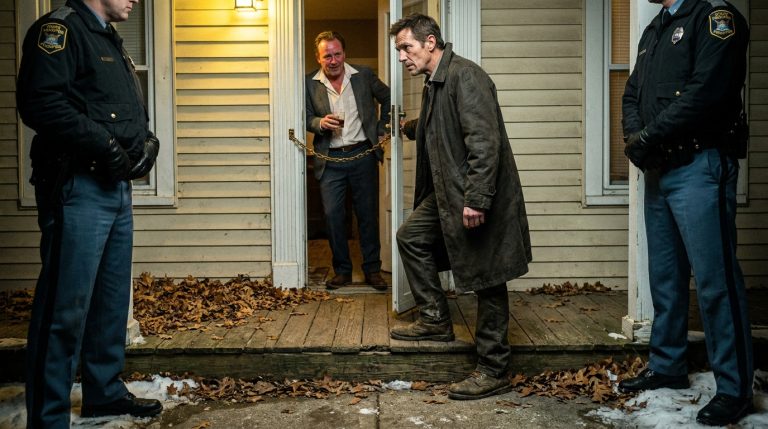
For a long moment, there was no sound save for the hum of an air-conditioning unit chugging beside the foundation. Then the heavy brass deadbolt clicked, and the door swung open six inches, restrained by a heavy security chain. Brenda peered out through the narrow gap. Her eyes were sharp, stripped of any professional pretense, narrowing as they locked onto my face.
“Private property, Nathan,” she said, her voice dropping into a low, defensive register. “Soliciting is prohibited in Whispering Pines. Step off the concrete.”
“I’m not selling anything, Brenda,” I said, holding my voice steady against the rising heat of the afternoon. I didn’t yell; I let the flat, heavy gravity of the words carry across the threshold. “And it’s not private property in the way you think. Not according to the county archives, anyway.”
I pulled the folded onion-skin copy of the nineteen-sixty-two court stipulation from my pocket, sliding it halfway through the narrow opening of the door chain so the embossed county seal caught the light of the porch fixture.
Brenda’s gaze dropped to the paper. The color drained from her cheeks with startling speed, leaving her skin the gray-white of weathered drywall. Her fingers, gripping the edge of the door frame, tightened until her knuckles turned translucent.
“This is an old administrative draft,” she said, though the sharp edge in her tone had splintered into a thin, reedy tremor. “It was superseded by the twenty-first-century master covenant integration act. The association holds blanket operational authority over all structural footprints within the perimeter.”
“That’s what you told the neighbors when you slapped them with fines, isn’t it?” I asked, leaning slightly closer to the gap in the door. “That’s what you told the board when you pushed through the drainage easement re-mapping last month. Except Miller down at the archives pulled the master register. The twenty-first-century act explicitly respects pre-existing seventy-two-acre exclusions. Which means my land isn’t just outside your jurisdiction—it’s legally immune to it.”
She stared at the seal, her breath catching audibly in her throat. The illusion was fracturing right down the middle. For ten years, she had maintained her little kingdom by wrapping every petty grievance and personal grudge in the official-looking armor of association bylaws, convincing everyone—including, perhaps, herself—that her word was absolute law.
“You don’t understand what it takes to keep this place stable,” she whispered, her voice cracking, dropping the administrative mask entirely. The hostility melted away, replaced by a raw, frantic edge of panic. “If one property breaks the mold… if the town council sees an unmanaged acre right in the center of the development… the whole valuation structure collapses. People will pull out. The board will audit the accounts.”
“The board’s already auditing the accounts, Brenda,” I said quietly, pulling the document back and letting the door settle against the chain. “I mailed the duplicate copy to the treasurer this morning. They’re going to want to know why you spent association funds on private boundary markers and fraudulent enforcement notices.”
She didn’t answer. She let go of the door frame, stepping backward into the darkened hallway of her house as if the sunlight itself had become too heavy to bear.
I turned my back on her front door and walked down the steps, the gravel crunching beneath my boots as I headed back toward the real world—the one with wild grass, deep roots, and boundaries that didn’t need to be painted over to survive.
CHAPTER 5: THE BOARD LETTER
The crunch of gravel beneath my boots lingered in the dry air as I walked away from Brenda’s porch, the weight of the certified documents shifting securely inside my canvas satchel.
I didn’t head straight back into the house. Instead, I looped around the side of the garage, where my grandfather’s old wooden workbench stood bolted to the wall under a corrugated tin roof. A gust of dry wind swept across the open pasture land beyond our southern border, rattling the loose iron flashing overhead and kicking up a swirl of dust that smelled of baked earth and dry grass.
The envelope addressed to the Whispering Pines Board of Directors was already sealed, stamped, and sitting on the workbench beside a cast-iron oil can. Inside was the duplicate copy of the county’s nineteen-sixty-two court stipulation, alongside a formal notice drafted in plain, unyielding language detailing the fraudulent encumbrance of an unassessed title.
Before dropping it into the mailbox at the edge of our drive, I paused to check the latch on the old hand-forged gate. The metal was pitted and rusted orange at the hinges, stiff from years of standing against the elements, but it held fast when I tested it. It had survived the developers’ bulldozers, the surveyors’ stakes, and a decade of passive-aggressive neighborhood policing. It would hold against this, too.
A low rumble cut through the steady hum of the neighborhood air conditioners. Down the block, a dark sedan pulled up to the curb outside Brenda’s house. Two men in lightweight gray suits stepped out, carrying briefcases. Association treasurer Marcus Vance and an independent auditor hired by the board to review the neighborhood’s administrative compliance records.
They didn’t look at my yard as they walked up Brenda’s driveway. Their steps were brisk, burdened with the heavy, unsmiling posture of men who had just discovered thousands of dollars in unaccounted-for legal expenses and unauthorized municipal filings.
I watched them mount Brenda’s front steps. One of them knocked—a sharp, professional double-tap that lacked the personal malice of Brenda’s clipboard patrols, carrying a far more dangerous authority. After a brief pause, the front door swung open, and the two men disappeared into the cool, uniform interior of the house, the door clicking shut behind them like a vault.
I picked up the envelope from the workbench, walked down the gravel path to the metal mailbox at the end of the drive, and raised the red flag.
The wind died down, leaving the afternoon quiet and heavy. Within forty-eight hours, the board’s emergency notice would clear out the last remnants of Brenda’s manufactured authority. But for now, the yard was silent, the sunflowers stood tall against the fading light, and the land remained exactly where my grandfather had left it.
CHAPTER 6: THE FINAL CELEBRATION ON THE DECK
The raised red flag of the mailbox cast a sharp, stationary shadow against the dry gravel as the sedan’s doors slammed shut down the block.
I didn’t turn back to watch the association’s representatives finish their audit inside Brenda’s house. The mechanics of her unraveling were already in motion, driven by the cold weight of the county’s nineteen-sixty-two registry and the quiet paper trail I had laid out on the workbench. Instead, I walked back toward the house, my boots hitting the wooden planks of the wrap-around porch with a hollow, steady rhythm.
Months had passed since Marcus Vance and the board investigators walked through Brenda’s front door. The aftermath had been swift and unsparing: an official apology letter delivered to my porch, the permanent updating of the municipal registries to mark our acre as wholly exempt, and Brenda’s swift removal from the presidency as the board discovered the extent of her unauthorized fines and fabricated boundary disputes. She still lived behind the sunflower wall, but the clipboard was gone, replaced by drawn blinds and the quiet isolation of someone who had learned that absolute control is a fragile thing.
Now, the afternoon sun hung low over the western tree line, casting a warm amber glow across the weathered boards of the back deck.
A string of paper lanterns flickered to life overhead, swaying gently in the evening breeze. Thirty people milled across the lawn and the wide wooden deck—neighbors from outside the subdivision, old friends, and local faces who had watched the battle for the property line unfold. A live band, set up near the edge of the old apple tree, struck up a slow, driving rhythm that filled the open air with the sound of acoustic guitars and steady percussion.
The air smelled of woodsmoke, grilled brisket, and the rich, earthy scent of blooming sunflowers and damp garden soil.
I stood leaning against the rustic wooden railing of the deck, holding a cold glass of water, watching the crowd move below. The metal latch of the old garden gate clicked open as another guest arrived, the familiar squeak of the hinge sounding like music against the hum of conversation. No one was measuring the grass height. No one was timing the music or checking mailbox dimensions. The space was loud, untamed, and entirely free.
Across the narrow strip of gravel, Brenda’s kitchen window remained dark, the blinds pulled tight against the light of our celebration. She was just another neighbor now, stripped of authority, watching a world she could no longer police move forward without her.
I set my glass down on the weathered wood of the railing and reached out, my fingers tracing the cold, pitted iron of the brace my grandfather had forged decades ago. It had taken a few drops of machine oil and a firm turn with a wrench to smooth out the stiffness after the dust settled, but the hinge moved cleanly now, swinging wide and true.
The payoff wasn’t a loud confrontation or a dramatic speech; it was the quiet, immovable reality of endurance. You didn’t beat a system built on intimidation by matching its anger. You beat it by planting your feet deep in the dirt, holding to the truth of your foundations, and refusing to move an inch.
Down on the lawn, the music swelled, carrying over the fence and echoing across the identical, manicured roofs of Whispering Pines. I gripped the smooth iron latch one last time, let out a slow breath, and stepped off the deck to join the crowd.