The Forgotten Janitor Who Proved That Decades of Real-World Grit Outsmarted a Billion-Dollar Artificial Intelligence System
CHAPTER 1: SQUEAK OF THE SQUEEGEE
The lever on the wringer took fifty pounds of pressure to press down, and my eighty-two-year-old right shoulder popped twice before the soapy water trickled into the yellow plastic bucket.
A cold female voice echoed from the ceiling speakers, flat and unfeeling as an iron slab. “Simulation failed. Casualty rate one hundred percent. Territory lost. Resetting scenario.”
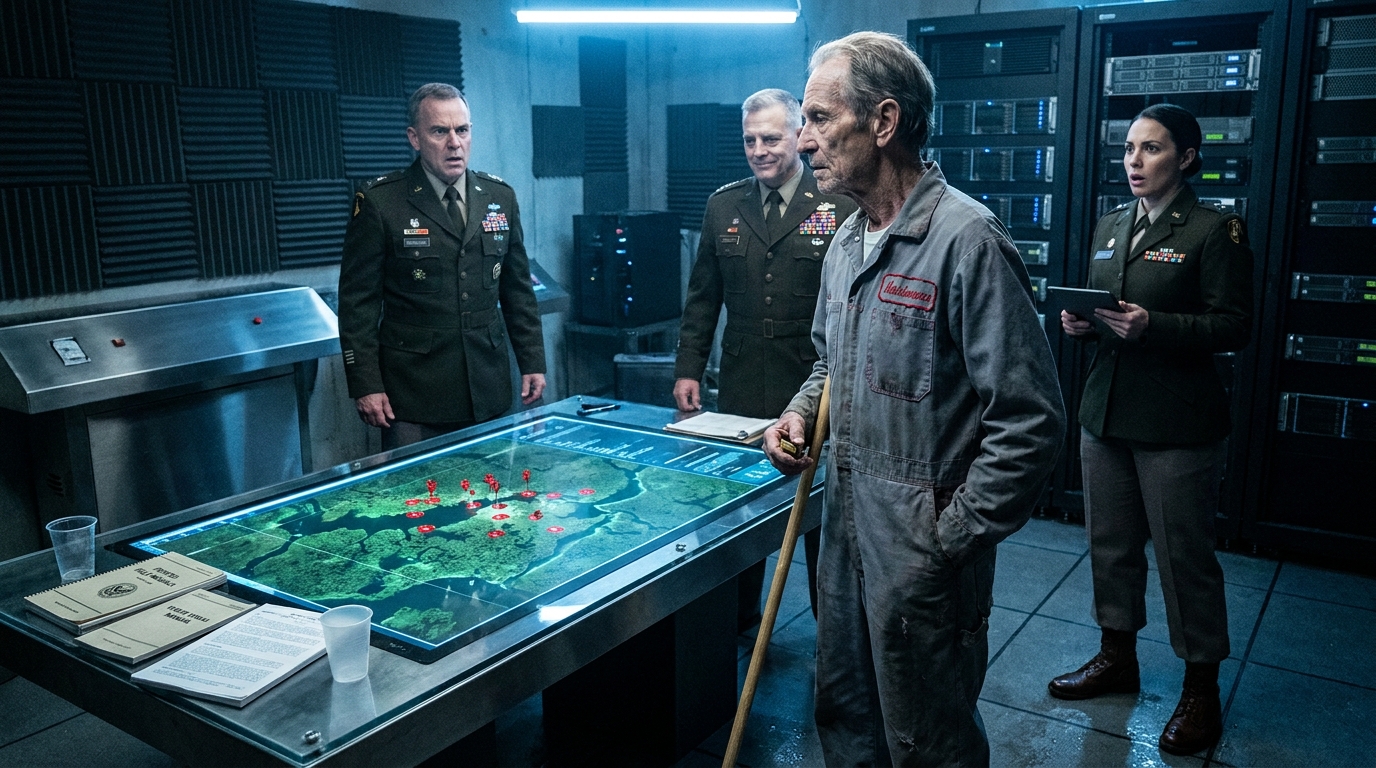
Colonel Sterling slammed his open palm onto the polished steel console, sending a plastic cup of cold coffee rattling across a stack of printed field manuals. “That is five times in a row! The Chimera system is reading our input before we even lock the grid!”
“It isn’t reading your input, Colonel,” General Vance said, pinching the bridge of his nose where two red pressure marks sat heavy on his skin. “It is a neural network. It learns every time you try to push armor through those hills.”
I kept my head down, dragging the damp cotton strands across a dark oil smudge near the baseboard. Squeak, swish. Squeak, swish.
To the six men in pressed camouflage standing under the blue glare of the room, I was just part of the room’s furniture, somewhere between the air filter and the fire extinguisher. My gray jumpsuit had Maintenance stitched across the left pocket in faded red thread that had frayed during the Reagan administration.
Inside my right pocket, my thumb rolled the cool, flat edge of a brass Zippo lighter, feeling the smooth wear on its 1951 unit crest.
“Resetting positions,” the automated voice droned overhead. “Scenario: Iron Pass. Friendly strength critical. Objective: Hold the line for four hours.”
Sterling straightened his belt, his neck bulging over his crisp collar. “We run the hammer and anvil again. Deploy the heavy tanks straight to the river bridge and hold the crossing.”
I stopped the mop mid-stroke, five feet back from the blue glow flickering across their polished boots. I didn’t step toward their glass table—I wasn’t allowed near the glowing displays, and I didn’t need to touch their glass to know what was sitting on the ground.
“Bridge is a trap,” I muttered into the mop handle.
The word was quiet, barely loud enough to carry over the hum of the cooling fans, but Sterling’s head snapped around like a dog catching a scent. “Who said that?”
The war room went dead silent, save for the hum of the server racks behind the acoustic panels. Sterling stepped away from his console, his leather boots creaking as he glared into the dark corner where I stood.
“Did you just speak, janitor?” Sterling asked, his eyebrows pulling down into a sharp, bitter V.
I let my thumb rest flat against the cold brass in my pocket, feeling the small notch on the flint wheel. “Just talking to the bucket, sir. Floor gets slick around the drain.”
“Then mop the floor and keep your mouth shut,” Sterling snapped, turning his back to me. “We are forty minutes away from a Pentagram briefing and I have an old man babbling about wet tile.”
General Vance raised a hand, his tired eyes lingering on the curve of my back. “Let him be, Colonel. He’s been sweeping this floor since before you got your commission.”
Sterling grunted and tapped the glass console with a manicured fingernail. “Execute the bridge deployment. Move the armor now.”
Across the blue grid, the digital icons shifted toward the narrow river span, moving in neat, perfect lines that only existed in computer code and dreams. I watched the movement from five yards away, my hand tightening on the wooden pole as the computer prepared to show them what ninety thousand pounds of steel actually does to loose gravel.
CHAPTER 2: THE MUD AND THE MAP
On the main wall, three dozen red indicators flared like hot coals.
The computer didn’t aim its virtual artillery at the blue tanks sitting on the bridge. It targeted the gray cliff face two hundred yards above them.
The sound of synthetic rock splintering rattled the glass light fixtures. A wall of virtual shale and topsoil cascaded down the slope, burying the entire lead battalion under forty feet of dirt in under six seconds.
“Casualty report heavy,” the female automated voice droned. “Defensive line breached. Game over.”
Sterling’s face turned the color of a fresh bruise. “What did it just do? It missed the target entirely!”
“It didn’t miss, Colonel,” Major Reeves said, his fingers flying across an iPad tablet. “It triggered a secondary landslide. It used structural geology against our armor.”
“How does a bunch of microchips know the cliff was loose?” Sterling shouted, his voice cracking against the acoustic wall tiles.
“Because it read the public geological survey arrays from 1998, you idiot,” General Vance muttered, sinking his face into both hands. His knuckles were white from five hours of straight failure.
I stood six paces back by the mop bucket, letting the handle rest in the crook of my elbow. I didn’t step an inch closer to their glowing glass table. I didn’t need to touch their light show to see what was right in front of them.
Near the base of my bucket, a white mineral salt ring had dried along the plastic lip—the exact same kind of salt deposit that forms when river water sits stagnant against clay for seventy years.
“It wasn’t reading your geological survey,” I said quietly.
Sterling spun around, his polished leather boots squeaking hard against the damp tile floor. “You again? I thought I ordered you to clear out.”
“It’s looking at the river bend,” I said, pointing a calloused finger across the five-yard gap between us toward the glowing blue topography. “North of the bridge span. See that sharp double curve?”
Sterling squinted, his chest puffed out like a rooster waiting for a fight. “I see a river, janitor. What of it?”
“The current undercuts the southern bank right under that ridge,” I said, rolling the cold brass Zippo in my pocket. “When high water comes down that valley in the spring, it hollows out the limestone base. Any heavy diesel vibration on that road brings the whole hill down.”
Sterling let out a sharp, nasty laugh that didn’t reach his eyes. “And where did you get your degree in civil engineering, old man? From the bottom of a pine-sol bottle?”
“I didn’t get a degree,” I said, looking him dead in the eye. “I drove a fifty-ton Sherman tank through that exact riverbed in November of 1951.”
The room went dead silent again. The only sound left was the low, electric hum of the cooling racks.
General Vance lowered his hands from his face. He looked at my gray jumpsuit, then down at my hands—rough, thick-knuckled, and steady as an old oak post.
“Hill 719,” Vance said softly. “The Iron Triangle.”
“Yes, sir,” I said. “We sat under that exact ridge for three days while the Chinese mortars tried to shake the mountain down on top of us. Mud is mud, Colonel. It doesn’t care how fast your computer processor runs.”
Sterling stepped closer, his jaw tight. “Sir, this is absurd. We are running a hyper-modern algorithmic combat simulation. We have satellite uplinks and stealth drones. A janitor’s seventy-year-old war story has zero tactical application here.”
“The terrain doesn’t change because you bought a faster screen, Colonel,” I said. “An enemy that wants to kill you thinks the exact same way whether he’s pulling a trigger or running a code.”
General Vance stood up from his leather chair, his old joints cracking. He walked past Sterling and stopped three feet away from my mop cart.
“What would you do, Sergeant?” Vance asked.
“Sir!” Sterling barked, his face twisting in anger. “We cannot take tactical advice from the cleaning staff!”
“We’ve lost five times in forty-five minutes, Colonel!” Vance roared, his voice echoing through the steel frame of the room. “The Pentagon delegation lands in thirty minutes. I’ll take advice from a ghost if it keeps us from getting stripped of our command.”
Vance turned back to me, his eyes sharp. “Speak, Arthur.”
I looked over at the blue icons flickering in the air above the glass. “The computer is smart, but it’s cold. It chases strength and it crushes anything that looks like a mistake.”
“So how do we break it?” Vance asked.
“You don’t fight its strength,” I said, snapping the Zippo lid closed inside my pocket with a quiet, solid click. “You offer it a piece of trash it can’t resist taking.”
CHAPTER 3: THE SALOW TRAPS
“You bait it,” I said, my thumb tracing the worn edge of my brass Zippo inside my pocket. “You give that machine something it thinks it can eat without chewing.”
Sterling let out a harsh, dry laugh from across the room. “Bait a neural network? It tracks seventeen thousand data points a second, janitor. It doesn’t have appetite. It has math.”
“It has programming,” I corrected, looking past Sterling’s shoulder at the dark green patch on the northern edge of their digital map. “And your programmers taught it to hunt weakness. Five miles west of the main pass—that marshland.”
Major Reeves squinted at his handheld tablet. “Sector Seven? That terrain is flagged as impassable for heavy columns, but passable for light reconnaissance. Why send units into a swamp?”
“Send one light scout vehicle,” I said, staying right beside my mop bucket, five yards back from their glowing table. “Turn off its digital cloaking. Let it broadcast a distress signal loud enough for the satellite to pick up.”
“You want us to sacrifice a scout unit?” Sterling demanded, slapping his palm against his belt holster. “To what end? The AI will vaporize it in thirty seconds!”
“It won’t vaporize it right away,” I said, my voice steady as concrete. “It’ll send heavy armor to cut off what it thinks is a broken supply line. We called that marsh the Salow back in ’51. The top crust looks solid after a hard frost, but underneath it’s ten feet of liquid silt.”
Vance stepped closer to the console, his eyes locked on the green sector. “The computer’s database lists the crust strength, not the silt layer.”
“Because a satellite takes pictures of grass, General, not what’s under the grass,” I said. “A five-ton scout car can roll over the crust. A sixty-ton automated battle tank breaks the crust and sits on its belly until the mud swallows the turret.”
“This is insane,” Sterling spat, his face tight with anger. “We are throwing away our last tactical reserve based on an old man’s memory of a hole in the ground!”
“Execute the order, Colonel,” Vance barked, the sharp command rattling the glass light fixtures overhead. “Deploy a single scout to Sector Seven. Drop the shield. Broadcast open-channel.”
Sterling’s fingers flew across his interface, trembling with suppressed rage as he punched in the coordinates. “Command sent. Bravo Six is moving to the marsh. Shields dropped. If this fails, General, the Pentagon evaluation team walks through those double doors in fifteen minutes.”
“Then we’ll know in five,” Vance said softly.
On the main display, a tiny blue icon broke away from our main line, wobbling slowly into the wide green expanse of the marshland. A high-pitched ping echoed from the overhead speakers—the scout’s unshielded radio calling out into the dark.
For six heavy seconds, the red cluster on the ridge didn’t move.
“See?” Sterling sneered, turning toward me with his chin raised. “It’s ignoring the decoy. It knows it’s a useless target—”
The red icons shifted all at once.
A massive wall of red markers—the AI’s entire heavy armored vanguard—wheeled west, breaking away from the high ridge and charging full-throttle toward the lonely, unshielded blue dot.
“It took the bait,” Reeves whispered, his thumb frozen over his tablet screen. “It’s diverting sixty percent of its strike force to crush the scout.”
“Come on,” I muttered under my breath, my fingers clenching tight around the cool brass in my pocket. “Come on, you mechanical bastard. Step on it.”
The red column hit the edge of the green sector at full speed. Two seconds later, the speed indicators beside the red markers began to drop.
Fifty percent. Thirty percent. Twelve percent. Zero.
“Enemy mobility failure detected,” the computer’s cold voice chimed. “Multiple drive train casualties in Sector Seven. Ground resistance exceeding parameters.”
“They’re bottomed out,” Vance said, a slow, grim smile spreading across his face. “They’re sitting ducks.”
“Hit them now,” I said from the back corner, not moving an inch toward their table. “Air strike, napalm, artillery. Everything you’ve got in the battery. They can’t maneuver.”
“Launch all assets!” Vance roared. “Target Sector Seven! Fire for effect!”
The ceiling speakers thundered as virtual missile strikes rained down on the trapped red column. Without room to turn or angle their armor, the AI’s heavy tanks were wiped off the grid in a blinding flash of blue victory light.
“Main enemy force neutralized,” the automated voice announced, its tone unchanged even in defeat. “Friendly forces hold the pass. Scenario complete. Rating: Distinguished.”
The war room fell into a heavy, suffocating silence, broken only by the squeak of my mop cart wheels as I shifted my weight.
Sterling stared at the blue victory banner hovering over the map, his throat working as he tried to swallow his pride, his eyes wide with unadulterated shock and fury. “It… it was a fluke. A statistical anomaly.”
“That wasn’t a fluke, Colonel,” Vance said, turning away from the screen to face me. “That was sixty years of dirt under the fingernails.”
CHAPTER 4: THE JANITORS GAMBIT
“This is an irregular test condition!” Sterling blurted out, his voice sharp and cracking at the edges as he pointed a trembling finger toward my mop bucket. “General, he disrupted a level-five classified simulation! The entire data array is compromised—I’m logging this as an unauthorized breach of protocol!”
General Vance didn’t even look up at him. He typed a service serial number into the secondary wall terminal, his eyes scanning the green text that flooded the dark screen.
“Shut up, Colonel,” Vance said, his voice quiet, flat, and absolute.
Sterling’s mouth opened, but no sound came out.
“Arthur Penhaligon,” Vance read aloud, the words echoing through the dead-silent command center. “Sergeant Major, United States Army, retired. Distinguished Service Cross. Silver Star with Oak Leaf Cluster. Tank commander, Hill 719, Chosin Reservoir.”
Major Reeves lowered his tablet to his side, his mouth slightly open as he looked at me.
“He wrote the 1968 tactical manual on asymmetric armored defense,” Vance continued, turning his head slowly to glare at Sterling. “The exact manual your team removed from the academy curriculum last year because you deemed it ‘technologically obsolete.'”
Sterling took a step backward, his back hitting the edge of the glass console. The color drained completely from his face as he looked at my frayed gray jumpsuit, his unearned authority evaporating like steam off a hot radiator.
I took my hand out of my pocket, letting the brass Zippo rest at the bottom, and wrapped both palms around the worn oak handle of my mop. I didn’t step toward their bright screens. I didn’t need their high-tech arrays to know my work here was done.
“Computers are sharp, Colonel,” I said, leaning lightly against the mop. “But they don’t know fear. And if you don’t feel fear, you don’t check the depth of the mud before you step in it. You just march right over the edge.”
General Vance stepped away from the terminal. He turned toward me, stood straight as an iron girder, and brought his right hand up to his temple in a crisp, motionless salute.
Major Reeves stood up immediately, snapping his boots together and saluting alongside his commander.
Sterling stood frozen for three long seconds, his jaw working in silence as the weight of his own arrogance crushed him down. Slowly, painfully, he raised his hand to his brow, his eyes fixed on the floorboards between us.
I didn’t salute back. I just gave them a small nod, lifted the lever on my mop bucket, and pushed the squeaky cart toward the heavy exit door.
“War isn’t chess, gentlemen,” I said over my shoulder as the automatic doors slid open into the quiet hallway. “It’s poker. And machines are terrible bluffers.”
The heavy rubber doors closed behind me, cutting off the hum of the server racks.
Out in the cool, dimly lit corridor, the floor was smooth and dry. I dipped the mop into the clear water, wrung out the excess, and dragged the cotton head across a tiny dark spot near the baseboard until the tile shone clean.