The Iron Ghost’s Echo: Bridging the Generational Divide Through the Raw Weight of Shared Sacrifice
CHAPTER 1: THE WEIGHT OF THE HOLE
The California sun hammered down on the red clay of the training pit, turning the air into a shimmering, oppressive haze. Gunnery Sergeant Tyler Brennan stood with his boots planted, his chest swelling with the hard-won pride of a career built on precise, lethal efficiency. Before him, the old man—Kendrick—stood by the fence like a forgotten relic, his denim jacket a map of wear and tear, stained with the dust of a life lived outside the sterile, polished lines of modern instruction.
“Maybe,” Brennan drawled, his voice a razor blade scraping against the silence of the gathered Marines, “you just got lucky. Hell, you can’t even afford to fix your damn jacket.”
Brennan reached out, his gloved finger flicking the ragged, frayed edges of the hole near the shoulder. It was a gesture meant to dismiss, to categorize the man as a failure of maintenance. But the moment his skin touched the fabric, the world didn’t tilt—it dissolved.
The heat of the training pit didn’t fade, but it was suddenly overlaid with a freezing, biting wind that carried the metallic tang of cordite and the wet, copper scent of blood. The sound of the surrounding Marines, their breathing, their shifting weight, fell away. In its place, the frantic, jagged crackle of a radio roared in Brennan’s ears—a desperate voice begging for fire support that was never coming.
Brennan’s finger remained frozen against the denim. He looked at the hole, really looked at it, and for the first time in his career, he saw not a lack of repair, but a structural integrity of a different kind. The frayed edges weren’t just decay; they were the scars of an impact that had stopped a bullet, a physical memory of a choice made in a mud-choked hell where mathematics and human value had collided.
The sergeant’s face, usually set in a mask of rigid command, wavered. He felt the weight of the jacket pressing back against him, an invisible, colossal pressure that made his own immaculate uniform feel suddenly flimsy, a costume of performance rather than substance. He saw in the ghost-still eyes of the old man a depth that made his own professional accolades seem like hollow, ringing bells.
Behind him, the silence of the young Marines was absolute. They were no longer looking at an instructor demonstrating a takedown; they were staring at two men frozen in a moment of history that neither of them had the capacity to name yet. Brennan tried to pull his hand back, but his muscles refused to obey. He was anchored to the spot by the realization that he had just insulted a threshold of human courage that he hadn’t even known existed, and the air around him, once clear and easy to command, was now dense with the suffocating, heavy truth of his own profound, reckless error.
A shadow moved at the edge of the pit, then another—the sudden, rhythmic rumble of heavy transport engines climbing the ridge, signaling that the silence was about to be shattered by an authority far greater than his own.
CHAPTER 2: THE SOUND OF FALLING TIES
The convoy had stopped, the dust was settling, and the silence that followed was not the quiet of a peaceful afternoon, but the weighted, suffocating silence of an interrogation room. Brennan stood anchored to the spot, his finger still hovering inches from the frayed denim of Kendrick’s jacket. He wanted to retract his hand, to retreat into the comfortable armor of his rank, but his body felt heavy, as if the ground beneath him had turned to liquid.
Lieutenant General Marcus Hayes didn’t look at the sergeant. He didn’t have to. The general’s presence was a physical force, a wall of command that seemed to push the very air out of the pit. Hayes’s salute was crisp, sharp enough to cut, and when his voice boomed across the sand-swept ground, it wasn’t directed at the instructors—it was directed at the soul of the Marine Corps.
“Mr. Kendrick,” Hayes said, his voice a low, resonant thrum that bypassed the ears and settled directly into the gut. “Sir, it is an honor.”
Brennan felt the blood drain from his face, leaving his skin cold and tight. His heart, usually steady and rhythmic under the discipline of years of combat training, gave a stuttering, uncertain beat. He watched the general—a man he had studied in text books, a man whose career path he had meticulously mapped as his own ambition—standing in the posture of a subordinate before a 73-year-old man in a tattered jacket.
The young Marines in the pit, the same ones who had been laughing at Brennan’s jokes moments before, were now as still as statues. They looked at Kendrick with wide, bewildered eyes, their hands hanging uselessly at their sides. Brennan’s gaze flickered to the faces of his students. He saw not the admiration he had cultivated, but a dawning, terrible confusion. He had taught them that the measure of a Marine was the polish on their boots, the speed of their draw, the sharpness of their takedown. And here, in the space of a single heartbeat, that entire philosophy had been rendered obsolete.
Kendrick didn’t preen. He didn’t boast. He merely stood there, his shoulders slightly stooped, his expression one of weary, quiet grace. He nodded to the general, a small, almost imperceptible gesture that carried the weight of a thousand unspoken conversations.
Brennan’s ears began to ring. He felt a sudden, sharp spike of sensory phantom—the static of a radio from a decade he had only read about, the hiss of incoming mortar fire that wasn’t there, and the desperate, pleading voice of a captain he had never met. It was a phantom, an intrusive thought born of the guilt that was rapidly calcifying in his chest. He saw the ragged hole in the jacket again, and this time, he saw the light filtering through the frayed threads. It wasn’t just a hole in clothing; it was a window into a past that Brennan, in his arrogance, had assumed was beneath him.
“Marines,” Hayes began, and the word held the weight of an indictment. He didn’t need to shout; his voice carried the authority of the grave.
Brennan stepped back, his boot catching on a patch of uneven sand. He was a Gunny. He was the man who made the impossible happen on the mat. But here, before the general, he felt like a child who had brought a wooden sword to a war of steel. He looked at his hands, those hands that had just flicked the denim with such careless disdain, and they seemed like foreign objects, detached from his will.
The air shifted, moving from the dry, heat-heavy atmosphere of the training pit to a sudden, biting chill that seemed to radiate from the general’s very posture. Brennan glanced at the staff officers standing behind Hayes. They weren’t looking at the pit; they were looking at the ground, their faces tight, their jawlines clenched in a collective, shared shame.
It was then that Brennan realized the truth. This wasn’t a punishment. This was a funeral for his own ego. He stood in the wreckage of his identity, listening to the general begin to speak, his words carving a narrative that Brennan would be forced to carry for the rest of his life. He looked at Kendrick, really looked at him, and realized that the old man wasn’t holding his jacket together. The jacket was holding the world together, and Brennan had been standing on the edge of the abyss, unaware that he was staring into the face of a god he had forgotten how to worship.
The general’s voice continued, steady and relentless, and with every sentence, the pride that had been Brennan’s engine was systematically dismantled, layer by layer, leaving him raw, exposed, and entirely, painfully awake to the reality of the service he thought he understood.
CHAPTER 3: THE ASHES OF COMPETENCE
The General remained motionless, his posture a masterclass in controlled, predatory patience. He didn’t look away from Brennan. He didn’t blink. The silence in the pit had reached a physical density, a thick, pressurized layer of heat and shame that made it difficult to draw a full breath. Brennan felt the grit of the red clay against the soles of his boots, a tactile reminder of the ground he had just desecrated with his ignorance.
“Gunnery Sergeant,” Hayes said, his voice dropping an octave, losing the oratorical flair and becoming something sharper, more personal. “Look at your hands.”
Brennan obeyed. His hands were shaking. They were the same hands that had performed countless demonstrations of lethal precision, yet in the light of the afternoon, they looked like the hands of a stranger—pale, soft, and utterly unprepared for the weight of the moment.
“You speak of ‘violence of action’ as if it’s a paint-by-numbers exercise,” Hayes continued, stepping closer. The General’s uniform was crisp, the medals on his chest glinting with a cold, unforgiving light. “You treat the art of survival as a commodity to be mastered, to be polished, to be ranked. But you have yet to understand that the only difference between you and the man standing by that fence is that he was forced to bleed for his clarity, while you were allowed the luxury of practicing in the sand.”
Brennan opened his mouth to offer the standard, scripted apology—the one he’d delivered to a hundred superiors—but the words died in his throat. The atmosphere had shifted. A sudden gust of wind swept through the pit, carrying with it a swirl of fine, red dust that clouded the air and forced him to squint. It was a minor, chaotic disruption, a butterfly of consequence that broke the rigid rhythm of his internal defense. He had expected a lecture; he had expected a formal reprimand. He hadn’t expected to be stripped down to the marrow.
“I… sir,” Brennan started, his voice cracking. He felt the eyes of the entire training company upon him. The recruits, previously hungry for his approval, now looked at him as if he were an artifact of a failed era.
“Don’t,” Hayes interrupted, his hand resting briefly on the hilt of his service pistol, not as a threat, but as a weight. “Don’t justify. Don’t explain. Just stand there and feel the space you’ve occupied. You called him a coward. You questioned his grit. You looked at the hole in that denim and saw a flaw. That hole is the only reason there are three men currently living in this world who would have otherwise been left in the mud of a valley you can’t even imagine.”
Brennan’s gaze darted to Kendrick. The old man was watching the scene with an expression of profound, quiet exhaustion. He wasn’t gloating. He wasn’t angry. He was simply existing, a living witness to a reality that made Brennan’s entire existence feel like a shadow on the wall. The texture of the denim jacket—the way the edges of the hole were worn, frayed, and softened by decades of touch—seemed to stand out in the sharp light. It was a tactile, undeniable fact of history.
“I didn’t know, sir,” Brennan whispered. The admission was hollow, even to his own ears.
“Exactly,” the General replied, his tone shifting into something almost pitying. “You didn’t know. You didn’t ask. You decided. That is the fundamental failure of your generation of leadership. You have replaced curiosity with calculation. You have replaced the human burden of command with the sterile efficiency of a grade sheet.”
The General turned, his polished boots crunching in the red dirt as he walked away from Brennan and toward the staff officers waiting by the Suburbans. He didn’t offer a dismissal. He didn’t grant the comfort of a closure. He left Brennan standing there, exposed in the center of the pit, while the rest of the world continued to rotate.
The recruits began to move, their training interrupted, their drills forgotten. They walked past Brennan, some avoiding his gaze, others looking at him with a mix of shock and skepticism. He remained in the center of the square, the sun beating down on his immaculate shoulders. The silence that had been forced upon the pit was slowly replaced by the ambient sounds of the base—the distant hum of aircraft, the metallic clatter of equipment—but it sounded different now. It sounded like the rhythm of a system that was fundamentally broken, and he was the one who had finally tripped the wire.
He realized then that he couldn’t go back to the office, to the files, to the curriculum he had so confidently drafted. The training was over. For him, the real, grueling work of learning how to be a leader had just begun, and the weight of the jacket—the weight of that hole—was a pressure he would have to carry every single day until he earned the right to stand in the same light as the man at the fence.
CHAPTER 4: THE GEOMETRY OF HUMILITY
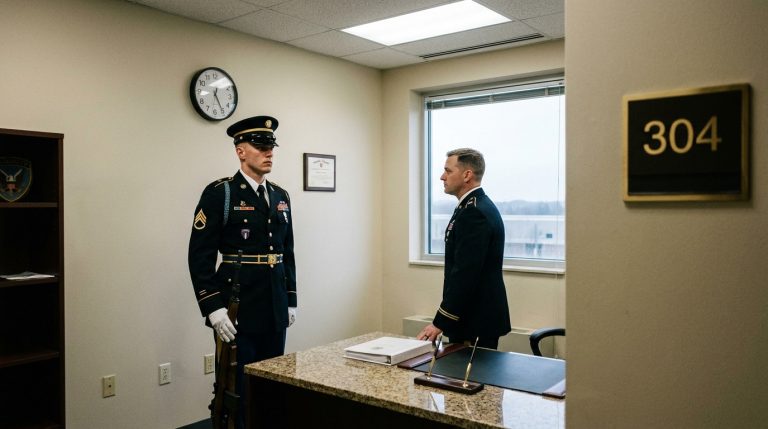
The light in the History Division office was harsh, a flat, artificial glow that bounced off linoleum floors and gray-painted cinderblock walls. It felt entirely different from the red-clay dust of the training pit, yet to Brennan, it felt just as suffocating. He sat at a desk that had belonged to a succession of career administrators, a workspace defined by thick, leather-bound folders and the dry, stagnant smell of old paper.
He had been here for three days. His duty was to review the archives and begin the initial framework for the Kendrick Standard, but every time he picked up a pen, his eyes were drawn to the small, circular hole he had imagined in his own uniform jacket, hanging on the rack by the door. His perception was shifting, tilting into a state of heightened, uncomfortable awareness. He found himself cataloging the room—not for tactical utility, but for its flaws. The way the paint was peeling in the corner; the persistent, low-frequency hum of the air conditioner that sounded, in his current, fragile state, like the distant chatter of a radio during a siege.
There was a soft knock at the door. A junior analyst stood there, holding a stack of files. Brennan didn’t look up immediately. He was focused on the way the light caught the edge of a paperclip on his desk, a small, twisted piece of metal that seemed to hold more weight than the entire doctrine manual he was supposed to be revising.
“Gunny? These are the files on the Khesanh engagement. General Hayes requested an update on the preliminary outline.”
Brennan took the files. The paper felt brittle under his fingers, like dried skin. He began to flip through the pages—after-action reports, casualty lists, the dry, sterile language of a war that had been reduced to ink and grid coordinates. He saw the name Kendrick, Robert repeated on page after page, always followed by the same, sparse descriptors: Action, Initiative, Valor.
“The General is waiting for a response by 0600 tomorrow,” the analyst added, his voice hesitant. “He mentioned he’d be checking in personally.”
Brennan looked up. “I know.”
The analyst retreated, leaving the door slightly ajar. Brennan sat in the silence, listening to the hum of the office. He felt a sudden, sharp spike of anxiety—not the fear of an enemy on the field, but the gnawing, internal dread of a man who knows he is constructing a monument to a truth he cannot fully inhabit. He looked at the outline he had drafted. It was clean, efficient, and entirely superficial. It lacked the grit, the blood, and the raw, human terror of the mud.
He realized with a jolt that he was trying to solve the problem by doing exactly what he had done at the training pit: he was trying to “fix” the jacket. He was trying to sew up the hole in the narrative with academic precision, ignoring the fact that the beauty—and the danger—lay in the ragged, unrepaired edge.
He stood up and walked to the window. The base outside was quiet, the evening sun casting long, orange shadows across the parade deck. He felt a strange, vertigo-like sensation, as if the ground were shifting beneath him. He was a Gunny, a man of iron and resolve, yet he couldn’t find the resolve to write a single honest word. Every sentence he drafted felt like a betrayal.
He leaned his forehead against the cool glass of the window, the friction of the pane against his skin grounding him. He had been told to teach the difference between strength and courage, but how could he teach what he had only just begun to recognize as his own profound absence? He watched a group of recruits marching in the distance, their movements synchronized and robotic. He felt a sudden, desperate urge to run out there and stop them, to tell them that the polish on their boots didn’t matter, that the rhythm of their march was a lullaby for the complacent.
His hands gripped the edge of the window frame, his knuckles white. The room felt smaller, the walls closing in with the weight of the history he was tasked to curate. He turned back to the desk, his gaze landing on the draft. He grabbed the top sheet of paper, crumpled it into a ball, and tossed it toward the wastebasket. It missed, rolling across the floor and coming to rest near the door. He didn’t pick it up. He stared at it, the ball of paper a chaotic, ruined shape in the perfect geometry of the office, and for the first time since the encounter, he allowed himself to breathe. He wasn’t going to write a manual. He was going to write a confession.
The realization was a failure of the current mission, a shattering of the decoy secret he had been tasked to build. He knew that if he changed the course now, he would be deviating from the General’s expectations. He was pushing toward a precipice, and he had no idea what was on the other side.
CHAPTER 5: THE WEIGHT OF THE UNWRITTEN
The sound of the door opening was sharp, like a gunshot in the sterile quiet of the History Division. Brennan didn’t scramble to hide the crumpled paper. He didn’t smooth his uniform. He stood by the window, his heart hammering against his ribs, as General Hayes stepped into the room. The General didn’t look like a man arriving for a routine update; his face was a mask of cold, concentrated purpose. He caught sight of the discarded paper on the floor, then his eyes flickered to Brennan, sharp and assessing.
“You’re behind schedule, Gunnery Sergeant,” Hayes said, his voice flat. He walked to the desk, his hand brushing the stack of files Brennan had been reviewing. “I expected the first draft of the Kendrick Standard on my desk an hour ago.”
Brennan didn’t look at the desk. He looked at the General. “I couldn’t write it, sir. Not the way you asked.”
The General paused, his hand hovering over the files. The air in the room grew heavy, the familiar, dry smell of old paper replaced by a sudden, metallic tang of ozone. “And why is that?”
“Because it’s a lie,” Brennan said, his voice stronger than he expected. He walked around the desk, his movements fluid, deliberate. “I spent three days trying to distill a human life into a doctrine manual. I tried to turn what Kendrick did at Khesanh into a series of repeatable behaviors, a checklist for courage. But that’s not what he did. He didn’t follow a checklist. He didn’t act out of doctrine. He acted because he was a man who refused to let his brothers die, even when the math told him it was a failure.”
Hayes stared at him, his expression unreadable. He walked to the center of the office, his gaze lingering on the discarded paper before returning to Brennan. “You think you understand the cost of that, Sergeant? You think you understand what happens when a leader decides that the ‘math’ doesn’t apply?”
“I think I understand why you asked me to write it,” Brennan said, taking a step closer. He felt a sudden, strange clarity—the same hyper-awareness that had plagued him for days, but now it was directed, focused. “I think you’ve been carrying the weight of that day for fifty-five years, and you wanted to see if someone else could articulate the burden, or if they’d just turn it into a recruiting poster.”
The General’s eyes narrowed. He walked to the shelf behind Brennan’s desk, his fingers tracing the spine of a leather-bound history ledger. He pulled out a thin, envelope-sized file—one that Brennan hadn’t seen before. He placed it on the desk. “Open it.”
Brennan hesitated, then flipped the folder open. Inside was a single, handwritten letter, the ink faded, the paper yellowed at the edges. It was addressed to the Commanding Officer of the Khesanh Combat Base, dated January 25, 1968—the day after the rescue. It wasn’t an after-action report. It was a request for resignation, written by Captain Marsh.
Brennan’s eyes raced across the text. I failed to protect the perimeter… I allowed a subordinate to carry the burden of my own fear…
“He wrote this because he knew he didn’t deserve to be a leader after that day,” Hayes said, his voice barely a whisper. “He stayed in because the Corps needed men, but he never forgave himself for letting Kendrick go out there alone. I was his adjutant. I sat in that bunker, and I watched him tear his soul apart. We all did. Every one of us who was there, we’ve spent our entire careers trying to balance the ledger. We didn’t keep Kendrick a secret because he was a hero; we kept him a secret because we were all terrified that someone would ask us why we let a nineteen-year-old boy hold the weight of our collective failure.”
Brennan stared at the letter, the physical texture of the paper—rough, uneven, aged—seeming to vibrate with the sheer, crushing reality of it. The “Kendrick Standard” wasn’t a training module. It was a mirror. The leadership hadn’t been failing to meet a standard; they were trying to hide the fact that they had been broken by it.
“You’re not writing a doctrine,” Hayes said, his gaze shifting to the window, toward the distant, hazy horizon. “You’re writing a witness statement. If you’re going to put this in front of the Marine Corps, you have to be prepared for the fact that it won’t just change the recruits. It will force every officer, every staff NCO, every leader who thinks they know what courage is, to look at themselves and admit they’ve been hiding behind the math.”
The room was silent. The hum of the air conditioner had stopped, leaving a vacuum that Brennan felt he needed to fill, but he couldn’t. He looked at the letter, then at the General, and for the first time, he saw the man underneath the stars—an old man, tired, grieving, and desperately searching for a way to finally put the ledger to rest. The reality was heavy, cold, and entirely inescapable.
CHAPTER 6: THE QUIET SETTLEMENT
Brennan looked at the letter, then at the General, and realized the room had become infinitely small. The weight of the secret, once an abstraction, was now a tangible pressure against his chest. He took a slow breath, the air tasting of stale paper and ancient, unresolved grief.
“So,” Brennan said, his voice steadying, “the Kendrick Standard isn’t for them. It’s for you.”
Hayes didn’t flinch. He walked to the window and stared out at the parade deck. “It was for all of us. Every commander who stood in the shadow of that day and knew, deep down, that they had played the game according to the math, and in doing so, had left a part of their humanity on that hillside in Khesanh. We kept Robert Kendrick a ghost because he was the only one who didn’t let the failure define him. He wasn’t a hero because he did the impossible; he was a hero because he was the only one who decided that the cost of being ‘smart’ was too high.”
Brennan looked down at the letter. The ink was brown, almost like dried blood. He reached out and touched the paper, feeling the grain. He had come here to curate a legacy, but he realized he was actually officiating a funeral. He picked up the letter, carefully folding it, and placed it back into the folder. He wasn’t going to include it in the module. The doctrine needed to be clean, professional, and accessible. But the reality—the messy, broken, human reality—would be held in the silence that followed every lesson.
“What do I do with this, sir?” Brennan asked, holding the folder.
“Keep it,” Hayes replied, his voice barely audible. “Keep it until you find someone who needs to know that the burden doesn’t have to be carried alone.”
The General turned, a ghost of a smile touching his lips. It wasn’t a happy expression; it was the look of a man who had spent his life waiting for the wind to change. He walked to the door, his gait heavy, and stopped. “The curriculum goes live on Monday, Gunny. Don’t make it a monument. Make it a mirror.”
When the door closed, Brennan sat back in his chair. The office was silent, save for the rhythmic, distant beat of a training drum outside. He looked at the jacket on the rack by the door. He didn’t see the hole in the shoulder anymore. He saw the threads that held it together, the way it had been patched and repatched by time, and he felt a strange, quiet peace.
He spent the next three hours rewriting the final page of the module. He didn’t write about the mortar fire or the minefields or the heroics. He wrote about the silence of a command bunker in the dark, about the weight of a decision that could never be undone, and about the importance of admitting when the math is wrong. He wrote until his hand cramped and the office windows turned the deep, indigo blue of a desert night.
The next morning, he met Kendrick at the same coffee shop in Oceanside. The old man was sitting at a corner table, his denim jacket draped over the back of the chair, the hole in the shoulder visible even in the low light. Brennan sat down, placing the folder on the table. He didn’t open it.
“I heard about the ceremony on Monday,” Kendrick said, his voice as soft as the morning fog.
“It’s not just a ceremony,” Brennan replied. “It’s a different way of starting the day.”
They sat in the quiet, the smell of roasted beans and ozone hanging in the air. Brennan watched the light catch the frayed edge of the denim. He had learned that the most important parts of a person aren’t the parts that are polished or perfect; they are the parts that have been broken, worn thin, and mended with quiet, daily effort. He reached across the table, not to shake hands, but to acknowledge a shared, unspoken truth.
“You should come,” Brennan said.
“I’ve seen enough ceremonies,” Kendrick smiled, his eyes holding that stillness that came from a lifetime of knowing exactly who he was. “But I’ll be there in spirit. And Gunny? Don’t worry about the jacket. It’s seen worse things than a few frayed threads.”
They drank their coffee in silence, watching the world wake up outside the window. The streets were filling with people—young, old, fast, slow—all of them carrying their own, unseen burdens. Brennan realized that he would never truly be the man he had been before the pit, and for the first time in his life, he didn’t want to be. He was something new, something deeper. He had stopped looking for the glory and started looking for the cost, and in that realization, he had finally found the weight of the peace he had been searching for.
As they parted ways, Brennan watched Kendrick walk into the crowd, the denim jacket swaying slightly with his steady, measured gait. He didn’t look like a hero. He looked like an ordinary man carrying the weight of an extraordinary life, and as Brennan turned to go back to the base, he knew that the lesson had finally been learned. The legacy wasn’t in the doctrine or the history books; it was in the quiet, everyday choice to keep going, to keep mending, and to keep listening to the voices that most people were too busy to hear.