The Frozen Sidewalk Contract: How One Broken Girl’s Sacrifice Brought a Suburban Predator to His Knees
CHAPTER 1: FROZEN SIDEWALK DEBT
The ice beneath my knees didn’t even feel cold anymore.
My wrists clicked on every downstroke, the old fracture in the left radius grinding like gravel in a grease trap. Thirty compressions. Two breaths. My lungs burned with the sour stench of raw winter air and untreated bronchitis, but I kept my weight centered over the girl’s sternum.
“Come on,” I rasped, my throat raw. “Don’t you dare.”
Around us, twenty smartphones hummed in the freezing morning light. Nobody reached out. Nobody offered a coat. A boy in a bright yellow puffer jacket angled his camera closer, adjusting his grip to capture the stain of dark foam at the teenager’s lips.
My safety-pinned high-tops skidded on the slush as I leaned in, pinching her nose to force two quick bursts of air past her blue lips. Her chest rose, then flatlined again.
A heavy, low rumble started three blocks down Elm Street. It wasn’t thunder. It was the synchronized, iron-heavy idle of a high-displacement V-twin engine being pushed past reasonable limits.
The pavement vibrated against my kneecaps.
A single gasp tore from the girl’s throat—wet, violent, and sudden. Her eyes snapped open, unfocused and terrified, reflecting the gray Ohio sky.
I collapsed backward into the gutter, my arms instantly going rubbery as the adrenaline dumped out of my bloodstream. I couldn’t even lift my hands to wipe the sweat and street grit from my eyes.
The black Harley-Davidson mounted the curb, its rear tire throwing a roost of dirty slush across the sidewalk before the engine cut out with a mechanical click.
The man who stepped off was built like a vault door—six-foot-two, two hundred and forty pounds of worn steerhide, black ink, and military stance. He didn’t look at the crowd holding up their phones. He didn’t look at the artisan coffee shop sign swinging in the wind.
He dropped to one knee beside the girl, his thick fingers checking the pulse at her neck with practiced, clinical speed.
“Dad,” she wheezed through the fog of her own breath. “Dad… I couldn’t…”
“Stay still, Miha,” the man said. His voice was low, flat, and completely devoid of panic—the tone of a man who had pulled boys out of burning Humvees.
Then his eyes shifted to me.
I flinched, pulling my knees toward my chest and slipping my hands inside the frayed cuffs of my navy hoodie. Nine months on the streets had trained me to prepare for the strike whenever an adult male looked at me that clearly.
He didn’t reach for me. Instead, he unbuttoned his heavy leather outer vest—the heavy black cut bearing the red-and-white skull emblem across the back—and draped it over my shoulders. It weighed twenty pounds, radiating a dense, trapped heat that smelled of exhaust, tobacco, and clean oil.
“Eight minutes,” he said, reading the raw patches on my knuckles. “You gave her eight minutes.”
I couldn’t answer. My teeth were chattering so hard I bit the inside of my lip, tasting copper.
The man reached into his breast pocket, pulled out an old, nickel-plated Zippo, and struck the wheel with his thumb. The flint sparked dryly, but no flame caught. Snap. Snap. He didn’t try to light it again. He just let the heavy metal cap click shut with a sharp, lethal sound that cut through the murmur of the crowd.
“My name is Miguel,” he said, extending a broad hand covered in knuckle scars, holding it completely still in the space between us. “They call me Reaper. You just bought my daughter’s life, kid. That means your debts are cleared, and mine just started.”
CHAPTER 2: THE PAPERWORK TRAP
“Inside,” Miguel said, his voice cutting clean through the low thrum of four more Harleys rolling up to the curb. “You’re done freezing on this sidewalk.”
He didn’t grab my arm. He just pivoted his bulk, creating a moving wall between my shivering body and the dozen open smartphone cameras still pointed at us. I stumbled after him, my safety-pinned high-tops squeaking against the wet linoleum of the clubhouse office two doors down from the coffee shop.
The door slammed shut, cutting off the street noise like a thrown switch.
A man in his early fifties with steel-gray hair cut close to the scalp stood by a battered oak desk. He wore a faded denim vest over a black long-sleeve, a pair of reading glasses pushed up onto his forehead. A scarred, nickel-plated lighter sat near his left hand, the flint wheel worn smooth.
“Reaper,” the older man said, his eyes scanning me from my frayed hoodie down to the salt-crusted canvas of my shoes. “This the girl?”
“This is Riley,” Miguel said, easing me onto a metal folding chair. “She pulled Sophia out of the dirt. Kept her heart pumping for eight minutes straight until the rig got there.”
The older man nodded once, a slow, heavy motion. “Gerald Thompson. Most folks call me Bones.” He reached into his vest pocket, pulled out an index card and a black ballpoint pen, and laid them flat on the desk. “I spent twenty years behind a badge in this county before I turned in my keys. I know how the system works, and I know how guys like your guardian operate. You want to tell me his name?”
“Marcus,” I whispered. My voice cracked, raw from the pneumonia rattling in my chest. “Marcus Webb.”
“And he’s got your money?” Miguel asked, leaning his broad back against the locked office door.
“One hundred and eighty thousand,” I said, reaching down with my uninjured hand to unzip the front compartment of my threadbare backpack. My fingers brushed the cold, sealed plastic wrap before I pulled it out—a blue spiral notebook, swollen from rainwater and bound tight with three rubber bands. “My mom’s life insurance payout. He’s the trustee until November third. My eighteenth birthday.”
Bones didn’t snatch the book. He waited until I laid it on the scratched oak before sliding it toward himself. He snapped off the rubber bands with a methodical crack, flipping past the early pages filled with my mother’s neat, slanted medical notes.
“He stopped buying food in April,” I said, my words coming faster as the cold inside me began to thaw into something sharp. “Locked the pantry. Put a padlocked deadbolt on the outside of the basement utility closet where he made me sleep. When I asked about my mom’s estate lawyer, he broke my wrist against the banister.”
Miguel’s Zippo clicked open and shut in the dark corner by the door. Snap. The flame never caught, but the metallic bite of the sound made the room feel instantly smaller.
“He told the neighbors you ran away?” Bones asked, his eyes tracking the ledger entries I’d kept in pencil—dates, times, receipts pulled from the kitchen trash before I escaped through the coal chute.
“Filed a chronic runaway report eight months ago,” I said. “Every time I tried to talk to someone at a gas station or a clinic, he showed them the paper. Said I had behavioral problems. Said I was lying about the bruises.”
Bones stopped at a page near the back. His thumb pressed into the paper, tracing a column of bank transfer numbers I’d copied off Marcus’s open laptop late one night.
“One hundred and twenty-seven thousand,” Bones read aloud, his voice dropping into a flat, dangerous register. “Withdrawn in four lump sums over seven months. Forty-three thousand for a brand-new Ford F-150 sitting in his driveway right now. The rest transferred to a personal liquid account to clear his own mortgage.”
“He told someone on the phone… three weeks before I ran,” I whispered, my chest tightening as the memory surfaced. “He said by spring it wouldn’t matter. Said street kids freeze, or they get sick, and the state just files the paperwork.”
Miguel stepped away from the door, his heavy boots thudding against the floorboards until he stood right beside the desk. He looked down at the notebook, then at the scarred bone of my left wrist where the fracture had set crooked beneath my skin.
“He thinks the system is going to protect his paper trail,” Miguel said softly.
“The system isn’t touching this,” Bones replied, shutting the notebook with a dry snap. “Not the way he expects. No badges, no state workers walking into his living room to ask him pretty questions while he smiles and hands them coffee.”
Bones looked up at me, his eyes cold and completely clear. “He built a trap out of paperwork, kid. So we’re going to use his own dirt to bury him.”
CHAPTER 3: WALL OF IRON
The neighborhood was the kind where people paid extra for manicured lawns and double-locked vinyl fences.
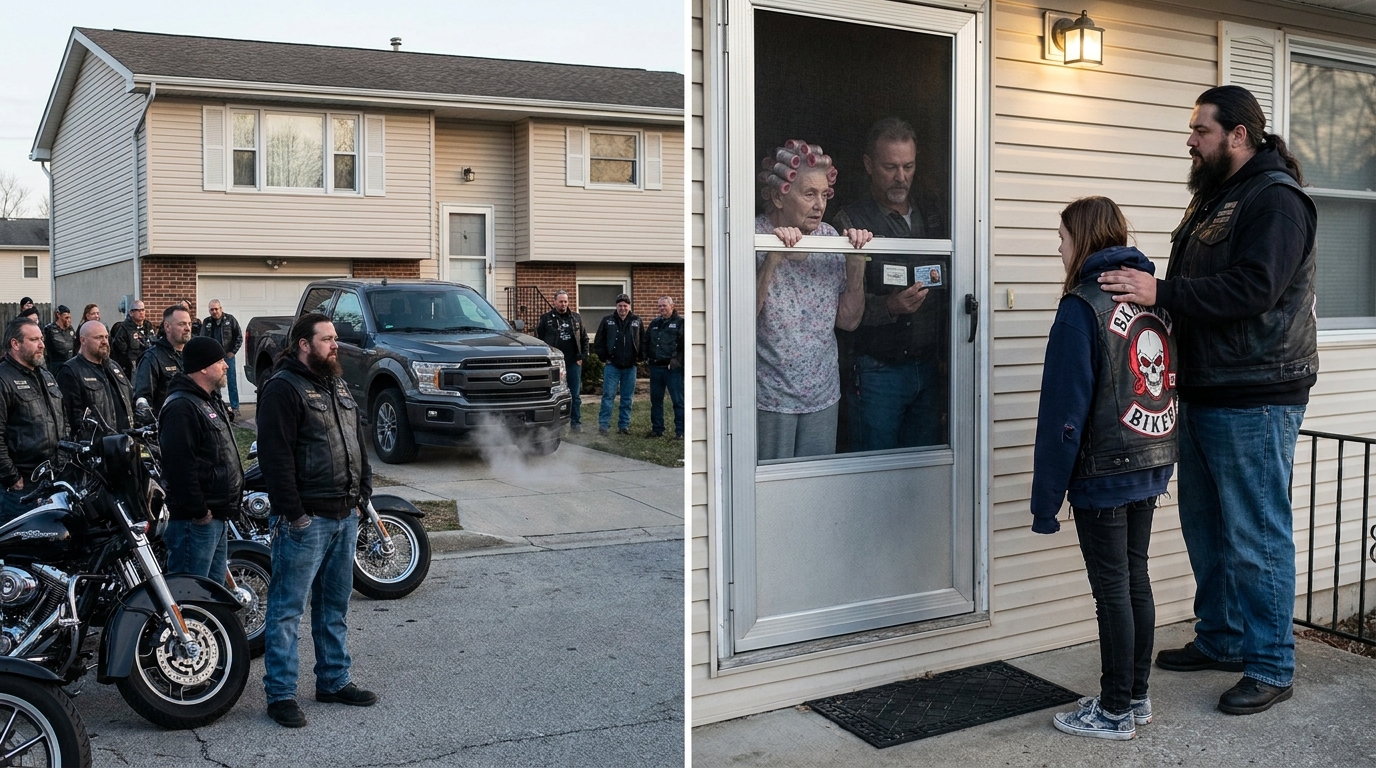
At 6:47 a.m., the frost on Thornhill Drive didn’t melt; it vibrated. One hundred and eighty heavy cruisers settled into disciplined rows along both curbs, their engines dying off in five-second waves until the street fell dead quiet.
Marcus Webb’s house sat at the end of the cul-de-sac—a beige split-level with a brand-new dark gray Ford F-150 idling in the driveway to warm up the cab.
Nobody drew a weapon. Nobody kicked a gate. One hundred and eighty men in heavy leather simply dismounted and stood beside their bikes, a solid wall of black hide and denim stretching three blocks deep.
“Stay close,” Miguel said, his large hand resting lightly on my shoulder as we walked up the steps of 2845 Thornhill—the house directly adjacent to Marcus’s driveway.
Bones knocked three times on the aluminum storm door.
The brass peephole went dark. A moment later, the inner door opened two inches, caught by a thin brass safety chain. An older woman with silver hair tucked into pink foam rollers looked out, her face pale behind the screen.
“I… I called the city earlier,” she stammered, her hands gripping the edge of the doorframe so hard her knuckles showed white. “Is there… what is all this?”
“Mrs. Patterson,” Bones said, holding his credential wallet flat against the wire mesh. His voice was calm, carrying the steady rhythm of a man reading a shift report. “I’m Gerald Thompson. We’re here about your neighbor, Marcus Webb.”
“Marcus?” She blinked, her gaze darting past Bones’s shoulder to the silent rows of patched backs standing on her lawn. “Marcus is a deacon. He coaches youth soccer.”
“Marcus has had a seventeen-year-old girl locked in his basement since last autumn,” Bones said flatly, stepping aside just enough for her to see me standing under the porch light in Miguel’s massive jacket. “Her name is Riley. She’s been living on the street since she escaped through the coal chute in May.”
Dorothy Patterson’s mouth opened, then snapped shut. Her eyes locked onto my face—taking in the sunken cheeks, the frayed hoodie cuffs, and the safety pins holding my pink high-tops together.
“You’re… Sarah’s girl,” she whispered.
“You heard her crying, didn’t you, Mrs. Patterson?” Bones asked. He didn’t raise his voice, but the question landed with the weight of a dropped anvil. “Late nights. Through the basement utility vent near your garden bed.”
She pulled back from the door, her chin trembling as she untied and retied the cord of her bathrobe. “I thought… I told my husband it sounded like someone crying. But Marcus said she was troubled. He told everyone at the block party she ran off to Chicago with some older boy.”
“He withdrew one hundred and twenty-seven thousand dollars from her mother’s insurance account while she was eating snow outside the roast house on Elm,” Miguel added, his voice dropping into a low rasp. “And you didn’t check.”
“I didn’t want to make trouble,” she sobbed, pressing a tissue to her nose as she unhooked the brass chain and let the door swing open. “He was always so polite when he brought the mail over…”
Across the driveway, the garage door of the split-level began to rattle upward on its steel tracks.
Marcus Webb stepped out onto the concrete, wearing a pristine beige polo, khakis, and a pair of yellow work gloves. He held a grease gun in one hand and a socket wrench in the other.
He took two steps toward his truck before his eyes registered the three hundred boots standing motionless on his street.
The wrench slipped from his fingers, hitting the driveway with a sharp, metallic clang.
CHAPTER 4: THE PAPER TRAIL CRACK
The screen of the micro-fiche reader flickered with gray static as Wire adjusted the focus knob with a grease-stained thumb.
The report was three years old. March 15, 2023. A dry spring night, clear roads, temperature forty-five degrees.
The primary cause listed by the responding officer was “loss of control due to mechanical failure.” Sarah Brennan’s sedan had taken the curve on Route 32 at fifty miles an hour, sailing clean through the wooden guardrail and down a thirty-foot embankment.
Wire leaned closer, his eyes narrowing at a handwritten note stamped in red ink along the lower margin of page three: Brake fluid reservoir depleted. Rear right hydraulic line severed at mounting bracket.
“She took the car to the shop two days before,” I whispered, leaning against the edge of the laminate desk, my left wrist throbbing in time with my pulse. “Mom always checked her maintenance logs. She kept every receipt in the glove box.”
“Look at the mechanic’s report,” Wire said, tapping the glass screen with the tip of his stylus. “The shop replaced both rear lines on March tenth. Brand-new steel braided hose. But the crash investigator noted that the retaining clamp on the rear right assembly hadn’t snapped from impact. It was stripped.”
He pulled up a second digitized folder—Marcus Webb’s personal financial transfers from May 2023. Two months after my mother died.
A single lump-sum payout of $180,000 from Sarah’s primary life insurance policy, deposited directly into a private account registered solely under Marcus’s name.
Wire tapped his mechanical pencil against the desk frame. Tap. Tap. “He didn’t just get lucky with her crash, Riley. He set the clock.”
“He took her car that morning,” I said, the room suddenly feeling too small, the smell of dust and old paper pressing into my chest. “He told her the alternator was whining. He spent forty minutes in the garage with the door pulled halfway down before he handed her the keys.”
“And two months later, he bought the first block of municipal bonds,” Wire said, zooming in on the bank ledger. “Using her death benefit as collateral. Then he took legal guardianship of you, locked up your trust, and started billing your estate five hundred dollars a week for ‘administrative upkeep.'”
A phone vibrated against the wooden table. Wire picked it up, swiping the screen without looking away from the terminal.
“Bones,” Wire said into the speaker. “I’ve got the original ME notes on Sarah Brennan. The crash report cites a stripped hose clamp on a brand-new brake line. And I’m looking at the garage tool list Marcus submitted for his home insurance audit last winter.”
Silence hung on the line for three seconds before Bones’s voice came through, raspy and steady. “What’s on the tool list, Wire?”
“A set of heavy-duty vise-grips,” Wire said, his eyes locked on the digitized image of a rusted steel clamp tucked in the corner of Marcus’s garage workbench photo. “With fresh jaw marks on the screw.”
“He didn’t just steal the kid’s inheritance,” Bones said from the other end. “He ran the exact same playbook twice.”
CHAPTER 5: THE CORNERED PREDATOR
Marcus didn’t run. Men who wear pristine polo shirts and deacon pins don’t sprint across icy lawns in front of their neighbors—their arrogance won’t allow it.
Instead, he wiped his greased hands on a yellow shop rag, his chin lifting as he took in the wall of leather boots blocking the end of his driveway. A twitch caught the corner of his left eyelid, but his voice came out loud, crisp, and dripping with civic authority.
“Gerald, isn’t it?” Marcus asked, pointing the grease gun toward Bones’s chest. “I don’t know what kind of stunt you think you’re pulling with this gang, but you’re trespassing on private property. Riley is a troubled ward who ran off months ago. I filed the paperwork.”
“You filed a runaway ticket to cover a hundred and twenty-seven thousand dollar cash draw,” Bones said, holding his position. He didn’t reach for a badge or a sidearm. He just unfurled the printed forensic audit against the hood of Marcus’s new F-150. “And you bought this truck six days after clearing her mother’s trust.”
Marcus laughed—a short, barking sound that didn’t touch his eyes. “I am her legal trustee! I am legally reimbursed for house maintenance, legal fees, and caretaking costs! You can’t prove a single dollar was misused, and you certainly can’t bring a pack of thugs onto my lawn to intimidate me!”
He turned his eyes to me, his jaw tightening as he registered Miguel’s cut hanging off my shoulders. “Riley, get over here right now. Stop embarrassing yourself. You tell these people you’re lying before I have you committed for psychiatric evaluation.”
I didn’t step back. My boots stayed locked to the concrete, my hands tucked deep inside the pockets of Miguel’s vest.
“The coal chute lock was three inches wide,” I said, my voice cutting through the crisp air without a tremble. “You forgot to clear the soot off the hinge when you padlocked it from the kitchen side.”
Marcus’s face flushed a blotchy, dark red. He stepped forward, raising his voice so Mrs. Patterson and James Chen could hear him from their porches. “She’s delusional! She’s been living on the streets taking drugs! Look at her! You think a judge is going to take the word of a homeless runaway over a registered guardian?”
“A judge won’t have to take her word,” Bones said, reaching into his inner pocket and pulling out the second printout—the high-resolution crash scan from Route 32. “They’ll take the word of the county medical examiner who just reopened Sarah Brennan’s file.”
Marcus froze. The rag in his left hand crumpled into a tight, greasy ball.
“The rear right brake line,” Bones continued smoothly, tapping the paper against the truck’s chrome grill. “The mechanic installed a new braided assembly on March tenth. But the clamp wasn’t sheared by the guardrail. It was stripped with a pair of ten-inch vise-grips.”
“That’s… that’s absurd,” Marcus stammered, his polished composure finally tearing at the seams. He backed toward his garage door, his heels catching on the concrete lip. “Sarah’s death was ruled an accident! The case is closed! You have no standing! You aren’t cops!”
“We don’t need badges to hand a prosecutor forty-eight pages of bank fraud and a murder weapon match,” Miguel said, stepping up alongside Bones, his massive frame blocking the light from the streetlamps. “You built a box for a seventeen-year-old kid, Marcus. But you forgot to check who was standing outside the door.”
Marcus’s eyes darted frantically toward his open front door, then toward the truck keys hanging from his belt loop, his breath coming in ragged, shallow gasps as the wall of silence closed in on him.
CHAPTER 6: THE QUIET ACCOUNT
The paper was crisp between my fingers, completely dry, devoid of the grease stains and coal dust that had ruined every page of my old spiral notebook.
Below the balance line sat a second entry—a trust deposit authorized by the probate court, marking the complete clawback of forty-three thousand dollars from the court-ordered liquid sale of Marcus’s F-150.
Victor “Priest” Dalton set two warm porcelain mugs onto the desk. He didn’t make a speech. He just pulled his reading glasses off his nose, letting them dangle by their silver chain against his black vest.
“The state board cleared your apprenticeship credits this morning,” Priest said, his voice low and steady. “Dr. Vasquez filed the clinical hours from your squad rotations. You start your official paramedic shift on Monday.”
I smoothed the edge of the bank statement with my thumb, feeling the faint, faint raised scar across my left wrist where the surgeon had reset the bone four months ago. It didn’t ache when the cold hit anymore.
Outside the office window, the low thrum of three Harleys pulling into the lot vibrated through the floorboards. Miguel stepped through the doorway, carrying two brown paper bags filled with warm diner sandwiches, his daughter Sophia right behind him with a stack of study flashcards under her arm.
“He tried to appeal the plea terms yesterday,” Miguel said, pulling a wooden chair up to the corner of the desk. He reached into his pocket, pulled out his nickel-plated Zippo, and flicked the wheel.
A bright, steady yellow flame caught instantly on the first strike.
He held it for two seconds before snapping the cap shut, extinguishing the light with a quiet, solid click.
“The judge threw it out,” Miguel continued. “Eight years state time, zero parole window, and the grand jury indictment for Sarah’s car was formally unsealed this morning. He’s not walking out of Lebanon Correctional.”
Sophia dropped her flashcards on the table, sliding into the seat beside me and nudging my arm with her shoulder. “You ready for trauma protocol drills tonight, or are you going to stare at that paper all day?”
“I’m ready,” I said.
I folded the bank statement once, tucked it neatly into the front chest pocket of my dark navy paramedic trainee uniform, and zipped it shut.
My mother’s stethoscope rested around my neck, its cold bell resting flat against my collarbone. I reached up, adjusted the tubing with my left hand, and stood up from the desk.