Rusted Gears And Silent Wires: The Everyday Mechanics Of Resistance In The Shadows Of Occupied Europe
CHAPTER 1: THE WEIGHT OF METAL
The exhaust heat shimmered off the rear deck of the Tiger 1, dissolving instantly into the wet summer grass of the hedgerow. Werner Brandt adjusted his grip on the elevation handwheel, feeling the cold, machined teeth of the gears respond with absolute, predictable obedience.
Outside the armored hull, the bocage country stretched away in a tangled maze of ancient boundary walls and overgrown blackberry vines. Inside, the air tasted of hot steel, lingering propellant residue, and the heavy musk of oil that never quite left the crew compartment.
Werner was twenty-three, and his hands knew the tolerance of metal the way a stonemason knew the grain of granite. He trusted the 88-mm cannon before him because it had never given him a reason to doubt its lethal efficiency.
The loader shifted behind him, the scrape of his heavy boots against the non-skid floor plates breaking the low hum of the idling Maybach engine. Werner checked the breech block one more time, his thumb brushing the firing mechanism with the automatic ease of long practice.
Through the binocular sight, the sunken lane 800 meters to the southwest remained quiet, save for the slow drift of summer dust. He did not know about the supply crates moving through the back roads of Belgium, nor did he care about the logistical paperwork piling up in rear- echelon headquarters.
He knew only the weight of the steel, the exact pressure required to traverse the turret two degrees left, and the absolute certainty that when he squeezed the trigger, the world outside would yield.
CHAPTER 2: THE FRYTHE LABORATORY
Colonel Reginald Thornton turned the heavy artillery segment over in his hands, his fingers tracing the fine rifling lands with a practiced, unforgiving familiarity. The smoke from his briar pipe wreathed his face in a perpetual gray haze, masking the old scar along his jaw that twitched whenever the damp air pressed hard against the windowpanes.
Across the scarred oak table, Major Geoffrey Hartley dropped a sheaf of captured Wehrmacht maintenance logs onto the timber surface with a dry slap.
— The reports from North Africa and the Eastern front are stacking up faster than the ordnance office can log them, — Hartley said, his voice dropping into a flat, measured register that betrayed no hint of relief. — They are still calling it metallurgical fatigue, blaming the Krupp steel batches from the spring production run.
Thornton did not look up from the barrel section, tapping the cold metal once more with a fingernail until the room caught the clear, vibrating note.
— The strongest machine is always the most brittle, lad, — Thornton murmured through the rising smoke, his eyes narrowing as he studied the microscopic stress tolerances etched into the bore. — A gun operating at thirty-two hundred atmospheres of chamber pressure does not forgive a single grain of misplaced friction.
Hartley leaned forward, resting his palms on the edge of the workbench while the coal fire in the corner snapped with a dry, resinous pop.
— If we push the substitution rate too high in the forward supply depots, the inspectors will spot the pattern before the spring offensive even clears the channel, — Hartley warned, his gaze locking onto the elder officer. — Marcel says the paperwork out of Caen can mask the inventory weight, but the physical tolerances on these obstruction devices have to be absolute.
Thornton reached into his coat pocket and pulled out a small, hardened length of steel wire, no thicker than a knitting needle, holding it up so the weak winter light caught the tiny lateral hook at the tip.
— We do not need to break every gun on the line, Geoffrey, — Thornton said quietly, laying the wire gently across the rifled steel. — We only need the gunner to trust the metal just enough to pull the trigger without looking down the tube.
CHAPTER 3: THE LIGE WORKSHOP
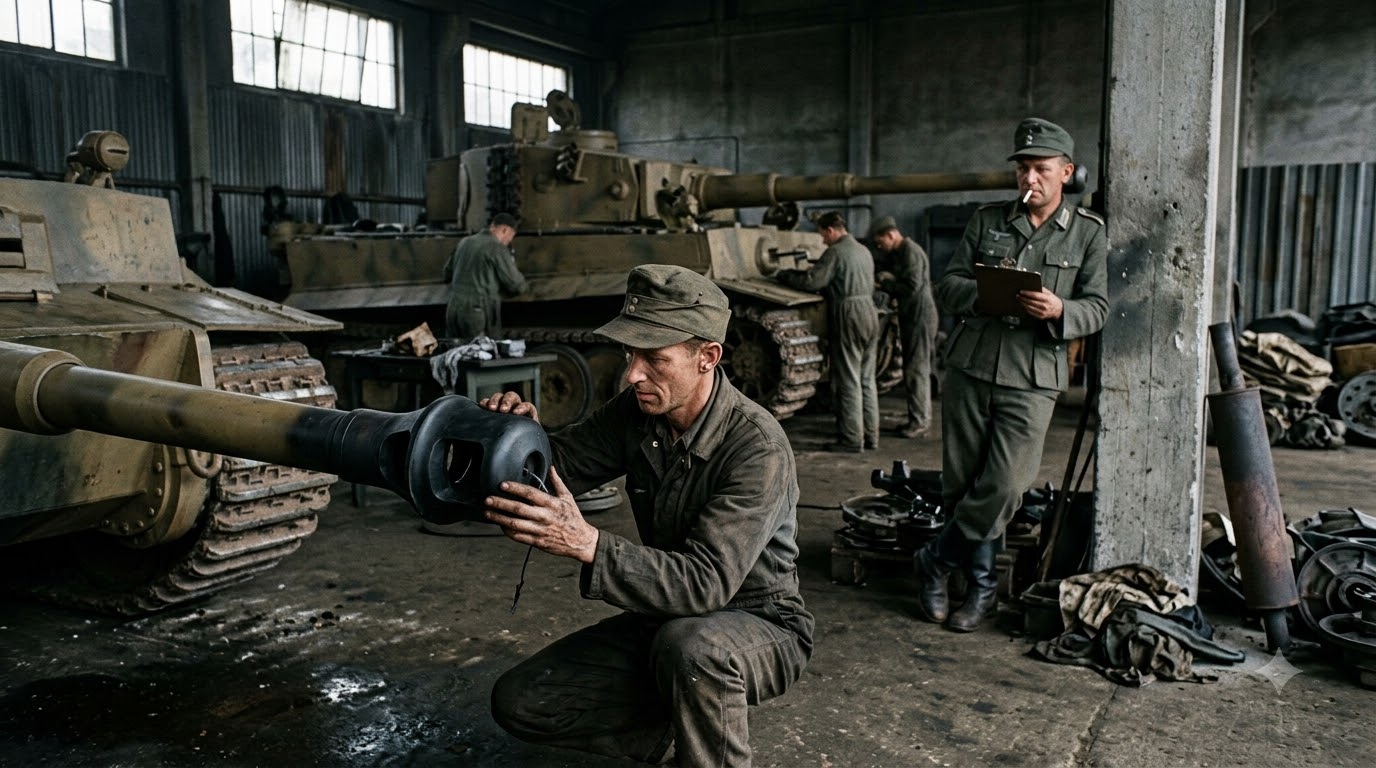
Louis Jansen stood beneath the looming steel mass of the heavy tank, his eyes fixed on the cold muzzle protruding over the front hull. The air inside the German vehicle depot smelled of burnt diesel and stale cabbage, thick enough to coat the back of the throat.
A German NCO leaned against the far wall, dragging on a cigarette while the radio crackled with static. Louis did not rush his movements, knowing that panic was the only thing capable of drawing an unwanted glance.
With slow, deliberate precision, he reached into his canvas jacket and pulled out the genuine bore plug he had unscrewed moments earlier. His fingers brushed against the false compartment hidden at the very bottom of his tool chest.
He pulled out a hardened steel wire, no thicker than a knitting needle, its small lateral hook catching the dull light of the depot windows.
— You are spending an awful lot of time on that track sprocket, Jansen, — the German guard barked, his voice cutting sharply across the concrete floor.
Louis did not flinch, keeping his breathing steady as he slid the wire up into the 88-mm barrel until the lateral hook bit firmly into the internal rifling lands.
— The thread was bound tight from the last mud run, — Louis replied flatly, his voice devoid of subtext or emotion. — If I do not clear it properly, your commanders will ask why the machine stalled before it even reached the ridge.
The guard grunted, turning back to his cigarette as Louis fitted the rubberized cap over the muzzle with an unhurried motion.
The device sat silently inside the steel tube, waiting for a crew that trusted their equipment completely. Louis picked up his wrench and walked away, his face entirely unreadable.
CHAPTER 4: THE CALCULUS OF SUPPLY
Marcel Fournier adjusted his wire-rimmed spectacles, his thumb tracing the bottom margin of a shipping form bound for the forward depots near Caen. The room smelled of dried ink and damp wool, the standard scent of a bureaucracy forced to account for every gallon of fuel and pound of steel moving through occupied France.
Across the cluttered desk, a German supply sergeant drummed his fingers against the wood, impatient for the clearance stamp.
— The transport trucks leave at midnight, Fournier, — the sergeant grunted, leaning forward with an air of petty, unearned authority. — Make sure the spare parts crates are tallied correctly or you will be explaining the discrepancy to the inspector general by morning.
Marcel did not look up, his fingers steady as he pulled a small wooden crate of standard replacement bore plugs toward the edge of his table.
— Every invoice matches the requisition order down to the last bolt, — Marcel replied in a flat, monotone voice designed to irritate through sheer compliance. — The mathematics of logistics do not tolerate mistakes, Sergeant.
With a quiet, practiced flick of his wrist, Marcel unlatched the crate lid during the momentary distraction of a passing vehicle outside, quickly swapping a dozen standard components for the modified wires hidden beneath his blotter.
He resealed the wooden box with precise pressure, leaving the surface looking completely undisturbed.
The shipment was logged, approved, and loaded into the back of a canvas-covered truck within minutes, carrying its silent burden toward the front lines.
CHAPTER 5: THE FORTYFIVE SECONDS
Corporal Hans Müller stared down the five-meter length of the KwK 36 cannon, his hand trembling slightly as the flickering yellow light of the bore lamp illuminated the rifled interior.
Outside the armored hull, the distant rattle of tracked vehicles and sharp rifle reports echoed across the damp Norman hedgerows.
The standing orders from the division commander were clear, carved into the routine of every heavy armor crew with the weight of an unpayable debt.
— Check the bore again, Hans, — the vehicle commander snapped, his voice tight with an exhaustion that had nothing to do with lack of sleep and everything to do with creeping dread. — The new directive says no firing without a full visual confirmation. Every single time.
Hans wiped sweat from his forehead, holding the brass lamp steady while his eyes strained against the shadows deep inside the steel tube.
Forty-five seconds.
That was how long it took to strip the muzzle, sight down the rifling, and verify that no foreign obstruction lurked in the dark. Forty-five seconds in an open lane where an enemy Sherman could close the distance before a round was even seated.
— It is clear, — Hans whispered back, though his throat felt dry as dust. — The tube is clean.
He pulled the lamp back, his muscles locked tight against the constant, gnawing question of whether the light had missed something seated just out of reach.
The gun was loaded, but the hesitation had already settled into the turret like cold iron.
CHAPTER 6: THE FINAL CALCULATION
Werner Brandt pressed his eye to the binocular sight as the narrow Norman lane opened into view through the thick hedgerow.
The Maybach engine vibrated beneath his boots, a steady mechanical pulse that had once felt like absolute security.
Outside, the tactical advantage should have been total, anchored by the unmatched power of the long-range tube resting above the hull.
Instead, the mandatory forty-five-second delay hung in the damp air like a suffocating blanket, forcing a grueling hesitation that fractured every instinct he possessed.
— Fire, — the commander shouted over the intercom, his voice cracking with strain.
Werner squeezed the mechanism without checking the bore one last time, trusting the metal the way he always had.
The chamber pressure spiked instantly against an invisible, hardened obstruction seated deep within the rifling, shattering the steel from the inside outward.
The turret interior filled with a blinding rush of hot gas and fragmented metal before his nervous system could even register the catastrophic failure.
Weeks later, miles away in a quiet West Virginia hardware store, Dale Mosley wiped dust off a shelf of iron nails, his hands steady and entirely free of old ghosts.
The machinery of war had stopped its grinding, leaving behind only the quiet silence of ordinary men who survived because of threads they never saw.