A Fragile Restoration: The Slow, Quiet Mending of a Soldier’s Heart in the Winter’s Light
CHAPTER 1: THE THRESHOLD OF SILENCE
The keys were heavy in Samuel’s palm, a cold, jagged weight that felt entirely alien. He stood in the doorway of the small apartment on Elm Street, his boots—new, sturdy, and stiff—clicking against the hardwood. The room was bathed in the late afternoon amber of a winter sunset, the light cutting through the dust motes like searchlights in a forgotten theater.
He stepped inside, the door latching shut behind him with a finality that made his heart stutter. It was quiet. Not the aggressive, booming silence of the battlefield, nor the jagged, teeth-chattering silence of the streets. It was a domestic silence, soft and thick, wrapped in the smell of fresh plaster and the faint, citrus sting of industrial cleaner.
He didn’t move toward the center of the room. He remained near the entrance, his duffel bag—now containing items he didn’t recognize as his own—sliding from his shoulder to the floor. He felt like an intruder in his own life. The state had given him this, a token of their apology, but every piece of furniture, every freshly painted white wall felt like a stage set designed to hold a version of Samuel Hayes that no longer existed.
Samuel reached into his pocket and pulled out the small, silver watch. It was a relic of his life with Caroline. He held it to his ear, listening for the rhythmic pulse of time, but there was only the hollow, dead weight of metal. He had carried it through the deepest freezes of the winter, its cold surface pressing against his palm as a reminder of what he had lost. Now, in the warmth of the apartment, the metal felt almost painful to touch.
He looked around, his eyes settling on the window that looked out over the street. Down below, the town of Fair Haven continued its slow, weary turn. A neighbor walked a dog, a car hissed through the slush, the world moved on without him, oblivious to the fact that he was finally standing inside a room with four solid walls.
But then, his gaze snagged on the edge of the hallway. Propped against the wall was a cardboard box the social worker had left behind, filled with the “reclaimed” personal effects from his time in the system—the files, the letters, the life that had been processed through a shredder.
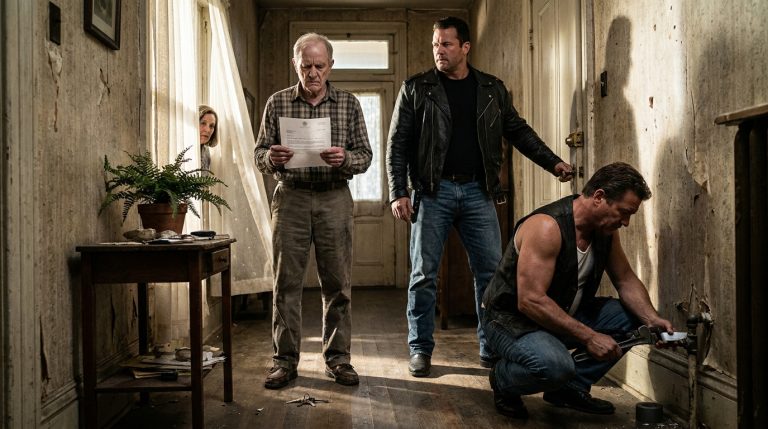
As the sun dipped lower, casting long, bruised shadows across the floor, Samuel noticed a small piece of paper fluttering out from beneath the box. It was a document, white and stark against the dark wood. He walked over, his legs feeling heavy, and leaned down to pick it up. It wasn’t one of the letters from the VA he had expected. It was a handwritten note, tucked into a file that shouldn’t have been in his possession—a list of names, dated from the time he was in the VA hospital, with his name crossed out in bold, angry ink.
His breath caught. He had been told his files were purged due to a computer error, but the ink on this paper wasn’t digital. It was human. And it was signed with a set of initials he recognized from a man he had pulled from the fire in Fallujah.
CHAPTER 2: THE WATCHS TICKING
The note felt brittle against Samuel’s calloused skin, a ghost of a document that had no business existing in a world that had officially declared his history a blank slate. His pulse thrummed in his fingertips, a dull, aching rhythm that mirrored the silence of the room. He stared at the initials at the bottom—R.D.—and a name flared in his mind, sharp as a tracer round in the night: Raymond Dunning. He hadn’t thought of Dunning in twenty years. They had been in the same platoon during the final push, the kind of bond forged in heat and exhaust, but Dunning had been a man of paper-thin loyalties even back then.
Samuel lowered his hand, his shoulder aching with a phantom weight. The apartment suddenly felt too bright, the white walls closing in like the sides of a trench. He looked toward the window, but the light had shifted, leaving the room in a bruised purple twilight.
He didn’t put the note down. Instead, he folded it carefully, his movements mechanical, and tucked it into the inner pocket of his jacket, right next to the photograph of Caroline. The interaction felt like a tactical maneuver, a defensive habit that had survived even when his life had crumbled. He needed to be steady. He needed to be invisible, just as he had been for years, but the invisibility was now a choice rather than a condition.
“Uncle Sam?”
The voice came from the hallway, soft and tentative. Ellie stood in the doorway, her silhouette framed by the dim light of the corridor. She held a small bag of groceries, her movements hesitant, as if she were afraid the apartment might vanish if she walked too far into the light.
Samuel turned slowly. His legs felt stiff, the transition from the sterile holding cell to this quiet space still vibrating through his bones. He forced a small, tight smile—a pale imitation of the man he used to be. “Ellie,” he said, his voice raspy, unused to forming words in a space that wasn’t a courtroom or a cell.
She stepped inside, her gaze sweeping over the spartan room. “I brought some tea,” she said, raising the bag. “And a few things to make this place… well, less like a hotel.”
She set the bag down on the small kitchen counter, the plastic rustling sharply in the silence. Samuel watched her. She had Caroline’s grace, the same slight tilt of her head when she was concerned. It was a texture he hadn’t touched in years, a faded, beautiful thread of his past woven into the present.
As Ellie moved, she bumped into a small side table, and a metallic sound rang out—the hollow, rhythmic clink of his pocket watch hitting the wood.
He pulled it out, his thumb tracing the worn engraving on the back. The glass was cracked, a spiderweb of fractures that obscured the frozen hands. He hadn’t wound it since the day of the funeral, yet now, as he held it, he felt a strange, jarring tremor in the metal. It wasn’t ticking, but it felt warm, as if it were holding a heartbeat that didn’t belong to the watch.
“It’s not working,” Samuel murmured, his eyes fixed on the frozen face.
Ellie moved closer, her shadow falling over his hand. “It doesn’t have to, Uncle Sam. Sometimes things don’t need to work to tell you where you’ve been.”
She reached out, her hand lingering near his, and for a heartbeat, the air felt thick with the weight of everything they hadn’t said—the missing years, the silence, the slow, agonizing erosion of his identity.
Samuel looked at her, his eyes scanning her face, searching for a sign that she knew about the note in his pocket. But she was looking at the watch, her expression soft, filled with a fragile, aching hope. He realized then that he was the only one holding the burden of the past. If he spoke, if he brought the note into the light, he would be tearing the roof off this temporary sanctuary.
“I’m just trying to hold on,” he whispered, the words barely audible.
“You don’t have to hold on anymore,” Ellie replied, though her voice wavered, a hairline fracture of doubt showing through. “The war is over.”
Samuel gripped the watch tighter, the metal biting into his palm. He looked back at the hallway, at the box of files, and then at Ellie’s kind, unknowing eyes. The note in his pocket felt like a live grenade. The silence in the room shifted, no longer soft, but heavy with the friction of a secret that was already starting to rot the edges of his new life.
CHAPTER 3: THE UNSEEN FILE
Samuel didn’t move. He stood in the center of the apartment, the weight of the note pressing against his fingertips. Ellie’s shadow remained cast across the floor, a dark, reassuring shape, but he felt miles away from her. The note, marked with the initials R.D., wasn’t just a list of names; it was a map of a deliberate, cold-blooded erasure.
He walked past Ellie, his gait stiff, and reached the cardboard box. He didn’t look at her, didn’t offer an explanation. He knelt, the floorboards groaning slightly beneath his weight. He began to sift through the contents—the letters of denial, the forms that had been stamped DECEASED or INELIGIBLE with such chilling casualness. He was looking for the dates.
“Uncle Sam?” Ellie’s voice was closer now, a ripple of worry in the still air. “What are you doing?”
“I’m looking for the timing,” he muttered, his voice gravelly. He pulled out a stack of documents from the VA’s “corrected” file. The official narrative was that his benefits had been cut due to a clerical error in 2007. But as he laid the pages out on the hardwood floor—the light from the window catching the frayed edges of the documents—he saw it.
The discrepancy was subtle. A stamp in the margin of a 2007 summary report indicated it had been processed before the application had even been submitted. It was a phantom timeline. Someone had pre-approved his erasure before the bureaucracy had even filed the paperwork.
“Look at this,” Samuel said, his finger tracing a line of small, typed numbers. “This shouldn’t be here.”
Ellie knelt beside him, her brow furrowing. She wasn’t a soldier, but she had an eye for the inconsistencies in the world; she knew when something didn’t sit right. She leaned over, the scent of her tea mingling with the musty smell of the old, recycled paper.
“The dates don’t match,” she whispered.
“They were waiting,” Samuel said, the realization settling into his chest like cold lead. “They weren’t just incompetent. They were anticipating. Someone knew I was going to lose my status, and they had the paperwork ready to ensure I never got back up.”
He felt the stirrings of a memory—the smell of the desert, the suffocating heat of the humvee, and the man who had scrambled out of the wreckage, his uniform torn and his eyes wide with a frantic, desperate greed. Raymond Dunning. Dunning hadn’t been an angel; he had been a man who understood leverage long before he understood the cost of a life.
Samuel sat back on his heels, the paper shivering in his grip. The apartment, once a sanctuary, now felt like a glass cage. If they had been tracking him back then, if they had been prepping this file before he even returned home, then his “disappearance” wasn’t just a result of his own broken heart. It was a target on his back that had been placed years before he realized it.
“I need to go back to the courthouse,” Samuel said, his voice hardening.
“It’s late, Sam,” Ellie said, reaching out to touch his arm. “The office will be closed. Whitaker said they were helping, didn’t he? Why don’t you talk to them tomorrow?”
“Because tomorrow is just another piece of paper,” Samuel replied, standing up. He felt the cold iron of his own resolve, a sensation he hadn’t experienced since he wore his blues. “I need to know if the others on this list—the ones crossed out—are still around.”
He walked to the window. The streetlamps of Fair Haven were flickering to life, throwing long, jagged shadows against the storefronts. He looked down at his own reflection in the glass—hollow-cheeked, weary, yet undeniably present. He was no longer the man who lived in the back alleys; he was a man with a target, and for the first time in two decades, he was ready to look his enemy in the eye.
Ellie stood, her face pale in the twilight. She didn’t argue. She saw the shift in him, the way he straightened his back, the way his eyes became focused, sharp, and calculating. She picked up his coat from the chair.
“If you’re going,” she said quietly, “you’re not going alone.”
Samuel looked at her, then at the note. He had spent his life protecting those he loved, often at the expense of himself. He had thought that was over. But as he took the coat from her, he realized that this, too, was a battle. He wasn’t just fighting for his own records anymore; he was fighting for the names on the list.
They walked toward the door, the floorboards quiet beneath their feet. He didn’t lock the door—he didn’t know if he would be coming back to this apartment tonight, or if this was just the first step in a much longer, darker march. He felt the watch in his pocket—still, silent, and heavy. It was time, he realized, to see if he could make it tick again.
CHAPTER 4: THE WEIGHT OF TESTIMONY
The night air of Fair Haven was thick, laced with the metallic tang of oncoming snow and the exhaust of a town that struggled to keep its machinery turning. Samuel walked with a purpose that felt new to his limbs—a steady, deliberate cadence that ignored the protest of his knees. Beside him, Ellie moved with quiet intensity, her presence a grounding, tethering force against the sudden, sharp vertigo of his own unfolding mystery.
As they crossed the bridge toward the municipal center, the streets were mostly empty, save for a few stray lights flickered in windows and the distant, lonely wail of a train. Samuel’s mind was a closed circuit. He replayed the note, the initials R.D., the timeline discrepancies. He wasn’t looking for a savior; he was looking for a ghost.
They reached the community center on the edge of the district, a place where, as per the rumor mill of the local VFW, a group of veterans gathered late on Tuesdays. The building was a squat, concrete block, its exterior weathered by decades of salt and wind. Samuel paused under the pale, buzzing glow of a streetlamp.
“If Dunning is on that list,” Samuel murmured, his voice barely rising above the wind, “he’s either been erased, or he’s waiting to be.”
He pushed the door open. The interior was a cavernous, dimly lit hall that smelled of floor wax and stale coffee. A few men sat scattered in the folding chairs near the back, their silhouettes jagged against the distant glare of the stage lights. One of them—an older man with a grey, thick beard and shoulders that sloped under the weight of an invisible burden—looked up as Samuel entered.
Their eyes locked. In that brief, fractured second, Samuel didn’t just see a stranger; he saw a mirror. The man’s eyes were hollowed out by the same kind of fatigue that had lived in Samuel’s for years—the kind that only comes from knowing too much and being unable to speak it.
Samuel walked toward him, his heart hammering against his ribs like a trapped bird. The man didn’t move, didn’t turn away. He simply watched, his hands resting on his knees, trembling with a subtle, rhythmic palsy.
“I’m looking for Raymond Dunning,” Samuel said, his voice stripped of all pretense.
The man stared at him, then let out a low, dry laugh that sounded like gravel grinding in a gear. “Dunning? He hasn’t been here in years. Not since the purge.”
“The purge?” Samuel echoed, the word tasting like copper.
“That’s what they called it, back in ’07,” the man whispered, leaning forward. His voice was a thin, frayed wire. “When the records started disappearing. Some of us, we tried to hold on. We kept copies, kept logs. But then the guys in the suits started coming around, offering settlements, offering clean slates. They didn’t want our stories, Hayes. They wanted our silence.”
Samuel felt a cold shiver crawl down his spine. The man knew his name. Of course, he knew his name. In the small, broken ecosystem of Fair Haven’s forgotten veterans, a man like Samuel Hayes was a legend whispered in the shadows of the VFW.
“Why me?” Samuel asked. “Why was I on the list?”
The man looked away, his gaze drifting to the darkened rafters of the hall. “Because you were there,” he said, his voice barely audible. “You were there when the convoy went up. You saw what happened to the supply manifests. You saw what Dunning did.”
The room seemed to tilt. The memory, previously buried under layers of grief and survival, surged forward with the force of a tidal wave—the fire, the heat, and the sudden, horrific realization that the supplies they were guarding weren’t food or medical kits. It was something else. Something the commanders had been desperate to keep buried in the sand.
“Dunning isn’t just a name on a list,” the man continued, his eyes meeting Samuel’s again. “He’s the architect. And if he knows you’re digging, he’s already moving.”
Samuel stood still, the weight of the revelation pressing down on him. The note in his pocket suddenly felt like it was burning through his jacket. He had come here looking for a lead, but he had found a collision course.
“Where is he?” Samuel asked, his voice a low, dangerous growl.
The man stood up, his movements stiff and painful. He walked past Samuel, his shoulder brushing against his, leaving behind the faint, lingering scent of diesel and dry earth. “He’s not in town, sergeant. He’s in the office. The one you’re heading to tomorrow.”
He stopped at the door, the cold wind gusting into the hall. He didn’t look back. “Careful what you open. Some things are buried for a reason, and the earth is very, very deep.”
The door swung shut with a hollow thud, leaving Samuel and Ellie alone in the cavernous, silent hall. Samuel turned to look at Ellie, whose face was pale, reflecting the dim, flickering light. He had wanted the truth, and he had gotten it. But as he stood there, the reality of the situation solidified around him. The bureaucratic purge wasn’t a mistake. It was a cover-up, and the man he had once dragged from a burning vehicle was the one holding the shovel.
He reached into his pocket and touched the cold, metallic face of his watch. It was still silent. But for the first time in twenty years, he understood why. It wasn’t broken. It was waiting for the right moment to start again.