Underestimated Veteran Shatters Prejudices and Uncovers a Lethal Conspiracy on a Marine Range
CHAPTER 1: THE MOCKERY ON RANGE 7
Gunnery Sergeant Michael Rodriguez crossed his tattooed arms, his chest expanding under his digital desert fatigues as he let out a sharp, barking laugh that carried across the sun-bleached concrete of Range 7.
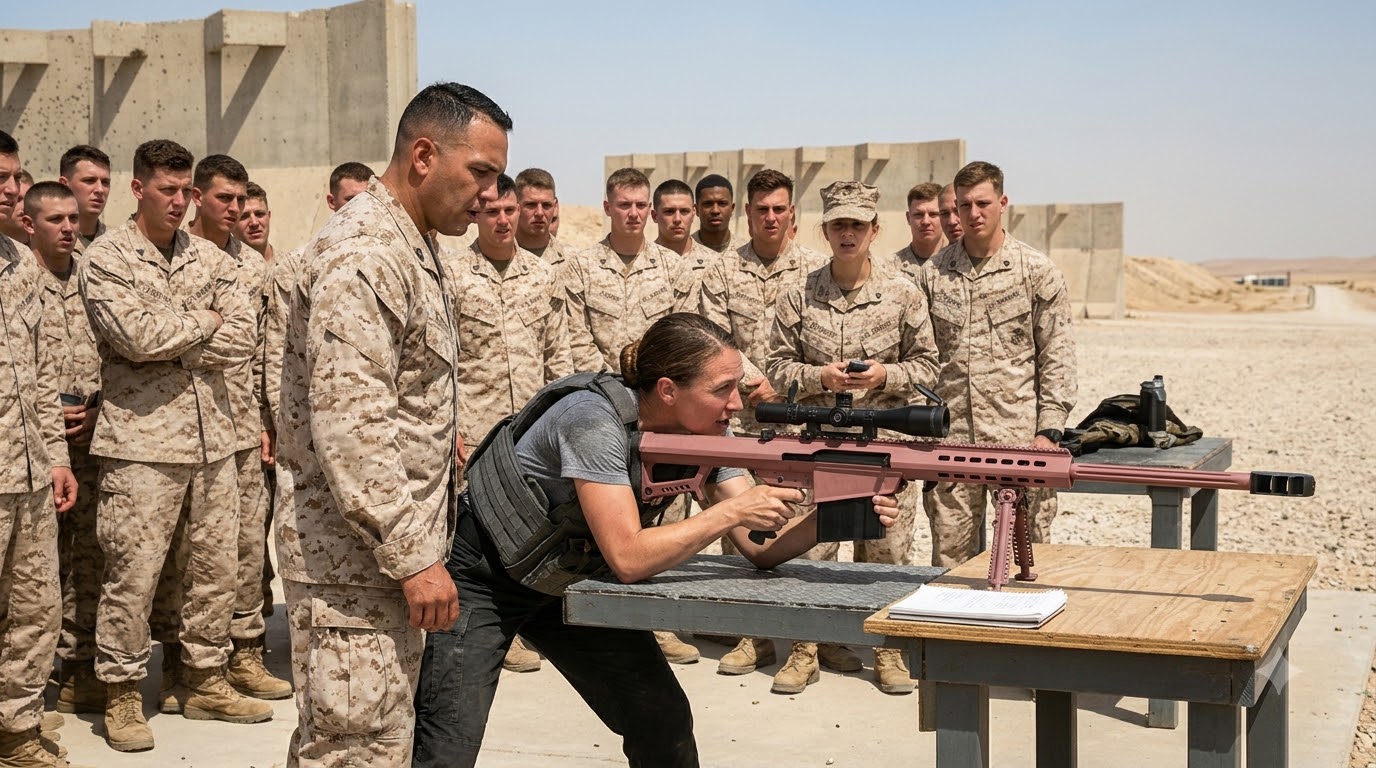
“Is that a Hello Kitty toy, or did you raid your daughter’s playchest?” Rodriguez sneered, towering over the steel shooting bench.
Emily Carter didn’t answer. She set her battered aluminum gun case down on the bench with a heavy, metallic clink that echoed off the sound-dampening baffles. Her gray t-shirt was faded at the seams, and her boots carried the dry, pale dust of high-desert terrain.
Nearby, Corporal Madison Brooks angled her smartphone high, her face framed by flawless makeup and a polished Marine cap. “Family, live on the feed right now—we’ve got Barbie Sniper trying to qualify with real Force Recon guys,” Brooks said into the lens, her voice sharp with amusement. “Let’s see how many seconds it takes before she cries.”
Thirty Marines shifted in a loose semicircle, their boots crunching on the loose gravel. A wave of snickers rippled through the line. Bills were pulled from pockets and slapped into open palms as side bets began to circulate.
Emily unlatched the case. The dual metal clasps snapped open with crisp, distinct cracks. Inside lay a Barrett .50 caliber rifle, its heavy receiver and long barrel finished in a vivid, unmistakable shade of rose-colored paint.
“What’s next, lady? Unicorn stickers on the scope?” Rodriguez barked, stepping closer until his shadow fell across her hands.
Her right hand twitched. It was a rhythmic, subtle shudder—not the rapid jitter of panic, but a deep, neurological tick that repeated every four seconds. She gripped the cold steel carrying handle of the Barrett, using the physical weight of the thirty-liter rifle to ground her frame against the bench.
“I need fifteen minutes to verify zero,” Emily said quietly. Her voice was flat, dry, and entirely devoid of inflection.
“Fifteen minutes?” Brooks laughed aloud, leaning toward her phone screen as comments flooded her broadcast. “Honey, you could take fifteen hours and you still wouldn’t hit a barn with those shaky hands.”
Stand-off distance was zero. Rodriguez leaned over the bench, his bulk blocking the morning sun. “You get one round on the steel at a thousand meters. You miss, you pack that pink piece of plastic into your trunk and you get off my range forever. Deal?”
Emily reached into her pocket, her fingers brushing the worn metal edges of two dog tags wrapped in black electrical tape. She pulled out a dog-eared spiral notebook instead, flipping the cover to reveal dense lines of hand-calculated density altitude, barometric pressure, and core Coriolis drift tables.
“Make it six thousand meters,” Emily murmured, her eyes fixed on the distant, shimmering heat waves rising off the impact area.
The crowd went dead silent for a single beat before exploding into thunderous, breathless laughter. Marines doubled over, slapping their knees, while Rodriguez just stared at her with a look of dark, unadulterated annoyance.
“The world record is three thousand five hundred meters, lady,” Rodriguez growled, his voice dropping an octave. “You’re not just out of your mind—you’re wasting my morning.”
Fifty yards back, near the brass-collection crates, Master Sergeant Jake Sullivan stopped wiping his shooting glasses. He didn’t laugh. His eyes narrowed on the rhythm of her hands—four seconds of tremor, a fraction of a second of stillness, four seconds of tremor.
He had seen that exact neurological sequence once before, in the dust of the Helmand Province, on a medic who had dragged three men out of a burning Humvee after an IED blast.
Emily ignored the roar of the crowd around her. She unzipped her side pocket, pulled out a box of standard-issue 660-grain FMJ ball ammunition, and pressed the first heavy brass cartridge into the steel box magazine. The spring compressed with a harsh, raspy scrape.
“Clear the back-blast area,” Emily said, her tone as cold and level as the steel bench beneath her elbows.
CHAPTER 2: THE IMPOSSIBLE TARGET
The range didn’t go quiet because people felt respect. It went quiet because thirty men were waiting to watch a wreck.
Emily’s left elbow dug into the concrete pad, anchoring her weight behind the stock of the rose Barrett. The heavy steel receiver was cold against her cheek. She didn’t have her brother’s custom red-tipped incendiary rounds—those had gone up in smoke five years ago in the desert. She had a standard military box of 660-grain ball ammunition, pulling round after round from the rack with routine mechanical precision.
“Ten seconds, princess,” Rodriguez barked from behind her shoulder, his boot soles scraping against the gravel line. “Ten seconds until physics turns you into a meme.”
Beside him, Corporal Brooks held her phone steady, the digital display glowing with tens of thousands of active comments. A soft, collective chuckle rippled through the front rank of Force Recon Marines. They were leaning back, hands resting on their belts, waiting for the massive .50-caliber recoil to throw her off the bench.
Emily ignored them. She adjusted her windage knob by three clicks left, accounting for the cross-draft sweeping off the Pacific ridges. Her right hand trembled—a steady, rhythmic twitch that ticked like a clockwork gear.
Four seconds of tremor. One fraction of a second of stillness.
She took a slow, measured breath in through her nose, holding it in her chest as her reticle lined up on the tiny metal square six thousand meters downrange. The target was nothing more than a microscopic gray pinprick swimming in the ocean heat haze.
The tremor stopped.
Emily pressed the trigger.
The Barrett didn’t just fire; it cracked the air open with a concussive shockwave that slammed into the chest of every Marine standing within twenty feet. Dust erupted from the dry dirt in front of the muzzle brake, blowing back over Rodriguez’s polished boots.
Brooks stumbled half a step backward, her phone slipping lower as the sheer force of the blast rattled the glass optics of her camera.
Eight seconds passed in total, absolute silence. No one laughed. No one breathed.
Far down the range, a faint, metallic ping traveled back through the morning air, followed instantly by the sharp visual report from Master Sergeant Sullivan’s spotting scope.
“Hit,” Sullivan said. His voice wasn’t loud, but it cut through the silence like a cold blade. “Dead center on the main plate. Pierced it. Pierced the backer plate behind it.”
Rodriguez didn’t move. He kept his eyes locked on the distant hill, his jaw slightly slack. “Check the optics. The scope’s wrong.”
“Scope isn’t wrong, Gunny,” Sullivan replied, his tone dropping into a low, hard register as he leaned back from his tripod. “She just put a standard round through five inches of target steel at six kilometers.”
Emily didn’t celebrate. She didn’t look up to check their faces. Her trembling hand reached down, flipped the safety selector back to single-shot, and pulled the hot brass casing from the ejection port. It fell onto the concrete pad with a sharp, hollow ring.
Brooks looked down at her glowing screen. The chat on her live stream was moving so fast the text was a solid blur of white light, but her hands were shaking too hard to read it.
Rodriguez took two slow steps forward, stopping right beside the steel bench. The arrogance was gone from his brow, replaced by a cold, sudden confusion that made his forehead furrow.
“Who gave you those wind charts?” Rodriguez asked quietly.
Emily set the warm brass casing on the wooden table, right beside her dog-eared notebook. She looked up, her brown eyes completely flat, reflecting nothing of the sun or the thirty men surrounding her.
“My brother,” she said.
CHAPTER 3: THE GHOSTS IDENTITY
Sullivan reached out, his thick, calloused fingers resting on the wooden table just inches from her spiral notebook. He didn’t look at the rose rifle or the pierced targets. He looked at the two metal rectangles tucked under her shirt collar, wrapped tight in degraded black tape.
“You’re using the Phantom rhythm,” Sullivan said, his voice flat enough to cut through the rising wind. “Four point seven seconds. I saw that pulse in Kandahar five years ago.”
Emily’s right hand twitched against the steel receiver, but she didn’t pull away. “Kandahar is buried.”
“The casualty list wasn’t,” Sullivan replied. He leaned down, his eyes catching a faint black mark inked into the skin behind her wrist—a small, stylized numerical seven half-hidden by her sleeve. “Phantom Seven was wiped out in an ambush. Official report said zero survivors.”
Rodriguez stepped up, his brow wet with sweat despite the morning chill. He looked between Sullivan and the woman standing motionless before them.
“What are you talking about, Master Sarge?” Rodriguez asked, his earlier hostility completely erased, replaced by an uneasy, defensive edge. “She’s a civilian contractor. She came off the main gate log.”
“She’s not a contractor,” Sullivan said without turning his head. He looked straight into Emily’s eyes. “Who was your handler?”
“Marcus Bishop,” Emily said softly.
The name hit Sullivan like a physical blow. His chest hitched, his mouth closing into a tight, hard line.
Before he could speak another word, the desert floor began to tremble. It wasn’t the deep, rolling vibration of artillery tests from the north ranges. It was a fast, aggressive chop that rattled the loose brass casings resting on the concrete pad.
Two dark shapes cleared the ridgeline to the south, flying low to the terrain, hugging the contours of the dry creek beds. They had no military numbers painted on their tails, no insignia, and no transponder lights.
“Those aren’t ours,” Rodriguez grunted, squinting through the dust kicked up by the incoming rotors. “Range control didn’t clear any inbound air units for Range Seven.”
Emily moved instantly. She didn’t ask for permission. She grabbed her notebook, shoved it into her side pocket, and gripped the carrying handle of the Barrett.
“Inside the reinforced range house. Now,” Emily said, her calm voice cutting through the growing panic of the perimeter.
“Hold on, lady,” Brooks stammered, holding her phone up toward the black airframes as they banked sharply toward the firing line. “You can’t just give commands to—”
“Inside!” Sullivan roared, grabbing Brooks by the shoulder of her tactical vest and shoving her toward the heavy steel door of the range bunker. “Move your legs, Corporal! Range lockdown! Get the men inside!”
The sky above the range turned dark as the rotor wash slammed into the gravel, blowing dust, paper targets, and empty ammo boxes across the line. The power grid on the outer poles snapped off with a loud, metallic pop as an electromagnetic pulse killed every phone screen and range monitor instantly.
Emily reached the steel threshold of the building first, her trembling hand holding the heavy door wide as thirty Marines scrambled across the threshold.
CHAPTER 4: THE CHECKMATE AT THE BREACH
The red emergency lights flickered on inside the range house, casting harsh, bloody shadows over the concrete walls. Emergency battery banks hummed against the back corner, their fans straining under the EMP disruption.
“North doorway breach!” Rodriguez barked, his sidearm clearing his holster with a sharp, metallic snip. “Get behind the concrete baffles! Secure the lanes!”
Marines scrambled into defensive positions, ducking behind heavy equipment crates and metal equipment racks. They were lightly armed with standard sidearms, outmatched in firepower, but nobody backed down.
Emily lowered herself behind a overturned steel workbench, resting the heavy barrel of the rose Barrett on the lip. Her hand twitched—four seconds of tremor, a fraction of a second of stillness. She stripped open her last box of standard-issue 660-grain ball rounds, racking the heavy bolt back with a smooth, rasping slide.
“They’re not here for a negotiation, Gunny,” Emily said, her tone level despite the dust settling in her throat. “Marcus Bishop sent them to sweep this range clean. Zero witnesses.”
“Then Marcus Bishop made a bad calculation,” Sullivan grunted, sliding in beside her with his service pistol trained on the buckling northern door hinges.
The steel door buckled inward with a deafening crack. Black smoke poured through the gap, followed by dark, heavily armored figures moving in silent, disciplined formation. They wore no unit patches, no flag emblems, and carried suppressed automatic weapons built for close-quarters clearing.
Emily waited out her tremor. The pause arrived.
She pressed the trigger.
The Barrett roared in the enclosed space, the concussive pressure wave rattling the overhead light fixtures. The heavy lead round slammed into the lead operator’s plate carrier, the sheer kinetic energy lifting the man off his feet and throwing him back through the smoke into the second operator behind him.
“East side covered!” Rodriguez shouted, firing three rapid shots down the narrow corridor as another shadow tried to flank the workbench.
“Keep your heads low!” Sullivan yelled, grabbing Brooks by her tactical harness and pulling her flat against the floor as suppressed rounds chewed through the plaster above them.
The black-clad team tried to push into the main room, but the narrow doorway turned into a brutal choke point. Emily didn’t have her brother’s incendiary rounds to blind them, but she had geometry and cold calculations. Each shot from the Barrett hit with crushing force, punching through body armor and tearing up the door frame itself.
One of the fallen operators slid across the slick floor, his weapon clattering near the foot of Emily’s workbench. Sullivan reached down, snagged the sidearm, and flipped it over to inspect the receiver under the dim red emergency light.
His thumb stopped on a laser-etched serial code near the ejection port.
“Emily,” Sullivan rasped, his voice tightening. “Look at this batch stamp. This isn’t CIA surplus. This is defense contractor stock—straight out of the Miramar logistics depot.”
Emily glanced down without breaking her aim, her eyes catching the distinct corporate insignia stamped right beside the serial number.
“Bishop didn’t just sell us out,” Emily said quietly, her index finger resting on the cold steel trigger shoe. “He was running hardware off military bases using contractor channels.”
Through the heavy smoke, the remaining hostile operators began dragging their casualties backward out the shattered entry, the sound of their heavy boots retreating fast toward the waiting rotor blades outside.
“They’re pulling back!” Rodriguez yelled, wiping sweat and cordite dust from his eyes. “They’re falling back to the birds!”
“They aren’t retreating,” Emily said, her hand twitching in its four-second cycle as she racked her second-to-last cartridge into the chamber. “They’re clearing the zone because someone higher up just realized this range isn’t going dark.”
CHAPTER 5: THE DESPERATE COLLAPSE
Outside, two dark, unmarked utility transports hovered low over the gravel line, their rotor blades churning up a blinding wall of yellow dust. Four black-clad figures backed toward the open side doors, covering their retreat with sporadic, blind bursts of suppressed automatic fire.
They weren’t retreating out of fear. They were cutting their losses before the base perimeter guard could close the net.
“Suppressing fire!” Rodriguez yelled, dropping to one knee behind a concrete firing bench and emptying his service pistol toward the boarding ramps. “Don’t let those birds clear the deck!”
Sullivan slammed an fresh magazine into his sidearm, his knuckles white against the grip. “They’re pulling out! Once those airframes clear base airspace, the paper trail goes cold!”
Emily didn’t run. Her right arm twitched in its four-second biological cycle, but her frame moved with rigid, unyielding momentum. She didn’t have her brother’s specialized incendiary rounds to disable the rotor assemblies or blind their pilot’s night vision optics. She had a standard military-issue Barrett with one heavy round left in the chamber, and a captured contractor sidearm clutched in her left hand.
She raised the heavy rose Barrett to her shoulder, anchoring her left elbow against the concrete corner of the bunker door.
“Emily, you don’t have the angle!” Sullivan shouted over the deafening roar of the turbines. “The dust is too thick!”
Through the whirling cloud of sand, the lead transport’s skids lifted three feet off the deck. Inside the open bay, an operator reached for the door latch to seal the cabin.
Emily waited out the tremor. Four seconds of muscle spasm. One fraction of a second of stillness.
She didn’t aim for the pilot or the engine housing. She aimed three inches below the rear skid mount—straight into the hydraulic steering linkages exposed along the tail boom.
The Barrett cracked. The concussive blast blew the surrounding dust clear for five yards in every direction.
Eight hundred meters down the line, a bright spark erupted from the transport’s tail boom as the heavy lead cartridge sheared straight through the exposed hydraulic lines. The aircraft lurched violently to the left, its tail rotor losing pitch control instantly. The pilot fought the cyclic stick, but the machine spun in a wild, ungraceful half-circle before slamming hard onto the concrete pad, its main blades shattering against the dirt.
The second transport aborted its departure immediately, banking hard into the canyon to escape before the sirens of the approaching base security convoy swept over the ridge.
Dust settled over the firing line like dry ash.
Four surviving operators crawled out from the crumpled fuselage of the downed transport, their black gear torn, hands raised in the glare of heavy halogen headlights cresting the hill. Heavy armored security vehicles skidded to a halt in a wide circle around the wreck, fifty armed base guards spilling out with weapons trained on the downed airframe.
Rodriguez stood up slowly, wiping a smear of grease and dust from his forehead. He looked from the smoking wreckage back to the woman standing quietly by the steel door.
In her left hand, Emily held the captured contractor sidearm, its laser-etched serial code visible under the harsh spotlight of the lead security vehicle.
“They aren’t going to sweep this under the rug,” Sullivan said, stepping up beside her and taking the serial-stamped weapon. “Not with thirty Force Recon Marines standing right here as primary witnesses.”
Emily lowered the rose rifle, letting the heavy barrel rest against her boot. Her right hand twitched—a steady, rhythmic tremor that tick-tocked in the silence of the morning.
“Marcus Bishop thought he could erase a ghost,” Emily said, her voice dry and quiet against the desert wind. “He forgot ghosts leave a trail.”
CHAPTER 6: THE NEW NORMAL
The grey morning sky hung low over Arlington, a fine mist settling over the long, perfectly straight lines of white granite.
In front of her, the newly chiseled stone read Robert Carter — Phantom Team 7. The restoration of official military records had taken weeks of grueling testimony, but the truth, once untangled from Marcus Bishop’s shell companies and contractor ledgers, was absolute. Bishop was currently sitting in a federal holding cell awaiting court-martial, his web of defense contractor kickbacks completely dismantled.
Master Sergeant Sullivan stepped up beside her, his dress blues immaculate, his posture straight. He didn’t offer a dramatic speech or empty condolences. He simply pulled a brass .50-caliber casing from his pocket—the same empty casing Emily had cycled through her Barrett on Range 7—and placed it quietly atop the granite headstone.
“General Morrison signed the orders this morning,” Sullivan said, his voice quiet against the cold morning wind. “The marksmanship unit at Pendleton wants you back on the line. As lead instructor.”
Emily lowered her salute slowly. Her right hand twitched—four seconds of tremor, a fraction of a second of stillness. She didn’t try to hide it, and she didn’t pull her glove over the wrist.
“They don’t need another sniper,” Emily murmured, looking at the fresh stone. “They need to learn how to see.”
“Rodriguez is already telling every junior Marine on the range that if they ever judge a shooter by their rifle color, he’ll personally assign them pit duty for six months,” Sullivan replied, a faint, rare dry smile touching the corner of his mouth. “He had the words Never Judge tattooed on his forearm yesterday.”
Emily looked down at her right hand. The biological tremor pulsed, four point seven seconds apart, the permanent souvenir of a war that was finally over. She reached into her pocket, pulled out her dog-eared notebook, and unclipped her simple ballpoint pen.
Without a word, she clicked the pen top, drew a single, neat line through the last wind calculation on the back page, and slid the book back into her coat pocket.
The wind shifted, blowing the light mist clear of the ridge. Emily turned away from the headstone and began walking down the paved walkway toward the gate, her stride measured, steady, and unhurried.