A Silent Reckoning: The Navigator’s Burden in the Shadow of a Cold War Ghost and Navy Pride
CHAPTER 1: The Weight of the Spatula
The scent of searing fat and industrial cleaner usually provided a wall of comfort for Thomas. Today, it felt like the walls were closing in, the fluorescent lights humming at a frequency that vibrated against his teeth. Lieutenant Blake’s face was a map of sharp angles and unearned certainty, his eyes reflecting the cold, sterile light of the galley.
“I’m documenting this,” Blake repeated, his voice cutting through the silence like a jagged blade. He held his phone up, the lens capturing the slight tremble in the air around them. “You’re a liability, Brennan. I’ve seen you staring at the bulkhead for hours, whispering to yourself. You’re not just a cook. You’re a ghost, and you’re making this ship sick.”
Thomas didn’t move. His hand, gripping the stainless steel spatula, felt the cool weight of the metal. He could feel the familiar pull of the deep ocean—the phantom roll of a ship in a 1962 hurricane—dragging at his equilibrium. He looked at the patch on his shoulder, the faded anchor with wings that Blake had brushed against with such casual, offensive ignorance.
“The order,” Thomas said, his voice a low gravel that seemed to drain the remaining oxygen from the room. “The cheese. I can replace it, Lieutenant. That is the service I provide.”
“That is the problem,” Blake hissed, leaning in until the scent of his expensive, sharp cologne clashed with the grease of the griddle. “You think you’re above the protocol because of some archaic seniority. You think because the old-timers talk about you in hushed tones, the rules don’t apply.”
Thomas felt a sharp, metallic tang in the back of his throat—the taste of salt spray and the smell of ozone. He saw the face of a man who hadn’t been on this ship in decades, a man who had looked at Thomas exactly the way Blake was looking at him now, right before the lights on the 1962 destroyer had gone dark for the last time.
Behind Blake, Chief Reeves was moving toward the beverage station, her eyes darting toward the bulkhead phone. The tension was a coiled spring, vibrating in the narrow space between the serving counter and the officer’s polished boots.
Thomas shifted his weight. He wasn’t thinking about the burger. He was thinking about the discrepancy he had noticed in the ship’s master log that morning—a missing four-minute window in the automated propulsion data that he had been trying to decipher for three days. He looked at Blake’s hand, resting on the counter, and noticed a smudge of black grease on the officer’s sleeve that shouldn’t have been there. It wasn’t galley grease. It was ship-grade lubricant from the engineering sub-level, a restricted zone.
“Lieutenant,” Thomas said softly, his eyes locking onto the dark stain on Blake’s cuff. “The engineering deck. You were down there this morning, weren’t you?”
Blake’s smug expression flickered—a hairline fracture in his composure. “That’s irrelevant to your incompetence.”
“Is it?” Thomas asked. He leaned forward, the spatula clattering against the counter, the sound echoing like a gunshot. “Because that smear on your sleeve is from a seal that hasn’t been used on this ship since the refit. And if you were down there, you saw what I saw.”
Blake froze. The color drained from his face, leaving it the shade of old parchment. He lowered his phone, his thumb hovering over the screen, but his gaze remained fixed on Thomas’s, no longer filled with contempt, but with a sudden, dawning terror.
CHAPTER 2: The Resonance of Steel
Blake’s breath hitched—a short, jagged sound that didn’t belong in the sterile, air-conditioned environment of the mess deck. His thumb slid off the phone screen, the device slipping in his palm as he stared at the dark, greasy smear on his cuff. It was a visceral, jarring detail in the otherwise polished theater of his uniform. The smudge was deep, industrial, and distinctly dated; it belonged to a class of pressurized hydraulic seals that hadn’t seen the light of a Navy ship since the late eighties.
“How,” Blake whispered, his voice stripped of its previous cadence of authority. “How do you know about that seal?”
Thomas didn’t answer immediately. He remained perfectly still, the spatula a cold extension of his hand. He watched the way the fluorescent light caught the edge of Blake’s uniform—sharp, crisp, and utterly disconnected from the grime the lieutenant had inadvertently brought up from the depths of the ship. The air between them felt thick, not with the heat of the griddle, but with the pressure of a memory Thomas had spent sixty years trying to keep beneath the waterline.
The ship groaned. It was a low, structural sound, the kind of deep-metal vibration that only occurs when a vessel is pushing through heavy seas, yet they were currently in calm, transit waters. To anyone else, it was just the ship settling. To Thomas, it was the ghost of 1962, the sound of the hurricane-battered hull of his old destroyer, the USS Vance, screaming against the pressure. His chest tightened, a phantom ache blooming beneath his ribs as the memory surged—the smell of ozone, the stinging salt air, the absolute, crushing isolation of being the only one who knew the ship was heading into the eye of a storm that didn’t officially exist.
“You weren’t looking for a cheese order,” Thomas said, his voice quiet enough that Chief Reeves, who was still hovering near the phone at the beverage station, had to strain to hear. “You were looking for a reason to get into the sub-level.”
Blake looked up, his eyes darting toward the hatch. The arrogance that had fueled his earlier outburst had been replaced by a frantic, defensive intelligence. He was trying to recalculate the parameters of this encounter, but he was losing. The “Navigator” label, which he had mocked only minutes ago, now seemed to possess a weight that pinned him to the floor.
“You’re not a civilian contractor,” Blake muttered, his gaze tracing the faded, hand-stitched anchor patch on Thomas’s shoulder. “The logbooks in the sub-level… they mentioned a blackout. A total loss of telemetry. They said the command structure collapsed.”
“The command structure didn’t collapse,” Thomas said, his hand finally moving. He laid the spatula down on the stainless steel counter with a sharp, resonant clang that drew the eyes of every sailor within twenty feet. “It was removed. For the safety of the group.”
Thomas walked out from behind the serving counter. He didn’t move like an 82-year-old man. His pace was measured, his posture locked into a rigid, military geometry. He stopped directly in front of Blake. The difference in their ages was vast, but in that moment, the power dynamic had inverted. Thomas loomed, not with physical strength, but with the gravity of someone who had lived through the truth that Blake was currently digging up in the shadows.
“The seal you touched,” Thomas continued, his tone low and dangerously even. “That was the primary hydraulic bypass for the old communications array. It wasn’t just a seal, Lieutenant. It was a barrier. You go down there, you turn that valve, and you don’t just find records. You find the reason why the official history of the 1962 convoy is a blank page.”
Chief Reeves stepped closer, her expression shifting from tactical readiness to genuine, chilling realization. She had heard the whispers about the ‘Navigator’s Curse,’ the rumors that the ship they were on was currently sailing over the very coordinates where the 1962 incident had occurred. She wasn’t just observing a dispute anymore; she was witnessing the unearthing of a classified fracture in the Navy’s foundation.
Blake took a step back, his heel catching on the edge of a floor grate. He gripped the edge of the serving table, his knuckles white. “If I report what I saw…”
“If you report it,” Thomas interrupted, the sharpness of his gaze cutting off any further protest, “you will be the one who disappears. Not because of me, but because the truth you’re chasing is a cargo that this ship—and the men who run it—are not equipped to carry.”
Thomas looked past Blake, out toward the darkened portholes of the mess deck. The ship felt smaller now, confined. He saw the reflection of the galley in the glass, but for a split second, he saw the churning, black Atlantic of 1962. He knew what was waiting in the sub-levels of this ship, and he knew that Blake had already opened the door.
“You think you’re enforcing standards,” Thomas said, turning back to the lieutenant. “But you’re just a scavenger, picking at a scab that’s trying to heal.”
He stepped closer, his voice dropping to a whisper that felt like a command. “Leave the sub-level alone. Go back to your duty station, finish your tour, and pray that the files you touched stay as silent as the men who died to keep them that way.”
Blake stared at him, his face a canvas of conflicting emotions—fear, ambition, and the crushing weight of a curiosity he could no longer satisfy. The mess deck was silent, the hum of the ventilation system the only thing remaining of the ambient noise. Thomas picked up a towel and began to methodically wipe the counter, his movements precise, deliberate, and entirely calm.
He didn’t wait for Blake to answer. He didn’t have to. The Lieutenant’s trembling hands told him everything. Blake backed away, slowly at first, then turning and hurrying toward the exit, his movements uncoordinated and frantic. He left the smudge of grease on the counter—a dark, indelible mark of the secret he had brought up from the deep. Thomas stared at the grease, the scent of the ship’s lubricant mingling with the smell of the fried food. The breach was already made. The countdown had begun, and he was the only one on board who knew how to set the final course.
CHAPTER 3: The Echo in the Bulkhead
Thomas did not move immediately. He let his hand remain on the cooling steel of the serving counter, his fingers brushing the dark, oily smudge Blake had left behind. It was a tangible, ugly streak of evidence—proof that the lieutenant had been where he shouldn’t have, and that the past was no longer buried under a simple layer of naval paint. The mess deck had returned to a semblance of normal, the clatter of trays and the low murmurs of sailors resuming, but the atmosphere felt altered. It was as if the air itself had thinned, strained by the sudden awareness that the USS Holstead was carrying a passenger who held a key to a locked room.
He looked at his own hand. Age had mapped his skin with deep lines, the skin papery and spotted, but the grip remained steady. Yet, as he stared at the grease, his vision flickered. For a heartbeat, the pristine, white-painted bulkhead of the current mess deck seemed to bleed into the dark, sweat-streaked steel of the USS Vance. He heard the distorted, mechanical whine of a radio that had been dead for sixty years, a sound that existed only in the architecture of his own mind. He was caught between two ships, two eras, and two versions of himself—the “Navigator” who had once commanded the impossible, and the quiet cook who just wanted to keep the night shift fed.
Chief Reeves was still standing near the beverage station. She hadn’t left. She was watching him, her posture tense, her eyes tracking his every move with a mix of concern and profound, dawning suspicion. She knew, as surely as the ship knew its own heading, that the confrontation with Blake had been more than a simple clash of ranks.
“Mr. Brennan?” she asked, her voice barely carrying over the hum of the galley equipment.
Thomas blinked, the two ships snapping back into alignment. The Holstead was firm beneath his feet; the Vance was a graveyard in the Atlantic. He took a steadying breath, the scent of industrial cleaner filling his lungs, replacing the phantom smell of salt and storm-blown ozone. He forced a thin, practiced smile—the grandfatherly expression he used to diffuse the young sailors’ anxieties.
“I’m fine, Chief,” he said, reaching for a clean rag. He began to wipe the counter, focusing on the grease, scrubbing until the stainless steel shined again. “Just an old man having a moment of dizziness. The heat from the griddle gets to me sometimes.”
Reeves moved closer. She didn’t buy the excuse, and they both knew it. She leaned against the counter, lowering her voice until it was almost intimate. “Blake wasn’t just talking about cheese, Thomas. He was scared. I’ve seen that look on him before, but never over an administrative issue. Whatever he found in the sub-level… it’s not standard ship maintenance.”
Thomas kept scrubbing. The repetitive motion was a tether. “The Holstead is an old ship, Chief. She has ghosts. Everyone who spends enough time in her bowels starts to hear things that aren’t there.”
“Don’t,” Reeves snapped, her voice sharpening. “Don’t treat me like one of the recruits. I’m a propulsion specialist. I know every wire, every conduit, and every sealed hatch on this vessel. I know there are areas that aren’t on the deck plans. I’ve seen the power draws. If you’re involved in something that puts this crew at risk, you need to tell me.”
Thomas stopped scrubbing. He looked at her, really looked at her, and saw the fierce, unyielding loyalty that had made her a Chief. She was the protector of her department, a woman who would tear the ship apart to ensure the safety of her sailors. It was a trait he recognized, one he had once shared.
“I’m not the threat, Chief,” Thomas said quietly. “The threat is the curiosity of people who don’t know the cost of the answers they’re seeking. Blake is going to keep digging. And when he does, he’s going to hit something that wasn’t designed to be moved.”
“What is it?” she pressed, stepping into his personal space. “What’s in the sub-level?”
Thomas leaned in, the fluorescent lights reflecting in his eyes, making them appear unnervingly bright. “A navigation log. A record of a journey where the rules of physics—and the rules of the Navy—were set aside. Some things are classified not because they’re secrets, but because they’re warnings. If Blake opens that log, he’s going to invite the past onto this deck. And this ship isn’t built to handle the weight of what happened in 1962.”
The vibration of the ship seemed to intensify, a deep, rhythmic thrumming that felt like a pulse. Thomas felt a cold dread settle in his stomach. He hadn’t just been a witness to the incident; he had been the architect of the silence that followed. He realized now that he had been naive to think he could volunteer on a ship in the same fleet without the past eventually surfacing. The coincidence of his assignment wasn’t a coincidence at all; it was a beckoning.
He looked at the stainless steel, now gleaming and clean. The grease was gone, but the impression remained in his mind. He had to know how much Blake had seen, and more importantly, he had to know if the records were still intact. The “Navigator” had been quiet for too long.
“Chief,” Thomas said, his voice regaining a crisp, commanding edge that startled even him. “I need you to do something for me. Not as a cook, but as a favor to someone who wants to keep this ship in one piece. I need you to monitor the security logs for the engineering sub-level. If Blake tries to return, I need to know immediately.”
Reeves hesitated, the weight of the request hanging heavy between them. Then, she nodded, a sharp, decisive movement. “I’ll watch the logs. But if this blows up, Thomas, I’m not going to be the one who takes the fall for you.”
“Fair enough,” Thomas replied. He picked up his apron, folded it neatly, and placed it on the counter. The shift was over. He walked toward the galley hatch, his gait purposeful, leaving the Chief behind in the hum of the mess deck. He was no longer just the old man in the kitchen. He was a man with a course to set, and for the first time in sixty years, he was going to chart it himself.
CHAPTER 4: The Archive of Shadows
The transition from the brightly lit mess deck to the industrial bowels of the USS Holstead was more than a change in illumination; it was a shift in the ship’s anatomy. The air here was dense, smelling of hot lubricant, recycled oxygen, and the metallic tang of deep-sea pressure. Thomas moved through the passageways with the economy of motion that had defined his life at sea. His shoulders were squared, his footsteps silent on the non-slip decking, yet his heart hammered against his ribs—a steady, rhythmic protest against the trespass he was about to commit.
He reached the hatch leading to the engineering sub-level. It was a heavy, circular door, its handle worn smooth by decades of use. He hesitated, his hand hovering over the locking mechanism. This was the threshold. Beyond it lay the history he had spent his retirement trying to bury. He thought of Chief Reeves back at the communication station, and he hoped the signal he had sent to her would hold—that she would find a way to patch the security logs if an alarm was triggered.
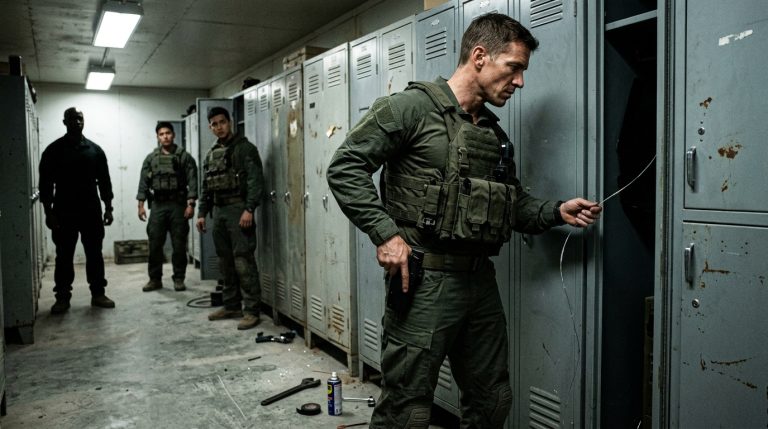
The hatch gave way with a hiss of equalization. Thomas stepped through, the darkness of the sub-level greeting him like an old acquaintance. He clicked on a small, high-intensity flashlight, the beam cutting through the gloom to illuminate a graveyard of outdated equipment. This was the space that didn’t exist on the official blueprints, a place where the Holstead kept the parts of herself that the modern Navy had forgotten.
His beam swept across the bulkheads, catching the glint of exposed conduits and the rusted edges of storage lockers. It was then that he saw it. A structural plate near the base of a support beam was slightly misaligned, the rivets sheared as if from a violent impact. It was the mark of someone who had recently and clumsily forced their way into the sub-compartment. Blake.
Thomas moved toward the opening, his senses heightened to a degree that felt almost supernatural. He could feel the ship’s vibration—a low, oscillating hum that seemed to sync with the beating of his own heart. He squeezed through the gap in the bulkhead, finding himself in a narrow space that smelled sharply of stale air and paper. He directed his light toward the floor, finding a discarded notebook—Blake’s notebook.
He didn’t touch it at first. He stood in the narrow space, his flashlight beam flickering over the contents. The notebook was open, pages covered in hasty, agitated handwriting—coordinates, schematics, and a recurring phrase he hadn’t seen in decades: Task Group Atlantic 7. Blake hadn’t just found the sub-level; he had stumbled upon the manifest of the USS Vance.
Thomas felt the floor pitch—not the ship, but his own equilibrium. The memory hit him with the force of a tidal wave. He was back on the bridge of the Vance, the hurricane howling like a wounded beast, the radar screen a chaotic mess of static. He was shouting orders that no one could hear over the roar of the wind. He remembered the feeling of the ship’s wheel under his hands, the raw, visceral desperation of trying to steer through the storm.
He shook his head violently, forcing the memory back into the dark corners of his mind. He couldn’t afford the luxury of a breakdown. He looked down at the notebook again, his flashlight beam steadying. He saw a page marked with a date: October 14, 1962. Below it, a series of log entries that made his blood run cold. Blake hadn’t just discovered the logs; he had cross-referenced them with the ship’s current navigational data. He had realized that the Holstead wasn’t just sailing the same route—it was retracing the exact, impossible path the Vance had taken sixty years ago.
A sudden, sharp metallic click echoed from the corridor behind him. Thomas extinguished his light instantly, plunging the space into absolute, suffocating darkness. He froze, his pulse thrumming in his ears. He wasn’t alone.
“I know you’re down here, Brennan,” a voice called out—distorted, echoing, but undeniably Blake’s. It was the voice of a man who had reached the point of no return. “I saw the security log. I saw Reeves tapping into the system. You’re not the one in charge anymore. I’ve seen the records. I know what happened to the command crew.”
Thomas stayed pressed against the cold steel of the bulkhead, his eyes adjusting to the faint, bioluminescent glow of the emergency lights recessed in the ceiling. He realized then that Layer 1—the decoy secret he had hoped would satisfy the lieutenant’s curiosity—had been shattered. Blake hadn’t just found a record of an experiment; he had deduced the mutiny.
“You don’t understand the scope of what you’re looking at, Lieutenant,” Thomas whispered, his voice steady despite the adrenaline surging through him.
“I understand enough,” Blake’s voice came closer, the sound of heavy boots echoing against the floor plates. “I understand that this ship is a cover-up. And I understand that you’re the last piece of evidence that needs to be scrubbed.”
Thomas didn’t wait for him to round the corner. He moved, using his knowledge of the sub-level’s layout to navigate the darkness. He knew the conduits, the blind spots, and the structural weaknesses of this deck better than anyone alive. He had built the silence around this history, and he would not let a career-hungry officer tear it down now. He slipped into the shadow of a massive generator, his hand finding the grip of a heavy iron pipe—the only weapon he had, and for the first time in his life, he prepared to defend the secret of 1962 with force.
CHAPTER 5: The Storms Return
The sub-level was alive with the sound of Blake’s movement—a chaotic, unpracticed rhythm of boot-thuds and frantic, shallow breathing. He wasn’t moving like a soldier; he was moving like a man who had finally seen the truth and found it too heavy to hold. Thomas pressed himself against the generator casing, the cold, vibrating steel seeping through his shirt. He didn’t want to hurt the boy. He just wanted the notebook, and he wanted the seal—the one Blake had touched—to remain unbroken.
“I know you think you’re the hero, Brennan,” Blake called out, his voice echoing through the narrow, pipe-cluttered space. “You think you’re protecting the Navy. But you’re just protecting a lie. A lie that’s been allowed to fester until it’s become part of the ship’s own DNA.”
Thomas saw a flicker of movement—a shadow cast by the emergency lighting—against the far bulkhead. He remained perfectly still. He was calculating the space between the generator and the primary hydraulic conduit. If he moved now, he could intercept Blake, but the risk of collateral damage to the ship’s systems was too high. He was still, after all this time, the Navigator. He still felt the phantom responsibility for the vessel beneath his feet.
Suddenly, a sharp, piercing whine shattered the tension—the high-frequency blast of an automated pressure-venting alarm. The entire sub-level lurched, the deck plating vibrating with a sudden, violent intensity. A mist of hydraulic fluid sprayed from a coupling nearby, the vapor instantly filling the narrow corridor with a sweet, acrid stench.
Blake screamed, a sound of surprise, followed by the clatter of his flashlight hitting the deck. The light spun, casting erratic, strobe-like beams across the ceiling and walls. Thomas saw his chance. He lunged forward, not with the intention of striking, but of securing the area.
He collided with Blake in the middle of the narrow passage. It was a messy, desperate struggle. They grappled in the dim, flickering light, the smell of hydraulic fluid thick in their nostrils. Thomas felt the youth and kinetic energy of the lieutenant—a sharp, stinging contrast to the stiff, aching resistance of his own eighty-two-year-old body. But Thomas had something else: the leverage of a man who had navigated a ship through a hurricane. He didn’t fight against the momentum; he guided it. He shifted his weight, tripped Blake over a protruding pipe, and pinned him against the bulkhead, his forearm pressing firmly against the lieutenant’s collarbone.
“Look at me,” Thomas hissed, his face inches from Blake’s. The lieutenant’s eyes were wide, bloodshot, and filled with a terrifying realization. “You want to know the truth? You want to know what happened in 1962? You’re experiencing it right now.”
Blake gasped, his hands clawing at Thomas’s wrists. “The ship… the telemetry is failing… just like the logs said…”
Thomas didn’t let go. He looked past Blake toward the overhead console, where the emergency pressure gauges were spinning into the red. The coincidence was impossible—the failure of the hydraulic systems mirrored the mechanical collapse of the Vance sixty years ago. The ship was echoing the past, a feedback loop of structural and historical trauma.
“This isn’t an experiment, Lieutenant,” Thomas growled, his voice a low tremor that seemed to compete with the alarm. “This is a resonance. When you opened those records, you didn’t just read history. You disturbed the ghost of the Vance. This ship is trying to solve a problem that was never finished.”
The alarms became deafening. Thomas realized with a sinking heart that his efforts to contain the information had failed. The ship was reacting to the exposure of the mutiny. He had to reach the bridge. He had to convince the Captain that the Holstead was not undergoing a standard maintenance failure, but a structural manifestation of a sixty-year-old moral fracture.
He shoved Blake away, not out of malice, but out of necessity. “Get to the bridge,” Thomas ordered, his voice ringing with an authority that stunned the lieutenant into silence. “Tell them to shut down the main power grid to the sub-level. If they don’t, the resonance will continue until the hull integrity fails. Go, now!”
Blake stumbled, his face pale, his arrogance completely evaporated. He looked at Thomas with a mix of awe and terror, then turned and bolted toward the hatch. Thomas stood alone in the dark, the sound of the alarm screaming in his ears, his body aching with the effort of the struggle. He looked at the notebook lying on the deck, abandoned and open. He knew what he had to do. He picked it up, tucked it into his apron, and turned to follow the path Blake had taken. The storm wasn’t over. In fact, he realized as the ship gave another violent, sickening lurch, it was only just beginning.
CHAPTER 6: The Final Bearing
Thomas stepped onto the bridge, his presence causing an immediate, palpable ripple in the room. The air was frigid, pressurized by the intensity of the command staff who were frantically trying to isolate the cascading system failures. Captain Morrison stood at the center console, his face illuminated by the harsh, red-filtered glow of the emergency lighting. He turned as the hatch hissed shut behind Thomas, his eyes scanning the elderly man with an intensity that bordered on desperation.
“Navigator,” Morrison said, the word catching in his throat. “The hydraulic systems are collapsing. We’re losing control of the steering axis. It’s exactly like the simulation in the sub-level archives. How do we stop this?”
Thomas didn’t waste time on pleasantries or apologies. He walked to the main navigation station, his movements fluid despite the ache in his shoulders. He reached into his apron and pulled out the notebook he had retrieved from the sub-level. He opened it to the final entry, the ink still fresh in his memory from sixty years ago.
“You can’t stop it with the current protocols, Captain,” Thomas said, his voice ringing clearly over the din of the alarms. “The ship isn’t failing. It’s being corrected. When we crossed these coordinates, we didn’t just sail through a patch of ocean. We triggered a resonance with the USS Vance.”
Commander Morgan stepped forward, her hand resting on the console, her expression one of dawning horror. “What are you talking about? Are you saying this is some kind of haunting?”
“I’m saying this is a consequence,” Thomas corrected. He spread the notebook flat on the console. “In 1962, the crew of the Vance didn’t just navigate through a storm. We were faced with a command structure that had lost its way—a leadership that believed the mission outweighed the lives of the men under their care. When the radar failed, we had to choose: follow the orders to continue into the eye of the storm, or save the crew by cutting the power and going silent. I chose to mutiny. I sabotaged the navigation systems to force the Vance off-course, out of the hurricane, and into the calm. I destroyed the logs to ensure that the officers responsible for the original orders wouldn’t be court-martialed, and to protect the men who followed me.”
He looked at Captain Morrison, his pale blue eyes unwavering. “I was the Navigator, Captain. But I was also the ghost who left this debt behind. The Holstead isn’t haunted. It’s just holding the mirror up to what we did. The sub-level isn’t a museum; it’s a circuit. Every time a ship passes over these coordinates, the data reacts to the secret I buried. It’s looking for a resolution.”
The bridge fell into a profound, heavy silence. The alarms seemed to diminish, the ship’s vibrations stabilizing as if it were finally listening. Morrison stared at the notebook, then back at Thomas. The fury he had shown when he first confronted Thomas had transformed into a grim, professional realization.
“You’re telling me,” Morrison began, his voice slow and deliberate, “that the entire engineering failure is a reaction to the truth of that mutiny?”
“I’m telling you that justice is a form of navigation,” Thomas said. He pointed to the console. “Cut the power to the sub-level entirely. Purge the archives of the Vance from the local drive. Don’t hide them. Don’t classify them. Declassify the truth of the mutiny. If the history is finally told, the resonance will end.”
Morrison looked at his command crew. There was no hesitation. He nodded to the systems officer. “Do it. Purge the sub-level data. Open the logs for the entire ship to see.”
As the systems officer keyed in the commands, a heavy, resonant thrumming shook the Holstead one last time—not a sound of failure, but of release. Then, the alarms fell silent. The red emergency lights flickered and returned to their standard, warm white. The ship’s pitch leveled off, the shuddering in the deck disappearing entirely.
Thomas let out a long, shuddering breath. He felt as if a physical weight had been lifted from his shoulders, the phantom pressure of 1962 finally dissipating. He looked at his hands, steady and still. The work was done.
In the quiet aftermath, the Captain approached him. The bridge was peaceful, the only sound the soft hum of the ship’s primary systems. Morrison reached out, but he didn’t salute. He simply placed a hand on Thomas’s shoulder—a gesture of respect that bridged the decades.
“You kept your promise, Navigator,” Morrison said softly. “They’re home.”
Thomas nodded, a faint, tired smile touching his lips. He looked out through the bridge window toward the horizon, where the first light of dawn was beginning to break against the dark expanse of the ocean. He didn’t feel like a legend, or a savior, or even a cook. He felt, for the first time in his life, like a man who was no longer navigating by the stars of the past.
He reached into his pocket and pulled out a small, worn piece of rope—the remnants of the anchor patch he had sewn sixty years ago. He walked to the edge of the bridge and, with a steady hand, placed it on the console. It was a small thing, frayed and faded, but it held the entirety of his life’s work.
He left the bridge, the quiet resonance of the ship following his footsteps. He wasn’t going back to the galley. He was going to the deck to watch the sun fully rise, to breathe the air of a world that was finally, and truly, at rest. He was done with the navigation. He was finally just a sailor, standing on a deck that was no longer heading into the eye of a storm, but sailing, simply and peacefully, into the light.