The Iron Perimeter: A Marine’s Tactical War on Suburban Tyranny
CHAPTER 1: THE RAW STUMPS
The air didn’t smell like morning dew anymore. It stank of acrid two-stroke engine exhaust, bar oil, and butchered hardwood.
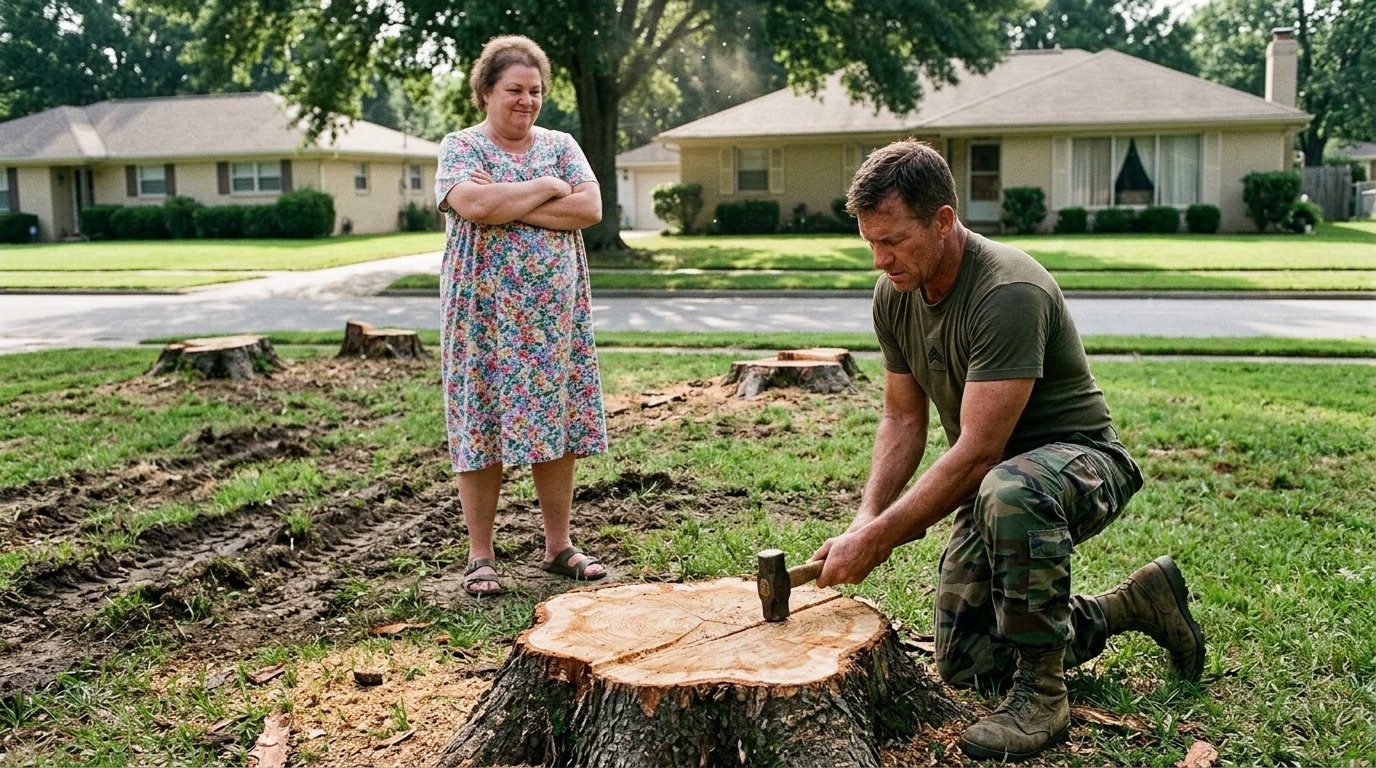
Four pale, jagged discs stared back at me from the torn lawn. They bled raw sap into the mud. Four black walnut titans—a century of growth—reduced to flat yellow altars in less than six hours. Tire ruts carved deep, ugly trenches through the turf where heavy crane trucks had backed in.
My right thumb rubbed the edge of my fingernail until the skin stung. Twenty-five years in the Marine Corps teaches you how to freeze your face when your blood spikes toward murder. I kept my breathing even. Four seconds in. Four seconds out.
“They were a menace, John.”
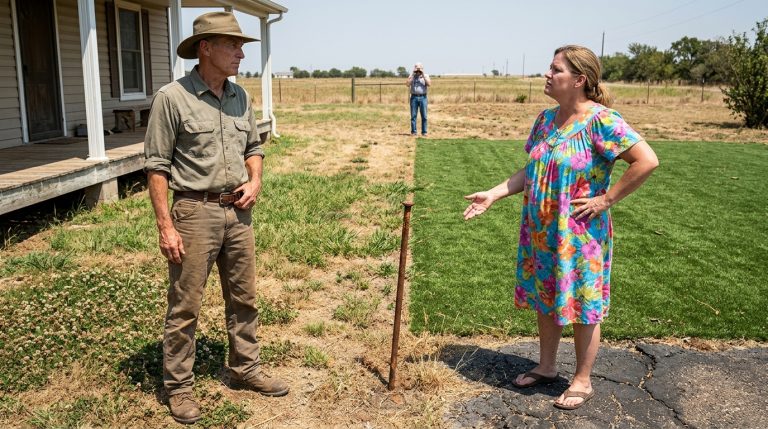
The voice slid across the grass, greasy with satisfaction. Karen Bishop stepped over a churned ridge of dirt, her arms crossed tight over a brightly patterned floral mumu. Her sandals sank an inch into the wounded soil.
“I did you a favor,” she said. Her chin tilted up. “Now your property finally looks clean.”
I didn’t move. I didn’t reach for her. I stared at the raw center ring of the largest stump—thirty inches across, tight growth lines stretching back past the First World War. Sarah had touched that bark the day we bought the key.
“You brought heavy machinery onto my deeded land,” I said. My voice dropped an octave, flat and dry as chalk.
“As president of the Oakridge Estates Homeowners Association, I am fully authorized to abate nuisance vegetation,” she replied instantly. She didn’t flinch. She had rehearsed this. “Bylaw 7.4. Those trees dropped walnuts onto the public street. Hazard to vehicles. Messy leaves. We have community standards here.”
I looked at her eyes. No hesitation. Just the hard, glittering pleasure of a petty bureaucrat who had finally found a weapon big enough to draw blood.
“You cleared four century-old trees without a written notice,” I said.
“The board operates under sole discretion for community safety,” she snapped, waving a plump hand toward the road. “Consider the debris on your driveway a violation while you’re at it. Get it cleared.”
She turned her heel in the mud, her mumu fluttering as she marched toward her beige driveway across the cul-de-sac.
I didn’t yell. I knelt by the nearest stump, reached into the damp sawdust, and picked up a clean, dense wedge of dark heartwood. I pressed the rough grain into the palm of my hand until the corner nearly broke the skin.
She had fired the opening shot. She thought she was dealing with a retired neighbor. She had no idea she had just locked herself into a kill-zone.
CHAPTER 2: THE EVIDENCE TRAIL
The sharp edge of the walnut heartwood dug into my palm until my skin went numb. Across the street, Karen’s heavy oak front door slammed shut, the brass lion knocker rattling against its plate. The sound echoed off the sterile beige facades of the cul-de-sac like a pistol shot.
I didn’t open my hand. I squeezed harder, letting the coarse grain burn into my callus. In the Corps, when an position gets overrun, you don’t chase the sniper into the brush. You map the grid. You set the perimeter. You secure the evidence before the rain washes the tracks away.
I turned back to the four raw stumps. The smell of chain oil hung thick in the humid morning air, mixing with the sharp, acidic tang of fresh sap.
I walked the perimeter of the ruts. Deep, dual-wheel impressions sank three inches into the turf. I knelt in the mud, taking a close look at the tread. The tire pattern wasn’t the aggressive knobby tread of an industrial forestry truck. It was a standard commercial highway pattern—light-duty, worn slightly on the outer shoulder.
A crew equipped to take down four century-old trees in under four hours doesn’t show up in a rented box truck unless they’re hiding who they belong to.
My phone vibrated in my pocket. I pulled it out, ignoring the screen, and switched to the camera app. Frame by frame, I documented the grid. Wide shots from the property line. Medium shots showing the distance from the stumps to my living room window. Close-ups of the rough saw teeth marks on the timber faces.
“Mr. Davis?”
I didn’t jump. I stood up slowly, slipping the wedge of walnut into my pocket.
Deputy Ror stood on the sidewalk. He looked twenty-four, his uniform shirt stiff with starch, his duty belt squeaking every time he shifted his weight. A spiral notepad was tucked under his thumb.
“Deputy,” I said. My voice was flat, dry as dust.
He looked past me at the carnage, his eyebrows drawing together. “Dispatch said there was a property destruction complaint. Karen Bishop called in ten minutes ago reporting an aggressive resident.”
“I spoke to her,” I said. “She was on my land. She admitted ordering the cutting.”
Ror walked over to the nearest stump, his boots crunching on the stray wood chips. He touched his belt, looking uncomfortable. “She showed me a document when I drove up. Said she’s the HOA board president. Cited bylaw 7.4. Claims these trees were a community hazard.”
“Those trees were on my deeded parcel,” I said, pointing to the iron boundary pin sticking up two inches from the grass near the sidewalk. “She didn’t issue a written notice. She didn’t hold a board vote. She hired an unlisted crew to enter private property in the dead of night.”
Ror sighed, a long, tired exhale that rattled his collar. “Look, Mr. Davis… I see what happened here, and it’s a shame. Truly. But if she’s claiming authority under the HOA covenants, my sergeant is going to call this a civil dispute. Contractual disagreement between a property owner and the association.”
“A civil dispute,” I repeated. The words tasted like cold ash.
“We can file an informational report,” Ror said, opening his notepad. “Document your statement. But we can’t arrest her for a bylaw disagreement. You’ll need to handle this through the civil courts.”
“Write the report, Deputy,” I said softly. “Include her admission. Include the case number.”
He nodded, taking down my name and rank from my ID. He didn’t ask about the monetary value. To him, it was just firewood and suburban drama. He didn’t know about Sarah. He didn’t know about the hundred years it took for those roots to anchor this ground.
When his patrol car pulled away, I went into the garage. I grabbed four clean gallon-sized freezer bags from the shelf, a permanent marker, and my brass calipers from my workbench.
I returned to the yard. I measured the diameter of each stump—thirty-two inches, thirty inches, twenty-eight inches, thirty-four inches. Straight grain. Zero hollow rot. I wrote the numbers down in a fresh field notebook. I scooped a handful of fresh sawdust from each mound into the labeled bags. Stump 1: Northwest. Stump 2: Northeast.
I was sealing the third bag when a white pickup truck pulled onto the shoulder. The door bore a magnetic sign: Legacy Tree Consultants — Certified Arboristry & Appraisal.
Dr. Alistair Evans stepped out. He was near seventy, wearing a faded canvas vest and a weathered wide-brim hat. He didn’t speak right away. He walked directly to the largest stump, took off his hat, and rested a gloved hand on the raw face of the wood.
“Black walnut,” Evans said, his voice a low, raspy rumble. “Juglans nigra. Look at the heartwood depth.”
“Four of them,” I said, walking over. “Healthy.”
Evans pulled a core bore from his bag—a T-shaped steel tool—and lined it up against the bark of the nearest stump. He drove the bit into the trunk with practiced, rhythmic turns. When he pulled the cylinder out, a pale, pristine plug of wood rested in the core sleeve. He held it up to the morning light, examining the ring density through a small magnifying lens.
“Consistent growth for over a century,” Evans murmured. “No drought stress. No disease. Master Gunnery Sergeant, whoever took these down didn’t just clear brush. They harvested top-tier timber.”
“What’s the value?” I asked.
Evans looked at me, his weathered eyes narrowing beneath his hat. “Veneer grade. Clear logs up to thirty feet before the first fork. At current market rates for high-grade North Carolina black walnut, you’re looking at a minimum of sixty-five thousand dollars per tree.”
Two hundred and sixty thousand dollars.
“And under state law?” I asked.
“Timber trespass,” Evans said flatly. “If someone unlawfully cuts standing timber on your land without a permit or title, the statute allows for treble damages. Three times the market appraisal.”
Seven hundred and eighty thousand dollars.
I looked across the street. Karen’s living room curtains twitched. A pale hand let the fabric drop back into place.
“I’ll have the certified report and notarized appraisal on your desk within forty-eight hours,” Dr. Evans said, packing his core bore into his leather kit. “It won’t bring them back, son. But it will give you a heavy hammer.”
“I have the hammer,” I said, looking down at the sealed evidence bag of sawdust in my hand. “Now I need to find where she hid the money.”
When I walked back to my front door, I found a paper clipped to the screen.
It was a bright yellow slip from the Oakridge Estates Architectural Control Committee. A formal fine notice. One hundred dollars for failure to clear “hazardous wood debris and unsightly timber waste” from the primary lawn area within six hours of notification. Signed at the bottom in looping, aggressive script: K. Bishop, President.
At the bottom of the page, printed in tiny, dark gray ink, was the management service line: Processing fee billed via Bishop Property Services.
I didn’t tear it up. I walked into my study, opened the metal filing cabinet, and placed the yellow slip directly into a fresh Manila folder labeled EXHIBIT A.
CHAPTER 3: THE NETWORK OF VICTIMS
The yellow slip felt dry and stiff in my fingers. I slid it into the Manila folder, pressed the drawer shut until the steel latch clicked, and carried my cold coffee out to the front porch.
The heat was rising fast off the asphalt, drawing out the sharp, bitter stench of crushed bark and engine exhaust from my lawn. Across the street, Karen’s blinds didn’t move, but two houses down, a wooden gate unlatched with a dull rasp.
Tom Miller stepped into his yard. He stood on the edge of his grass, holding a garden hose, his eyes fixed on the four pale stumps jutting from my soil. He didn’t turn the spigot on. He just stood there, his shoulders hunched in an old grey sweatshirt despite the muggy air.
I walked down my steps, my boots crunching softly over the stray wood chips scattered across the walkway.
“John,” Tom said as I reached his property line. His voice was low, strained around the edges. He set the hose down on the turf. “I heard the saws at four in the morning. I looked out the window… I saw the crane truck.”
“I know,” I said.
Tom’s eyes flicked toward Karen’s house before settling back on me. His jaw worked, his thumb hooking into his pocket, rubbing a white scar across his knuckle. “She didn’t give you a notice, did she?”
“No,” I said. “Just the bill afterward.”
Tom let out a short, harsh breath through his nose. “That’s her way. Hit you while you’re sleeping, then hide behind the paperwork.” He turned toward his backyard, where an empty patch of packed dirt sat beneath a giant oak. The grass there was dead, pale yellow in the shape of a rectangle. “Two years ago, it was Lily’s swing set. I built it out of cedar. Accessible ramp, smooth leather harnesses so her legs wouldn’t catch. Took me three weekends.”
“I remember,” I said. “Lily was on it every afternoon.”
“Karen called it a ‘non-conforming outbuilding’ under bylaw 4.1,” Tom said. His hand tightened into a fist inside his pocket. “Gave us forty-eight hours to tear it down or face fifty dollars a day in fines. I brought a letter from Lily’s physical therapist to the board. Karen wouldn’t even look at it. She looked right past my wife and said, ‘Rules don’t bend for personal circumstances, Tom.'”
He looked down at his boots. “I couldn’t afford fifteen hundred a month in fines. I took a crowbar to it myself while Lily watched from the kitchen window. I threw the cedar in the dump.”
“She didn’t act alone, Tom,” I said softly. “A president needs votes. She needs a paper trail.”
“She has Gary and Brenda on the board,” Tom said, his tone bitter. “They sign whatever she slides across the table. Nobody wants to fight her, John. The last guy who tried was David Chen.”
“David?”
“Used to be the treasurer,” Tom said. “CPA. Smart guy. He started asking questions about where the road maintenance funds were going two years back. Suddenly he was getting fined twenty-five bucks a week for his trash cans being out an hour early. Then a lean notice hit his door. He resigned from the board three weeks later just to make it stop.”
I absorbed the name, letting it settle into my mental grid. David Chen. Former Treasurer.
“Where is David now?” I asked.
“House at the corner of Oak and Ridge,” Tom said. “Spends most of his time in his garage.”
I nodded once. “Thanks, Tom.”
“John,” Tom called out as I turned to leave. He took a step closer, his eyes dead serious. “Be careful. She’s got the HOA’s legal fund behind her. She uses our own dues to hire lawyers against us.”
“She has a legal fund,” I said, my voice dropping into that cold, level register. “I have the timber appraisal.”
I walked past Mrs. Gable’s house on the way to the corner. Her lawn was a pristine carpet of green, but near the porch, three empty ceramic rings sat in the soil where her hand-painted garden gnomes used to stand. She was on her knees in a sunhat, pulling weeds with small, sharp tugs.
“Morning, Mrs. Gable,” I said softly from the sidewalk.
She looked up, her hands trembling slightly inside her canvas work gloves. “Oh, John… I saw what she did to your beautiful walnuts. It’s a sin. It’s an absolute sin.”
“Did she fine you for the gnomes again this week?” I asked.
Her lips pressed into a thin line. “Twenty-five dollars. Every Monday like clockwork. Six hundred dollars total so far. She says they violate the visual harmony of the street. George gave me those gnomes for our thirtieth anniversary, John. He’s been gone ten years. They were all I had left of his hands in the garden.”
“Keep the receipts, Mrs. Gable,” I said quietly. “Every single one.”
She blinked at me, her old eyes searching my face. “Why?”
“Because she’s going to pay you back,” I said. “With interest.”
Five minutes later, I stood in front of David Chen’s open garage. The sharp smell of motor oil, mineral spirits, and old leather filled the space. A disassembled 1972 Triumph motorcycle sat on a stand in the center, and a short, lean man in his fifties was cleaning a carburetor with an brass wire brush.
“David Chen?” I asked.
He didn’t look up immediately. He set the carburetor on a clean shop towel, wiped his hands on a rag, and then turned his head. His eyes were sharp, calculating me in an instant—my posture, the dust on my boots, the cold look in my eyes.
“Master Gunnery Sergeant Davis,” he said. He had a dry, precise way of speaking. “I heard the chainsaws this morning. I assumed you’d be at a lawyer’s office by now.”
“I called an arborist first,” I said. “Dr. Evans.”
David paused, a faint eyebrow raising. “Evans? The timber appraiser?”
“Two hundred and sixty thousand in standing timber,” I said. “Treble damages under North Carolina statute.”
David set his rag down on the workbench. He walked to the edge of the garage door, looked up and down the quiet street, and then waved me inside. He reached behind a stack of plastic storage bins and pulled out a metal stool, sliding it toward me.
“Sit down, John,” David said, his tone shifting from guarded to clinical. “You’re the first person in this neighborhood to bring a real weapon to this fight. But if you think this is just about trees, you’re missing the engine.”
“Explain the engine,” I said.
David pulled a thick black accordion folder from a drawer beneath his workbench and opened it on the hood of the Triumph. He flipped through plastic sleeves filled with copied ledgers and cancelled checks.
“I was treasurer for eighteen months,” David said. “I resigned because Karen stopped letting me review the primary bank statements. She set up a secondary operating account—Reserve Account 402—and routed all specialized vendor contracts through it.”
He tapped a finger against a line item on a photocopied bank ledger.
“Look at the vendor name,” David whispered.
I leaned in. The line read: Bishop Property Services — Emergency Abatement & Clearing — $8,500.00.
“Bishop Property Services,” I read aloud. “Her husband?”
“Frank Bishop is a retired plumber,” David said, his eyes narrowing. “He doesn’t own a timber rig. But her brother-in-law, Rick Snyder, runs a haulage LLC out of County Line. They registered Bishop Property Services as a shell entity eighteen months ago. Every time Karen issues a mandatory removal, or a landscape fine, the contract goes to that name. The HOA pays the bill out of Reserve Account 402, and the money stays in the family.”
“Self-dealing,” I said. “Breach of fiduciary duty.”
“It’s worse than that,” David said, his voice dropping an octave. “It’s a kickback scheme funded by arbitrary enforcement. She fines residents until they break, uses the threat of liens to enforce compliance, and uses the association’s capital to enrich her family. She’s not just an annoying neighbor, John. She’s running a racket.”
I looked at the copied ledger. The paper felt cool under my fingers. The pieces were locking together—the light-duty commercial tire tracks in my mud, the unnotified midnight cutting, the immediate yellow violation slip for ‘waste removal’ issued six hours later.
“Can you certify these ledgers?” I asked David.
David looked at me, a flicker of old hesitation crossing his face before his jaw set hard. “I kept these copies when I left the board. I knew eventually someone would stand up to her. If you bring a legal team that can protect me from personal liability, I’ll sign the affidavit.”
I reached into my pocket, pulled out my phone, and dialed a number I hadn’t used in three years.
“Marcus,” I said when the line picked up.
“Gunny?” Marcus Thorne’s voice came through the speaker, crisp and sharp from his downtown office. “I’m looking at your email. You sent me photos of four tree stumps.”
“They’re black walnuts, Marcus,” I said, staring at the line item on David Chen’s ledger. “Two hundred and sixty thousand in timber. And I’m sitting in a garage with a former CPA looking at a shell company kickback log.”
There was a three-second pause on the line. I heard the quiet rustle of paper as Marcus adjusted his headset.
“Gunny,” Marcus said, his tone turning instantly hard and cold. “Tell me you didn’t yell at her.”
“I didn’t yell,” I said.
“Good,” Marcus said softly. “Don’t touch her property. Don’t speak to her again. I’m clearing my schedule for two p.m. Bring the CPA and the folder to my office. We aren’t filing a civil nuisance suit, John. We’re going to dismantle that board.”
CHAPTER 4: THE LEGAL KILLZONE
“Two o’clock,” I told Marcus, sliding my thumb across the glass to end the call.
The garage went still. The low hum of a distant lawnmower buzzed somewhere across the cul-de-sac, but inside, David Chen was already pulling a fresh manila folder from his metal shelf. His fingers, stained dark at the tips with motorcycle grease, worked with practiced speed.
“We take my truck,” David said. He didn’t ask. He snapped the metal clasp shut on his accordion file and tucked it under his arm. “If Karen sees your truck leave, she’ll know you’re moving. If she sees me drive out alone, she won’t think twice.”
“Thirty seconds,” I said, stepping to the edge of the garage door.
I checked the cul-de-sac. Karen’s living room blinds were motionless now. Across the asphalt, the four pale walnut stumps glistened under the heavy North Carolina sun, small beads of amber sap bubbling along the outer bark. I reached into my pocket, my thumb running over the sharp, square corner of the walnut core sample Dr. Evans had handed me. The wood was cold, dense, and unyielding.
We took the back roads out of the subdivision, cutting through the commercial bypass toward downtown Raleigh.
By one-forty-five, we were riding the glass elevator up to the twelfth floor of the Wachovia building. Marcus Thorne met us in the lobby. He wore a charcoal suit that looked like armor, his tie knotted so tight it looked forged. His jaw was lean, his eyes tracking David’s accordion folder before he even shook my hand.
“Gunny,” Marcus said, his grip like a vice. “Mr. Chen.”
He led us into a corner conference room. A glass wall overlooked the city, but the long mahogany table was clear except for a heavy yellow legal pad and two silver pens.
“Lay it out,” Marcus said, leaning against the edge of the table.
David didn’t sit. He opened the file, spreading the photocopied ledgers across the polished wood like a dealer dropping cards.
“Eighteen months of bank records from Reserve Account 402,” David said, pointing to a column of highlighted figures. “Every check above three thousand dollars is made out to Bishop Property Services. Totaling ninety-four thousand dollars over six quarters.”
Marcus leaned down, his eyes scanning the numbers. “Where are the supporting invoices?”
“There aren’t any,” David said flatly. “I asked Karen for the vendor tax IDs three months before I resigned. She told me the architectural committee handles its own internal auditing. When I pressed her, she threatened to audit my home additions.”
Marcus picked up one of the copies, holding it up to the overhead light. “Who’s the insurance carrier for the association’s Directors and Officers policy?”
“NorthState Mutual,” David said instantly. “Policy number is on the third page. Five hundred thousand dollar limit per occurrence.”
Marcus let out a soft, dry whistle. He turned to me, his fingers tapping a rhythmic cadence against his legal pad.
“Here’s where we stand, John,” Marcus said. “The trees are a slam-dunk timber trespass. Two hundred and sixty thousand base appraisal, three times that under statute. Seven hundred and eighty thousand total. But if we just file a civil lawsuit, her lawyer will file for a stay, tie us up in discovery for two years, and let the HOA’s insurance pay for her defense.”
“We don’t let her hide behind the insurance,” I said.
“Exactly,” Marcus said. His eyes glinted with a cold, predatory light. “We hit the board with a litigation hold first. Today. By certified mail and courier to every single board member’s home address. We notify them that a major multi-million dollar suit is imminent and demand the immediate preservation of all financial records, emails, text messages, and bank statements related to Reserve Account 402 and Bishop Property Services.”
“What does that do to her board?” I asked.
“It fractures them,” Marcus said. “Gary and Brenda aren’t criminals; they’re sheep. The moment a process server hands them a litigation hold warning them that spoliation of evidence carries personal criminal liability, they’ll panic. They’ll realize Karen didn’t just cut down your trees—she put their personal assets in the crosshairs.”
“And the insurance carrier?” David asked.
“We send a copy of the hold directly to NorthState Mutual’s legal risk division,” Marcus smiled, a sharp, knife-like gesture. “Insurance companies do not cover bad-faith criminal self-dealing. Once NorthState Mutual sees that Reserve Account 402 is funneling money to a family shell company, they will open a fraud investigation into Karen Bishop. They won’t defend her. They’ll isolate her to save themselves.”
He slid a pre-drafted document across the table toward me. It was four pages of dense, unyielding legal prose, capped by a heavy red stamp at the top: NOTICE OF INTENT TO SUE & DEMAND FOR PRESERVATION OF EVIDENCE.
“Sign at the bottom, Gunny,” Marcus said. “By five o’clock, her world goes cold.”
I picked up the silver pen, signed my name in clear, block lettering, and handed it back.
The heat-lapse of the afternoon blurred as David drove us back into Oakridge Estates just before six p.m. The sky had turned a dark, bruised purple, heavy with the threat of a summer downpour.
As David slowed his truck near the neighborhood clubhouse, I saw a bright blue sheet of cardstock taped to the glass front door.
“Stop,” I said.
David pulled to the curb. I got out, my boots striking the hot asphalt.
The blue paper was fresh. The ink was still slightly damp to the touch. It was an emergency announcement signed by Karen Bishop.
EMERGENCY BOARD MEETING NOTICE
Pursuant to Bylaw 7.4, an emergency session of the Oakridge Estates HOA Board will convene in 48 hours to vote on a Special Legal Assessment and proposed amendments to covenants regarding unauthorized nuisance trees and retroactive board indemnity.
She wasn’t retreating. She was trying to rewrite the rules before the lawsuit hit the court docket, trying to force the entire neighborhood to pay for her legal defense and retroactively grant herself the power to cut down whatever she wanted.
Right below the text was the official management contact line: Administered via Bishop Property Services.
I didn’t tear the paper down. I took out my phone, snapped a crystal-clear photograph of the notice, and texted it directly to Marcus Thorne.
Three seconds later, my phone vibrated.
Marcus: She just walked right into the kill-zone. Don’t stop her. Let her hold that meeting.
I turned away from the clubhouse glass and looked down the street. Across the manicured lawns, the first fat drops of rain began to splatter against the dusty pavement, hitting the raw stumps in my front yard with a dull, hollow thud.
CHAPTER 5: THE CLUBHOUSE AMBUSH
The rain had stopped by seven o’clock, leaving the night thick, warm, and smelling of wet asphalt.
Outside the Oakridge Estates clubhouse, sixty cars lined the curbs. Inside, every metal folding chair was filled. Neighbors who hadn’t spoken in three years sat shoulder-to-shoulder in the harsh fluorescent glare. Rain slickers hung over chair backs, dripping onto the linoleum.
I stood near the back wall beside an wooden easel. A large, square poster board rested on the frame, covered by a heavy black bedsheet I’d pulled from my linen closet.
At the front table sat Karen Bishop. She wore a dark blue blazer over a high-collared shirt, her hair stiffened with spray. To her right sat Gary, the retired car salesman, rubbing his neck nervously. To her left was Brenda, clutching a beige folder like a shield.
Karen struck her gavel twice on the oak block. The sharp crack echoed off the concrete walls.
“This emergency session of the Oakridge Estates Homeowners Association is called to order,” Karen said. Her voice was loud, amplified by a small portable PA speaker. “Item one: proposed special assessment to cover unforeseen legal and environmental remediation fees. Item two: amendments to Bylaw 7.4 to streamline nuisance tree removal.”
She didn’t look at the crowd. She looked at her papers.
“Before we open discussion,” Karen continued, tapping her pen on the microphone, “I want to address rumors regarding recent board actions. Certain property owners have attempted to disrupt community harmony over routine maintenance decisions. The board acts under sole discretion for the safety and aesthetics of this neighborhood. We will not be intimidated by threats of frivolous litigation.”
She raised the wooden gavel to move to the vote.
“Point of order, Madam President.”
David Chen stood up from the second row. He wore a crisp white button-down, his hand steady at his side.
Karen’s eyes narrowed. “Mr. Chen, you are not a recognized speaker on this agenda.”
“Under Section 18.2 of our governing documents,” David said, his voice carrying clearly across the room without a microphone, “a petition signed by fifteen percent of deeded homeowners mandates a motion of no confidence before any financial votes can occur. We submitted forty-two verified signatures to the board secretary forty-eight hours ago.”
Gary flinched. He glanced at Karen, then down at his hands.
“The petition was deemed non-compliant by executive review,” Karen snapped, her knuckles turning white around her pen.
“The executive review has no standing under Robert’s Rules of Order,” David replied calmly. “And as former treasurer, I yield the floor to Mr. John Davis to present the petition evidence.”
The room went dead silent. Dozens of heads turned toward the back of the room.
I didn’t rush. I walked slowly down the center aisle, my boots clicking against the floor tiles. I reached the easel, took the corner of the black sheet, and pulled it down in one smooth motion.
The foam board underneath held three high-resolution photographs.
The first was my yard from six months ago—the massive, lush green cathedral of my four black walnut trees shading the driveway.
The second was a stark, brutal close-up taken two mornings ago—the four raw, bleeding stumps jutting out of the mud, tire tracks carved deep into the grass.
A collective, sharp intake of breath rippled through the room.
“Two days ago,” I said, my voice level, cutting through the hum of the overhead lights, “four century-old black walnut trees were cut down on my private property in the middle of the night. No written notice was delivered. No board vote was held.”
“Bylaw 7.4 grants absolute discretion for hazard removal!” Karen barked into the microphone, her face flushing red. “You are out of order!”
“Dr. Alistair Evans, certified master arborist, appraised those four trees yesterday,” I continued, ignoring her. I flipped the first poster board over, revealing a second sheet covered in enlarged financial ledgers. “The standing timber value is two hundred and sixty thousand dollars. Under North Carolina timber trespass law, statutory damages are treble—seven hundred and eighty thousand dollars.”
Gary leaned back in his chair as if he’d been struck in the chest. Brenda’s hand dropped from her folder.
“And who did President Bishop hire for this emergency job?” I pointed to a highlighted line item on the board. “Bishop Property Services. A shell company registered to her brother-in-law, Rick Snyder. Paid eight thousand five hundred dollars directly out of Reserve Account 402 without board authorization.”
“That is a lie!” Karen slammed her hand on the table. Her microphone emitted a loud, high-pitched screech. “That was a legal vendor contract!”
“It’s self-dealing,” David Chen called out from the floor. “And breach of fiduciary duty.”
“I have more,” I said. I pulled three manila envelopes from my jacket and set them on the edge of the front table, right in front of Gary and Brenda.
“What are those?” Gary asked, his voice cracking.
“Copies of the litigation hold served on you personally this afternoon by courier,” I said softly. “Along with the fraud notification delivered to NorthState Mutual, the HOA’s insurance carrier. Insurance policies do not cover intentional self-dealing or illegal timber trespass. If you vote to approve her special assessment tonight, you aren’t protecting the community. You are assuming personal, unindemnified liability for three-quarters of a million dollars.”
Gary looked at the envelope, then at Karen. His lip trembled. “You said… you said the insurance would handle the veteran.”
“Shut up, Gary!” Karen shouted, standing up so fast her chair scraped loudly against the floor.
“I make a motion,” Tom Miller’s voice rang out from the middle of the room. He stood up, his face hard as granite. “I make a motion for an immediate vote of no confidence in President Karen Bishop and her removal from the board.”
“Seconded!” Mrs. Gable called out, standing up right beside him, her small hands clenched into fists.
“Seconded!” three more voices shouted from the back.
Karen grabbed her gavel, swinging it down hard against the wooden block. “Meeting adjourned! This meeting is adjourned!”
Nobody moved toward the exit.
David Chen stepped forward with a stack of paper ballots, handing them down the rows. “All deeded owners, mark your ballots. Yes to remove, No to retain.”
Karen stood frozen behind the table. Her chest heaved under her dark blazer. She looked across the sea of faces—neighbors she had fined, bullied, and silent-checked for six years. Not a single person looked away.
Gary picked up a pen, checked the ‘Yes’ box on a ballot, folded it in half, and laid it quietly on the table in front of her. Brenda broke down, pulling her purse over her shoulder, and walked off the stage without saying a word.
Karen looked at me. Her eyes were wide, glassy with a mixture of shock and cold, terrifying hatred.
“You think you won?” she whispered, her voice carrying under the hum of the fluorescent lights. “You think a piece of paper stops me?”
“I don’t think,” I said, reaching down to collect my poster boards. “I execute.”
CHAPTER 6: THE CHECKMATE SETTLEMENT
Karen didn’t wait for David to finish tallying the folded ballots. She grabbed her leather handbag, her heels cracking like gunfire against the floor tiles, and shoved her way through the double doors into the damp night. Nobody called after her.
I stayed in the clubhouse until the last vote was recorded: fifty-six to zero in favor of removal.
The next morning, the legal engine Marcus Thorne had set in motion reached maximum velocity.
At nine-fifteen, a courier from NorthState Mutual delivered a formal notice to the HOA office and a copy to my study. The insurance carrier’s fraud division had reviewed the bank transfers from Reserve Account 402. Their position was concise: because the eight-thousand-five-hundred-dollar expenditure to Bishop Property Services was executed without board authorization and benefited a direct family relative, Karen Bishop had acted outside her fiduciary scope.
NorthState Mutual denied coverage for Karen personally. They stepped in to protect the HOA entity from total insolvency, but they left Karen standing alone on the legal firing line.
Two weeks later, Karen’s counter-move collapsed.
She attempted to file a cross-claim against the association, claiming indemnification under Bylaw 7.4. Marcus met her private defense attorney in a deposition room on the eighth floor of the county courthouse.
I sat beside Marcus at the oak table. Across from us, Karen looked gray. The stiff confidence that had filled her floral mumu on my front lawn had evaporated; her eyes were sunken, her fingers twitching continuously against the strap of her purse.
Marcus didn’t raise his voice. He slid three documents across the polished table.
“First,” Marcus said, “the timber trespass appraisal from Dr. Evans: two hundred and sixty thousand base, trebled to seven hundred and eighty thousand. Second, the certified ledger from Reserve Account 402 showing systematic self-dealing through Bishop Property Services. Third, NorthState Mutual’s denial of your personal defense.”
Karen’s lawyer scanned the pages, his mouth setting into a grim, tight line. He leaned over and whispered three words into Karen’s ear. She flinched as if she’d been slapped.
“We are prepared to execute a consent judgment today,” Marcus continued, his voice as cold and steady as steel. “Nine hundred and fifty thousand dollars total settlement. Five hundred thousand paid by NorthState Mutual on behalf of the association, four hundred and fifty thousand entered as a personal lien against Karen Bishop’s primary residence and personal accounts.”
Karen’s hand trembled as she reached for her water glass, her knuckles scraping against the rim. “You’re taking my house,” she whispered, her voice cracking around the edges.
“You took four century-old trees off deeded land to fund a kickback scheme,” I said softly, meeting her eyes for the first time since the clubhouse meeting. “You signed every check yourself.”
She looked at her lawyer, searching for a lifeline, a technicality, a single loophole in the covenants she had weaponized for six years. Her lawyer simply slid a pen into her fingers and turned the signature page toward her.
With a ragged, shaky stroke, Karen signed her name.
Six months later, the cul-de-sac was silent.
A ‘FOR SALE’ sign stood on Karen’s lawn, stuck deep into the overgrown grass. She had moved out three weeks prior under the quiet supervision of a court-appointed trustee, her belongings packed into a single brown truck.
I stood in my front yard under a clear, crisp autumn sky. The four raw stumps were gone, ground down twelve inches below the surface by an arborist crew I had hired and paid for out of the settlement funds.
In their place lay a wide, circular garden bed lined with river stone and rich, dark loam.
At the four cardinal points of the bed stood four young black walnut saplings—eight feet tall, their thin stems supple and green, their leaves catching the bright afternoon light. In the center, set into a low granite pedestal, rested a polished bronze plaque.
It bore no mention of Karen, no mention of the HOA, and no mention of the lawsuit. It read simply:
THE SARAH DAVIS MEMORIAL GROVE
Rooted in Peace. Established 2026.
A soft footstep crunched on the gravel path behind me. I turned to see Tom Miller walking up with Lily. She was rolling smoothly along the smooth stone walkway in her chair, her face bright with a clear, easy smile.
“John,” Tom said, setting a wooden tool rack down near the garden edge. “The new swing set in the common area is finished. The board approved the ramp design this morning.”
“David Chen moves fast,” I said, a faint smile touching my lips.
“He does,” Tom agreed, looking at the four young walnuts swaying gently in the breeze. “These saplings… they look strong, John.”
“They have deep roots,” I said.
I reached into my pocket, my fingers brushing against the polished wooden core sample Dr. Evans had pulled from the first stump on that cold, bitter morning. I pulled it out, looked at the tight growth rings one last time, and slid it gently into the soft, dark soil at the base of the center sapling, burying it deep beneath the earth.
I stood up straight, drew a long, clean breath of autumn air, and looked out across the quiet street. The war was over. The perimeter was secure. And the trees were growing back.