The Weight of Iron: How a Single Veteran and a Priceless Inheritance Toppled a Suburban Tyrant
CHAPTER 1: THE IRON IN THE DRIVEWAY
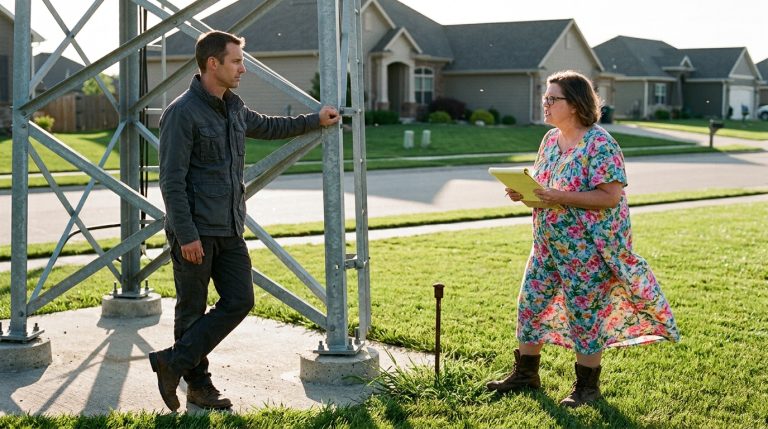
The air smelled of scorched rubber and damp asphalt, the kind of heavy summer heat that settled over Oak Meadows like a wet wool blanket. Across the property line, Karen Miller’s floral muumuu seemed to ripple with a quiet, menacing energy, her rhinestone glasses catching the afternoon sun and throwing sharp, blinding reflections against the side of Michael’s garage.
In her hand, the clipboard acted less like a tool of administration and more like a scepter. Five hundred dollars a day. The figure was absurd, a deliberate wedge driven into the quiet life he had built after two tours of quiet nightmares and narrow margins. Michael kept his hands loose at his sides, his fingers curling instinctively into his palms before relaxing into a calculated stillness. His military training did not vanish when he put on civilian clothes; it merely adjusted its scope. He viewed her stance—feet planted wide, chin elevated, the small, yapping terrier tucked under her arm like an accessory of war—not as a neighborly dispute, but as an initial engagement.
“That pile of rust,” Karen said, her voice grating against the humid air, “is a direct violation of section 7.14b. You have forty-eight hours, Mr. Donovan. After that, the meter runs.”
Michael looked past her shoulder, ignoring her face entirely. His eyes rested on the 1948 John Deere Model M parked on the custom concrete pad he had poured with his own hands. The faded green paint was flaked, exposing the dark, sturdy iron beneath, but to him, it was a monolith of memory. It was his grandfather Jack’s hands gripping the wheel, the rhythmic pop of the two-cylinder engine echoing across the dusty Ohio fields, a promise kept through distance and time. It was a tangible piece of a man who knew how to weather storms without ever raising his voice.
“Karen,” Michael said, his tone low, steady, and entirely devoid of heat. “That tractor is a registered antique. It’s licensed with the state, and it rests entirely within my property line. It isn’t going anywhere.”
Her mouth tightened into a thin, white line, the skin around her eyes pinching behind the rhinestones. “We will see about that. The neighborhood standards protect us from people who bring their junk into our investment.”
She spun on her heel, her muumuu snapping in the stagnant breeze, and marched back toward her immaculate lawn across the street. Michael didn’t move. He stood on the edge of the concrete pad, feeling the familiar, ice-cold clarity settle over his chest. The anger didn’t flare; it crystallized. He knew women like Karen. They didn’t care about the rules; they cared about the submission.
When he turned back toward the house, the screen door clicked open, and Sarah stood in the doorway, her eyes tracking the tension in his shoulders with a quiet, practiced dread. She didn’t have to ask what had happened; the folded white notice already visible in the mailbox across the street told her everything she needed to know.
Michael walked up the steps, but before he reached the threshold, a sudden glint of light from the corner of the garage caught his eye—a small, silver wrapper wedged deep between the concrete pad and the siding, something that hadn’t been there when he poured the slab yesterday morning.
CHAPTER 2: THE ENVELOPE IN THE MAILBOX
Michael did not immediately reach down for the silver scrap. Instead, his boots stayed planted on the concrete pad, his eyes tracing the line where the garage siding met the foundation. The sun was dipping lower behind the neighboring rooflines, casting long, bruised shadows across the manicured lawns of Oak Meadows. The quiet of the late afternoon felt staged, like a painted backdrop held up by props just out of frame.
He bent down, his joints making a faint, dry pop, and hooked a finger beneath the crumpled silver foil. It wasn’t a standard candy wrapper. It was heavy-duty, crinkled at the edges, bearing the faint, embossed logo of a local printing and office supply shop downtown—the kind of place that handled bulk commercial mailings, legal notices, and multi-part carbon forms. It had been wedged tightly into the gap, deliberately concealed rather than blown there by the erratic afternoon gusts.
A slow, calculation-heavy weight settled behind Michael’s ribs. Karen hadn’t just walked across the street on a whim; her movements were choreographed, backed by supplies that didn’t belong to a casual neighborly complaint.
He straightened up, clutching the foil in his fist, and walked into the cool dimness of the garage. The smell of old oil, cut grass, and dry rust greeted him like an old friend. In the center of the space sat the 1948 John Deere Model M, shrouded under a heavy canvas tarp that he had pulled back just enough to expose the dull, oxidized green of the steering cowl. He tossed the wrapper onto the workbench beside a can of penetrating oil and walked into the kitchen.
Sarah was standing by the counter, her hands wrapped tightly around a ceramic mug as if she were trying to absorb its heat. The kitchen window looked directly across the street toward Karen’s immaculate colonial. The blinds there were drawn shut, a blank, unblinking stare directed right at their front door.
“She’s not going to drop this, is she?” Sarah asked, her voice dropping an octave as Michael stepped onto the linoleum.
“No,” Michael said, setting the crumpled wrapper on the edge of the island. “She’s treating this like a campaign. She didn’t just type that letter on a home computer.”
Before Sarah could answer, a sharp, metallic rattle came from the front of the house. The mail slot.
The sound was abrupt, cutting cleanly through the hum of the refrigerator. In Oak Meadows, the mail usually arrived like clockwork at eleven in the morning. It was now past four-thirty. A late delivery, hand-dropped or specially routed, carried a specific kind of administrative weight.
Michael walked through the living room, his steps measured and silent, training taking over the immediate physical response. He pulled open the front door and looked down at the threshold. Resting on the welcome mat was a single, crisp white envelope. There was no postage stamp, no postmark cancellation, and no return address printed in the corner. Just his name written in sharp, precise cursive, underlined twice with a dark red pen.
He bent down, picked it up, and felt the heavy cardstock inside. It wasn’t the standard tri-fold notice from the HOA board; it was thicker, heavier, the kind of paper used for formal legal motions or certified demands.
“Is it another one?” Sarah asked, stepping into the hallway, her bare feet making no sound on the hardwood. Her gaze flicked from his face down to the unblemished white envelope in his hand.
“Not in the mail,” Michael said quietly. “Hand-delivered.”
He tore the top edge open, sliding the single sheet of heavy paper into the dim light of the entryway. The text was printed in a stark, sans-serif font, devoid of the usual passive-aggressive pleasantries of the previous notices.
Final Administrative Warning, it began. Failure to cure the statutory nuisance located at 212 Willow Creek Lane within twenty-four hours will result in the immediate initiation of legal encumbrance proceedings, bypassing standard board review pursuant to emergency clause 4.2.
Michael stared at the clause number. Emergency clause 4.2. He had read the entire eighty-page HOA bylaws twice, highlighting every section, indexing every subsection. Clause 4.2 did not deal with architectural nuisances, aesthetic blight, or vehicle storage. Clause 4.2 dealt exclusively with hazardous environmental waste and structural condemnations—fire hazards, chemical leaks, biohazards requiring immediate municipal intervention.
To apply it to a restored antique tractor on a concrete pad was not just a stretch of the rules; it was an outright falsification of administrative jurisdiction.
“What does it say?” Sarah’s voice was tight, the strain in her throat unmistakable.
“She’s accelerating the timeline,” Michael said, his eyes scanning the bottom of the page where a signature line should have been. Instead of a signature, there was only a digital stamp: Karen Miller, Executive Director, Architectural & Compliance Oversight.
Executive Director. That title didn’t exist in the HOA bylaws either. She was inventing offices on the fly, creating a ghost hierarchy to give her personal vendetta the illusion of municipal law.
“We need to talk to someone who knows how these systems actually break,” Michael said, turning toward the kitchen where his phone lay on the counter. “Because Karen is operating outside the playbook, which means we stop playing defense.”
Sarah watched him, her eyes searching his face for a flicker of doubt and finding only the cold, unyielding geometry of a marine assessing a compromised perimeter. She reached out, her fingers brushing his forearm. “Do what you have to do, Mike. But don’t let her break this house.”
Michael nodded once, picked up the phone, and dialed a number he had memorized from a business card he’d tucked into his wallet three days ago—the direct line of retired Gunnery Sergeant Frank Kowalski, who lived three houses down and had been watching the neighborhood’s silent wars longer than anyone else.
The phone rang twice before a gravelly, low voice answered on the other end. “Kowalski.”
“Gunny,” Michael said, looking through the front window toward the dark, unmoving windows of Karen’s house across the street. “She just invoked emergency clause 4.2. She’s moving straight to encumbrance.”
A short, dry chuckle came through the speaker, followed by the heavy scrape of a chair being pushed back on a wooden deck.
“Well, son,” Frank muttered, the sound of a match striking coming clearly over the line. “The Queen Bee just flew too close to the flame. Get your binder. We’re going to pay a little visit to the records office before she has time to shred the paper trail.”
CHAPTER 3: THE DOSSIER OF THE QUIET REBELLION
Michael did not set the emergency notice down. His thumb traced the rough edge of the cardstock, feeling the rigid resistance of paper that had been cut by a heavy guillotine rather than a standard office printer. He walked back into the kitchen, his boots making a dull, rhythmic thud against the hardwood, and placed the document squarely beside the silver commercial wrapper he had recovered from the siding.
“Gunny’s meeting us at the back patio in five,” Michael said, his eyes fixed on the parallel lines of the two items.
Sarah exhaled slowly, the tension in her shoulders dropping an imperceptible fraction, though the shadow in her eyes remained. “Mike, if she’s invoking emergency clauses that don’t exist, this isn’t just about a local nuisance anymore. She’s creating a paper trail to justify seizing something. Can she actually put a lien on the house over this?”
“Not legally,” Michael said, opening the bottom cabinet where the heavy-duty three-ring binder lay waiting like a tactical manual. “Not if we pin her down to the actual bylaws before she manufactures enough fake precedent to trick a title company. But we need more than my binder. We need to document every single time she bypassed the architectural committee.”
He opened the thick vinyl cover, sliding the new emergency notice into a clear plastic sleeve behind the escalating fine logs. The total was already climbing past logical boundaries, a financial fiction designed to induce panic. A memory flickered uninvited across his mind—an old logistics briefing from overseas, where supply lines were choked off not by direct assault, but by strangling paperwork until the outpost starved from within. Karen was running a textbook siege on a residential scale, relying on the assumption that ordinary people would surrender their rights simply to avoid the exhausting friction of bureaucratic combat.
A soft, distinct double-tap sounded on the aluminum frame of the sliding glass door leading to the back patio.
Michael looked up. Frank Kowalski stood on the other side of the glass, his broad shoulders filling the frame, a weather-beaten leather satchel tucked under one arm. He wasn’t wearing his usual civilian jacket; he had thrown on an old surplus field coat, zipped halfway up, giving him the unmistakable look of a man reporting for a watch rotation.
Michael slid the door open, letting in a draft of dry evening air scented with cut grass and distant exhaust.
“Kitchen is closed to casual visitors,” Frank muttered as he stepped across the threshold, his eyes instantly locking onto the open binder on the island. He didn’t offer a greeting; men who had spent their lives watching flanks didn’t waste time on pleasantries when the perimeter was active. He dropped the leather satchel onto a bar stool and unzipped it with a sharp, metallic hiss.
“She’s getting sloppy,” Frank said, pulling out a thick manila folder stuffed with photocopied pages and sticky notes. “When tyrants start inventing emergency clauses, it means their normal weapons aren’t working fast enough. I ran into Tom Henderson down at the mail kiosks ten minutes ago. He was shaking so hard he dropped his keys.”
“Tom?” Michael asked, narrowing his eyes. “What did she hit him with?”
“Not him. Mrs. Gable,” Frank replied, pulling a folded pink slip from his coat pocket and laying it flat on the counter next to Michael’s white notice. “Karen sent her a final notice this morning. Eighty-dollar fine because the wind blew a single dry leaf from her maple tree onto the common walkway. An eighty-dollar littering fine for a natural act of God.”
Michael stared at the pink slip. The petty cruelty of it was staggering. It wasn’t about the leaf; it was about establishing absolute dominion over every square inch of earth within sight of Karen’s front porch.
“She’s testing the threshold,” Michael said, his voice dropping into that flat, dangerous register that signaled total tactical focus. “She wants to see who folds first so she can clear the board before the quarterly meeting next month.”
“Then we don’t let her clear it,” Frank said, tapping the manila folder. “I spent the last two hours on the horn with three different families down on the east loop. The Rodriguez kids, the couple in the blue colonial, and old man Miller—no relation to the queen bee, thank God. They’re all sitting on notices they were too ashamed or too scared to fight.”
He opened the folder, revealing a dozen folded letters, each bearing the same hunter-green Oak Meadows logo.
“They aren’t scared anymore, Mike,” Frank continued, looking up with a steady, veteran’s gaze. “They’re just waiting for someone to hand them a weapon. You’ve got the antique registration, you’ve got the appraisal value on that tractor, and you’ve got the binder. What you need now is a pattern. If we show the state board or a real estate attorney that she’s systematically weaponizing the compliance committee while refusing to seat the other two required board members, her entire administrative authority collapses under its own weight.”
Sarah stepped forward, her hand resting lightly on the edge of the table as she looked over the spread of documents. The fear that had gripped her earlier was gone, replaced by a cold, sharp resolve that mirrored her husband’s. “What’s the first move?”
Michael closed the binder with a sharp, decisive snap that echoed through the quiet kitchen.
“We stop playing defense in the mailbox,” Michael said, sliding his phone into his pocket. “We take the binder, we take Frank’s folder, and we drive downtown to David Chen’s office before she has time to file that fraudulent encumbrance.”
Frank grunted in approval, zipping his satchel back up with a firm tug. “That’s what I like to hear. Let’s go break a monopoly.”
CHAPTER 4: THE LEGAL THRESHOLD
The drive downtown through the grid of darkening streets took twenty minutes, twenty minutes of silence save for the low hum of the sedan’s engine and the rhythm of the windshield wipers clearing a stray mist. Frank rode in the passenger seat, his eyes fixed on the glove compartment where the dossier rested like unexploded ordnance. Neither Michael nor Frank spoke; the weight of the upcoming confrontation required no rehearsal. In tactical operations, communication was compressed to essentials, and the impending meeting with David Chen was nothing less than a council of war.
They turned onto Elm Street, the asphalt gleaming dark and wet under the sodium-lit amber streetlamps. The offices of Chen & Associates occupied the second floor of a modest, red-brick building that had once been a bank before the financial district shifted west. A single light burned above the brass-plated door.
Michael cut the ignition, the engine dying with a soft shudder. He reached across and picked up the heavy-duty binder, his fingers wrapping firmly around the spine.
“Remember,” Frank said quietly, resting a heavy hand on the door handle. “Chen’s a former JAG. He doesn’t want histrionics. He wants clean lines of accountability. Give him the paperwork, let him map out the kill zone.”
They crossed the damp pavement, the heavy oak door swinging open with a muted pneumatic sigh. Inside, the hallway smelled of old paper, floor wax, and dry coffee grounds. The waiting room was empty, stripped of pretense, featuring only two worn leather chairs and a low table piled with regional legal gazettes.
David Chen’s office door stood half open. A shaft of harsh fluorescent light cut across the linoleum floor.
“Come on back, gentlemen,” Chen’s voice called out before Michael could raise a knuckle to rap against the wood.
The attorney was seated behind a large oak desk that was entirely clear save for a green blotter, a heavy glass stapler, and a sleek, modern laptop. He was in his late forties, wearing a crisp white shirt with the sleeves rolled up to the elbows, exposing forearms corded with lean muscle. His dark hair was cropped close, and his eyes—sharp, analytical, completely devoid of professional fatigue—lifted to meet Michael’s as they stepped inside.
“Close the door behind you, Frank,” Chen said, gesturing to the two chairs opposite his desk.
Michael laid the binder down on the blotter, the vinyl cover sliding across the green felt with a muffled rasp. He popped the metal rings open an inch, revealing the dense array of sleeved notices, timestamped photographs, and highlighted municipal statutes.
“She escalated tonight,” Michael said, taking a seat and resting his forearms on the edge of the desk. “Hand-delivered emergency clause 4.2. Bypassing the standard board review to initiate immediate encumbrance.”
Chen didn’t flinch. Instead, a thin, slow smile touched the corners of his mouth. He leaned back in his leather chair, interlocking his fingers over his flat stomach.
“Emergency clause 4.2,” Chen repeated, tasting the words as if they were a familiar, poorly brewed wine. “Let’s see what the bylaws actually say about that.”
Michael didn’t need to look. He flipped directly to tab four, sliding a transparent sheet across the desk toward the attorney. “Clause 4.2 covers structural hazards, biohazards, and active fire risks requiring municipal intervention. It has nothing to do with aesthetic vehicle storage or architectural covenants.”
Chen pulled the sheet toward him, his eyes scanning the dense text with practiced speed. He didn’t read word for word; he hunted for the structural weak points, the legal seams where an overreaching administrator exposed her flank. After a long moment, he picked up a red pen from the blotter, though he didn’t write on the document. He merely tapped the plastic sleeve.
“She didn’t just misinterpret the clause, Michael,” Chen said quietly, looking up. “She fabricated the enforcement mechanism. Under state real estate code, an HOA president cannot unilaterally invoke an emergency clause without a quorum of at least three seated board members voting in the affirmative.”
“The other two members resigned six months ago,” Frank interjected from the corner chair, crossing his arms over his surplus field coat. “Karen never bothered to replace them. She’s been running a one-woman show.”
Chen’s smile widened into something sharp and predatory. “Which means every single notice, every compounding fine, and every threat of lien she has issued over the last half-year is legally void ab initio—invalid from the very beginning. She’s been operating outside her corporate charter.”
Michael felt a cold, hard knot of satisfaction tighten in his chest. “Can we stop the encumbrance proceedings tonight?”
“We can do better than stop them,” Chen said, reaching for his keyboard and tapping a sequence of keys that brought up a blank document on his monitor. “We don’t just defend your property line. We launch a pre-emptive strike. We serve her and her nephew’s law firm with an injunction for bad-faith harassment and unauthorized administrative overreach.”
He paused, his fingers resting lightly on the home row, his gaze shifting from Michael to Frank and back again.
“But if we do that, she’s going to fight back by calling a public board meeting. She’ll try to rally her loyalists and paint you as the aggressor in front of the entire community. Are you prepared to take this out of the shadows and put it right in the center of the gymnasium floor?”
Michael looked down at the binder, his hand resting on the edge of the heavy vinyl cover. Through the closed window of the office, the distant hum of the city faded, replaced in his mind’s eye by the image of the 1948 John Deere sitting silently under its tarp, waiting in the dark garage.
“Let her call the meeting,” Michael said, his voice flat, steady, and entirely absolute. “We’re done hiding behind the mailbox.”
CHAPTER 5: THE COALITION OF THE SILENT NEIGHBORS
The return drive from downtown felt shorter, compressed by the tight friction of purpose. Frank sat in the passenger seat, his arms crossed over the surplus field coat, staring through the rain-speckled windshield as the suburbs of Oak Meadows unrolled under the amber glare of the streetlamps. They didn’t speak; the strategy was locked, the legal framework established, but the human element—the neighborhood itself—remained an untamed variable.
When Michael pulled the sedan into his driveway, cutting the headlights so the beam didn’t sweep across Karen’s darkened colonial, he saw a solitary figure standing near the edge of his property line.
It was Mrs. Gable.
She stood wrapped in a dark woolen shawl, her shoulders slightly hunched against the damp chill that had rolled in off the asphalt. Beside her, resting quietly on the grass, was the small, empty bracket where her husband’s memorial bird feeder had once hung before the eighty-dollar fine forced her to take it down.
Michael killed the engine, the sudden silence inside the cabin pressing heavily against their ears. He pushed his door open, his boots hitting the wet grass with a soft squelch.
“Mrs. Gable,” Michael said, keeping his voice low so as not to carry across the quiet street. “It’s late. You shouldn’t be out in this damp air.”
The elderly woman turned slowly, her face pale in the shadow of the maple tree, her fingers nervously pleating the edge of her shawl. “I saw your car pull in, Michael. Frank told me earlier today… about what your lawyer said. That she didn’t have the legal right to do any of it.”
Michael stepped closer, his posture softening just enough to show respect without losing the steady focus that defined his movements. “She didn’t. Chen confirmed it tonight. Every single notice she issued under that emergency clause is void.”
Mrs. Gable looked across the street toward Karen’s house, where a faint, yellow light burned behind the upstairs curtains. A tremor ran through her thin frame, part cold, part long-suppressed fury. “For six months, I thought I was losing my mind, Michael. I thought maybe I misread the rules, maybe I was just an old woman who couldn’t keep her yard neat enough for her neighbors. Henry loved those cardinals. When she made me take that feeder down… it felt like she was erasing him piece by piece.”
From behind Michael, Frank stepped up quietly, his boots clicking softly against the concrete pad near the tractor. He didn’t offer empty comfort; a veteran didn’t offer pity where steel was needed. Instead, he reached into his pocket and pulled out a small, folded piece of paper—a clean copy of the statement Chen had drafted for witnesses to sign.
“We aren’t just pushing back against the fines, Mrs. Gable,” Frank said, his gravelly voice steady and grounding. “We’re building a formal record of every time she used her position to bully someone who wouldn’t fight back. If you’re willing to put your name to what she did, we take her authority away permanently.”
Mrs. Gable looked at the paper in Frank’s hand, then up at Michael. The hesitation in her eyes flickered for a fraction of a second, shadowed by the fear of retaliation, before the cold truth of what she had endured settled over her features. She reached out, her fingers remarkably steady as she took the paper.
“Give me a pen,” she whispered.
Michael pulled a black ballpoint from his jacket pocket and steadied the paper against the metal hood of his sedan while she signed her name at the bottom, her cursive sharp and clear against the white page.
It was the second signature on the roster. Earlier that evening, Rodriguez had signed after hearing about the legal injunction. Now, with Mrs. Gable joining the fold, the silent coalition was taking physical shape—not as a mob, but as an organized, documented front.
“Thank you, ma’am,” Michael said, taking the signed statement and slipping it carefully into the front sleeve of his binder. “Keep your doors locked tonight. If Karen comes across the street, you don’t answer. You call me or Frank.”
As Mrs. Gable turned and walked slowly back toward her lit porch, Michael stood beside the concrete pad, his hand resting briefly on the cold, weathered iron fender of the John Deere. The air carried the sharp scent of ozone and wet earth, the prelude to a heavier storm brewing just beyond the horizon. The lines had been drawn, the witnesses secured, and the administrative trap was fully set. All that remained was for the records office to open in the morning.
CHAPTER 6: THE FORENSIC DISCOVERY OF THE FAMILY KICKBACKS
The management office smelled of ozone from a overworked laser printer and stale commercial carpet. The room assigned to them was windowless, its walls painted an uninspired institutional beige that reflected the harsh, white glare of overhead fluorescent tubes. It was a space designed to wear down patience, to make anyone searching for discrepancies give up after a few dozen pages of boring spreadsheets.
Michael sat at the edge of the narrow metal table, his sleeves rolled up to his elbows, a yellow highlighter gripped firmly in his right hand. Across from him, Maria—the forensic accountant David Chen had brought in—methodically turned the plastic-coated pages of a heavy three-ring binder filled with Oak Meadows vendor payment logs from the past two fiscal years.
“She didn’t try very hard to hide the totals,” Maria murmured, her voice flat and professional as her fingernail tapped a line item midway down a summary sheet. “Tyrants get lazy when they think nobody is watching the ledger.”
Michael leaned in, his eyes tracking the highlighted entry. Evergreen Landscaping LLC. The name appeared with clockwork regularity every month, attached to round-figure disbursements that ranged from four thousand to over eight thousand dollars at a time. Across thirty-six months, the cumulative total had quietly swelled past eighty thousand dollars.
“Look at the descriptions,” Michael said, his voice dropping into a low, measured register. “Common area mulching, seasonal floral rotation, sign enhancement. No itemized breakdown of labor hours, no equipment rental fees, no material manifests.”
“And more importantly,” Maria added, sliding a separate ledger sheet across the table, “no competitive bidding records. Under section 11.2 of the HOA charter, any contract exceeding two thousand five hundred dollars requires a minimum of three independent quotes submitted to the board for review. There are no other bids in this entire drawer. Just Evergreen.”
Michael felt the familiar, ice-cold clarity settle over his chest. The legal trap was closing, but this went far beyond an overzealous HOA president issuing fake fines for antique tractors and bird feeders. This was an institutional pipeline designed to bleed the community dry for private gain.
He pulled his phone from his pocket, opened a commercial registry application, and typed in the LLC name listed on the invoice header. The screen loaded slowly under the weak basement Wi-Fi, refreshing with a public registry filing from three years prior. The registered agent and sole managing member wasn’t an independent commercial contractor.
The name listed was Paul Miller.
Michael looked up, locking eyes with Maria. She didn’t need to speak; the sharp, knowing lift of her eyebrow confirmed what they had both suspected from the start. Paul Miller was Karen Miller’s brother-in-law.
“She wasn’t just terrorizing the neighborhood to keep property values high,” Michael said quietly, the pieces clicking into a rigid, inescapable pattern. “She was funding her family through non-competitive, inflated maintenance contracts paid for out of the mandatory dues collected from elderly widows and young families.”
“It’s a textbook self-dealing violation,” Maria said, already reaching for her portable scanner to capture high-resolution copies of every invoice, check stub, and registry filing. “And because she operated as a unilateral authority without seating the rest of the committee, she authorized every single one of these payouts herself.”
Michael stood up from the metal table, the chair scraping sharply against the linoleum floor. He walked to the corner of the small room, his gaze resting on a stack of cardboard storage boxes marked with old fiscal years. The paper trail wasn’t just a collection of grievances anymore; it was an explosive device with a very short fuse.
“Pack up the files, Maria,” Michael said, his voice steady and relentless. “We have everything we need for the public meeting.”
CHAPTER 7: THE PUBLIC SHOWDOWN AT THE COMMUNITY CENTER
The multipurpose room of the Oak Meadows Community Center was packed to absolute capacity, the air thick with body heat, damp wool, and the electric hum of collective tension. Every folding chair was occupied, and dozens of residents lined the perimeter walls, standing shoulder-to-shoulder under the harsh glare of the fluorescent ceiling fixtures. At the front of the room, seated behind a long laminate table, Karen Miller commanded the space with the rigid, unyielding posture of a magistrate preparing to pass sentence. Her rhinestone glasses caught the light as she surveyed the crowd, her expression a mask of absolute, predatory confidence.
Michael walked down the center aisle, his boots striking the commercial linoleum with steady, deliberate rhythm. He carried no briefcase; only the thick vinyl three-ring binder held firmly beneath his left arm. Beside him walked Frank Kowalski, his surplus field coat unzipped, his eyes scanning the room like a scout reading a potential ambush line. Behind them came David Chen and Maria, carrying the heavy folders containing the forensic audit and the registry filings for Evergreen Landscaping LLC.
As Michael took a seat in the front row directly facing the board table, a low murmur rippled through the seated crowd. Karen’s eyes narrowed slightly, her gaze flicking from Michael to the binder in his lap, but she quickly smoothed her features back into a patronizing smile.
She tapped a polished fingernail against the edge of her microphone, producing a sharp, metallic screech that immediately silenced the room.
“We are here tonight,” Karen began, her voice carrying the grating quality of gravel ground under a boot, “to address the persistent and disruptive violations committed by Mr. Michael Donovan of Two Hundred Twelve Willow Creek Lane. For weeks, the board has exercised immense patience while an individual chose to treat our community standards with open contempt.”
She clicked a small remote in her hand, and the projector overhead hummed to life. A massive, high-contrast photograph of the 1948 John Deere tractor appeared on the pull-down screen behind her, lit from a low angle to cast deep, menacing shadows across its rusted iron frame.
“As you can see,” Karen continued, sweeping her arm toward the image with theatrical disdain, “this abandoned agricultural apparatus sits in clear violation of our bylaws. It is an eyesore, a blight upon our collective investment, and a deliberate refusal to abide by the rules that bind every law-abiding homeowner in Oak Meadows.”
She paused, letting the silence stretch, expecting the usual submissive murmurs of agreement from the room. When none came, a faint line of tension appeared at the corners of her mouth. She pressed on, her tone sharpening. “The board has levied standard corrective fines in accordance with our compliance protocols. Yet, rather than cure the nuisance, Mr. Donovan has chosen to launch a campaign of slander and evasion. I ask you now: do we allow one resident to lower our property values, or do we uphold the standard?”
Karen stopped, folding her hands atop the table, waiting for the applause she had engineered.
None came.
Instead, the silence in the room grew heavy, cold, and entirely still. Michael did not flinch. He slowly stood up, leaving the binder resting on his chair, and walked three paces forward until he stood directly in the center aisle, facing not just Karen, but the entire assembly of his neighbors.
“Karen,” Michael said, his voice low, even, and cutting cleanly through the heavy air without a trace of hesitation. “You talk extensively about standards. You talk about protecting property values. But you haven’t mentioned a single word about how those standards are enforced.”
Karen’s chin snapped up, her eyes flashing behind the rhinestones. “You are out of order, Mr. Donovan. Sit down before the board initiates immediate legal encumbrance.”
“You can’t initiate anything, Karen,” Michael replied, his voice remaining terrifyingly steady. “Because under state real estate code and the association’s own corporate charter, an HOA president cannot unilaterally issue compounding fines or declare emergencies without a quorum of three seated board members. The other two members resigned six months ago. You never replaced them. You have been operating a one-woman ghost board.”
A sharp intake of breath swept through the front rows. Karen’s face lost its color, her fingers gripping the edge of the laminate table so hard her knuckles turned white. “That is a malicious fabrication. The board acts with full legal authority.”
“Does it?” David Chen stepped forward, sliding a certified document onto the corner of the board table. “My name is David Chen. I represent Mr. Donovan. And we aren’t just contesting the fines for an antique tractor that happens to be fully licensed and appraised at over one hundred thousand dollars. We are addressing the financial ledgers of this association.”
Maria stepped up beside the attorney, opening a slender folder and placing several photocopied spreadsheets directly in front of the two nervous-looking men sitting on either side of Karen—the board’s compliance pets who had spent months nodding along to her edicts.
“Over the past twenty-four months,” Maria announced clearly into the room’s acoustics, “this board awarded over eighty thousand dollars in maintenance and landscaping contracts to a single vendor: Evergreen Landscaping LLC. There were zero competing bids submitted, violating section 11.2 of your charter. And the registered owner of Evergreen Landscaping is Paul Miller—Karen Miller’s brother-in-law.”
The room erupted.
The murmurs instantly fractured into a wall of outraged shouts. Mrs. Gable stood up near the back, her voice shaking with righteous fury. Rodriguez and several other families threw their hands up, pointing directly at the table where Karen sat paralyzed. The two compliance board members physically recoiled, shoving their chairs backward away from Karen as if her very presence were toxic.
Karen scrambled for her microphone, her voice cracking through the feedback shriek. “It’s a lie! It’s a conspiracy to distract from his junk pile! Order! I demand order!”
She hammered her fist against the table, but the authority she had wielded like a weapon for years had completely vanished. The illusion was shattered. She was no longer a magistrate passing sentence; she was a cornered operator exposed under the harsh, unblinking light of the community she had exploited.
Frank Kowalski stepped into the aisle beside Michael, his voice booming over the chaos with military precision.
“I move for an immediate vote of no confidence,” Frank shouted, his eyes locked on the terrified compliance members. “All in favor of stripping Karen Miller of her office and handing her records straight to the district attorney, raise your hand.”
Every single hand in the room went up.
CHAPTER 8: THE RESTORATION AND THE BLUE RIBBON
The motion carried on a tidal wave of vocal affirmation that left no room for parliamentary appeals or procedural delays. Karen did not wait for the final tally to be officially logged into the transcript. Her face flushed a blotchy, mottled white, she shoved her chair back with a sharp, grating scrape against the floorboards, grabbed her clipboard, and marched down the center aisle without making eye contact with a single person in the room. Her departure was entirely silent save for the quick, uneven click of her heels against the commercial linoleum, a swift and unceremonious retreat from the empire of petty fines she had spent years constructing.
Within forty-eight hours, the interim board led by Frank Kowalski formally rescinded every fraudulent notice, fine, and threatened lien associated with Two Hundred Twelve Willow Creek Lane. The courier letter containing the official apology arrived on a crisp Thursday afternoon, sliding quietly through the mail slot without fanfare. But the true closure didn’t come from a piece of municipal cardstock; it came from the sudden, profound shift in the air of Oak Meadows itself.
The heavy, stifling atmosphere that had hung over the neighborhood like a low-pressure storm front evaporated overnight. When Michael stepped out onto his front porch the following morning, the street was alive with a different kind of motion. Down the block, Mrs. Gable’s memorial bird feeder had been rehung from its bracket, the bright red flash of cardinals darting back and forth against the green foliage of the maples. Further down, the Rodriguez children’s basketball hoop stood unmolested at the edge of their driveway, the rhythmic thud of a rubber ball echoing against the asphalt.
The criminal investigation into the eighty thousand dollars in unbid landscaping contracts moved through the county channels with the heavy, grinding inevitability of a legal engine. Confronted with the forensic audit Maria and David Chen had compiled, Paul Miller and Karen accepted plea agreements rather than face a public trial for fraud and embezzlement. The terms were absolute: two years of probation, mandatory financial restitution totaling over fifty thousand dollars to the association treasury, and a permanent, legally binding injunction barring Karen from ever serving on a residential board again.
When her house finally went on the market six weeks later, Michael was standing in his driveway, holding a lint-free cloth and a can of chrome polish. He watched the large white moving truck idle against the curb across the street. Karen emerged from the front door carrying a single small cardboard box, looking remarkably diminished in a plain gray coat, stripped of the rhinestone glasses and the artificial authority that had once defined her existence. She glanced across the asphalt, her eyes meeting Michael’s for one brief, unbroken second. There was no triumph in his gaze, only a quiet, steady neutrality. She looked away first, climbed into the passenger seat of a sedan, and drove out of Oak Meadows without a backward glance.
With the perimeter secured and the neighborhood restored to a place of genuine community, Michael turned his full, undivided attention back to the interior of his garage.
The winter months had transformed into spring, and the sanctuary of the workshop smelled of fresh lacquer, solvent, and old iron. The 1948 John Deere Model M no longer wore its rusted, weather-beaten coat. Over hundreds of hours of methodical, hands-on labor, Michael had stripped the machine down to its bare frame, cleaning every gear, rebuilding the two-cylinder engine block, and smoothing out every dent in the heavy metal housing.
On a bright Saturday morning in May, the restoration reached its final phase. The iconic John Deere green paint gleamed under the overhead lights, coated in layers of clear lacquer that caught the morning sun streaming through the open garage doors. The yellow steel wheels were brilliant, and the newly rebuilt engine emitted a deep, steady, rhythmic purr that resonated through the concrete foundation.
The Rodriguez boys—along with young Leo—sat cross-legged on a rubber mat near the workbench, watching with wide, absorbed eyes as Michael tightened the final bolt on the steering cowl.
“Is it really done, Mr. Donovan?” Leo asked, reaching out to gently touch the polished chrome exhaust pipe.
“Every bolt, every gasket,” Michael said, wiping a smudge of grease from his thumb with a shop rag. He looked down at his son, then past him to where the framed newspaper clipping hung on the wall—the photograph of the state fair’s antique tractor show from the previous year, featuring a large blue first-place ribbon pinned right beside a faded black-and-white snapshot of his grandfather Jack standing proudly on an Ohio farm decades ago.
The tractor was no longer just a machine; it was a physical monument to endurance, a tangible proof that some things in this world were worth defending against every administrative threat and bureaucratic wall.
Michael walked over to the workbench, picked up his grandfather’s vintage grease gun, and set it neatly into its fitted slot. The air outside was warm and clear, carrying the distant sound of neighbors laughing down the block and the bright chirping of birds from the trees across the property line. His grandfather had always told him that if you took care of your tools, they would take care of you. Standing there in the quiet stillness of the garage, watching the afternoon light settle across the polished green hood, Michael knew the old man had been right all along.