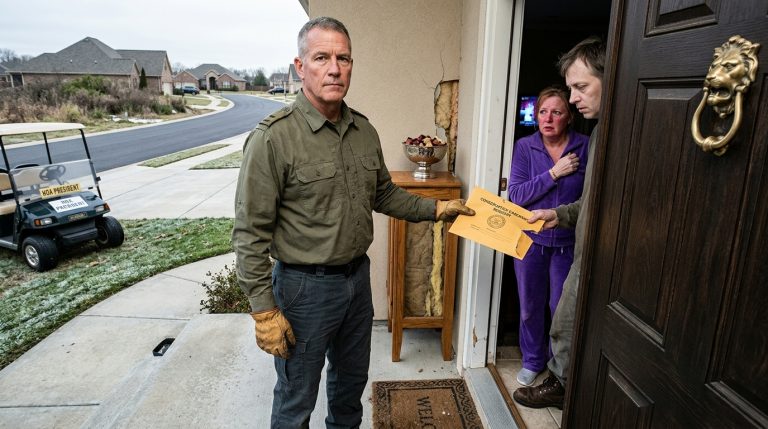
The Iron Blueprint: How a Retired Master Plumber Dismantled a Tyrant’s Fiefdom One Pipe at a Time
CHAPTER 1: THE CEDAR SHIELD
The grit of dry earth bit into Mark’s calloused palms as he tightened his grip on the garden spade. Three decades of wrestling cast iron stacks and threading galvanized steel in cramped crawlspaces had taught him one absolute law of survival: never swing at the first shadow. You watch, you measure, and you wait for the joint to bear weight before you apply torque.
Karen’s voice had the metallic rattle of a loose gate hinge, vibrating across the perfectly manicured lawn of 124 Willow Creek Lane. Her clipboard served as a shield against the morning glare, held high enough to hide the sharp, predatory tilt of her chin.
“Fifteen days, Mr. Davis,” she repeated, her words clipped with the practiced authority of someone who had never once had to crawl through a muddy trench to fix a blown main. “Payable to the association, or the figure doubles. And that eyesore comes down. Today.”
Mark didn’t look at the paper she thrust toward his chest. Instead, his gaze dropped past the hem of her floral caftan to the precise boundary line where his zoysia grass met the municipal easement. He could smell the sharp, sweet scent of crushed jasmine trailing from the lattice screen behind him—the screen shielding his new cedar outdoor shower from the street. It was a clean, meticulous piece of carpentry, built with the same uncompromising pitch and quarter-turn ball valves he had installed into custom homes from coast to coast during his fifty years as a master plumber and Marine.
To Karen, it was an unsanctioned modification. To Mark, it was a sanctuary—a quiet place to wash off the grey dust of grief after a long day of tending the vegetable beds where his late wife, Sarah, had planned to grow heirloom tomatoes.
“Karen,” Mark said, his voice dropping an octave into that flat, unyielding register he used when inspecting a compromised sewer line. “There isn’t a single bylaw in the covenant prohibiting a free-standing fixture outside the public right-of-way.”
“Section 7, Article B, Paragraph 4,” she snapped back, her eyes narrowing as she stepped closer to his flower bed, her heels crushing a border stone. “All exterior alterations require prior architectural review and approval. You bypassed the committee. Therefore, you are in default.”
She spun on her heel, the fabric swirling like a reprimand as she marched back toward the asphalt, leaving her righteous indignation hanging in the humid air like stagnant grease in a grease trap.
Mark didn’t shout. He didn’t chase her. He simply bent down, picked up the white violation notice where she had deliberately let it flutter to the turf, and folded it twice. His thumb traced the sharp crease. He walked past the jasmine screen, turned the brushed nickel handle, and let the cool, steady stream of water run over his blackened knuckles. The pressure was clean. The drainage was clear. But deep beneath the concrete pad, where the French drain fed into the rock garden, he could already hear the faint, distant grinding of iron teeth turning against each other. The war wasn’t in his backyard. It was buried in the blueprints of every house on this hill.
CHAPTER 2: THE FIREPROOF ARCHIVES
The garage air tasted thick, smelling of old zinc, heavy oil, and the dry, powdery dust that settles on paper left undisturbed for a decade and a half. Mark didn’t turn on the overhead fluorescent tubes immediately; he let his eyes adjust to the amber shaft of evening light cutting horizontally through the dirty window panes, painting long, barred shadows across the concrete floor.
His knuckles were still damp from the outdoor shower, the water cooling rapidly in the drafty space. He walked past the drill press and the rows of organized PVC fittings, stopping dead in front of the tall, institutional-grey metal cabinets that lined the back wall. The paint was chipped at the corners where a stray pipe had clipped it back in ninety-eight, exposing the dark, rusted metal beneath.
He didn’t need to check the label on the top drawer to know where the friction points were. His thumb found the cold, greasy handle of the middle tier, and he heaved. The heavy steel rollers groaned, a long, protesting screech of dry bearings that echoed off the drywall before giving way with a solid, metallic thud as it hit the travel stop.
DAVENPORT CONSTRUCTION.
The files inside were stacked vertically, yellowed manila folders sagging under their own weight like old muscle. Mark did not rush. A man who rushes a pipe joint forgets to clean the burrs, and a clean-looking joint will always weep under pressure six months down the line. His fingers, calloused and stiff from the morning’s cold air, flicked past the D’s until they hooked the thick, grease-stained tab labeled Oak Hollow Estates – Phase 1.
He pulled it free, the cardboard edge scraping against its neighbors with a dry whisper.
The memory didn’t come to him as a cinematic flash; it arrived as a physical sensation—the sharp, acrid reek of cheap PVC primer burning his nostrils in the damp trench of Lot 1 on a Tuesday morning fifteen years ago. Barry, the developer, had stood on the plywood subfloor above him, leaning over the rim of the foundation with a cell phone pressed hard against his ear, screaming about bank deadlines and the release of tranche three.
“Just get it past the inspector’s clipboard, Mark,” Barry had shouted down through the floor joists, his voice echoing off the bare studs. “We’re not building a cathedral. We’re building boxes for people who want granite countertops. Slap the unions on, skip the pressure test on the secondary loops, and let’s move on to the next slab.”
Mark had stayed down in that dark trench, his wrench locked onto a brass union, and he had done two things. He had installed the system to his own unyielding standards because his name was stamped on the blue prints—and he had pulled out his pocket ledger to write down every single deviation Barry had forced him to bypass.
He carried the heavy folder over to the workbench under the window, brushing away a light dusting of sawdust with the side of his palm. The workbench was scarred by decades of soldering torches, acid brushes, and pipe vises. He laid the file flat, untied the brittle yellow cotton string wrapped around the brass eyelets, and lifted the cover.
Inside sat the exact duplicate of the primary blueprints submitted to the city, but it was buried beneath a secondary wedge of papers: handwritten carbon copies, yellow legal pads filled with his own sharp, block-lettered notes, and a series of frantic printouts from an old desktop printer.
There it was. Stapled to a requisition slip for one hundred and fifty water heating units dated October 12th was Barry’s explicit directive. Not a verbal order this time, but an email printed out on thermal paper that had begun to fade into a ghostly grey haze at the margins. Proceed with the units as delivered, Barry had typed, ignoring Mark’s technical warning about the municipal code update requiring thermal expansion tanks on closed-loop systems. I take full liability. The inspector is an old friend of mine; he doesn’t crawl into closets to count expansion tanks.
Mark tapped his forefinger against the faded text. Barry was gone now—bankrupted by a different project down in the county seat a decade ago. But the liability hadn’t vanished into thin air like evaporating steam. According to corporate law and the succession clauses written deep into the Oak Hollow covenants, the homeowners association didn’t just inherit the manicured common areas and the community pool; they inherited the unexploded ordnance buried in the mechanical closets of every single dwelling.
Including Karen’s colonial at the end of the cul-de-sac.
He reached deeper into the file, sliding out the thin, grease-pencil-marked manila sleeve labeled K. Miller – Private.
The interior was starker. No developer emails here. Just the raw invoice from five years after the development closed—the job Karen had insisted on handling entirely off-the-books to dodge the county tax assessor’s reassessment gaze. Plumbing services rendered: Master Suite Renovation. Beneath that single line item, written in Mark’s own hand to protect himself if the floor joists ever gave way under the massive, hundred-gallon soaking tub she had demanded, was a precise inventory of structural violations: 2×10 joists sistered inadequately for dead-load weight; unvented steam shower stack tied into primary soil pipe without a secondary loop; no permits filed.
He sat back in the metal stool, the legs scraping a sharp, discordant note against the concrete floor.
The silence of the garage closed in around him, broken only by the steady, rhythmic drip-drip-drip of a leaky hose bib out by the side yard—a minor imperfection he hadn’t yet gotten around to repacking. He picked up a mechanical pencil, its lead extended half an inch, and flipped the folder open to the blank margin of the final page.
He didn’t need to shout across a lawn or wave a clipboard to make his point. A proper plumbing layout didn’t fight the pressure of the municipal main; it redirected it, using the building’s own weight and velocity to crush whatever blockage stood in the drain. Karen had built her entire kingdom on a network of unvented traps and unpermitted connections, assuming the walls would hide the rot forever.
Mark adjusted his glasses, the yellow light catching the deep lines around his eyes, and began to draft the first calculation. He wasn’t breaking the rules. He was simply opening the main valve and letting the system drain down to the bare, rusted iron.
CHAPTER 3: THE COLD COFFEE CONSULTATION
The mechanical pencil didn’t move. Mark stared down at the gray lead hovering over the yellow pad until the graphite snapped under an imperceptible twitch of his thumb. He didn’t curse. He simply reached into the shallow wooden tray built into the side of his workbench to grab a replacement lead, his fingers brushing against the partitioned compartments where he kept copper elbows, Teflon tape, and spare O-rings.
His fingers paused.
A small, heavy brass compression washer—one of a specialized batch he had ordered back when he was plumbing the custom sinks on the east side of the development—was missing from its designated bin. It wasn’t rolling around the bottom; the compartment was completely empty. Mark’s gaze narrowed in the dim, amber light. No one else touched his workbench. Jessica didn’t come into the garage unless she needed a screwdriver, and Lily knew better than to dig through the hardware trays.
He didn’t dwell on the phantom discrepancy. A compromised line will always show its pressure drop somewhere else in the network. He tucked a fresh piece of graphite into the brass chuck, twisted the cap down until it bit hard, and stood up from the stool. The metal legs groaned against the concrete, the sound carrying sharp and dry through the cold air.
It was time to move the water from the private notebook out into the open air.
The diner sat three miles outside the Oak Hollow municipal line, tucked behind an overgrown row of scrub pines and a faded sign that flickered with a tired amber hum. It was neutral territory—far enough from the pristine, manicured lawns of the subdivision that nobody wearing a floral-print caftan would ever be caught dead breathing the grease-laden air of its vinyl booths.
Dave Riley was already sitting in the corner booth when Mark pushed open the heavy glass door. The bell above the lintel gave a flat, un-oiled jingle. Dave wore a faded canvas jacket that smelled faintly of dry pine needles and engine oil, his posture ramrod straight against the cracked red vinyl. He didn’t stand up, but his chin lifted an inch in a silent, military acknowledgment as Mark slid onto the bench opposite him.
A waitress dropped two thick ceramic mugs onto the formica table without breaking her stride, sloshing dark, lukewarm coffee over the rims into small brown puddles. Neither man touched the cups immediately.
“You look like a man who just finished pressure-testing a cracked manifold,” Dave said quietly, his eyes fixed on the small black binder Mark had laid flat between them.
“The lines are holding,” Mark said, his voice a low gravel rasp. He didn’t open the binder yet. Instead, his thumb traced the worn leather edge. “Your street, Dave—lot thirty-four. You ever check the water heater closet behind your garage since you moved in eight years ago?”
Dave’s brow furrowed, the deep creases on his forehead tightening like a failing pipe clamp. “It’s a heater. It heats water. It sits there and makes noise when I run the washing machine. Why?”
“Because when Barry’s crew dropped those units in back when the subdivision was cleared, they skipped a thirty-dollar brass expansion tank on every single closed-loop system from here to the cul-de-sac,” Mark said, his tone flat, stripped of all theatrics. “They saved four thousand five hundred bucks on your street alone. The city code got updated the month before final sign-off, but Barry had a buddy at the municipal desk who signed off on the rough-ins sight unseen.”
Dave reached out, his thick, calloused index finger tapping the edge of the closed binder. “That’s a code violation. That’s a municipal fine.”
“It’s worse than a fine,” Mark corrected, lifting his coffee mug and watching the dark liquid settle without drinking. “It’s a closed system with no relief valve for thermal expansion. Every time your heater kicks on during a midnight cycle, the pressure builds against the internal welds. Most of them will hold for twenty years. But the ones that take a surge, or catch a micro-fracture from factory stress…” He let the sentence hang, heavy and absolute in the stale diner air.
Dave went completely still. The retired sergeant major didn’t blink. He looked at Mark with a sudden, sharpened clarity that had nothing to do with neighborhood gossip and everything to do with tactical survival. “And Karen?”
“Karen is sitting on top of a four-hundred-square-foot unpermitted sunroom that extends ten feet into her rear setback,” Mark said, sliding the manila printout of the plat map across the formica. “She fined me three thousand dollars for a cedar shower that isn’t even visible from the public right-of-way, while her own master bath is tied into an unvented soil stack that could back sewer gas into her drywall the first time she runs that oversized Jacuzzi tub all at once.”
Dave picked up the plat map, his eyes scanning the red marker lines. A slow, humorless grin stretched across his weathered face, revealing the tight line of his jaw. “You’ve got the schematics.”
“I have the carbon copies,” Mark said. “Every signature, every shortcut Barry forced us to take, and every off-the-books cash invoice Karen handed me when she wanted her luxury suite built without the tax man looking over her shoulder. She thinks she’s running an association. She’s actually running a leaking basement with the main drain plugged from the inside.”
“The board won’t care about your paperwork if they think they can bury you first,” Dave warned, setting the map down. “Gary and Brenda are weak, but they’re terrified of her. If we walk into that clubhouse with just a binder of old notes, Karen will use the association’s legal fund to slap an injunction on you before you can even reach the podium.”
“We aren’t walking in with notes,” Mark said, finally taking a slow sip of the bitter coffee. “We’re walking in with a formal notice of unaddressed structural liability. My son-in-law Tom finished drafting the legal demand this morning. It doesn’t just ask the board to review my fine. It puts Gary, Brenda, and Karen on personal notice that if a single water heater blows or a mold colony blooms in an unvented wall, their home insurance will drop them for willful negligence because they were officially informed and chose to ignore it.”
Dave let out a short, sharp whistle that made the waitress look up from behind the counter. He leaned back against the vinyl, crossing his arms over his chest as the amber light from the neon sign outside flickered once, casting a long, shifting shadow across the table.
“That’s not a counter-attack,” Dave muttered, his eyes gleaming with grim satisfaction. “That’s turning the municipal pressure valve all the way to maximum and walking away from the handle.”
“We give them ten days to rescind the fines and call a special meeting,” Mark said, closing the binder with a dull, heavy slap that rattled the ceramic mugs. “If they comply, we let them resign quietly. If they don’t, we drop the whole package on the city code enforcement desk and let the inspectors do the heavy lifting.”
Mark pulled a folded paper towel from the dispenser and wiped a stray drop of coffee from the edge of the table, his movements methodical and unhurried. The system was primed. The main valve was cracked. Now it was just a matter of waiting for the water to hit the lower floors.
CHAPTER 4: THE ANONYMOUS ENVELOPE
The gravel in the diner parking lot crunched dry and sharp beneath the tread of Mark’s work boots. A sudden gust of wind swept off the highway, rattling a loose sheet of corrugated tin against the side of the dumpster and kicking up a cloud of grey dust that smelled of dry asphalt and decaying leaves. Mark pulled the collar of his canvas jacket tight against his throat, his breath pluming white in the dropping temperature.
He didn’t head straight home to Willow Creek Lane. A prudent man checks the return lines before he charges a system. Instead, he drove his battered truck three miles south to the public post office box he rented near the hardware store—a precaution born of fifty years of keeping client logs away from prying eyes.
The heavy metal door of box 114 swung open with a dry clink. Inside sat a single, thick manila envelope, unaddressed on the exterior except for his box number, written in block letters with a broad-tipped felt marker. There was no return stamp, no postmark.
Mark pulled it free, his thumb testing the thickness of the contents. It felt like heavy stock paper. He slid back into the cab of his F-150, leaving the engine off so the rhythmic tick of cooling metal was the only sound in the dark cabin. He flicked on the overhead dome light, its yellow bulb casting a jaundiced glow over the steering wheel.
With the tip of his pocketknife, he sliced the glued flap open.
Inside were three photographs, developed on glossy stock that still smelled faintly of chemical baths, and a handwritten note torn from a yellow legal pad. The note was brief: Found these behind the clubhouse shed after the Tuesday board meeting. Thought you might want them for your binder.
Mark picked up the top photograph first. It was shot from a low angle, likely taken with a digital camera zoomed in from the treeline bordering the community park. The image captured Karen standing on the back patio of her colonial home, leaning over a set of architectural blueprints spread out across a patio table. But it wasn’t Karen that drew Mark’s tactical eye; it was the date stamp glowing in the bottom right corner—two days after she had officially filed the $3,000 fine against his cedar shower.
More importantly, the blueprints on her table weren’t neighborhood covenants. They were detailed schematic drawings of the municipal water main crossover that fed the eastern quadrant of Oak Hollow—the exact primary feed Mark had helped rough-in fifteen years ago.
He picked up the second photograph. A close-up of Karen’s hand holding a red grease pencil, circling a specific gate valve junction located right at the edge of her property easement—a master shutoff that controlled the pressure distribution for the entire cul-de-sac.
The third photograph was a shot of Gary, the nervous board member, standing near the same patio table, handing over a thick stack of blue-jacketed municipal inspection certificates.
Mark let out a slow, measured breath, watching it condense against the cold windshield. This wasn’t just a petty dispute over lawn height or exterior siding colors. Karen wasn’t merely ignoring the rules; she was actively mapping out the infrastructure controls. If she had possession of the master utility overlays, she had the leverage to manipulate water pressure or shut off service lines to targeted homes under the guise of “emergency maintenance.” It was a classic playbook move—starving out dissent by cutting off the supply at the main.
He slid the photographs back into the envelope, folded them carefully, and tucked them into the inside pocket of his jacket, right against his ribs where he could feel their hard, rectangular edges.
The system was under greater stress than he had originally calculated. If Karen had the master valve overlays, waiting ten days for a legal demand letter to take effect might give her enough time to pull a stunt with the local utility shutoffs before the board meeting could even be called. Pragmatism demanded an adjustment to the flow rate.
He turned the key in the ignition. The old Ford’s engine rumbled to life, vibrating through the floorboards with a steady, reassuring thrum. He didn’t head north toward the subdivision’s main entrance. He turned the wheel south, taking the back roads toward Dave Riley’s place. If they were going to map out the countermeasures against a blocked main, they needed to pull the trench covers off before the pressure built high enough to crack the pipes.
CHAPTER 5: THE TOW TRUCK STANDOFF
The old Ford’s tires crunched across the asphalt of Willow Creek Lane just as the amber streetlights flickered on, casting long, bruised shadows across the manicured turf. Mark didn’t pull into his driveway immediately. Instead, he slowed the truck to a crawl, his eyes scanning the curb in front of his house.
The tow truck was already there.
It was a rusted flatbed with a flashing amber strobe bolted to the roof, its hydraulic winch whining softly in the quiet twilight. A young driver in a grease-stained jacket stood with one boot planted on Mark’s front bumper, frantically wrapping a heavy nylon tow strap around the F-150’s front axle.
Mark didn’t slam on the brakes or shout out the window. He cut the engine, let the truck roll three feet to a quiet stop behind the flatbed, and pulled the door handle with mechanical precision. The metal creaked—a familiar, rusted friction he had heard a thousand times on job sites where a subcontractor thought he could bypass the code inspector.
“Hold it right there,” Mark said. His voice wasn’t raised, but it carried the flat, absolute weight of a concrete foundation setting in a frost line.
The young driver froze, his hands half-wrapped around the steel-reinforced strap. He blinked, looking past Mark’s headlights at the faded Marine Corps decal on the rear window of the Ford before swallowing hard. “Look, man, I’m just doing my job. Got a dispatch from the association office. Said this vehicle’s in violation of municipal street storage, leaking hazardous fluids.”
Mark walked slowly around the front of his truck, his eyes locked on the dry, spotless asphalt beneath the engine block. Not a single drop of oil marred the grey pavement. He reached out and tapped the top of the fender with his knuckle. “Dry as a bone,” Mark said softly. “You tow this vehicle without a signed municipal warrant or a verified hazard report, you’re looking at grand theft auto under color of authority. And your boss’s insurance policy won’t cover a fraudulent seizure.”
The kid dropped the strap, his hands twitching nervously toward his utility belt. “She said it was an emergency removal. Said you were uncooperative.”
“She lied,” a sharp voice cut through the evening air.
Mark turned his head slightly. Dave Riley was walking briskly down the sidewalk from three houses over, his hands thrust deep into the pockets of his canvas jacket, his eyes fixed on the tow truck driver with the cold stare of an infantry sergeant. Behind Dave came Mr. Rodriguez and the Lees, their silhouettes sharp against the fading amber light of the cul-de-sac. They weren’t hiding behind their curtains anymore. They were standing out in the open air, closing the perimeter.
The tow driver looked from Mark to Dave, then over at the small group assembling on the pavement. The math was simple. A one-hundred-dollar tow fee wasn’t worth losing a commercial license or getting dragged into a multi-party civil suit.
“Screw this,” the kid muttered, kicking the nylon strap out from under the bumper. He climbed up into the flatbed’s cab, slammed the door, and threw the transmission into reverse. The tires spun once on the gravel before the flatbed jerked backward, roaring up the cul-de-sac and disappearing around the corner.
Mark stood beside his truck, his hand resting flat against the cool steel of the door panel. The immediate tactical threat was neutralized, but the pressure in the system was rising. Karen hadn’t waited for the ten-day legal window to close; she was lashing out blindly, trying to clear the board before Tom’s demand letter could land on the other board members’ desks.
Dave stepped up beside him, his gaze fixed on the glowing windows of Karen’s colonial house at the top of the hill. “She’s panicking,” Dave said quietly. “Panic makes a commander sloppy. What’s our next move?”
Mark pulled the anonymous envelope from his jacket pocket and handed it across without a word. Dave slid the photographs out under the streetlamp, his eyes narrowing as he studied the image of the water main crossover and the red grease-pencil markings.
“She’s mapping the shutoffs,” Dave whispered, his voice tightening. “If she cuts the main to the south loop before the special meeting, she can manufacture an artificial crisis and blame the infrastructure failure on the city.”
“Not if we take the valve keys first,” Mark said, his jaw set in a hard, unyielding line. He walked to the back of his truck, dropped the tailgate with a sharp metal clatter, and pulled his heavy cast-iron utility wrench from the toolbox. The iron was cold, heavy, and balanced perfectly for turning buried brass. “The system’s got a leak, Dave. And it’s time we opened the inspection hatch.”
CHAPTER 6: THE PARKING LOT CONFESSION
The kitchen smelled of damp wool and stale lemon cleaner. Gary stood by the refrigerator, his hands shaking so violently he nearly dropped the ceramic mug of instant coffee he was holding. He didn’t offer Mark a seat. He just stared past the blinds at the dark street outside, watching the tail-lights of passing cars smear against the wet glass.
“She has the master valve overlays, Mark,” Gary whispered, his voice cracking slightly as he set the mug down with a sharp clatter on the laminate counter. “She pulled them from the county archive drawer last Thursday. I didn’t want to sign off on it, but she said if I didn’t help her verify the primary supply lines for the eastern sector, she’d release the audit logs from my wife’s charity committee.”
Mark kept his weight balanced on his heels, his fingers loosening their grip on the iron utility wrench only enough to ease the tension in his forearm. The room was freezing, the thermostat set low to conserve oil, but beads of sweat glistened along Gary’s hairline.
“A master valve overlay isn’t a zoning document, Gary,” Mark said, his voice flat and deliberate. “You don’t pull utility maps unless you’re planning to isolate a sector. What else did she make you sign?”
Gary swallowed hard, his throat working convulsively. He reached into the pocket of his cardigan and pulled out a folded piece of heavy blue-lined paper—an official emergency shutoff authorization form bearing the forged signature stamp of the municipal water district supervisor.
“She told me it was just a precautionary measure,” Gary stammered, his eyes darting toward the hallway as if Karen might materialize out of the shadows. “She said if the neighborhood association meetings got out of hand, we had the legal right to suspend non-compliant properties from the primary grid for maintenance. She was going to use it on your house first, Mark. And on Dave’s street.”
Mark stepped forward, taking the paper from Gary’s trembling fingers. The ink was fresh. The seal was an amateur forgery, copied clumsily from an old municipal permit form Mark had signed fifteen years ago when the development was first tied into the city main. Karen thought she held all the master keys, but she had miscalculated the pipe diameters. A forged shutoff order on a closed-loop municipal system didn’t just target one house; it created a backpressure spike that would trip every unmitigated water heater relief valve from the cul-de-sac down to the main highway.
“You signed an authorization to choke your own distribution line,” Mark said quietly, folding the paper twice and sliding it into his inner pocket alongside the anonymous photographs. “If she executes that order before the special meeting, she’s going to flood every basement on this hill, starting with her own unvented soil stack.”
Gary slumped back against the counter, the last vestiges of his nervous defiance draining out of him. “What do we do? She’s calling an emergency executive session for tomorrow afternoon—just her, me, and Brenda. She plans to ratify the shutoff order before the 10-day notice period for the general meeting expires.”
Mark turned toward the door, his hand resting on the cold brass handle. The pressure was building against the seals, and the gasket was about to blow. There was no more time for quiet documentation or polite legal warnings.
“You show up to that executive session, Gary,” Mark said, looking back over his shoulder with a gaze as hard as cast iron. “You sign nothing. You let her lay out the whole plan on the table. And leave the back door unlocked. We’re going to test the flow rate live.”
CHAPTER 7: THE GAVEL FALLS
The fluorescent tubes of the Oak Hollow community clubhouse hummed with a low, irritating frequency that tasted like dry dust in the back of the throat. The sterile beige room smelled faintly of burnt coffee and cheap lemon wax, identical to the night Karen had levied her first arbitrary fines against the neighborhood.
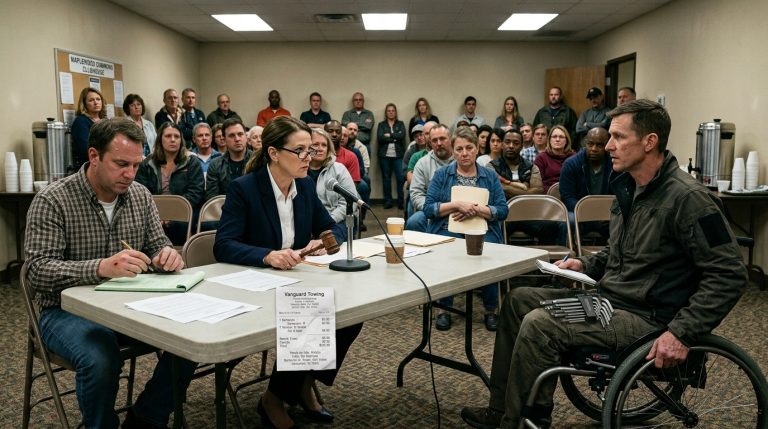
Karen sat at the head of the long folding table, flanked by Gary and Brenda. She wore her severe black pantsuit like bolted armor, her shoulders squared, her chin thrust forward with an imperious rigidity that defied the mounting friction in the room. Around her, the fold-out metal chairs were packed tight with over a hundred residents—Dave, the Rodriguezes, the Lees, and dozens of others who filled the aisles and spilled out into the open doorway.
Mark didn’t take a seat in the front row. He stood near the back corner by the fire exit, his hands tucked deep into the pockets of his canvas jacket, his fingers brushing against the cold, crisp edges of the documents he had gathered over the past three weeks. He didn’t need to speak yet. A good system manager lets the pressure build inside the manifold until the weak joints declare themselves.
Karen slammed her gavel down once. The sharp crack echoed off the acoustic tiles, cutting through the low murmur of the crowd.
“This emergency executive session of the Oak Hollow Board of Directors is called to order,” Karen announced, her voice rising with a practiced, razor-sharp edge. “We are here to address unauthorized disruptions, malicious neighborhood propaganda, and unverified safety claims circulated by agitators who refuse to respect community standards.”
She didn’t look at the crowd; her gaze was fixed squarely on Gary and Brenda sitting beside her.
“Furthermore,” Karen continued, her hand sliding across the table to tap a crisp blue-backed paper, “pursuant to executive oversight and emergency maintenance provisions, the board has authorized an immediate infrastructure restriction on targeted properties to preserve the integrity of our water grid.”
Gary’s face went chalk white. He looked down at his hands, his fingers knotting together in his lap, remembering the forged stamp in his kitchen drawer. Brenda stared straight ahead at her legal pad, her breathing shallow and fast.
Karen reached for her pen to sign the top document, her expression a mask of absolute, unchallenged supremacy. “As president, I move to ratify this emergency order effective immediately.”
“Second,” Karen said, her voice dropping into a flat, bureaucratic rhythm as she prepared to second her own motion in the absence of board support.
“Hold on just a minute,” a voice cut through the room.
Dave Riley stood up from the second row, his broad shoulders squared, his eyes fixed on the head table with the unyielding stare of an old infantryman. “You can’t ratify an emergency shutoff order when the board itself has already been placed on formal legal notice for gross negligence, civil harassment, and fraudulent asset seizure.”
Karen’s pen froze an inch above the paper. Her head snapped up, her eyes narrowing into venomous slits. “You are out of order, Mr. Riley. This is an executive session of the board. Non-board members have no floor privileges.”
“The board doesn’t exist in a vacuum, Karen,” a second voice echoed from the side aisle.
Mark stepped out from the shadows near the fire exit, his movements unhurried, his boots striking the linoleum floor with a heavy, measured cadence. The crowd parted silently before him, making a wide, respectful channel as he walked down the center aisle toward the front table. Every eye in the room locked onto him.
Karen slammed the gavel down twice, a frantic, rhythmic pounding. “Guard! Someone remove this man from the premises! He is trespassing!”
Nobody moved. The residents standing in the aisles stood their ground, their arms crossed, their expressions as cold and grey as weathered iron.
Mark stopped three feet from the folding table. He didn’t raise his voice. He reached into his jacket, pulled out the heavy manila folder containing the original master development logs, the photographs of her unpermitted sunroom, and the forged municipal shutoff authorization Gary had surrendered an hour ago, and laid them flat upon the formica surface.
“You wanted to talk about standards, Karen,” Mark said, his voice carrying clearly across the silent room. “Let’s talk about the standard depth of a sewer stack. Let’s talk about why your master suite addition extends ten feet into the rear property setback without a single county permit on file.”
Karen’s face mottled from pale to a dark, furious crimson. “Those are private records! That’s defamation!”
“They’re municipal public records, cross-referenced with my original plumbing logs from fifteen years ago when I plumbed this entire hill,” Mark replied, his tone never wavering. He slid the forged shutoff order across the table toward Gary and Brenda. “And this is a criminal forgery—an attempt to shut down residential water lines using a fake municipal stamp to cover up a four-hundred-square-foot zoning violation.”
Brenda leaned forward, pulled the blue-backed paper toward her, and scanned the signature block. Her hand began to tremble violently. She looked up at Karen, her voice cracking with sheer disbelief. “Karen… did you forge the water district stamp?”
“Don’t be ridiculous!” Karen shrieked, half-rising from her chair, her professional facade finally shattering completely. “I am protecting the property values of this community! If I hadn’t taken control of the infrastructure, these animals would have torn the whole subdivision apart!”
The word hung in the sterile air of the clubhouse. Animals.
A sharp, collective intake of breath swept through the packed room. The residents didn’t shout or roar this time; the silence that followed Karen’s outburst was far heavier, charged with the final, undeniable realization of what her rule had always been. It wasn’t about law. It wasn’t about landscaping or curb appeal. It was about absolute, unearned control over people’s homes.
Gary slowly stood up, pushing his metal chair back until it scraped loudly against the linoleum. He reached across the table, picked up his gavel—the one Karen had dropped—and set it down firmly in the center of the formica.
“The executive session is adjourned,” Gary said, his voice shaking but clear. “And as secretary-treasurer pro tem, I recognize Mark Davis’s petition for an immediate, full-board vote of no confidence and the formal appointment of David Riley as interim association president.”
Karen stared at them, her mouth opening and closing silently, her hands flat against the table as if trying to anchor herself to a sinking foundation. The main valve had blown. The pressure was gone. There was nothing left to hold back the flow.
CHAPTER 8: THE OPEN CEDAR SHOWER
Karen didn’t scream. When a main line ruptures under full municipal pressure, it doesn’t rattle; it simply blows the fitting clean off the threads, leaving a wide, hollow roar of escaping air. She gathered her black leather folio with stiff, mechanical jerks, her eyes avoiding every face in the room as she turned on her heel and pushed past the cluster of residents near the exit. The double doors swung shut behind her with a dull, hollow thud.
She put her colonial house on the market three weeks later, selling it at a steep discount to a young couple who came equipped with structural engineers and a copy of the city’s stop-work order. The unpermitted sunroom was dismantled board by board before the first frost, the lumber hauled away in rented dumpsters while the neighbors watched from their front porches with quiet, steady detachment.
The rebuilding of Oak Hollow didn’t happen overnight, but proper plumbing never does. At the first official meeting of the newly elected board under Dave Riley’s presidency, a single motion was introduced and passed unanimously: every arbitrary fine, violation notice, and punitive fee levied over the past five years was voided, wiped clean from the association ledgers as if it had never been written. The $3,000 charge against Mark’s cedar shower vanished with a single stroke of a pen.
Then came the systematic remediation of the infrastructure. Semper Fi Plumbing was awarded the contract to bring every dwelling in the subdivision up to code. For two solid months, Mark and his crew moved house to house down every cul-de-sac, cutting into drywall, threading brass unions, and installing the missing thermal expansion tanks on every closed-loop water heater in the development. It was hard, dusty, physical labor—the kind that leaves grease beneath fingernails and the taste of iron on the back of the tongue. But every joint was soldered with absolute precision, and every pressure test held steady at one hundred psi without a single weeping drop.
By late spring, the work was finished. The community culture had shifted away from the nervous, shadowed watchfulness of the past toward something solid and enduring. The Architectural Review Committee was overhauled with clear, reasonable guidelines that protected common-sense property standards without turning the neighborhood into a petty fiefdom.
The afternoon sun hung low and warm over Willow Creek Lane, casting long, golden shadows across the Zoysia grass.
Mark stood in his backyard, dressed in a faded flannel shirt and work pants stained with dry mortar dust. He stripped off his leather work gloves, tossing them onto the workbench in the garage before walking slowly across the grass toward the back corner of the yard.
The jasmine climbing the lattice screen had burst into thick, white blossoms over the last few weeks, filling the evening air with a heavy, sweet fragrance that masked the scent of damp earth. He stepped behind the screen into the enclosure he had built with his own hands.
He reached out and turned the brushed-nickel handle.
The water hissed briefly in the PEX lines before settling into a steady, powerful rush. It cascaded down from the overhead head, drumming against the tongue-and-groove red cedar panels with a clean, resonant echo. Mark stood beneath the stream, letting the cool water wash away the stubborn grit of copper shavings and dry soil from his neck and forearms.
His cell phone buzzed against the wooden bench ledge outside the enclosure. He turned off the valve, dried his hands on a clean towel, and picked up the receiver.
“Hey, Dad,” Jessica’s voice came through the speaker, bright and clear over the background clatter of a kitchen. “Lily’s got her ruler and her safety goggles ready. Are we still on for drawing up those tree house plans this afternoon?”
Mark looked up through the open gaps of the cedar frame toward the unbroken blue of the sky, then down at the dry, perfectly pitched concrete pad beneath his boots where the French drain carried the gray water safely away into the rock garden.
“Tell her to bring her pencils,” Mark said, a slow, deep smile breaking across his weathered face. “And tell her we’re going to check every single measurement twice before we drive the first nail. We’ve got rules to follow now.”
“Dave said the association will expedite the permit,” Jessica laughed.
“I know,” Mark replied, stepping out from the sanctuary into the golden warmth of his own yard. “But we’re doing it right anyway. Because we can.”
The water pressure was perfect. The system was sealed. And the house on Willow Creek Lane finally, truly, belonged to the ground it stood on.