A Legacy of Precision: How One Veteran Finds the Quiet Power to Rebuild a Broken World
CHAPTER 1: The Weight of the Paper
The silence of the mountain morning was usually a comfort, a thin veil between Thomas and the chaos of the world he had left behind in 1994. Today, it felt fragile.
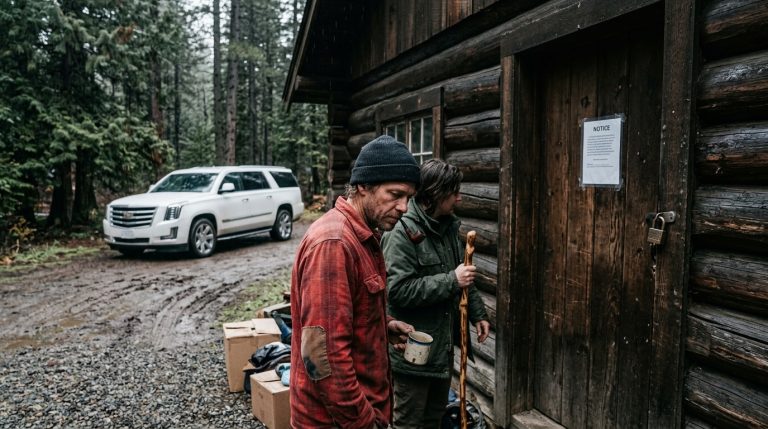
Thomas leaned forward, the weight of his body shifting onto the cane as he inspected the document. The language was sterile, bureaucratic, and final. It spoke of ‘land-use optimization’ and ‘zoning realignment.’ It used words like ‘decommissioning’ and ‘rehabilitation,’ as if the range—the very ground that had held his history for over three decades—were merely a piece of faulty equipment needing repair.
He reached out, his fingers tracing the edge of the paper. It was stiff, high-quality cardstock, far removed from the thin, yellowed paper of the training manuals he kept in his closet. As he pulled the staple free, the wood gave a wet, protesting creak. Behind the notice, tucked into a deep fissure in the gate post, he saw a sliver of something metallic.
He paused. His hand, steady as it had been on the day he rang the 600-yard plate, reached into the gap. He pulled out a small, bent surveyor’s pin, its orange paint chipped away to reveal dull, corroded steel. It was tucked deep, hidden from casual sight. It hadn’t been hammered in; it had been wedged, as if someone were marking a boundary they didn’t want the current tenants to notice.
His heart rate didn’t spike. It didn’t stutter. It simply settled into the rhythmic, low-frequency pulse he had cultivated over twenty-six years of surveillance. He looked up toward the ridge line, where the trees grew thick and the ground sloped sharply toward the old, abandoned creek bed behind the range—a place he rarely walked because the terrain was treacherous, and because of what he knew lay beneath the thick moss of the southern slope.
The developer wasn’t just planning for buildings. They were surveying the slope. They were looking at the ground he had protected for fifty years.
A cold breeze rolled down from the summit, carrying the sharp, metallic tang of ozone and the damp, decaying scent of autumn leaves. He held the surveyor’s pin in his palm. It was cold, biting into his skin. He didn’t know the name ‘Summit Peak’ yet, but he knew the rhythm of an encroaching threat. It was the same rhythm he had felt in the dark jungles of Laos, the same subtle displacement of air before an ambush.
He turned toward the truck, the gravel crunching unevenly under his boot. He had expected to spend the morning on the reloading bench, finishing a batch of .308s for the youth mentorship program. Now, he felt the heavy, familiar pull of a different kind of duty.
He walked past the range office, his gaze lingering on the window where the photographs of his two perfect shots were taped—the two bright smears of copper on the dark steel plate. They seemed so distant now, like memories of a different man. He climbed into the cab of the Tacoma, the engine turning over with a tired, familiar groan.
As he shifted into gear, his eyes caught a flash of movement near the entrance gate. A black SUV, pristine and out of place on the mountain road, sat idling three hundred yards down the hill. It wasn’t moving. It was watching.
Thomas kept his hand on the gear shifter, his gaze fixed on the vehicle through the rearview mirror. The bubble began to form, closing around him, insulating him from the cold morning air, from the ache in his knee, from the uncertainty of the letter in his pocket. He was no longer just an old man with a cane. He was the Ghost, and the range was his territory.
He put the truck in reverse. He wasn’t leaving. He was simply moving into position.
CHAPTER 2: The Quiet Threshold
The Toyota Tacoma didn’t move. It sat in the gravel of the trailhead, the engine idling with a rhythmic, mechanical tremor that Thomas felt through the soles of his boots. Three hundred yards down the mountain road, the black SUV remained motionless. It was a silhouette against the rising sun, a dark shape that disrupted the natural geometry of the hollow.
Thomas watched it. He didn’t reach for a weapon, because he didn’t need one. He reached for the air, for the stillness, for the bubble. He let the world outside the cab dissolve until the only things that mattered were the distance, the wind, and the posture of the man sitting behind the wheel of that SUV. The car was positioned to observe, not to engage. It was a tactical placement—a classic picket line move.
He allowed himself to breathe, four seconds in, four seconds held, four seconds out. As his heart rate leveled, a memory surfaced, unbidden and sharp. It was 1974, a training lane at Camp McCall. He had been crouching in the damp undergrowth, waiting for a tracker team that was hours overdue. He remembered the smell of wet pine needles and the specific, vibrating hum of a vehicle idling in the distance—the sound of someone waiting for him to make a mistake.
The memory was so vivid that the interior of his Tacoma seemed to shift. The modern plastic of the dashboard faded into the rough bark of a pine tree. The threat was the same, even if the tools had changed. The developer, Thorne, was playing a game of intimidation, but he didn’t realize he was playing it on ground that Thomas had mapped with his own blood and bone.
Thomas shifted the Tacoma into gear. He didn’t head for the main gate. Instead, he steered the truck toward the secondary logging trail that branched off toward the southern slope—the area the surveyor’s pin had been marking. It was an old path, overgrown and difficult, one that the developer’s scouts likely wouldn’t bother with until they brought in the heavy equipment.
The truck bounced over roots and loose shale. Every jolt sent a ripple of dull ache through his knee, but he ignored it, his attention entirely focused on the terrain. He wasn’t just driving; he was patrolling. He stopped at the edge of a clearing that overlooked the back boundary of the range. From here, he could see the back of the SUV’s position.
He killed the engine. The sudden silence was heavy, filled only with the distant cry of a red-tailed hawk. He stepped out, his hand instinctively going to the grip of his hickory cane. He moved toward the ridge line, his steps deliberate and quiet. He wasn’t moving like an old man; he was moving like a ghost.
As he reached the crest of the ridge, he saw them. Two men in high-visibility vests stood near a cluster of ancient, moss-covered oaks, checking a map. They were marking trees with bright blue tape. Not for removal, but for mapping. And they were standing exactly where the old creek bed narrowed, exactly where he had seen the soil disturbed three weeks ago.
Thomas stood in the shadow of a hemlock, his lungs burning slightly from the climb. He watched them with the cold, detached gaze of a professional. They were careless. They laughed, their voices carrying thin and flat in the mountain air, oblivious to the fact that they were being observed from less than fifty yards away. They weren’t looking for contamination; they were looking for elevations. They were planning the infrastructure.
He took a slow, steady breath and checked the position of the sun. He had enough light for another hour. He didn’t confront them. Not yet. Confrontation was a tactical error when you didn’t have all the intelligence. Instead, he pulled a small, battered notebook from his pocket and began to sketch the perimeter of their activity, marking the locations of the blue tape against the landmarks he knew by heart.
He noticed something then—a faint, iridescent sheen on the surface of a puddle nearby, the result of a recent, thin rain. It wasn’t natural. It was a chemical rainbow, thin and oily, shimmering against the gray silt. It didn’t belong in the pristine drainage of this mountain.
His breath hitched, just for a second. The developer wasn’t just building; he was hiding. The range was the perfect screen. If they cleared this land, if they buried the evidence under a concrete foundation, no one would ever be able to trace the source of that runoff.
Thomas closed the notebook and shoved it back into his pocket. The ache in his back was forgotten. The gravity of the situation had clarified his mission. He was no longer just protecting a patch of land; he was protecting a truth that the landscape itself seemed desperate to hold onto.
He turned and began the slow, measured walk back to the truck. He moved with a renewed sense of purpose, his cane striking the earth with a sound like a metronome. He had a path now. He had a target. And for the first time in a year, the Ghost was fully awake.
CHAPTER 3: The Circuit of Shadows
The office was a small, square room that smelled of gun oil, dry cedar, and the ghost of old tobacco. It was where Thomas spent the hours between training sessions, usually hunched over a workbench, but today the space felt different—contested. He closed the heavy door behind him, the latch clicking with a finality that underscored his isolation.
He didn’t turn on the overhead lights immediately. Instead, he stood in the thin, dusty shafts of afternoon sun that cut through the slats of the blinds, listening to the ambient sounds of the range. The wind rattled the loose siding on the exterior, and the distant, rhythmic ticking of the cooling heater created a cadence he knew better than his own heartbeat.
His eyes scanned the room, moving with the practiced efficiency of a man looking for anomalies. His gaze landed on the main breaker box near the rear workbench. He knew every fuse, every wire, and every connection in that box—he had wired it himself in 1995. But something was off. A thin, dark line of dust, which had coated the hinges of the box for decades, had been disturbed. There were faint, fresh scratches near the secondary conduit.
He moved toward it, his cane barely making a sound on the worn linoleum. He didn’t reach for his tools; he reached for the flashlight hanging from a hook on his belt. He clicked it on, the narrow beam of white light cutting through the dimness.
He unscrewed the metal casing. Inside, behind the standard mess of old, fabric-wrapped wiring, was a modern plastic enclosure—a secondary junction box, zip-tied to the main frame. It was clean, brand new, and completely out of place. It was a bridge. Someone had been tapping into the range’s power grid, likely to feed the electronic surveillance equipment he’d seen the survey crews using.
A cold, analytical calm washed over him. Thorne wasn’t just planning to build; he was planning to monitor. The range’s own electricity was being used to fuel the very eyes that were tracking its demise.
Thomas reached out and gently traced the path of the new cable. It ran up through the ceiling joists, hidden behind the insulation, leading toward the far wall—the wall that backed directly onto the protected southern slope. That was where the contamination was coming from. Not from the range itself, but from somewhere higher up the mountain, funneled through these hidden connections to ensure the data stayed off the public grid.
He felt the familiar, heavy weight of the “Ghost” persona settling into his shoulders. The anger was a slow-burning heat, deep in his chest, but he kept it leashed. Anger was a variable; it could lead to mistakes. He needed to be precise.
He didn’t pull the wires. If he disabled their feed now, they would know he was onto them. Instead, he carefully documented the connections with his small notebook, drawing a schematic of the bypass. Every wire, every colored lead, every point of entry. He was building a map, not of the land, but of their deception.
The door creaked behind him.
Thomas didn’t jump. He didn’t turn around with a start. He simply straightened, his hand closing over the handle of his cane, and shifted his weight.
“Mr. Dancy?”
It was Kyle Beckett, the young veteran he had mentored. Kyle stood in the doorway, his silhouette blocked by the afternoon sun. He looked hesitant, his eyes adjusting to the dim light of the office. He held a bag of coffee in his hand, a peace offering.
“I didn’t mean to startle you, sir,” Kyle said, his voice dropping as he stepped inside. “I saw the truck back. I thought you might want a break.”
Thomas clicked off the flashlight and turned, his face unreadable in the shadow of his brow. “I’m fine, Kyle.”
Kyle’s gaze drifted to the open breaker box. His brow furrowed, the natural curiosity of a young man warring with his ingrained respect for Thomas’s privacy. “Did we have a power surge? I noticed some of the lights flickering near the 600-yard line earlier.”
Thomas leaned back against the workbench, shielding the box from Kyle’s view with his body. He wasn’t sure if Kyle was part of this, or just another set of eyes. He looked at the young man, really looked at him, searching for the tell-tale signs of a double agent—the nervous twitch, the avoidance of eye contact, the rehearsed speech.
Kyle just looked concerned.
“Old wiring,” Thomas said, his voice level. “It’s a constant battle.”
“I can help you look at it,” Kyle offered, moving a step closer. “I did a bit of electrical work before I enlisted. Might save you some time.”
Thomas paused. He needed an ally, someone who knew the range as well as he did but possessed the physical agility he lacked. But he also needed to ensure that ally was clean.
“Perhaps tomorrow,” Thomas said, his tone final but not unkind. “I’m finished for the day. Let’s head to the mess area. We can talk about those groups you were shooting at 300 yards.”
Kyle smiled, the tension leaving his posture. “Yeah, I’d like that. I feel like I’m still pulling to the left.”
“You are,” Thomas said, walking toward the door and brushing past Kyle. “And we’re going to fix it.”
As they walked out into the cool evening air, Thomas looked up at the ridge line one last time. He knew now that the range wasn’t just a physical space; it was a contested territory. And he knew that if he was going to save it, he would have to become the very thing the mountain had trained him to be—a silent observer, a master of the invisible, and a protector of things that others wanted to bury.
The black SUV was still there, a dark, pulsing knot in the landscape. Thomas walked toward the barbecue area, his cane rhythmic against the gravel, his mind already calculating the next move. He had the bypass map. He had the visual of the crews. Now, he needed to find the source of the contamination on the southern slope. And he would do it tonight, when the shadows were long and the world was quiet.
CHAPTER 4: The Saturated Truth
The weather in the North Georgia mountains didn’t just change; it arrived with a sudden, localized violence. By the time Thomas reached the tree line near the southern slope, the sky had bruised into a deep, sickly purple. The air pressure dropped, a sensation he felt in the old, sensitive ache of his knee—the barometer of his own internal wreckage.
He didn’t retreat. He adjusted his coat, pulling the collar tight, and used the hickory cane to test the ground ahead. The slope was steeper than the survey maps had suggested, a jagged tear in the mountainside that caught the runoff from the entire ridge.
He moved carefully, his boots finding purchase on the slick, decaying leaves. He was looking for the chemical trail, the iridescent sheen he had glimpsed earlier, but the rain was already beginning to wash the surface clean. He had to think like the water. If there was contamination, it wouldn’t just sit on the surface; it would pool in the low points, the small, hidden depressions where the soil had been disturbed.
He pushed deeper into the brush, his eyes scanning the ground with the same intensity he had once applied to spotting tripwires in the jungle. The smell here was different—less like pine and wet earth, and more like industrial solvent, faint but unmistakable against the raw, wet scent of the storm.
He found it near an ancient, uprooted oak. The earth around the roots was a different color, a dark, bruised gray that shouldn’t have been there. He knelt, his bad knee screaming in protest, and dug a small, tentative hole with his pocketknife. The soil wasn’t just wet; it was saturated with a thick, viscous liquid that stained his fingers.
It was oil, or something heavier, leaking from a depth that shouldn’t be disturbed by mere landscaping.
He didn’t just see the contamination; he saw the implication. Someone had buried drums, or a tank, years ago. This wasn’t a recent spill by Thorne’s development crew; they were just the ones who had accidentally punctured the lid. The developer wasn’t trying to build something new; he was trying to excavate and dispose of a liability he had inherited, and the range was simply the most convenient place to dump the cost.
A branch snapped behind him.
Thomas didn’t look back. He stayed low, his hand sliding away from his cane and into his pocket, his thumb resting against the casing of the small, multi-purpose tactical light he carried. He waited, his breathing perfectly still, listening to the rhythm of the rain against the canopy.
“Mr. Dancy?”
It was Thorne. The voice was smooth, cultured, and entirely out of place in the mud and the storm.
Thomas rose, turning slowly. Elias Thorne stood at the edge of the clearing, draped in a high-end, waterproof jacket that cost more than Thomas’s truck. He looked ridiculous in the setting, a sharp, corporate silhouette against the raw, wild slope. He didn’t have an umbrella. He just stood there, watching Thomas with eyes that were cold, calculating, and entirely devoid of the respect he had shown earlier.
“You’re a long way from the range, Thomas,” Thorne said, his voice barely rising above the wind.
“Checking the drainage,” Thomas said, his tone flat. He didn’t bother to wipe the gray mud from his fingers. “The rain does funny things to this slope.”
Thorne took a step forward, his boots sinking into the muck. He didn’t look at the mud, or the trees, or the sky. He looked only at Thomas. “This land is going to be reclaimed, Thomas. It’s a process. Sometimes that process involves things that are… unpleasant. It’s for the best. For the community, for the future.”
“Is that what you call it?” Thomas asked. “Reclamation?”
Thorne stopped, his gaze dropping to the hole Thomas had dug. He saw the stained soil. He saw the knife. For a split second, the corporate mask slipped, revealing a flicker of raw, jagged panic—a glimpse of the man behind the project, the man who was in over his head.
“It’s a site-remediation project,” Thorne corrected, his voice hardening. “It’s been approved by the county board. You’re trespassing on private property, Thomas. I’d suggest you go back to the office and enjoy your retirement. It’s a lot safer than playing soldier in the mud.”
“I was never playing,” Thomas said.
Thorne turned, walking back the way he came, his footsteps heavy and uneven. He didn’t threaten him, not with words. He didn’t have to. The threat was in the way he walked, the arrogance of a man who owned the paper, the permits, and the law.
Thomas remained in the mud, the rain soaking through his coat. He felt the cold reaching into his bones, but he didn’t care. He had seen the truth, and he had seen the man trying to bury it.
He didn’t need to fight him with the same weapons. He had the map, he had the evidence of the bypassed power grid, and now he had the physical location of the contamination. He had enough to force a halt, enough to bring in people who couldn’t be bought with a developer’s permit.
But as he looked back down at the gray, stained soil, he felt a sudden, sharp pang of realization. The hole he had dug—the ground beneath his boots—it wasn’t just the site of a spill. It was the place where he had come to sit, fifty years ago, when the war was a fresh wound and the world was too loud. It was where he had buried his gear, his mementos, and the memories of the men he had left behind in Laos.
He stared at the mud, his heart tightening. The contamination wasn’t just a threat to the range; it was a desecration of his own, personal grave. He had thought he was protecting a piece of land. He was actually protecting his own past, and it was being unearthed by a man who didn’t even know what he was digging up.
The rain intensified, a downpour that erased the world, leaving only the sound of the water and the cold, hard weight of the decision he had to make. He wasn’t just the Ghost anymore. He was the guardian of the dead, and the battle had just turned personal.
CHAPTER 5: The Testimony of the Earth
Thomas didn’t climb out of the mud; he crawled, his movements dictated by the necessity of staying low. Every muscle in his shoulders burned with the effort of fighting the slip of the slope. He reached the higher ground near the old access road, his breath coming in ragged, shallow stabs. The rain had turned the mountain into a slide, a living entity that seemed to want him gone, to wash away the evidence he had just uncovered.
He found the cab of his truck and pulled himself inside, the metallic tang of the interior a stark contrast to the chaotic, wet world outside. He sat there for a long moment, shivering uncontrollably. The shivering wasn’t just the cold; it was the physical reaction to the adrenaline hitting his system, the “Ghost” recalibrating to the fact that he was no longer a silent observer, but a participant.
He needed to get this out. He needed a voice that carried more weight than an old janitor with a hickory cane.
He drove slowly, his headlights cutting through the sheets of rain like dull blades. He wasn’t heading home. He was heading to the only place that felt solid in a world that was rapidly liquefying: the municipal hall in Dahlonega. It was a late Tuesday; the council meeting was in progress. He’d seen the announcement posted on the community board near the post office earlier that day.
He parked, the truck shuddering to a halt in the flooded asphalt of the lot. He didn’t bother with his coat; he was already soaked to the bone. He grabbed his notebook, the damp pages holding his frantic sketches and notes, and started the long walk toward the entrance. His knee was a white-hot spark of pain with every step, but he walked with the rhythmic, steady cadence of a man who had marched through worse.
The hallway of the municipal hall was quiet, lit by the harsh, flickering hum of fluorescent tubes. The meeting room at the end of the corridor was packed. He could hear the low, rhythmic murmur of debate, the sound of a community trying to decide its own fate without knowing it was already being sold.
He entered at the back, dripping water onto the polished floor. The sudden hush that fell over the room was immediate. He was a presence—a man defined by his age, his cane, and the raw, tangible weight of the storm he brought with him. He didn’t speak. He just walked to the microphone at the front of the room, his eyes locked on the presiding member of the council, a woman he recognized from his years at the elementary school.
“I’m Thomas Dancy,” he said. His voice wasn’t loud, but it had the quality of gravel shifting—an old, resonant sound that commanded attention.
He laid his notebook on the podium. He didn’t open it. He didn’t need to. He began to speak, not about permits or zoning or “reclamation.” He spoke about the land. He spoke about the drainage, the chemical runoff, and the truth hidden beneath the roots of the southern slope. He didn’t use jargon; he used the vocabulary of the mountains. He described the way the water moved, the way the soil tasted of something it shouldn’t, and the subtle, illegal bypasses of the range’s power grid.
The room remained silent. Thorne, sitting in the front row, turned to look at him. His expression was a carefully crafted void, but Thomas saw the tension in his jaw, the way his fingers tightened on his own tablet. Thorne was ready to dismiss him—he had the authority, the money, and the influence. He was ready to paint Thomas as a confused, aging man who had spent too many years in the isolation of the mountains.
“This man,” Thorne began, standing up, his voice smooth and condescending, “is a local fixture. We respect his service, we respect his past. But he is mistaken about the technicalities of the site-remediation. He is conflating local drainage issues with our development goals. It’s an unfortunate confusion, born of age and an overactive imagination.”
The council members shifted, their eyes turning toward Thomas with the pitying look that he had learned to expect, the look that said they had already decided.
“I didn’t bring imagination,” Thomas said, his voice steadying. He opened the notebook and laid it flat on the podium. “I brought evidence.”
He pushed the notebook forward. It wasn’t just sketches. He had taken photos earlier, small, polaroid snapshots he’d developed in his home lab—a hobby he’d maintained for years. He had photos of the junction box. He had photos of the iridescent oil in the puddle. And he had a small, plastic bag containing a sample of the soil from the southern slope.
He didn’t make a speech. He let the photos speak. He pushed them toward the council member. “This isn’t about development. This is about burial. And I know what’s buried there, because I was the one who helped map this ground fifty years ago.”
The room erupted. It wasn’t the eruption of a riot, but the sudden, sharp buzz of a community being forced to confront a reality it wanted to ignore. Thorne’s mask slipped again, the veneer of corporate calm replaced by a frantic, jagged edge. He reached for the photos, but Thomas’s hand—the steady, trigger-ready hand—slammed down onto the podium, pinning the evidence to the wood.
“It isn’t yours,” Thomas said, looking directly at Thorne. “It never was.”
The presiding council member, the woman from the school, looked from the photos to Thomas, her face pale. She knew who he was. She knew he was a man who didn’t lie. The weight of his reputation, the quiet, unshakable integrity of the man who had spent eighteen years as a janitor and twenty-six years as a Ghost, filled the room.
The meeting was adjourned, not because the business was finished, but because the truth had just walked through the door and broken the table.
As Thomas walked out, his knee throbbing with the effort, he felt the heavy, suffocating pressure of the secret he still carried—the grave, the comrade, the reason he had really protected that slope. The truth he had revealed was only the first layer. The storm outside was still raging, and he knew that Thorne would not stop here. He would retaliate. He would dig deeper.
And in doing so, he would get closer to the thing Thomas couldn’t let him find.
CHAPTER 6: The Architect of Shadows
The ride home was a blur of high-beam headlights cutting through the retreating storm. Thomas gripped the steering wheel, his knuckles white, his mind racing through the tactical implications of the council meeting. He had won the vote, but he had lost the element of surprise. Thorne now knew exactly what Thomas knew. The developer wouldn’t retreat; he would accelerate.
When Thomas pulled his Tacoma into the drive of his cabin, the familiar silhouette of his home greeted him, but something felt wrong. The stillness was too profound.
He didn’t approach the front door. Instead, he killed the headlights and sat in the cab for a long minute, watching the house. His hand reached into his pocket and touched the keys he’d found in his mailbox—the ones left there while he was at the council meeting. They were heavy, brass-heavy, with an embossed tag: Summit Peak Storage – Unit 4B. Thorne wasn’t just intimidating him; he was taunting him. He was inviting Thomas into the very belly of the operation.
Thomas stepped out, his boots sinking into the wet Georgia red clay. He circled the house, moving through the shadows of the porch and the garden he hadn’t tended in years. Everything was as he’d left it, yet the air felt charged, metallic.
He didn’t go inside. He went to his workshop, the small, timber-frame shed where he kept his lathe and his tools. He turned on the single, low-wattage bulb above his workbench. He took the keys from his pocket and laid them on the wood. Beside them, he placed the notebook from the council meeting.
He began to clean his rifle—not because he expected to use it, but because the ritual of cleaning it kept his hands steady and his mind focused. He broke the action, the smell of solvent rising to meet him. It was a grounding, familiar scent, one that had been his constant companion for decades.
As he worked, he thought about the grave. The grave in the southern slope. It wasn’t just a physical place; it was the anchor of his silence. Thorne thought he was dealing with an environmental cover-up, a simple matter of toxic dumping. He didn’t know he was stepping on the hallowed ground of Thomas’s own history.
The sound of a vehicle engine caught his ear—a low, distant thrum. He paused, his cleaning rag hovering over the bolt. He went to the window, peering through the slats of the blinds. A vehicle was idling at the end of his drive. Not the SUV from the trailhead, but a nondescript sedan, its lights extinguished.
They were watching him. They were waiting for him to move, to react, to lead them to whatever else he was hiding.
Thomas turned back to the workbench. He didn’t panic. Panic was a waste of resources. He packed a small, canvas duffel with the barest essentials: a headlamp, his digital camera, a set of lock picks he hadn’t touched since the nineties, and a heavy, rubber-coated flashlight.
He didn’t need to lead them anywhere. He was going to take the fight to them.
He stepped out of the workshop, moving into the darkness of the woods behind his cabin. He knew these trees better than he knew the palm of his own hand. He moved through the brush, his cane clicking softly against the roots, his gait fluid and quiet. He circled the end of the drive, keeping the sedan in his peripheral vision. He could see two men inside, their faces illuminated by the occasional glow of a cigarette.
They were local security, hired muscle with no concept of the man they were watching.
Thomas bypassed the drive entirely, cutting through the dense thicket that bordered the property line. He emerged a hundred yards down the mountain road, well behind the sedan. He was in the shadow of a large, abandoned barn, the structure rotting and leaning into the night. He waited. He watched.
The sedan didn’t move for an hour. Thomas stood, immobile, his body blending into the dark, wet trunk of a massive oak. He was the Ghost again. He wasn’t the old man with the cane or the janitor from the school. He was a man who had spent twenty-six years learning how to disappear, and now, he was using that training to peel back the layers of a deception that threatened to ruin everything he loved.
He began the walk toward the town, toward the address marked on the key tag: the Summit Peak storage facility on the outskirts of Dahlonega.
He moved through the fields, avoiding the road, his every step a calculation of energy and exposure. The rain had stopped, but the ground was a treacherous trap of mud and hidden debris. He reached the facility as the moon broke through the clouds, casting a sharp, silvery light over the rows of corrugated steel units.
He found 4B.
He approached it, his breathing shallow, his focus absolute. He took the keys from his pocket—the ones Thorne had left for him—and felt the weight of them. This was the moment of decision. If he turned back, he was just a man with a grievance. If he went inside, he was a man at war.
He slid the key into the lock. It turned with a crisp, mechanical thunk.
He pushed the door open. It wasn’t a storage unit. It was a digital archive, filled with rows of servers, humming with a low, constant vibration. And in the center of the room, on a large drafting table, were the maps. Not the development plans he’d seen at the council meeting, but the real ones.
The maps showed the southern slope, the creek, the range—and they marked, in precise, crimson ink, a location that didn’t appear on any municipal survey. It was the location of his comrade’s grave, and it was marked for “deep excavation.”
Thomas felt the world tilt. Thorne didn’t just know about the contamination. He knew about the grave. He had known all along.
CHAPTER 7: The Final Calibration
The humming servers felt like a hive, a buzzing network of artificial intent that filled the cramped storage unit with a cold, oscillating energy. Thomas stared at the crimson ink on the map. The mark wasn’t just a coordinate; it was a target. The grave of his comrade, the man who had stayed behind in the humid dark of Laos so that Thomas could make it to the extraction point—it was marked for destruction.
He felt a tremor in his left hand, the one that betrayed him after his third cup of coffee, but it wasn’t the caffeine today. It was the crushing weight of fifty years of silence being shattered. Thorne wasn’t just a developer; he was a grave robber, a man who viewed the resting places of the forgotten as mere obstacles to a ledger entry.
Thomas reached into his duffel and pulled out his digital camera. His movements were deliberate, the economy of a man who had long ago stripped his life of unnecessary motion. He snapped high-resolution photos of the drafting table, the server racks, and the specific coordinates on the map. He was documenting the desecration.
As he finished, the unit’s heavy steel door groaned. It was a slow, deliberate sound, a warning.
Thomas pivoted, his back to the wall, his cane gripped like a short sword. Two men stood in the threshold, silhouetted by the yellow light of the facility’s exterior. They weren’t the local muscle from his drive. They were professional, suited, their hands resting on their hips with a practiced, dangerous ease.
“Mr. Dancy,” the man on the left said. His voice was flat, devoid of the corporate polish Thorne used. “You’ve seen enough. Step away from the table.”
Thomas didn’t step away. He looked at them, his eyes narrow, his posture loose and ready. He felt the phantom weight of a rifle in his hands, the familiar call of the bubble descending over him. He was tired, his knee was screaming, and his back was a map of old injuries, but in the center of the room, he was a Ghost, and ghosts didn’t surrender to men in suits.
“You’re digging in the wrong place,” Thomas said, his voice quiet, carrying in the small, enclosed space.
The lead man chuckled, a dry, humorless sound. “We’re digging exactly where we need to, Mr. Dancy. Your little crusade at the council meeting was a nuisance. This is a liability.”
He took a step forward. Thomas didn’t back down. He stood his ground, his gaze unwavering. He knew he couldn’t win a physical confrontation against these two, not in his condition. But he didn’t need to win a fight. He needed to win a narrative.
He moved his right hand, not to attack, but to the small, wireless transmitter he had pulled from his pocket—a backup device he had rigged that afternoon, triggered to upload the contents of his camera to the local sheriff’s email server the moment he pressed the button.
“You’re too late,” Thomas said.
The man lunged.
Thomas sidestepped, the maneuver a flick of muscle memory from a different life. He tripped the man with the base of his cane, using the momentum of the man’s own weight against him, and sent him sprawling into the server rack. The sound was a metallic crash—a chaotic symphony of snapping plastic and sparks.
The second man froze, startled by the sudden, violent efficiency of the old man. In that split second of hesitation, Thomas hit the button on the transmitter.
The upload light on his camera flickered from amber to green.
He didn’t stay to watch the chaos. He turned and bolted for the side exit of the unit, a narrow service door he had noted on his way in. He shoved through, the cool, rain-washed air of the night hitting him like a physical blow. He ran, ignoring the stabbing pain in his knee, moving through the labyrinth of the storage units with the desperate, jagged speed of a man who had one final, defining act left to perform.
He reached his truck, vaulted into the cab, and cranked the engine. The engine roared, a deep, guttural sound that sliced through the night. He wasn’t going home. He was going to the range. He was going to finish this on the ground where it started—the only ground where he knew every ridge, every hollow, and every secret.
He looked at the empty passenger seat. The grave was waiting. Thorne was coming. And Thomas Dancy, the man who had been called Ghost, was finally going to ensure that no one else would ever be left behind.
He drove with the lights off, the moonlight guiding him up the mountain, his hands steady on the wheel. The calibration was complete. Every variable had been accounted for. The wind, the distance, the truth—everything was set for the final, inescapable shot.
CHAPTER 8: The Clearing of the Mist
The moon hung low over the mountains, casting long, fractured shadows across the range. Thomas stepped out of his truck and onto the gravel, his legs trembling with a fatigue that reached into his very marrow. He walked not toward the office, but toward the southern slope, his cane sinking into the soft, rain-soaked earth. He was at the site of the grave. The silence of the night was broken only by the sound of heavy tires crunching up the mountain access road. Thorne had arrived, his confidence undeterred by the council’s vote, bringing a crew to finalize what he had started in the dark.
Thomas reached the clearing near the ancient oak, the place where he had spent a lifetime holding his breath. He didn’t turn to face the headlights sweeping across the ridge. He knelt, his hand brushing away the mud from a small, stone cairn he had maintained in secret for decades. This was the Layer 2 truth: no contamination spill, no simple negligence. This was the final resting place of Sergeant Elias Thorne Sr.—the developer’s own estranged father, a man who had died in the same operation as Thomas’s comrade. The “contamination” was the deteriorating metal of a crash-landed aircraft Thorne had been trying to scrub from history to avoid the legal fallout of his father’s past, using the range as a sacrificial lamb.
As the headlights pinned him against the night, Thorne emerged from the lead vehicle, his face a mask of frantic, sweating desperation. He stopped twenty feet away, his gaze darting between Thomas and the disturbed earth.
“You don’t know what you’re doing, Dancy,” Thorne shouted, his voice cracking. “This isn’t just land! It’s a liability that will destroy my family’s name. I’m fixing it.”
“You aren’t fixing anything,” Thomas said, his voice calm, cutting through the mechanical hum of the idling trucks. “You’re just repeating the same mistake. You think the past is something you can pave over.”
Thorne started toward him, his hand reaching into his jacket—a move of pure, impulsive aggression. Thomas didn’t reach for a weapon. He stood, his movements slow and deliberate, and held out the photograph he had taken earlier that night. It was an old, faded snapshot from 1974, found tucked in his own pocket, showing a young, smiling Elias Thorne Sr. beside the very man Thomas had mourned for fifty years.
“Your father died here,” Thomas said. “He didn’t run. He stayed to help the men who couldn’t walk. He was a better man than you, Elias. And he deserves better than to be buried under a foundation of lies.”
Thorne froze, the image in the moonlight turning his face the color of ash. The arrogance, the drive, the corporate shield—it all shattered. He looked at the cairn, then at the man who had guarded it, and for the first time, he saw the depth of the legacy he was trying to erase. He didn’t surrender; he collapsed, falling to his knees in the same mud he had tried to exploit.
The confrontation was over, not with a struggle, but with the sudden, crushing weight of reality.
In the weeks that followed, the mountain range was spared. The county, faced with the overwhelming evidence of the crash site and the involvement of Thorne’s family history, declared the southern slope a protected memorial zone. Thorne, shamed and legally gutted, disappeared into the administrative machinery of his own ruin.
Thomas returned to his daily rhythm. He spent his afternoons at the range, the hickory cane resting against the bench as he sat with the new generation of veterans. He began to repair the garden Catherine had once tended, the soil rich and yielding under his hands.
He didn’t speak of the grave, and he didn’t speak of the night on the slope. But he was whole. The phantom tremor in his hand had ceased. The bubble he had lived in was no longer an isolation, but a sanctuary—a place where the past and the present finally existed in a quiet, enduring balance. One afternoon, while teaching a young girl to steady her breathing on the 300-yard line, he felt a soft breeze pass through the trees. He waited, listened, and for a brief, resonating moment, he heard the faint, distant clang of a bell—not of a steel plate being hit, but of a long, heavy silence finally being given its due.
He smiled, a rare, slow movement of his face, and pressed the trigger on the pencil he held to demonstrate the release. “Again,” he whispered. “And this time, let it be true.”