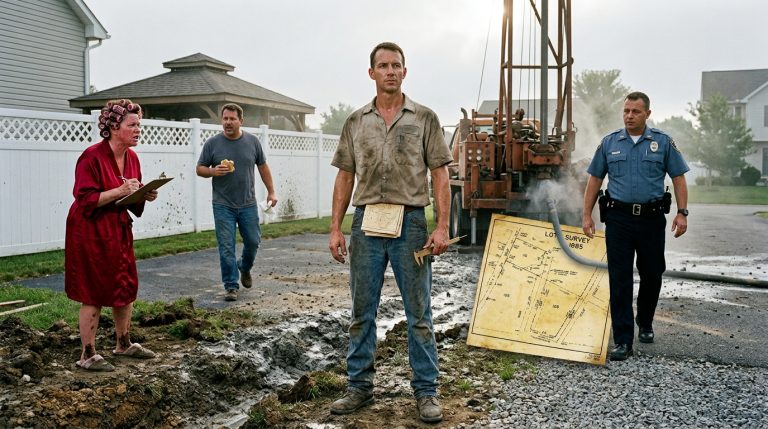
A Federal Auditor Dismantles a Corrupt Suburban Empire Using Only Cold Math, Exact Boundaries, and Unforgiving Laws
CHAPTER 1: THE RED SHINGLE AND THE PADLOCK
The engine of my sedan ticked as it cooled, a hollow sound in the damp mountain air of Ridgewood Pines. I didn’t turn off the headlights immediately; I let them rake across the stacked boxes of my father’s life sitting out on the chestnut porch. His flannel shirts—the green one with the patched elbow, the gray one smelling faintly of cedar and pipe tobacco—were absorbing the gray drizzle like discarded rags.
My hand stayed clamped around the steering wheel, knuckles pale against the leather. In federal auditing, you learn to spot the anomalies within the first three minutes of opening a ledger. A misplaced decimal, an inflated disbursement, a signature that lacks the erratic drag of a human hand. But this wasn’t a spreadsheet. This was physical. This was the front door of the cabin my father had built board by hand in 1987, now choked by a laminated blue notice and a heavy, unyielding lock.
Notice of Property Seizure.
The words were printed in bold, unfeeling sans-serif font, stapled right through the grain of the historic wood he had hauled across two counties.
My phone buzzed in the cup holder—a reminder for a conference call in Washington that I had abandoned six hours ago. I swiped the screen dark without looking. bereavement leave wasn’t a pause button on reality; it was a grace period before the system tried to swallow whatever you left behind.
Footsteps crunched on the wet gravel behind me.
I didn’t turn my head, but my eyes flicked to the rearview mirror. A white Cadillac Escalade had nosed directly into the narrow drive, its front bumper inches from my rear panel. A deliberate box-in. The power move of someone who assumed every piece of dirt between the highway and the ridge belonged to their private ledger.
The driver’s door swung open with a heavy, pneumatic thud. Before her feet hit the mud, the air shifted. It hit me through the cracked window—heavy, synthetic floral perfume, expensive enough to choke a courtroom.
“Honey,” a voice called out, sharp as a surveyor’s stake. “You’re parked on community-managed easement. Move the sedan before the tow unit gets here.”
I cut the engine, the sudden silence ringing in my ears like a tuning fork. I opened the door, stepped out into the steady mountain rain, and let the cold water soak instantly through the shoulders of my coat. Grief is a loud, chaotic thing when it starts, but after six weeks of hospital monitors and funeral home quiet, it hardens into something else. It condenses. It turns into math.
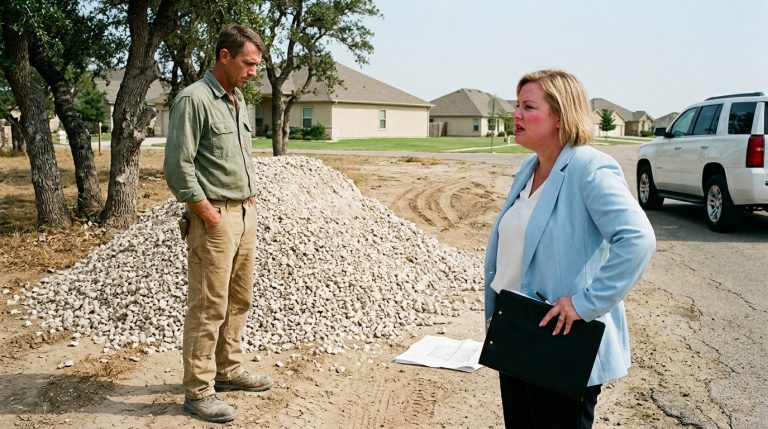
Denise Keller stood by her Escalade, a camel-colored blazer unwrinkled by the storm, a clipboard clutched to her chest like a shield. Behind her, a man with a thick neck and a black weather-resistant jacket leaned against the passenger door, arms crossed, staring at me not with anger, but with the vacant boredom of a bouncer waiting for a bar fight to clear out.
“My name is Jamie Hollis,” I said, my voice lower and steadier than my own ribs felt. I reached into my coat pocket, my fingers brushing the damp edge of my father’s death certificate. “And you’re standing on my father’s property.”
Denise didn’t blink. She didn’t check my face. Her eyes flicked down to my shoes, assessed the mud on my soles, and then snapped back to her clipboard, where a red plastic pen was slotted neatly into the spiral binding.
“Earl Hollis passed away over a month ago,” Denise said, tapping the clipboard with a manicured nail. “According to Section 14, Paragraph C of the Ridgewood Pines bylaws, un-reclaimed properties with delinquent maintenance assessments revert to community control within thirty days of probate abandonment. Your father’s estate is currently in arrears by four thousand eight hundred dollars.”
“There are no arrears,” I said, taking two deliberate steps toward her. The rain plastered my hair against my forehead, but I didn’t reach up to wipe it away. “My father paid his county land fees annually. The HOA maintenance fee is legally voluntary for parcels established prior to the 1990 municipal incorporation. My dad was here a full year before this subdivision was even a blueprint.”
Denise finally looked up, her smile tightening into a thin, porcelain line that didn’t reach her eyes. She tilted her chin up, looking down her nose despite our equal height.
“In Ridgewood Pines, Mr. Hollis, history doesn’t override the bylaws. And the bylaws say this cabin is currently a blight on property values.” She gestured with her pen toward the boxes of my father’s coffee mugs and carved walking sticks sitting out in the rain. “We’ve already contracted a liquidation crew for Tuesday morning. You’re welcome to collect your personal sentimental items from the curb before then, provided you sign the visitor waiver.”
She turned back toward her Escalade, her hand reaching for the door handle as if the conversation had already been audited, balanced, and filed away.
I didn’t move. My hand slipped deeper into my pocket, tightening around the folded paper until the heavy parchment tore slightly at the crease. She thought she was dealing with a grieving tourist who would pack up the wet boxes and drive back to Washington with a bruised ego. She didn’t know what a federal compliance auditor does when a balance sheet doesn’t balance.
“Tuesday morning,” I said quietly, the words cutting cleanly through the sound of the dripping pine trees.
Denise paused, her hand on the chrome handle, glancing back over her shoulder with a faint twitch of annoyance.
“What did you say?”
“I said,” I took another step forward, the mud squelching softly beneath my boots, “you’re going to want to check the county surveyor records from October nineteen eighty-seven before you bring any liquidation crew up this mountain. Because if you touch a single shingle on that porch on Tuesday, you’re not going to be dealing with an estate sale. You’re going to be looking at a federal title fraud investigation that will tear every single deed in this zip code down to the studs.”
Denise froze, her fingers tightening on the chrome. For a fraction of a second, the bored arrogance in her eyes flickered, replaced by something cold and sharp. Then she pulled the door open, climbed inside, and locked the doors with a heavy thud.
The Escalade backed down the narrow drive, its tires throwing gravel against my bumper.
I stood alone in the rain, staring at the brand-new brass padlock on my father’s door. But as I reached out and touched the cold metal of the lock, feeling the precise weight and make of the shackle, I noticed something small and wrong. The stamping on the keyhole wasn’t standard commercial grade. It was a restricted municipal core—the exact kind used on county utility boxes and restricted municipal water valves.
Municipal core. Not an HOA lock at all.
My heart gave a slow, heavy thud against my ribs as the real implications began to map themselves out in my head.
CHAPTER 2: THE WHITE ESCALADE AND THE CLIPBOARD STRATEGY
The brass shackle was cold against the pad of my thumb. In federal compliance, you learn early that corruption rarely wears a mask; it wears an ordinance number. It hides behind municipal stamps and duplicate filing cabinets designed to discourage anyone from digging past the first page.
The stamping on the lock was faint—a small, indented M-4 stamped into the steel curve just beneath the shackle pin. That wasn’t a standard hardware store purchase. That was a municipal core, the precise serial imprint used by the county water and utility sector to secure restricted access points. The kind of lock an ordinary citizen cannot buy off a shelf, but one that an HOA president with a zoning-commission husband could requisition with a phone call and a favor.
My thumb lingered on the stamped steel as the steady mountain drizzle pooled in the collar of my coat.
A memory flickered, sharp and unbidden—the psychological phantom of my father standing in the damp mud of this exact ridge thirty years ago, anchoring a heavy brass plumb bob to a cedar stake. He had worn that same gray flannel shirt, his knuckles stained with permanent black ink from his field logbooks, muttering about how a line on a map is only as honest as the man who walks it. He didn’t build this cabin to sit on a subdivision spreadsheet. He built it to outlast them.
“You’re not towing anything today,” I whispered to the empty porch.
I released the lock, let my hand drop to my side, and turned away from the door. The gravel crunched under my boots as I walked back toward my sedan. The white Escalade was gone, its tire tracks cutting deep, arrogant ruts into the wet mud of the drive, but the air still hung heavy with the cloying weight of synthetic floral perfume. Denise Keller operated on momentum. She assumed that a laminated sign and a heavy-grade lock would cause a grieving stranger to pack up the wet cardboard boxes and flee back to Washington within twenty-four hours.
She didn’t know the exact weight of a federal audit.
I opened the driver’s side door, slid into the damp upholstery, and tossed my leather briefcase onto the passenger seat. The metal latches snapped open with a sharp, metallic bite. Inside sat my government-issue laptop, a portable scanner, and a thick, tabbed binder containing my father’s original 1987 property acquisition filings.
I didn’t start the engine. Instead, I reached into the glove box, pulled out a small tactical flashlight, and flipped it on, casting a harsh, focused beam across the passenger seat maps.
If Denise Keller wanted to play a game of municipal jurisdiction, we would start with the foundation. The cabin wasn’t subject to Ridgewood Pines HOA bylaws because the parcel predated the 1990 incorporation by three full years. My father had grandfathered the land under a county conservation exemption—a specific legal status that protected historical surveyor benchmarks from commercial rezoning.
The dashboard clock glowed green in the dim cabin interior: 4:14 PM.
The county recorder’s office in downtown Asheville closed at five. That left forty-six minutes to navigate eighteen miles of winding mountain switchbacks and reach the municipal archives before the sliding glass doors locked for the night.
I turned the key. The engine caught instantly, rumbling through the damp air with a low, steady vibration. I put the transmission into reverse, backing down the narrow gravel drive without turning on the headlights until I hit the paved county road. The wet asphalt stretched out ahead of me like a dark ribbon cut through the black timber.
The windshield wipers beat a rhythmic, mechanical cadence against the glass—thwack, thwack, thwack—matching the rising pulse in my chest. Grief was no longer a hollow ache behind my ribs; it was a calibrated instrument. Every mile I put between myself and the cabin was another data point added to an equation Denise Keller hadn’t even realized she was solving.
When I pulled into the municipal parking lot behind the county courthouse, the fluorescent lights of the records annex were already flickering against the gray dusk. I cut the ignition, grabbed my briefcase, and stepped out into the chill evening wind. The concrete steps were slick with rain, but I didn’t slow my pace.
Inside, the air smelled of old paper, floor wax, and dry toner. The clerk behind the high counter—a tired-looking man with half-moon spectacles pushed down his nose—barely looked up as I approached.
“Annex closes in five minutes, mister,” the clerk muttered, not lifting his eyes from a stack of tax assessment forms.
I placed my federal ID badge squarely on the wooden counter, the gold foil seal catching the overhead fluorescent glare.
“Jamie Hollis, HUD Compliance,” I said, my voice dropping into the flat, unyielding register I used when conducting an unscheduled site audit. “I need immediate access to the 1987 Ridgewood Pines master plat map, specifically the original survey notes filed under Earl Hollis, Surveyor of Record.”
The clerk’s hand froze over his stack of papers. Slowly, he raised his head, his eyes shifting from the gold seal up to my face, taking in the damp coat and the unyielding set of my jaw. The boredom in his expression vanished, replaced by the cautious, instinctive wariness of a man who knew what happened when federal oversight crossed municipal lines.
“Room four-B,” the clerk said, reaching slowly for a heavy brass key ring hanging on the wall behind him. “Sign the register. And you only have twenty minutes before the security system auto-locks the archive floor.”
I took the key, the cold metal biting into my palm, and walked toward the heavy fire door at the end of the hall. The hinges groaned as I pushed through, stepping into the dim, towering rows of paper files where the true history of the mountain was buried. Denise Keller had built an empire on intimidation, but an empire built on paper can always be unmade by the exact same material.
CHAPTER 3: THE FEDERAL DESK IN THE BASEMENT RECORDS ROOM
The fire door clicked shut behind me with a dense, weighted thud, sealing off the hallway hum of the municipal clerk’s desk. Room four-B was an interior vault, windowless and smelling permanently of dry wood pulp, cold concrete, and the bitter residue of old coffee left in ceramic mugs by past clerks.
I turned the heavy brass key in the inner deadlock, stepping fully onto the scuffed linoleum floor. The overhead fluorescent tubes flickered twice before catching, casting a pale, sickly green glow down the long metal aisles of compact shelving units.
My briefcase was heavy in my left hand, the leather straps biting into my palm. I walked down aisle three, my boots striking the floor with a rhythmic, sharp tap that echoed off the concrete walls. According to the index placard on the end of the shelf, the 1987 Ridgewood Pines master plat filings were stored in cabinet twelve, drawer four—the very section my father had personally certified three decades ago.
The air in the vault was dry, catching slightly in the back of my throat. Under the flickering buzz of the ceiling lights, the lines on the technical blueprints taped to the central sorting table seemed to shift and crawl, a subtle distortion of perception born from exhaustion and the fluorescent glare. I shook the thought away, setting my briefcase down on the laminate table and snapping open the brass latches.
I didn’t need to guess where to look. When a surveyor of record maps an entire tract, they file two sets of documents: the public subdivision plat submitted to the county commissioners, and the restricted field notes containing benchmark elevations and conservation buffer zones.
I pulled out my federal issue tablet, connected a portable high-speed scanner via a braided cord, and slid open drawer four.
The documents inside were thick, heavy-stock vellum, yellowing slightly at the edges but remarkably preserved. I lifted the cover sheet of the 1987 Ridgewood Pines primary survey. Earl Hollis’s signature sat in the bottom right corner—clean, precise, drafted with an architect’s pen that brooked no error. Every coordinate was mapped down to the fractional degree.
As I began feeding the pages through the compact scanner, the rhythmic whir and click of the feed rollers filled the quiet room. Each page illuminated a darker layer of municipal engineering.
My father’s parcel—the cabin land—wasn’t just an independent lot grandfathered in before the incorporation. According to the original conservation addendum filed on October 14, 1987, the four acres surrounding the cabin were designated as a permanent municipal watershed and historical access buffer. That meant no homeowner’s association, no municipal zoning board, and no private development corporation could legally alter its property classification, levy maintenance assessments against it, or place a commercial lien on its title.
So why did Denise Keller’s laminated seizure notice cite a four thousand eight hundred dollar arrearage?
I paused, my finger tracking down a supplementary financial disclosure attached to the back of the 1994 municipal re-zoning ledger—a document that had no business being stapled to an eighty-seven survey unless someone had deliberately cross-filed it to bury an audit trail.
My eyes locked onto a corporate entity name scrawled in the margin of a secondary assessment sheet: Ridgewood Management & Development LLC.
The registration address for the LLC matched a commercial suite in downtown Raleigh. But the managing partner signature on file was redacted with a heavy black marker—a clumsy attempt to hide an ownership stake. Yet, pressing the page flat under the harsh desk lamp revealed the faint, embossed impression stamp underneath the black ink: Keller Holdings Corp.
It wasn’t a standard HOA maintenance fee dispute. It was a calculated land grab. The $4,800 seizure fee was a manufactured default designed to force a quick tax-lien foreclosure, clearing the way for a commercial access road directly through my father’s watershed buffer to service a new luxury expansion phase spearheaded by Denise Keller’s husband.
The screen of my tablet blinked, alerting me to a completed PDF compilation of the scanned records. I tapped the export icon, saving the encrypted archive directly to my secure cloud server.
A sharp metallic sound cracked through the silence of the vault.
Click.
It wasn’t the hum of the fluorescent lights. It was the heavy, distinct rotation of a key turning in the exterior fire door behind aisle three.
I froze, my hand resting flat on the cold vellum of the 1987 survey map. The archive vault was restricted access. The clerk downstairs had the only other key, and he had explicitly stated the security system auto-locked the floor at five o’clock.
Slow steps padded against the scuffed linoleum, moving deliberately down aisle two, keeping pace with the rows of shelving. Whoever it was wasn’t browsing files; they were hunting.
I didn’t reach for my phone. Instead, my fingers slid into my briefcase, closing around the heavy metal casing of my portable scanner. The shadow of a figure stretched long and distorted across the opposite wall, cast by the flickering overhead tubes.
The footsteps stopped right at the end of aisle three.
CHAPTER 4: RUTH ODUMS KITCHEN AND THE LEDGER OF FEAR
The shadow against the shelving unit did not move. It stayed fixed at the end of aisle three, cutting across the rows of metal bins like an ink stain on gray concrete.
I didn’t reach for my phone. My fingers kept their tight, balanced grip around the heavy metal base of the portable scanner inside my briefcase, calculating the distance between the sorting table and the blind corner. In federal compliance audits, you learn that people who ambush records rooms after hours rarely want a conversation. They want the thumb drive. They want the vellum sheets.
A shoe scuffed the scuffed linoleum—a soft, deliberate squeak of rubber sole against dry wax. Then a voice cut through the hum of the fluorescent ballast, thin and dry as old parchment.
“The clerk downstairs forgot to lock the secondary service latch,” an older voice said. “He does that every Tuesday. Means anyone can walk right in off the municipal parking lot.”
The figure stepped out from the shadow. It wasn’t a bouncer in a black polo, nor was it Denise Keller smelling of heavy floral perfume. It was an elderly man wearing a faded brown utility jacket, his hands shoved deep into his pockets, carrying a battered leather ledger tucked under one arm. He had sharp, watery eyes that had spent forty years squinting at property markers under glaring mountain suns.
“Arthur Vance,” I said, letting go of the scanner casing as I recognized the name from my father’s old field logbooks. Arthur had been the deputy county surveyor back when my dad ran the district office.
“Earl’s boy,” Arthur murmured, walking slowly toward the sorting table. He didn’t look surprised to see me standing in a restricted archive vault after hours. He looked tired. “Saw your car parked down by the municipal annex. Thought I’d come make sure you weren’t trying to walk out with blueprints that vanished twenty years ago.”
“They didn’t vanish,” I said, tapping the screen of my tablet where the encrypted PDF of the 1987 conservation addendum glowed green. “They were cross-filed behind a 1994 zoning ledger to hide an artificial default clause.”
Arthur stopped a few feet away, his gaze dropping to the open vellum sheets spread across the table. A bitter, ironic twist touched the corners of his mouth. He reached into his utility jacket, pulled out a folded packet of lined notebook paper, and laid it down beside my father’s signature.
“Denise Keller didn’t invent the game, Jamie,” Arthur said softly, his voice dropping into a raspy whisper as if the concrete walls themselves were listening. “She just automated it. When your dad laid out Ridgewood Pines back in the eighties, he protected the watershed buffer because he knew what happens when developers start shaving corners off mountain ridges to cram in high-density lots. But once the county commission turned over in the late nineties, the board started trading variances for campaign contributions.”
He tapped the corner of the notebook paper with a thick, calloused finger.
“They couldn’t touch your dad’s cabin while he was alive because he knew every benchmark by heart,” Arthur continued. “So when he went into hospice, they engineered that $4,800 assessment spike through a shell company called Ridgewood Management. It’s not an HOA fee. It’s a manufactured tax default. If they seize the parcel, they clear the legal title for the commercial access gate to Keller’s new luxury expansion phase.”
The pieces locked into place with the cold, mechanical precision of a vault door sliding shut. The laminated padlock, the fake violations, the hurried liquidation notices—it was all a front for a targeted real estate land grab.
I closed my laptop and slid it into the briefcase, the metal latches snapping down with authority.
“If we stay here talking in an archive basement, all we have is a paper trail,” I said, looking straight into Arthur’s weathered eyes. “A paper trail that Denise Keller’s husband can bury with a single motion from the zoning commission.”
Arthur nodded slowly, pulling a small, thumb-sized micro-cassette recorder out of his pocket and setting it gently on the table.
“Then we don’t use paper,” Arthur said. “Ruth Odum, down on Elm Street in the subdivision, has been paying three hundred dollars a month in illegal special assessments for two years. She kept every receipt. And she recorded a phone conversation where Denise’s brother-in-law explicitly bragged about inflating maintenance bills to push seniors off their deeds.”
I picked up the micro-cassette recorder, feeling its light, plastic weight in my palm. The tactical game had just shifted from defense to offense.
“Where is Ruth living now?” I asked.
“Phase two,” Arthur said, turning toward the fire door. “Right behind the main clubhouse. But you better move fast, Jamie. Because when they realize those 1987 survey files were accessed from this terminal, they won’t send a bouncer with a clipboard next time. They’ll send the sheriff.”
CHAPTER 5: THE CONFRONTATION BEHIND THE CLOSED GLASS DOOR
The micro-cassette recorder sat in my coat pocket like a dead weight, its plastic housing cold against my ribs as I stepped out of the municipal archives into the damp mountain air. Arthur Vance had already vanished down the gravel service alley, fading into the gray drizzle before the security lights could catch him.
I didn’t head back to the cabins immediately. The digital archive files were securely backed up on my server, and the micro-cassette contained the audio blueprint of Denise Keller’s manufactured invoice scheme. But evidence left sitting in a briefcase is just dead paper unless it is applied with leverage.
I started my sedan, the engine catching with a low, steady rumble, and steered the vehicle back toward the main entrance of Ridgewood Pines. The subdivision gates loomed ahead through the mist—wrought iron hung between thick stone pillars, looking less like a welcoming neighborhood arch and more like the portcullis of a private toll road.
Instead of turning toward my father’s ridge, I pulled into the asphalt lot of the Ridgewood Pines Community Center.
The building was a sprawling, modern structure of cedar siding and smoked glass windows, completely out of character with the older logging cabins scattered deeper in the timber. Through the floor-to-ceiling glass of the main office, I could see the pale glow of fluorescent panels and the distinct silhouette of a camel-colored blazer. Denise Keller was working late, reviewing assessment ledgers with the steady, unbothered rhythm of someone who believed her authority was absolute.
I cut the headlights, leaving the sedan idling in the shadows of an ornamental pine, and stepped out into the steady rain.
The pneumatic glass doors hissed open as I approached. The climate-controlled lobby smelled faintly of lemon disinfectant and expensive toner, a sterile contrast to the wet cedar and mud of the mountain outside. The receptionist’s desk was empty, the computer monitor glowing with an open spreadsheet of delinquent accounts.
I didn’t wait for an invitation. I walked straight down the carpeted corridor toward the executive suite at the end of the hall, my boots making no sound on the heavy industrial weave.
The door to Denise’s office was half-open. Warm yellow light spilled across the carpet. Inside, she sat behind a wide mahogany desk, a gold-plated pen in her hand, initialing a stack of pink violation notices. Her husband, the zoning commissioner, sat in a leather armchair in the corner, scrolling through his phone with the vacant posture of a man accustomed to rubber-stamping his wife’s agenda.
I pushed the door open the rest of the way. The heavy wood swung silently on its hinges, striking the drywall with a muffled thud.
Denise didn’t look up immediately. She assumed, like she always did, that anyone entering her orbit was either an intimidated resident or an obedient contractor.
“If this is about the trash disposal schedule for Phase Three, leave the manifest on the credenza,” Denise said, her voice smooth and dismissive, never lifting her eyes from the paperwork. “And tell maintenance the recycling bins need to be cleared before the morning board briefing.”
“The maintenance schedule isn’t the problem, Denise,” I said.
The pen froze in her hand.
Denise slowly raised her head, her sharp, perfectly manicured features tightening as she recognized me standing in the doorway. Beside her, her husband lowered his phone, his eyes narrowing as he assessed my posture and the wet shoulders of my coat.
“You have a lot of nerve coming back into this building after being served with a trespassing notice,” Denise said, her voice dropping into a cold, transactional register. She didn’t raise her voice; she didn’t need to. In her mind, the structural weight of the board was entirely behind her. “Mr. Vance, call the county sheriff’s non-emergency line. Tell them we have an unauthorized individual harassing administration staff.”
Her husband didn’t move. He stared at me, his gaze lingering on the leather briefcase in my hand, sensing the shift in the room’s atmospheric pressure before his wife did.
“You can save the phone call,” I said, stepping fully into the office and letting the door click shut behind me. I didn’t sit down. I stood just inside the threshold, my hands loose at my sides, looking down at the immaculate mahogany desk. “Because the county sheriff’s office isn’t going to enforce an HOA lien that was built on a fraudulent tax default.”
Denise stood up slowly, her camel-colored blazer smoothing out over her rigid frame. A thin, brittle smile touched her lips, though her eyes remained hard as river stone.
“You really think a grieving son can walk in here and wave some sentimental papers around and overturn a legally incorporated community board?” She laughed, a short, dry sound devoid of humor. “Ridgewood Pines is incorporated under state municipal guidelines. Every fee, every lien, and every seizure is vetted by our legal counsel. Your father’s cabin was a dilapidated blight, and by tomorrow morning, the liquidation crew will have cleared the lot for our commercial access expansion.”
The psychological weight of her words hung in the air—the deliberate confirmation of what I had only suspected in the archives. Commercial access expansion. She had just admitted on record, in front of a witness, that the seizure was never about unpaid maintenance fees. It was a planned corporate land grab.
I reached slowly into my coat pocket, my fingers wrapping around the small plastic housing of the micro-cassette recorder, and laid it squarely in the center of her mahogany desk.
The tiny machine clicked against the wood, its red indicator light blinking softly in the warm office light.
“Arthur Vance sends his regards,” I said quietly. “And so does the 1987 county surveyor general.”
Denise stared down at the small recorder, her smile vanishing entirely, replaced by the sudden, chilling realization that the ledger she thought she controlled had just been audited by an expert.
CHAPTER 6: THE AUDIO FILE AND THE DECOY REVELATION
The red indicator light on the micro-cassette recorder blinked with mechanical regularity, casting a tiny, rhythmic pulse across the smooth grain of the mahogany desk. Denise Keller did not move. Her fingers remained flat against the polished surface, her manicured nails pressing down with enough force to whiten the tips.
Beside her, her husband shifted his weight in the leather armchair, the springs groaning in the quiet office. His eyes flicked from the small plastic machine to my face, testing the dimensions of the threat.
“Where did you get that,” Denise said, her voice dropping the honeyed condescension she had used in the driveway. It was flat now, stripped down to its bare, defensive mechanics.
“An archive doesn’t protect a lie when the man who mapped the mountain left his field notes behind,” I said, keeping my hands loose at my sides, my posture balanced. “Arthur Vance has been keeping more than just survey benchmarks, Denise. He has the audio log from the 2022 board meeting where you instructed your brother-in-law to inflate the maintenance assessments by three hundred percent specifically to manufacture default conditions on grandfathered parcels.”
Denise’s husband leaned forward, his hands gripping the arms of the chair. “That’s an unauthorized recording. It’s inadmissible in any civil proceeding.”
“It’s not going to civil court,” I replied, stepping slightly closer to the edge of the desk. The synthetic floral scent of her perfume felt heavy, almost suffocating in the climate-controlled air. “As a federal compliance auditor for HUD, I deal with municipal grant fraud and interstate housing violations daily. When an HOA uses a shell company like Ridgewood Management to manufacture artificial tax defaults on federally protected watershed buffer zones, it crosses from local civil dispute into federal grant manipulation.”
I let the words land, watching the micro-expression of panic flash across Denise’s eyes before she re-established her mask of cold control. She was smart enough to know what a federal audit meant for a real estate portfolio built on county favors and hidden LLCs.
Before she could form a counter-move, the desktop intercom speaker crackled to life with a sharp, electronic hiss.
“Mrs. Keller?” the administrative assistant’s voice filtered through the office, tinny and strained. “Sorry to interrupt, but the county zoning inspector is on line two. He’s asking why the commercial access variance for Phase Two hasn’t cleared the environmental buffer review yet. He says the state land office flagged an old 1987 conservation covenant attached to the ridge parcel.”
The silence in the office became absolute.
The intercom hummed quietly in the background, a small mechanical witness to the exact vulnerability I had uncovered in the basement archives. The $4,800 seizure fee wasn’t just a local bullying tactic to steal my father’s cabin; it was a desperate attempt to bulldoze the 1987 conservation easement before the county zoning office realized the entire luxury expansion phase was slated on illegal ground.
Denise slowly reached out, her fingers hovering over the intercom toggle, her eyes locked on mine with a mixture of pure, unfiltered venom.
“Tell him we’re reviewing the local addendums right now,” Denise snapped into the speaker, her voice trembling slightly before she clicked the toggle down.
She looked back up at me, her chest rising and falling beneath the camel-colored blazer in sharp, calculated rhythms. The facade had cracked. The game of intimidation was over, replaced by the grim realization that she was no longer the predator in this equation.
“You think stopping a single bulldozer is going to save that ramshackle cabin of yours?” Denise whispered, leaning across the desk, her voice a razor-thin hiss. “Even if you block the variance, the board will bury you in daily code violations, architectural fines, and environmental citations until you’re bankrupting yourself just to pay the legal retainers.”
“Try it,” I said, turning toward the door with the briefcase firm in my grip. “My father spent thirty-four years measuring the exact lines of this mountain. I spent my entire career auditing people who think they can erase them. We’ll see whose math holds up first.”
I didn’t wait for her reply. I pulled the heavy office door open, stepped out into the carpeted corridor, and let it swing shut behind me, leaving the hum of the intercom and the blinking red light far behind in the dark.
CHAPTER 7: THE ZONING COMMISSIONS PAPER TRAIL
The glass doors of the Ridgewood Pines Community Center hissed shut behind me, cutting off the sterile hum of the administration lobby and dropping me back into the wet, relentless chill of the mountain night. My boots crunched hard against the wet asphalt of the parking lot, each step a measured impact against the ground.
I didn’t head straight back to the cabin. The audio log and the archive vellum were secured in my briefcase, but municipal power structures do not crumble from a single blow; they require a systematic dismantling of every supporting pillar.
I opened the driver’s side door of my sedan, slid onto the damp leather seat, and dropped the briefcase onto the passenger console. The interior smelled of cold rain and the faint metallic tang of wet wool. I flipped open my government-issue laptop, the screen flashing a sharp, luminescent blue across the dark dashboard.
The county zoning commission’s public database required a secure portal login, but my federal credentials bypassed the standard municipal paywalls. I typed rapidly, the tactical clack of the keyboard filling the cab.
My target wasn’t Denise Keller. It was her husband, the zoning commissioner whose rubber stamp had authorized every commercial variance in the valley for the past decade. If Denise was the face of the HOA franchise, her husband was the engine that cleared the legal path.
Files scrolled down the screen in a blur of black-and-white text—property deeds, variance applications, infrastructure disbursement receipts, and zoning board minutes. I narrowed the parameters, filtering specifically for land transfers executed between 2020 and 2026 within the municipal buffer zones.
A pattern emerged with cold, mathematical precision.
Every single residential expansion project approved by the commission shared a common denominator: a shell corporation registered in Delaware called Apex Horizon Holdings, which subsequently funneled development rights directly to Ridgewood Management & Development LLC. And every single one of those parcels had been acquired through the exact same mechanism deployed against my father’s cabin—a manufactured default on minor community assessments followed by a rapid, below-market tax-lien transfer.
They weren’t just managing an HOA. They were running an institutionalized property-flipping syndicate, using the authority of the community board to strip elderly residents and deceased estates of their land, clear the titles through compliant municipal channels, and resell the acreage to commercial developers at a massive premium.
My fingers hovered over the trackpad as I opened a sub-file containing the physical parcel maps of Phase Two.
The screen flickered. A sharp, high-pitched notification tone pinged from the laptop speakers.
Access Restricted.
A secondary encryption firewall had locked out the specific sub-folder containing the banking routing numbers for Apex Horizon Holdings. Someone on the municipal network had just initiated a remote permission revocation on the archive terminal I had used earlier in the evening.
They knew I was digging into the ledger roots.
I leaned closer to the screen, watching the encrypted data packets bounce across the local router IP address—originating not from the county courthouse, but from an active terminal inside the Ridgewood Pines administrative suite just fifty yards away. Denise wasn’t waiting for morning; she was scrubbing the digital registry in real-time.
“You’re a bit late to purge the cache, Denise,” I whispered to the empty car.
I unplugged my portable drive, slid the laptop into its armored sleeve, and snapped the latches of my briefcase shut. If they were scrubbing the digital registry from the office, it meant the physical paper deeds stored at the county annex office in downtown Asheville were their only remaining vulnerability. And those papers couldn’t be deleted with a keystroke.
I turned the key in the ignition. The engine roared to life, casting twin beams of white light across the wet pine trunks as I swung the sedan around toward the highway, leaving the community center behind in the dark.
CHAPTER 8: THE COUNTERNOTICE SERVED AT DAWN
The tires of my sedan hummed a low, vibrating drone against the asphalt as I descended the winding switchbacks of Route 64. The dashboard clock glowed green in the dark cabin: 2:14 AM. The rain had cleared, leaving behind a heavy, freezing mountain fog that clung to the windshield like a wet veil, blurring the sharp edges of the pine trees flashing past the windows.
My foot hovered over the brake pedal as I navigated a sharp hairpin turn, but the moment I applied pressure, the pedal gave a soft, ominous squish—a sudden loss of resistance that sent a cold spike of adrenaline straight through my chest.
Friction drop.
Someone had tampered with the brake line bleed valves while the vehicle was parked in the shadow of the Ridgewood Pines Community Center. It wasn’t a random mechanical failure; it was a calculated escalation. Denise Keller and her syndicate weren’t just scrubbing digital ledgers; they were actively trying to ensure I never made it off the mountain with the evidence.
I pumped the brake pedal twice, building enough residual pressure to slow the sedan into a controlled, skidding slide around the curve, guiding the vehicle onto the gravel shoulder before bringing it to a dead stop.
The engine idled quietly, ticking in the damp night air. I didn’t panic. Panic is a luxury for people who don’t understand mechanics. In federal compliance investigations, when an adversary resorts to physical sabotage, it means their legal and administrative defenses have completely collapsed. They were cornered, and a cornered beast thrashes blindly.
I grabbed my heavy-duty tactical flashlight from the glove box, popped the driver’s side door, and stepped out into the freezing mountain mud.
The air smelled of wet earth and hot metal. I knelt beside the front driver’s-side wheel, flicked on the flashlight, and directed the harsh, focused beam down into the wheel well. The rubber brake line had been cleanly scored near the fitting with a razor blade, allowing the fluid to bleed out slowly under pressure. It was a crude, desperate sabotage job—the kind executed in a hurry by someone terrified of what would happen if the state land office opened the 1987 conservation files in the morning.
I reached into my briefcase, pulled out a roll of heavy-duty self-fusing silicone repair tape, and tightly wrapped the fractured line, sealing the leak well enough to hold pressure for a low-speed drive. It wouldn’t survive a cross-country highway trip, but it was more than enough to get me back to my father’s cabin and into position for the final phase.
When I climbed back behind the steering wheel, the exhaustion that had dogged my steps for six weeks was entirely gone, replaced by a cold, razor-sharp focus.
The sun was just beginning to streak the eastern ridge with a pale, bruised light when I finally turned into my father’s gravel drive. The mist hung low over the chestnut porch, wrapping the stacked boxes of his life in a gray shroud. But the blue laminated seizure notice was no longer the only thing anchored to the front door.
Taped squarely over Denise Keller’s notice was an official, heavy-stock legal document bearing the red-ink seal of the North Carolina State Superior Court and the signature of the District Attorney’s office.
Cease and Desist: Immediate Injunction on All Municipal Disclosures and Property Liens within Ridgewood Pines Phase Two.
Arthur Vance had moved faster than expected, deploying the audio files and the 1987 survey Addendum directly to the state prosecutor’s desk before the midnight hour.
I cut the engine, stepped out onto the wet gravel, and walked up the wooden steps of the porch. My hand reached out, brushing past the cold metal of the municipal padlock still hanging from the latch. I didn’t need to pick the lock anymore. The state injunction had rendered every rule Denise Keller had written legally null and void.
Footsteps crunched on the gravel behind me.
I turned my head. A white Cadillac Escalade had pulled halfway up the drive, its engine cut, its headlights still casting long, pale beams through the morning fog. The driver’s door swung open with a heavy thud, and Denise Keller stepped out.
She wasn’t wearing her camel-colored blazer today. Her hair was unstyled, her face pale and drawn under the harsh morning light, her eyes bloodshot from a night spent scrubbing servers and dodging state investigators. She looked at the red-inked injunction taped to the door, and then slowly raised her gaze to meet mine.
CHAPTER 9: THE BOARD ROOM AMBUSH UNDER THE FLUORESCENT LIGHTS
The morning mist curled around the tires of the white Escalade as Denise Keller stared up at the red-inked injunction taped over her laminated seizure notice. Her breathing was shallow, visible as faint wisps of white vapor in the freezing mountain air.
“An injunction doesn’t invalidate the board’s administrative authority,” she said, her voice dropping into a harsh, tight whisper that carried across the gravel drive. She didn’t look at me; her eyes were locked on the state seal stamped at the bottom of the legal notice. “A local judge signs whatever emergency petitions a disgruntled heir slides across the desk before coffee. By Monday morning, our legal team will have the stay vacated on grounds of corporate restructuring.”
“Your corporate restructuring is currently being audited by the North Carolina Department of Revenue and the federal land office,” I said, stepping down off the wooden porch, closing the distance between us until the cold hood of her SUV separated us. “You didn’t just restructure a board, Denise. You operated an unlicensed property-seizure syndicate using forged assessment ledgers and municipal utility locks to clear protected watershed land for private commercial development.”
Denise’s jaw tightened. The brittle, untouchable composure she had worn like armor during our first encounter in the rain had completely fractured. Without her office, her desk, and her clipboard, she looked smaller—just a woman standing in the mud realizing the numbers didn’t balance.
“You think you’ve won something by dragging this out,” Denise spat, her eyes flashing with a desperate, trapped fury. “The annual community board meeting is scheduled for ten o’clock this morning in the main community hall. Every homeowner in Ridgewood Pines will be sitting in those folding chairs. When I tell them that a federal bureaucrat came up here to devalue their property values and block the new commercial access road that would have lowered their annual dues, they won’t cheer for you, Mr. Hollis. They’ll run you off the mountain with pitchforks.”
“Then I’ll see you at ten o’clock,” I said quietly.
I didn’t wait for her to formulate another counter-move. I turned my back on her, walked past the stacked boxes of my father’s life on the chestnut porch, and pulled open the heavy wooden door of the cabin.
The interior smelled exactly as I remembered it—cedar, pipe tobacco, and dry pine. The wood-burning stove sat silent in the corner, its iron surface cold to the touch. I stepped inside, let the heavy door click shut behind me, and locked it from the inside with a solid, echoing turn of the deadbolt.
The clock on the kitchen wall ticked with a steady, unhurried rhythm. I had two hours before the board meeting convened in the main hall. Two hours to review the complete financial dossier Arthur Vance had compiled, ensuring every fraudulent invoice, every inflated assessment, and every shell company routing number was cataloged and cross-referenced.
I placed my briefcase on the oak kitchen table, snapped open the metal latches, and pulled out my laptop. The screen cast a sharp, cold blue light across the rough-hewn timber walls.
Outside, the morning sun finally broke through the heavy mountain fog, casting bright, geometric shafts of light across the valley floor below. The trap was set. All that remained was walking into the lion’s den and springing it.
CHAPTER 10: THE UNRAVELING OF THE BROTHERINLAWS CONTRACTS
The sedan’s tires crunched over the gravel as I steered back up the ridge toward the Ridgewood Pines Community Center. The patched silicone tape on the brake line held firm under my boot, but every press of the pedal reminded me of the margins we were operating on. In federal compliance work, you don’t win a case by shouting louder than your opponent; you win by stacking the exhibits until the weight of the evidence collapses the table under their feet.
The parking lot of the community center was jammed with vehicles—sedans, SUVs, and pickup trucks parked haphazardly along the verges, their drivers filing through the double glass doors under the pale late-morning sun. Word of the state injunction and the emergency board session had rippled through the valley like dry timber in a drought.
I cut the engine, grabbed my leather briefcase, and stepped out into the crisp air.
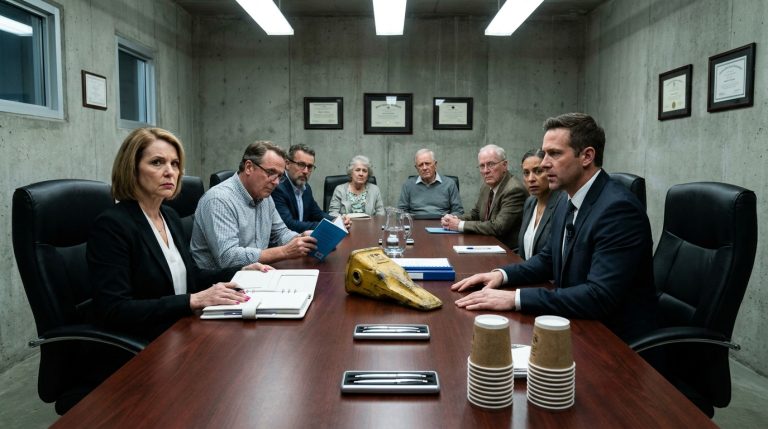
Inside the main assembly hall, the atmosphere was thick with the murmur of a hundred anxious voices bouncing off the vaulted cedar ceiling. Rows of metal folding chairs were packed tight, filled with elderly residents holding crumpled assessment notices and younger homeowners whispering among themselves. At the front of the room, elevated on a raised dais, sat the board members. Denise Keller occupied the central chair, her face carved from cold stone, flanked by her husband and her brother-in-law—the owner of the landscaping company who had spent years cashing inflated municipal checks.
I walked down the central aisle, the sharp tap of my boots on the polished concrete floor cutting cleanly through the murmur of the room. Heads turned. Whispers died down instantly.
Denise leaned toward her microphone, her voice echoing sharp and metallic off the PA speakers.
“Mr. Hollis,” she said, her tone dripping with manufactured public composure. “This is a private property owners’ association meeting. Non-residents and individuals under active administrative investigation are not permitted to address the assembly.”
“I’m not here to address the assembly as a resident,” I said, stopping ten feet from the dais. I set my briefcase on an empty folding chair, flipped open the heavy brass latches, and pulled out a thick, tabbed dossier. “I’m here as a federal compliance auditor executing an interstate municipal fraud review on Apex Horizon Holdings and its operating subsidiary, Ridgewood Management.”
A sharp wave of murmurs rippled through the rows of folding chairs.
Denise’s brother-in-law stood up abruptly from his seat on the dais, his face flushing dark red. “That’s a complete fabrication! The board operates entirely within state municipal guidelines. Security, escort this man off the premises immediately!”
Nobody moved. The two local security guards standing by the exit doors remained rooted in place, their eyes darting from the brother-in-law to the official federal ID badge I held up at eye level.
“You can call security, or you can call your corporate accountant,” I said, stepping closer to the dais and laying the first exhibit flat on the edge of the wooden platform. “Because right here in Exhibit A is the original 1987 county surveyor plat map certified by Earl Hollis—proving conclusively that the four acres encompassing the ridge cabins are protected federal watershed buffers, exempt from HOA jurisdiction.”
I dropped the second set of papers beside the map.
“And here in Exhibit B are the inflated landscape and maintenance invoices billed to residents like Ruth Odum over the past three years—invoices signed off by your brother-in-law’s company, funneling over six hundred thousand dollars into shell accounts registered to Apex Horizon Holdings.”
The silence in the hall became absolute. Every eye in the room shifted from me up to the dais, locking onto the pale, rigid expressions of Denise and her family. The illusion of an unassailable administration had just been stripped away, exposing the rot underneath.
CHAPTER 11: THE SURVEYORS STAKES REDRIVEN IN THE RAIN
The silence in the assembly hall did not break; it deepened, pressing down on the rows of metal folding chairs like an atmospheric front before a storm.
Denise Keller remained frozen in her elevated seat, her fingers clawing slightly into the wooden armrest as the exhibits on the dais lay exposed under the fluorescent glare. Her husband, the zoning commissioner, stood up beside her, opening his mouth to object, but the heavy, unyielding weight of the federal documents made any administrative defense impossible.
“The investigation covers every transaction executed under the shell name Apex Horizon Holdings since 2020,” I said, my voice carrying cleanly across the silent hall. I didn’t raise my tone; cold facts required no amplification. “Every manufactured default, every fraudulent maintenance lien, and every commercial variance tied to the unpermitted encroachment of the protected watershed buffer is now locked under federal review. The state injunction is permanent.”
A murmur broke out among the residents in the rows—not of confusion, but of sudden, collective realization. Ruth Odum stood up slowly near the third row, her hands trembling slightly as she clutched a worn folder of illegal assessment receipts to her chest. Other neighbors began to nod, the fear that had kept them silent for years dissolving under the weight of unassailable documentation.
Denise stood up, her face completely drained of color. The untouchable posture of the HOA president was gone. She realized, with sudden, absolute clarity, that her entire empire—the franchise, the LLCs, the commercial expansion corridor—had been dismantled not by an emotional outburst, but by the exact same tool her victims had been denied: the unyielding geometry of the law.
“You can’t do this,” Denise whispered, her voice cracking for the first time as she looked out over the assembly of homeowners who were no longer looking at her with fear. “This community… we built this.”
“No,” I said, packing the exhibits back into my leather briefcase and snapping the brass latches shut with a crisp, final click. “My father surveyed this mountain when it was just timber and stone. You just tried to put a price tag on a line that wasn’t yours to sell.”
I turned my back on the dais, walking back up the central aisle as the double glass doors of the community hall swung open to let the fresh mountain air rush inside.