Beneath the Manicured Turf, a Cold War Measured in Inches and Thermal Mass
CHAPTER 1: THE THERMAL BREAK
The brass calipers registered a three-thousandths expansion on the front door’s deadbolt casing. Heat didn’t just warm Oak Creek Estates; it crushed it.
Ninety-eight degrees outside. Inside, the indoor thermometer flickered at ninety-two. The air tasted of hot carpet glue and old insulation. On the living room floor, my ninety-pound golden retriever lay flat against the ceramic tile, his ribcage heaving in fast, shallow thuds.
The central air condenser outside gave a final, metallic rasp—a sound like a lawnmower swallowing a handful of gravel—and went dead.
I didn’t call the manufacturer. I didn’t pray. I took a steel ruler to the window frame in the east bedroom, slid the sash up twelve inches, and waited for the hardware store run to pay off. The twelve-thousand BTU unit weighed sixty-eight pounds. I lifted it single-handed, jammed the lower flange into the vinyl track, and drove three zinc-coated screws through the security bracket until the heads flush-seated.
When I plugged it in, the compressor groaned, cleared its throat, and shot a sharp stream of sixty-degree air against my chest.
Thirty minutes later, the front knocker hit the oak panel. Three sharp, measured raps.
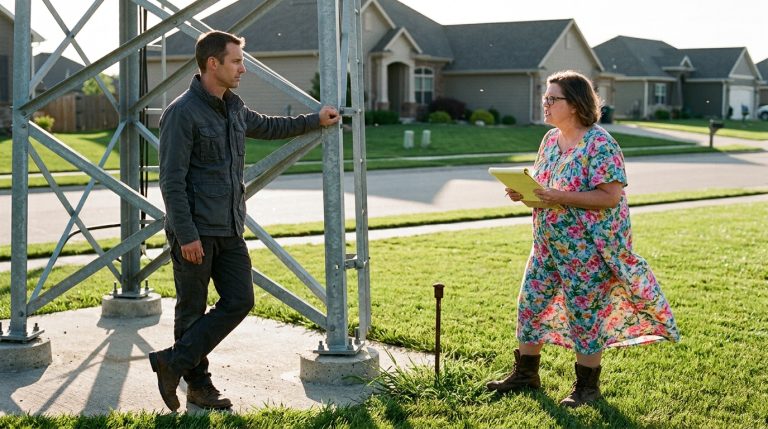
I opened the door. Brenda stood on the porch mat, holding a leather-bound clipboard against her floral blazer. Her hair didn’t move in the humid draft. Behind her, three doors down, the manicured turf of the HOA common area baked under the midday sun.
“David,” she said. She didn’t look at my eyes. Her gaze locked onto the gray box protruding nine inches past the exterior brick. “Bylaw 14.2, Section C. No mechanical protrusion visible from the street or adjoining lots.”
I loosened the thumb-screw on the brass caliper in my pocket, clicking the slide against the stop. “It’s ninety-eight degrees, Brenda.”
“It’s an aesthetic violation,” she said, sliding a pink carbon sheet out from under her thumb. She pressed it against my chest. “Five hundred dollars per day. Retroactive to five p.m. today if the window is not cleared.”
She turned on her heel, her low heels clicking on the dry concrete walkway.
I stepped back inside, pulled the pink paper flat against the kitchen counter, and picked up the thirty-page Oak Creek Estates Covenants, Conditions, and Restrictions manual. I didn’t read the fluff about lawn height or flowerbed mulch. I flipped straight to the definitions section at the back, sliding my thumb down the fine print until the word hit the page.
Visible.
I dropped the paper, walked to the basement door, and looked down into the dark, cool concrete foundations beneath the floorboards.
CHAPTER 2: THE AMBIGUOUS LINE
The cellar stairs groaned under my weight. Down here, thirty inches below the frost line, the air dropped twelve degrees. My dog, Barnaby, stayed at the top of the flight, his chin resting flat against the top riser, whining in slow, rhythmic huffs as the hot air from the kitchen pressed against his back.
I set the brass calipers on the wooden workbench next to a dusty 1985 plat map of Oak Creek Estates.
The paper was brittle, yellowed at the margins, and smelled of dry rot. I pulled a ten-x jeweler’s loupe from the drawer, pressed the glass against my eye, and leaned over the property boundary separating Lot 14—my dirt—from the northern common area.
The property line wasn’t a sharp India-ink stroke. It was a fat, bled line from a felt-tip pen used forty years ago by a county surveyor who wanted to go home early. At scale, that ink bleed covered four feet of real estate.
Four feet of gray zone.
Near the corner of the lot, a tiny, faded stamp read Vanguard Utility Access—Sub-Parcel 9B. It wasn’t listed on the standard home buyer’s disclosure. It sat right under the boundary line, buried beneath two decades of HOA-mandated perennial rye grass.
I picked up the calipers, adjusted the thumb wheel until the steel points matched the width of the ink line on the map, and locked the screw.
My phone vibrated on the workbench, the glass tapping against a tray of rusted iron pipe fittings.
“Yeah,” I answered.
“David?” The voice sounded like two cinderblocks grinding together in an empty barrel. “It’s Mike. From the shop.”
“Tell me you found a compressor.”
“Not a chance,” Mike said. He spat into a shop towel on his end; the wet slap came through the speaker clean. “Supply chain is locked up until August. But I talked to Bedrock.”
“Bedrock?”
“Barney,” Mike said. “He runs deep-core rigs out of West Chester. He don’t like floral blazers. He don’t like pink paper. But he don’t work for free, and he don’t drill without a survey.”
I looked down at the fat black line on the yellowed paper. My thumb ran over the locked steel jaws of the caliper. “I have a survey. How fast can he mobilize?”
“Seven in the morning,” Mike said. “Bring cash for the diesel.”
I hung up, folded the 1985 plat map into four neat quadrants, and shoved it into the back pocket of my jeans.
Upstairs, the house was creeping back toward ninety degrees. The window unit in the east bedroom hummed, but it was fighting a losing battle against three thousand square feet of sun-baked attic space. The drywall gave off a faint, hot chalk smell—the sound of wood framing expanding and pulling against drywall nails.
At 6:45 AM, the sun hadn’t cleared the treeline, but the humidity was already at eighty percent.
The diesel engine hit the neighborhood before the truck turned the corner. It wasn’t the refined hum of a municipal delivery van. It was an unmuffled, straight-piped six-cylinder diesel hauling a twin-axle trailer with a steel derrick folded over the bed like a bent arm. The rig was painted the color of old rust, flaking off in long scabbed strips to reveal red primer beneath.
The truck stopped at the curb in front of Lot 14. The driver’s door swung open, and a man built like a commercial water heater stepped down onto the asphalt. He wore work boots with no laces, grease-stained denim, and no shirt under his canvas suspenders. A unlit cigar stump was clamped between his back teeth.
He didn’t introduce himself. He walked straight to the tailgate, unhitched the safety chains with a heavy iron clatter, and stared at my front lawn.
“You the guy with the hot house?” he asked.
“David,” I said, holding out a hand.
He ignored the hand, spat a bit of tobacco onto the curb, and squinted past my shoulder toward the common area. “Name’s Bedrock. Mike said you need holes.”
“Vertical closed-loop,” I said. “Three hundred feet.”
“I drill,” Bedrock said, unholstering a rolled print of his own from a steel tube mounted to the rig’s chassis. “I don’t dig gardens. I don’t move bird baths. I hit rock, I set pipe, I take my money.”
I pulled the folded 1985 survey map from my back pocket and spread it across the hood of his truck. I laid the brass caliper flat across the fat ink line bordering the common area.
“Here,” I said, pointing to the grass twenty-five feet past my formal edging. “Property line is ambiguous. Marker bleed gives me four feet. The common area turf gives me twenty.”
Bedrock leaned over the map, his thick, calloused thumb leaving a smear of black grease over the words Sub-Parcel 9B. He looked at the map, then looked at the pristine, golf-course-quality fescue extending toward Brenda’s property fifty yards away.
A slow, ugly grin spread across his face, showing a gap between his front teeth.
“That’s HOA grass,” he said.
“It’s ground,” I replied. “Ground holds heat. Ground dumps cold.”
Bedrock turned to his rig, grabbed the hydraulic control lever, and pulled it back until the fluid squealed in the high-pressure lines.
“Clear the driveway,” he grunted, slamming the lever into gear. “We’re making mud.”
CHAPTER 3: SLURRY AND STEEL
The steel drill bit struck the topsoil with a dry, cracking thump that sent a shudder straight through the asphalt and up into the soles of my boots.
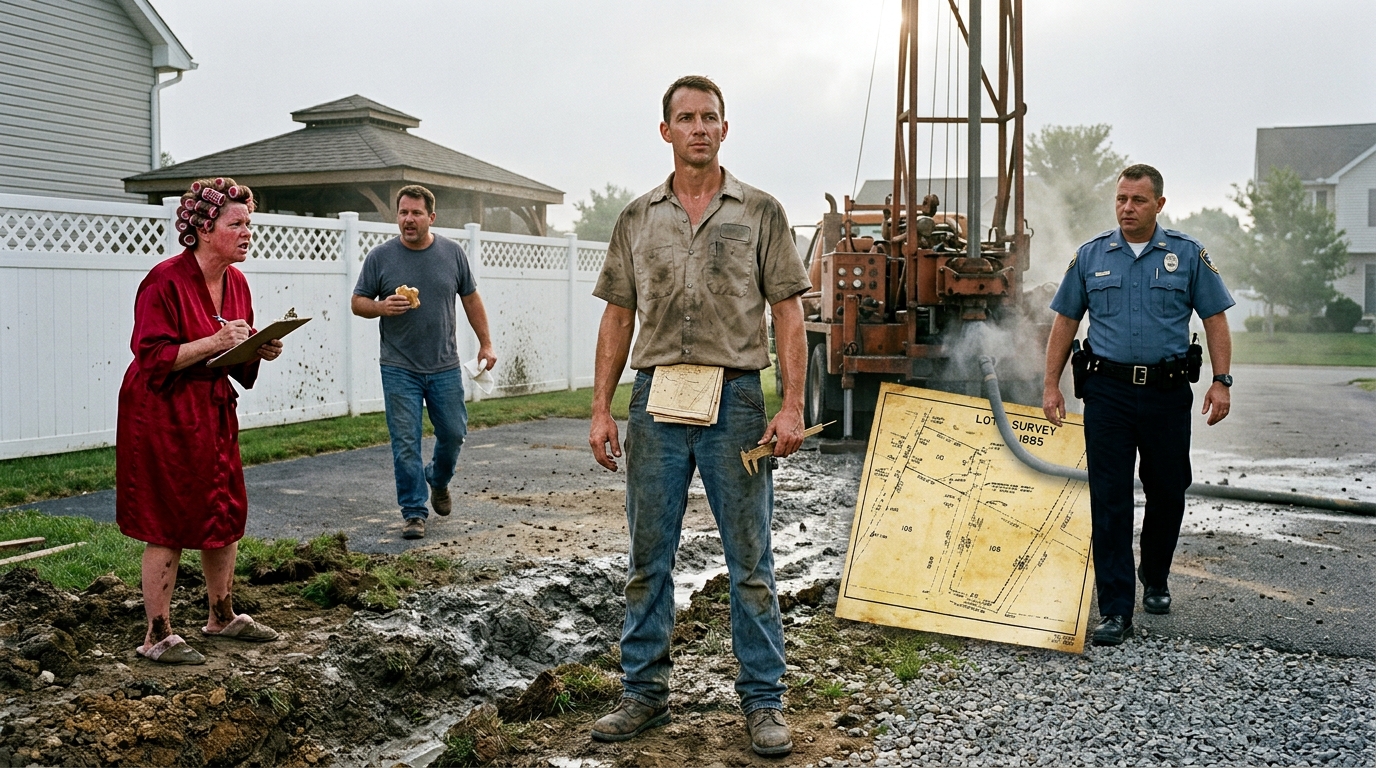
Bedrock didn’t flinch. He leaned his two-hundred-pound frame against the hydraulic bank, his calloused palm white-knuckling the iron stick as the derrick groaned. The rig’s engine pitched up to a high, metallic shriek. Twenty feet out, right across the invisible border of the HOA common area, the lawn began to pulse. The manicured fescue bulged upward six inches, tore open with a wet pop, and vomited a plume of grey clay slurry into the humid air.
A heavy glob of wet drill mud caught the edge of my work boot, soaking through the canvas with cold, mineral-heavy moisture.
“Hit bed at twelve feet!” Bedrock barked over the engine’s roar. He didn’t look back. A stream of blue-grey exhaust rolled off the manifold, blanketing the drive in the sharp, acrid smell of burnt sulfur and diesel. “She’s soft limestone! We’re making time!”
“Keep the angle tight to the line!” I yelled back, tapping my knuckles against the rolled plat map tucked into my belt.
Across the lawn, a front door slammed.
It wasn’t a gentle latch. It was a sharp, hollow crack that cut right through the diesel thunder. Brenda hit the top step of her porch in pink terrycloth slippers and a silk robe the color of dried blood. Her hair was locked in plastic curlers that bounced with every frantic step. In her right hand, she gripped her leather-bound clipboard like a riot shield.
“David!” Her voice reached us as a high, strangled screech. She didn’t bother using the flagstone walkway. She cut straight across the turf, her slippers sinking two inches into the pristine, manicured grass. “Stop that machine! Stop it right now!”
Bedrock didn’t even turn his head. He reached down, grabbed a steel casing pipe, and slammed it into the central chuck with a heavy, bell-like ring of iron on iron.
Brenda crossed the boundary line, her slippers throwing up wet clods of mud. She stopped six feet from the rotating drill string, her face mottled red beneath a thick layer of night cream. “This is a criminal violation! You are destroying common property!”
I stepped between her and the hydraulic levers, keeping my hands low and flat at my sides. “It’s a civil survey inquiry, Brenda. We’re testing subsurface load capacity.”
“You are drilling on HOA land!” She shoved the clipboard toward my chest. The top sheet was already pre-filled with red ink. “Section 4, Paragraph B! Unsanctioned heavy equipment excavation! Five thousand dollar immediate assessment! I am calling the county sheriff!”
“Call them,” I said. I pulled the brass calipers from my pocket, let the steel jaws slide open three-tenths of an inch, and held them up against the horizon, sighting the distance between her slippered feet and the property pin. “Have them bring the 1985 county registry map for Sub-Parcel 9B while they’re at it.”
Her eyes flicked down to the brass tool in my hand, then to the map at my waist. For a fraction of a second, the screaming stopped. Her jaw tightened, her throat working in a hard, dry swallow. “What did you say?”
“Sub-Parcel 9B,” I repeated, keeping my voice steady, flat, and devoid of heat. “The utility easement.”
Before she could speak, a second voice cut in from the street.
“Hey! What the hell is going on with my gazebo?”
Greg from Lot 12 was marching up the asphalt, holding a half-eaten slice of toast in a paper towel. The fine grey slurry mist drifting off the rig’s discharge hose had drifted forty feet downwind, speckling his white vinyl lattice work with tiny, drying spots of mud. “David, you’re throwing dirt on my property line!”
“It’s mineral clay, Greg,” I said without looking at him. “Washes off with rain.”
“It’s a mess!” Greg shouted, turning to Brenda. “Why aren’t you shutting this down? My property value is dropping by the minute!”
“I am shutting it down!” Brenda snapped, her voice spiking an octave as she swung back toward me. “Officer Miller is already on his way!”
Five minutes later, a white-and-blue cruiser pulled up to the curb, its roof lights flashing silently against the morning haze. Officer Miller stepped out, adjusting his duty belt with a slow, tired grunt. He took in the scene in one long glance: the roaring diesel rig, the three-foot mound of grey mud sitting on the common area turf, Brenda in her curlers, and me standing on the driveway with grease on my shirt.
He walked over, his heavy boots crunching on the gravel edge. He looked at the drill bit disappearing into the earth, then down at the pink violation slip flapping in Brenda’s hand.
“David,” Miller said, nodding once. “Brenda.”
“Officer, arrest him!” Brenda demanded, her thumb digging into the edge of her clipboard until the plastic bent. “He is actively trespassing on private community land!”
Miller rubbed the bridge of his nose. He looked at me. “You got a permit for this, David?”
I pulled the folded 1985 survey map from my belt and handed it to him. I pointed to the fat, bled ink line running along the northern boundary. “Property line is disputed within four feet due to historical map bleed. Excavation is contained within the contested easement zone under Sub-Parcel 9B pending a formal county re-platting.”
Miller squinted at the yellowed paper, his thumb tracing the worn fold. He looked at the mud, then at Brenda. “It’s a lot line dispute, Brenda.”
“It is an invasion!” she yelled.
“It’s a civil matter,” Miller corrected, handing the map back to me. “I can’t tow a rig off a property line until the county surveyor drops a brass pin and files a court injunction. Work stops if there’s a safety hazard, but nobody’s bleeding.”
“He’s destroying the landscaping!” Brenda screamed.
Miller sighed, turning back toward his cruiser. “File for an emergency hearing at the courthouse, Brenda. I don’t write tickets for dirt.”
As the cruiser pulled away, Bedrock reached out and yanked the throttle lever wide open. The rig howled, the steel derrick shaking as the drill bit bit deep into the rock bed, spraying another thick cloud of grey slurry directly over the edge of the manicured lawn.
Brenda stood in the mud, her slippers soaked through, her eyes locked on mine with a cold, silent fury that had nothing to do with bylaws.
“Twenty-four hours, David,” she whispered, her voice dropping into a harsh, ragged rasp over the engine noise. “I will have a judge sign the order by noon tomorrow.”
She turned and marched back across the ruined grass, her heels leaving deep, water-filled holes in the turf.
Bedrock spat his tobacco stump into the mud pile and looked at me. “We’re going to run out of water for the drill head in two hours if we don’t hook a supply line.”
I looked down the street toward Mr. Henderson’s property line, where a blue plastic hose ran out from his heavy-duty pool pump house. “Keep drilling,” I said. “I’ll go buy some water.”
CHAPTER 4: THE LIQUID TRACTATE
My work boots crunched across the sun-baked gravel along the property divide.
Behind me, the drill rig’s diesel motor churned at three thousand RPM, a dry, metallic screech that rattled the teeth in my jaw. Bedrock was already backing off the hydraulic pressure, his hand resting on the bypass valve to prevent the diamond head from binding in the dry limestone casing.
I reached the wooden cedar fence separating my yard from Lot 16. Mr. Henderson was leaning over his pool filter housing, a pair of rusted tongue-and-groove pliers gripped in his liver-spotted hand. The blue reinforced backwash hose snaked from his sand filter across fifty feet of scorching flagstone, its nozzle resting near the ditch.
“Seven hundred,” I said, leaning my forearm against the hot cedar post.
Henderson didn’t look up immediately. He tapped the pressure gauge glass with the blunt nose of his pliers. The needle quivered at eighteen PSI. “Seven hundred for what, David?”
“Four thousand gallons out of that pool,” I said, pointing down at the clear, turquoise water rippling under the noon sun. “Straight through a high-pressure booster pump to Bedrock’s swivel head. Cash.”
He wiped a bead of sweat off his chin with the back of his wrist, leaving a smudge of white filter grease across his skin. His eyes flicked past my shoulder toward Brenda’s front lawn, where deep grey tire tracks and mud pits sat open like raw wounds.
“She hit me with a two-hundred-dollar fine last April,” Henderson muttered, his thumb tracing the jaw of his pliers. “Said my solar cover was visible from the cul-de-sac. Two hundred dollars for a blue tarp.”
“Seven hundred buys a lot of tarps,” I said.
He reached down, kicked the blue hose three inches closer to my fence, and dropped his pliers onto the concrete. “Pay before you hit the main drain. And don’t burn my pump motor out.”
Ten minutes later, the blue hose was clamped to Bedrock’s auxiliary intake valve with a steel worm-gear fitting.
I tightened the screw until the rubber bulged around the band. Bedrock threw the engagement dog. The hose stiffened, pulsing like a thick arterial vein as four thousand gallons of chlorinated water surged into the drill string. A cloud of steam erupted from the hole as the cold water hit the friction-hot drill head three hundred feet down.
The slurry turned from thick, dry grey paste into a smooth, frothing soup that bubbled out of the ground and poured into the common area ditch.
“That’s the stuff!” Bedrock hollered over the roar, throwing his weight against the feed lever. “She’s sliding now!”
By two o’clock, the drill bit hit three hundred and twenty feet. The soil composition shifted. The grey limestone cuttings disappeared, replaced by coarse, black river gravel and chunks of red clay that didn’t belong in a local shale stratum.
Bedrock slowed the rotary head. He reached down into the mud trough, scooped up a handful of the black gravel, and rubbed it between his thick fingers. He brought it to his nose, sniffed it, and spat his tobacco into the dirt.
“This ain’t natural earth,” he grunted, holding out his muddy palm.
I stepped closer, squinting through the heat shimmer. Mixed in with the black river gravel were tiny, machine-cut fragments of orange PVC and bits of stamped brass. I picked out a piece of metal no larger than a fingernail. Stamped into the brass curve were three crisp letters: FLW-V4.
Flow-Valve 4.
Before I could clear the mud from the brass fragment, a black sedan pulled up to the curb behind Bedrock’s rig.
A man in a sharp grey suit stepped out into the ninety-nine-degree heat. He didn’t look at the mud or the diesel smoke. He adjusted his silk tie, pulled a white envelope from his breast pocket, and walked straight toward me, his leather dress shoes stepping precisely around the wet slurry tracks.
“David Vance?” he asked.
“Yeah,” I said, wiping my hand on my jeans before taking the paper.
“I’m Arthur Pendelton, counsel for Oak Creek Estates Homeowners Association.” He held out the white envelope. “You’ve been served with a temporary restraining order issued by the County Court of Common Pleas. All excavation activities on or adjacent to Sub-Parcel 9B are ordered to cease immediately.”
I didn’t open the envelope. I held it flat between my thumbs, feeling the stiff weight of the judicial seal pressed into the thick stock.
“We’re setting casing,” I said flatly. “If we stop the drill string now without backfilling or running the loop, the bore collapses. The ground destabilizes.”
Pendelton’s face remained entirely blank, like polished granite. “The order is effective upon delivery, Mr. Vance. If that rig is operating in five minutes, Sheriff Miller will return with a bench warrant for contempt.”
Behind him, sitting in her Buick at the edge of the cul-de-sac, Brenda sat behind the steering wheel, watching through her air-conditioned windshield. Her hands were folded neatly over her lap.
I looked down at the brass fragment still gripped tightly in my left palm, the sharp edge of FLW-V4 digging into my skin until it drew a tiny pinprick of blood.
“Bedrock,” I said softly, turning my back on the lawyer.
“Yeah?”
“Kill the rotary.”
Bedrock grunted, slamming the main clutch into neutral. The deafening roar of the diesel engine died instantly, dropping the neighborhood into a sudden, suffocating silence.
Pendelton nodded once, satisfied. “You have until six p.m. tomorrow to remove the heavy equipment from the premises.” He turned and walked back to his sedan without another word.
I stood in the sudden quiet, feeling the heat radiate off the driveway asphalt. I looked at the three hundred and twenty feet of open steel casing sticking six inches out of the mud, then at the brass piece in my hand.
I pulled the 1985 survey map from my back pocket. I didn’t look at the ink bleed this time. I looked at the bottom corner, right where the faded stamp read Vanguard Utility Access.
They didn’t want me off their grass because of the bylaws. They wanted me off because three hundred feet down, Bedrock’s drill bit had just bitten into something they had buried twenty years ago.
CHAPTER 5: NIGHT FUSION
The black sedan disappeared around the curve of the cul-de-sac, leaving a thin trail of exhaust hanging in the ninety-eight-degree air.
I slid the brass fragment into my pocket alongside the brass calipers, then unfolded the temporary restraining order. The paper was crisp, stamped with blue ink from the municipal clerk’s desk. Cease excavation on or adjacent to common properties.
“We ain’t excavating no more,” Bedrock said, spitting a dark drop onto the gravel. He wiped his palms on his canvas suspenders, leaving two wide grease tracks down his ribs. “Holes are dug. Steel casing is in. What you do with the pipe inside the hole ain’t digging. It’s plumbing.”
“The order says cease work,” I said, thumbing the edge of the paper.
“Order says cease excavation,” Bedrock grunted. He reached into the truck cab and pulled out an electric pipe fusion iron, its heavy aluminum heating jaws scraped down to raw metal. “It don’t say nothing about backfilling to prevent environmental soil collapse. Law requires you to stabilize an open bore so the ground don’t swallow Brenda’s driveway.”
I looked at him. “You got three hundred feet of high-density polyethylene loop on that trailer?”
“Three hundred and fifty,” Bedrock said. “And a mini trenching attachment for my skid-steer that runs on an electric battery. Quiet as a bicycle.”
“Midnight,” I said.
The sun went down at 8:42 PM, but the heat didn’t break. The dark felt thick, like hot oil poured over the roof shingles. At 11:30 PM, I killed every light on the ground floor of Lot 14.
Barnaby lay on the cool tile near the basement door, his chin rested on his paws, watching me through half-closed eyes as I pulled on leather work gloves and grabbed two five-gallon cans of heat-transfer fluid.
I slipped out through the bulkhead doors into the side yard.
Bedrock was already there. He moved like a shadow shaped like a refrigerator, silent despite his size. The mini electric excavator didn’t roar; it gave off a low, high-pitched whine as its rubber tracks bit into the mud.
In the dark, we worked by the dim red glow of a single headlamp shielded with electrical tape.
Bedrock fed the heavy black plastic U-bend into the three-hundred-foot casing. I held the pipe fusion iron between my knees, warming the heater faces to five hundred degrees until the odor of melting polyethylene filled the humid night air. I shoved the manifold fittings together, holding them locked for twenty seconds until the plastic bead rolled over smooth and solid.
Click.
The connection fused.
Every ten minutes, I checked the street. The streetlights cast orange pools across the pristine asphalt. Across the common area grass, Brenda’s two-story colonial sat completely dark, save for the blue flicker of a television screen behind her upstairs curtain.
By 2:15 AM, three hundred feet of fluid-filled poly pipe sat buried beneath six inches of packed gravel and wet clay.
Bedrock pulled a hand-trenching shovel through the narrow ditch connecting the wellhead on Sub-Parcel 9B directly to my basement wall. We ran two three-inch insulated lines straight through the foundation penetrations I had pre-drilled three days ago.
When the last line crossed the concrete seal, my spade hit a buried steel plate six inches under the turf—a plate stamped with the letters Vanguard Utility.
I didn’t stop to scrape the rust off. I dropped two spadefuls of heavy clay over the steel, smoothed the topsoil flat with the back of the rake, and tamped it down under my boots until the surface looked like an ordinary lawn settling after a heavy rain.
Inside the basement, the air smelled of damp earth and hot copper.
The heat pump unit sat in the center of the floor like a steel safe—four feet tall, silent, painted grey. Bedrock tightened the final brass union on the liquid manifold with a sixteen-inch pipe wrench, the steel teeth biting into the fitting with a sharp, metallic crunch.
“Loop’s primed,” Bedrock muttered, wiping his forehead with the back of his arm. “Eighty gallons of glycol sitting three hundred feet under Brenda’s lawn. Cold as a well-pipe in January.”
I walked over to the main breaker panel on the cellar wall. My fingers felt damp against the plastic casing.
I reached out, hooked my thumb over the double-pole forty-amp breaker labeled AUX HVAC, and flipped it up.
The breaker clicked.
For two seconds, nothing happened. The basement stayed quiet, save for the slow drip of condensate from the old ductwork overhead.
Then the heat pump exhaled.
It wasn’t a roar. It wasn’t the rattling, dying cough of the old compressor. It was a deep, silent rush of moving air—a smooth, heavy draft that smelled of cold iron and clean ice.
Within ninety seconds, the copper intake line frosted over. A thin ring of white ice crystals formed along the brass union where Bedrock’s wrench had left its teeth marks.
I walked up the cellar stairs, pushed open the door, and stepped into the living room.
The indoor thermometer read eighty-eight degrees. As I stood there, the digital display flickered, dropped to eighty-seven, then eighty-six. Barnaby got up from the tile, walked over to the supply register in the floor, and sat down directly over the vent, his ears fluttering in the cold draft.
I walked to the front window, pulled the wooden blinds back an inch, and looked out into the dark.
Brenda’s yard sat quiet under the moon. The common area grass looked flat, freshly tamped, and undisturbed. But six inches beneath her feet, three hundred feet of steel and plastic were drawing the suffocating heat from my living room and dumping it silently into the subterranean rock.
The house was cold. But down in the dark under Sub-Parcel 9B, the real war was just getting started.
CHAPTER 6: THE UNDERGROUND WAR
The digital thermostat on the wall clicked in the dark. Sixty-eight degrees.
I let the wooden slat snap back against the glass. Cold air surged through the floor registers in a steady, silent river, cooling the hardwood beneath my bare feet. Outside, the sky was turning the color of bruised slate.
At 6:15 AM, Brenda walked down her front path. She wasn’t wearing her floral blazer or pink slippers today. She wore a tailored charcoal suit, her clipboard tucked firmly under her left arm, her heels striking the wet asphalt in a sharp, mechanical cadence.
She stopped at the edge of the common area, right where Bedrock’s rig had sat twenty-four hours ago.
There was no diesel engine. No drilling derrick. No mud slurry.
In their place sat fresh, level topsoil, neatly rolled and seeded with rye grass, blending seamlessly into the slope. She stood on the turf, her chin tilted up, listening.
No fan hummed. No compressor rattled. The neighborhood sat in dead, unbroken silence.
I opened the front door, pulled my leather work gloves into my back pocket, and stepped out onto the porch. Barnaby trailed behind me, his wet nose sniffing the crisp morning air before he stretched flat on the cool concrete steps.
Brenda turned as my boots hit the porch floor. Her lips drawn into a thin, colorless line. “David.”
“Brenda,” I said.
She marched across the line onto Lot 14, her gaze flicking across the exterior walls, searching the roofline, scanning the foundation for a wire, a vent, a box—anything that violated Bylaw 14.2, Section C. “Where is the unit?”
“Removed,” I said, leaning my shoulder against the porch pillar. “As requested.”
“You were served a court order to cease excavation,” she said, her voice dropping into a low, tight rasp. “Where is the cooling coming from?”
I pulled the folded 1985 plat map from my pocket and laid it across the wooden porch railing. Next to it, I placed the small brass valve fragment stamped FLW-V4 and the county land registry printout for Sub-Parcel 9B.
Brenda’s eyes dropped to the paper. The color drained from her cheeks, leaving the skin around her mouth pale and pinched.
“Sub-Parcel 9B isn’t an HOA common area,” I said, keeping my voice quiet, flat, and measured. “It never was. Vanguard Utility recorded that easement in 1982 to run an unmetered cooling conduit for the commercial strip behind the estate. When the HOA annexed the surface turf in 2004 to build the manicured green, you didn’t just hide the boundary line on the survey.”
I picked up the brass piece and tapped it against the word Vanguard.
“You tapped Flow-Valve 4 directly into the municipal line,” I continued. “You used the HOA fine fund to pay off the land assessment penalties while drawing unauthorized utility power under the common ground to keep the estate maintenance bills at zero.”
Brenda’s hand tightened around her clipboard until the metal clip creaked under the strain. She didn’t scream. She didn’t quote bylaws. Her thumb rubbed a raw, white spot into the leather backing of her binder—an involuntary tremor she couldn’t suppress.
“That infrastructure keeps this entire development financially solvent,” she whispered, her eyes dark, hard, and desperate. “If the county re-surveys Sub-Parcel 9B, the back taxes and utility liens will liquidate the HOA reserve. Every house in this cul-de-sac will face a forty-thousand-dollar special assessment.”
“Then I suggest you update the bylaws,” I said.
She stared at me for five long seconds, calculating the legal vectors, looking for a crack, an angle, a leverage point. She found none. The loop was in the ground. The pipe was fused. The water was circulating three hundred feet below the grass, completely invisible to the street, the county, and the bylaws.
“The board will waive the five-hundred-dollar daily fine,” she said, her voice completely devoid of emotion. “And the restoration assessment.”
“The board will also approve Mrs. Higgins’s bird feeder,” I added softly. “And Greg’s gazebo lattice.”
Brenda didn’t answer. She pulled the carbon copy pink slip from her clipboard, folded it once, and tore it cleanly in half. She dropped the pieces onto the porch railing, turned on her heel, and walked back across the common turf toward her house, her posture stiff, unyielding, but utterly defeated.
I picked up the torn pink paper, stuffed it into my pocket, and sat down on the top step beside Barnaby.
The morning sun finally cleared the oak trees, casting long, golden shadows across the damp grass. Down in the basement, four hundred feet of closed-loop pipe hummed silently, drawing sixty-eight-degree air into the living room while dumping the summer heat deep into the bedrock.
I reached into my pocket, pulled out the brass calipers, and adjusted the thumb screw until the jaws rested flat against the zero mark.
The house was cold. The lawn was green. And beneath the feet of Oak Creek Estates, the truth lay buried six inches deep—quiet, functional, and untouchable.
I tightened the thumb lock on the caliper, set it on the step beside my mug, and watched the sun rise over the quiet neighborhood.