The Mayor’s Gambit: Dismantling a Suburban Tyrant Through Shadows, Statutes, and Calculated Silence
CHAPTER 1: THE WEIGHT OF A BADGE
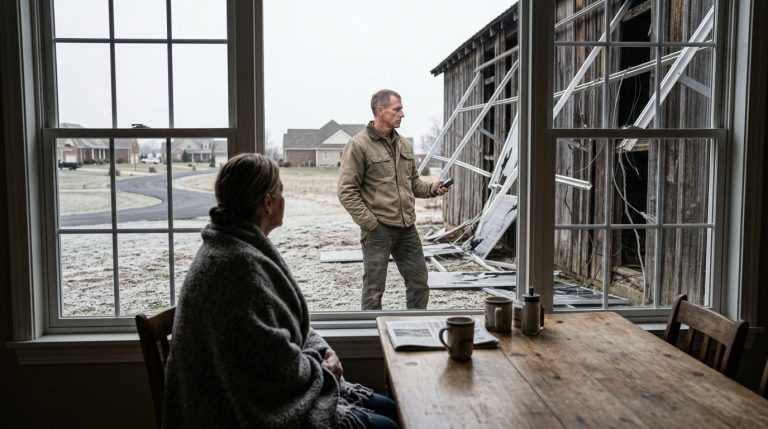
The screen light cast a pale, unforgiving blue across the edges of the kitchen table. Outside, the December wind scraped frozen branches against the siding, bringing with it the sharp, clean scent of frost and dead pine needles. Ethan did not look up when Sarah set the ceramic mug down; he already knew the exact weight of it, the way the chipped rim felt against his lower lip.
“Another one?” Sarah asked, her voice low, carrying the quiet exhaustion of a woman who had spent six months watching her neighborhood turn into a penal colony.
“Delilah,” Ethan said, his fingers resting motionless over the keyboard. “Paragraph three demands an immediate investigation into neighborhood property value terrorism. She’s complaining about the green Subaru parked in our driveway.”
“Our Subaru.”
“Our Subaru.” Ethan leaned back, letting the leather of his chair groan under the shift in weight. His mind worked like a calibrated instrument, calculating angles of risk and exposure. To the twelve thousand residents of Maplewood Heights, he was the mayor—three years on the city council, a former planning attorney who knew every municipal loophole between here and the county line. To the forty-seven families of Oakidge Estates, he was just Marcus, the quiet guy who worked some nondescript downtown desk job and kept his head down. Strategic anonymity. It was the only armor left that worked.
He pulled up the digital docket of pending citations. Forty-seven households, all systematically targeted over six months. Basketball hoops branded as aesthetic violations; children’s chalk drawings classified as structural defacement; threats of five-hundred-dollar fines issued with the casual cruelty of a bureaucrat who had spent too many decades behind a glass partition. Delilah Thornfield did not govern an HOA; she occupied it.
The screen flickered, revealing a digital copy of her latest certified mailing list. Ethan narrowed his eyes, tracking the margins of the document. Something in the formatting—a missing state corporate renewal seal from two years prior—caught the sharp, analytical edge of his legal training.
A board operating without a valid state license was not a governing body. It was an individual playing dress-up with a copy machine.
Footsteps padded softly from the hallway, and a moment later, six-year-old Emma appeared around the corner, clutching the frayed ear of a stuffed rabbit. Her eyes were wide, unburdened by the cold mechanics of municipal law, but shadowed by the strange, tense silence that had settled over the street since the letters went out.
“Daddy,” she whispered, her voice small in the quiet kitchen. “Why are the big kids not allowed to draw on the sidewalk anymore? Mrs. Thornfield yelled at Tommy’s big sister yesterday.”
The air in the room seemed to drop ten degrees. Ethan felt the familiar, cold burn of control lock into place behind his ribs—the exact sensation he relied on in courtrooms when opposing counsel thought they had secured a checkmate. He kept his expression neutral, his breathing measured, conscious of every micro-expression his daughters might mirror.
“Some people just like rules more than they like people, sweetie,” Ethan said, keeping his tone light, masking the absolute, razor-sharp resolve hardening underneath. He stood up, stepping across the cold tile to press a brief kiss to the top of her head. “Go help Grace with her boots. We’re going to have a quiet morning.”
As Emma skipped back down the hall, Ethan turned back to the glowing monitor. He opened a private browser tab, navigating past the municipal firewalls straight to the state business registry. The corporate status for Oakidge Estates Inc. was stamped in bright, unforgiving red letters: Administratively Dissolved – October 2024.
She had no legal standing. Not a single citation held the weight of paper it was printed on.
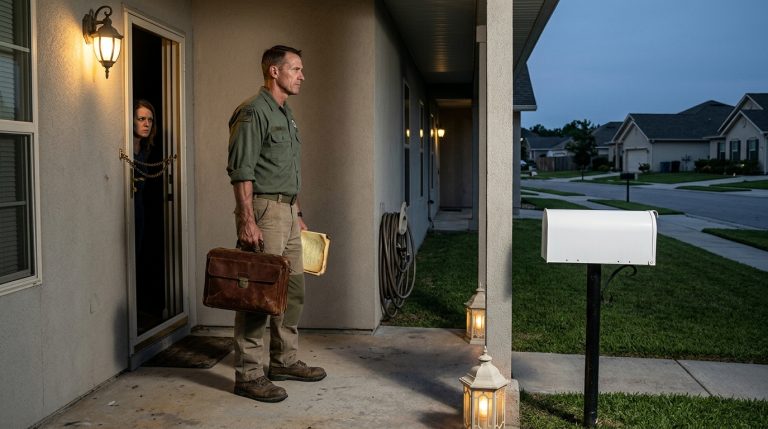
Ethan reached out and closed the laptop lid with a soft, decisive click, plunging the kitchen back into the gray shadows of the winter morning. But as he turned toward the hallway, a sharp tap sounded at the front window—a deliberate, rhythmic rapping of fingernails against glass that made the silence snap like thin ice.
CHAPTER 2: THE GARAGE SUMMIT
The rapping stopped as abruptly as it began, leaving only the dull, rhythmic thrum of the radiator beneath the sill. Ethan did not flinch. His hand, still resting near the edge of the kitchen counter, curled into a deliberate, quiet fist. In the next room, the low murmur of Sarah murmuring to the twins faded as the front window glass creaked under the weight of an unseen pressure.
He stepped past the threshold of the hallway, moving with the measured, economic stride of a man accustomed to narrow corridors and unpredictable council chambers. When he cracked the front door, the heavy December air rushed in, carrying the scent of damp wool and exhaust fumes.
Nobody was on the porch. Just a single, thick manila envelope wedged upright between the aluminum screen and the wooden jamb, secured by a heavy brass paperweight that bore the unmistakable, embossed crest of the Oakidge Estates Homeowners Association—a stylized oak leaf that looked more like a clenched fist.
Ethan reached out, his fingertips grazing the cold metal of the paperweight before lifting the envelope. It was heavy, swollen with stiff cardstock. He did not need to open it to know the architecture of Delilah’s mind; every warning she issued followed the same bureaucratic geometry, designed to intimidate through sheer volume and the threat of cascading financial penalties.
“Marcus?” Sarah’s voice came from down the hall, soft and sharp with caution. “Who was at the door?”
“Nobody,” Ethan said, sliding the envelope beneath his coat as he stepped back inside and bolted the deadbolt with a solid, metallic thud. “Just a delivery for the neighborhood archives.”
Ten minutes later, the kitchen was quiet again. The girls were bundled in their winter coats, red scarves wrapped snugly around their necks, sitting at the dining table with a box of oat-shaped cereal while Sarah managed their boots. Ethan stood by the back door, pulling on a heavy canvas work jacket that smelled faintly of old paper and garage grease.
“You’re heading out?” Sarah asked, her eyes locking onto his with the quiet, shared understanding of a marriage forged in political skirmishes and municipal trench warfare. “Joe called ten minutes ago. The garage is already cold, but they’re waiting.”
“Forty-seven families don’t gather in a garage on a Tuesday morning because they want to talk about weather stripping,” Ethan replied, adjusting his collar. “Delilah filed another batch of warnings this morning. If we don’t coordinate the counter-paperwork before the afternoon mail run, Tom Rodriguez is going to lose his flag pole.”
The walk down Maple Street was crisp, the pavement iron-hard under a thin glaze of morning frost. Every lawn on the block bore the silent, anxious hallmarks of Delilah’s six-month campaign: missing lawn ornaments, bare flagpoles, and curtains drawn tight against the morning light. Oakidge Estates looked less like a suburban haven and more like a demilitarized zone waiting for the next artillery shell of certified mail.
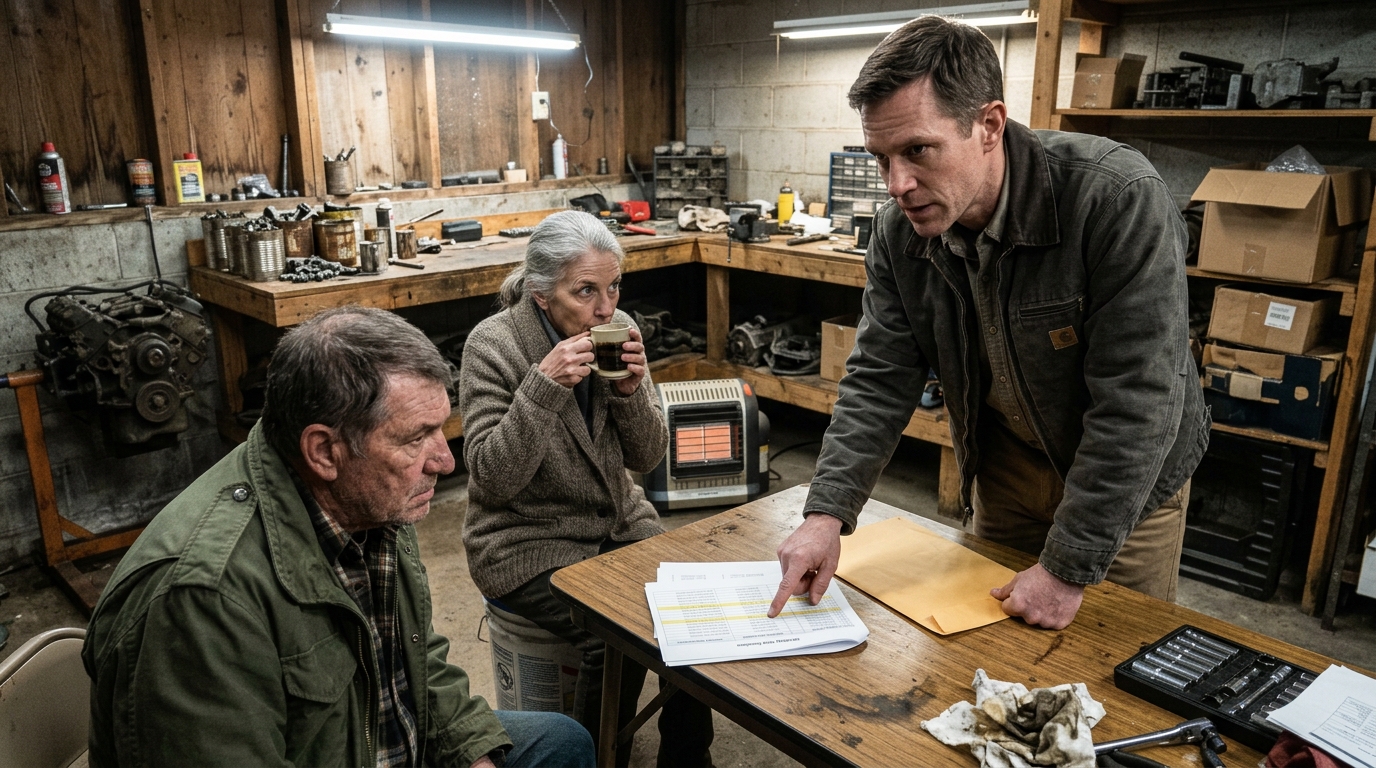
At the end of the cul-de-sac, Joe Kowalsski’s garage doors stood cracked open by three feet. Inside, the air was thick with the dual scent of motor oil and stale diner coffee. A portable propane heater hummed near a workbench piled high with socket sets and stacks of yellowed tax documents.
Tom Rodriguez, a retired army veteran with a posture that defied his seventy years, looked up from a grease-stained folding table as Ethan ducked under the garage door.
“She’s escalating, Mayor,” Tom said, using the title only when the garage doors were shut tight and the street was clear. He tossed a fresh citation onto the scarred wood. “This one came for the widow Patterson down the lane. Five hundred dollars because her roof shingles are three shades darker than the neighborhood aesthetic code. The woman lives on a fixed pension, and Delilah’s trying to foreclose by New Year’s.”
Ethan stepped forward, picking up the citation. The paper was crisp, the ink fresh—printed from the high-capacity laser printer Delilah kept in her sunroom. But beneath the aggressive formatting and the bold-faced threats of property liens, his eyes locked onto the corporate seal in the footer. It was the same expired state license number he had pulled from the state registry twenty minutes ago.
He laid the paper flat against the workbench, smoothing the crease with the side of his thumb. The silence in the garage grew heavy, punctuated only by the ticking of a cooling engine block in the corner.
“She’s not just issuing fines, Tom,” Ethan said, his voice dropping into the steady, unyielding register he used during late-night arbitration hearings. “She’s operating an unregistered corporate entity. Every single piece of paper she’s pushed across these thresholds for the last twenty-four months is legally void.”
Mrs. Patterson, who had been sitting quietly on an overturned bucket near the corner heater with a steaming mug of black coffee, raised her white head. Her eyes were sharp, bright with the stubborn resilience of a retired schoolteacher who had survived worse than a suburban tyrant.
“Void doesn’t stop a sheriff’s deputy from serving a foreclosure notice, Marcus,” she said, her voice dry as autumn leaves. “And it certainly doesn’t stop the bank from freezing our accounts if Delilah files her fraudulent assessments with First National on Friday.”
“The bank won’t freeze anything,” Ethan replied, turning to face the cluster of neighbors watching him from the shadows of the garage rafters. “Not if we cut the head off her paper trail first. But to do that, we need to prove she’s been double-billing the subdivision for city-provided services since the municipal integration agreement was signed.”
Tom Rodriguez crossed his arms, a slow, grim smile touching the corners of his mouth. “And how do we get our hands on those records without alerting her private investigators? She’s got a black sedan parked down by the corner utility pole right now, logging every car that pulls into this driveway.”
Ethan pulled the heavy manila envelope from beneath his jacket and laid it squarely in the center of the workbench, sliding it across the grease-stained wood toward Tom.
“We don’t go looking for the records,” Ethan said, his eyes reflecting the harsh glare of the overhead work light. “She just delivered them to my front porch.”
CHAPTER 3: THE MIDNIGHT MAILBOX DROP
Tom Rodriguez did not touch the envelope immediately. His fingers, calloused from decades of mechanical work and military service, hovered an inch above the brass paperweight. The silence inside Joe Kowalsski’s garage grew thick, weighted down by the steady hum of the propane heater and the low whistle of the wind finding cracks in the old wooden door frame.
“Delilah doesn’t make mistakes with her mail,” Tom said, his eyes narrowing as he studied the embossed seal. “Everything she sends goes through the central post office on Maple Avenue with a certified barcode. This… this came without a cancellation stamp.”
Ethan stepped closer, the heels of his boots clicking sharply against the concrete floor. He reached out and picked up the paperweight, tilting it toward the light. Tucked into the inner flap of the envelope was a thin strip of blue carbon paper—the kind used in commercial ledger books to duplicate receipts.
“She didn’t mail it,” Ethan said quietly, his legal training translating the physical evidence into motive. “She dropped it off personally during her 2:00 a.m. perimeter sweep. She wanted it waiting on my porch when I woke up, a direct signature of her presence.”
Mrs. Patterson shifted on her bucket, leaning forward. “And what’s inside, Marcus? More threats against the holiday fund?”
Ethan pulled the contents free. A cascade of stiff, cream-colored pages spilled across the workbench: carbon copies of utility sub-metering logs, snow removal contracts bearing signatures from out-of-county LLCs, and a formal ledger detailing the collection of monthly administrative fees. But it was the final sheet that made the air in the garage feel suddenly thin. It was a preliminary draft of a property lien schedule, listing fourteen homes whose owners had questioned her authority over the past three months.
She wasn’t just harassing them; she was preparing a systemic financial lockout.
“She’s laying the groundwork for foreclosures before the year closes,” Ethan said, his voice dropping an octave, carrying the cold, calculated certainty of a prosecutor reviewing an airtight indictment. “If these liens get filed at the county courthouse on Friday morning, the titles freeze. Families won’t be able to refinance, sell, or even clear their title work for years.”
Tom looked up, his jaw set in a hard, uncompromising line. “Then we don’t wait for Friday. We hit her incorporation status first. You said the state business registry showed her corporate charter was administratively dissolved back in October.”
“Dissolved,” Ethan confirmed, tapping a finger against the edge of the ledger. “Which means any contract she’s signed, any fee she’s collected, and any lien she attempts to file in the name of Oakidge Estates Inc. is legally an act of individual fraud, not corporate governance. But knowing Delilah, she has a secondary paper trail hidden somewhere off-site—likely a backup filing cabinet where she keeps the real banking records.”
Mrs. Patterson stood up slowly, her joints popping slightly in the cold air. She walked over to the workbench and pointed a frail, steady finger at a specific address handwritten on the bottom of the snow removal contract.
“She doesn’t keep those records in her sunroom, Marcus,” the retired teacher said, her voice dropping to a conspiratorial whisper. “She keeps them in the utility annex behind the old community pool house. The municipal code gives the city maintenance department access to that box twenty-four hours a day. And as mayor—or whatever downtown desk you pretend to sit at—you have the master key.”
Ethan looked at the elderly woman, catching the glint of fierce intelligence in her eyes. The pieces clicked into place with the precision of a tumbler lock. The pool house annex was municipal property, technically under his mayoral jurisdiction, yet illegally locked behind a private padlock Delilah had installed two summers ago to keep residents out of the maintenance logs.
“It’s a trespass violation if we break that lock without a formal municipal work order,” Ethan noted, though a sharp, cold smile touched the corner of his mouth.
“Good thing you know the mayor, then,” Tom muttered, a dry, humorless chuckle escaping his lips as he reached for his heavy canvas jacket. “When do we move?”
“We don’t wait for nightfall,” Ethan said, sliding the documents back into the manila envelope and tucking it securely beneath his arm. “Delilah is holding an emergency compliance walk on Maple Street in twenty minutes. While she’s busy harassing the Nakamura family over their holiday lights, the pool house annex is going to be wide open.”
He turned toward the garage door, pulling it upward with a sharp, metallic screech that cut through the winter morning. The cold air rushed in, smelling of dry earth and impending snow, framing the quiet, tense length of Maple Street stretching out before them like a chessboard waiting for the first calculated move.
CHAPTER 4: THE CUT UTILITIES
The wind had picked up, sweeping across the open expanse of the subdivision cul-de-sac and driving needles of frozen sleet against Ethan’s collar. He pulled the heavy canvas jacket tighter around his chest, keeping his stride measured as he walked back toward the pavement. Joe Kowalsski’s garage door settled shut behind him with a dull thud, sealing the cluster of desperate families inside their makeshift command center.
Two houses down, a black sedan sat parked improperly across the apron of a vacant driveway. Its tinted windows offered no reflection of the pale winter sun, but the faint exhaust plume curling from its tailpipe confirmed it was occupied. Delilah’s eyes and ears on the street.
Ethan did not look directly at the vehicle. He kept his gaze fixed straight ahead, executing the standard urban transit discipline he had learned during his years on the city planning board: make yourself unremarkable, blend into the geometry of the street, and never quicken your pace when observed.
As he crossed the intersection toward the community green space, a sudden drop in pressure echoed through the municipal water mains beneath his boots—a brief, shuddering thrum that signaled a diversion at the main junction valve near the corner utility pole. Ethan paused, his instincts locking onto the anomaly. He crouched slightly near the low brick retaining wall of the park, pretending to adjust the laces of his work boot while his eyes scanned the green infrastructure.
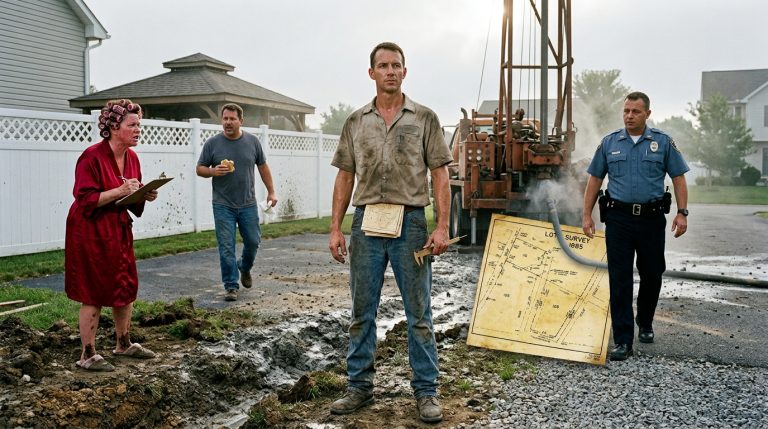
Ten yards away, the municipal utility box stood half-open, its heavy iron door swinging slightly in the wind. A padlock lay snapped on the frozen grass, its brass shyp shorn clean.
Someone had forced the box within the last hour.
Ethan abandoned his initial route toward the pool house annex, altering his trajectory toward the utility enclosure with quiet, deliberate steps. The cold air smelled faintly of scorched copper and damp soil. When he reached the iron box, he pulled the heavy door open all the way, exposing the tangle of municipal telecommunication lines and regional water controls inside.
Taped to the interior service panel was a laminated compliance notice bearing the unauthorized, custom-printed seal of the Oakidge Estates Homeowners Association. Notice of Suspension: Communal Utility Services. Below it, a handwritten post-it note in Delilah’s sharp, angular cursive read: Water pressure restricted for non-compliant properties pending fee settlement.
She hadn’t just cut off mailbox access; she was actively tampering with regional utility valves to manufacture compliance crises across the subdivision.
Ethan’s jaw tightened. The legal implications of tampering with municipal water lines escalated her administrative harassment straight into a severe structural hazard. He pulled his phone from his inner pocket, framing a series of clean, high-resolution photographs of the compromised valve and the laminated notice. Every pixel captured was a brick pulled out from the foundation of her self-built empire.
A crunch of frozen gravel behind him broke the silence.
Ethan didn’t spin around in a panic. He pivoted slowly on his heel, his posture relaxed yet defensively balanced, maintaining the steady, unreadable demeanor of a municipal inspector.
Standing ten feet away, leaning against the trunk of a skeletal oak tree, was a man in a nondescript gray overcoat. He had the unmistakable slouch of a private investigator—heavy-set, eyes scanning with transactional detachment, a leather folio tucked beneath his arm. This was the operative Delilah had hired to tail the residents.
“City property line ends ten paces back, friend,” the investigator said, his voice flat, raspy from cheap tobacco. “You shouldn’t be poking around private utility enclosures unless you’ve got a work order signed by the board president.”
Ethan met the man’s gaze with the cold, absolute authority of a magistrate who had spent a decade presiding over municipal codes. He did not blink, nor did he shrink away from the challenge.
“I don’t need a work order from a dissolved corporation,” Ethan said, his voice level, carrying a quiet, authoritative resonance that made the investigator’s eyes narrow in sudden uncertainty. “And you’re standing on public easement. Which means your surveillance vehicle parked down the block is currently in violation of section twelve of the municipal traffic code.”
The investigator shifted his weight, his hand drifting toward his coat pocket before freezing as Ethan didn’t flinch. “You talk like you own the place.”
“I know who maintains the water mains,” Ethan replied, stepping forward with deliberate slowness until the physical distance between them compressed into a zone of pure, razor-thin tension. “Tell Mrs. Thornfield her paperwork is missing a few vital stamps. And tell her that tampering with city infrastructure is a very expensive hobby to explain to a judge.”
Without waiting for a response, Ethan turned his back on the operative, pocketing his phone with the evidence securely stored, and resumed his steady walk toward the pool house annex. He could feel the investigator’s eyes burning into his spine, but the man didn’t follow. The first true crack in Delilah’s control had formed, and the weight of it was beginning to drag her entire operation down into the frozen mud.