The Subsoil Protocol: A Hardboiled Account of Property, Bureaucracy, and Gravity
CHAPTER 1: THE SINKING LINE
The tire ruts were three inches deeper than yesterday.
I stood on the porch with my hands wrapped around a heavy, chipped ceramic mug, watching steam curl off the black liquid inside. Rain had stopped at dawn, leaving the air thick with the metallic reek of wet asphalt and crushed clover. Fifty yards out, near the drainage ditch, the grass wasn’t just flattened—it was torn to the raw, reddish clay beneath.
A six-thousand-pound SUV doesn’t slip over a curb by accident. It takes intentional weight, a steady foot on the gas, and a total disregard for the property line.
I set the mug against the wooden porch railing. The ceramic gave a dull clack. I didn’t reach for a shovel. I didn’t reach for a phone. I just watched the far end of the street where the white metallic box of her vehicle sat idling in her driveway, its exhaust puffing white against the tree line.
The driver’s door slammed with a heavy, pressurized thud.
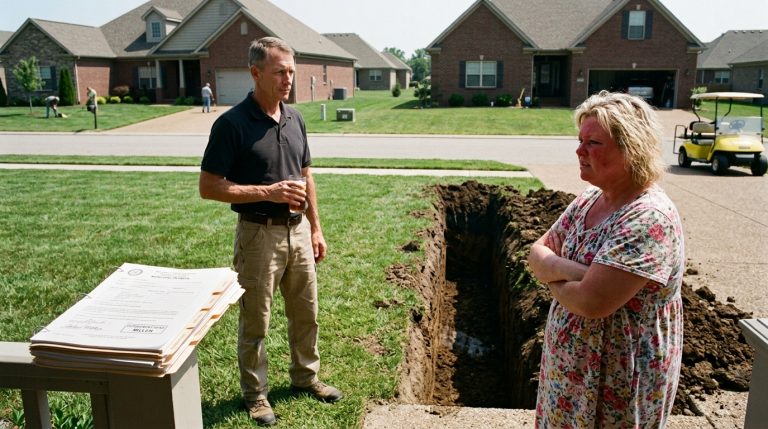
Karen walked down her driveway with the precise, deliberate stride of someone who owned the air she breathed and expected the ground to pay rent for the privilege of holding her up. Her heels clicked sharply against the pavement before hitting the soft verge of my grass. She didn’t slow down. She cut straight across the corner—my corner—heading toward her mailbox.
“Morning,” I said. My voice didn’t carry anger. Anger is heavy; it makes a man slow.
She stopped, her hand hovering near her waist where a leather designer bag rested against her hip. She didn’t look at my eyes. She looked at the porch, at the mug, at the worn toes of my work boots.
“You ought to trim those weeds by the culvert,” she said, her voice dry as dead pine needles. “It’s collecting standing water. Ruins the view from my drive.”
“The water moves fine,” I said. “The tires don’t.”
Her mouth tightened, just a fraction—the micro-expression of a predator noticing a fence where there used to be open field. Her thumb dragged across the brass buckle of her bag, polishing a spot that didn’t exist.
“It’s a neighborhood, sweetie,” she said, taking one step closer to the property stake. “We share the space. Don’t go getting dramatic over two feet of dirt.”
“Two feet is twenty-four inches,” I said. “I pay taxes on every one of them.”
“The HOA board handles land disputes,” she replied, her tone dripping with a quiet, icy satisfaction. “I happen to chair the infrastructure committee. If you have a formal complaint, put it in writing. We meet in three weeks.”
She turned on her heel, her left boot leaving a deep, crescent-shaped indentation in the damp sod. She didn’t look back.
I picked up the coffee mug, the ceramic cold against my palm now. I didn’t yell. I didn’t follow her. I walked down to the edge of the lawn, knelt in the mud, and pressed my fingers into the fresh rut. The topsoil was stripped clean. Beneath it, the packed clay was cold, slick, and firm.
She thought she was driving on a lawn. She thought she was fighting over grass.
I reached into my pocket, pulled out a small brass measuring tape, and clicked it open against the edge of the rut. Four inches past the survey pin.
I looked up down the long, gray stretch of the avenue. Underneath the grass, right where her front axle always landed, sat the old drainage conduit—Culvert-4. It was municipal property, technically. But the earth sitting directly above it belonged to the deed in my desk drawer.
I let the tape measure snap back into its casing. The click echoed off the wet oak trees like a hammer dropping on an empty chamber.
It was time to read the city bylaws.
CHAPTER 2: MUNICIPAL STEEL
The brass casing of the tape measure vibrated against my thumb, the metallic click echoing off the wet clay banks of Culvert-4 like a dropped bolt. Rainwater was still trickling through the galvanized iron pipe below, a thin, persistent hiss against the gravel.
I didn’t wipe the red mud off my knuckles. I let it dry into a tight, chalky skin across my joints while I walked back up the porch steps, picked up the cold coffee mug, and went inside.
The basement was cool, smelling of concrete sealer and old cedar. My desk was an eight-foot slab of reclaimed white oak, raw at the edges, supported by iron trestles. On the left side sat the original survey maps from 1984; on the right, the county assessor’s plat book.
I didn’t turn on the overhead light. The low desktop lamp threw a sharp yellow cone across the paper, highlighting the tiny, precise ink lines that defined where my life ended and the city’s right-of-way began.
Section 14-B. There it was, stamped in faded purple ink at the bottom of the property deed.
I traced the boundary with the flat edge of a steel ruler. My land didn’t just border the street; it wrapped over the drainage easement under a conditional stewardship clause. The city owned the water flow through Culvert-4, but the surface soil—the top three feet of dirt and sod—was explicitly maintained by the deed holder.
I pulled a blank manila folder from the drawer. On the tab, I printed three words in block letters: STORMWATER MITIGATION PLAN.
By 9:00 AM, the sun was cutting through the grey mist, turning the wet pavement outside into a blinding mirror. I drove down to the Municipal Annex building in the beat-up Ford F-150 I kept for hauling timber. The air inside the Annex tasted of floor wax, stale coffee, and recycled air-conditioning.
The clerk behind the zoning counter was a middle-aged man named Henderson. He had thick glass lenses in his frames and a grease stain on his collar, the mark of a man who had spent thirty years watching citizens try to argue with topographic maps.
“Need a land-use modification permit,” I said, setting the manila folder on the formica counter. The wood of the counter was cold under my wrists.
Henderson didn’t look up immediately. He finished marking a red line on a blueprint with an iron-tipped stylus, then blinked up at me through his bifocals. “Residential or commercial?”
“Residential stewardship,” I said. My voice was low, flat, unhurried. “Section 14-B easement. I’m installing a bio-retention swale along the eastern boundary to control road runoff.”
Henderson reached for the folder. His fingers were dry, cracking at the cuticles. He opened it, scanning the neat, hand-drawn schematics I’d spent two hours drafting at dawn. He passed his thumb over the reference numbers I’d pulled straight from the municipal environmental code.
“You’re putting in native sedge and uncompacted aggregate base?” Henderson asked, a faint spark of curiosity flickering behind his thick lenses. “Most folks just want to throw down concrete or complain about the mud.”
“Concrete redirects the volume,” I said, leaning one elbow on the counter. “Uncompacted aggregate absorbs it. Keeps the road shoulder from washing out into Culvert-4.”
I reached into my breast pocket, pulled out a folded slip of paper, and laid it beside the schematics. It was an abstract printout I’d pulled from the county records an hour prior—a filing reference under the name Vanguard Deed Holdings, listed as a contingent commercial applicant for the adjacent utility corridor. Henderson’s eyes drifted to the header on the paper, then back to my face. His jaw tightened just a fraction.
“Vanguard’s been sniffing around the road margins,” Henderson muttered, almost to himself. He tapped his pen twice on the formica. “They’ve been trying to claim that shoulder is unstable so the city reclassifies it as a public utility easement.”
“It’s not unstable,” I said softly. “It just needs proper drainage. And the code says a homeowner who installs an approved bio-swale gets a mandatory five-year structural exemption.”
Henderson looked at the schematics again. He saw the technical terms—indigenous root systems, gravel settling basin, natural filtration. What he didn’t calculate, because the math wasn’t on the paper, was the depth of the excavation. Two feet of crushed limestone, a layer of geotextile fabric, and sixteen inches of loose, saturated topsoil. Perfect for absorbing rainwater. Absolutely incapable of supporting three tons of axle weight.
“The HOA chairman is going to hate this,” Henderson said, a small, weary smile touching the corner of his mouth. “She’s been filing complaints about that corner for six months, claiming the city needs to widen the turning radius.”
“Karen chairing the infrastructure committee doesn’t override Section 14-B,” I said. “Not when the paperwork is stamped by the city engineer.”
Henderson picked up the heavy brass recording stamp. He didn’t ask any more questions. He breathed once onto the rubber pad, aligned the corner of the permit, and brought the handle down with a heavy, metallic thunk.
The blue ink was still wet when he slid the copy back across the counter.
“You’ve got ninety days to complete the work,” Henderson said, his tone dropping back into bureaucratic indifference. “Make sure you post the permit sign at the property line. If she touches it, it’s a municipal misdemeanor.”
I took the paper, folding it carefully along the crease line. “She won’t touch the sign,” I said. “She’ll just try to drive over it.”
I walked out of the Annex into the glaring daylight. The heat was rising off the asphalt now, smelling of hot tar and diesel exhaust. I sat in the cab of the F-150, resting my hands on the worn leather of the steering wheel.
The permit was signed. The legal foundation was poured.
Now all I needed was twenty tons of crushed stone, a load of native sod, and three days of heavy rain. I turned the key in the ignition, the engine turning over with a dark, throaty rumble, and headed toward the quarry.
CHAPTER 3: THE WEIGHT OF CLAY
The dark rumble of the Ford’s engine vibrated straight up through the steering column, buzzing against the raw skin of my knuckles where the dried mud still held tight. I backed out of the Municipal Annex parking space, shifted into second gear, and turned the truck north toward the river quarry.
An hour later, the bed of the F-150 was riding low, the rear leaf springs groaning under the weight of three tons of coarse, uncompacted angular limestone.
By mid-afternoon, the sun had turned the sky into a flat sheet of polished zinc. I backed the truck down the driveway, stopping two feet short of Culvert-4. The air smelled of hot exhaust, turned earth, and the sharp, chalky tang of crushed stone.
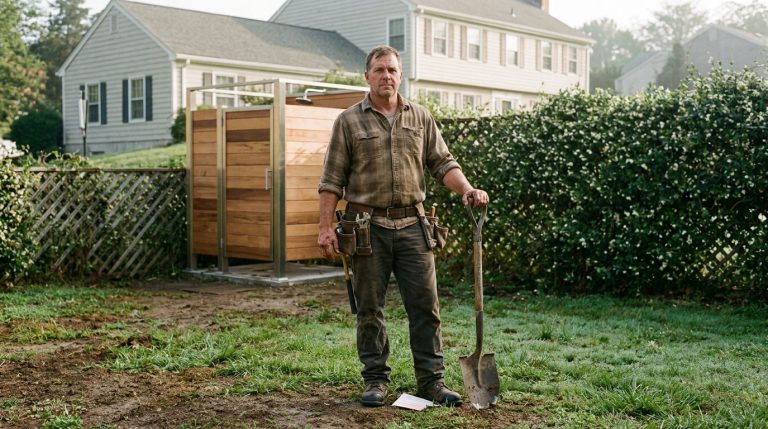
I grabbed the heavy, wooden-handled flat shovel from the truck bed. The ash wood was smooth, stained dark near the grip by years of sweat.
I didn’t use a machine. Diesel excavators make noise, and noise draws eyes. Manual shovel work leaves a clean, quiet perimeter.
I drove the spade into the sod right at the four-inch rut Karen’s passenger tire had carved this morning. The steel edge cut through the grass with a wet, tearing sound. Slice by slice, I stripped the topsoil away, piling the dark turf neatly onto a tarp to my left.
Beneath the grass, the red clay was slick and dense. I dug down twenty-four inches, shaping a trench three feet wide and twelve feet long—a precise rectangular basin directly overlapping the road shoulder.
My shirt was soaked through across the shoulder blades by the time the blade scraped against the galvanized iron top of Culvert-4. The metallic clang echoed up through the wooden handle, ringing in the bones of my wrists.
I stood in the trench, my boots caked in cold clay, and looked down at the exposed pipe.
This was the structural core of Layer 1.
I laid down a permeable geotextile fabric along the bottom and sides of the excavation. The black synthetic material would allow water to filter through freely while preventing the surrounding soil from migrating into the stone layer. Then came the limestone.
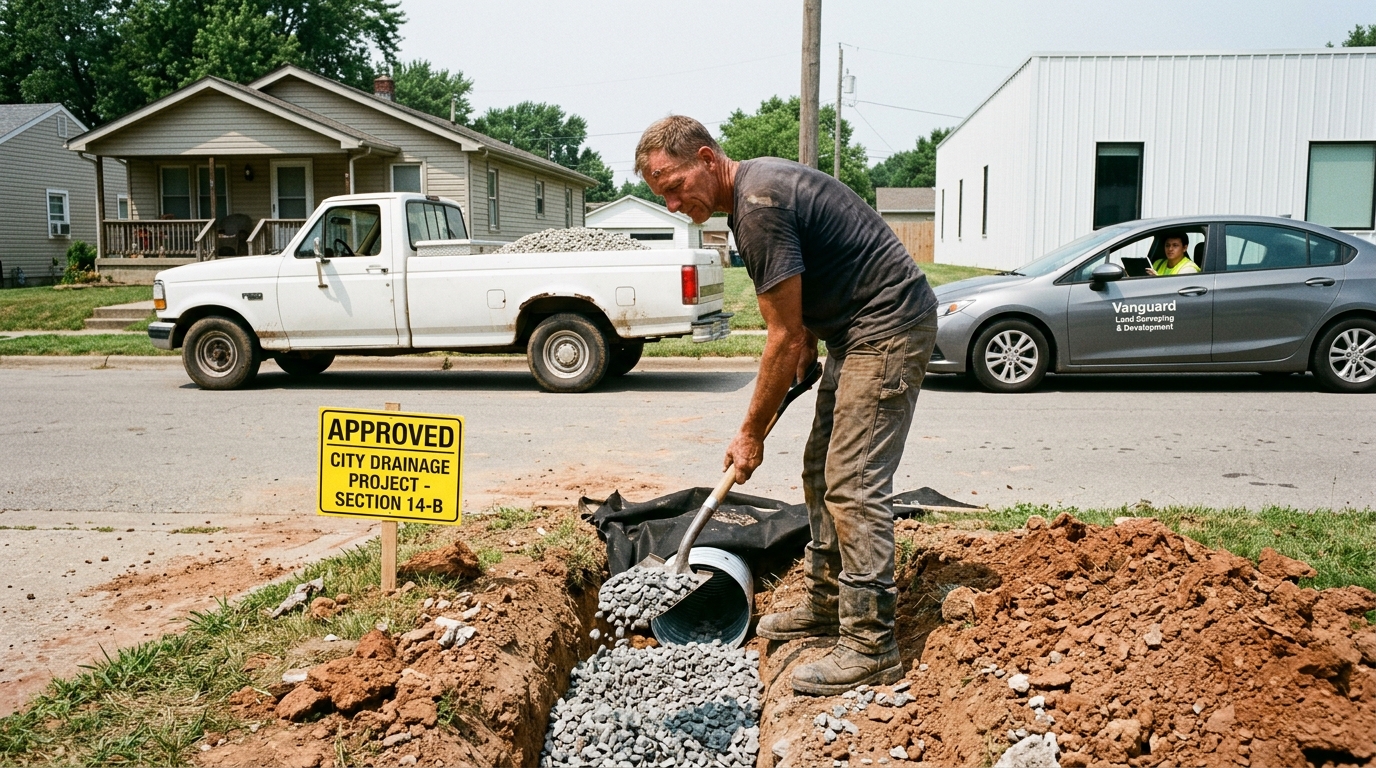
Shovel by shovel, I threw the stone into the pit. The angular rock didn’t settle like rounded gravel; it interlocked loosely, creating massive air pockets beneath the surface. To a surveyor’s eye or a casual glance, it looked like standard civil roadbed stabilization. But without a ten-ton vibratory roller to pack it down, those air pockets were structural voids waiting for a concentrated load.
As I reached the halfway mark, a dark silver sedan slowed to a crawl on the asphalt behind my truck.
I didn’t stop swinging the shovel. The rhythmic shhhk-thud of rock hitting the basin stayed perfectly steady. Out of the corner of my eye, I caught the bold white lettering printed across the passenger door: Vanguard Land Surveying & Development.
The driver—a young man in a crisp high-visibility vest with a digital clipboard resting against the steering wheel—idled there for five long seconds. He wasn’t looking at me. He was staring at the yellow municipal permit sign I’d staked into the ground at the edge of the ditch: APPROVED CITY DRAINAGE PROJECT – SECTION 14-B.
His jaw worked once, silently. He reached for a phone on the dashboard, tapped the screen without taking his eyes off the trench, and then hit the accelerator, the sedan kicking up a small cloud of dry road dust as it sped away.
I paused, leaning my chest against the top of the shovel handle. A drop of sweat ran down the side of my nose and dropped onto the raw stone below.
Vanguard wasn’t just interested in the utility corridor. They had scouts monitoring the shoulder in real time. Karen’s daily trespassing wasn’t just an arrogant driver taking a shortcut—she was actively crushing the soil, trying to create an argument that the shoulder was collapsing so Vanguard could claim a public necessity easement.
I wiped my brow with the back of my forearm, leaving a smear of red clay across my forehead.
“Keep watching,” I muttered to the empty road. “See how stable it looks in the morning.”
I spent the next two hours finishing the top layer. I covered the loose limestone with a thin sixteen-inch mantle of rich, uncompacted topsoil blended with sand and peat. From the surface, it looked like a fresh, pristine seedbed ready for native lawn grass. It was soft, level, and utterly deceptively even.
I re-laid the native sedge along the very edge of the pavement, concealing the border where the asphalt ended and the structural trap began.
By dusk, the work was finished. The shovels were wiped down and stowed in the truck bed. The yellow permit sign stood tall in the fading light, its laminated face catching the first dim glow of the streetlamps.
I walked back up to the porch, my legs heavy, my lower back burning with the dull, satisfying ache of hard physical labor. I picked up my old ceramic mug from the railing, filled it with cold water from the pump, and stood in the darkness, watching the quiet road.
The sky was turning a bruised, heavy purple from the west. The air was cooling rapidly, carrying the distinct, heavy scent of oncoming rain.
CHAPTER 4: GRAVITYS DIVIDEND
The rain started as a low, drumming whisper against the tin flashing of the porch before opening up into a steady wall of grey water. By 6:00 AM, the downpour had filled the ditches to the brim, turning the surface of Culvert-4 into a swirling vortex of muddy foam.
I stood by the kitchen window, the heavy ceramic mug resting against my lower lip. The steam from the black coffee inside rose straight up, warm against my nose, while the glass pane before me stayed cold, fogging slightly with every exhaled breath.
Outside, the rain pounded the fresh turf. The uncompacted aggregate eighteen inches below was doing exactly what physics dictated: drinking the water, swelling, and dissolving what little cohesion the loose topsoil possessed.
The low, heavy rumble of a multi-valve V8 engine broke through the sound of the storm before the vehicle even rounded the curve.
Karen’s white SUV came cruising down the street. She wasn’t driving fast—she was driving with that deliberate, possessive rhythm, her white-knuckled grip on the steering wheel visible even through the rain-streaked windshield. Her headlights cut yellow cones through the sheet of falling water.
She didn’t slow down as she approached my boundary stake. She leaned into the turn, cutting the corner with practiced, arrogant precision.
Her right front tire mounted the curb.
“There it is,” I said quietly into the empty kitchen.
The front right wheel hit the fresh turf of the bio-swale. For half a second, the chassis stayed level. Then gravity collected its dividend.
The turf gave way with a wet, heavy shhh-tuck. The front right corner of the six-thousand-pound vehicle dropped eight inches in a single violent pulse, the steel skid plate slamming down against the saturated clay bank with a hollow THUMP.
The vehicle rocked violently to the right. Inside the cabin, Karen’s silhouette jerked sideways, her hands flailing against the wheel as the seatbelt locked.
She slammed her foot on the gas.
The rear tires spun, screaming against the wet asphalt. High-velocity plumes of red mud, crushed sod, and loose limestone sprayed twenty feet backward into the street, coating her own pristine white doors in a thick layer of dripping muck. The more she revved the engine, the deeper the front axle settled into the uncompacted stone reservoir. The loose limestone shifted like liquid glass under the weight, locking her lower control arm into the mud.
The driver’s door burst open.
Karen stepped out into the pouring rain. She wore a tailored beige trench coat and high-heeled leather boots. The instant her right heel touched the grass beside the running board, the thin leather heel sheared through the topsoil and sank four inches into the slurry. She shrieked—a sharp, ragged sound cut short by the roar of the rain—and nearly went down on one knee, her fingers clawing at the muddy door panel to keep her balance.
“You!” she screamed, her face flushed red, plastering dark hair across her forehead as she glared up at the porch. “You did this!”
I pushed the screen door open and walked out onto the porch steps, keeping the overhang between me and the downpour. I took a slow sip of coffee.
“The sign’s three feet from your bumper, Karen,” I called out. My voice didn’t rise; I let the flat tone carry under the roof line. “Approved City Drainage Project. Section 14-B. You’re parked in a municipal retention basin.”
“This is a hazard!” she yelled, her boots making wet plop-plop sounds as she tried to pull her right foot free, leaving the shoe behind in the red clay. “I’m calling the police! I’m calling the HOA! You sabotaged the road!”
“I filed the permit with Henderson at the Annex,” I said, setting the mug down on the top step. “The city stamped it. The aggregate base is designed to hold stormwater, not six-ton commercial vehicles.”
She reached into her coat, pulled out her phone, and began furiously tapping the screen with a trembling thumb. “We’ll see what the board says when your property gets condemned for civil liability!”
Ten minutes later, the flashing amber lights of a heavy commercial tow truck cut through the grey sheet of rain.
The driver—a burly guy in a rubberized high-vis slicker—hopped out, leaving his diesel engine idling with a deep clack-clack-clack. He walked to the edge of the ditch, looked down at her buried axle, and then looked at the yellow municipal sign standing pristine in the rain.
“I can’t hook from the road without an anchor line,” the driver told her, wiping rain from his mustache. “Ground’s too soft along the shoulder. If I back up to get leverage, I’m putting my front tires on that turf.”
“Just pull it out!” Karen barked, her coat ruined, her left sock soaked black with clay. “I don’t care how you do it!”
The driver grunted, spat into the ditch, and climbed back into his cab. He backed the flatbed truck up three feet, bringing his rear dual wheels onto the very edge of the grass to set his hydraulic outriggers.
He didn’t know about Culvert-4. He didn’t know about the sixteen-inch loose limestone bed extending two feet past the permit sign.
The moment the tow truck’s heavy rear axle took the strain of the winch cable, the outrigger didn’t press against solid earth—it punched straight through the geotextile fabric into the loose aggregate. With a sharp, metallic groan, the tow truck’s right rear frame dropped four inches, the outrigger sinking into the clay like a hot iron through butter.
The winch cable snapped taut with a terrifying PING, vibrating like a bass string before the automatic overload brake tripped.
“Shut it down!” the driver roared, scrambling out of his cab, his face pale as he looked at his own trapped rear duals. “Hey! Nobody move! The whole shoulder’s giving way!”
Across the street, three living room curtains twitched open. Old Mr. Vance from house 104 stepped onto his porch with a pair of yellow rain gear on, holding a digital camera. Down the block, two more neighbors appeared under umbrellas, watching the spectacle in silence.
Karen stood barefoot in the red mud between two trapped multi-ton vehicles, her phone still pressed to her ear, screaming into a dead line as the rain washed the makeup down her neck.
I picked up my ceramic mug, took a final, lukewarm sip, and walked back inside to grab the manila folder. The emergency HOA meeting wasn’t scheduled for three weeks, but I had a feeling Henderson’s phone at the Annex was going to ring within twenty minutes.
CHAPTER 5: THE PAPERWORK TRAP
The manila folder was stiff in my fingers, the cardstock slightly warped from the damp air outside. The fluorescent tubes buzzing overhead in the clubhouse basement cast a harsh, dead-white light over the six folding tables arranged in a tight semicircle.
The room smelled of damp raincoats, stale urn coffee, and wet wool.
Karen sat behind the center table, flanked by two board members. She had changed into a dry dark blue blazer, but her hair was still damp at the ends, pinned back tight. Her face was pale, the skin around her eyes pinched and white. On the table before her lay three printed pages of what looked like an emergency municipal damage report, freshly stapled.
Beside her sat a man I hadn’t seen at the regular meetings—a sleek individual in a charcoal suit, holding a leather folio stamped with a silver logo. I recognized the font before he even opened his mouth: Vanguard Development.
I took my seat at the resident’s table opposite them. I set my heavy ceramic mug on the formica, the base settling with a firm, quiet thud.
“This emergency hearing of the infrastructure committee is called to order,” Karen said. Her voice was too loud for the small room, brittle around the edges. She didn’t look at my eyes; she looked at the manila folder in my hands. “We are addressing a severe civil hazard created on the eastern road margin of Lot 14. The owner has excavated public right-of-way without board authorization, resulting in vehicle damage and towing infrastructure failure.”
The man in the charcoal suit cleared his throat. He slid a paper across to Karen without looking at her.
“Pursuant to the municipal emergency access code,” the man said, his voice smooth, practiced, devoid of regional cadence, “the shoulder adjacent to Lot 14 has suffered structural degradation. Vanguard Deed Holdings has submitted a preliminary petition to reclassify the perimeter of Section 14-B as an essential utility easement. That reclassification takes effect if the shoulder is deemed unmaintained or unsafe.”
Karen picked up the paper, her chin tilting up. “The board intends to vote immediately to condemn the excavation, issue a ten-thousand-dollar fine for willful endangerment, and grant Vanguard immediate easement access to pave the shoulder.”
The two board members beside her nodded on cue, like puppets pulled by the same string.
I didn’t reach for a pen. I didn’t raise my voice. I leaned forward, resting my forearms on the cold oak edge of the table.
“You’re five days late,” I said.
Karen’s brow furrowed. “What?”
I opened the manila folder. I pulled out the top sheet—the blue-stamped municipal permit Henderson had issued at the Annex—and slid it across the floor of the basement to the table. It came to rest right against the edge of the charcoal suit’s leather folio.
“That’s a Section 14-B stewardship permit,” I said, pointing a finger at the blue ink seal. “Signed and stamped by the City Engineer on Monday. The top three feet of topsoil and aggregate along Culvert-4 are designated as an approved private stormwater retention swale.”
The lawyer in the charcoal suit looked down at the stamp. His eyebrows twitched—a micro-expression so fast a man not watching for it would have missed it entirely. He didn’t pick up the paper. His fingers tightened on the brass latch of his briefcase.
“An HOA board cannot override a municipal environmental permit,” I continued, keeping my tone flat, rhythmic, unyielding. “And under city code, any vehicle exceeding three tons that enters an approved retention swale is legally classified as an unauthorized trespasser damaging civil drainage infrastructure.”
Karen slammed both palms onto the folding table. The metal legs rattled against the linoleum. “You built a trap! You deliberately dug out the gravel so my car would sink!”
“I installed uncompacted aggregate according to city drainage specifications,” I said. “It holds water. It filters runoff into Culvert-4. It is not built to support an SUV cutting corners to force a land reclassification.”
I reached into the folder again and pulled out a stack of eight-by-ten glossy photographs, laying them out side-by-side like a hand of cards.
“These are trail-cam photos from three weeks ago,” I said, stepping back so the two neutral board members could see. “That’s Karen’s license plate mounted on my grass at 11:42 PM. Here’s another from Tuesday. And this one—” I tapped the last photograph, taken at 2:15 AM two nights ago “—shows her dumping powdered quicklime into the drainage ditch in an attempt to artificially harden the soil edge.”
The room went completely silent. The only sound was the low, steady hum of the fluorescent lights.
One of the board members—an older woman named Mrs. Gable who lived near the entrance—reached out and picked up the photograph of the quicklime. She looked at the timestamp, then looked up at Karen.
“Karen,” Mrs. Gable said softly, her voice carrying a cold, sharp edge of betrayal. “You told us the shoulder was collapsing naturally.”
“It was!” Karen stammered, her face turning from pale to a mottled, furious red. “He—he’s manipulating the records! He’s picking a fight with the board!”
“No,” I said, leaning over the table until I was looking directly into her eyes. “You were trying to create a structural failure so Vanguard could seize the easement under Section 14-B. You wanted the corporate payout from the utility corridor.”
The lawyer in the charcoal suit didn’t say another word. He quietly closed his leather folio, clicked the brass latches shut, and stood up. He didn’t look at Karen. He didn’t look at the board. He turned on his heel and walked straight out the basement door, his leather soles clicking sharply against the concrete stairs until the door shut behind him.
Karen sat frozen, her hands still flat against the table, watching the empty doorway where her backing had just vanished.
“The vote on the fine,” Mrs. Gable said, turning her gaze back to the agenda sheet, “is tabled indefinitely. And I believe we need to discuss a motion regarding committee leadership.”
I picked up my manila folder, placed the photographs back inside, and tucked it neatly under my arm. I picked up my coffee mug with my right hand.
I didn’t smile. I didn’t offer a polite closing remark. I turned and walked out into the cool rain, leaving Karen sitting alone under the buzzing lights.
CHAPTER 6: THE QUIET BOUNDARY
The rain had tapered off into a fine, cool mist by the time I pushed open the clubhouse exit door. The air smelled of wet asphalt and turned earth. I tucked the manila folder securely beneath my arm, my thumbs resting against the cold, heavy glaze of my ceramic mug. Behind me, the muffled hum of the basement meeting dissolved into absolute silence.
Three days passed in that steady, unhurried rhythm.
The corporate apparatus didn’t launch a dramatic second wave. When the paper trail is stamped by the city engineer under Section 14-B, legal teams don’t waste billable hours fighting over water retention basins. By Thursday afternoon, a county crew arrived in an orange municipal truck, set up two traffic cones, and spent an hour clearing the silt out of Culvert-4. They didn’t touch my stone bed. The crew foreman—a guy in a grease-stained ballcap—looked at the yellow permit sign, nodded once toward my porch, and drove off.
Karen’s white SUV stayed parked in her garage, the aluminum door pulled shut until late Sunday morning.
I was standing on the porch with my mug, watching the early light cut through the pine trees, when a commercial moving van backed slowly down her driveway. The air carried the sharp, rhythmic beep of its backup alarm. Two men in canvas work pants began hauling out leather sofas and wardrobe boxes, stacking them into the dark interior of the truck.
Karen came out through her side door once, carrying a stack of plastic storage bins. She wore plain gray sweatpants and a dark rain jacket, her hair pulled back into a loose knot. She didn’t look across the road. She didn’t glare at Culvert-4. When her boot crossed the edge of her own lawn, her shoulders stayed rounded, her head down, her movements quick and defensive.
She wasn’t a chairman anymore. She wasn’t an agent clearing a path for a Vanguard Deed expansion. She was just a resident clearing out her lease before the board issued its formal assessment on her property file.
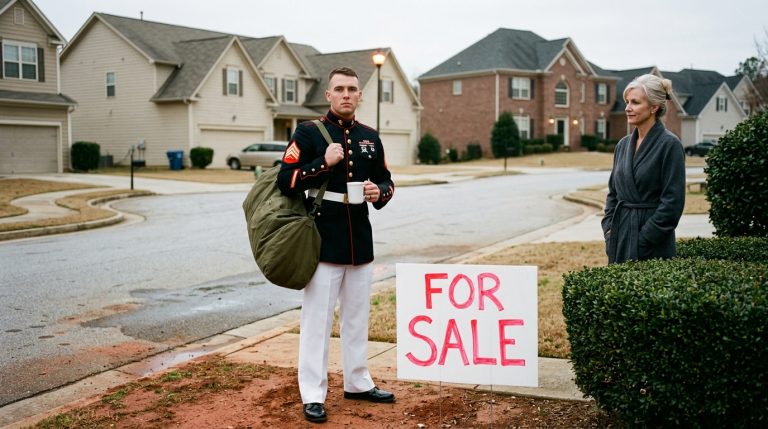
By noon, a wooden real estate post was driven into her front lawn. The red-and-white sign hung straight in the stillness: FOR SALE – BANK OWNED / IMMEDIATE POSSESSION.
I walked down the driveway, my work boots crunching softly over the gravel. The sun was fully up now, warming the back of my neck.
I stopped at the edge of the ditch where Culvert-4 disappeared under the road. The bio-swale had settled into its permanent form. The native sedge grass I’d planted along the border had taken root, its deep green blades holding the topsoil firm against the stone base below. Water moved through the basin cleanly, dropping its sediment into the aggregate before trickling out into the municipal main.
I knelt down in the dirt. The clay was dry now, firm under my fingers.
I reached into my pocket, pulled out the brass measuring tape, and opened it across the shoulder. Four inches past the survey pin, right where her tire used to land every morning.
The rut was gone. The earth was level.
I let the tape snap back into its casing with a short, clean click.
I stood up, wiped a fleck of dry dirt from my thumb, and looked down the quiet length of the avenue. Down the block, old Mr. Vance was out on his driveway, sweeping pine needles off his pavement with a long-handled broom. He paused, looked up, and gave me a single, slow nod before going back to his work.
I walked back up to the porch, set my mug down on the wooden railing, and picked up the flat shovel resting against the house. The ash wood handle was smooth, broken-in, ready for the next project. The boundary was marked, the paperwork was filed, and the dirt belonged to the deed.