The Navy Regulations of Willowbrook: How a Returning Sailor Dismantled a Predatory Suburban Empire Built on Stolen Homes
CHAPTER 1: The 3:00 AM Arrival
The grease on the seals of the sea bag had long since gone cold, tasting of salt and stale aviation fuel, but the weight of it still bit into my shoulders as the taxi left me at the corner of Willowbrook Estates.
Three o’clock in the morning in a zip code designed by algorithms doesn’t smell like pine or damp earth. It smells like manicured sod and chlorinated runoff from automated sprinklers. My boots hit the asphalt with a hollow, flat thud—the only sound breaking the sterile silence of cul-de-sacs lined with houses that looked like they had been extruded from the same plastic mold.
I stopped where my driveway should have been.
There was no driveway. There was no blue-shuttered ranch with the porch light I’d left flickering on a timer when the deployment orders pulled me across an ocean. Instead, my front yard had been scraped clean down to the red clay, a smug little rectangle of decorative gravel and a newly planted boxwood hedge sitting precisely where my living room sofa used to face the television. A single, pristine white for-sale sign was staked dead-center in the dirt, its fluorescent red lettering catching the amber wash of the streetlamp like a fresh scar.
A dog barked twice—sharp, rhythmic, and entirely joyless—somewhere to the left.
“Back early, sailor?”
The voice didn’t rattle. It glided. It had the smooth, expensive cadence of someone who had never had to scrape ice off a windshield or check the oil on a dying engine.
I didn’t turn around right away. I let the damp night air fill my lungs, tasting the residual grit of the flight deck and the sharp, chemical tang of Constance Blackwater’s perfume before I shifted my weight.
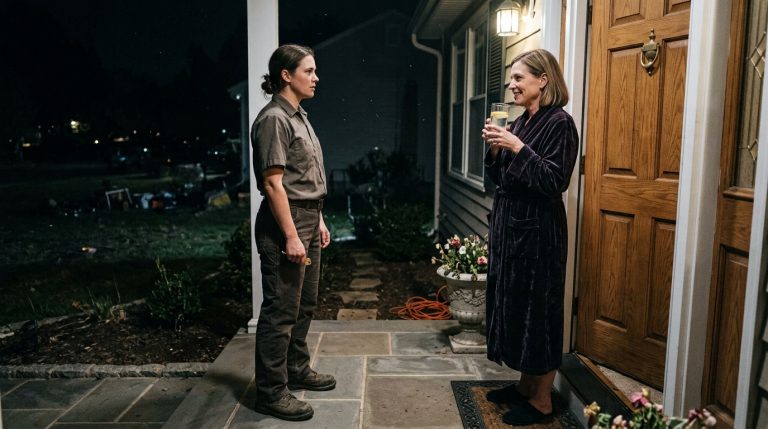
She stood near the curb, wrapped in a cashmere robe that cost more than my dress blues. Her silver-blonde hair was pinned up with casual precision, and she held a porcelain mug of something steaming in one hand while the leash of a shivering, overweight Pomeranian looped through her fingers. Her smile wasn’t a greeting; it was an inventory.
“You missed the assessment notices,” she said, tilting her chin up as if inspecting a minor mildew stain on siding. “We reallocated the parcel for community enhancement. Property values require strict continuity, Mr. Thornfield. Abandoned structures tend to draw the wrong sort of demographic.”
My hand tightened around the canvas strap of my sea bag. I looked past her shoulder toward the corner lot where her mansion sat behind a manicured perimeter, then back down at the boxwood hedge mocking what was left of my three years overseas.
“Funny thing about that, Constance,” I said, my voice dropping into the low, flat register I used when the communications gear was failing and the landing window was closing. “You just violated federal law. The Service Member Civil Relief Act doesn’t give a damn about your community enhancement.”
Her smile didn’t break, but the skin around her eyes tightened like a fist closing on wool.
“We follow local governance here,” she murmured, stepping closer, her eyes glittering with the cold certainty of someone who had never lost a single argument that mattered. “And down here, you don’t exist.”
CHAPTER 2: The Pavements of Willowbrook
The silence that settled between us wasn’t the comfortable quiet of a sleeping neighborhood. It was the calculated vacuum of two people calculating angles in the dark.
Constance didn’t blink. Her fingers tightened around the leash of her Pomeranian just enough to make the small animal let out a dry, rattling wheeze. The cashmere of her robe absorbed the amber glare of the streetlamp, making her look less like a homeowner and more like an apparition cut from an expensive catalog.
“Federal law,” she repeated, the syllables clicking together like pool balls on a slate table. She let out a small, dry exhale that smelled faintly of peppermint and expensive gin. “Mr. Thornfield, you’ve been on a greyhound bus and a military transport for thirty-six hours. You’re standing on private community property, looking at a legally reallocated parcel. The paperwork was filed, adjudicated, and stamped by the municipal registry while you were busy playing communications tech in some desert bunker where nobody cares about local ordinances.”
I didn’t step back. I shifted my weight from my left boot to my right, letting the worn leather grind against the newly laid decorative gravel she’d put in place of my front porch.
“The Service Member Civil Relief Act isn’t a municipal ordinance, Constance,” I said, keeping my voice level, the tone flat and steady like a carrier frequency holding against interference. “It’s federal statute. Title 50. It overrides your little neighborhood committee meetings, your decorative guidelines, and whatever hurried paperwork your real estate friends pushed through the county clerk while my deployment orders were active.”
Her eyes flicked down to my sea bag, resting for a fraction of a second on the frayed canvas strap where the salt-stiffened stencil of my name was half-faded. For a second—just a heartbeat—the immaculate mask slipped. The skin at the corners of her mouth twitched, a micro-expression of sudden, sharp irritation that she smoothed away with a practiced tilt of her chin.
“You left a vacant lot,” she said, her voice dropping an octave into something colder, more transactional. “An unmaintained structure with an unauthorized military banner hanging in the window. Under Willowbrook bylaws section fourteen, paragraph three, properties showing signs of chronic neglect or visual non-compliance are subject to receivership. We didn’t steal your house, Sergeant. We rescued the block from your absence.”
“Rescued,” I muttered, letting a dry, humorless sound escape my chest.
“You’re welcome to take it up with the board during regular business hours,” she said, turning on her heel with a precise, synchronized click of her designer heels against the curb. The Pomeranian trotted behind her, its tags jingling like loose change. “Though I’m afraid Tuesdays are booked. And our legal counsel, Mr. Crest, is exceptionally thorough when it comes to frivolous filings from returning personnel who don’t understand how civilian property values work.”
She didn’t look back as she crossed the immaculate asphalt of the cul-de-sac toward the sprawling corner lot where her brick-faced mansion loomed behind a perimeter of trimmed boxwoods.
I stood alone in the dark where my living room used to be.
The air was heavy with the smell of wet turf and automated fertilizer. My boots felt anchored to the red clay beneath the gravel, heavy and immovable. I reached into the breast pocket of my field jacket, my fingers brushing against the waterproof zip-lock bag where I kept my deployment log, the stamped postal receipts, and the ironclad power of attorney I had handed to Marcus eighteen months ago.
Marcus hadn’t answered my text messages from the airport terminal. That wasn’t like him. Marcus was the kind of guy who tracked logistics for a living; he kept spreadsheets of spare parts and backup generators. When a bank merger glitches and an autopay fails while a proxy is active, it doesn’t happen because of a clerical error. It happens because someone with an address stamp and a legal retainer put a thumb on the scale.
I swung the sea bag back over my shoulder, the metal clasps biting into my collarbone, and started walking down the empty street toward the edge of the subdivision where the old highway met the county line.
The streetlights buzzed overhead, casting long, fractured shadows across driveways identical to the one that had just been erased. Every lawn looked like an advertisement; every house wore the same neutral, desaturated beige designed to offend no one and cost a fortune. But as I passed the third cul-de-sac, I noticed the pattern.
It wasn’t just my house.
Two doors down, the small, single-story ranch belonging to Master Sergeant Rodriguez had its side gate chained shut with a heavy brass padlock. A bright orange notice of violation—the exact same high-vis fluorescent stock Constance favored—was taped to the front window glass, half-obscured by a stack of circulars that had accumulated over weeks. Across the street, the Kim family’s driveway was empty, the basketball hoop dismantled and laid flat against the side of the garage like a discarded toy.
Systematic.
Connie wasn’t protecting property values. She was clearing a perimeter.
My phone buzzed against my thigh—a single, sharp vibration breaking the stillness of the suburban night. I pulled it out. The screen lit up with a text from an unknown local number, time-stamped 3:14 AM.
If you’re smart, Thornfield, you’ll take the morning bus out of county. Some people are finding out the hard way that Willowbrook doesn’t like veterans asking questions about the registry.
I stared at the glowing letters for three seconds, watching the battery indicator pulse in the upper corner. Then I typed back a single word—Try and stop me—and hit delete before it could send.
The pavement hummed beneath my boots as I reached the edge of the neighborhood, the neon sign of a twenty-four-hour diner blinking through the smog a mile down the highway. Janet Reyes’s office downtown didn’t open for another five hours, but I didn’t need an appointment to know that the war didn’t end when you crossed the border. Sometimes, the real front line was right where you left your front door.
CHAPTER 3: The Warning Signs in the Service Record
The neon sign above the diner door flickered with a tired, rhythmic hiss, casting a sickly green pallor over the cracked linoleum floor. I didn’t break stride as I pushed the heavy glass door open. The air inside smelled of stale grease, burnt chicory coffee, and the sharp, chemical reek of floor cleaner.
It was 3:42 AM. At this hour, the only people awake were truckers dodging weigh stations and ghosts trying to outrun their own paperwork.
I slid into a cracked vinyl booth near the back, my heavy sea bag thudding against the metal table leg with a dense, unyielding weight. A waitress with tired eyes and a name tag that read Brenda appeared instantly, dropping a thick ceramic mug onto the formica without looking at me. A brown, bitter stream of coffee splashed over the rim, cutting a jagged line through the dust on the table.
“Refill’s free if you don’t die first,” she said, her voice flat, before wiping her hands on an apron that had seen better decades. “You want the eggs or just trouble?”
“Just the coffee,” I said.
My fingers felt stiff as I pulled the waterproof zip-lock bag from my field jacket. The plastic crinkled loudly in the quiet booth. Inside lay the physical architecture of my defense: certified mail delivery receipts, bank statements showing the exact minute the automated transfer window had slammed shut, and a copy of the ironclad power of attorney I had handed to Marcus eighteen months before I shipped out.
I spread them out under the harsh, unshaded glare of the overhead fluorescent tube. Sharp edges. No curves. Every document was a brick in a wall I hadn’t wanted to build.
A sharp hum vibrated against my thigh. I didn’t reach for the phone immediately. I let it buzz twice—a mechanical, low-frequency pulse—before pulling the device out. It wasn’t another anonymous warning from a local burner number this time. It was an email notification flagged with high priority from military logistics.
From: [email protected]
Subject: RE: Proxy Dispute / Willowbrook Estates – Case File 44-B
Status: Initial Review Complete. SCRA Title 50 violations noted. Jurisdictional overlap requires local counsel substantiation.
I stared at the glowing blue text, the memory of the comms room on the carrier deck flashing behind my eyes—the banks of blinking amber lights, the hum of the cooling fans, the absolute certainty that when you punched coordinates into a terminal, the system executed the command without flinching. Civilian law wasn’t a closed-loop circuit. It was full of corroded connections, back-channel favors, and municipal loop-holes designed to protect people who wore cashmere robes at three in the morning.
Marcus had tried to run those loops for me. That was the part that didn’t add up.
Marcus was an engineer who double-checked his torque specifications twice. When the bank merger had glitched our autopay system three months into my deployment, Marcus hadn’t just shrugged and walked away. He had driven down to the local branch with a physical copy of the power of attorney stamped by the base legal officer.
So why did Constance’s legal team have a signed waiver claiming Marcus had relinquished the property rights voluntarily?
I pulled out my deployment logbook, flipping past the operational columns of grid coordinates and encrypted frequencies until I reached the back pages where I kept my personal roster. My thumb traced Marcus’s phone number. I hadn’t called him since getting off the bus; the shock of the flattened lawn and Constance’s toothy grin had short-circuited my tactical focus.
I pressed the call button, holding the cracked plastic receiver to my ear.
It didn’t ring. It went straight to a hollow, high-pitched carrier tone—the distinct, mechanical stutter of a disconnected line.
“The subscriber you have dialed is no longer in service or has been temporarily suspended.”
The diner’s overhead light flickered, dropping the booth into a sudden, gray shadow. I sat completely still, my eyes locked on the stamped postal receipt dated eighteen months ago. The paper was crisp, but the implications were turning to iron.
Marcus didn’t just drop the ball. Someone had made sure he couldn’t pick it back up.
A shadow fell across the table. I didn’t look up right away; my fingers automatically tightened around the edge of the ceramic mug, testing the balance of the weight.
“You’re making a lot of noise for a ghost, Sergeant,” a voice muttered from the aisle.
I raised my chin. Standing beside the booth was a man in a rumpled gray windbreaker, holding a Styrofoam cup of water. He wasn’t wearing a uniform, but he had the distinct, carved-out posture of someone who spent twenty years carrying a heavy pack before sitting behind a desk. His eyes flicked down to my deployment papers spread across the Formica, lingering for a fraction of a second on the header of the legal brief.
“If you’re looking for Janet Reyes,” the man said softly, not waiting for an invitation as he slid into the opposite side of the booth, “you’re six hours early. And if you think Constance Blackwater is just a bored housewife protecting her petunias, you’re looking at the wrong map.”
CHAPTER 4: The Office of Janet Reyes
The man didn’t introduce himself by name until he had slid a weathered manila folder across the sticky Formica table, right over my deployment receipts.
“Call me Davidson,” he said, though the badge tucked halfway into his inside pocket carried a county seal that suggested municipal oversight was only half his job. “And before you start digging into Marcus’s phone records like you’re tracking a missile trajectory, you should know that your friend didn’t vanish because of a bank error.”
I kept my hand flat on the table, my fingers inches from the manila folder. The diner’s fluorescent tube hummed overhead, casting a cold, diagnostic light over the gray-streaked stubble on his jaw. “Marcus was trained to execute a power of attorney under operational constraints. He didn’t drop the ball unless someone kicked it out of his hands.”
“Someone did,” Davidson murmured, lifting his Styrofoam cup of water and swirling the ice cubes with a dry, clicking sound. “Or rather, a corporation with twenty-four registered subsidiaries did. Willowbrook isn’t just a neighborhood association, Sergeant. It’s a clearinghouse. Constance Blackwater runs the board like an infantry platoon, but the legal architecture behind these property seizures belongs to Byron Crest. And Crest doesn’t file paperwork in county courts unless he’s already secured a buyer.”
My eyes narrowed. “Glenn Watsworth.”
“Glenn’s the shovel,” Davidson corrected quietly. “He buys the flattened lots for eight hundred dollars at rigged emergency auctions, flips the landscape permits, and triples the valuation overnight. But he’s just an employee of a holding company registered in Delaware. A holding company that shares an office suite with three other shell corporations controlled by people who sit on the county zoning board.”
The pieces didn’t snap together like a neat puzzle; they ground against each other like gears with mismatched teeth. I thought back to the flattened rectangle of red clay where my living room used to be, the smug little herb garden, and the boxwood hedge planted with clinical precision. It wasn’t about thirty-six hundred dollars in back dues. It wasn’t even about the decorative flag in my window.
It was about clearance.
I picked up the manila folder, my thumb catching the sharp edge of the cardboard tab. Inside were photocopies of property deeds, land registry transfers, and a highlighted bank statement showing a massive, unaccounted-for cash deposit made to a personal account bearing Constance Blackwater’s name just four days after Master Sergeant Rodriguez’s house was seized.
“Janet Reyes’s office opens in three hours,” I said, my voice dropping into that flat, steady register. “Does she have these?”
“She has copies,” Davidson replied, standing up from the booth with a slow, deliberate creak of his joints. He dropped a crumpled one-dollar bill onto the table beside my untouched coffee mug. “But Janet operates inside the rules of civil procedure. She files motions, she requests injunctions, and she waits for judges to schedule hearings. Constance Blackwater plays a different game. By the time your first injunction reaches her desk on Friday morning, she’s already scheduled an emergency board meeting to push through a second seizure on Martha Coleman’s property three streets over.”
I looked up sharply. “Martha Coleman? Her son is deployed in Korea.”
“And her husband passed away last year,” Davidson said, pausing at the edge of the glass door as the neon sign buzzed overhead. “She’s an easy target for a neighborhood committee claiming unmaintained lawns threaten property values. If you want to stop this, Sergeant, don’t wait for the lawyers to finish filing. Go down to Janet’s office right now, pick up the federal notice packets, and let’s see how Constance likes an audit that doesn’t clear through the county clerk.”
He pushed through the doors, stepping out into the pre-dawn chill. The glass swung shut behind him with a heavy, muffled click.
I didn’t finish the coffee. I gathered my deployment papers, slid them back into the waterproof zip-lock bag with a crisp, rustling snap, and hoisted the heavy sea bag over my shoulder. The sun was just beginning to bleed a pale, bruised gray over the edge of the highway as I stepped out into the cold air, heading downtown toward the smell of old leather, stale paper, and the office of Janet Reyes.
CHAPTER 5: The Midnight Ledger
The smell of Janet Reyes’s office didn’t change for the weather or the hour. It smelled of old buckram, damp wool, and the unmistakable, biting tang of a laser printer running hot jobs through the night.
I didn’t bother using the brass door knocker. My hand found the handle, pushed down against the stiff latch, and swung the oak door open just as a sharp hiss of cold rain began to rattle against the frosted windowpanes.
Janet didn’t look up from her desk. She was knee-deep in a sprawling grid of photocopied deeds and municipal ledger sheets that spanned the length of a mahogany table. A half-empty mug of black coffee sat beside her elbow, a film of grey dust settling over the rim.
“If you’re going to tell me that Marcus tried to call your cell and got a disconnected tone,” Janet said, her voice dry as parchment, “save your breath. I already pulled the telecom routing logs. The line wasn’t dropped by accident. Someone filed an administrative suspension using a fraudulent identity verification code routed through a server in Dover.”
I dropped my heavy sea bag against the baseboard with a dull, leaden thud that made the stacks of case files jitter on the table. “Davidson already filled me in on the shell corporations. Crest isn’t just defending an HOA. He’s fronting a clearinghouse.”
Janet finally raised her head, adjusting her wire-rimmed glasses down the bridge of her nose. The fluorescent desk lamp carved deep, hard shadows across the lines of her face. “Crest is a symptom, Derek. I spent the last four hours cross-referencing every property seizure in Willowbrook over the past four years. Twelve military families. Every single one of them deployed overseas when the default notice dropped. Every single one of them bought out by Glenn Watsworth’s landscaping LLC for pennies on the dollar.”
She reached out, tapping a thick sheaf of blue-backed financial disclosures with the eraser end of a yellow pencil.
“Look at the ledger sequence,” she instructed, her tone dropping into a surgical cadence. “Watsworth doesn’t just resell the land. The moment a parcel is cleared, the deed is flipped to a holding entity called Blue Heron Properties. And who sits on the board of Blue Heron? Not Constance. Constance is just the local enforcer. The primary shareholder is a corporate trust registered under a residential address three counties away—an address owned by a development firm that happens to hold the municipal zoning contracts for the entire lakefront expansion project.”
The physical reality of the puzzle clicked into place with the cold finality of a bolt sliding home in a breach block.
My house wasn’t seized because of an unpainted shutter or an unpaid grass-cutting fee. My house—and Rodriguez’s, and Kim’s—sat directly on the ridge line overlooking the municipal lake. Every single one of those modest, single-story ranches blocked the sightlines and the premium valuation of the multi-million-dollar estates crowding the water’s edge on the north side of the subdivision.
Constance Blackwater wasn’t protecting neighborhood aesthetics. She was clearing a dead zone to drive up the valuation of her own neighborhood block by two hundred thousand dollars per lot.
“If we file through normal civil channels,” I said, stepping closer to the desk and resting my knuckles on the cold wood, “Crest will drag this out through administrative hearings until Martha Coleman’s house is auctioned off on Friday morning. Davidson said they’re staging an emergency board meeting to push the paperwork through while I’m tied up in the county courthouse.”
Janet didn’t flinch. She pulled a fresh legal pad toward her, tearing off a sheet with a sharp, crisp rip.
“We don’t wait for Friday,” she said, her pen poised like a scalpel. “We bypass the local magistrate entirely. I’ve already drafted an emergency federal injunction under the Service Member Civil Relief Act, combined with an NCIS jurisdictional request for interstate wire fraud. But to make it stick before Friday morning, we need physical proof that Constance coordinated the shell company transfers directly from her home office.”
She looked up, locking her dark eyes onto mine.
“Which means someone has to get inside the HOA administration files stored in the community center basement before the Friday morning meeting. And the security system on that building isn’t connected to local police—it’s monitored by a private security firm tied directly to Byron Crest’s office.”
The rain hammered harder against the window, streaking the glass with distorted grey ribbons of light from the streetlamps outside. I reached down, the leather of my field jacket creaking as I flexed my shoulders, testing the weight of the work ahead.
“Give me the access codes,” I said. “I’ll check the wiring.”
CHAPTER 6: The Perjury Trap
The paper didn’t feel like an official court filing; it felt thin and cheap, like grease-stained butcher paper handed out at a drive-thru window.
The deputy who served it stood beneath the concrete overhang of the county courthouse entrance, his thumb hooked awkwardly into his utility belt while the rain bounced off the brim of his campaign hat in a steady, silver mist. He looked down at the wet concrete between my boots as if hoping the ground would open up and swallow his embarrassment.
“Nothing personal, Sergeant,” the deputy muttered, his voice muffled by the passing roar of a delivery truck on the asphalt. “Just procedure. Judge signed off on the emergency temporary injunction fifteen minutes ago based on the affidavit.”
I didn’t blink. I took the folded sheet of white bond paper from his outstretched hand, feeling the moisture from the drizzle instantly curl the edges. My thumb tracked down the text until it hit Constance Blackwater’s signature—smooth, looping, and entirely unbothered by the federal perjury statutes attached to it.
The affidavit claimed I had been seen staking out her private residence at midnight, flashing military communications gear into her windows, and making direct, verbal threats involving physical retaliation. A textbook construction of the unstable veteran trope, engineered precisely to keep me locked outside the legal perimeter while her board pushed through the emergency seizure of Martha Coleman’s house on Friday morning.
“She didn’t just write a complaint,” I said, my voice flat and low, keeping my eyes fixed on the deputy’s badge. “She filed a sworn fabrication to manipulate an active court docket.”
“That’s for your lawyer to argue at two o’clock,” the deputy said, already stepping backward into the dry shelter of the double doors. “If you’re within five hundred yards of her property line before the hearing, the judge won’t be listening to affidavits. He’ll be signing a warrant.”
The heavy glass doors swung shut with a muffled, airtight thud.
I stood alone on the wet concrete, the rain soaking through the shoulders of my field jacket. My fingers tightened around the paper until the corners crumpled into a dense wad inside my palm. Janet had warned me about this counter-move. When an institutional predator gets cornered by federal jurisdiction, they don’t fold; they weaponize the local system to force a technical default. If I missed the hearing, the injunction became permanent. If I violated the geographic boundary, I handed them the arrest record they needed to discredit the entire NCIS investigation.
My phone vibrated against my ribs. I pulled it out, shielding the screen with my hand against the driving drizzle.
It was a text from Marcus’s old number—or rather, a data packet routed through an automated relay server.
File verified. Shell corporation bank records downloaded from the county tax assessor’s unindexed server. Check your email before two o’clock.
I didn’t wait for a bus. I turned my collar up against the cold wind blowing off the lake and started walking down the concrete blocks toward Janet’s office, my boots grinding against the grit. The streetlamps flickered overhead, casting long, fractured shadows across the empty pavement.
The trap was set. But Constance and Byron Crest had made a fundamental miscalculation in their logistics. They assumed that because I was a service member deployed across an ocean, I wouldn’t leave a secondary redundant circuit behind.
When I pushed open the heavy oak door of Janet’s office five minutes later, the smell of hot printer toner and damp paper hit me like a wall. Janet was standing by the back counter, her sleeves rolled up to her elbows, holding a freshly printed bank wire transfer slip between two fingers as if it were a live detonator.
“They filed the emergency board meeting notice for Martha Coleman’s property,” Janet said without turning around, her voice sharp and tight. “Moved it up to ten o’clock this morning. Right while we’re supposed to be sitting in Judge Yamamoto’s courtroom defending against their fake restraining order.”
I dropped the crumpled affidavit onto her desk, the wet paper leaving a dark, circular stain on the mahogany.
“Then we don’t go to their courtroom first,” I said, my hand resting on the edge of the table as I looked at the routing numbers on the wire transfer slip. “We intercept them at the community center while the federal marshals are still watching the doors.”
CHAPTER 7: The Federal Intervention
The rain had settled into a persistent, heavy grey mist by the time we reached the perimeter of the Willowbrook Community Center.
There were no parking spaces left near the front entrance. Instead, three unmarked federal SUVs—their dark paint slick with moisture and their tinted windows reflecting the grey light of the morning—idled squarely across the asphalt apron, blocking the secondary access lane. A pair of federal marshals in plain rain jackets stood near the heavy glass doors, their expressions as blank and immovable as concrete pillars.
Janet killed the engine of her sedan three slots down from the blockade. The windshield wipers made a dry, squeaking stutter across the glass before she flicked them off.
“The board meeting was scheduled for ten o’clock sharp inside the main assembly hall,” Janet said, her fingers tightening around the steering wheel until her knuckles went white. “If Byron Crest and Constance have already rammed through the emergency seizure motion for Martha Coleman’s property, the title transfer becomes legally binding before our injunction reaches the desk.”
I didn’t answer. I reached across the center console, unlatched the glove box, and pulled out the waterproof zip-lock bag containing the raw wire transfer logs Davidson had pulled from the unindexed server.
“They won’t get the gavel down,” I said, pushing the passenger door open.
The cold morning air bit straight through my field jacket, smelling of wet pavement and exhaust fumes. My boots hit the asphalt with a sharp, flat snap as I crossed the open lot toward the double doors. The marshals didn’t move as I approached, but one of them shifted his weight, his eyes dropping briefly to the waterproof folder in my hand before flicking back toward the glass.
“Federal observers only inside, Sergeant,” the lead marshal said, his voice dropping into a professional monotone. “Unless you’re carrying an active subpoena or an injunction signed by Judge Yamamoto.”
I pulled the federal injunction packet from the folder and held it out, the blue backing stiff against the damp wind. “Title 50 violation, interstate wire fraud, and an active NCIS jurisdictional notice. We’re not here to observe. We’re here to serve notice on the presiding board members before they ratify an illegal land seizure.”
The marshal looked at the signature block at the bottom of the page, read the seal stamped by the Pacific Fleet legal desk, and gave a slow, measured nod. He reached out, pushed the heavy glass door open, and stepped aside.
The interior of the community center smelled of industrial carpet cleaner, stale coffee, and expensive perfume.
The double doors to the main assembly hall were cracked open an inch. From inside came the smooth, practiced cadence of Constance Blackwater’s voice—clear, confident, and dripping with the false benevolence of someone accustomed to rubber-stamping her own agenda.
“…and furthermore, under section nine of the community governance charter, prolonged absence due to personal occupational choices constitutes a forfeiture of property standing,” Constance was saying from the dais at the front of the room. I could picture her standing there in her tailored charcoal suit, her silver-blonde hair pinned back with absolute precision, looking down at a room full of intimidated residents. “We have provided multiple notices. The board moves to approve the emergency receivership and transfer of the Coleman parcel to Blue Heron Properties for immediate redevelopment.”
I didn’t wait for a knock. I grabbed the brass handle of the assembly hall door and shoved it hard.
The heavy oak door swung inward, slamming against the interior drywall with a sharp, echoing crack that cut Constance off mid-sentence.
The room went dead silent. Thirty pairs of eyes snapped toward the back entrance. Constance’s hand, poised gracefully over the wooden gavel on the podium, froze mid-air. In the front row, Byron Crest turned in his folding chair, his expensive legal briefcase half-zipped on his lap, his expression shifting from bored arrogance to sudden, sharp confusion as he saw the blue-backed legal folders in my hands and the two federal marshals stepping through the doorway behind me.
“Mr. Thornfield,” Constance recovered quickly, her lips thinning into a hard, brittle line as her chin lifted. “This is a closed executive session of the Willowbrook board. You are currently in violation of a county restraining order. I must ask you to leave immediately, or we will have local law enforcement remove you.”
I walked down the central aisle, my boots hammering a steady, unyielding rhythm against the industrial carpet.
“You can call whoever you want, Constance,” I said, stopping ten feet from the base of the dais, letting the cold air from the open doorway wash over the room. “The county restraining order was based on a fabricated affidavit of stalking. But the federal warrant Agent Torres just filed against your shell corporation subsidiaries? That one covers interstate wire fraud, mail tampering, and twenty-four counts of systematic civil rights violations under the Service Member Civil Relief Act.”
Constance’s face drained of color, the immaculate powder over her cheeks suddenly looking like chalk. She looked down at Byron Crest, but her legal counsel was already frantically stuffing papers back into his briefcase without making eye contact.
Agent Torres stepped through the doorway behind the marshals, holding a leather folder open toward the dais.
“Mrs. Blackwater,” Torres said, her voice cutting through the humid silence of the room like a scalpel. “You’re coming with us.”
CHAPTER 8: The Docket and the Reconstruction
The sound of the metallic cuffs clicking together wasn’t loud, but in the tense silence of the assembly hall, it carried the sharp, final resonance of a closing breach block.
Constance Blackwater didn’t struggle. When Agent Torres took her by the elbow to guide her past the first row of folding chairs, Constance’s posture remained rigidly upright, her chin tilted up with a desperate, frozen dignity. But the immaculate veneer had cracked. As she passed Master Sergeant Rodriguez in the aisle, she tried to maintain her cold stare, but her eyes flicked away under the weight of his steady, unblinking gaze.
Byron Crest was already sliding his legal briefs into his leather briefcase with trembling fingers, trying to make himself as thin as the linoleum floor beneath him.
“Mr. Crest,” Janet Reyes said, stepping smoothly into his path before he could slip toward the side exit. Her voice was quiet, but it had the crushing weight of an iron anchor. “Don’t bother packing up your precedents. The federal prosecutor’s office has already impounded your firm’s escrow account records under suspicion of coordinating corporate shell transfers for real estate fraud. You’ll be receiving a formal deposition notice before the sun goes down.”
Crest didn’t look up; he simply zipped his case with a harsh, jagged rasp and squeezed past her toward the exit doors, where two county deputies stood waiting to take his statement.
I turned away from the aisle and walked back out through the double doors into the gray, misty air of the parking lot. The rain had slowed to a fine, persistent drizzle, coating the hoods of the federal SUVs in a smooth, gleaming sheet of water.
Six months later, the red clay where my living room used to be was gone.
In its place stood the skeleton of the rebuilt ranch—its walls framed in fresh, untreated timber, its lines true and plumb. The local jurisdiction, battered by the fallout of the federal investigation and the resulting congressional inquiry that birthed the Deployed Heroes Housing Act, had expedited every municipal waiver and building permit without a single bureaucratic delay.
I stood on the newly poured concrete of the front porch, holding a gallon can of Navy regulation blue paint.
The air smelled of fresh sawdust, damp earth, and the clean scent of wood shavings. Across the cul-de-sac, Master Sergeant Rodriguez’s garage door was open, and the rhythmic sound of a socket wrench clicking against metal echoed softly down the street. Martha Coleman’s house sat untouched and secure, her son’s deployment photo resting proudly in her front window behind clean, unbroken glass.
Where Constance Blackwater’s smug little herb garden and boxwood hedge had once mocked the landscape, a neat path of flagstones now led up to the front steps, flanked by two American flags snapping crisply in the midday wind.
I set the paint can down on the porch deck, the metal base clanking softly against the concrete. I picked up the brush, dipped the bristles deep into the rich, dark blue pigment, and began to stroke it evenly across the edge of the newly hung front shutters. Every stroke was deliberate, steady, and unhurried—a physical repair of something that had been broken, carried out with the quiet certainty that when the foundations are built on solid ground, no predator in designer pajamas can ever bulldoze them away again.