The Iron Ledger of Clearwater Lake: How a Single Conservation Easement Shattered an Empire Built on Sand
CHAPTER 1: THE IRON LEDGER
The cold had settled deep into the grain of the fence posts, a dry, biting chill that smelled faintly of pine resin and old iron.
Daniel stood three paces back from the wire, boots planted squarely in the ruts of the gravel road where the washboard ridges gave way to packed earth. Half a mile down the slope, four heavy SUVs idled in a neat, hostile row, their rubber tires crushing the wild grass that had grown undisturbed since the Carter family first strung wire across the western boundary. The blue and silver decals on the doors caught the pale morning glare—Lakeshore Estates HOA—gleaming like cheap tin under a gray sky.
At the center of the gate stood Elaine Mercer.
She did not move with the hurried anxiety of a trespasser; she moved with the practiced, unyielding rhythm of someone accustomed to rewriting maps to suit a portfolio. Her polished leather boots were entirely free of dust, an absurdity on a logging track that chewed through truck suspensions before breakfast. In her hands, a pair of heavy-duty yellow-handled bolt cutters parted the frozen air with a sharp, metallic clink as she adjusted her grip against the cold links of the grandfather’s padlock.
Daniel did not raise his voice. To raise one’s voice on the ranch was to surrender the ground before the argument even began. He simply watched the sunlight catch the edge of the blue-tinted lenses shielding her eyes, noting how her shoulders squared against the wind—a posture built entirely on the assumption that ownership was determined by the price per square foot rather than the depth of the roots.
“Go ahead,” Elaine called out over the idling engines, her voice carrying the smooth, frictionless cadence of a real estate prospectus. She tossed the severed iron lock into the dry weeds near the ditch without looking down. “The resort construction starts today. Clear the timber along the bluff.”
Behind her, the first flatbed trailer shuddered as the chocks were kicked free. A medium-track bulldozer growled to life, its diesel exhaust pluming thick and gray against the cedar line before its treads bit directly into the topsoil of the southern pasture. The earth yielded instantly, a long, black scar opening up where the grass had held firm for forty years.
Daniel felt the slight shift of the weathered fence post beneath his palm, the rough timber vibrating with the heavy rumble of the machinery below. He reached slowly into the pocket of his canvas jacket, his fingers brushing against the cold steel casing of his phone while his eyes tracked the movement of the survey flags fluttering like cheap paper along the ridge.
The machine dropped its blade three inches too deep, carving straight through the root system of an old oak that marked the old county line, and for a fraction of a second, the sweet, damp scent of disturbed loam rose above the smell of diesel.
It was clean, precise destruction, executed with the confident haste of people who believed every boundary in the county could be dissolved with a sufficient filing fee.
They had measured the acreage, surveyed the grade, and calculated the profit margins down to the last square yard of lakefrontage, but they had missed the single handwritten line tucked away in the back of the brown leather ledger upstairs in the attic—a line written the year the lake was still silent, detailing a federal restriction that did not care who sat on the board of an HOA.
The bulldozer groaned as it hit a stubborn shelf of limestone near the lower bluff, the metallic shriek of its treads echoing sharply off the water.
Daniel pulled his hand from his pocket, leaving the phone screen dark for now, and watched the second truck roll past the broken gate.
He didn’t run. He didn’t shout. He simply waited for the machine to clear the second marker, knowing precisely how far it had to travel before it ran out of road.
CHAPTER 2: THE ARCHITECTURE OF STEWARDSHIP
The heavy rattle of the diesel engine did not fade; it merely shifted pitch as the bulldozer reversed off the limestone shelf, its treads spitting pulverized shale and dark, damp topsoil into the drainage ditch.
Daniel did not move his hand from the fence post. The wood was freezing under his palm, the old cedar seasoned by four decades of frost and summer baking until it possessed the density of iron. Below the slope, the orange survey flag fluttered violently in the downdraft of the machine’s exhaust, a stark, synthetic wound against the muted greens and browns of the cedar break.
Elaine Mercer stood near the edge of the newly cut scar, her clipboard tucked firmly beneath her arm like an officer’s dispatch case. She was speaking to the equipment operator, her gestures crisp and economical, pointing toward the cluster of old-growth oaks that bordered the southern pasture. Even at a distance of fifty yards, the intent was entirely transparent. They weren’t just clearing a path; they were staking out the geometry of a marina access road, mapping out curves that assumed the fifty-foot strip of riparian frontage belonged to the community ledger rather than the title deed in the county vault.
Daniel turned slowly away from the fence, his boots crunching against the frozen ruts of the road.
The silence of the upper ranch settled back over him the moment he put twenty yards between himself and the idling equipment, but it was a brittle silence now, weighted by the mechanical rhythm echoing up from the lake. He walked past the old stock tank where a skim of ice still bridged the edges, his eyes fixed on the weathered grey siding of the equipment shed.
Inside, the air smelled of dry hay, stale gasoline, and the faint, sweet scent of linseed oil used to treat harness leather years ago. He didn’t turn on the overhead bulb. He didn’t need to. His boots found the familiar hollow spots in the pine plank flooring through sheer muscle memory, carrying him toward the workbench built from heavy oak beams by his grandfather back in the late seventies.
Resting on the second shelf beneath a stack of rusted fencing pliers and spare cotter pins lay the brown leather ledger.
He pulled it out, blowing a thin layer of dust from the cover. The leather was cracked along the spine, held together by coarse linen thread that had darkened with age. He carried it to the workbench, laying it flat under the pale, watery light filtering through the small, dust-smeared window that looked out toward the lake.
The pages didn’t crack; they whispered.
His grandfather’s handwriting filled the middle signatures—neat, deliberate, written with an ink pen that occasionally caught on the coarse grain of the paper. There were notes on rainfall totals from the spring of eighty-two, records of cattle inoculations, and detailed tallies of timber yields after the ice storm of ninety-one. But tucked into the back pocket, secured by a yellowed paperclip that had left a rust-colored stain across the margin, was the document that governed every inch of soil between the pasture fence and the high-water mark.
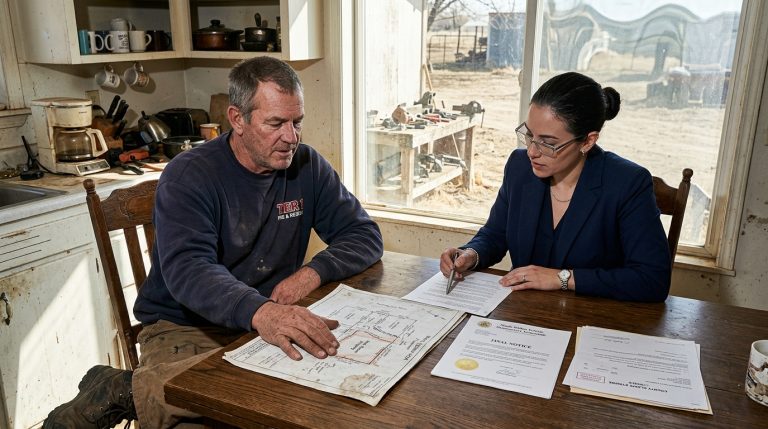
Daniel unfolded the thick, cream-colored parchment of the federal conservation easement, dated October 14, 1978.
The legal language was dense, stripped of human emotion, but its architecture was brilliantly absolute. It did not merely restrict building; it established a permanent, non-transferable environmental covenant supervised directly by the regional district office. Every square yard of the shoreline slope, extending three hundred feet inland from the ordinary high-water mark, was legally classified as an inviolable ecological buffer.
And buried in the fine print of paragraph seven was the clause that separated this land from every modern subdivision carved out of the surrounding farmland: Any unauthorized commercial alteration, civil engineering intrusion, or corporate infrastructure development initiated within the easement zone triggers an immediate, non-negotiable administrative stop-order, carrying mandatory remediation liabilities directly assigned to the authorizing entity, regardless of good-faith claims or municipal zoning overlaps.
In plain terms, the HOA hadn’t just crossed a property line. They had stepped onto a tripwire that had been sitting quietly in the dark for nearly fifty years, waiting for someone arrogant enough to mistake an old man’s quiet stewardship for vacant land.
Outside the shed, the diesel roar hitched again as the bulldozer shifted gears, pushing deeper into the brush near the lower dock.
Daniel closed the ledger slowly, his fingers tracing the embossed county seal on the easement document. He didn’t reach for his phone just yet. The machine down on the slope was still carving its first pass, digging a deeper trench into the soil, piling up evidence with every rotation of its steel tracks. Let them cut. Let them move the survey stakes another ten yards toward the water. Every foot of disturbed earth they added to the tally simply increased the weight of the lever he was about to drop.
He slid the ledger back into its shelf, picked up a roll of heavy galvanized wire from the corner, and walked back out into the cold grey morning, his eyes locked on the white dust rising from the shore.
CHAPTER 3: THE PAPER TRAIL AT THE COUNTY CLERKS OFFICE
The interior of the county courthouse smelled distinctively of damp masonry, floor wax, and the particular, unmistakable musk of paper that had surrendered its moisture decades ago.
Daniel pulled his canvas jacket tighter against the chill of the municipal hallway as he pushed through the heavy oak door marked County Records & Deed Registry. The digital clock on the wall read 10:14 AM, but the light filtering through the high, arched windows had the flat, grey quality of an impending squall. Outside, a pair of county utility trucks idled near the curb, their orange strobe lights painting rhythmic amber flashes across the peeling white paint of the brick facade.
He didn’t head for the public terminals where tourists traced local genealogies or weekend landowners looked up basic tax assessments. Instead, he walked past the waist-high mahogany counter toward the secure bays in the back, where the microfiche cabinets and the heavy linen-bound plat books were kept under lock and key.
Mrs. Gable looked up over the rim of her bifocals as his boots hit the linoleum. She had worked behind that counter since the Carter family still brought winter hay down to the rail siding, her memory as deep and tangled as the county’s property plats.
“You’re a long way from the western fence line, Daniel,” she said, her voice dry as rustling corn husks. “Especially on a Tuesday morning when the HOA has got half their board members walking around with clipboards like they own the watershed.”
“They’re moving fast down there,” Daniel said, leaning his forearms against the scarred wooden surface of the counter. “Faster than standard zoning adjustments usually allow.”
Mrs. Gable let out a short, nasal hum that passed for a laugh in the municipal office. “Zoning adjustments require public hearings, public notice, and a thirty-day review period. What they’re doing isn’t zoning, Daniel. It’s a land grab dressed up in a brochure.” She reached beneath the counter and slid a thick, green-cloth binder across the wood toward him. “You aren’t the first one to ask about those parcels this month. Elaine Mercer had her title clerk in here three weeks ago pulling every title chain from the seventy-eight subdivision split.”
Daniel flipped open the binder, his eyes scanning the onion-skin copies of land grants and corporate transfers. A sudden memory flickered at the edge of his concentration—his grandfather sitting on the back porch with a whetstone and a drawknife, running the steel blade back and forth with slow, rhythmic precision while explaining how a clear title was like a well-hung gate: if the hinges weren’t set deep into bedrock, the first heavy frost would throw the whole thing out of square.
“She’s looking for a loophole in the boundary covenants,” Daniel murmured, his fingers tracing the margins of an 1982 addendum.
“She’s looking for something that doesn’t exist,” Mrs. Gable corrected, tapping a long, ink-stained fingernail against the page. “She thinks because the surrounding farms converted to residential lots and signed onto the Lakeshore Estates charter, your grandfather’s sixty-two acres were just an oversight waiting to be corrected. She believes the narrative she’s selling to those doctors and tech executives across the water.”
“What narrative is that?”
“That your land is a bottleneck holding back the community’s economic potential,” she said quietly, leaning forward over the counter. “People with a lot of money don’t like looking at an open pasture when they can imagine a private marina in its place. They convinced themselves your grandfather was just an old farmer who didn’t know the value of what he was sitting on.”
Daniel looked down at the documents. The surface layer of the HOA’s campaign—the nuisance letters, the drone flights, the manufactured neighborhood complaints—began to lock into place with mechanical clarity. It wasn’t just petty neighborhood friction; it was an orchestrated psychological smokescreen. By keeping him busy defending fence lines and clearing driftwood, they were buying time for their commercial financing to clear committee, assuming he would eventually tire out and accept a below-market buyout for the lakefront strip.
They had engineered a brilliant illusion of administrative inevitability.
Except they had miscalculated the depth of the foundation. They thought they were fighting a single property owner over a disputed view, failing to realize that the land was anchored to a federal legal mechanism designed specifically to break the teeth of any corporate entity that tried to bite into it.
Daniel slid the binder back toward the clerk, his expression flat, betraying none of the calculated certainty tightening in his chest.
“Thanks, Mrs. Gable,” he said quietly, buttoning his collar against the wind. “Keep the register open. I think we’re going to need a few certified copies of that seventy-eight easement before the week is out.”
She watched him turn toward the exit, a faint, knowing smile touching the corners of her mouth. “Bring them back when you’re done, Daniel. And tell that board president of theirs that federal ink doesn’t wash off with a coat of white paint.”
He stepped back out into the grey morning air, the sound of the municipal truck tires hissing against the wet asphalt matching the steady, unrelenting rhythm of the work waiting back at the ranch.
CHAPTER 4: THE ESCALATION OF THE MACHINERY
The sound did not belong to the woods.
It was a tight, metallic vibration, like a swarm of hornets trapped inside an aluminum pipe, cutting through the steady sigh of the wind in the cedar canopy. Daniel did not look up immediately. He finished buttoning his collar, his fingers stiff against the cold brass snaps, before lifting his gaze toward the western ridge where the property line met the high pasture.
A small quadcopter hung fifty feet above the tree line, its twin carbon-fiber rotors blurring into grey disks against the overcast sky. A high-resolution optical lens tracked back and forth with mechanical precision, staring down into the interior of the Carter ranch like an unblinking eye mounted on a stalk.
Daniel stood by the side of his truck, his boots planted firmly in the loose gravel of the driveway, and simply stared back at it.
The machine held its position for three agonizingly long seconds, its internal gyroscopes whining as it compensated for a gust off the water, before tilting its nose downward and retreating rapidly toward the multi-million-dollar rooftops lining the opposite shore of the bay. It was the third time that week a commercial drone had mapped the perimeter, but today the flight path had shifted. They weren’t just checking the fence line anymore; they were photographing the equipment shed, the old barn roof, and the exact coordinates where the tractor trails intersected the lower ridge.
A minute later, the distant crunch of tires on the washboard road announced the arrival of another vehicle.
A white pickup truck bearing the magnetic logo of a regional engineering firm rolled to a halt near the lower cattle guard. Two men in high-visibility reflective vests stepped out, carrying aluminum tripods and an electronic total station. They didn’t knock on the front door or seek permission; they simply crossed the rusted wire boundary as if the property lines printed in the county plat book were mere suggestions subject to revision by majority vote.
Daniel walked slowly down the slope toward them, his steps measured and unhurried. The frost had frozen the top layer of mud into a brittle crust that shattered beneath his boot heels with sharp, glassy snaps.
“You’re inside the fence line,” Daniel said, his voice level, cutting across the low hum of the transit scope being locked onto its mount.
The older surveyor, a man with sun-weathered skin and a clipboard tucked tightly under his arm, didn’t look particularly surprised by the interruption. He glanced up, offering the defensive, practiced smile of a contractor accustomed to hostile landowners.
“We’re just running preliminary grade markers for the municipal utility easement extension,” the surveyor said, his tone breezy and administrative. “Lakeshore Estates filed the civil layout with the county planning commission last Friday. We’re authorized to verify the utility corridor coordinates.”
“There is no utility easement across this pasture,” Daniel said, stopping five feet from the tripod. “And the county planning commission hasn’t approved a utility variance for this parcel.”
The surveyor shifted his weight, his eyes flickering toward his partner before returning to Daniel. “Look, mister, we just follow the engineering schematics given to us by the board. According to our project maps, this strip of shoreline is designated for shared infrastructural access. The association is preparing the ground for the marina support road.”
It was the decoy secret laid bare in real time—the deliberate psychological conditioning designed to normalize their presence until the physical intrusion felt like an accomplished fact. They weren’t trying to hide the encroachment anymore; they were flaunting it, banking on the assumption that a lone landowner would eventually grow exhausted by the sheer friction of daily opposition and concede the perimeter.
“Pack your gear,” Daniel said quietly.
The surveyor’s smile tightened into a thin, flat line. “We’re under contract with the association, and we have a job to finish before the frost sets in.”
“You have a trespass citation waiting for you if that tripod moves another inch onto private ground,” Daniel replied, his voice dropping an octave, carrying the cold, flat weight of absolute certainty. “And if your total station touches the federal easement boundary down by the bluff, the conservation authority will seize every piece of aluminum in your truck before lunch.”
The surveyor stared at him for a long, heavy moment, searching Daniel’s face for a bluff, a flicker of hesitation, or a sign of fatigue. He found none. The silence between them stretched out, filled only by the distant lapping of grey water against the rocky shore below.
With a sharp, irritated flick of his wrist, the surveyor motioned to his partner. “Pack it up,” he muttered, turning his back. “We’re done here for today.”
Daniel watched them load the transit into the bed of the white truck, listening to the heavy slam of the tailgate echo across the pasture. They would leave, but they would report back to Elaine Mercer that the friction hadn’t broken the line. And that meant the board’s next move wouldn’t involve survey stakes or letters—it would require a heavier, more desperate play.
CHAPTER 5: THE MORNING THE HEAVY ENGINES RROLLED
The frost did not melt off the shaded side of the cedar break until noon, leaving a brittle white crust clinging to the dead grass along the bluff.
Daniel stood near the edge of the lower terrace, his weight braced against a stout oak sapling while he watched the western road through binoculars. The silence of the morning was abruptly shattered by a deep, mechanical growl—the rhythmic, concussive thrum of heavy diesel engines laboring up the washboard grade.
Four SUVs appeared over the crest of the hill, their tires throwing up twin plumes of pale dust against the dark timber. Behind them rolled two flatbed trailers loaded down with steel fencing panels, timber skids, and a medium-track caterpillar bulldozer painted a bright, aggressive yellow. The blue and silver logos of Lakeshore Estates gleamed against the pristine sheet metal of the lead vehicle.
They weren’t sending surveyors this time. They were bringing the physical footprint.
Daniel did not rush down the slope. He kept his movements slow and measured, walking back toward the ranch house to retrieve the heavy waterproof folder from the passenger seat of his truck. Inside were the certified copies from the county clerk’s office and the original plat diagrams stamped in seventy-eight.
When he reached the western fence line, the convoy had already pulled to a halt. The drivers’ doors swung open almost in unison. Elaine Mercer stepped out first, her polished boots hitting the gravel with an air of absolute finality. She wore a tailored wool coat that looked entirely out of place against the raw, weathered timber of the ranch, her sunglasses reflecting the grey expanse of the lake below.
She did not look like a woman negotiating a dispute; she looked like an executive executing a hostile takeover.
“Mr. Carter,” Elaine called out, her voice cutting cleanly through the steady rumble of the idling trailers. She didn’t wait for an acknowledgment before gesturing toward the workers tumbling out of the rear support trucks. “I trust you received our final notice regarding the community enhancement corridor. We’re opening the access route today.”
Daniel leaned against the weathered gray rail of the gate, his hands buried deep in his pockets. He didn’t speak. He simply watched as one of the workmen walked forward carrying a heavy pair of yellow-handled bolt cutters.
“You’re outside your jurisdiction, Elaine,” Daniel said finally, his voice low and even.
“Jurisdiction is a matter of interpretation,” Elaine replied smoothly, stepping closer to the boundary line while the workman moved into position beside the grandfather’s rusted padlock. “The association represents the economic future of this watershed. Your sixty-two acres cannot remain an administrative vacuum while the rest of the community moves forward. We offered you a fair valuation last month. You chose to ignore it.”
“It’s not an administrative vacuum,” Daniel said. “It’s a boundary.”
Elaine offered a thin, practiced smile that didn’t reach her eyes. “Boundaries are drawn by men, Mr. Carter. And they can be redrawn when they interfere with progress.” She flicked her hand toward the worker. “Cut the chain.”
The jaws of the bolt cutters clamped down with a sharp, heavy snap. The old iron link parted instantly, the severed padlock clattering uselessly into the dry weeds beside the ditch.
“Go ahead,” Elaine told the crew supervisor, pointing down the narrow ranch road toward the lower bluff. “Bring the dozer off the trailer. We start clearing the timber along the shoreline immediately.”
The heavy metal ramps groaned as the caterpillar began its descent, its steel treads biting savagely into the packed earth of the pasture road. The machine lurched forward, trailing a thick cloud of blue exhaust smoke that hung heavy in the cold air, its massive steel blade lowered to scrape away forty years of undisturbed topsoil.
Daniel watched the blade dig into the sod, carving a raw, black gash across the green slope. Every foot of earth the machine displaced was another piece of evidence locked into the record. He pulled his phone from his pocket, the screen cold against his thumb, and dialed the three pre-set numbers he had verified the previous afternoon.
“This is Daniel Carter,” he said quietly into the receiver as the roar of the diesel engine crested the hill. “Clearwater Lake Ranch, southern parcel. The Lakeshore Estates association has breached the easement boundary with heavy machinery. We require immediate enforcement dispatch.”
On the other side of the fence, the bulldozer dropped its blade another three inches, tearing through the root system of a cedar tree while Elaine Mercer stood calmly on the gravel road, watching the dirt fly with the serene, unshakeable confidence of someone who believed she had just won the entire lake.
CHAPTER 6: THE ARRIVAL OF FEDERAL ENFORCEMENT
The diesel note changed pitch before the trucks even crested the rise of the gravel road.
It wasn’t the heavy, double-clutching roar of construction transport or the high-revving whine of contractor pickups. It was the synchronized, measured deceleration of institutional vehicles—heavy-duty suspension systems settling evenly over the washboard ruts.
Daniel did not lower his phone. He kept the screen dark, his thumb resting against the edge of the casing while the lead vehicle—a dark, charcoal utility truck bearing the midnight-blue seal of the regional conservation authority—slowed to a halt directly behind Elaine Mercer’s parked SUV. A second vehicle, marked with the forest-green and gold emblem of the federal environmental protection division, pulled in behind it, followed tightly by the local sheriff’s department pickup.
The flashing amber light on the sheriff’s bar spun silently against the grey, overcast sky, casting a rhythmic red-and-amber glow across the fresh, black gash the bulldozer had just torn into the hillside.
Elaine turned away from the excavation site, her expression shifting smoothly from cold irritation to an practiced, accommodating mask. She smoothed the front of her wool coat with one hand, adjusting her sunglasses as she stepped forward to meet the lead inspector, clearly assuming the convoy had arrived to process a routine municipal utility permit or a minor setback variance.
“Good morning,” Elaine said, her voice carrying easily across the twenty yards of open pasture. “I’m Elaine Mercer, president of Lakeshore Estates. I assume you’re here regarding the utility corridor alignment. We’re prepared to expedite the local review filings if there’s any paperwork outstanding.”
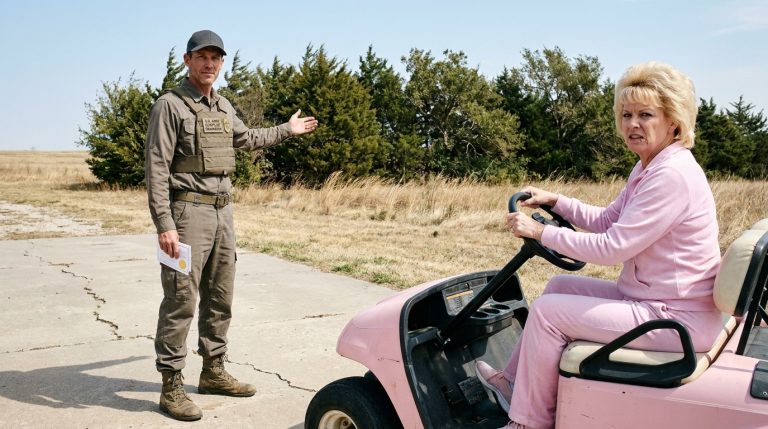
The lead inspector—a tall, weathered man in a canvas field jacket with a heavy leather badge case clipped to his belt—did not slow his stride. He stepped past her extended hand without a glance, his boots crunching heavily into the pulverized shale as he stared down the slope toward the caterpillar.
“Who authorized the excavation of this shoreline?” the inspector asked. His voice was flat, devoid of negotiation, carrying the absolute weight of statutory authority.
Elaine’s hand dropped to her side, her smile tightening at the edges. “This is part of the approved community marina expansion project for Lakeshore Estates. The association holds administrative jurisdiction over the watershed development framework.”
The inspector pulled a thick, waterproof binder from beneath his arm, flipping open the metal rings to reveal a creased, heavily stamped document bearing a 1978 date stamp. He didn’t look at Elaine when he spoke; his eyes remained fixed on the caterpillar idling fifty feet down the slope, its steel blade still resting deep in the damp earth of the protected root zone.
“You aren’t inside an association jurisdiction,” the inspector said, his tone dropping into a hard, measured cadence. “This parcel is bound by federal conservation easement number seventy-eight dash four-B. Every cubic yard of earth moved within three hundred feet of this high-water mark constitutes an unauthorized federal environmental violation.”
The silence that followed was broken only by the rhythmic, mechanical thrum of the dozer engine idling in neutral.
For a fraction of a second, Elaine’s posture fractured. The polished, unassailable confidence of the real estate broker flickered, replaced by a sudden, sharp confusion as she stared at the map held open in the inspector’s hands. “That’s impossible,” she said, her voice rising slightly over the wind. “We had our title clerk pull the district plats. This is zoned for residential-commercial transition.”
“Your title clerk missed the federal register,” the inspector replied coldly. He turned his head, signaling the second officer behind him. “Shut the machine down. Tag the equipment.”
The sheriff’s deputy moved past them with deliberate, heavy steps, a roll of bright orange seizure tape gripped in his hand. The bulldozer operator, sensing the sudden shift in gravity, cut the diesel engine. The abrupt silence that rushed in to fill the void was absolute, broken only by the faint, melancholy creak of the old cedar dock shifting against its pilings down on the water.
Elaine stepped directly into the inspector’s path, her voice sharpening into an edge of controlled panic. “You cannot seize this equipment. We have contracts with county suppliers. This land affects our community’s property values—”
“This land is federal trust,” the inspector interrupted, snapping the binder shut with a dry, authoritative slap. He looked past her shoulder, his eyes locking briefly onto Daniel standing by the fence line, before returning his gaze to the board president. “And right now, your association owns every dollar of the environmental remediation bill required to put this dirt back the way you found it.”
The stop-work order was pressed into her hand before she could offer a counter-argument, the white paper looking impossibly small against the dark wool of her sleeve.
CHAPTER 7: THE FRACTURING OF THE BOARD
The acoustic ceiling tiles of the Lakeshore Estates Clubhouse hummed with the low, oppressive vibration of too many people crowded into a space designed for leisurely committee meetings.
The emergency session had been called three nights after the federal stop-work orders were nailed to the caterpillar tracks and equipment trailers down on the Carter ranch. By seven o’clock, every folding chair in the hall was occupied, and a dense knot of homeowners stood pressed against the wood-paneled rear walls, their faces lit by the harsh fluorescent glare of the overhead fixtures.
Daniel did not attend the meeting. He remained three miles away on the porch of the ranch house, watching the distant, amber lights of the community center flicker across the dark surface of Clearwater Lake, listening only to the steady, rhythmic wash of the water against the rocks. But the consequences of that room rolled outward across the water as clearly as if he were sitting in the front row.
Inside the clubhouse, the atmosphere was tight with the unmistakable panic of investors realizing their capital had been tied to a sinking asset.
Elaine Mercer stood behind the mahogany podium at the head of the room, her usual clinical composure strained at the edges. She had spent the last twenty minutes attempting to frame the federal intervention as an administrative misunderstanding—a temporary zoning friction that the association’s legal counsel would resolve through standard municipal appeal channels.
“The development permits are undergoing routine restructuring,” Elaine insisted, her voice projecting clearly across the room, though her fingers gripped the edges of the podium with a white-knuckled intensity. “The association board acted in full alignment with community enhancement goals. Once the environmental assessment is processed, the marina expansion will resume.”
A heavy silence hung over the first three rows before a doctor who owned one of the multi-million-dollar glass houses across the bay stood up.
“Restructuring doesn’t cost three hundred thousand dollars in federal fines, Elaine,” he said, his voice flat and hard. “The notices posted on those trailers down on the Carter property carry mandatory remediation liabilities assigned directly to the authorizing board. That means the association—us—is on the hook for the entire restoration bill.”
Murmurs rippled through the room, a low, angry tide swelling against the walls.
“We were told the land was clear,” another voice called out from the back. “We were told the title search came back clean before we voted on the resort assessment. Who signed off on the engineering contracts without verifying the federal easement status?”
Elaine’s jaw tightened. She opened her mouth to speak, but the polished, transactional authority she had wielded over the neighborhood for years had vanished. The illusion that rules could be rewritten by majority vote or corporate optimism had collided directly with the unyielding reality of federal environmental law.
One by one, the other board members seated behind her began shifting uneasily in their chairs, physically distancing themselves from the podium. The treasurer slumped forward, resting his forehead in his hands; the vice president stood up abruptly and walked toward the exit without offering a word of defense.
The fracture wasn’t subtle; it was total.
By the time the meeting dissolved into a shouting match twenty minutes later, the association leadership had effectively ceased to exist. The board that had spent months orchestrating drones, survey markers, and manufactured rumors to force a buyout of the Carter shoreline had discovered a fundamental truth about the land: you cannot asphalt over a history written fifty years deep into bedrock without breaking your own foundation in the process.
Down on the ranch, the wind shifted from the north, carrying the sharp, clean scent of cedar and damp earth across the dark pasture, undisturbed and entirely secure.
CHAPTER 8: THE RETURN OF THE SILENCE
The restoration crews finished pulling their heavy equipment off the lower bluff just as the first spring thaw turned the frozen ruts of the access road into soft, dark loam.
Daniel stood near the edge of the terrace, watching the last flatbed truck bounce slowly toward the main gate, its tires kicking up a light spray of wet gravel. The raw scar carved by the caterpillar tractor three months earlier had already been blanketed with erosion control matting and seeded with native switchgrass under the strict supervision of the federal conservation officer.
There were no more survey flags fluttering along the tree line, no more quadcopters whining above the cedar canopy, and no more glossy envelopes in the mailbox bearing the blue and silver emblem of Lakeshore Estates.
The financial wreckage of the board’s ambition had settled with the slow, crushing weight of an unpayable ledger. The hundreds of thousands of dollars in federal environmental penalties and mandatory site restoration costs had not vanished into administrative appeals; they had landed squarely on the shoulders of the corporate entity that authorized the breach. Within weeks of the emergency clubhouse meeting, the association was forced to levy emergency assessments across its membership, triggering a cascading wave of internal litigation, board resignations, and property value adjustments that effectively neutralized any further development plans along the western shore.
Elaine Mercer had quietly placed her luxury lakefront home on the market before the spring thaw was fully underway, her presence fading from Clearwater Lake as quickly as the administrative illusions she had tried to build.
Daniel turned away from the lake and walked back toward the ranch house, his boots making a familiar, heavy crunch against the gravel path.
Upstairs in the attic, the air still smelled of dry pine boards and old paper. The wooden chest near the back wall remained open, its contents sorted across the workbench. He picked up the brown leather ledger, sliding it open to the entry dated October 14, 1978.
His grandfather’s handwriting was steady and deliberate across the yellowed page. It had never been about merely owning sixty-two acres of dirt and timber; it had been an act of deliberate foresight. The conservation easement was never designed as a simple defensive shield against local zoning disputes—it was a pre-engineered legal trap constructed decades in advance, calculated to exploit the absolute arrogance of modern commercial developers the moment they attempted to monetize the shoreline.
The grandfather had understood that men who measure land purely by its profit margins will always trip over the laws designed to protect it.
Daniel carried the ledger downstairs and stepped out onto the front porch, the cool afternoon breeze carrying the sharp, clean scent of damp earth and cedar resin.
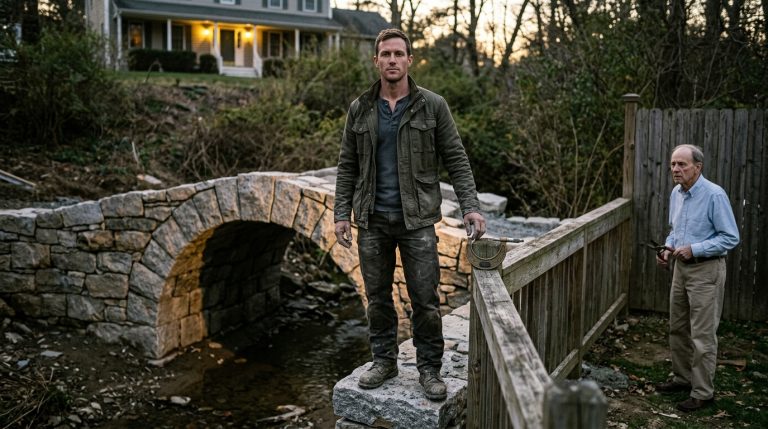
He walked down to the old dock where the water lapped rhythmically against the weathered pilings. One of the iron drift bolts securing the outer stringer had worked itself loose during the winter storms, leaving the corner board to sway slightly with the current.
He set his toolbox down on the weathered planks, pulling a heavy adjustable wrench and a replacement galvanized bolt from the tray. Kneeling down on the wood, he lined up the joint, the rusted iron groaning softly under the torque as he turned the nut down until it bit firmly into the solid timber.
The dock settled, steady and immovable against the push of the lake.
Out on the water, a pair of blue herons glided low across the surface, banking smoothly toward the shelter of the cedar point before disappearing into the reeds. The silence that settled over the shoreline was complete—heavy, unbroken, and moving at the slow, ancient pace of the seasons.
Daniel wiped a smudge of grease from his hands with a rag, sat back against the wooden piling, and looked out across the open water as the sun dipped below the western ridge, leaving the Carter ranch exactly as it had always been.