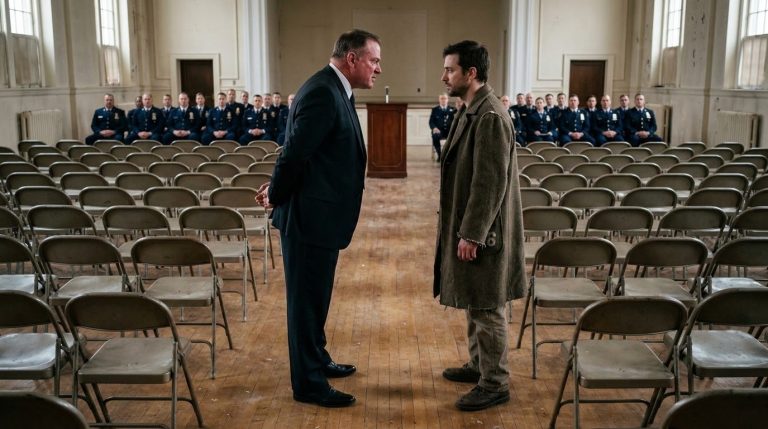
The Weight of Faded Satin: A Journey Through Time, Resilience, and the Echoes of Honor
CHAPTER 1: The Fragile Ring
Maya traced the condensation ring on the glass countertop, her fingertip lingering on the cold, damp circle. It was a perfect, temporary shape—a mark of something that had existed for a moment and was already vanishing into the stale, dust-choked air of Henderson’s Pawn. The shop smelled of copper, forgotten intentions, and the lingering, metallic scent of other people’s disappointments.
It was Tuesday, and the world was moving at the speed of rust.
Then, the air shifted. It was an atmospheric pressure drop, the kind that happens just before a summer storm. She didn’t hear the door close, but she felt the change in the room’s weight. She kept her eyes on the ring on the glass, letting the silence stretch, testing the boundaries of her own boredom.
“I have these,” a voice whispered.
It wasn’t a request. It was an offering—a dry, brittle sound, like dead leaves skittering across cracked pavement.
Maya finally looked up.
The man standing on the other side of the counter was a study in eroding geometry. He was impossibly thin, his frame draped in a tweed coat that had once been tailored for a man of substance, a silhouette of a different era. Now, it hung from his shoulders like a shroud. He stood with a ramrod posture that seemed to be fighting a losing war against the pull of the earth. But it was his hands that held her attention. They were knotted with age, the skin translucent as antique parchment, trembling with a fine, high-frequency vibration that betrayed nerves, or perhaps just the sheer exhaustion of holding himself together.
He placed a velvet-lined box on the glass. The movement was slow, agonizingly deliberate. He didn’t slide it toward her; he set it down as if the box contained the weight of an entire decade.
Maya’s breath hitched. She reached out, her own fingers steady, contrasting with his, and lifted the lid.
Inside, nested in satin that had long ago lost its luster, lay three medals. A Bronze Star, a Purple Heart, and a Distinguished Service Cross. The ribbons were frayed at the edges, their colors muted to the soft, dusty hues of a dying sunset. They weren’t just metal and fabric; they were saturated with a history that felt heavy enough to shatter the glass between them.
“I need…” the man started, his gaze drifting to the barred window. He didn’t finish the sentence.
Maya picked up the Purple Heart. It was cool, heavier than she expected. She turned it over, the familiar name engraved on the back—Arthur Pendleton—glinting under the harsh fluorescent lights of the shop.
She looked up at him. His eyes were a pale, watery blue, devoid of the usual pleading she saw in the eyes of customers. They were vacant, resigned to a future that had run out of road.
“Mr. Pendleton,” Maya said, her voice softer than she intended. She hesitated, her eyes flickering toward the security camera in the corner—the little black dome that recorded every transaction, every humiliation. She could smell the faint, musty odor of the coat, a scent of damp basements and unheated rooms.
“I’m listening,” she said, though she knew exactly what he was about to ask. And beneath the medals, tucked against the velvet, she noticed a small, folded scrap of paper. It wasn’t part of the set. It was tucked away, almost hidden, as if it were a shame he couldn’t quite bring himself to discard.
CHAPTER 2: The Archive of Discarded Promises
Maya’s fingers hovered over the scrap of paper. It was tucked so deeply into the velvet lining of the box that it seemed less like an oversight and more like a tombstone. She felt the shop’s silence pressing in against her, the ticking of the wall clock sounding like an irregular heartbeat.
“Is there a problem?” Arthur asked. His voice was a thin, reedy sound, barely audible over the hum of the overhead lights. He was still watching her, his pale eyes tracking her every movement with a terrifying, bird-like intensity. He wasn’t looking at her as a pawn broker anymore; he was looking at her as the final guardian of something he had carried for fifty years.
Maya didn’t answer immediately. She unfolded the scrap of paper. It wasn’t just a note; it was a formal, typed letter from a government agency, dated forty years ago. Her eyes scanned the dry, bureaucratic language, and the blood drained from her face. It was a denial of benefits, citing a lack of corroborating evidence for service-related injuries. It was a cold, clinical piece of paper that effectively erased a man’s sacrifice with a single, bureaucratic stroke of a pen.
As she read, the dust motes dancing in the light filtering through the grime-streaked window seemed to slow. A sudden, visceral memory surged through her—not her own, but a phantom echo of a command shouted across a rain-slicked field, a memory of mud and iron that she had never lived. It was a sensory splinter, a shard of someone else’s nightmare that Arthur’s proximity had triggered. She gripped the counter, the edge biting into her palms, tethering her to the present.
“This,” Maya whispered, her voice tight. “Mr. Pendleton, this is… they said there was no record of your division’s actions in that sector. They called it a clerical error.”
Arthur’s shoulders, which had been holding a fragile, ramrod dignity, seemed to sag, just a fraction. It was the movement of a man whose armor had finally been breached by a soft word. He looked away, his gaze fixing on a display of cheap, tarnished pocket watches.
“They said a lot of things,” Arthur murmured. “They said it didn’t happen. They said the maps were wrong. They said I was a ghost.”
Maya felt a sudden, frantic urge to wipe the counter, to remove the condensation ring, to fix the imperfection that had started this entire unwanted journey. But she couldn’t. The truth of the letter sat there, a jagged piece of reality that refused to be smoothed over. She realized then that Arthur wasn’t just selling his medals because he was hungry. He was selling them because he had finally reached the point where the cost of holding onto his truth—the truth that he existed, that his friends existed, that they had suffered—was higher than the cost of losing the silver.
She looked at the medals again. The Bronze Star, the Purple Heart, the Distinguished Service Cross. In the harsh, artificial light of the shop, they looked like beautiful, cruel ornaments. They were tokens of a debt that society had defaulted on.
“Mr. Henderson is going to be back in twenty minutes,” Maya said, her voice dropping into a professional register that felt like a lie. She wasn’t talking to the pawn broker anymore; she was talking to the woman who was about to break the rules. She looked at the security camera, that silent, glass-eyed judge. She needed a distraction. She needed a way to stall the inevitable, to keep the shop from closing in on them while she figured out what to do with a piece of paper that could ruin her, or save a soul.
“I need to,” she began, then stopped. She couldn’t call a specialist. There was no one to call. “I need to verify the provenance of these,” she said, her voice steadier now. “It’s a requirement for items of this… high historical value. I have to lock them in the safe to register them in the system.”
Arthur nodded, a slow, jerky motion. He didn’t seem to care about the money anymore. He looked tired—a weariness that went deeper than bones, deeper than blood. He shuffled toward the plastic chair in the corner and sat, his posture failing him for the first time. He looked like a statue that had been left out in the rain too long, eroded by the very elements he had once stood against.
Maya gathered the medals and the letter, her hands moving with a fluid, terrified precision. She walked to the back of the shop, her heart drumming against her ribs like a trapped bird. She knew she was standing at the edge of something irrevocable. Every step she took away from Arthur was a step further into a territory she didn’t know how to navigate.
She reached the small office and clicked the light on. It was a cramped space, smelling of old invoices and floor wax. She sat at the desk, the computer monitor flickering into life, casting a cold blue glow over her face. She looked at the medals, then at the letter. She had to act. But as she reached for her phone, she realized the magnitude of what she was about to do. She wasn’t just stalling; she was pulling a thread that could unravel the entire fabric of this gray, quiet town.
She looked out through the glass partition. Arthur was sitting in the corner, head bowed, his hands resting on his knees. He looked like he was waiting for a bus that would never arrive. Maya took a breath, the air in the office tasting of stale coffee and fear. She tapped the screen, the light reflecting in her eyes, and began to type. She didn’t write about the value. She wrote about the letter. She wrote about the denial. She wrote about the cost of being forgotten.
Outside, the street was quiet. The world was still turning, oblivious to the fact that, inside a small, dusty shop on Elm Street, a single act of defiance was beginning to take root.
CHAPTER 3: The Digital Ripple
Maya’s thumb hovered over the ‘Post’ button, her pulse thrumming in the hollow of her throat. For a heartbeat, the screen was just a grid of pixels—the blue light reflecting off her pupils, painting her face in the synthetic glow of a modern confessional. Then, she pressed down. A soft click, almost imperceptible, and the truth about Arthur Pendleton was out, cast into the vast, uncaring architecture of the internet.
She didn’t move. She couldn’t. The office felt suddenly cavernous, the walls pressing in with the accumulated weight of a thousand pawned lives. Arthur was still in the front, his head bowed, the posture of a man who had long ago resigned himself to the gravity of his own misfortunes. He was a silent monolith in the corner of the shop, unaware that a digital storm was already gathering around him.
The first notification buzzed—a sharp, metallic vibration against the desk surface. Then another. Then a chorus. The phone began to jitter across the wood like a startled insect.
Maya looked out through the glass partition. Arthur shifted, his hand rubbing the back of his neck, his eyes drifting toward the window. Outside, the sky, which had been a flat, oppressive gray for most of the afternoon, suddenly tore open. Rain hammered against the glass with the intensity of a thousand tiny fists. It was a torrential, cold downpour that instantly transformed the street, turning the familiar asphalt into a shimmering, distorted mirror. The sudden deluge muffled the sounds of the city, plunging the shop into a heavy, claustrophobic silence that felt intentional.
The buzzing of her phone reached a crescendo. She picked it up. Comments were cascading down the screen—a waterfall of disbelief, rage, and a sudden, sharp surge of communal empathy. This is wrong. Where is this place? I’m on my way.
Maya’s stomach knotted. She hadn’t expected a reaction—or rather, she had expected the world to remain indifferent, allowing her to bear the burden of this choice in isolation. But this wasn’t isolation. This was ignition. She saw a share from a local news account, followed by a series of urgent messages from strangers demanding the exact address.
“Maya?”
She jumped. Arthur was standing at the threshold of the office, his back stiff, his hands clutching the front of his coat. He looked bewildered by the sudden shift in the air, his watery blue eyes searching hers for an explanation.
“Is something wrong? I heard… I thought I heard a ringing.”
“It’s nothing, Arthur,” Maya said, her voice betraying her by cracking slightly. She shoved the phone into her apron pocket, the screen still flickering with notifications. “Just an update. From the… the specialist.”
She lied with the practiced ease of someone who had spent too much time hiding things, but the weight of the phone against her thigh felt like a burning coal. She moved past him, her boots clicking sharply on the worn linoleum. She had to reach the front door. She had to see what the rain was hiding.
The shop felt different now. The smell of old paper and rust was being overwhelmed by the scent of ozone and wet pavement seeping in through the door frame. She looked at the cash register, the silent, unblinking eye of Mr. Henderson’s control, and then at the front window. The rain was so thick that the world outside was a blurry, impressionistic smear of colors—the yellow of a streetlamp, the white of a passing headlight.
“They’re not coming, are they?” Arthur asked from behind her. His voice wasn’t accusing. It was just hollow. “The specialists. They never do.”
Maya gripped the edge of the counter, her knuckles turning white. She thought of the letter—the bureaucratic erasure of Arthur’s life—and then of the phone in her pocket, humming with the growing anger of a hundred strangers. She realized then that she hadn’t just posted a plea; she had ignited a beacon.
“They are coming, Arthur,” she said, though she wasn’t sure if she was talking to him or to the storm. “Just not the ones you’re used to.”
A car screeched around the corner, its tires hydroplaning on the flooded street, and pulled to a halt in front of the shop. A young woman hopped out, drenched in seconds, clutching a phone in one hand and a bag of groceries in the other. She sprinted toward the door, her face a mask of determined, wet intensity.
Maya’s heart hammered. This wasn’t just a transaction. This was a crack in the dam. She reached for the lock on the front door, the metal cold and slick under her touch. She had broken the rules of Henderson’s Pawn, but as she watched the woman reach for the handle, she felt a strange, terrifying sense of clarity. The shop wasn’t a tomb anymore. It was a crossroads.
She unlocked the door and swung it open, the rain misting into the room, cooling the stifling heat. The woman stumbled inside, shivering, her eyes darting around the shop until they locked onto the fragile, tweed-clad figure of Arthur Pendleton.
“Are you… are you Arthur?” the stranger asked, her voice breathless.
Arthur stood frozen, his hands trembling—not with nerves this time, but with a shock that seemed to reach into the very marrow of his being. He looked at Maya, his eyes wide, the pale blue depth of them shimmering with a sudden, impossible light.
Maya stood back, a spectator to her own defiance. The ripple had become a wave, and she had no idea how to swim.
CHAPTER 4: The Chrome Tide
The woman at the door was just the precursor, a single drop of rain before the deluge. Before she could even articulate her next words to Arthur, the air outside shifted. It wasn’t the natural shift of a weather front; it was a rhythmic, guttural vibration that bypassed the eardrums and settled directly into the marrow of Maya’s bones. The windowpanes rattled in their frames, a frantic, glass-on-wood percussion.
“They’re here,” the woman said, looking over her shoulder. She sounded terrified and exhilarated all at once.
Maya stepped past her, moving to the threshold. Through the curtain of rain, she saw them. It wasn’t a mob; it was an organized, kinetic force. Motorcycles, black and chrome, cut through the downpour in tight formation. They didn’t park haphazardly; they arrived with the geometric precision of a military unit. The lead bike, a massive, custom-built machine, pulled up to the curb with a final, barking roar that died into a heavy, expectant silence.
A man dismounted. He was a mountain of a human, his frame clad in heavy leather, his beard braided into two thick, grey ropes. He moved with a deliberate, grounded grace, his boots heavy on the wet sidewalk. He didn’t look at the crowd that had started to gather; he looked only at the pawn shop, his gaze scanning the interior until it pinned onto Arthur.
Maya felt a sudden, frantic need to step in front of the old man. She didn’t know these people. She only knew the stories, the labels, the warnings. But as the man—Sarge—approached the door, his eyes met hers. They weren’t the eyes of a predator. They were clear, almost unnervingly intelligent, and they carried a weight of recognition.
He stopped at the door, pulling off his helmet to reveal a face etched with the same lines of endurance she had seen on Arthur’s. He waited for her to open it.
Maya turned back to Arthur. He was still standing by the counter, his hands clenching the edge of the velvet box so tightly his knuckles were white. “Arthur?” she whispered.
“I know them,” he replied. His voice was no longer brittle. It was steady, anchored by something Maya couldn’t yet see.
Maya pushed the door open. The smell of gasoline and wet leather flooded the shop, pushing back the stale scent of dust and neglect. Sarge stepped inside. He stood over six feet tall, his presence shrinking the already cluttered pawn shop into an intimate, high-stakes space. He didn’t loom; he stood at a careful, respectful distance.
“Arthur Pendleton,” Sarge said. His voice was a low, gravelly rumble, like stones shifting in a riverbed. He didn’t look at Maya, or the stranger in the doorway. He addressed the veteran with a formal, almost archaic grace.
“I am,” Arthur replied, stepping forward.
Sarge moved toward him, his gaze falling momentarily on the velvet box. Then, his eyes shifted to the patch on his own leather cut. Maya noticed it then—a small, embroidered detail on the man’s vest, a sequence of numbers stitched into the fabric. Her heart skipped. She had seen that sequence before, just moments ago, on the bottom corner of the government denial letter she had tucked into the desk drawer.
The coincidence was a physical shock, a needle-prick of realization that this wasn’t random. This was a convergence.
Sarge didn’t speak the connection aloud. He simply reached out a hand, massive and calloused, and took Arthur’s hand in his. The handshake lasted long, a silent transmission of history. “Unit, Second Infantry,” Sarge said, his voice dropping an octave. “We heard you were in need of a watch.”
The metaphor was clear. They were here to stand guard.
“I’m not in need of anything, son,” Arthur said, his voice holding a sliver of that old, brittle humor.
“The hell you aren’t,” Sarge replied, his tone shifting from formal to protective. He turned then, his eyes finally landing on Maya. “You’re the one who sent the signal?”
Maya nodded, unable to find her voice. Her hands were shaking again, but not from fear—from the sheer, kinetic energy of the room. She felt like she was standing in the eye of a storm that she had helped summon.
“Good work,” Sarge said, the praise simple and unadorned. He turned back to his men—who were now crowding the entrance, a silent wall of leather and resolve—and gave a single, sharp nod.
The pawn shop, once a place where dreams were traded for pennies, had become something else entirely. It was now an outpost. The air felt charged, metallic and alive, and as the rain continued to batter the roof, Maya realized that the wall between her and the truth was beginning to thin. She had broken the system’s rules, but she had invited something far more permanent into her life.
She moved back behind the counter, her eyes darting to the office door, where the pension letter lay hidden. She knew that what she had uncovered wasn’t just a denial; it was a key. And as she watched the giants in leather surround the fragile old man, she knew they were about to use it.
CHAPTER 5: The Architecture of Memory
The bungalow had been stripped to its ribs. Sunlight, sharp and indifferent, poured through holes in the roof where the rot had finally conceded to the bikers’ sledgehammers. Dust hung in the air—a thick, golden suspension of pulverized lath and plaster that coated Maya’s skin, leaving her feeling like she was walking through the ruins of a life that had been systematically erased.
She moved through the hallway, her boots crunching on debris. Sarge was in the kitchen, his massive frame hunched over the subfloor. He was working with a surgical focus that seemed entirely at odds with his rugged appearance. Nearby, a man with ‘Plumber’ stitched onto his vest was wrestling with a pipe that groaned under his grip, the metal shrieking in protest.
“Keep the pressure steady,” Sarge muttered, not looking up.
Maya held a flashlight for him, her arm aching. She had been here for hours, the rhythm of the work becoming a heartbeat for the house. But every time she caught a glimpse of the original structure—the way the walls had been patched with thin, mismatched scraps of wood—she felt a cold knot of dread. It wasn’t just poor maintenance. It looked like someone had been searching for something, peeling back the layers of this house with a frantic, systematic greed.
She retreated to the kitchen counter—or what was left of it. Her hand brushed against a loose floorboard near the pantry. It wobbled. She knelt, her fingers catching on a splintered edge. She pulled. The wood gave way with a sharp, dry crack that seemed to echo through the empty house.
Beneath the board was a metal tin, sealed with heavy, industrial-grade tape.
Her breath caught. She didn’t look at Sarge; she looked at the hidden space. This was the Layer 1 decoy, the physical manifestation of the secret she had stumbled upon. She slipped the tin into her pocket, her heart hammering a frantic rhythm against her ribs. She felt watched, a sudden, paranoid prickle of sweat on her neck. Was it the weight of the house, or the realization that she was currently holding something someone had gone to great lengths to hide?
The hammer-blows in the other room suddenly ceased. The silence that followed was heavy, pressurized.
Maya turned, her movements slow and deliberate. Sarge was standing in the doorway, his silhouette blocking the light. He wasn’t looking at her with hostility, but there was an intensity in his gaze that made the breath catch in her throat. She briefly mistook his focused scrutiny for aggression, her mind reeling with the sudden, irrational fear that he had known about this cache all along—that he was here to reclaim it, not restore it. She blinked, the dust in her eyes making him seem to sway, a giant made of shadow and intent.
“Everything alright, kid?” he asked. The question was soft, almost gentle, cutting through the haze of her panic.
Maya swallowed, her hand gripping the tin in her pocket. “Fine,” she managed to choke out. “Just… the flooring. It’s worse than we thought.”
Sarge stepped into the kitchen, his boots quiet on the joists. He stopped inches from her. The scent of sawdust and fresh, raw pine was overpowering. He looked at the hole in the floor, then at her. He knew. The realization hit her with the force of a physical blow. He wasn’t just a veteran; he was a man who understood the architecture of secrets.
“Some things,” Sarge said, his voice a low, resonant rumble, “are buried for a reason. You have to decide if you’re ready to see what they are.”
He didn’t demand the tin. He didn’t even reach for it. He simply stood there, a guardian of thresholds, waiting for her to make the first move. Maya felt the weight of the secret in her pocket, a cold, hard presence that felt like it could anchor her to the truth or pull her under. She thought of Arthur, sitting on the porch, waiting for a past that was finally being dragged into the light.
She realized then that the bungalow wasn’t just a structure; it was a shell. And as she looked at the man who had brought a hundred motorcycles to defend an old man’s dignity, she knew that the secret she held wasn’t just about money. It was about a debt that reached back to the muddy fields of Normandy.
“I’m ready,” she said, her voice steady for the first time that day.
She pulled the tin from her pocket and set it on the makeshift counter. The sound of the metal meeting the wood was final, a gavel striking in a silent court. Sarge nodded, his expression unreadable, and he reached out, his large fingers tracing the edge of the taped seal. They were about to open the heart of the house, and Maya knew that once the seal was broken, there would be no turning back to the quiet, dusty world she had occupied only days ago.
CHAPTER 6: The Promise Kept
The tin didn’t contain gold, or stacks of cash, or the bureaucratic answers Arthur had spent half a lifetime hunting. It contained photographs. Faded, curled at the edges, and brittle as autumn leaves, they depicted two young men in uniform, their grins wide and reckless against a backdrop of European stone and shadow. Beside them sat a single, handwritten journal and a small, tarnished ring—the token of a pact made in the mud of Normandy.
Sarge held the photograph, his eyes scanning the faces of the soldiers. He didn’t look at Maya, but his thumb brushed the image of the young man standing next to Arthur. “This isn’t a pension denial,” Sarge murmured, his voice thick with a sudden, uncharacteristic softness. “This is a pilgrimage.”
Arthur walked into the kitchen, his gait slow but steady, a man who had finally stopped fighting the wind. He took the photograph from Sarge, his hands, for once, perfectly still. “Thomas,” he whispered, the name hanging in the room like a benediction. “He didn’t make it to the line. I promised him I’d bring him home, in my own way. I never had the means to cross the ocean again. So I kept his face here, in the dark, waiting for the day I could finish the work.”
Maya looked at the letters. They weren’t just correspondence; they were a record of a ghost. The pension denial letter she had found earlier—the one that had felt like a cruel, systemic erasure—was actually the catalyst that had kept Arthur from returning, a paper cage he couldn’t break.
“The money,” Arthur said, looking at the bikers who filled the skeletal kitchen, their hard faces softened by the gravity of the moment. “The money wasn’t for bread, Sarge. It was for the ticket. I was selling my medals because I thought they were the only currency I had left to buy a final walk across that field.”
The silence in the bungalow wasn’t oppressive anymore. It was sacred. Sarge stepped forward and placed a hand on Arthur’s shoulder. “Then we’re going to help you finish the work, Arthur.”
The final resolution didn’t happen in a shout or a clash. It happened in the quiet weeks that followed. The bungalow was finished, not as a monument to past pain, but as a home for a man who was no longer a ghost. Maya, working with the club’s resources, managed to navigate the legal corridors that had blocked Arthur for decades, finally securing the acknowledgment he had been denied. It wasn’t about the money—the club had more than enough to cover the journey—but about the principle.
Poetic justice, she realized, was rarely a thunderclap. It was a slow, steady correction of the scales.
The payoff came on a crisp autumn morning at the airport. The entire club was there, a legion of leather-clad men standing in silent, respectful formation as Arthur checked his bags. He wore his own cut now, his name stitched over the heart, but he carried his medals in the box, safe and revered.
Sarge stood at the front, his expression serious. “You have your orders, Arthur,” he said, handing him an envelope containing the flight documents and a contact in France who would guide him to the plot of ground he had dreamt of for fifty years. “You get there, you do what you need to do, and you come back. We’ll be here.”
Arthur looked at them—all of them. He wasn’t the broken man who had entered the pawn shop. He was someone who had been seen. “I’ll see you all on the other side of the Atlantic,” he said, his voice ringing with a new, quiet strength.
When he left, the terminal felt strangely empty. Maya stood beside Sarge, watching the plane taxi onto the runway. The struggle had left its mark on her, too; she was no longer the girl tracing circles on a glass counter, waiting for the days to bleed into one another. She had learned that the world was only as broken as the people who refused to look at it, and that courage was often just a matter of staying put when everyone else told you to walk away.
The cooldown that followed the weeks of activity was a profound, atmospheric peace. Maya spent her afternoons at the club, managing the books, the accounts, the charities—the mundane, vital work of keeping a community whole. She often found herself in the pawn shop, which she now ran with a sense of purpose. She had taken the old counter and refinished it, scrubbing away the layers of dust and disappointment until the wood glowed with a warm, resilient light.
She kept the condensation ring. She didn’t wipe it away this time. It was a reminder—a mark of a moment that had changed the trajectory of her life.
Months later, Arthur returned. He didn’t come back with fanfare. He came back a few pounds lighter, his face bronzed by a foreign sun, but his eyes were clear, the haunted, watery look replaced by a profound, settled calm. He walked into the pawn shop, the bell chiming a bright, musical note.
He didn’t need to say anything. He walked to the counter, placed a small, polished stone from a field in Normandy on the glass, and smiled.
Maya looked at the stone, the texture cool and smooth under her touch. She reached out and placed her hand over his—a quiet, grounded connection that needed no words. The promise was kept. The history was honored. And in the silence of the shop, the echoes of the past finally fell into step with the present, moving forward into a future that was, for the first time, entirely their own. She had repaired the broken pieces of a stranger’s life, and in doing so, she had found the missing pieces of her own.