A Sovereign’s Code of Soil and Iron: The Tactical Demolition of Harmony Creek’s Petty Queen
CHAPTER 1: THE BOUNDARY LINE
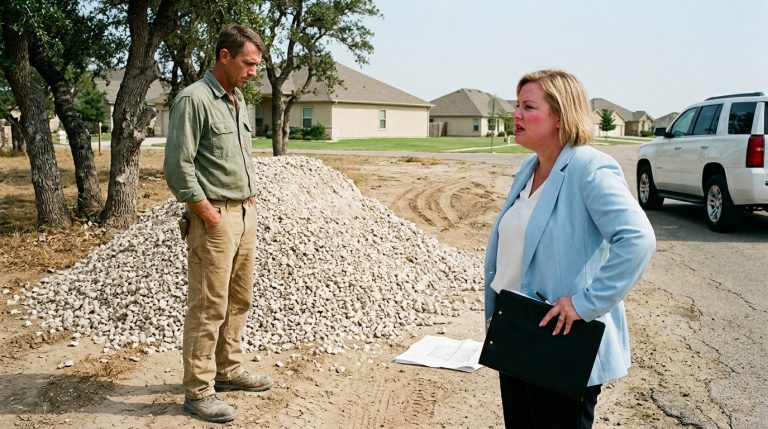
The white sedan idled at the foot of my asphalt, its engine humming a low, uneven rhythm that vibrated through the soles of my boots. Five miles under the limit. No turn signal. The driver didn’t park; she staged.
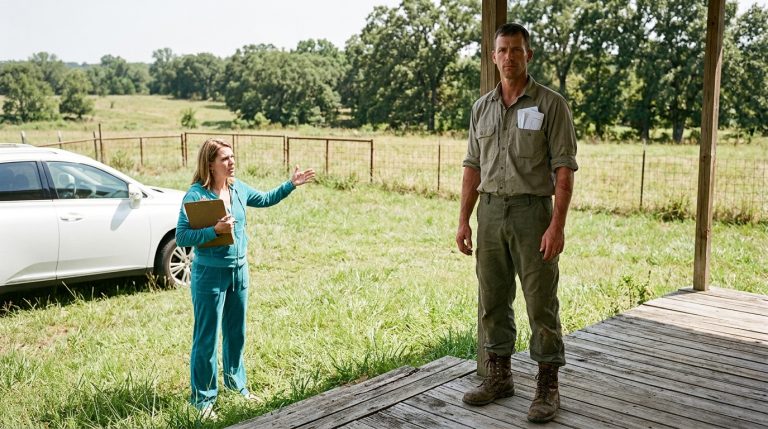
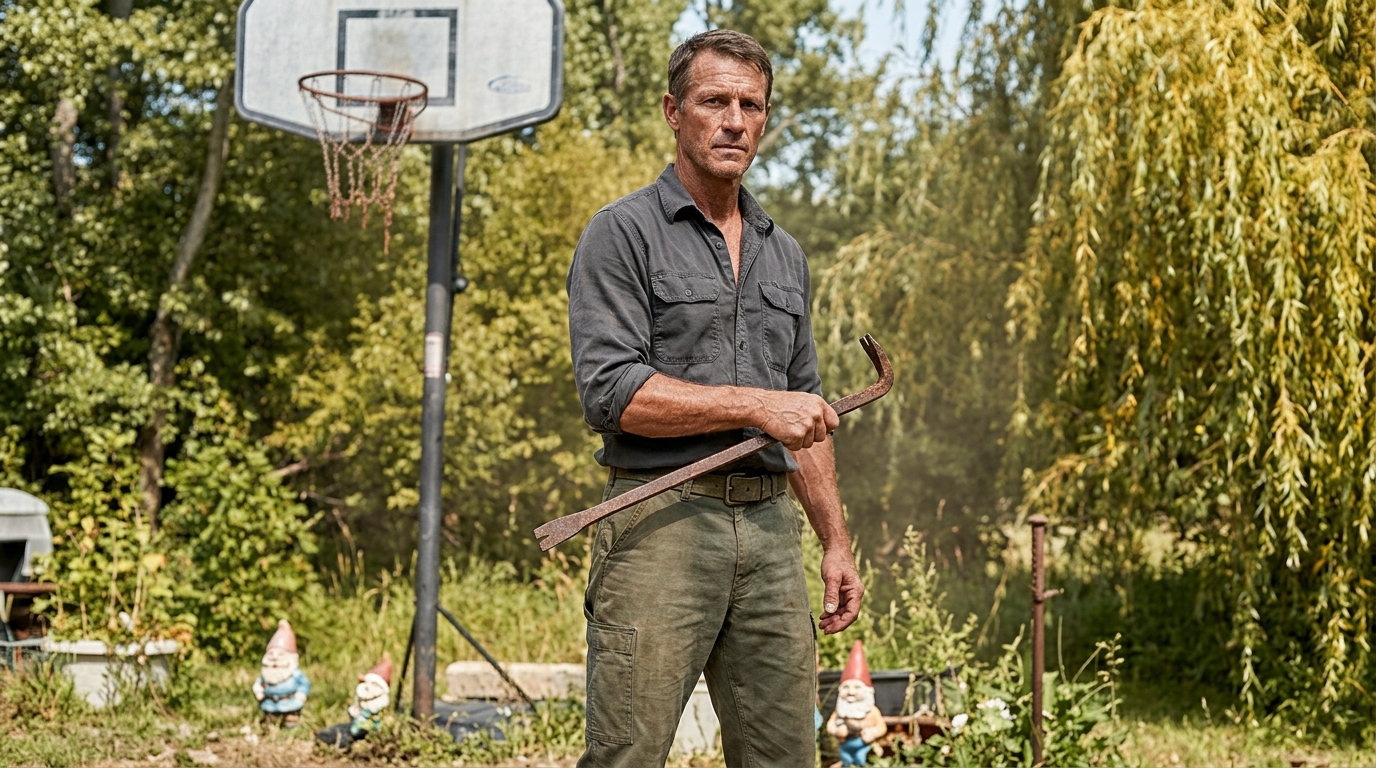
I didn’t drop the pry bar. I held it across my forearm, feeling the flat, rusted iron bite into my palm while the sun baked the fresh coat of primer on the porch railings. Twenty years in the Army Corps of Engineers teaches you to read terrain before you touch it. Right now, my terrain was two acres of oak and limestone, and the threat was five feet of floral polyester stepping into the dust.
The Lexus door shut with a heavy, double-latch thud.
“Mr. Caldwell.”
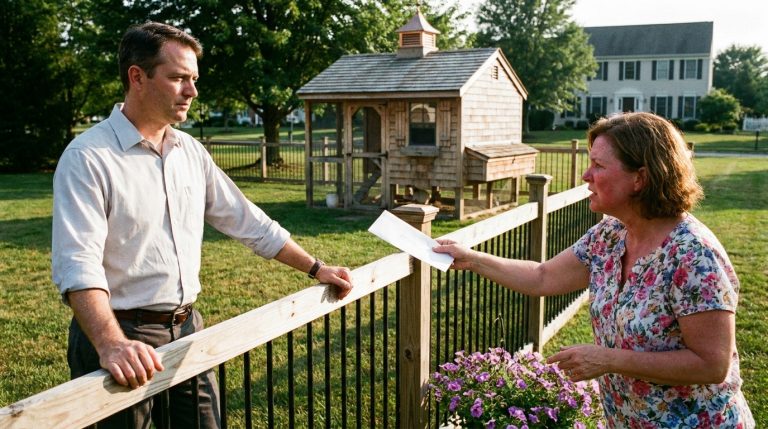
She didn’t offer a hand. She held a plastic clipboard against her sternum like a ballistic plate. Her fingernails were painted the color of fresh arterial blood, short and squared off, digging into the acrylic edge. The scent hit me a second later—cheap, synthetic lavender thick enough to coat the back of my throat.
“Mrs. Hendricks,” I said.
“President Hendricks.” She corrected me without a beat, her gaze sliding past my shoulder, past the porch, straight toward the thicket of golden willows at the property line. “I’m taking the liberty of conducting an unannounced perimeter compliance check. Community standards don’t pause for move-in grace periods.”
“The lot ends at the survey pins,” I said, pointing the iron bar toward the rusted iron rod flush with the dirt near the mailbox. “You’re six feet inside it.”
She didn’t step back. Instead, her thumb flicked the metal spring of her clipboard. Snap.
“That water back there,” she said, her voice dropping into a raspy, rehearsed register. “It’s visible from the access lane. It’s an unapproved, man-made excavation.”
“It’s a natural artesian spring.”
“It is a standing health hazard under Article 9,” she snapped back. Her eyes narrowed, the skin around her mascara tightening into pale, dry folds. “Unregulated standing water violates association insurance parameters. You will have a excavation team fill that basin with engineered dirt by Friday at five, or the board will contract the heavy equipment and attach the invoice directly to your property title.”
I didn’t argue. I didn’t raise my voice. I looked at the clip on her board. Beneath the top sheet of cream-colored paper, tucked crookedly into the corner, was a yellowed carbon slip bearing an outdated municipal code stamp—one that had nothing to do with residential zoning. A local department stamp that shouldn’t be in an HOA president’s hands.
“I have the original 1974 survey,” I said quietly. “It’s bedrock-fed.”
“I don’t care what your little geologist says, Mr. Caldwell.” Karen leaned in, the lavender perfume spiking sharp and sour in the humid air. “You fill it, or I fill it for you and bill you for the privilege.”
She turned on her heel, her heavy sandals slapping against the hot concrete as she marched back to the Lexus.
I stood on the driveway long after the white sedan disappeared down the curve of Harmony Creek Boulevard. The heat rose in shimmering waves off the road, but inside my chest, the temperature dropped to absolute zero.
I walked back through the house, past the half-unpacked boxes in the hallway, out onto the rear lawn. The grass sloped down toward the shade of the willows, where the spring bubbled out of a fissure in the grey limestone, clear and ice-cold, feeding a pool eight feet deep before trickling toward the state preserve boundary.
Leo was sitting on the wooden plank deck I’d finished two days ago, dipping his bare feet into the current, watching a blue dragonfly hover over the reeds.
I went into my workshop, reached under the workbench, and pulled out a brand-new, heavy-duty three-ring binder. I snapped the cold steel rings open. Clack.
I took a clean sheet of paper, uncapped a black marker, and wrote across the top block in thick, level strokes:
OPERATION SPRING FREEDOM.
The war had started. She just didn’t know the rules of engagement yet.
CHAPTER 2: OPERATION SPRING FREEDOM
The ink on the top divider page was barely dry. I tapped the chrome tip of the Parker pen against the steel ring mechanism. Tink. Tink. Tink. The sound was small, sharp, and clean in the quiet of the two o’clock hour.
To my left, the black coffee had gone cold, a thin film reflecting the amber glow of the desk lamp. To my right lay the three hundred and twelve pages of the Harmony Creek Estates Covenants, Conditions, and Restrictions—a dense, poorly indexed tome printed on cheap recycled paper that smelled faintly of damp cellar storage.
I didn’t read it like a novel. I read it like an enemy order of battle.
Section by section, I broke down her authority. Article 4, Section 2: Landscaping Restrictions. Article 7, Section 5: Maintenance of Nuisances. And there it was, highlighted in yellow marker: Article 9, Section 1: Community Insurance and Liabilities.
Karen’s letter had cited Article 9 like a hammer. But as my thumb traced the small print beneath paragraph C, the wording changed. The board held power over man-made structures, impoundments, and artificial drainage alterations. Nowhere in the hundred and forty paragraphs did the document define a natural, subterranean artesian outlet as a structure. She was stretching the text past its elasticity, relying on the fact that most suburbanites would rather pay a two-hundred-and-fifty-dollar fine than read ninety pages of subordinate clauses.
My phone vibrated against the desk blotter. A single text from an old buddy at the district engineer office in Jacksonville: Check state water management codes, Chapter 373. Don’t waste time with county zoning.
I pulled up the Florida Administrative Code on the monitor, the blue light washing over the open binder.
It took forty minutes of cross-referencing before I hit the core structure. Florida Statute 373.309: Protection of Artesian Waterways and Aquifer Windows. The language wasn’t vague like the HOA covenants. It was hard, cold state law. No person, municipal entity, or private corporation shall obstruct, fill, divert, or introduce foreign fill material into a documented artesian spring feeding the Floridan Aquifer System without a Class I Environmental Impact Permit.
I stared at the screen. Filling in the spring wasn’t just an association dispute. If I backed down, brought in a dump truck, and poured dirt into that limestone fissure, I would be committing a state-level misdemeanor punishable by ten thousand dollars a day in civil penalties.
Karen hadn’t just issued an overreaching fine. She had ordered me to break environmental law to satisfy her board’s arbitrary aesthetic code.
I clicked the pen. Snap.
I opened a new browser tab, navigating directly to the portal for the Florida Department of Environmental Protection. The online reporting form was straightforward, but I didn’t want an automated queue. I located the direct line for the Regional Water Resource Management Division in Tallahassee, wrote down the supervisor’s extension, and taped it to the inside cover of the binder.
Next, I pulled out a fresh sheet of heavy bond paper. I didn’t write an emotional letter. I wrote a formal notice of dispute.
I addressed it to the Board of Directors, Harmony Creek Estates HOA, explicitly avoiding Karen’s personal name in the salutation to keep the record corporate. I cited Article 9 back to them, pointed out the legal distinction between an artificial impoundment and an artesian spring, and attached a high-resolution photocopy of the 1974 county survey marking the bedrock spring.
As I slipped the original into a white glassine envelope, my gaze caught the corner of the citation Karen had left on my driveway. Near the bottom margin, printed in microscopic grey ink, was a vendor routing code: CCS-MNT-04.
It meant nothing to me right now—just another bit of administrative clutter from a cheap management process. I dropped the copy into the binder behind the tab labeled Exhibits, closed the heavy steel rings, and snapped the binder shut.
At 0600, the sun broke over the oaks at the back of the lot. I walked out to the mailbox at the edge of the asphalt, the wet grass soaking the toes of my boots. I flagged down the postal carrier, handed him the certified envelope, and paid for the green return-receipt card.
When I walked back up the driveway, the white Lexus wasn’t there. But as I looked down the long, empty stretch of Harmony Creek Boulevard, I knew the green card would hit her mailbox by tomorrow afternoon.
The baseline defense was set. Now I needed to find out who else in this neighborhood was paying her taxes.
CHAPTER 3: THE RECONNAISSANCE RUN
The mail carrier’s truck pulled away, leaving two faint dark tracks on the dew-dampened asphalt. I didn’t head back inside for a fresh cup of coffee. I turned left, keeping my boots on the shoulder where the mown grass met the crushed limestone drainage ditch.
A campaign requires intelligence before you mass your force. If Karen was operating on a pattern of arbitrary pressure, she wouldn’t limit herself to lot seventy-two.
Two doors down, Mrs. Gable was already in her front garden, her knees resting on a foam kneeling pad. She held a pair of small pruning shears, her hands trembling slightly as she clipped dead blooms from a hydrangeas bush. Around the base of the flowerbed stood seven small, ceramic garden gnomes, their chipped paint faded by years of Gulf Coast humidity.
“Morning, Mrs. Gable,” I said, stopping at the edge of her driveway.
She flinched, her shoulders tightening before she turned her head. When she recognized me, the rigid line of her back slackened, but her knuckles remained white around the plastic handles of the shears.
“Oh. Good morning, Mr. Caldwell.” Her voice was thin, rustling like dry leaves. She looked past me, her eyes darting toward the crest of the street where the pavement curved toward the main gate.
“Hot early,” I noted, resting one arm against the wooden mailbox post.
“It is,” she said softly. She set the shears down on the clay soil, her thumb nervously rubbing a dry, flaking patch on her palm. “I’m just… trying to get these tidied up before the sun gets too high. Or before another notice gets stuck to the screen door.”
I kept my voice quiet, even. “Notice?”
She swallowed, her chin dipping. “A third warning. Article 7. Unapproved lawn embellishments. Four hundred dollars now.” She gestured with a frail hand toward the gnomes. “My late husband bought the first two in Biloxi twenty years ago. They aren’t hurting anyone. But she says they drag down the aesthetic index.”
“She give you a formal hearing?”
“No,” Mrs. Gable murmured. “Just the pink paper slip under the wiper blade or taped over the lock. She said if I don’t pay by the fifteenth, the association puts a lien on the deed.”
I noted the detail—no board quorum, no fourteen-day registered delivery, no due process. Just a slip of paper and an extortionate threat.
“Don’t move the gnomes, Mrs. Gable,” I said quietly.
She looked up, her faded blue eyes wide with a mix of fear and confusion. “Mr. Caldwell, I can’t afford a lien. I live on Arthur’s pension.”
“Keep the gnomes where they are,” I repeated, letting the gravel in my voice anchor her. “Don’t sign anything she hands you. And don’t pay a dime.”
I gave her a brief nod and continued down the cul-de-sac.
Three houses further, at lot sixty-four, the Martinez driveway was quiet, but a metal basketball hoop sat near the garage door. The backboard was scuffed, the chain net ringing faintly in the coastal breeze. A bright yellow citation slip was slapped flat against the black steel pole, secured with clear packing tape.
I walked up the concrete pad, stepped close enough to read the typed text without touching the pole: Violation of Covenant Section 12-B: Temporary Athletic Equipment visible from primary thoroughfare exceeding 24 hours. Fine: $50.00/week cumulative.
Below the signature line was a pre-stamped corporate account reference: Remit to CCS Management Services.
There it was again. The second reference to the same acronym I’d seen on my own violation slip at three in the morning. Not the HOA’s registered bank account at First National. A secondary routing string.
I took out my phone, angled the lens to catch the glare off the tape, and took two crisp, high-resolution photographs—one of the citation, one of the overall lot showing the hoop sat entirely behind the property setback line.
By nine o’clock, I was sitting in a corner booth at a diner two miles past the highway interchange. The air smelled of burnt grease and industrial disinfectant. Across the laminate table sat Frank Peterson.
He didn’t look like a high-priced corporate attorney. He wore a rumpled grey suit, a faded infantry pin on his lapel, and had a face that looked like it had been carved out of salt oak. He didn’t order food—just black coffee, which he drank while flipping through the pages of my binder with a thick, calloused thumb.
For twenty minutes, the only sound between us was the clatter of silverware and the sharp, dry snap of plastic sleeves turning.
When he reached the page containing the photograph of my artesian spring, he stopped. He leaned back, his eyes narrowing as he stared at the color printout.
“Artesian?” he rasped.
“Bedrock fissure,” I said. “Flows year-round into the preserve creek.”
Frank let out a low, dry chuckle that sounded like grinding stones. “And this woman gave you a written demand to dump fill dirt into it?”
“Twice. Certified.” I reached into my coat pocket, pulled out the green postal return receipt bearing Karen’s spiky, aggressive signature, and laid it on the table between us. “She signed for the survey copy yesterday.”
Frank picked up the green card, turned it over once, and set it down precisely over the photo of the spring.
“This isn’t a civil property dispute, Mark,” Frank said, his voice dropping into a low, predatory murmur. “This is a tactical gift. She’s so used to stomping on elderly widows over garden ornaments that she didn’t bother to check state environmental jurisdiction before she put her name on a felony solicitation.”
“I want her off my back,” I said. “And I want her off Mrs. Gable’s.”
“Off your back?” Frank smiled, a grim, toothy expression with zero warmth. “Son, when an adversary digs themselves into a open trench like this, you don’t wave a white flag and ask them to be polite. You call in the heavy artillery and collapse the trench.”
He opened his briefcase, pulled out a thick pad of yellow legal paper, and uncapped a heavy brass fountain pen.
“Step one,” Frank said, his pen hovering over the paper. “We file a formal Case notice with the Department of Environmental Protection under Case 7A4T831. We put the case number directly into a cease-and-desist letter addressed to her personal residence and every member of that puppet board.”
“And step two?”
“Step two,” Frank said, the brass pen scratching violently across the yellow pad, “we put her on notice that if she attempts to place a lien or touch your title, we sue her personally for tortious interference and malicious prosecution. We pierce her corporate immunity shield. We make her realize her own house is on the firing line.”
He looked up from the pad, his grey eyes locked on mine. “It’s going to cost you two thousand dollars for the initial filings and the courier delivery. You ready to spend that?”
I reached into my breast pocket, pulled out my checkbook, and laid it flat on the laminate table.
“Write it up, Frank,” I said. “Load the shell.”
CHAPTER 4: THE SHOW TRIAL MUTINY
The blue ink of my signature dried on Frank’s retainer agreement just as a torrential downpour hit the diner windowpane.
Seven days later, the air in the Harmony Creek Community Clubhouse smelled of damp carpet, ozone, and cheap roasted hazelnut.
The room was set up like a tribunal. At the far end, behind a long folding table skirted in blue plastic, sat three chairs. Karen occupied the middle seat, wearing an oversized violet blazer that clashed violently with the beige drywall. To her left sat Janice, holding a ballpoint pen above an open ledger; to her right was Barry, his neck tie pulled loose, sweating into his collar.
Twenty metal chairs faced the dais. Every one of them was taken. Mrs. Gable sat in the second row, clutching her vinyl handbag against her knees. Mr. Martinez stood against the back wall next to two guys from lot eighty-eight.
I walked down the center aisle alone, carrying my binder under my arm. Frank wasn’t at my side; he was parked in his sedan near the entrance, waiting for my signal. This phase required local posture.
I took the single folding chair placed four feet in front of Karen’s table—the defendant’s mark. I laid the binder flat across my knees.
Karen brought a wooden toy gavel down on a plastic block. Thwack.
“This disciplinary hearing of the Harmony Creek Estates Board of Directors is now called to order,” she declared, her voice elevated to project over the whisper of the air conditioning unit. “The subject is Lot 72, registered to Mr. Mark Caldwell. Uncured violations under Article 9, willful non-compliance, and failure to remit assessed administrative penalties.”
She didn’t look at me. She read from a double-spaced document on her clipboard, her finger tracing the lines.
“Total outstanding fines currently stand at eleven hundred and fifty dollars,” Karen continued, her jaw setting hard. “The board has provided statutory notice. Mr. Caldwell, you have five minutes to present a compliance schedule for the complete drainage, excavation backfill, and restoration of Lot 72.”
She stopped. The room went silent except for the low hum of the ceiling ballast overhead.
I didn’t open the binder. I rested my palm flat against its cover, feeling the cold steel edge of the locking mechanism through the vinyl.
“There won’t be a compliance schedule, Mrs. Hendricks,” I said. My voice was low, carrying effortlessly through the small room.
Karen’s eyes snapped up from her sheet. “Then this board will proceed with immediate lien placement and third-party contractor dispatch under Section 4-C. Your property title will be encumbered by noon tomorrow.”
“You can try,” I said. “But before Barry signs that lien form, he might want to check the criminal liability rider on his personal homeowner’s policy.”
Barry froze. His head jerked toward me, a drop of perspiration trickling down his temple into his sideburn. “What?”
“Florida Statute 373.309,” I said, turning slightly so my voice reached the back row where Martinez stood. “It’s the state environmental protection code governing artesian aquifer windows. I opened an official file with the Department of Environmental Protection three days ago. Case 7A4T831.”
A murmur rippled through the row behind me. Mrs. Gable leaned forward, her fingers tightening on her handbag.
“That spring on Lot 72 is state-protected groundwater,” I continued, looking directly at Barry, then at Janice. “Anyone who brings heavy machinery onto that lot to dump fill dirt is committing a Class 1 environmental misdemeanor. That includes the equipment operators, the board members who sign the work order, and anyone who uses association funds to pay the invoice.”
Janice’s pen stopped mid-word. She looked at Karen, her lips parting. “Karen… did you verify the water survey?”
“Silence!” Karen slammed the gavel down twice. Thwack. Thwack. “This is a municipal covenant issue! State regulatory claims are completely irrelevant to community aesthetic standards!”
“They aren’t irrelevant to the State Attorney,” I said evenly. I reached down, popped the three rings of the binder open—Clack—and pulled out three collated stapled sets of papers. “And neither are the billing routing tags.”
I stood up, walked two steps forward, and laid one set in front of Barry, one in front of Janice, and the third directly over Karen’s clipboard.
“That’s a copy of the cease-and-desist served on your home address by courier this afternoon,” I said. “Along with a formal notice that any attempt to attach a lien to Lot 72 based on illegal demands will result in an immediate personal lawsuit against each board member individually.”
Barry looked down at the header on Frank’s legal letterhead, his face draining of color until his skin matched the beige wall behind him. “Personal? The HOA insurance covers board actions—”
“Not for intentional illegal acts,” I cut in. “Your policy drops you the second a state statute is cited. Read paragraph four.”
“This hearing is adjourned!” Karen shouted, standing up so fast her metal folding chair scraped violently against the linoleum. “You are out of order, Caldwell! You don’t dictate procedure here!”
“He’s not the only one asking questions, Karen,” Mr. Martinez called out from the back row, stepping into the aisle. “What about the fifty bucks a week for my kid’s basketball hoop? Where’s that money going?”
“And my gnomes!” Mrs. Gable’s voice piped up, surprisingly sharp from the second row. “Four hundred dollars for ceramic gnomes?”
The room erupted into a dozen simultaneous conversations. Neighbors stood up from their metal chairs, crowding toward the front table with papers in hand. Janice was already packing her ledger into her tote bag, refusing to look at Karen. Barry had pulled his cell phone out and was frantically scrolling through his contacts with a wet thumb.
Karen stood behind the table alone, her face flushed dark crimson, her hands shaking as she tried to gather her scattered printouts.
She caught my eye across the table. The authority was gone from her expression, replaced by a cold, sharp hatred that promised no retreat.
I picked up my binder, snapped the steel rings shut, and walked out the double doors into the humid night.
CHAPTER 5: KINETIC FRICTION ON THE LAWN
The rain cleared by morning, leaving the humidity clinging like wet wool to the grass.
Three days after the clubhouse hearing collapsed, the diesel rumble started at six forty-five. It wasn’t the mail truck. It was a twin-axle flatbed hauling a steel ramp trailer, its engine braking hard as it turned onto my street. Painted across the side panel of the cab in faded red block lettering was the name ACME Landscaping and Excavation.
I didn’t reach for my boots. I put on my work shoes, stepped onto the front porch, and pulled my phone from my hip pocket. My thumb hit the screen, unlocking the camera interface and setting the lens to wide-angle recording.
The flatbed stopped directly across the foot of my asphalt, blocking both lanes of the cul-de-sac. Two men in high-vis vests unhooked the rear tie-down chains, the steel links clattering against the deck like iron hammers. On the back sat a five-ton Bobcat compact excavator, its bucket dripping greasy hydraulic fluid onto the timber bed.
The driver climbed down, carrying a grease-stained clipboard. His neck was sun-scorched, his forehead creased with the tired irritation of a man paid by the job, not the hour.
“Mark Caldwell?” he called out, stepping over the ditch line toward my survey stake.
I walked down the incline, stopping three inches inside my survey pin. I held the phone steady at chest height, the lens locked on his face.
“You’re on private property,” I said, my voice level. “Name and company.”
He stopped, his work boots kicking up a small puff of dry dust from the shoulder. “Ray Miller. ACME Excavation. Got a work dispatch here from the association president. Fill job on an unauthorized pond in the rear yard.”
“Who signed the purchase order?”
Ray flipped the top sheet on his board. “Karen Hendricks. Board President. Says here it’s an emergency covenant abatement under Article 9.”
“Ray,” I said, stepping half an inch closer to the property pin. “Look at the corner of your work order. Read the vendor payment routing line.”
He frowned, shifting his grip on the board. His thumb moved aside a corner of the carbon paper. “It says… Creative Community Solutions. Sub-contractor billing.”
“Creative Community Solutions isn’t the HOA,” I said. “And that water feature isn’t an unauthorized pond. It’s an artesian aquifer window protected under Florida Statute 373.309. State case number 7A4T831.”
Ray’s jaw tightened. “Look, buddy, I don’t care about your neighborhood politics. I got a paid work order to put three yards of dirt in a hole.”
“If that track touches this grass,” I said, pointing down at the iron survey pin flush with the dirt, “you’re committing felony trespass under state environmental jurisdiction. You, personally. Not the woman who signed that paper. The state fine starts at ten thousand dollars a day per operator, and the Department of Environmental Protection already has this lot flagged.”
Ray looked from my face to the phone lens, then back down at the survey rod. The foreman behind him paused with the trailer ramp latch half-unhooked, the heavy steel bar hanging suspended in his grip.
“She said it was a drainage ditch,” Ray muttered, his voice losing its edge. “She said the owner was an out-of-town landlord who wouldn’t be on site.”
“She lied to you, Ray,” I said. “And if you back that machine off the deck, you’re the one taking the fall.”
Ray stood motionless for five long seconds. The heat rising off his flatbed’s manifold shimmered in the space between us. Then he turned his head, looking past my left shoulder toward the shade of the live oaks two hundred yards down the boulevard.
Parked under the drooping Spanish moss was a pristine white Lexus. The windshield glinted in the morning sun. Inside, behind the tinted glass, a dark silhouette sat motionless, watching the driveway through a pair of oversized sunglasses.
I slowly panned my phone camera away from Ray, tracking across the ditch line, zooming in until the white Lexus filled the frame—the license plate crystal clear, the driver’s face framed against the headrest.
Ray saw the camera move. He spat into the dust, turned on his heel, and walked back to the flatbed.
“Lock the chains back up, Jimmy,” Ray barked at his operator. “We’re out.”
“Hey!” Jimmy called back, wiping grease from his arm. “What about the trip fee?”
“Invoice it to Creative Community Solutions,” Ray spat, climbing into the cab and slamming the heavy door shut. “And tell her to hire her own shovel.”
The diesel engine roared, the trailer ramps clattering as the flatbed hauled itself into a three-point turn, leaving two heavy black rubber smears on the hot pavement.
Across the street, the white Lexus didn’t wait. The brake lights flashed once, the tires squealed against the asphalt, and Karen sped away toward the main gate, her rear bumper bouncing over the speed bump.
I stopped the recording, saved the file as Exhibit_E_Landscaping_Standoff, and tapped Frank’s speed dial.
“Frank,” I said as soon as he picked up. “She just sent heavy equipment to the lot. I have the foreman on tape identifying Creative Community Solutions as the payor.”
On the other end of the line, Frank’s dry, papery laugh rasped through the speaker. “Creative Community Solutions? That’s it, Mark. That’s the thread that pulls the sweater apart. I’m pulling the corporate registry filings now.”
CHAPTER 6: CHECKMATE AT THE TRIBUNAL
The line went dead as Frank clicked his phone shut.
Thirty-six hours later, the humidity in the Harmony Creek Clubhouse was suffocating. Every metal chair was occupied, and two dozen residents stood three-deep against the back wall, spilling out past the double doors into the dusk air.
At the long table under the fluorescent lights, Karen sat alone.
Barry’s chair was vacant. Janice’s chair was vacant. Both board members had submitted formal written resignations the previous afternoon, leaving Karen isolated in her violet blazer behind the long plastic table. Her knuckles were white where her right hand gripped the wooden handle of her toy gavel, but her eyes darted frantically across the crowd, scanning the faces of neighbors who no longer looked down when she met their gaze.
Frank stood at the wooden lectern near the front row, his grey suit pressed, his leather briefcase resting open on the floor beside him. Beside him, I sat in the front row, my heavy three-ring binder resting closed on my knees.
The representative from the regional HOA management firm—a young man in a wrinkled shirt named Miller—tapped the microphone twice. Thump. Thump.
“This special meeting of the Harmony Creek Estates membership is called under Bylaw Section 8-A pursuant to a petition signed by sixty-two percent of voting parcels,” Miller announced into the static. “The single item on tonight’s agenda is the formal recall vote of President Karen Hendricks.”
Karen’s hand twitched, her gavel hitting the plastic block with a weak, dull click. Tack. “This meeting is procedurally invalid! The petition signatures were solicited using fraudulent character defamation!”
“The signatures were verified by county clerk records this morning, Mrs. Hendricks,” Miller said without looking up from his clipboard. “The floor is recognized for ten minutes to the petitioners’ legal representative.”
Frank stepped up to the microphone. He didn’t adjust the neck. He opened a single manila folder, resting three sheets of paper flat against the wood.
“We aren’t here tonight to talk about lawn height, paint codes, or Article 9,” Frank began, his raspy baritone cutting through the low hum of the ceiling ballasts. “We are here because of a paper trail.”
He picked up the first sheet.
“Over the past three years, forty-eight thousand two hundred and fifty dollars was paid out from the Harmony Creek Estates operating account to a vendor registered as Creative Community Solutions,” Frank said. “The line items in your annual reports were listed under ‘Environmental Maintenance and Covenant Compliance Enforcement.'”
A sharp hush settled over the room. In the third row, Mrs. Gable leaned forward, her mouth open slightly.
“Three days ago,” Frank continued, turning his gaze toward the long table, “an excavation crew arrived at Lot 72 under a work dispatch issued by Mrs. Hendricks. The foreman’s dispatch order listed the paying entity not as Harmony Creek Estates, but as Creative Community Solutions.”
Karen stood up so fast her chair scraped two feet backward against the linoleum. “That is an independent management vendor! The board authorized those consulting fees under discretionary administrative powers!”
“Creative Community Solutions isn’t a management vendor, Karen,” Frank said softly. He pulled the second paper from his folder and laid it facing the crowd. “It is a fictitious name filing registered with the Florida Department of State Division of Corporations. The sole proprietor listed on the deed is Karen M. Vance—your maiden name. The bank routing address is your home on Willow Run Lane.”
The room didn’t erupt immediately. It froze.
The silence was absolute, heavy enough to hear the faint drip of condensation from the wall AC unit.
“You weren’t enforcing community standards,” Frank said, his voice dropping into a flat, unemotional register. “You were issuing arbitrary citations under Article 9, threatening legal encumbrances against elderly residents and young families, and using those fines to funnel community dues directly into a personal shell account to cover your own private liabilities.”
Karen’s mouth opened, but no sound came out. The dark crimson flush that usually crept up her neck was gone, replaced by a grey, waxy paleness. Her hand hovered above the wooden gavel, her fingers trembling so hard the metal band on her ring clinked against the wood.
“The state Division of Business and Professional Regulation opened case file 7A4T831 this afternoon,” Frank added, capping his brass pen with a clean, metallic click. “And the State Attorney’s Office has been provided with the complete banking ledger.”
Miller took a step toward the microphone. “All those in favor of the immediate recall and removal of Karen Hendricks from the Board of Directors, raise your right hand.”
Every single hand in the room went up.
Mrs. Gable raised hers first, her arm straight, her fingers un-trembling. Beside her, Mr. Martinez raised both hands. Even the residents standing outside in the doorway lifted their palms into the yellow porch light.
“The motion carries unanimously,” Miller said, marking his ledger with a single stroke. “Mrs. Hendricks, you are relieved of all board authority effective immediately. Please surrender the master keys and ledger stamp to the clerk.”
Karen didn’t look at the crowd. She didn’t look at Miller. She picked up her vinyl handbag, her eyes fixed on the floor, and walked down the center aisle. Her heavy sandals sloshed against the damp entryway carpet, the double doors swinging shut behind her into the humid Florida night.
By Saturday afternoon, the front lawn was quiet.
The white Lexus was gone from Willow Run Lane, replaced by a red For Sale by Owner sign shoved crookedly into the turf near her mailbox. The state audit team had already served its first subpoena, and the bank accounts for Creative Community Solutions were frozen solid.
I sat on the wooden deck at the back of Lot 72, the sun filtering through the oak leaves overhead, casting golden coins of light across the limestone fissure.
The water bubbled out from the bedrock, ice-cold and clear as glass, flowing over the smooth grey gravel before trickling toward the state preserve boundary. Leo was sitting at the edge, floating a piece of carved pine bark down the current, his laughter carrying soft and clear across the lawn.
I reached down into my toolbox, pulled out a pair of pliers and a fresh brass hinge pin, and set to work tightening the latch on the deck railing where a board had worked itself loose during the move.
The iron felt heavy, cool, and solid in my hand. I aligned the pin, tapped it home with the flat of a small hammer, and felt the metal seat perfectly into the wood.
No notices. No citations. No white sedan idling at the edge of the asphalt.
I set the hammer down on the timber deck, leaned back against the post, and listened to the steady, unceasing gurgle of the spring as it cut its clean path through the stone.