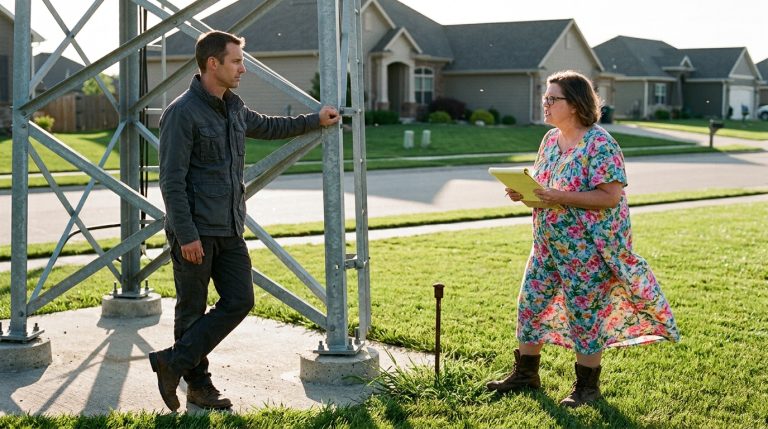
The Granite Ledger: How a Retired Engineer and a Dusty Forty-Acre Parcel Dismantled a Suburban Empire of Iron and Fraud
CHAPTER 1: THE RUSTED PERIMETER
The words dripped with a calculated entitlement that tasted like dry iron and stale dust. They hung in the heavy air between the splintered cedar of my porch and the pristine, unblemished white paint of an SUV that belonged nowhere near these forty acres. The gravel pit had been dormant for a decade, a sun-baked hollow of crushed granite and silence on the far edge of my grandfather’s land, yet here was a stranger standing on my grass, issuing decrees as if the soil itself took orders from a three-ring binder.
I did not move from the top step. My boots were caked with the red clay of the lower ridge, dry and cracked from a morning spent repairing a rusted perimeter fence.
“Your little rock pile is a blight on this community,” she said, her voice sharp enough to nick glass, “and you will pay to have it removed, or we will seize your land.”
She slapped a crisp sheet of paper against my chest. The impact was light, almost theatrical, but it carried the distinct paper-cut friction of bureaucratic hostility. I looked down at the formal notice without touching it. A ten-thousand-dollar fine for operating an unauthorized commercial quarry, supplemented by an extra five thousand for aesthetic nuisance.
Whispering Pines had sprouted fifteen years ago like a fungus of identical beige drywall and manicured sod, pressing hard against my northern boundary line. They had paved their roads, planted their ornamental pear trees, and fenced off their conformity, but my grandfather’s deed was ironclad. It was an independent parcel, carved out before the county lines grew teeth, entirely exempt from their bylaws and covenants. I paid my county taxes, maintained my own gravel road, and expected nothing more than the quiet friction of solitude in return.
Instead, Karen—self-appointed custodian of suburban purity—stod on my property with her clipboard and her turquoise velour, convinced that a printed fine could rewrite the survey maps locked in my safe.
“Karen,” I said, my voice dropping into that low, flat register I hadn’t used since my final tour with the Corps of Engineers, “you are standing inside a perimeter you do not own, and you have made a fundamental miscalculation.”
She scoffed, a dry, dismissive expulsion of breath that rustled the papers in her hand. “The bylaws are absolute, Mr. Henderson. Article 7, Section 4. We have the documentation. We have pictures. You cannot fight this.”
She gestured vaguely toward the thick stand of hundred-year-old oaks that choked the ravine separating the main pasture from the old pit. That gesture was the micro-fracture in her armor. The pit was a quarter-mile away, entirely obscured by dense timber and stubborn briars. There was no line of sight from any Whispering Pines kitchen window.
We have pictures.
That meant someone had crossed the fence line. Someone had walked the overgrown service road with a lens.
I folded the notice into a neat, unhurried square and tucked it into the breast pocket of my work shirt. “You’ll be hearing from my lawyer,” I said—the standard, expected deflection of a cornered man.
Let her think she had cornered someone. Combat engineers do not get cornered; they establish perimeters, inventory their losses, and wait for the dust to clear.
She turned on her heel, her sneakers crunching against the fine limestone gravel of my drive—material her own wheels had ground down—and climbed back into her gas-guzzling chariot. The SUV reversed with a sharp beep, spat a cloud of gray exhaust into my cedar trees, and sped down the grade toward the beige uniformity of her subdivision.
I waited until the engine whine faded into the steady hum of cicadas before I moved.
My work boots were still by the door, smelling of old leather and neatsfoot oil. I swapped my slippers for the heavy leather, laced them tight to the ankle, and reached behind the coat rack for a heavy-duty flashlight with a cracked aluminum housing. The sun was sliding low behind the western ridge, casting long, bruised shadows across the uncut pasture grass.
The service road was little more than a pair of twin tracks choked with Queen Anne’s lace and wild blackberry briars. I hadn’t driven a truck back there since the autumn before last, when I hauled a single bucket of stone to patch a washouts near the creek.
As I rounded the first sharp bend where the oaks grew thickest, the shadows deepened into a cool, green twilight. That was when I saw the anomaly.
Cutting across the old weed-choked ruts were fresh tracks. They weren’t the narrow tread of an SUV or the light footprint of a neighbor taking a stroll. They were wide, deep, and heavily compressed—the double-axle imprint of a commercial dump truck, pressed deep into the damp earth left by yesterday’s passing squall. The soil had been churned up, the roots of the wild ferns torn clean from the dirt, exposing raw, dark earth that smelled sharply of crushed iron and wet stone.
Someone had heavy machinery back here. And they hadn’t come through my front gate.
CHAPTER 2: RECONNAISSANCE AT THE RIDGE
The mud in the tread of those fresh tracks was still soft, the edges of the tire-waffle sharp enough to skin a thumb. That was the first detail my eye registered as I crouched at the edge of the service road. In this country, rain fell hard and dried fast under the afternoon bake of the open pasture, turning red clay into baked brick within six hours. This soil was still weeping moisture. Whatever heavy-duty rig had been down here had rolled through not hours ago, but perhaps within the last sunrise.
My hand automatically dropped to the small folding utility knife in my pocket—not out of panic, but out of habit. Twenty years in the Army Corps of Engineers teaches you to read the geometry of an intrusion before you ever look for a face.
I stood up slowly, letting my boots settle into the dry weeds alongside the tire tracks. The service road curved sharply around the base of the hundred-year-old oak line, plunging into the deep, shaded corridor where the sun barely touched the ground even at high noon. The air here changed. It lost the sweet, cut-grass aroma of the open pasture and took on the heavy, stagnant smell of damp leaf mold, crushed shale, and the unmistakable, bitter taint of hot diesel exhaust.
My mind slipped backward, unbidden, to a dusty ravine outside of Kandahar where we tracked fuel bladders stolen right out from under our logistical nose. The method was always the same. Greed wrapped in authority. Someone with a clipboard and a clipboard’s arrogance assuming that because a piece of land looked quiet, it was abandoned.
I kept my steps light, placing my weight on the balls of my feet to keep the loose gravel from rattling underfoot. The canopy overhead grew thicker, a tangled lattice of black oak and stubborn thornbushes that acted as a natural sound baffle. Ten yards ahead, the two dirt ruts widened, the ground flattening out into the staging apron of the old gravel pit.
My grandfather had worked this hollow with a battered International Harvester dragline and a fleet of single-axle dump trucks back when Whispering Pines was nothing more than a few thousand acres of scrub oak and wild turkey roosts. He had dug deep, carving a terraced amphitheater into the hillside to get at the high-grade crushed granite layered beneath the topsoil. When the county paved the secondary roads back in the seventies, it was my grandfather’s stone under their asphalt.
When he retired, he simply walked away. He shut down the diesel engines, pulled the battery cables, locked the heavy chain across the access road, and let nature take the floor. For ten years, wild sumac and blackberry vines had done their best to swallow the scars.
As I rounded the final stand of maples, the trees broke open, and the scale of the violation hit me with the force of a physical blow.
The natural amphitheater was no longer a silent, sun-baked hollow of overgrown brush. It was an industrial wound.
The western wall—a sheer cliff of stratified gray granite that had stood untouched for a generation—had been cleanly shaved back by at least fifteen feet. The jagged face showed the fresh, glittering fracture lines of modern hydraulic excavation. Hundreds, perhaps thousands, of cubic yards of premium aggregate had been systematically stripped away.
In the center of the hollow sat the churned, muddy signature of heavy equipment: deep, crescent-shaped pivot scars where a commercial front-end loader had turned its wheels while lifting a full bucket, and the broad, flat parking pads where a tandem-axle dump truck had backed up to receive its payload.
I walked slowly into the center of the clearing, my boots crunching on the glittering gray dust that carpeted the ground like coarse snow. I bent down. Resting near the edge of a fresh tire rut was a crushed paper cup from a regional gas station fifty miles north, and beside it, a discarded pack of budget cigarettes.
This was no sporadic midnight scavenging by a couple of kids with shovels and a pickup bed. This was a scheduled, mechanized operation. It required heavy iron, commercial fuel, coordination, and above all, time. To strip that much granite without anyone in the valley hearing the roar of diesel engines meant they had timed their runs precisely during weekday hours when the wind blew east or when the subdivision’s residents were sealed inside their air-conditioned homes behind double-paned glass.
I reached out and touched the raw face of the granite wall. The stone was cool, rough, and stubbornly real under my fingertips. Karen had stood on my porch a few hours ago threatening to seize my land under the guise of an unauthorized commercial quarry fine. The irony was so dense it tasted like copper. They weren’t fining me because I was running an illegal quarry. They were fining me to shut down my access so I wouldn’t discover they were running one.
My pocket buzzed.
It was a low, mechanical vibration against my thigh. I pulled out my phone, the screen flashing with a reminder I had set for myself, but as I cleared the notification, a deeper tactical question anchored itself in my chest: how long before they came back for another load?
The tracks were fresh. The operation was ongoing. And if Karen’s confidence on my porch was any indication, they believed they had thirty full days before any legal consequence could touch them. Thirty days was plenty of time to empty the western wall completely.
I slipped the phone back into my pocket, my eyes tracking the heavy, sweeping curve of the tire tracks back toward the service road entrance. I didn’t head back to the farmhouse. Instead, I crouched beside the deepest truck rut, pulled a small wooden carpenter’s rule from my back pocket, and began measuring the tread width and depth in the fading twilight, locking every detail into the map of the next move.
CHAPTER 3: THE LEDGER IN THE ARCHIVES
The wooden ruler slid back into my pocket with a dry click, the measurement data safely committed to memory. I did not linger in the shadow of the excavated cliff face. The dusk was settling fast, turning the upper canopy into a heavy, bruised canopy of purple and slate gray. I walked the service road in reverse, my boots finding the familiar ruts without the aid of the flashlight, letting the silence of the forty acres close in around me like water behind a hull.
Back inside the farmhouse, the air smelled of old cedar and the dry, sweet scent of unburnt hickory stored in the box by the hearth. I did not turn on the overhead lights. Instead, I struck a match, touched the wick of a heavy brass oil lamp on the corner of my grandfather’s old oak desk, and let the amber glow throw long, dancing shadows across the rows of leather-bound ledgers stacked against the backboard.
This desk had survived three decades of commercial contracting before I was even old enough to hold a plumb line. The drawers were stiff, swollen slightly by the humidity of changing seasons, but they pulled open with a solid, protesting groan of old pine and rusted steel slides.
I bypassed the modern plastic organizers and reached into the deep well at the back, sliding out the heavy, canvas-bound binder containing the original 1968 property covenants and the county survey maps stamped with the registrar’s violet seal.
The text was crisp, typed on heavy onion-skin paper that had yellowed around the margins like old parchment. Article 1, Section 2 explicitly defined the boundaries of the original parcel—forty contiguous acres carved out before the township incorporated the surrounding lowlands. It was designated a sovereign agricultural and residential holding, explicitly excluded from any future municipal annexation or neighborhood association zoning codes.
Karen’s clipboard-wielding tyranny rested on a legal fiction. She was attempting to enforce internal subdivision covenants upon a piece of land that had existed as a legal entity long before her subdivision’s developers ever bought their first bulldozer.
I turned the heavy pages, my thumb tracing the faint purple ink of the old county clerk signatures, looking for the chain of easements. That was when I realized the document in my hand was only half the puzzle. A legal deed proves what you own, but it doesn’t explain how an organized body like the Whispering Pines Homeowners Association managed to direct heavy commercial equipment onto a private service road without drawing the immediate attention of the county sheriff.
To understand how a thief operates within an administrative framework, you have to look at the ledgers where they keep score.
The county records office sat in the center of town, a squat, utilitarian building of red brick and frosted glass that smelled permanently of floor wax, damp wool, and municipal indifference. I was there the next morning before the heavy oak front doors had fully unlatched, my work jacket zipped to the throat against a sharp autumn wind that carried the metallic taste of an approaching front.
Betty, a woman whose desk calendar had apparently been stuck in 1994 judging by the faded floral print, looked up over the rim of half-moon reading glasses as I stepped up to the counter.
“Morning, Jack,” she murmured, her fingers automatically pausing over a stack of yellowed tax rolls. “You look like a man who’s either trying to fix a broken well pump or dispute a property line. Which is it?”
“Neither, Betty,” I said, leaning my forearms against the scarred wooden counter. “I’m looking for the public financial disclosures and contractor expenditure filings for the Whispering Pines Homeowners Association over the last five years.”
Betty’s eyebrows lifted, her expression shifting from casual neighborly warmth to a tight, knowing squint. She reached into a drawer beneath the counter and pulled out a porcelain mug decorated with a fading cartoon cat. “Bless your heart. Dealing with Karen and her board, are you? Half the county has been through this window trying to figure out why their fence-height fines are paying for the landscaping board’s personal pet projects.”
She disappeared into the back stacks for nearly twenty minutes, the hollow echo of her orthopedic shoes fading against the concrete floor. When she returned, she didn’t just carry a folder; she hauled a solid stack of three-ring binders that landed on the counter with a heavy, authoritative thud.
“They’re public record,” Betty said, tapping the spine of the top binder. “Technically. But they don’t make it easy to parse. Every line item is buried under layers of administrative code and beautification sub-accounts. Bring a pencil and a lot of patience.”
I carried the stack to a small, isolated wooden table near the back window where the morning light cut through the dusty panes in pale, golden shafts. For three hours, I stripped away the administrative veneer.
The mechanics of their operation weren’t sophisticated; they were simply brazen. Every fiscal quarter, the Whispering Pines HOA allocated tens of thousands of dollars to an internal line item designated as Community Pathway and Roadbed Maintenance. It was a legitimate-looking expense on paper, designed to keep the subdivision’s private lanes patched and the decorative stone borders looking pristine for prospective home buyers.
Yet when I cross-referenced the dates of those heavy maintenance disbursements with the entries in the contractor registry, the paper trail snapped into sharp focus.
The sole beneficiary of every single roadbed maintenance contract was a commercial outfit registered as Prestige Landscaping and Hardscapes.
I traced the company name back through the state corporate registry filings. The principal owner listed on the incorporation documents was a man named David Miller. A secondary filing for corporate officers revealed a silent partner holding an advisory stake, but the address listed for the corporate agent matched a residential property three streets over from Karen’s own colonial-style home. More importantly, when I pulled the HOA board roster from the previous year’s annual meeting minutes, the name Susan Miller appeared right beneath the president’s signature block, holding the title of Association Treasurer.
David Miller and Susan Miller. Brother and sister operating a private contracting firm that received sole-source, unbid municipal maintenance contracts funded entirely by the forced levies of the subdivision’s residents.
And the raw material they used to patch those subdivision roads, build those decorative stone retaining walls, and bill the homeowners at top-tier commercial aggregate rates? It didn’t come from a commercial quarry fifty miles north. It came from my grandfather’s dormant pit, hauled out in tandem-axle dump trucks down an overgrown service road under the cover of quiet weekday mornings.
They weren’t just trespassing. They were running a closed-loop embezzlement engine. They stole the stone from my unannexed land, processed it through a family-owned shell company, billed their own neighborhood association top dollar for the delivery, and pocketed the difference through inflated labor and material fees.
The ten-thousand-dollar fine they had slapped on my chest wasn’t an administrative error or a neighborhood dispute over aesthetics. It was a preemptive strike. They had noticed my recent visits to the lower ridge, realized the pit was being inspected, and moved quickly to criminalize my presence on my own property before I could discover the hole they had blasted into the western wall.
I closed the top binder, the cardboard cover snapping shut with a dry, flat sound that broke the quiet of the municipal archive room.
My reflection stared back at me from the dark glass of the window pane—graying hair, a lined face, and eyes fixed with the cold, measured calm of a man who had just finished mapping an enemy fortification’s supply lines.
The paperwork was in order. The trail was established. But paper alone didn’t clear a minefield. To dismantle an entrenched operation protected by administrative authority, I needed leverage, and that meant stepping outside the municipal building and finding the people who had been paying the bills for a crime they didn’t even know they were committing.
CHAPTER 4: THE GEOTECHNICAL AUDIT
The dusty municipal window pane did little to blunt the cold glare of the afternoon sun as I closed the final binder. My fingertips were stained gray from the toner and cheap pulp paper of a thousand budget resolutions. Across the room, the mechanical hum of an old ceiling fan stirred the stale scent of floor wax and damp drywall.
Betty looked up from her sorting tray, her glasses sliding a fraction down her nose. “Find what you were looking for, Jack?”
“I found the math,” I said, sliding the heavy stacks back into alignment.
The numbers were clean, undeniable, and entirely illegal. Prestige Landscaping had billed the Whispering Pines HOA over two hundred thousand dollars across five fiscal years for aggregate materials, delivery runs, and roadbed stabilization. Yet the county’s commercial transport registry showed no corresponding inbound shipments of stone coming from any licensed regional quarry north of the river. The material had materialized out of thin air—or rather, out of my grandfather’s western ridge.
I left the municipal building with the photocopies folded securely into my inside coat pocket, but paper alone would not hold up against a well-funded HOA legal defense if they claimed the extraction was a misunderstanding or an old handshake agreement. A court of law, or even a local tribunal, required hard volumetric proof. It required a man who knew how to measure a wound in the earth.
I dialed Tom Reynolds from the truck, my thumb pressing hard against the cracked plastic of the burner phone. Tom had spent thirty years in the Corps evaluating bridge foundations, earthwork displacement, and structural integrity before retiring to a workshop full of precision lasers and digital transits.
“Jack,” his voice boomed through the speaker over the background hiss of a drill press. “Don’t tell me your gravel pit has decided to slide down into the creek.”
“Worse,” I said, shifting the old Ford into reverse. “Someone’s been borrowing my granite without asking. I need a topographical survey done on a forty-acre holding, and I need it compared against the county baseline maps from fifteen years ago. Down to the cubic yard.”
There was a brief pause on the line, the sound of the drill press winding down to a whining stop. “That sounds less like a property dispute and more like an after-action review of a hostile takeover.”
“Let’s call it a volumetric assessment,” I replied. “Bring your gear. Friday morning.”
Friday arrived with a heavy, bruised sky that smelled of wet iron and frost. Tom’s truck rolled down my gravel drive at precisely six o’clock, the bed loaded with Pelican cases containing laser transits, GPS rovers, and laptop hardware that looked like it belonged in a tactical command post rather than a retired engineer’s back pasture.
We didn’t talk much as we humped the equipment down the overgrown service road. The morning dew clung heavy to the wild blackberry briars, soaking through the cuffs of my work pants as we pushed past the dense wall of hundred-year-old oaks and stepped out into the raw amphitheater of the pit.
Tom dropped his tripod onto the churned mud, unlatched a case, and whistled low through his teeth. He walked the perimeter of the shaved cliff face, his boots crunching on the glittering gray dust, his eyes squinting up at the sheer, vertical fracture lines where the mechanical excavator had bitten deep into the hillside.
“They didn’t just scoop the loose surface stone, Jack,” Tom said, his voice dropping into professional gravity as he unspooled a measuring tape. “They benched this slope. They brought in heavy tracking equipment, stripped the overburden, and worked the face systematically. This is commercial-grade extraction.”
For four hours, we worked the grid. Tom manned the laser transit, sighting off fixed benchmark pins we drove into the unmovable granite outcrop at the northern edge of the property, while I hauled the rover rod across the uneven floor of the pit, recording elevation drops and coordinate shifts. Every sweep of the laser mapped another slice of the missing mountain.
By mid-afternoon, we were back at the kitchen table in the farmhouse, the oil lamp casting a steady amber glow over Tom’s laptop screen. Complex three-dimensional wireframe models glowed against the dark display, translating the physical scars of the land into stark, mathematical wire grids.
Tom tapped a key, and a dense red volumetric overlay bloomed across the center of the screen, highlighting the exact void left by the excavation.
“Here is your delta,” Tom said, pointing a thick finger at the glowing calculation in the corner of the display. “Comparing my survey data against the county’s archival topographical baseline from fifteen years ago… they have removed approximately nine thousand six hundred cubic yards of high-grade crushed granite.”
I stared at the number. The scale of it hung in the air between us like heavy smoke.
“And the market value?” I asked quietly.
Tom pulled a small calculator from his pocket, punching the numbers with practiced mechanical efficiency. “Screened, crushed, and ready for roadbed installation? In this regional market, you’re looking at a baseline of thirty dollars per cubic yard, excluding heavy transport and local delivery fees.” He looked up, his expression grim. “Jack, they have stripped nearly three hundred thousand dollars worth of aggregate right out from under your nose.”
The ten-thousand-dollar fine Karen had slapped on my chest suddenly felt like a pathetic, desperate smoke screen. They weren’t just protecting their subdivision’s aesthetics; they were protecting a massive, long-running financial fraud funded by stolen stone.
Tom printed out the certified report, complete with the notarized calculations, three-dimensional wireframes, and his official engineering seal. He handed it to me across the scarred oak surface.
“There’s your weapon,” Tom said, packing his laptop into its rugged case. “Now you just have to figure out who you’re going to shoot with it.”
I looked down at the crisp white pages, feeling the heavy, cold certainty of a counter-offensive locking into place. The data was ironclad. But an engineer knows that even the best fortifications cannot hold without a garrison to defend them. To break Karen’s grip on Whispering Pines, I couldn’t fight alone. I needed to cross the fence line and find the people who had been paying for the excavation all along.
CHAPTER 5: FORGING THE ALLIANCE WITH ARTHUR AND MARCUS
The printed pages of Tom’s report still lay flat on the kitchen table, the notarized seal catching the pale morning light through the glass. Data is only ink until it hits the hands of people who know how to wield it. An engineer builds structures to hold weight, but an insurgency requires more than concrete; it requires a coordinated perimeter.
I picked up the report, folded it twice into a dense rectangle, and tucked it into the interior pocket of my canvas work jacket.
The wind had picked up from the north, driving dry oak leaves across the packed earth of my drive as I walked the boundary fence toward the eastern edge of my property. Whispering Pines sat just beyond the line of rusted wire and overgrown honeysuckle—a sea of beige siding, matching asphalt roofs, and identical clipped lawns that looked as though they had been measured with a ruler and manicured with a razor blade.
My first target was Arthur Penhalligan’s place three lots down. Arthur was a man who lived by columns of figures and decimal points, a retired corporate accountant whose crime against the subdivision’s aesthetic code had been a garden gnome standing two inches taller than the maximum allowable limit for whimsical lawn ornaments.
I found him beside his side-yard hedge, kneeling on a rubber kneeling pad with a pair of manual hedge shears in one hand and a miniature spirit level in the other. He was checking the vertical plumb of a boxwood shrub with an intensity usually reserved for structural engineering.
“Arthur,” I said, my boots crunching softly on his pristine limestone walkway.
He didn’t jump, but the shears froze mid-snap. He slowly lowered the tool, wiped his palms on his twill trousers, and looked up over the rim of his bifocals. He didn’t look angry; he looked chronically tired—the weary resignation of a man who spent his life auditing spreadsheets only to find that his own neighborhood was governed by a three-ring binder of arbitrary tyranny.
“Jack,” Arthur murmured, glancing nervously toward the empty street before gesturing with his chin toward the shade of his back patio. “If this is about the petition signatures, you know Karen has eyes on every driveway on this block. She treats the morning mail delivery like an intelligence briefing.”
“This isn’t about signatures anymore, Arthur,” I said, stepping onto the clean slate patio. I pulled the folded report from my coat and laid it across his small patio table, smoothing the creases with the side of my thumb. “This is about where your maintenance fees have been going.”
Arthur adjusted his glasses, his eyes dropping to the engineering header, the volumetric calculations, and the corporate registry cross-references for Prestige Landscaping.
At first, his expression was defensive—the instinctive guard of a homeowner bracing for another citation. But as his accountant’s eye tracked the columns, tracing the flow of funds from the HOA treasury to David Miller’s shell company, the defensive posture vanished. The silence stretched between us, thick and heavy, broken only by the distant hum of a lawnmower two streets over.
“This isn’t just a billing discrepancy,” Arthur whispered, his voice tightening into a hard, focused edge. He pointed a finger at the corporate cross-filing linking Susan Miller, the HOA treasurer, to the landscaping firm’s primary bank routing numbers. “She’s not just overcharging for contractor work. She’s sole-sourcing unbid contracts to her own family, funding it out of our reserve funds, and covering the physical deficit by stealing raw aggregate off your land.”
“And when I noticed the heavy truck ruts on my ridge,” I added quietly, “they slapped a ten-thousand-dollar fine on my gate to criminalize my presence and keep me away from the pit.”
Arthur stood up slowly, the shears clattering against the slate stones. The mild-mannered accountant was gone, replaced by the precise, calculating mind of a professional who had spent forty years auditing corporate fraud.
“The unredacted transaction logs,” Arthur said, his jaw tightening. “Karen has stonewalled every formal request I’ve made under the bylaws, citing executive privilege and vendor privacy clauses. But if we attach your engineering survey to a formal community notice… people will stop looking at garden gnomes and start looking at their bank statements.”
“We need more than a notice,” I said. “We need a tactical flank.”
“Marcus,” Arthur said, the name dropping like a dropped bolt. “Three streets over. Former police detective. Karen tried to ticket his trash cans last month and he’s been looking for a reason to test the legal limits of her authority ever since.”
Marcus Thorn’s garage smelled of linseed oil, cedar sawdust, and gun oil. When Arthur and I walked up his paved drive, the rhythmic shhh-shhh of a hand-plane smoothing a length of white oak stopped instantly. A tall man with iron-gray hair and shoulders built like a bulkhead stepped out from behind a massive woodworking bench, wiping his hands on a stained shop rag. He didn’t smile, but his eyes swept us both with the instant, automatic assessment of a man who used to clear rooms for a living.
“Jack Henderson,” Marcus said, leaning against the edge of the workbench. “And Arthur. You two look like you’re carrying a very heavy toolbox.”
I didn’t waste breath on pleasantries. I laid Tom’s report and the municipal registry printouts right on the sawdust-covered wood, beside a half-finished cabinet door.
Marcus didn’t touch the papers immediately. He looked at them, then looked at me, a slow, grim smirk touching the corner of his mouth.
“Trespassing, grand larceny, and a familial kickback scheme disguised as a home association board,” Marcus muttered, shaking his head. “Classic abuse of administrative power. They build a paper wall of rules so nobody checks what’s happening in the basement.”
“Karen thinks she’s untouchable because she holds the gavel,” I said.
“Gavel’s just a piece of wood if the handle breaks,” Marcus replied, picking up the survey report and scanning the notarized figures with expert precision. “If we go straight to the county sheriff with just this, it’ll sit in a backlog for six months while their insurance lawyers tie it up in motions. To break her grip here, in the neighborhood, we have to take away her ground before she takes away yours.”
“What do you suggest?” Arthur asked.
Marcus set the papers down, his gaze steady between us. “We don’t attack the fine. We launch a community-wide petition demanding a full, independent financial audit of every contractor payout over the last five years. We frame it purely around fiscal transparency—no mention of the gravel yet. We make her fight a transparent, public review. When she panics, when she stonewalls us in writing like she always does, she’ll hand us the final piece of evidence we need.”
The three of us stood around the dusty workbench in the dim garage light—the soldier, the accountant, and the cop. The perimeter was drawn. The alliance was forged. Karen thought she was governing a quiet suburban subdivision, but she had just stepped into a coordinated crossfire.
CHAPTER 6: THE POISON PEN NEWSLETTER
The heavy wooden door of Marcus’s garage slid shut with a dull thud, cutting off the scent of sawdust and linseed oil as we stepped back out into the sharp autumn air. The wind had shifted coming off the northern ridge, carrying the dry, rattling sound of dead oak leaves scraping against asphalt.
Arthur tucked the copies of Tom’s engineering report into his briefcase, his jaw set tight. “The petition is already circulating,” he said, pulling his wool collar up against the chill. “Marcus and I have forty signatures on the primary rosters by noon. People are tired of the proxy fines, Jack. When they realize the maintenance fund has a structural leak, the board won’t be able to stonewall with a simple memo.”
“They won’t try to stonewall,” Marcus said, his hands shoved deep into his coat pockets as he scanned the quiet, manicured cul-de-sac. “Karen doesn’t know how to retreat. When an administrator of her stripe feels the floor slipping, she doesn’t check her math—she doubles down on the volume.”
He was right. Tyranny rarely surrenders quietly; it publishes a manifesto.
Two days later, the retaliation arrived in every beige driveway box across Whispering Pines. It was a special edition of the neighborhood newsletter, printed on thick, glossy stock that smelled faintly of fresh copier toner. At the top, bold crimson letters decried what it called a “malicious, slanderous campaign orchestrated by disgruntled outsiders attempting to dismantle community harmony.”
I sat at my grandfather’s oak desk, holding the glossy sheet under the amber glow of the brass oil lamp. Karen hadn’t just defended her board; she had made a tactical error born of pure panic.
Halfway down the page, her signature block sat beneath a paragraph that dropped all administrative pretense: This divisive audit is being pushed by non-resident Jack Henderson, who seeks to distract from his own ongoing violations regarding an illegal commercial quarry operating right on our border.
She had put it in writing. She had publicly linked the community’s audit request to my property fine, tying her own administrative defense directly to the gravel pit. She thought she was isolating me, painting me as the foreign enemy threatening their pristine suburban sanctuary. Instead, she had just handed a retired military engineer a signed confession of motive.
The phone on the wall began to ring within an hour of delivery.
It wasn’t Karen. It was a homeowner three streets over—a woman whose name I hadn’t known until she started reading me a list of her own arbitrary fines for unapproved wind chimes and mailbox colors. By evening, Arthur called, his voice pitched high with a fierce, quiet energy.
“Jack, have you seen the mailboxes?” Arthur asked. “People are furious. She didn’t just target you; she named-dropped your property like it was a criminal safehouse. Half the neighborhood is calling my landline asking if the maintenance budget numbers are real.”
“Let them ask,” I said, my thumb tracing the edge of the printed newsletter. “A cornered administrator always mistakes noise for control.”
The friction was accelerating. The petition for an independent financial audit had transformed from a quiet procedural request into an open-air rebellion. Karen had forced the community to choose between her three-ring binder of bylaws and the raw, undeniable proof of financial bleeding.
The stage was set. The perimeter was locked. All that remained was to deliver the ledger directly to the table where she sat.
CHAPTER 7: THE MASTER INVOICE AT THE TOWN HALL
The community hall smelled of damp wool, stale instant coffee, and the collective anxiety of eighty homeowners packed shoulder-to-shoulder onto folding metal chairs. The air was thick, heavy with the hum of low murmurs and the sharp, nervous friction of people who sensed a reckoning was overdue.
At the front of the room sat Karen and her board behind a long laminate table. She wore a power-red pantsuit that strained slightly at the seams, her face composed into a mask of severe, unyielding authority. Her hand rested beside a heavy wooden gavel, the metal ring of her rings clicking against the podium wood as she adjusted her notes.
I stood quietly at the back of the hall, flanked by Marcus and Arthur. I carried a single manila folder containing Tom’s certified engineering report, the volumetric wireframes, and the master invoice we had drafted.
Karen banged the gavel twice. The sharp crack cut through the room like a rifle shot.
“As you all know,” Karen began, her voice ringing with rehearsed theatrical indignation, “we are here tonight to address a serious, coordinated threat to the harmony and property values of Whispering Pines. We will not allow a vocal minority—or outside agitators who refuse to abide by our community standards—to tear down what we have built.”
She launched into a prepared tirade, painting the audit petition as an act of subversion, warning of plummeting property values, and finally pointing a sharp, manicured finger straight down the central aisle toward where I stood.
“Mr. Henderson thinks the rules do not apply to him,” she shouted, her voice cracking slightly under the strain of her own fury. “He is running an illegal quarry on our border, and he expects us to look the other way while he undermines this entire community!”
The room murmured, heads turning back to look at me. This was the moment. The perimeter was breached.
I didn’t wait for her to finish. I began walking down the central aisle. The crowd parted instinctively, the weight of my work boots clicking rhythmically against the scuffed linoleum floor.
“You’re right, Karen,” I said, my voice carrying flat and steady across the hushed hall. “I’m not here to debate my fine. I’m here to collect a debt.”
I reached the front table, dropped the manila folder squarely across her printed notes, and slid it forward.
“That is an invoice,” I said, “for four hundred twelve thousand five hundred and fifty dollars. It covers nine thousand six hundred cubic yards of high-grade crushed granite systematically stripped from my unannexed land over the past twelve years by your designated contractor—Prestige Landscaping, owned by your treasurer’s brother.”
A collective gasp sucked the air out of the room. Susan Miller, sitting two seats down, turned the color of chalk and clutched her hands into her lap.
Karen sputtered, her face flushing a blotchy, violent crimson. “Preposterous! You have no proof! These are lies!”
Marcus stepped up beside me, plugging a compact projector into the side table while Arthur pulled down the projection screen. The lights overhead flickered and died, replaced by the sharp, brilliant glare of a digital display against the white wall.
Slide after slide flashed in real-time sequence: timestamped trail-cam photos of the commercial dump trucks rolling down my private service road, close-up shots of David Miller’s face behind the wheel, the mechanical front-end harvesters biting into the western granite cliff, and finally, Tom’s notarized three-dimensional topographical wireframe glowing in stark red volumetric detail.
“For twelve years,” I said, my voice cutting through the dead silence of the hall, “the board paid Prestige Landscaping top dollar for roadbed maintenance using your reserve funds. They didn’t buy stone from a commercial quarry. They stole it from my land for free, billed you at inflated rates, and split the profit through the treasurer’s family accounts.”
The room erupted.
Chairs scraped backward against the floor. Voices surged into a chaotic wave of outrage and disbelief as neighbors turned on the board, demanding answers, shouting down Karen’s frantic, desperate bangs of the gavel.
“Lies! All lies!” Karen shrieked, standing up so hard her chair overturned behind her. She lunged forward, her hands clawing toward the projector table to knock it down, to erase the evidence glaring against the wall.
Marcus stepped into her path with the calm, immovable gravity of an old cop, blocking her with a single hand raised. “Sit down, Karen,” he said softly, his voice cold enough to freeze water. “It’s over.”
She stared at him, her chest heaving, the illusion of her administrative empire dissolving into dust under the harsh white light of the projector. Slowly, the fight drained out of her. She slumped back into her chair, a defeated bureaucrat trapped inside the very paper walls she had built.
CHAPTER 8: THE SURFACE OF THE NEW POND
The air in the community hall stayed heavy long after Karen slumped back into her chair. Her defeat was not dramatic or cinematic; it was administrative, absolute, and dry.
Within a week, the emergency board session was convened under Arthur Penhalligan’s interim presidency. Karen, Susan Miller, and David Miller were stripped of their administrative titles and handed over entirely to the district attorney’s office, where their paper trail of inflated invoices and family kickbacks dissolved into a series of mandatory plea bargains, probation terms, and court-ordered restitution. The insurance carriers for the Whispering Pines Homeowners Association folded within days of receiving Ben Carter’s formal filing, settling for a lump sum that covered the volumetric value of the stolen granite, site remediation costs, and legal fees.
A year later, the physical landscape of my forty acres had evolved past the scars of extraction.
I stood on the edge of the lower ridge, looking down into the amphitheater where the jagged western granite cliff once bore the fresh, raw marks of commercial excavators. The contractor hired through the settlement funds had regraded the slopes, stabilized the earth, and packed the base with heavy clay. The spring rains had done the rest, filling the excavated basin into a wide, mirror-flat pond that reflected the pale autumn sky.
The surface of the water was dead calm, broken only by the occasional ripple of a passing mallard or the heavy plunge of a diving bass.
My work boots crunched softly against the fine gravel path as I walked down toward the water’s edge. The ten-thousand-dollar fine notice Karen had slapped on my chest years ago was framed behind non-glare glass, hanging quietly on the back wall of my workshop—a permanent, rusted reminder of how small minds mistake control for ownership.
A low rumble of an engine interrupted the stillness. A dusty sedan pulled up the upper drive, and Arthur stepped out, carrying a heavy canvas bag filled with supplies for the neighborhood’s annual autumn gathering. He walked down the newly cleared path, his shoulders unburdened by the constant weight of spreadsheet audits and compliance threats.
“Looking good, Jack,” Arthur said, stopping beside me to look out over the water. “The new HOA board voted unanimously yesterday to officially dissolve the architectural review committee. People are painting their front doors yellow, planting tomatoes in their front yards, and nobody has received a compliance citation in fourteen months.”
“A community shouldn’t need a compliance officer to remember how to talk to its neighbors,” I replied, leaning my weight against a smooth granite boulder near the water’s line.
“True,” Arthur said, offering a faint, easy smile. “And your old gravel pit is officially the most popular parkland in the county. Who would have thought an industrial hole in the ground would turn into a sanctuary?”
“That’s the funny thing about extracting stone,” I said, reaching down to pick up a smooth, gray piece of weathered granite resting in the wet reeds. I turned it over in my palm, feeling its density and cool weight. “You dig deep enough looking for profit or power, and eventually you hit bedrock. Everything else just washes away.”
Arthur laughed, clapping a hand against my shoulder before heading back up toward the open pasture where the smell of wood smoke and grilling burgers was already drifting on the breeze.
I stood by the water for a long moment longer, watching the last golden rays of the sun catch the edge of the northern ridge. The ground beneath my boots was steady, quiet, and entirely my own. The perimeter was secure, the ledger was balanced, and the water was clear. I tossed the stone into the center of the pond, watching the ripples spread outward in widening circles until they vanished against the shore, leaving the surface perfectly, beautifully still.