The Architecture of Retribution: How a Custom Cedar Coop Dismantled a Suburban Tyrant’s Empire
CHAPTER 1: THE FENCE LINE
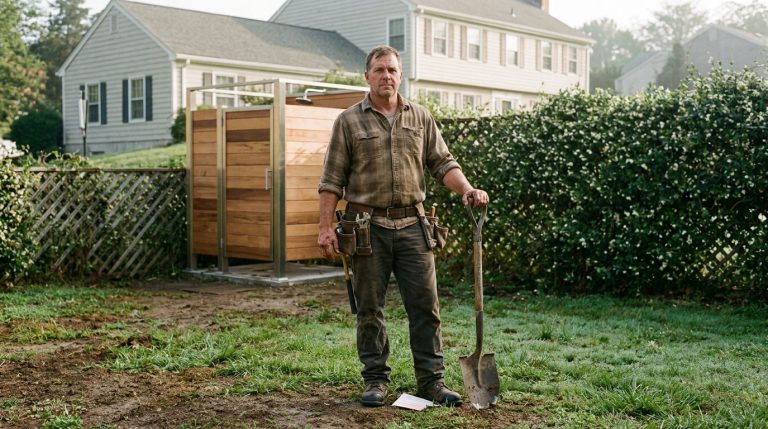
The wood of the top rail was cool under my palms, planed down smooth from three separate passes with a belt sander before the weather seal went on. I could feel the microscopic grain pressing against my skin, solid and true, completely unaffected by the rising volume of the woman standing three feet beyond my property line.
Karen’s face had reached the particular shade of plum-tinged crimson that usually preceded an administrative stroke. Her chest rose and fell beneath synthetic silk, straining the buttons near her collarbone as if the fabric itself were trying to escape her authority.
“It’s a blight, Mr. Evans,” she said, her voice dropping into that practiced, theatrical register designed to carry across suburban lawns without requiring a megaphone. “An outright blight on the property values of everyone who paid for architectural integrity.”
My gaze didn’t meet her eyes immediately. It dropped past the severe line of her sensible walking shoes to the object of her wrath. The coop sat six yards back on the manicured turf, its reclaimed cedar siding catching the low afternoon sun like honey-colored brick. The copper-capped cupola on top reflected a sharp, clean sliver of light, and the tiny window boxes—primed for the marigolds Emily had picked out from the seed packets—looked back at her with silent, unblinking defiance. I had mortised every joint by hand, sinking three-inch structural screws countersunk and plugged with cedar bungs so moisture couldn’t find a foothold. It was built better than the load-bearing walls of half the tract homes on this street.
“A blight,” I repeated softly. The word felt small and weightless between us.
She snapped the white envelope against her left palm, a sharp thwack that made a robin scatter from the lower branches of the neighbor’s maple. “Two hundred and fifty dollars for an unapproved structure under Section C, paragraph twelve. Plus fifty dollars a day accumulating as of midnight.” She thrust the paper forward through the iron pickets, stopping just short of my knuckles. “You can fight the board all you like, but the covenant is absolute. You pull it down by Friday, or we start placing liens.”
Two decades of military engineering taught me to measure an adversary by their panic, not their volume. In the sandbox, the officers who shouted the loudest were invariably the ones who had lost control of their supply lines. Karen was sweating through her foundation, her fingers twitching against the paper like she wanted to claw through the fence and rip the cedar boards apart with her bare hands. She wasn’t angry about the aesthetics. She was angry because I hadn’t flinched when she drove her first warning letter into my mailbox three weeks ago.
I kept my weight balanced evenly on both feet, letting the silence stretch out until it began to chafe against her nerves.
“There’s no architectural prohibition against small animal husbandry in the municipal code, Karen,” I said, my tone flat, devoid of heat or sarcasm. “I checked with the zoning board before I laid the first footing.”
“Municipal code doesn’t govern Oakwood Preserve,” she snapped, stepping half an inch closer, her toe coming to rest precisely on the boundary stake. “We govern ourselves. We maintain a standard here. People who move into this neighborhood are expected to understand that conformity is the price of admission.”
Conformity. The word tasted like dry dust.
I looked at the envelope resting on my prize-winning petunias where she had contemptuously flicked it after I refused to take it from her hand. The white paper sat stark and foreign against the purple blooms. Two years after Sarah died, when the world had shrunk down to the permanent, hollow ache in my chest and the bright, terrified eyes of an eight-year-old girl who kept asking when Mommy was coming back from the hospital, I hadn’t moved to Oakwood Preserve for conformity. I had moved here for silence. I wanted a place where the only noise in the morning was the wet slap of grass against sneakers and the quiet scratching of hens in dry straw.
Karen turned on her heel with a sharp jerk, her floral print snapping in the humid air like a pennant of bad news. She didn’t say goodbye. She just marched back down the sidewalk toward her oversized colonial, her shoulders rigid with the self-righteous satisfaction of a small-town tyrant who believed she had just broken another nail off the wheel.
I waited until she was four houses down before I reached over the picket and picked up the envelope. The paper was stiff, expensive stock paid for by the mandatory dues of three hundred homeowners who thought they were buying peace of mind.
As I slid my thumb under the flap, the screen door behind me clicked open, and the light, quick patter of bare feet hit the back deck.
“Daddy?” Emily’s voice was small, hesitant, hovering just behind my shoulder. “Did the mean lady leave?”
I turned, folding the paper twice before slipping it into my back pocket, and let the cold, hard knot in my chest soften just enough to look down into her wide, dark eyes—eyes that looked so much like her mother’s when the world grew too loud.
CHAPTER 2: THE BUREAUCRATIC APPEAL
The fluorescent tubes in the municipal management office hummed with a flat, chemical drone that smelled faintly of old carpet adhesive and bad institutional coffee. It was an environment designed to drain the fight out of anyone who walked through the glass double doors. The carpets were a dull, industrial beige—a shade selected specifically to hide footprints and ambition—and the synthetic ficus trees standing sentinel in the corners collected dust in their plastic leaves with absolute indifference.
I sat across from Brenda in a chair whose hydraulic stem had given up half a decade ago, leaving me tilted slightly lower than the laminate desk. Brenda didn’t look up immediately when I set the manila folder down. Her fingers, stained pale pink around the cuticles from cheap highlighters, kept rhythm against a plastic keyboard.
“Mr. Evans,” she said, her voice dropping at the end of the syllable like an anchor finding silt. “The architectural review committee doesn’t typically grant in-person consultations for minor citation appeals. The form is self-explanatory.”
“Section C, paragraph twelve,” I said, my voice cutting through the hum of the overhead fixtures without raising its decibels. “Lack of architectural harmony.”
She stopped typing. Her hands hovered over the keys for a second before she pulled them back and laced her fingers together, resting them on top of a stack of past-due water bills. When she finally raised her eyes, there was a weary, defensive glaze over them. She had spent ten years mediating disputes between people who treated lawn ornaments like acts of war.
“It’s the standard covenant language for Oakwood Preserve,” Brenda said, reciting a script she had clearly memorized long before she learned my name. “Structures must complement the established aesthetic tone of the community.”
“Define the tone, Brenda.”
The silence that followed was heavy, salted with the realization that nobody had ever asked her to define it using actual words. In her world, the tone was whatever Karen said it was at eight o’clock on a Tuesday morning.
I slid a single sheet of paper across the laminate surface. It wasn’t the citation notice. It was a printed copy of the municipal zoning code for the county, highlighted in yellow across a single paragraph that explicitly protected accessory structures under one hundred square feet on residential lots of a half-acre or more. Below it, I had neatly stapled the purchase receipt for the reclaimed cedar and the exact mathematical calculations for the coop’s load distribution and runoff pitch.
“The county recognizes the structure as a permitted utility installation,” I said quietly, keeping my hands flat on my knees. “The HOA covenants state that local ordinances supersede internal guidelines in matters of structural safety. If your committee maintains that a properly anchored, code-compliant coop lacks harmony, I need that interpretation entered into the official written record, signed by every voting member, along with their legal counsel’s direct contact information.”
Brenda stared down at the highlighted paper as if it might detonate. Her fingers twitched once toward her mouse, then retreated.
“You’re making this very complicated, Mark,” she murmured, using my first name for the first time. It wasn’t a friendly gesture; it was an attempt to humanize a process that had just hit a steel wall. “Karen… the president takes these things personally. She feels like an unapproved outbuilding sets a precedent. Once one person builds something outside the standard catalog, the whole aesthetic unravels.”
“The aesthetic isn’t unraveling, Brenda. It’s just being looked at.”
I stood up before she could formulate a defense, leaving the paperwork centered perfectly on her desk. The hydraulic chair hissed softly as it rose behind me.
“I’ll expect the written interpretation by Thursday afternoon,” I said, adjusting the cuffs of my shirt with slow, deliberate precision. “Otherwise, my lawyer will assume the board is operating outside its chartered mandate, and we can start addressing the liability under state commercial code.”
I didn’t wait for her to answer. I turned and walked out through the glass doors, letting them swing shut with a clean, heavy snap against the rubber seals. The afternoon heat outside was thick, but as I climbed back into the truck, my mind was entirely clear. The first gear was turning. The machine was starting to feel resistance.
CHAPTER 3: THE DOUBLE LIFE
The pen in my hand hovered three inches above a blueprint schematic for a commercial facade in downtown Raleigh, its graphite tip dark and sharp against the blue grid lines. My office was quiet, save for the steady whisper of the desktop fan pushing cool air across the circuit boards. It was a space defined by straight angles and structural logic, where every line drawn represented a calculated load, a welded joint, or a designated tension point. Here, errors were impossible to hide behind vague adjectives like harmony. Here, physics either held the weight or it did not.
The shrill ring of the desk phone sliced through the quiet, sharp enough to make the graphite snap under a sudden, involuntary tightening of my fingers.
I set the mechanical pencil down, wiped a speck of gray dust from the paper, and reached for the receiver. “Evans Design and Build.”
“Mr. Evans?” The voice on the other end was thin, slightly breathless, wrapped in the distinct cadence of a man who spent his life calculating insurance payouts or capital improvement margins. “My name is Arthur Wembley. I’m calling on behalf of the Oakwood Preserve Homeowners Association.”
A slow, deliberate stillness settled over my ribs. I leaned back into the worn leather of my desk chair, letting the springs groan softly under the shift in weight. The coincidence was too precise to be random; it carried the cold, calculated irony of a trap springing shut before the bait was even fully set.
“I’m listening, Mr. Wembley,” I said, keeping my voice neutral, polished with the exact register of a commercial contractor evaluating a new municipal bid.
“We are undertaking a major capital project,” Arthur continued, his words tumbling over one another with nervous eagerness. “A complete redesign of the community’s main entryway. Stone pillars, architectural lighting, water integration—a grand statement piece for the neighborhood. Your firm came recommended by a municipal contact who saw what you did with the Blackwood Creek Clubhouse. We’d like to retain your services for the preliminary design phase.”
The Blackwood Creek project was a multi-million-dollar commercial triumph that had earned a spread in regional architectural journals six months prior. Of course they wanted that level of execution. They wanted prestige wrapped in natural stone, paid for with the mandatory assessments of three hundred unsuspecting homeowners.
“We take on select municipal and community contracts,” I replied smoothly, tracing the edge of the blueprint with my index finger. “It requires a rigorous preliminary design scope. I assume your board president is aligned with this initiative?”
“Oh, absolutely,” Arthur sighed, dropping his voice an octave as if sharing a state secret. “She is driving the vision. Very particular about aesthetic standards, you understand. She insists on being involved in every step of contractor selection to ensure absolute quality.”
Karen. The irony tasted like cold iron on the back of my tongue. The woman who was currently levying fifty-dollar daily fines against a handcrafted cedar chicken coop because it lacked “architectural harmony” was simultaneously desperate to hire the exact same man—unrecognized behind a pressed blazer and a clean-shaven jaw—to design a four-million-dollar monument to her own ego.
“I can arrange a preliminary presentation next Tuesday afternoon,” I said, my tone flat and professional. “I’ll bring our portfolio, material samples, and a comprehensive scope of work. We can review the site parameters then.”
“Splendid!” Arthur’s relief was palpable, humming down the copper wires. “The board president will be thrilled. We’ll see you in the smaller conference room at the main clubhouse at two o’clock.”
“I’ll be there, Mr. Wembley.”
I hung up the phone and let my hand rest on the receiver for a long moment. The silence of the office returned, but the air felt denser now, charged with a new trajectory. I opened a clean digital file on my workstation, labeled it Capital Oversight, and began drafting the baseline parameters for a project that would eventually require an independent financial audit. The architecture of her undoing was no longer theoretical. It was being drawn in ink, straight and unyielding, waiting for the exact moment she would sign her own name at the bottom of the page.
CHAPTER 4: THE KANGAROO COURT
The folding chairs were arranged in three awkward rows on a scuffed linoleum floor that smelled of pine disinfectant and institutional fatigue. At the front of the room, behind a long, collapsible table draped in a blue felt cloth that had seen better decades, sat the Architectural Review Board. Karen occupied the absolute center, her posture rigid, her chin tilted upward at an angle designed to project sovereign authority.
To her left sat Arthur Wembley, shifting his weight constantly and staring down at a yellow legal pad as if it held the secret to his immediate survival. To her right, a middle-aged woman named Susan clicked her knitting needles together with a dry, rhythmic metallic click that punctuated the tense silence of the room. A few scattered residents sat in the rows ahead of me, each nursing their own quiet grievances: a faded mailbox paint code, an unapproved garden hose reel, minor infractions treated like federal offenses.
When my name was called, the sound of Karen’s gavel striking the felt was sharp and hollow.
“Mr. Evans,” she began, her voice pitching into its familiar, theatrical authority. “We are here to review your ongoing refusal to comply with citation notice seventy-four-three-B. The committee’s denial of your appeal is absolute. The fines now total nine hundred and fifty dollars, and unless the unauthorized structure is dismantled by sunset Friday, the board will authorize legal counsel to initiate lien proceedings against your title.”
The word lien hung in the air like a dropped wrench. In suburban real estate, it was a tactical weapon designed to induce immediate, unthinking panic—a legal anchor thrown into a homeowner’s financial security to force compliance without trial.
I didn’t rush to the podium. I stood slowly from my folding chair, letting the metal legs screech against the linoleum, and walked forward with measured, deliberate steps. I placed a single, neatly typed folder on the blue felt table, exactly six inches from her manicured fingertips.
“The fines are predicated on Section C, paragraph twelve,” I said, my voice low, even, and completely devoid of defensive heat. “Lack of architectural harmony. Yet when my office formally requested the written definition of that standard two weeks ago, Brenda was unable to provide one.”
Karen’s eyes narrowed, her fingers curling over the edge of the folder as if it were contaminated. “The standard is determined by the collective aesthetic judgment of the committee, Mr. Evans. It does not require a checklist to be enforceable.”
“An arbitrary standard enforced without written precedent is not a regulation, Karen,” I replied, leaning slightly forward, resting my palms on the cold edge of the table. “It is an exercise of unbridled discretion. Under state property law, applying subjective rules selectively while waiving them for favored residents constitutes bad faith. Furthermore, jumping straight to a lien without a formal arbitration hearing violates the due process clauses outlined in the association’s master charter.”
A low murmur rippled through the small group of residents sitting behind me. Arthur Wembley stopped tracing lines on his legal pad and looked up, his eyes wide and panicked, realizing the legal ground beneath them was suddenly full of hairline fractures.
Karen’s face flushed a deep, mottled crimson. She struck the gavel again, harder this time, though the wood merely thudded against the cloth. “You are not here to lecture the board on legal theory! You are here to answer for a blatant violation of community standards. The board moves to authorize council to file the lien immediately. All in favor?”
Her hand shot straight up into the air like a semaphore. Susan dropped her knitting into her lap and raised her hand with a reluctant, mechanical jerk. The third board member, a man who had spent the first ten minutes staring blankly at the ceiling tiles, blinked, jolted awake by the silence, and slowly thrust his hand upward. Arthur hesitated for three agonizing seconds, his hand twitching over the table before he slowly, miserably, raised it to complete the unanimous vote.
“Motion passes,” Karen declared, her voice trembling slightly with suppressed fury. “You have thirty days, Mr. Evans. Next case.”
I turned away from the table without another word, my face a mask of absolute neutrality. Inside, the engine was running clean and cold. She had just used her final tactical card. She had filed a public lien, thinking it was a checkmate, completely unaware that she had just handed me the exact paper trail required to blow her entire operation wide open.
CHAPTER 5: THE TROJAN HORSE
The private conference room smelled of lemon-scented wood polish and expensive wool. It was an interior designed to reassure corporate clients and municipal boards that their money was being converted into absolute permanence. A polished mahogany table reflected the crisp, linear glare of recessed overhead fixtures, and three leather executive chairs stood waiting around its perimeter like sentries.
When the heavy oak door clicked open, Arthur Wembley stepped inside first, his shoulders slightly hunched, followed closely by a committee member I recognized from the tax rolls. Karen entered last. Her face was flushed with the triumphant afterglow of a monarch who believed she had just crushed a minor rebellion at the community hearing the previous evening.
She wore a structured cream blazer with sharp, metallic buttons that caught the light like small daggers. Her eyes swept over me—standing cleanly beside my leather portfolio in a tailored charcoal suit and pressed button-down—with absolute, unrecognizing dismissal. To her, the man in jeans and a polo shirt from the kangaroo court and the principal of Evans Design and Build were two entirely different species inhabiting separate ecological tiers.
“Mr. Evans,” Karen gushed, extending a hand across the mahogany with an ingratiating, performative smile. “So wonderful to finally meet you in person. Arthur has told me a great deal about your conceptual work.”
I shook her hand, keeping my grip firm, measured, and completely neutral. “The pleasure is mine, Karen. Arthur has outlined an ambitious vision for the community entryway.”
“Oh, it’s going to be transformative,” she declared, sweeping into the central leather chair with practiced grace. “Stone pillars, integrated water features, absolute architectural permanence. We want something that tells anyone driving down this road that Oakwood Preserve stands for uncompromising standards.”
For the next forty-five minutes, I played my part with clinical precision. I unrolled full-color architectural renderings across the mahogany, pointing out sightline analyses, durability indexing for local weather patterns, and the precise tonal consistency of mortar joints. I fed her own pretentious, empty jargon right back to her—phrases like cohesive visual narrative and exclusive spatial cadence—and she devoured every syllable, nodding with grave, theatrical importance.
At the conclusion of the presentation, I slid the comprehensive contract package across the table. It was a masterpiece of standard commercial boilerplate, complete with professional timelines and a $15,000 non-refundable preliminary design fee.
Arthur winced slightly when he saw the fee, his eyes darting toward Karen to gauge her reaction to the cost. But Karen’s ego was a hungry furnace; a high price tag wasn’t a deterrent to her, it was validation of prestige.
“This is precisely the level of quality we require,” she pronounced, practically beaming as she pulled a heavy gold-plated fountain pen from her designer handbag. “We’ll authorize the retainer immediately.”
She flipped straight to the signature page without glancing at the dense legal text of the intermediate sections. Her pen moved swiftly across the paper, leaving a dark, permanent trail of ink across the designated line. She signed away her authority and sealed the fate of her administration without reading a single word of Section 8, subsection 8.4C—the dry, unyielding legal clause mandating an independent forensic financial audit before a single stone of phase two could be laid.
She handed the folder back to me with a triumphant smile, entirely unaware that she had just signed an execution order written in her own name.
CHAPTER 6: THE SILENT ASSEMBLY
The living room had been stripped of its ordinary domestic comfort. The sofa was pushed back against the baseboards to accommodate a semicircle of folding chairs borrowed from the garage, and the air smelled faintly of dry paper and nervous sweat. Outside, the streetlights flickered on through the front windows, casting long, fractured shadows across the hardwood floor where George had placed a plate of untouched sugar cookies.
At precisely seven o’clock, the doorbell chimed once—short, hesitant, like a code tapped out by someone afraid of the dark.
I stepped to the entryway and pulled the door open. George stood on the porch, his hands jammed deep into the pockets of a windbreaker, his face lined with the deep, permanent fatigue of a man who had spent thirty years avoiding conflicts that weren’t his. Behind him, emerging from the shadows of the driveway, Mr. and Mrs. Garcia walked side by side, their steps cautious, casting quick glances down the quiet suburban street as if expecting a patrol car to round the corner. Maria, the plumber who lived three blocks over, came last, striding up the concrete path with her jaw set hard and her eyes fixed on mine with a fierce, quiet intensity.
They filed into the house in silence, each of them moving with the hushed reverence of people entering a command bunker during a ceasefire.
When everyone was seated, I didn’t waste time with pleasantries or introductory small talk. I stepped to the center of the room and dropped a thick stack of printed financial ledgers and correspondence files onto the coffee table. The paper hit the wood with a heavy, solid thud.
“For years,” I said, my voice cutting cleanly through the quiet hum of the refrigerator, “each of you was led to believe that your individual fines, your rejected permits, and your mandatory corrections were unique failures of your own making. George was told his memorial garden lacked aesthetic harmony. The Garcas were fined because their playset was the wrong shade of brown. Maria was penalized for parking a work van in her own driveway while selective blind eyes were turned elsewhere.”
I tapped the top folder with my index finger. “They weren’t failures. They were quotas. And they were all engineered by the same person.”
Mr. Garcia leaned forward, his hands locked tightly between his knees. “We heard she’s pushing a lien on your property now, Mark. Over that chicken coop. Everyone on the block is talking about it.”
“She thinks she has,” I replied, a cold, measured calm settling over my tone. “She filed the paperwork with the county clerk this morning. She thinks a lien is an absolute checkmate.”
I pulled a single sheet of paper from the file and slid it across the table toward Maria. She picked it up, her eyes scanning the typed corporate registration details.
“Suburban Maintenance Solutions LLC,” Maria read aloud, her voice dropping into a harsh rasp. “I’ve never heard of this contractor. Is this who she hired for the common areas?”
“It’s a shell company registered to a P.O. box in a neighboring county,” I explained, leaning back against the edge of the brick fireplace. “The registered agent is Gerald Finny. Karen’s brother-in-law. Over the past four years, this phantom company has pulled over a hundred and fifty thousand dollars out of the association’s operating accounts for landscaping services that were never performed. It’s a closed-loop grift disguised as a homeowners association.”
The room went completely dead. The silence was absolute, save for the faint ticking of the wall clock in the hallway. The realization didn’t produce immediate anger; it settled over them like cold lead, heavy and undeniable, transforming years of private humiliation into a collective, razor-sharp clarity.
George looked down at the financial tables, his knuckles white against his knees. His voice, when it finally broke the stillness, was barely a whisper. “All this time… I thought I was just getting old. I thought I didn’t fit into the neighborhood anymore. I took down Helen’s bench because I didn’t want the stress.” He raised his head, the old, dormant spark of a marine or a lifelong worker flashing in his eyes. “What do we need to do, Mark?”
“We don’t fight her in the streets,” I said, meeting the gaze of every person in the room. “We let her walk right into the perimeter. She just signed a major architectural contract with my firm for the grand entryway project. And buried deep inside that contract—hidden in the standard boilerplate—is a mandatory clause requiring an independent forensic financial audit before a single shovel touches the dirt.”
Maria let out a sharp, sudden breath that sounded almost like a laugh. “She didn’t read it.”
“She didn’t read a word of it,” I confirmed. “Her ego wouldn’t let her slow down long enough to examine the fine print. She’s currently bragging to the board about the prestige of the project, completely unaware that she has legally obligated herself to open the books wide open.”
The tension in the room shifted, the heavy lead melting away into a cold, focused resolve. The oversight committee was no longer a defensive shelter; it was an operational battery. We spent the next two hours mapping out our communications, synchronizing our records requests, and preparing the collective voice that would shatter her illusion of absolute control at the upcoming emergency meeting.
CHAPTER 7: THE EMERGENCY COLLAPSE
The community center air was thick with the body heat of eighty residents crammed into a space built for forty. Folding chairs scraped against the polished concrete floor in a chaotic chorus, and the fluorescent panels overhead buzzed with a sharp, aggressive frequency. At the front table, Karen sat flanked by her board members. She looked flushed, her posture rigid with the defensive adrenaline of a monarch sensing rebellion in the courtyard.
When she struck the wooden gavel against the table, the sound was dry and cracking, swallowed instantly by the restless murmur of the room.
“This emergency session has been called to address unauthorized community disruptions and malicious vendor extortion,” Karen began, her voice cutting through the noise with practiced theatrical sharpness. She launched directly into her script, brandishing the 3D renderings of the entryway like a shield. She spoke of uncooperative contractors holding projects hostage, of bad-faith actors attempting to dismantle neighborhood standards, painting herself as the sole guardian of property values against a rising tide of chaos.
She reached her crescendo, leaning over the table with a triumphant glint in her eye. “So we face a choice. Do we capitulate to blackmail, or do we stand firm against the malcontents who want to turn our streets into a junkyard?”
She paused, expecting the usual collective nod of submissive agreement. Instead, the room remained dead, suffocatingly quiet.
I pushed away from the back wall where I had been standing with my arms folded, the weight of my boots steady against the concrete. I stepped forward into the wide central aisle, my voice carrying clean and level across the room without shouting.
“There is no blackmail, Karen,” I said.
Heads snapped around. Karen’s expression soured instantly into a mask of pure venom as her eyes locked onto mine. “Mr. Evans, this is a closed board proceeding—”
“I’m not speaking as a resident right now,” I interrupted, taking another slow, measured step down the aisle. “I’m speaking as the principal of Evans Design and Build.”
A sharp intake of breath swept through the rows. Whispers erupted like dry brush catching a spark. Karen’s mouth dropped open, her professional veneer shattering in a single heartbeat as the terrifying realization of who stood before her finally breached her defenses.
“That’s right,” I continued, my gaze holding hers like a vise. “I am the contractor you hired. And I am the resident you tried to crush. The clause you call extortion is an independent forensic financial audit—a clause you personally approved and signed into contract under Section 8.4C.”
Chaos exploded. George stood up near the front, his voice ringing out clear and strong as he detailed the forced destruction of his wife’s memorial garden. Mr. Garcia rose next, holding up the paperwork for his son’s playset fines. Maria stepped forward from the side, naming the selective enforcement of parking violations. One by one, the quiet victims of her administration stood, transforming the sterile meeting hall into an undeniable tribunal of truth.
Arthur Wembley, white-faced and trembling, looked at the roaring crowd, then down at Karen. He stood up slowly, raising a shaking hand for silence.
“In light of these disclosures,” Arthur shouted over the uproar, his voice cracking slightly before finding its footing, “I move that the board immediately authorize the forensic audit, and I move that President Karen Miller be suspended from all presidential duties pending the results.”
The knitting woman in the front row dropped her needles with a sharp metallic clatter. “I second the motion.”
Karen lunged to her feet, her face mottled purple with rage. “You can’t do this! This is my board!”
“The motion carries,” Arthur declared, banging the gavel down with finality. “You are suspended, Karen. Turn over the gavel.”
She looked around the room, finding only cold, unwavering stares from the neighbors she had ruled through fear for years. Her shoulders slumped, the manufactured authority draining out of her entirely as she sank back into her chair, a dethroned tyrant in a room that had finally found its voice.
CHAPTER 8: THE REBIRTH OF OAKWOOD PRESERVE
The sunlight cutting across the turf was crisp and clean, catching the edges of the cedar fencing where the morning dew still clung in tiny, reflective beads. I knelt beside the flower bed, pressing the dark, rich soil firmly around the roots of the new petunias. They were purple—deep, vibrant, and entirely uninterrupted by white envelopes or municipal threats.
A hundred feet away, down the asphalt of Oakwood Preserve, a plain black sedan with government plates rolled to a silent stop beside Karen’s immaculate colonial. Two figures stepped out—a man and a woman in tailored gray suits carrying leather briefcases. They mounted the porch steps with the calm, methodical inevitability of a tide coming in.
I didn’t stare. I kept my rhythm steady, my hands working the soil while my peripheral vision registered the front door opening, the brief exchange of words on the threshold, and the moment Karen stepped back onto her own porch under escort. She wasn’t in handcuffs, not yet, but her shoulders were completely collapsed, her posture hollowed out of every ounce of manufactured authority she had wielded for years. As they led her down the steps toward the sedan, her gaze drifted across the street.
Our eyes met for a fraction of a second. There was no fire left in her expression, no calculated glare or righteous indignation. Just a flat, dawning realization that the empire she had built on fear and paperwork hadn’t been toppled by a grand conspiracy, but by a handful of cedar boards, a memorial garden, and a refusal to bow.
I didn’t gloat. I gave her a slight, measured nod, then turned my attention back to the earth beneath my palms. The sedan doors closed with a dull, heavy thud, and the vehicle pulled away, leaving the street as quiet as it had always promised to be.
The fallout from the forensic audit struck like a localized earthquake. Sterling Forensic Accounting delivered its final report to the new board within three weeks, uncovering nearly a quarter of a million dollars funneled through Suburban Maintenance Solutions LLC—the shell company registered to Karen’s brother-in-law—along with personal expenses disguised as administrative costs. The district attorney’s office acted swiftly, filing multiple felony counts of wire fraud and embezzlement. Karen and her co-conspirators were no longer a local administrative nuisance; they were a matter for the state penal system.
Inside the neighborhood, the reconstruction was immediate and thorough. A special election was held under the guidance of the newly formed community oversight committee. George, despite his initial reluctance, was elected board president by an overwhelming landslide, stepping into the role not as a ruler, but as a caretaker. The Garcas and Maria took their places alongside him, ensuring that transparency and common sense finally replaced suspicion.
For three consecutive weekends, the community clubhouse hosted a total overhaul of the bylaws. Every vague, subjective restriction—including the infamous architectural harmony clause—was stripped out, rewritten, and replaced with explicit, fair guidelines that protected individual property rights without choking the life out of the neighborhood. The grand entryway project was redesigned through an open community vote, scaling back a billionaire’s vanity monument into a welcoming, modest stone archway that actually reflected the quiet character of the people who lived there.
On a warm Saturday afternoon a few months later, the tension that had once hung over the streets like a permanent humidity was entirely gone. My backyard was filled with the sound of laughter and splashing water. George stood near the fence, holding court by the new community compost bin. The Garcia family was gathered near the lawn, and Emily was teaching a younger neighbor how to hold a feed scoop without spilling grain.
I stood by the edge of the cedar coop, my hand resting on the smooth, planed top rail. The structure was as solid as the day I sank the first screws, its copper cupola catching the afternoon sun and throwing a bright, steady spark across the grass.
The back screen door clicked open, and Emily came running across the lawn, her face flushed with excitement, holding something cupped carefully in both hands.
“Daddy,” she called out, skidding to a halt beside me with a wide, bright grin. “Esther just laid another one.”
She opened her hands. Resting in the center of her small palms was a single, flawless brown egg, still holding the gentle warmth of the nest.
I took the egg, feeling its smooth, unbroken surface against my fingertips. I looked from the shell in my hand out across the crowded, laughing yard—my daughter safe, my neighbors united, and the quiet rhythm of the neighborhood restored to its rightful balance.
“Is it perfect, Daddy?” she asked, her dark eyes looking up at me with absolute trust.
“Yes, sweetie,” I said, my voice settling into a deep, permanent peace. “It’s entirely perfect.”