Calculated Tides: The Cold Engineering of Retribution Against a Corrupt Neighborhood Empire
CHAPTER 1: THE LIMESTONE SHARDS
The coffee in my mouth tasted of chicory and stale panic.
When the first shockwave rattled the windowpanes of the kitchen at precisely six o’clock, I had been staring down into a ceramic mug, measuring the distance between my divorce settlement and the quiet oblivion of the twelve acres my great-grandfather had carved out of the Colorado foothills. By the time I slammed my pickup into reverse and screeched up the long, gravel drive, the dam was already breathing its last gray breath.
A hundred years of hand-cut limestone blocks—blocks fitted together during the Depression with mortar that tasted of iron and river silt—lay in jagged, smoking ruins across the creek bed.
And there he stood.
Dexter Hawthorne, president of the Milbrook Estates Homeowners Association, parked his BMW X7 squarely on the shoulder with the casual arrogance of a man who owned the county surveyor’s office and everyone inside it. He was fifty-two years of age, carved out of pressed khakis and self-righteous entitlement, smiling the smile of a lottery winner who had just discovered someone else’s ticket in the gutter.
“Free demolition, Ezra,” he called out, his voice cutting cleanly through the diesel rumble of the contractor’s idling excavators. His thumb hooked into his belt loop. “Your little swamp was dragging down the valley’s property values. We’ve got standards to maintain here.”
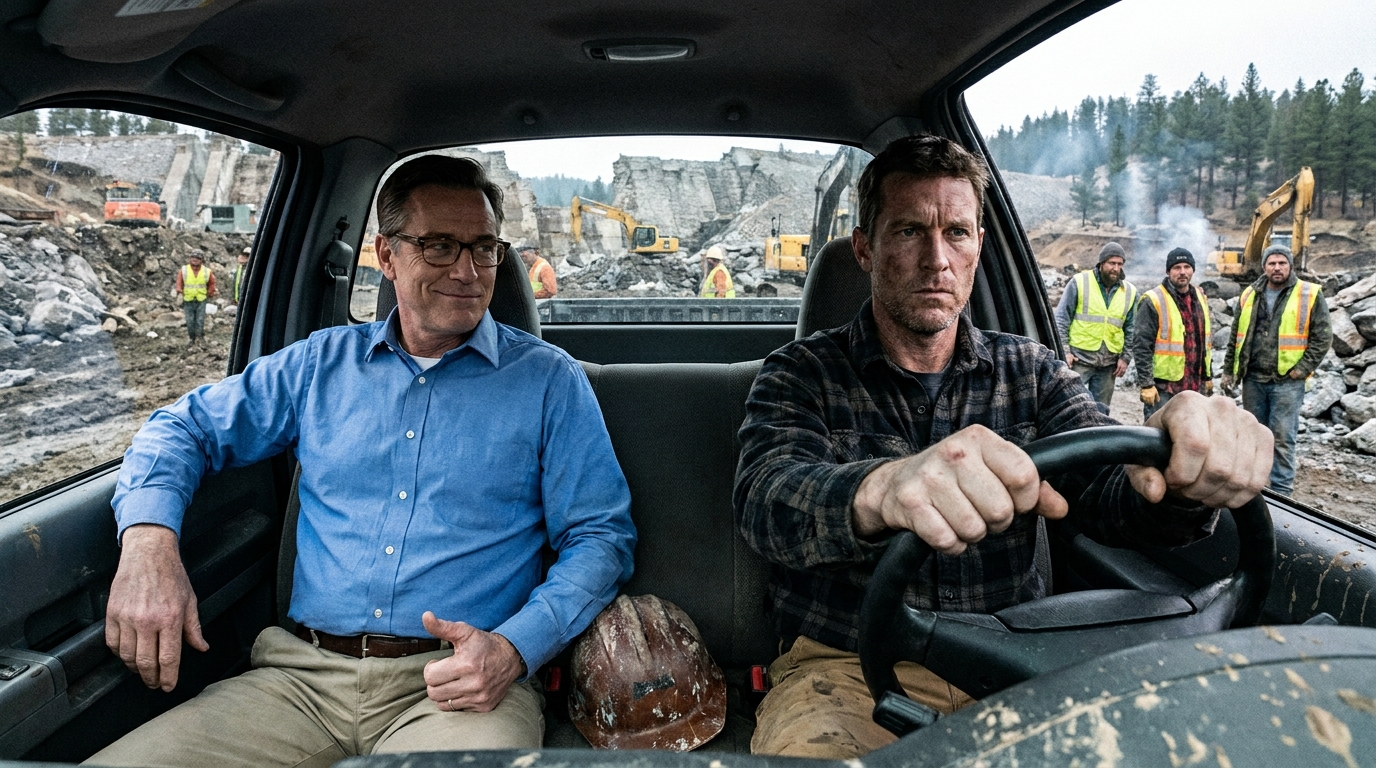
I cut the engine, but I didn’t step out immediately. My hands remained locked at the ten-and-two position on the steering wheel, knuckles bleached white against the black polyurethane. Through the windshield, the morning mist was lifting off what remained of the three-acre pond, exposing the raw, bleeding banks of mud where cattails had stood undisturbed since Warren G. Harding occupied the White House.
What Dexter Hawthorne did not know—what his expensive real estate development seminars had apparently neglected to mention—was that our little swamp had held back the high-country spring runoff for nearly a century. He had just pulled the plug on a pressurized, ticking time bomb, and the snowpack in the peaks above us was sitting at a brutal hundred and forty percent of normal.
The air grew sharp with the metallic tang of high-altitude frost mixing with burnt cordite. I reached slowly across the console, my fingers brushing the cold plastic of my phone, calculating angles, risk ratios, and the precise velocity of a man sprinting toward his own destruction.
“You’re standing on private property, Dexter,” I said, my voice dropping into that flat, measured register I usually reserved for hydraulic stress tests.
Hawthorne laughed—a dry, mechanical sound like a garbage disposal grinding down beer bottles. He took a slow, deliberate step closer to my truck, his eyes narrowing behind designer frames. “Your property line ends where our water management jurisdiction begins, Blackwood. Pay the twelve thousand in back assessments by noon, or consider this the first installment of your compliance education.”
He turned on his heel before I could answer, the crunch of fresh gravel beneath his loafers sounding painfully loud in the thin mountain air.
I didn’t reach for the horn. I didn’t shout. I simply watched the rhythmic twitch of his shoulder blades as he climbed back into his Beamer, leaving behind a plume of blue exhaust and an open, bleeding wound in the earth. The steering wheel grew colder beneath my palms, but inside my chest, something heavy and cold locked firmly into place.
CHAPTER 2: THE PAPER TRAIL
The hum of the truck engine died slowly, the cooling block pinging in the crisp morning air like a metronome counting down seconds I couldn’t afford to waste. Dexter’s BMW was already a quarter-mile down the county road, kicking up a rooster tail of pale dust that hung suspended in the dense shade of the ponderosa pines.
I sat there for a long moment, my fingers still glued to the wheel, feeling the subtle vibration of the chassis settling into the grade. The air smelled of crushed pine needles, exhaust, and the sharp, coppery scent of damp iron rising from the ruins of the dam. It was a familiar smell—the smell of things breaking under pressure that had built up too long.
My great-grandfather had left behind three heavy steel lockboxes in the root cellar beneath the main cabin, tucked behind jars of pickled green tomatoes and a crate of kerosene lanterns that hadn’t seen an open flame since the Eisenhower administration.
I killed the ignition, the sudden silence crashing down like a physical weight. Stepping out of the cab, my boots crunched on the gravel with a dry, aggressive rhythm. Every step I took toward the cabin felt heavy, burdened by the realization that a man in pressed khakis and designer frames had just put a price tag on a century of sweat.
The cabin door gave a familiar, complaining groan as I pushed it open. Inside, the light slanted through the western windows in thick, dusty bars, illuminating the rough-hewn pine logs of the walls. It was a good room—a room built by men who understood that winter doesn’t care about your zoning permits or your HOA dues.
I crossed the plank floor directly to the trapdoor hidden beneath the heavy oak work table. Hauntingly familiar blueprints, grease-pencil notes, and salt-stained ledgers from 1924 stared back at me as I lifted the heavy iron ring. Samuel Blackwood had written his calculations in a cramped, sharp script that looked like barbed wire. He hadn’t just stacked rocks; he had mapped the ancient behavior of the watershed, tracing the hidden veins of snowmelt that fed the valley every spring.
A sudden, sharp memory flared behind my eyes—my father standing in this very room years ago, warning me about the downstream developers who looked at a natural wetland and saw only blank canvas waiting for asphalt and manicured lawns. The psychological phantom of that warning pressed against my ribs, tightening my breathing. Dexter wasn’t just a nuisance; he was part of a machine that ground down history to pour concrete foundations for people who wouldn’t know a spring flood from a leaky garden hose.
I didn’t reach for the phone to call the sheriff. Local law enforcement in Milbrook County drank coffee at the diner where Dexter bought breakfast; they didn’t care about state survey boundaries or historical water rights.
Instead, I pulled the 1954 county water district refusal letters from the bottom of the lockbox. The paper was yellowed and brittle, smelling faintly of dry basements and old ink, but the ink itself was indelible. There, scrawled in my great-grandfather’s confident hand, was an explicit rejection of the newly formed Milbrook Homeowners Association’s jurisdiction, countersigned by a county clerk whose signature had long since faded into administrative history.
My fingers traced the edge of the paper. Twelve thousand dollars in back fees. Five hundred dollars a day in municipal penalties. They were trying to starve me out, using legal paper cuts to force a sale of twelve acres of ancestral ground so they could flatten the pond, channelize the creek, and build decorative water features for a resort community.
The front door creaked.
I didn’t startle. I simply let the ledger drop back into the box with a dull, hollow thud and straightened up, turning toward the dim light of the doorway.
It wasn’t Dexter. It was Janet Morrison, standing on the threshold with her arms crossed tight over a faded canvas jacket, her face pale and pinched against the morning chill. She lived three doors down from Hawthorne’s McMansion, right in the primary drainage corridor below my ridge.
“He’s filing the emergency demolition paperwork with the county commissioners today, Ezra,” she said without preamble, her voice dropping to a harsh whisper. She didn’t step inside; she stayed out on the porch, casting a long shadow across the floorboards. “Rick Morrison—no relation, thank God—signed off on a structural condemnation report an hour ago. They’re calling it an immediate public safety hazard.”
I walked slowly to the doorway, leaning one shoulder against the rough pine jamb, looking down at her. The morning sun caught the gray in her hair and the deep, exhausted circles under her eyes.
“Rick Morrison hasn’t stepped foot on my property in six months,” I said, my voice dangerously level. “And the last time he looked at that masonry, he couldn’t tell granite from limestone.”
“It doesn’t matter what he knows,” Janet snapped, her frustration breaking through her guarded exterior. “It matters what the board votes on. Hawthorne’s got three of the five commissioners in his pocket. They’re going to push an emergency ordinance through before the weekend. If you don’t show up with an injunction, they’re going to bring in heavy equipment and tear out whatever’s left of your spillway.”
I looked past her shoulder, down the valley where the roofs of Milbrook Estates glittered uniformly in the pale sunlight—a hundred identical boxes huddled together, completely unaware that the only thing keeping their basements dry was a pile of hand-cut rock they were currently trying to legislate out of existence.
The air grew colder, the scent of pine sharpening into something medicinal.
“Let them bring their equipment,” I said softly, the edges of my words hardening into iron. “Just make sure you’ve got your own property records handy, Janet. Because when they pull the plug on my grandmother’s pond, they aren’t just destroying my history. They’re signing the eviction notice for their own backyards.”
She stared at me for a long, quiet second, searching my face for a bluff, finding only the cold, unyielding geometry of a hydraulic engineer who had just finished running the numbers. Without another word, she turned and walked back down the path, her boots crunching away into silence.
I closed the cabin door, locked the heavy deadbolt, and walked back to the work table. There were three weeks left before the high-country snowpack began its inevitable descent. Three weeks to turn a corrupt county’s weaponized bureaucracy back against the men who built it.
CHAPTER 3: THE MUNICIPAL TRAP
The click of the deadbolt echoed in the empty cabin like a pistol cocking.
I didn’t turn back to the work table immediately. Instead, I stood motionless in the dim pine-scented air, listening to the faint, crunching rhythm of Janet’s boots fading down the gravel track until the mountain silence swallowed them whole. The threat wasn’t theoretical anymore. Hawthorne was pushing the municipal levers, and if the county commissioners rubber-stamped an emergency demolition order before the weekend, I wouldn’t even have a platform to defend the watershed.
My boots hit the floorboards with a heavy, deliberate thud as I walked back to the heavy oak table. The 1954 water district letters lay scattered across the wood like dry autumn leaves. I picked up a blue-backed county surveyor’s map from May of that year, my thumb tracing the faded red ink marking the original property bounds.
Something didn’t line up.
Under the harsh glare of the adjustable gooseneck lamp, the parcel lines around the lower gorge showed a subtle, deliberate alteration. It wasn’t ink from 1954; it was a modern pencil trace—thin, sharp graphite that had been pressed into the old paper fiber with a mechanical drafting pencil. Someone had doctored the county archives to make it look like the HOA’s water management jurisdiction extended fifty feet upstream past my spillway.
The scent of dry, brittle paper mixed with the metallic tang of cold coffee as my mind began calculating the angles. This wasn’t just sloppy zoning administration. This was a targeted administrative forgery, designed to give Hawthorne the legal pretext he needed to seize the land under emergency public safety statutes. And the man holding the drafting pencil in the county records office was almost certainly Rick Morrison’s brother-in-law, who handled municipal mapping for the district.
I didn’t reach for the phone this time. You don’t call the police when the map itself has been stolen by the county’s own cartographer.
Instead, I pulled my laptop from its canvas case, plugged it into the solar-backed generator humming quietly on the back porch, and opened the county’s public GIS database. Side by side, I laid out the digitized property records from 1924, the 1954 water compact, and the current electronic mapping layers. The discrepancy screamed from the screen: three parcels upstream had been quietly reclassified under a commercial development umbrella three months ago, all bearing the corporate seal of Hawthorne Holdings LLC.
He wasn’t just trying to fix an eyesore. He was clearing the board for a multi-million-dollar resort expansion, using the county’s zoning board as a blunt instrument to break my family’s century-old water rights.
The cabin grew noticeably colder as the sun dropped behind the jagged western ridge, casting long, razor-sharp shadows across the floorboards. My fingers flew across the keyboard, exporting high-resolution metadata stamps, IP logs of the database edits, and time-stamped administrative modifications. If Hawthorne wanted a bureaucratic war fought with certified documents and municipal ordinances, I would give him an avalanche that would crush his legal team before the week was out.
The hum of the generator outside hitched on a stutter of wind.
I paused, my fingers hovering over the enter key. A pair of headlights swept across the lower windows—slow, deliberate, unhurried. No local delivery truck drove that softly, and no neighbor dropped by unannounced after dark without laying on the horn.
I stood up from the desk, moving with absolute silence, keeping below the level of the window sills. The gravel outside crunched once, twice—heavy and calculated. Someone was standing right outside the heavy oak door, listening for the sound of breathing in the dark.
CHAPTER 4: THE MIDNIGHT SHREDDER
The knock didn’t come.
Instead, the brass doorknob turned slowly—a soft, metallic click as the latch tested the deadbolt and found it locked. Then came a sharp, double-tap of knuckles against the seasoned pine, followed by a muffled voice speaking low against the wood.
“Ezra. Don’t open the front. It’s Janet.”
I let out a slow, measured breath, my finger sliding off the heavy pocket knife I’d palmed from the desk. Crossing the floorboards in two silent strides, I turned the deadbolt and pulled the door inward just enough to let the cold night air sweep across the threshold.
Janet Morrison slipped inside before the latch could protest, her breath pluming white in the dim illumination of the gooseneck lamp. Her eyes were wide, glittering with a frantic, nervous energy that didn’t belong to a woman who went to bed at nine. She reached out, her fingers catching my sleeve with a grip like a vice.
“They’re scrubbing the drives, Ezra,” she whispered, her voice trembling slightly. “Right now. At the community center.”
I closed the door, throwing the deadbolt back into place with a solid, reassuring thud. “Who?”
“Hawthorne. And his brother-in-law.” She pulled a crumpled sheaf of paper from her jacket pocket and slapped it onto the oak work table right beside my open GIS screen. “My husband woke up to use the bathroom around eleven, looked out the window toward the HOA administrative annex, and saw the BMW parked under the broken street light. There’s an industrial shredder running in the back room. They’re dumping three years of financial ledgers into cross-cut confetti.”
I looked down at the paper she had brought. It was a partial printout—a surviving page from an unredacted contractor payout sheet dated six months prior. Highlighted in yellow marker was an eighteen-thousand-dollar transfer labeled Hawthorne Consulting Maintenance, routed directly through a shell account that shared a mailing address with a vacant commercial lot in downtown Denver.
The pieces clicked into place with the cold, mechanical precision of a well-oiled valve. The fake safety violations, the forged zoning maps, the rushed municipal votes—they weren’t just stepping stones for a resort development. They were desperate smokescreens designed to bury an embezzlement trail wide enough to swallow the entire board.
“They think they’re destroying the only copies,” I said, my voice dangerously flat.
“Aren’t they?” Janet stared at me, her chest heaving as she fought to control her breathing. “If those files go into the bin, Hawthorne walks clean. The county commissioners will vote on the emergency demolition tomorrow morning, and nobody will have the paper trail to prove why he’s pushing it.”
I turned back to the glowing screen of my laptop, where the metadata exports from the county GIS database still blinked green in the dark.
“He’s destroying copies, Janet,” I murmured, my fingers flying across the keyboard to execute a secure data dump to an external cloud server hosted out-of-state. “But my lawyer filed a formal financial subpoena with the regional credit union four days ago. The originals are already sitting in a secure digital lockbox in Denver. All Dexter is doing right now is committing active destruction of evidence in a pending criminal fraud case.”
The realization seemed to drain the last bit of color from her face, leaving her staring at the wood grain of the table as the weight of the situation settled over her.
“What do we do?” she asked, her voice dropping to a harsh whisper.
“We let him make noise,” I said, reaching for my heavy wool coat hanging by the door. “Desperate men with shredders always leave witnesses. Grab your coat. We’re going to give Deputy Santos something interesting to look at before the night is over.”
The gravel driveway crunched beneath our boots as we stepped out into the biting mountain air, moving toward the truck with the quiet, deliberate momentum of a trap closing shut.
CHAPTER 5: THE EXPLOSIVE STAY
The truck tires bit into the frost-hardened gravel of the driveway, spitting loose stone against the wheel wells as I swung the nose around toward the main road. Beside me, Janet sat wrapped tightly in her canvas jacket, her eyes fixed on the pale ribbon of asphalt winding down the dark canyon toward the Milbrook community center.
The air inside the cab smelled of cold rubber, damp wool, and the faint, metallic musk of adrenaline.
“If Hawthorne’s lawyer managed to scrub the primary drive before Santos arrived,” Janet said, her voice cutting softly through the low hum of the heater, “what happens to the subpoena?”
“It doesn’t matter,” I kept my eyes locked on the dark curves of the road, my hands steady on the steering wheel. “A corporate server audit leaves digital footprints deeper than an office shredder can reach. Every keystroke logged into that billing software has a timestamp and a signature. He isn’t erasing a crime; he’s documenting panic.”
We rounded the final stand of ponderosa pines, and the low-slung, cinder-block profile of the Milbrook community center came into view.
A single marked cruiser from the county sheriff’s department sat angled across the gravel lot, its overhead light bar casting a slow, rhythmic pulse of amber and blue against the peeling white paint of the annex walls. Beside it, Dexter’s black BMW X7 idled with its headlights blindingly bright, casting long, distorted shadows across a knee-high drift of confetti paper that had fluttered out the side door into the weeds.
I killed the engine three spots down, letting the truck coast into silence.
The cold night air rushed in the second I pushed my door open, carrying the sharp, chemical smell of hot electric shredder motors and burnt toner. As my boots hit the gravel, the metallic clink of handcuffs caught my ear.
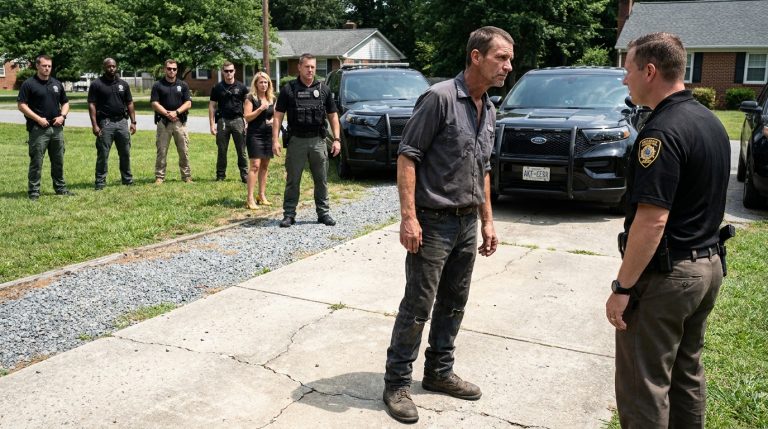
Deputy Maria Santos stood near the open doorway of the annex, her flashlight beam cutting through the gloom to illuminate a very flustered, pale-faced Dexter Hawthorne standing ankle-deep in shredded financial statements. His expensive polo shirt was rumpled, his designer frames slightly askew, and his hands were cuffed securely behind the small of his back.
“Community business doesn’t follow standard office hours, Deputy,” Dexter was stammering, his voice tight with forced authority as he tried to twist away from the cruiser’s rear quarter-panel. “We were merely updating our municipal server architecture.”
“At midnight, Mr. Hawthorne?” Santos’s voice was flat, devoid of humor, as she clicked her pen against a pocket notebook. “Surrounded by ten bags of cross-cut paper and an industrial shredder that smells like it’s about to catch fire?”
I walked slowly across the gravel lot, my boots crunching a steady, rhythmic beat against the frozen earth. Janet stayed by the truck, her arms crossed, watching the wreckage of the HOA president’s administrative empire blow away in the mountain breeze.
Dexter spotted me coming through the amber light, his eyes narrowing into venomous slits. “This is harassment, Blackwood,” he snarled, straining against the cuffs. “Your little stunt is going to cost you every square inch of that property. The emergency demolition order goes in front of the commissioners at nine o’clock this morning, and your dam is coming down whether you like it or not.”
I stopped three feet from him, letting the cold air settle between us. I didn’t smile. I didn’t gloat. I simply looked at him the way a hydraulic engineer looks at a hairline crack in a concrete wall—calculating the exact pressure point where failure becomes absolute.
“You can push all the emergency ordinances you want, Dexter,” I said quietly, my words carrying easily over the idle of the cruiser engine. “But while you were busy shredding eighteen months of embezzled contractor payouts, my lawyer was filing a federal stay with Judge Morrison based on the 1953 county flood control compact.”
His breath hitched, a tiny, involuntary twitch of his jaw betraying the sudden drop in his confidence.
“You don’t have standing,” he muttered, though the sharp edge had vanished from his tone.
“Under federal law,” I continued, my voice dropping an octave, “anyone who authorizes the destruction of a certified watershed barrier right before a hundred-and-forty-percent spring snowmelt isn’t just violating local zoning codes. They are assuming personal, civil, and criminal liability for every flooded basement from here to the county line.”
Deputy Santos looked up from her notebook, her eyes shifting slowly from Dexter’s pale face to mine. “Is that right, Mr. Blackwood?”
“The court order is already being faxed to the commissioner’s office,” I said, pulling a folded document from my inner pocket and tapping it against my palm. “And the demolition crew scheduled for dawn is about to find out that a federal injunction carries a lot more weight than a forged municipal permit.”
Dexter opened his mouth to reply, but no words came out. The cold reality of the numbers—the lawsuits, the missing funds, the impending wall of high-country water—finally caught up with him.
I turned my back on him without another word, leaving him standing in the drift of his own shredded paper, and walked back toward the truck as the first gray light of dawn began to bleed over the jagged eastern peaks.
CHAPTER 6: THE WEIGHT OF GRAVITY
The truck tires crunched back onto the gravel drive of the cabin just as the sun broke the high ridgeline, casting long, sharp shadows across the broken masonry of the ruined spillway.
I didn’t turn off the ignition right away. I sat behind the wheel, letting the engine idle while I watched the pale, gray line of Milbrook Creek below. The water was moving faster now than it had twenty-four hours ago, swollen by the initial, aggressive bleeding of the high-country snowpack. Up here, six thousand feet above sea level, physics didn’t care about municipal ordinances, backroom embezzlement schemes, or executive board meetings. Water moved because of elevation, and it stopped for nothing less than absolute mass.
The radio on the dash hissed with static before a local emergency dispatcher’s voice broke through, reporting rising water levels along the lower residential avenues.
I stepped out of the cab, my boots striking the frozen dirt with a dull, heavy thud. The air carried the unmistakable scent of wet earth, crushed pine, and the cold, metallic tang of an impending deluge. Down in the valley, a mile below my ridge, tiny dots of color moved frantically across lawns—homeowners dragging plastic storage bins out of basements and stacking sandbags against front porches that had never been designed to withstand a natural overflow channel.
Dexter Hawthorne had spent three years building an empire of pressed khakis and forged zoning permits, believing he could legislate away a century of water management. But as I walked down toward the broken stone dam, the gradual unpacking of his absolute ruin became glaringly clear. The secret wasn’t just that he had stolen eighteen thousand dollars here or forged a boundary line there. The core reality—the Layer 2 truth that he had fought so desperately to conceal—was that his entire $12 million resort development depended entirely on the quiet, unpaid labor of a concrete and limestone barrier he had just destroyed. By blowing up the dam to clear space for artificial golf course water features, he had ripped out the valley’s only shock absorber. And under the 1953 federal flood control compact, that catastrophic error made him personally, individually liable for every single gallon of water that was about to reclaim its historical bed.
A sharp roar echoed up the canyon—not an explosion this time, but the deep, sustained bass rumble of a thousand tons of melting snow breaching the lower gorge.
By two o’clock in the afternoon, the first wave hit the outskirts of Milbrook Estates.
I stood on the high stone outcropping above my property, a pair of heavy binoculars pressed to my eyes. Through the magnified lenses, I watched the water spill over curbs and sweep across manicured lawns with the ruthless efficiency of a ledger balancing itself out. The pristine McMansions, built directly in the path of the ancient creek bed, were taking the brunt of it. Water pooled three feet deep across the asphalt, turning cul-de-sacs into stagnant brown lakes and swallowing the expensive imported shrubbery that Hawthorne had insisted on planting.
Below, in the center of the chaotic evacuation, a familiar black BMW X7 sat stranded halfway up a flooded driveway, its expensive low-profile tires completely submerged in murky brown runoff.
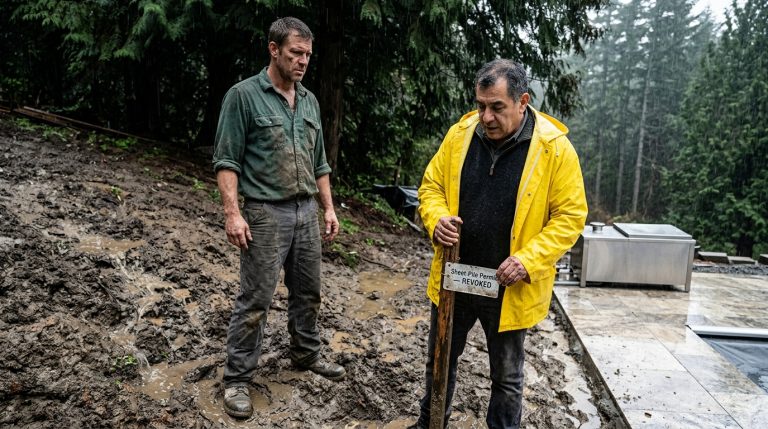
A pair of county sheriff cruisers blocked the lower access road, their emergency strobes cutting through the gray afternoon rain. And right there, standing in the middle of his own ruined driveway with mud soaking into his designer loafers, was Dexter Hawthorne. He was shouting something wild and incoherent at a pair of deputies, his hands gesturing frantically toward his flooded garage, but the roar of the creek drowned out whatever defense he thought he had left.
The 5-Pillar Catharsis required no sudden rescue or unearned miracles; it simply demanded that the architecture of cause and effect finish its work.
First came the Payoff: Deputy Santos stepped forward, flanked by two state environmental officers holding a fresh set of federal indictments. They didn’t argue with him; they simply read the charges—fraud, criminal negligence, and direct personal liability for eight million dollars in structural flood damage—and placed him under formal arrest while the local news crews zoomed in on his mud-soaked khakis.
Poetic Justice followed instantly: Dexter was defeated by the very element he had tried to weaponize and exploit for corporate profit, trapped by the water he refused to respect.
The Cool Down settled slowly over the valley as the afternoon faded into a deep, atmospheric dusk. The rain eased to a steady, quiet drizzle, washing the gray dust from the pine needles and restoring the ancient, rhythmic sound of the watershed finding its natural equilibrium. The panic in the valley subsided into the quiet, exhausted labor of homeowners bailing out basements and learning the hard way that nature cannot be rezoned.
Back at the cabin, I walked to the heavy oak work table, picked up a small, chipped mason jar filled with river stones from my great-grandfather’s original foundation, and set it squarely in the center of the desk—Symbolic Closure for a legacy defended against institutional rot.
I sat down in the wooden chair, resting my hands on the cool surface of the wood. The room was dark, save for the amber glow of the desk lamp cutting through the shadows. The battle was over, the law had held, and the water was finally flowing where it always belonged. A quiet, steady sense of peace settled deep into my chest, marking the true beginning of the work ahead.