The Iron Cl clause: How a Century-Old Deed and an Old Farm Tractor Defeated a Suburban Empire
CHAPTER 1: THE WEIGHT OF IRON
The soil of the five-acre patch did not yield easily; it was packed tight with the stubborn grit of hard winters and generations of unyielding labor. On his knees in the damp earth of his late wife’s rose garden, John McIntyre dragged a calloused thumb across a clod of dirt, feeling the familiar, dry friction that had worn down his father’s palms before him. Above him, the air carried the sharp, biting tang of rusted iron and morning dew.
A shadow fell across the flowerbed, blotting out the pale autumn sun.
“Your little patch of dirt is an eyesore, Major,” Karen Thompson said. Her voice was coated in that cloying, manufactured sweetness that always preceded administrative violence. “And according to this bylaw, it’s now our patch of dirt.”
John did not rush to stand. He let the silence stretch, measuring the distance between the ancient, moss-covered stone wall—laid by his great-grandfather’s own hands in 1922—and the manicured, emerald-green sod of Whispering Pines Phase 4. Behind her, Gerald shifted his weight from one glossy sneaker to the other, his eyes fixed on the toes of his shoes as if inspecting a fracture in the earth.
Slowly, John pushed himself up, his knee clicking with the dull, familiar souvenir of a decades-old deployment. At sixty-five, he stood a full head taller than the HOA president, his shoulders squared beneath a faded canvas jacket that smelled faintly of diesel and tobacco. He wiped his palms on his thighs, his gaze level and devoid of heat.
“This ground has held an unbroken line since my grandfather cleared it,” John said, his voice dropping into the measured, parade-ground cadence he had perfected over thirty years in uniform. “It has never been part of your association. It never will be.”
Karen let out a sharp, dismissive bark of laughter, tapping a pristine clipboard against her chest. “Times change, Major. The developer who scraped together Phase 4 folded during the bankruptcy hearings. In the fallout, the master covenants rolled over into the HOA’s hands. That includes every unassigned parcel within the plotted perimeter.” She smiled, her teeth flashing with predatory certainty. “You have two choices. Pay the twenty years of back dues, fines, and penalties totaling ninety-two thousand four hundred and fifty dollars, or we place a lien on the property and bring in the heavies to clear that rusted piece of junk by the barn.”
She gestured toward the 1953 Farmall tractor—a restoration project saved piece by piece for his deployed son—sitting silently against the weathered wood of the outbuilding.
John’s jaw tightened, the muscle ticking once beneath his weathered skin. He didn’t shout. Rage burned too fast, too bright; a soldier in a siege didn’t waste fuel on smoke. He watched her clipboard, noting the cheap plastic binder rings and the dog-eared corner of the enforcement notice.
“You’re welcome to try,” John said quietly.
Karen turned on her heel, her floral skirt whipping around her ankles as she marched back toward the manicured lawns of the subdivision. Gerald hurried after her, casting one last, apologetic glance over his shoulder before disappearing behind a row of neatly trimmed boxwoods.
John stood alone in the stillness of his yard, the silence settling back over the five acres like a heavy woolen blanket. He walked over to the Farmall, resting a palm against its cold, iron fender. The air was turning amber as the sun dipped lower, casting long, fractured shadows across the dry earth. He needed to check the rolltop desk in the study, but as he reached for the screen door, the brass handle felt unusually cold beneath his fingers, and a single, freshly snapped twig lay squarely across the threshold—an object out of place, marking a footprint that hadn’t come from his side of the wall.
CHAPTER 2: DUST IRON AND THE 1922 DOCUMENT
The screen door swung shut with a muted, oiled click that muffled the distant hum of traffic from the outer perimeter of Whispering Pines. John did not rush. A man who moves too fast in a house built by his own ancestors trips over ghosts, and John had no intention of missing any details. The snap of the fresh twig on the threshold—green, sappy pine, completely out of place among the dry oak leaves littering his porch—sat like an unexploded round on his scarred floorboards.
He didn’t bend to pick it up immediately. Instead, his gaze tracked across the dusty floor to the baseboard near the antique umbrella stand. A faint smear of moist loam, rich with synthetic turf fertilizer rather than the heavy, iron-heavy clay of his own acreage, marked the grain of the white pine. Someone had stood there while he was at the fence, listening, measuring the silence of his yard.
John stepped over the mark, his boots making a heavy, solid impact as he walked down the narrow corridor toward the study. The air inside the house held a steady, reassuring chill—the permanent shade cast by the thick stone walls his great-grandfather had laid during the hard winter of twenty-two.
He crossed the Persian rug, its fibers worn thin by decades of pacing feet, and stopped before the rolltop desk. The brass hardware was dull, coated in a fine patina of oxidation that he usually welcomed, but tonight it felt like armor needing polish. He reached into the dark recess at the back of the bottom drawer, his fingers sliding along the smooth wood until they found the cold, unyielding curve of the long metal tube.
The threaded cap gave way with a sharp hiss of vacuum-sealed air, releasing a faint scent of parchment, dried linseed oil, and time.
John pulled the documents free with practiced, reverent care, laying them flat across the polished oak surface of the desk. He didn’t turn on the overhead brass lamp; the amber glow of the desk’s small, green-shaded banker’s light was enough. It cast deep shadows across the yellowed edges of the paper, highlighting the dark, bleeding lines of iron gall ink that had bitten deep into the wood pulp over the last hundred years.
At the top rested the 1922 master deed of sale—a sprawling agreement between Angus MacIntyre and a forgotten local developer named Silas Blackwood. Below it lay the specific indenture parceling out the five-acre homestead as an absolute sovereign island within the larger tract.
John leaned forward, placing both palms flat on either side of the brittle edges. His knuckles were gray, the skin tight over prominent joints. He read the dense legal prose not as a story, but as a blueprint for fortification.
“…hereby and in perpetuity excluded from any and all covenants, restrictions, or encumbrances of any future homeowners association, governing body, or incorporated community that may arise from the development of the surrounding lands…”
It was clean. It was absolute. But it was the secondary clause—the paragraph his father had always referred to with a dry, quiet grin as the poison pill—that held the true weight of the architecture.
“…should any legal or administrative action be taken by said association or governing body to forcibly annex, lien, or otherwise compel the McIntyre homestead… this action shall be deemed a breach of this foundational covenant. Upon such a breach, the ownership of all common areas, including but not limited to parks, roadways, and recreational facilities built upon the original 500 acres sold herein, shall revert to the ownership of Angus McIntyre or his legal heirs and assigns.”
John’s thumb traced the signature of old Judge Miller at the bottom of the page, the ink slightly feathered where the quill had caught a rough spot in the rag paper.
Karen Thompson thought she was dealing with a nuisance property tax dispute. She thought she was shaking down an old man with a broken tractor and a faded memory of how things used to be. She didn’t know—couldn’t know, because no one at Whispering Pines had ever bothered to pull the original parent deed from the county archives—that the roads her residents drove on every morning, the clubhouse where she held her clipboard meetings, and the manicured green belt surrounding the neighborhood were legally tethered to this very desk.
The front window rattled softly as a late-evening gust of wind swept across the pasture, dragging dry brush against the exterior stone.
John straightened up, his hand hovering over the telephone resting on the corner of the desk. He didn’t pick it up yet. A tactical commander does not radio headquarters until the enemy has fully committed their forces to an indefensible advance. Karen had sent her pink slips; she had levied her petty fines. Next, she would try something structural. She would try to force a lien through a municipal clerk who didn’t look past page one of the title chain.
When she did, the trap would trip. But before that happened, he needed to make sure the physical perimeter of the homestead could withstand a siege.
He turned off the banker’s light, plunging the study back into a deep, velvety shadow, and walked out through the back kitchen door toward the dark bulk of the barn, where the 1953 Farmall waited in the silence, half-restored and entirely unyielding.
CHAPTER 3: THE FRICTION OF PAPER AND IRON
The heavy wooden doors of the barn slid open on rusted iron rollers with a dry, protesting shriek that cut through the evening wind. John did not turn on the overhead fluorescent strip; the harsh, buzzing white light belonged to a different world—a world of strip malls, asphalt, and hurried corporate memos. Instead, he reached up and clicked on the single amber work lamp clamped to the rafter above the tractor’s hood.
The cone of yellow light cut through the floating dust motes, catching the dull, pitted finish of the 1953 Farmall’s grille.
John stepped inside, the soles of his boots crunching on dry straw and flakes of dried mud that had fallen from the chassis weeks ago. He walked past the front tires, his fingers trailing across the cool, grease-slicked steel of the steering arm. A sudden, sharp ache pulled at the back of his throat—a memory of his son, Eric, kneeling right here on the concrete floor with a wrench in his hand, laughing as they tried to seat the stubborn generator belt. That laughter felt distant now, muffled by the encroaching noise of Karen Thompson’s paperwork and the synthetic hum of the subdivision rising just beyond the tree line.
He pulled a clean rag from his back pocket and wiped a smudge of old engine oil off the valve cover. The metal was solid, heavy, and real. You couldn’t file a lien against cast iron. You couldn’t legislate away the weight of an engine block with a photocopied HOA covenant.
Yet, Karen was coming for it. The physical intrusion at the boundary wall earlier that week wasn’t an isolated incident; it was the preamble to a bureaucratic siege.
John walked around to the side of the tractor, stepping over a stray creeper board, and stopped as a sudden mental image flickered across his thoughts—Eric, back from his second deployment, walking down this very aisle to find the shed empty, the tractor dragged off to some municipal impound lot because an HOA president wanted an unobstructed view of a manicured lawn. The phantom grief was sharp, turning into a cold, hard knot of tactical pragmatism in his gut.
He didn’t have to wait for them to make a mistake. He only had to wait for them to overreach.
His cell phone buzzed against his hip, a low, vibrating hum that rattled softly against his belt loop. John pulled the device out, the screen glowing with a harsh blue light in the dim interior of the barn. It was a text message from his daughter, Sarah: Checking county records. Phase 4 developer’s parent corporation dissolved two years ago. Title insurance trail is a complete mess. Dad, they aren’t just overstepping—they’re standing on thin ice.
John stared at the glowing text, a slow, grim smile touching the corners of his mouth. Thin ice required weight to crack, and Karen Thompson was carrying a very heavy clipboard.
He thumbed a short reply: Keep digging. Let them bring the heavy equipment.
He slipped the phone back into his pocket, his gaze returning to the Farmall. The mechanical work was nearly done, but the real restoration was about to begin. He picked up a wire brush from the workbench, the bristles stiff and worn, and began methodically scraping away a stubborn scale of rust from the tractor’s exhaust manifold. Each scrape produced a rhythmic, grating scratch that echoed off the cedar rafters, steady and unyielding against the coming storm.
CHAPTER 4: THE TIRE TRACKS IN THE RED CLAY
The rhythmic scratch of steel against cast iron died away, leaving only the hollow drip of a leaky gutter somewhere in the upper eaves of the barn. John set the wire brush down on the workbench, its stiff bristles gray with old scale. He wiped his palms on his jeans, his eyes narrowing as he stared at the entrance.
The tire treads pressed into the damp red earth just outside the sliding door didn’t belong to his old truck, nor did they match the light tread of Sarah’s sedan. They were wide, aggressive, with a deep lug pattern designed for heavy hauling over unpaved ground—the unmistakable signature of a commercial tow vehicle.
They hadn’t waited for the mail. They hadn’t waited for a court date.
John stepped out of the amber pool of the work lamp, his boots hitting the packed dirt floor with a dull thud. The afternoon light outside was flat and bruised, the color of wet slate under a low, heavy cloud cover. He walked past the fender of the Farmall, his gaze locked on the mud. The tracks curved away from his property line, swinging in a sharp, careless arc that had gouged deep, ugly gashes into the corner of his lawn where the wild fescue met the driveway.
A cold, methodical anger settled behind his ribs—not the hot flash of a startled man, but the slow, heavy gravity of a commander inspecting a breached perimeter.
He didn’t need to check the front door to know what was waiting there. Karen Thompson was operating on a tight, panicked schedule. The developer’s bankruptcy in Phase 4 had left her association with a hollow foundation, and she knew it, even if she didn’t yet understand the full extent of the legal trap waiting in his desk drawer. Her weapon of choice was escalation: turning administrative paperwork into physical harassment.
John walked out into the open air, the cool autumn wind catching the collar of his canvas jacket. He followed the fresh mud ruts around the side of the house toward the front porch.
Sure enough, a strip of cheap, yellow masking tape hung limply from the white-painted wood of the screen door, fluttering in the draft. Stuck to it was a neon-pink notice of violation, its glare an intentional affront to the weathered timber.
He didn’t rip it off immediately. He stepped closer, squinting against the flat light. The citation was written in sharp, heavy marker: Final Notice of Administrative Compliance and Impound Authorization. It cited unapproved landscaping, unmaintained outbuildings, and the storage of an unlicensed industrial vehicle within line of sight of the community common area. The fine had ballooned to nearly five hundred dollars, stamped with a warning that a commercial towing contractor had been placed on retainer to execute the removal at dawn the following morning.
John pulled a small digital camera from his pocket—an old, dependable model with a heavy metal body—and clicked the power button. The lens whirred softly. He took three time-stamped photographs of the notice in place, framing it against the chipped paint of the doorframe and the ancient stone wall across the drive. Then he stepped back to capture the wider view: the sprawling, quiet acreage of his pasture rolling down toward the treeline, completely isolated from the uniform, cookie-cutter roofs of Whispering Pines visible just beyond the ridge.
He peeled the pink paper away with two fingers, the adhesive tearing with a dry, papery rip, and folded it neatly into his pocket alongside the others.
The physical assault was coming sooner than he calculated. They weren’t going to wait for David Chen to file an answer. They were going to try to drag the tractor away while it sat unprotected in the yard, betting that an old man with a bad knee wouldn’t move fast enough to stop a flatbed.
John walked back inside, the screen door clicking shut behind him with the familiar, weighted snap. He didn’t turn on the lights in the kitchen. He walked straight to the landline on the counter, lifted the heavy black receiver, and dialed a familiar, direct local number.
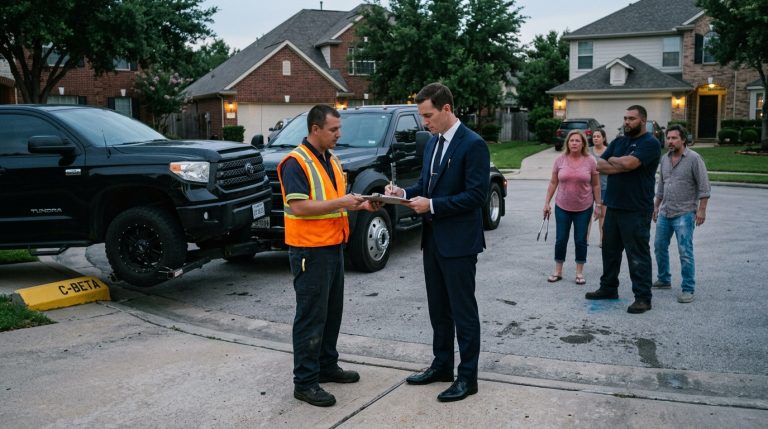
“David,” John said when the line picked up on the second ring, his voice low, steady, and entirely devoid of hesitation. “They just put up a final notice. They’re bringing the truck tomorrow morning. Let’s make sure the sheriff’s office has a copy of that survey plat ready before the sun comes up.”
On the other end of the line, a sharp, appreciative laugh echoed through the earpiece. “Send me the photos, Major,” David replied, the sound of papers shuffling in the background. “Let’s see how fast their towing contractor wants to explain grand theft to Sergeant Miller.”
John hung up the phone. The trap was baited. All he had to do now was stand his ground and let them walk right into the kill zone.
CHAPTER 5: THE BRIEFING IN THE MINIMALIST OFFICE
The tires of the old truck crunched over the gravel lane, throwing small stones against the wheel wells as John navigated the winding road into town. The morning light was pale and flat, casting long, gray shadows across the weathered brick storefronts of the commercial district. He parked three spaces down from a restored 1920s brick building whose minimalist glass facade carried a single, understated brass plaque: David Chen, Attorney at Law.
John didn’t rush his exit. He sat for a moment in the cab, his right hand resting on the scarred wooden steering wheel while his left thumb rubbed the rough grain of his jacket cuff. The engine of the truck idled with a deep, low rumble, the exhaust puffing white into the crisp autumn air. He checked his side mirror. A municipal utility van drifted past on the main road, its tires kicking up dry leaves against the curb—a routine detail, yet in the current climate, every shadow looked like an outpost.
He killed the ignition. The abrupt silence inside the cab felt heavy, filled with the ticking of the cooling manifold.
Pushing the heavy truck door open, John stepped down onto the asphalt, the grit grinding beneath his boot heels. He crossed the concrete sidewalk, the sharp scent of damp earth clinging to his clothes giving way to the sterile, polished aroma of a modern office as he pulled open the heavy glass door.
Inside, the space was all polished concrete, clean lines, and muted charcoal tones—a stark, deliberate contrast to the century-old timber and dust of the McIntyre homestead. David Chen stood by a standing conference table strewn with thick, color-coded files and photocopied county plats. Sarah sat opposite him, her brow furrowed over a high-resolution printout of the Phase 4 subdivision map.
“Major,” David said, looking up with a sharp, welcoming nod. He gestured to the leather chair across the table. “You look like a man who just checked his perimeter and found the wire intact.”
“The wire’s intact,” John said, pulling out the chair and sitting down with a slow, deliberate creak of leather. He reached into his coat pocket and slid the neon-pink notice of final violation across the smooth oak surface. “They skipped the mail service this time. Taped it right to the screen door with a threat about dawn removal.”
Sarah picked up the pink slip, her eyes scanning the heavy marker scrawl. “They’re accelerating the timeline, Dad. Slate’s firm hasn’t formally answered our preliminary letter yet, but Karen is acting like a commander whose supply lines have just been cut.”
David leaned forward, resting his forearms on the edge of the table. He tapped a finger against a stack of documents bearing the county clerk’s official seal. “That’s because she doesn’t realize how deep the sinkhole goes. I spent the last twelve hours pulling the title chain for the entire Phase 4 development. The developer who went bankrupt two years ago didn’t just cut corners on the landscaping bonds; they skipped the primary title insurance rider for the common areas.”
John narrowed his eyes, leaning back slightly. “Explain.”
“When Silas Blackwood sold off the surrounding land back in the twenties, the master deed was recorded with explicit reversion triggers tied to the homestead’s perimeter,” David explained, tracing a line on the old blueprint with a silver pen. “When the later phase was built, the title company issued a blanket policy assuming the HOA owned everything outside your five acres. But because your great-grandfather’s porcupine clause was written directly into the parent deed, any attempt to legally coerce your property acts as a tripwire. It voids the association’s claim to the common grounds entirely.”
David offered a thin, razor-sharp smile. “Karen thinks she’s trying to collect ninety-two thousand dollars in back dues. What she’s actually doing is dragging a multi-million-dollar title defect out into the open for every homeowner in Whispering Pines to see. If we let her file that lien, the resulting litigation will instantly freeze every home sale and title transfer in the entire subdivision.”
“She’s building a mob because she’s terrified of a mirror,” John murmured, his hand resting flat on the conference table.
“Exactly,” Sarah said, looking up from the map. “She wants to turn it into a neighborhood fight so nobody looks at the paperwork.”
John stood up, the chair legs scraping softly against the polished concrete floor. The tactical objective was clear now. They wouldn’t stop Karen by arguing with her pink slips; they would let her push the envelope right up to the community meeting she had threatened to call, and then hand the entire neighborhood the unvarnished reality of her recklessness.
“Let her schedule her meeting,” John said, adjusting his collar. “When she stands up at that podium, we’ll make sure she has an audience ready to listen.”
CHAPTER 6: THE COMMUNITY MEETING TRAP
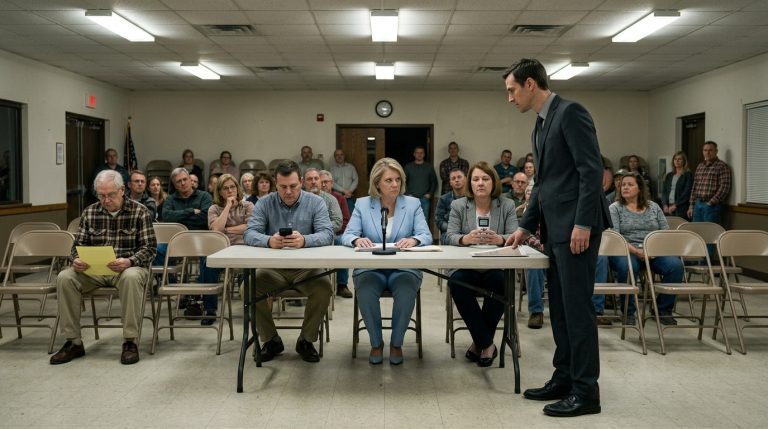
The glass door of the clubhouse swung inward, letting in a sharp gust of autumn wind that rattled the flyers pinned to the community bulletin board. The room was packed shoulder-to-shoulder, the folding chairs scraping against the linoleum floor with a restless, collective friction. Murmurs bounced off the drywall—a low, anxious hum born of Karen Thompson’s emergency letters, which had painted a picture of an aggressive interloper looking to seize their playground and clubhouse.
John did not pause at the threshold. His shoulders were squared beneath the worn fabric of his canvas jacket, the weight of the hundred-year-old deeds resting securely in the leather folio tucked under his arm. Sarah and David walked close behind, moving with the measured, deliberate cadence of a detail securing a perimeter.
At the front of the room, standing behind a small, tinny podium, Karen Thompson tapped a plastic gavel against the wood. Her floral print dress looked overly bright under the harsh fluorescent glare, her smile tight and rehearsed.
“Please, everyone, take your seats,” Karen called out, her voice pitching up slightly to cut through the noise. “We are facing an unprecedented challenge to our community stability, and unity is our only shield against—”
“Before we discuss shielding anything, Mrs. Thompson,” David Chen’s voice cut across the room with effortless projection, clean and surgical, “the community might appreciate knowing who actually holds the liability for the land beneath their feet.”
The murmurs spiked into sharp gasps of surprise. Every head in the room turned toward the back entrance.
John met their stares with a flat, unwavering gaze. He didn’t look like a greedy land-grabber; he looked like what he was—an old soldier who had spent thirty years maintaining lines others had tried to cross. As he walked down the central aisle, the crowd parted naturally, the rustling of papers and shuffling of sneakers creating a narrow path.
Karen’s face mottled a dark, furious crimson behind the podium. “This is a private association meeting. Mr. McIntyre is not a member, and—”
“He is the subject of your emergency summons, Mrs. Thompson,” David replied smoothly, stepping up beside the podium while Sarah began distributing crisp packets of documents down the front rows. “And under state statute regarding defamation and public misrepresentation, he has every right to present the administrative record.”
John stopped a few paces from the front row. He reached into his folio and pulled out the chronological log of violation notices, the sheriff’s report from the attempted towing incident, and the printed text of the master deed. He didn’t raise his voice; he didn’t need to. The quiet authority of a man speaking facts in a room built on panic was heavier than any shout.
“I am not here to take your pool, and I am not here to take your playground,” John said, his voice carrying clearly to the farthest corners of the room. “My family has worked these five acres since 1922. The only thing we have ever asked for is the peace to keep what is ours.”
He held up a highlighted copy of the ancient indenture. “Your association president chose to ignore the parent deed. She chose to issue fabricated fines, send trespassers onto private ground, and hide the fact that her administrative overreach has just triggered a reversion clause that invalidates the subdivision’s core title insurance.”
A heavy, suffocating silence fell over the clubhouse. In the front row, a resident named Bill dropped his copy of the letter, his eyes widening as he stared at the legal seals. The illusion was cracking, and the raw, unvarnished truth was bleeding through the floorboards.
CHAPTER 7: THE UNRAVELLING OF SLATE HARDING AND FINCH
The silence in the clubhouse was absolute, thick enough to muffle the hum of the overhead HVAC unit. Residents who had arrived clutching Karen’s pink-tinted letters like shields now stared down at the crisp white pages of David Chen’s documentation, their expressions shifting from righteous indignation to cold, hard realization.
Karen stood frozen behind the podium, her knuckles white as she gripped the edges of the plastic veneer. Her mouth opened, closed, and then opened again, but no sound came out. The polished facade she had maintained for months—the clipboard, the bylaws, the manufactured authority—had dissolved under the weight of a single, unyielding historical fact.
David Chen didn’t press her immediately. He let the silence work, letting the heavy, suffocating physics of the room settle over the board members seated to Karen’s right. Gerald, the nervous board member who had spent months shifting uncomfortably in the background, looked down at his own packet, swallowed hard, and slowly rose to his feet.
“Wait a minute,” Gerald said, his voice cracking slightly before he cleared his throat and projected it across the room. He looked directly at Karen. “Arthur Slate’s firm… they didn’t just advise caution. Did they resign?”
David stepped forward, his expression neutral, transactional, and entirely lethal. “Mr. Slate and his partners formally withdrew from representing the Whispering Pines Association forty-eight hours ago, Mr. Gerald. They did so because their internal review confirmed what we stated in our initial response: your board’s aggressive pursuit of Major McIntyre didn’t just trigger an exemption clause—it exposed a catastrophic gap in the subdivision’s parent title insurance policy.”
A sharp intake of breath rippled through the middle rows. Bill, the homeowner who had vocally supported Karen earlier that evening, stood up, his chair scraping loudly against the linoleum.
“What does that mean for our titles?” Bill demanded, looking from David to Karen. “If the master deed has a reversion clause tied to the common areas, does that mean the pool, the roads, the park—they aren’t even insured?”
“It means,” David said, his voice flat and clinical, “that every property title tied to Phase 4 is currently clouded by an active, unaddressed administrative breach. Your association attempted to levy illegal fines and execute an unauthorized seizure against a sovereign parcel explicitly protected since 1922. Under the terms of the master indenture, that action transfers the legal claim of the common infrastructure directly to the McIntyre estate.”
Karen slammed her palm against the podium, the plastic cracking with a sharp pop. “He’s lying! It’s a forged piece of paper—an old trick designed to steal what belongs to this community!”
“Check the county registry, Mrs. Thompson,” John said, his voice dropping into that low, steady parade-ground register that brooked no argument. He didn’t raise his pitch; he simply let the gravity of his decades on the land anchor the room. “Book four, page twelve, recorded by Judge Miller on October fourth, 1922. The record has been open to the public for a century. You just couldn’t be bothered to look past your own clipboard.”
Gerald looked around the room, meeting the wide, panicked eyes of his neighbors. The fragile illusion of suburban harmony was completely shattered, replaced by the harsh, unyielding light of financial survival. Without a lawyer, without insurance backing, and facing a direct challenge to their community’s common land, the board was standing on crumbling earth.
“We need a vote,” Gerald said, his voice steadying as he faced the crowd. He turned his back entirely on Karen. “Right now. A vote of no confidence in the presidency, and an immediate motion to authorize our new counsel to settle this dispute on Major McIntyre’s terms.”
Before Karen could draw breath to scream an objection, a dozen hands shot up across the room. The second-hand gavel she had used to terrorize the neighborhood for months sat uselessly beside her white-knuckled grip.
John watched her face crumble, the bitter, hollow anger replacing her manufactured authority. He didn’t gloat. Victory, to a man who had spent his life maintaining boundaries, wasn’t a celebration; it was simply the restoration of order. He turned his back on the podium, leaving David and Gerald to pick through the wreckage of the HOA’s collapse, and walked out the heavy glass doors into the cool, quiet embrace of the night.
CHAPTER 8: THE RED PAINT AND THE QUIET HORIZON
The gravel crunched beneath John’s boots as he walked away from the clubhouse, the murmurs of the stunned residents fading behind the heavy aluminum frame of the entrance. The night air was sharp, smelling faintly of woodsmoke from a distant chimney and the cool, damp loam of his own pastures. He did not look back. A commander who has secured the perimeter does not linger to watch the enemy retreat; he returns to his post to inspect the damage and tend to the ground.
Two weeks passed before the final paperwork was signed. The new HOA board, operating under Gerald’s temporary leadership, moved with the frantic efficiency of men bailing water from a sinking skiff. They didn’t negotiate, and they didn’t posture. They drafted a binding settlement, reviewed and countersigned by David Chen, which formally expunged every fabricated fine, acknowledged the permanent and perpetual exemption of the McIntyre homestead from all association covenants, and included a certified check covering the repair of the tire ruts left by Lakeside Towing.
The formal letter of apology arrived on a Tuesday morning, signed by every remaining member of the board. John filed it neatly inside the blue binder in his study, right beneath the original 1922 deed.
Karen Thompson’s house went on the market on a crisp Thursday morning. The “For Sale” sign drove into her front lawn with a sharp, heavy thud that echoed across the property line. Within days, the movers arrived, loading boxes into the back of a large van while Karen sat behind the wheel of her sedan, her face set in a hard, unyielding mask of bitterness.
John was out in the front yard that Saturday, working under the amber glow of the barn’s work lamp. The restoration of the 1953 Farmall tractor was finally complete.
He dipped a fine-bristle brush into a small tin of bright, industrial red paint, carefully smoothing a final coat over the edge of the tractor’s newly seated hood latch. The smell of fresh enamel mixed with the lingering scent of old oil and iron. The chrome grille gleamed under the overhead bulb, reflecting the sharp, clean lines of a machine brought back from the brink of neglect.
A car slowed down on the macadam road outside his fence. John paused, lifting his head to watch through the gaps in the ancient stone wall. Karen’s sedan crept past, her eyes turning toward the yard. Through the glass, their gazes locked for a brief, unbroken second. She sat surrounded by the sterile packaging of a life packed up in cardboard, her hands tight on the steering wheel. John did not smile, nor did he look away; he simply held her gaze with the quiet, indifferent neutrality of a man rooted in the earth. With a sharp hiss of rubber against asphalt, she pressed the accelerator and disappeared down the road, leaving Whispering Pines behind her for good.
The silence that followed was deep, resonant, and entirely uninterrupted.
A pair of bright headlights swept across the pasture gate. John turned around, wiping his red-stained thumb on a shop rag as an old sedan pulled up the lane and parked near the barn. The passenger door clicked open, and Eric stepped out into the gravel, his duffel bag slung over one shoulder, his uniform jacket creased from travel, and a tired, familiar grin breaking across his face.
“Dad,” Eric said, closing the car door with a dull thud.
John dropped the rag onto the workbench and walked out to meet him, his knee giving its usual dull pop before settling into stride. He reached out, grabbing his son by the forearm in a firm, solid grip.
“Welcome home, son,” John said, his voice steady and warm.
They walked back toward the barn together, the cool autumn wind rustling the dry leaves along the fenceline. Eric stopped dead in his tracks as the light from the overhead lamp hit the restored tractor, its red paint gleaming like fresh fire against the weathered gray wood of the outbuilding.
“You actually finished it,” Eric whispered, stepping closer to run a hand over the polished steel of the fender.
“We finished it,” John corrected quietly, handing him a clean wrench from the workbench. “And the perimeter is secure.”
They stood side by side in the quiet amber light, the sound of the wind dying down across the open fields, leaving only the steady, unshakeable peace of the land that had always been theirs.