The High Cost of Quiet Ground: A Suburban War of Boundaries, Iron Laws, and Territory
CHAPTER 1: COLD ASPHALT
The red vinyl of the sticker caught the glare of the noon sun.
It sat dead center on the hood of my sedan, fresh and thick, the aggressive block letters reading RESERVED FOR VIP. The adhesive was commercial grade. Removing it would take solvent and a blade.
Beside the car, six inches over my property line, the rear tire of a lifted pickup pressed heavy against the concrete apron. Beyond it, a white crossover sat sideways across the sidewalk. The double blockade left less than forty inches of clearance. A physical trap.
“You’re crowding the thoroughfare, Jordan!”
Karen stood twenty feet away on her lawn, waving a pair of stainless steel grill tongs. Her plastic tumbler clinked with melting ice as she tipped it toward my driveway.
“We’ve got twenty-two families coming through today,” she called out, her voice carrying easily over the low thump of a bass speaker sitting on her porch. “Community Spirit Kickoff! Everyone shares the load.”
I didn’t answer. I pulled the heavy brass fountain pen from my inner jacket pocket. Unscrewed the cap. Solid metal. Cold.
I pressed the tip of the nib against the corner of my legal pad, logging the exact time: 11:42 AM.
“Hey! Talkin’ to you, college boy.”
Brad stepped out from behind the tailgate of the lifted truck. He had a half-eaten burger in one hand and a sweating can in the other. He kicked the front tire of my sedan with the heel of his work boot. The bumper shuddered on its clips.
“Truck stays where it is,” Brad said. He took a slow bite, chewing with his mouth open. “I got four crates of ice in the bed. I ain’t hauling ’em down the block because your car needs a sunbath.”
My thumb slid down the barrel of the brass pen, finding the deep, knurled grip near the point. The metal dug into the pad of my skin until the pressure turned white.
“The sedan stays where it is,” I said. My voice didn’t rise. It stayed flat, buried under the rumble of his idling engine. “The driveway is private property. Clear it by noon.”
Karen let out a sharp laugh that sounded like dry gravel hitting tin. She stepped up to the edge of the turf, her oversized sunglasses reflecting the glare off my windshield.
“Oh, don’t start with the technicalities,” she said, tilting her head. “We’re a neighborhood, Jordan. We share space. You’ve been here two months and all you do is sit inside with your folders while the rest of us actually build a home here.”
She turned toward a couple walking past with a toddler, raising her tumbler in a toast.
“Help yourselves to the punch! Driveway’s open for overflow!”
My eyes shifted down. Near the base of my mailbox, right where the driveway met the gutter, a thin yellow line of paint had been freshly applied along the curb edge. It wasn’t city paint. It was hardware-store enamel, still tacky enough to trap dust.
A physical mark. An assertion of control over Parcel 409.
“Noon,” I said.
Brad spat a piece of gristle onto my driveway. “Or what? You gonna call the mayor?”
I clicked the cap back onto the brass pen. The snap was loud, metallic, and absolute. I turned on my heel, walked up the steps to my porch, and closed the heavy oak door behind me, locking the deadbolt with a single, firm turn.
Inside, the house was dead silent except for the low hum of the refrigerator. I walked straight to the desk, pulled up the property survey map for my lot, and laid it out beside the printed HOA codebook.
At 11:58 AM, the floorboards vibrated as another SUV pulled up the curb, idling directly behind Brad’s tailgate.
They thought it was a party. They thought it was a neighborhood gathering.
I picked up the desk phone, dialed the direct line to regional dispatch, and laid my bar card beside the legal pad.
“Authorization code 4-2-1,” I said into the receiver. “I have two commercial blockades on a private residential easement. Send the heavy rigs.”
CHAPTER 2: THE PAPER TRAIL
The glass of the front window vibrated against my knuckles before I even heard the air brakes.
Two air-suspended diesel chassis turned onto the cul-de-sac, their yellow hazard rotators splashing amber light across the front brick of the houses. The lead truck was a heavy-duty flatbed with a three-stage winch; the second, an underlift tow rig with dual rear dualies.
Outside, the music from Karen’s porch speaker didn’t stop, but the conversation did.
I stepped onto the porch, pulling the front door shut behind me. The latch clicked into the strike plate with a dry, mechanical snap. I held the legal pad against my ribs, the brass fountain pen clipped securely into my breast pocket.
“What is this?” Karen’s voice cut through the idling rumble of the diesel engines. She still had the plastic tumbler in her left hand, but her right was pointing the barbecue tongs directly at the lead driver as he slammed his cab door shut. “Excuse me! This is a private neighborhood event! You can’t park those monstrosities here!”
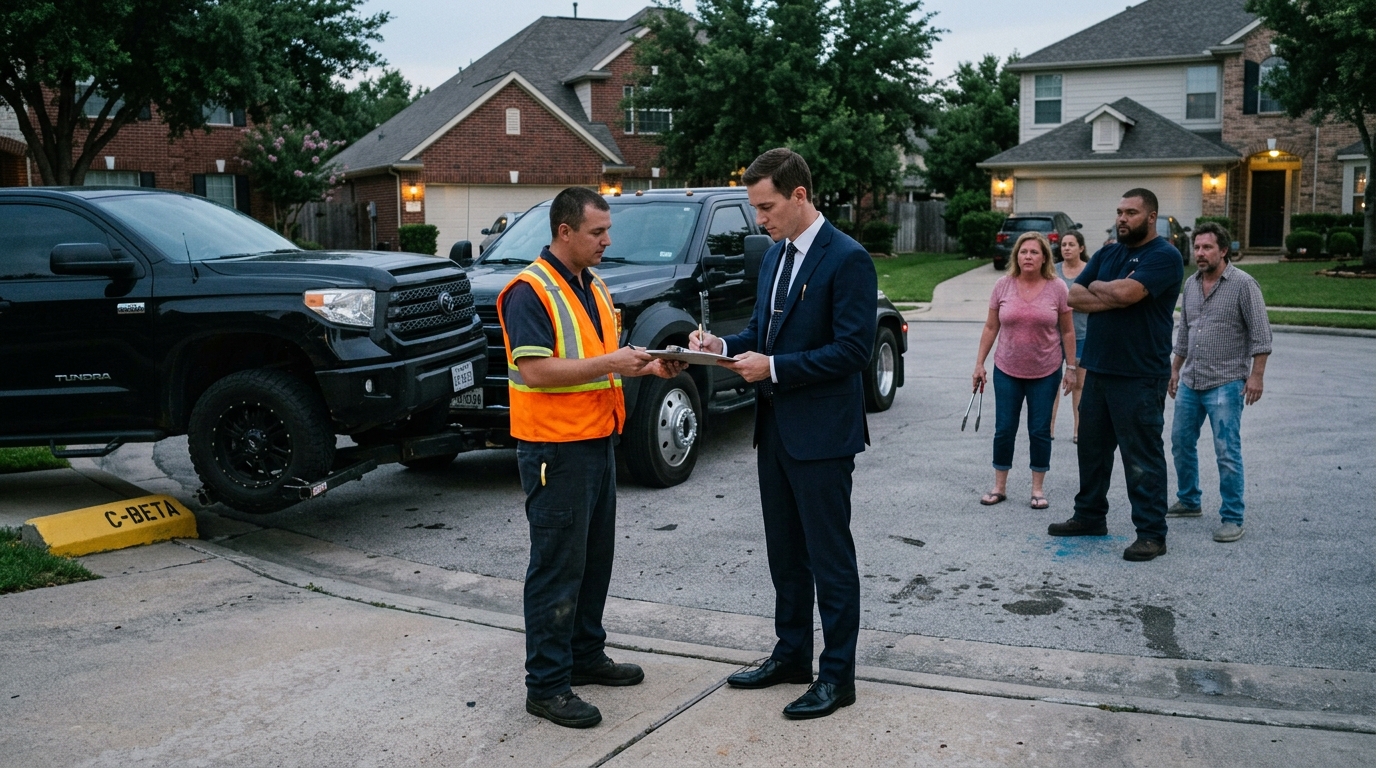
The lead driver didn’t look at her. He was a broad man in an orange high-visibility vest, a heavy steel clipboard tucked under his arm. He walked straight to the rear bumper of Brad’s lifted truck, checked the license plate against a printout on his board, then looked up at my porch.
“Jordan?” he called out over the engine noise.
“Right here,” I said, descending the three concrete steps to the walkway. “Vehicle one is the lifted pickup, blocking ninety percent of the primary ingress. Vehicle two is the white crossover parked laterally across the sidewalk apron. Both are positioned within the registered boundaries of Parcel 409.”
Brad dropped his burger into the grass. He took three long strides toward the driver, his chest puffed out, his jaw working hard on a unchewed bite.
“Hey! Touch that rig and we’re gonna have a serious problem, boss. That’s my vehicle. I’m a guest of the HOA president.”
The driver didn’t flinch. He reached down to his belt, unclipped a digital camera, and took three quick shots of the rear tires resting over the fresh yellow paint on the curb. The strobe flashed white against the black rubber.
“Authorization Code 4-2-1,” the driver said, his voice flat, completely devoid of heat. “Private property blockage on a dedicated easement. City Code Section 12-B. Owner of the real estate signed the impound order. Back away from the lift area, sir.”
“Owner?” Karen marched over, her sandals slapping hard against the pavement. Her oversized sunglasses had slipped down the bridge of her nose, exposing wide, bloodshot eyes. “I am the President of the Homeowners Association! This street is common ground during sanctioned community functions!”
“The street is municipal,” I said, stopping at the edge of my lawn, three feet from the tack-dry yellow paint line. “The apron you are standing on is Parcel 409. It is deeded exclusively to this address. The HOA bylaws do not grant executive override for private land seizures, Karen. Section 4.2.1. Page fourteen.”
Karen turned on me, her jaw tight. “You think you’re so smart with your folders and your little laws? We’ve run this block for six years! We share the space because that’s how civilized people live! You’re acting like a hostile outsider!”
“I’m acting like a property owner,” I said.
I reached up, unclipped the brass pen, and pointed the capped end toward the rear axle of Brad’s truck.
“Hook it,” I told the driver.
“You can’t do that!” Brad lunged forward, reaching for the driver’s high-vis vest.
The second operator—a massive man who had been silently unhooking the safety chains from the flatbed—stepped smoothly into Brad’s path. He didn’t raise his hands. He just placed his center of mass directly between Brad and the winch controls.
“Back up, son,” the second operator said. His voice was lower than the diesel idle. “Interfering with a licensed municipal tow is a Class C misdemeanor. You want to talk to the police, or you want to figure out how to pay the impound fee?”
Brad stopped. His eyes darted from the second operator to his truck, then to the small crowd of neighbors who had drifted out from Karen’s front yard, plastic cups suspended in mid-air.
The hydraulic lift groaned. The steel crossbar dropped under the front axle of the lifted truck with a harsh, metallic clank. The operator worked the lever with practiced, rhythmic movements. The front tires of Brad’s truck cleared the asphalt by six inches, eight inches, a foot.
“This is illegal!” Karen shouted, her voice cracking as she turned toward the spectators. “Sharon! Call the police! He’s stealing Brad’s truck! He’s towing guests from a neighborhood cookout!”
Nobody pulled out a phone to call the police. Three people pulled out phones to record.
“Check the curb,” someone called out from the sidewalk near Mr. Lawrence’s house down the block. “He painted the line himself! I saw Brad with the spray can this morning!”
Karen’s head snapped toward the voice, her face flushing a deep, blotchy red under her spray tan. “Shut up, Arthur! You don’t know what you’re talking about!”
The winch cable whined under tension as the white crossover was dragged backward onto the bed of the flatbed. Metal scraped against metal with a sound like a heavy gate closing.
I stood motionless on the edge of the turf, my thumb resting on the cold cap of the brass pen. I didn’t smile. I didn’t raise my voice. I watched the rear lights of the second tow truck illuminate the yellow line Brad had painted on my driveway apron.
Underneath the fresh paint, right where the curb met the drainage grate, the concrete was chipped away in a neat, rectangular notch. It wasn’t wear and tear. It was a survey key notch—a physical reference point used by civil engineers to mark municipal utility junctions.
And painted directly beside it, half-faded under years of road grime, were three small, stenciled letters in faded white enamel: C-BETA.
Brad stepped backward as his truck swung out into the center of the cul-de-sac, his boots catching the lip of a plastic cooler sitting near the curb. He stumbled, his arms flailing as he hit the turf hard, spilling ice and glowing blue sports drink across his jeans.
A brief, sharp burst of laughter erupted from the group by the sidewalk before being quickly smothered.
The lead driver walked over to me, handed me a yellow carbon copy of the tow manifest, and pointed to the signature line. “Sign at the bottom, Mr. Vance. Vehicles are being transported to the North County impound facility. Storage fees accrue starting at midnight.”
I signed my name using the brass pen, the ink setting dark and permanent into the cheap paper.
“Thank you,” I said.
As the two heavy trucks pulled out of the neighborhood, the diesel rumble slowly faded, replaced once again by the absurdly upbeat pop music still playing from Karen’s empty porch.
Karen stood in the middle of the street, her barbecue tongs hanging limp at her side, looking at the wide, empty grease spots left on my driveway.
“You think you won something today, don’t you?” she whispered, stepping closer to the property line. Her voice wasn’t loud anymore; it was thin, venomous, stripped of its polite suburban veneer. “You have no idea how this board works, Jordan. You have no idea what lies under this street.”
I folded the yellow receipt neatly in half and slid it into my jacket pocket.
“I know where the property line is, Karen,” I said flatly. “And tomorrow morning, I’m going to start digging.”
CHAPTER 3: POISON IN THE MAILBOX
The grease spots on the concrete were still wet enough to catch the yellow light of the sunset.
I didn’t turn back as Karen’s sandals slapped against the street toward her front walk. The deadbolt engaged with a heavy, metallic thud, sealing out the residual hum of the cul-de-sac. Inside, the house smelled of dry drywall and cold tea.
I walked straight to the kitchen table, unscrewed the cap of the brass fountain pen, and uncapped a fresh page on the legal pad.
18:45. Tow completed. Threat leveled by K. regarding subterranean infrastructure.
My phone rattled against the oak tabletop. A text from Arthur Lawrence: She’s filing an emergency injunction with the county recorder first thing Monday. Claims your driveway apron overlaps a municipal drainage easement by six feet. She’s calling it Parcel 409-B.
My thumb traced the knurled brass barrel. The line wasn’t an accident. The yellow paint wasn’t just suburban posturing. She wasn’t trying to park a truck—she was trying to establish adverse possession over a six-foot strip of my land.
At 06:15 AM, the aluminum flag on my mailbox clicked upward.
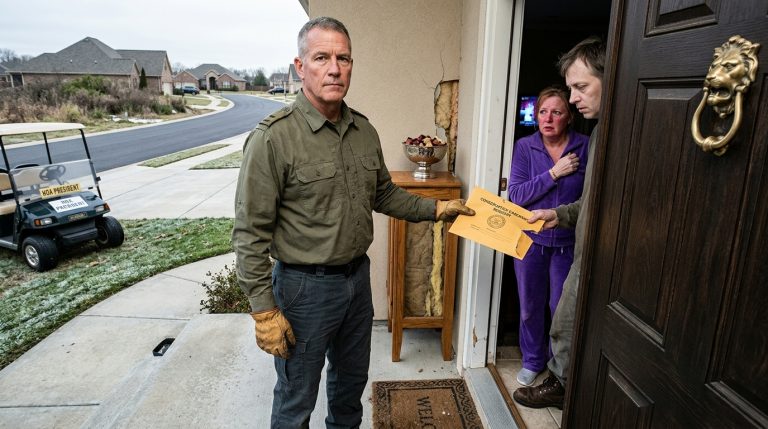
I watched from the living room blinds as a white sedan rolled past without stopping. No postal seal on the door. Just a private courier in a navy windbreaker dropping a thick manila envelope into the slot before acceleration pulled the car out of the loop.
I stepped outside into the damp morning air. The grass was wet against the soles of my work boots.
The envelope in the box was unsealed, heavy with eight-and-a-half-by-eleven bond paper. Standard municipal filing stock. The top document bore an official-looking header: Notice of Intent to Mandate Structural Easement — Sub-District 4.
Attached to the front was a bright pink adhesive note. The handwriting was tight, angular, pressed so hard into the paper that the pen had torn the backing: Jordan. Civil Code 8.4 allows the HOA to seize unmaintained access corridors. You have 72 hours to surrender the gate clearance. Appreciate you. K.
I pulled out the brass pen, tapped the metal nib against the pink paper twice, then peeled the note off and stuck it to the inside of my folder.
The third page was the trap.
It was a photocopied site map, heavily highlighted in pink marker. It showed my lot, my house, and a thick dashed line cutting straight through my southern lawn, three feet from my foundation. The line was labeled The Culvert Bypass.
Underneath the map was a petition sheet with twelve signatures. At the top, in clean print: Resident Acknowledgment of Environmental Nuisance and Easement Transfer.
Arthur Lawrence’s signature was on line four.
I walked down the block. The damp air smelled of wet pine needles and rotting lawn clippings.
Arthur was on his porch, kneeling beside a rusted iron plant stand, scraping dry moss from the legs with a wire brush. His hands were gnarled, the knuckles swollen with arthritis, but his movements were precise, rhythmic.
“You signed it, Arthur,” I said, stopping at the base of his porch steps. I held the petition sheet out so he could see his name.
Arthur didn’t stop scraping. The wire bristles made a harsh, dry sound against the iron.
“She brought three citations with her, Jordan,” he said without looking up. “Windchimes. Fog machine from three years ago. Unapproved brick paint on my retaining wall. Totaling eleven hundred dollars in retro-active fines.”
“The board can’t enforce retro-active fines without a thirty-day notice,” I said flatly. “Section 2.1.”
“The board can do whatever Karen types up on her computer if nobody stops her,” Arthur muttered. He set the wire brush down and looked at me, his eyes clouded behind thick lenses. “She told me if I signed the easement paper, the fines would vanish into the administrative slush. I’m seventy-two, son. I live on a fixed pension. I can’t afford a lawyer to fight a four-hundred-dollar lien every six months.”
“Look at the line on the map, Arthur.” I pointed to the dashed curve crossing my yard. “That’s not a municipal bypass. That’s a private diversion. Where does that pipe go?”
Arthur’s gaze shifted to the edge of the paper, then down to his rusted plant stand. His fingers twitched against his knee—a subtle, involuntary micro-action that betrayed the steady set of his jaw.
“It goes toward the ravine,” he whispered. “Under Brad’s old workshop. They put a four-inch PVC line through the culvert six years ago when he was rebuilding boat engines in her backyard. They needed somewhere to dump the wash water.”
The picture shifted. The puzzle pieces locked together with the cold weight of lead.
She wasn’t just trying to steal six feet of my lawn for parking. She was trying to legally codify the ground above an illegal waste conduit before the city’s green space survey crew arrived next month to map the drainage basin. If my lot remained private property, she couldn’t stop the excavation. But if she turned it into a designated HOA easement, she controlled the access permits.
“She’s using your signatures to cover a toxic bypass,” I said.
Arthur reached out, his thumb rough against the edge of my legal pad. “Don’t go to the board meeting alone, Jordan. She’s got three proxies in her pocket. She’ll vote you down before you open your mouth.”
“She won’t get the chance to vote,” I said.
I pulled out my phone, took a high-resolution photo of Arthur’s signed page beside the highlighted site map, and pulled the brass pen from my pocket.
“Sign this,” I said, handing him a clean sheet from my pad.
“What is it?”
“A revocation of consent based on fraudulent misrepresentation of municipal authority,” I said. “And an affidavit stating you witnessed the installation of Conduit Beta.”
Arthur looked at the blank line at the bottom of the page. His hand trembled slightly, but when he took the brass pen from my grip, his hold was firm.
“She’ll double the fines,” he said softly.
“She won’t have an HOA by Tuesday,” I replied.
CHAPTER 4: THE BOARDROOM STRIKE
The ink on Arthur’s signature was dry before I reached the end of his driveway.
I capped the brass fountain pen with a sharp, heavy click. I slid the fresh affidavit into the manila folder alongside the tow manifest, the photocopied site map, and the photos of the yellow-painted curb over Parcel 409.
Four hours later, the community clubhouse smelled of pine cleaner and old coffee.
The fluorescent overhead tubes hummed at a low, vibrating frequency that resonated right in the back of my teeth. Thirty metal folding chairs scraped against the scuffed linoleum as neighbors took their seats. At the front table, Karen sat behind a microphone, flanked by two senior board members who stared intently at their laptops. Brad stood by the emergency exit, arms folded across his chest, his work boots shifting restlessly on the floorboards.
“This emergency meeting of the Oakridge Estate Governance Board is called to order,” Karen announced. Her voice boomed through the small PA speaker, high and brittle. She adjusted her reading glasses, her thumb pressing so hard against the plastic frame that her knuckle turned white. “We are here to address a severe breach of community standards and an act of direct hostility against HOA leadership.”
She didn’t look at the audience. She looked directly at me, sitting in the front row with my manila folder laid flat across my knees.
“On Saturday afternoon,” Karen continued, tapping a stack of stapled papers against the table, “a resident engaged in predatory legal action, bringing unauthorized commercial vehicles into our cul-de-sac to seize guest property. Furthermore, this resident has repeatedly refused to honor the established land-use protocols regarding Parcel 409.”
A low murmur rippled through the back rows.
Karen raised her chin. “The board has drafted a resolution. We will immediately assess a two-thousand-dollar fine for community disruption, place a temporary administrative lien on lot forty-two, and officially codify the southern lawn corridor as an emergency access easement.”
She picked up a wooden gavel, resting the head lightly against the sound block. “Do I have a second from the board?”
“Before you take that vote,” I said, standing up. My voice didn’t rise, but the room dropped into immediate, heavy silence. “You need to clear the record.”
Karen’s jaw tightened. “You do not have the floor, Jordan. You are under board review.”
“Section 3.4 of the municipal bylaws grants any property owner the right to present physical documentation prior to any vote concerning real estate encumbrances,” I said.
I walked to the front table, laying four separate documents side by side in front of the three board members.
“First,” I said, pointing to the top page. “The tow executed on Saturday was authorized under Municipal Code Section 12-B. The vehicles were parked over a private apron deeded exclusively to lot forty-two. Here is the certified property deed for Parcel 409.”
The board member on Karen’s left—a retired accountant named Miller—leaned forward, pulling the deed closer. He squinted through his bifocals. “This shows private ownership extending all the way to the curb line.”
“That’s an outdated draft!” Karen snapped, her hand slamming onto the table. “The original developer set aside six feet for neighborhood utility maintenance!”
“The original developer set aside six feet for a municipal storm drain,” I corrected flatly. “Which brings us to document two.”
I slid Arthur’s signed affidavit to the center of the table.
“This is a sworn statement from Arthur Lawrence, revoking his signature from your easement petition. It details how you used fraudulent citations—windchimes, fog machines, paint variances—to coerce six elderly residents into signing away their boundary rights.”
Miller looked up from the affidavit, his brow furrowing. “Karen… did you issue retro-active fines without board authorization?”
“He’s twisting the facts!” Karen stood up, her microphone screeching with feedback as her chair scraped backward. “He’s trying to destroy community cohesion! He towed Brad’s truck! He publicly humiliated us!”
“I protected my property line,” I said. “And the reason you need that lawn corridor isn’t for guest parking, Karen. It’s because the city’s green space survey crew arrives next month to inspect the basin.”
Brad took two steps forward from the emergency exit, his boots thudding hard against the linoleum. “Shut your mouth, Vance.”
“Sit down, Brad,” Miller said, his tone turning ice-cold. He turned to Karen, his hands hovering over the documents. “Karen, what is he talking about? What survey?”
“It’s a bluff!” Karen shouted, though her eyes darted toward Brad—an involuntary micro-action that lasted less than a second, but spoke louder than her words. Her fingers trembled against the wood of the gavel. “He’s making up wild accusations to avoid paying his fines!”
“I’m not making up anything,” I said quietly. “I’m looking at the site map you filed with the county courier this morning. You labeled my lawn as The Culvert Bypass.”
I stepped closer to the table, leaning down until I was at eye level with her.
“The decoy secret was the easement claim, Karen,” I whispered, just loud enough for the microphone to pick up the low rasp of my voice. “You wanted everyone to think this was a petty fight over parking spaces and property lines so nobody would ask why there’s a four-inch PVC tap running straight out of Brad’s old shop into the municipal drain.”
The room went dead silent. Even the fluorescent lights seemed to quiet down.
Miller looked from the map to Karen, his face pale. “Is there an unpermitted bypass line on lot forty-two?”
Karen didn’t answer. Her mouth opened, but no sound came out. Her gaze drifted past me, fixing on the rear door where Brad was already backing out into the hallway.
“Motion to suspend the vote on the fines,” Miller said, his voice shaking slightly as he stood up and pulled the gavel away from Karen’s hand. “And a second motion to initiate an immediate independent audit of all HOA administrative files.”
“Seconded,” the second board member muttered, not looking at Karen.
I reached out, picked up my brass pen from the table, and clipped it back into my breast pocket.
“The meeting is adjourned,” I said.
CHAPTER 5: CONDUIT BETA
The door of the clubhouse closed behind me with a soft, rubberized latch.
The night air had turned cold enough to condense my breath into thin white plumes under the yellow streetlamps. Rain had started ten minutes before the meeting broke up, and the street was slick, reflecting the red taillights of the neighbors’ cars as they pulled away in absolute, heavy silence.
I walked down the asphalt curve of the cul-de-sac, my boots making a wet, rhythmic suction sound against the pavement.
When I reached the southern boundary of my lawn, I didn’t go inside. I pulled a steel flashlight from my jacket pocket, clicked the tail-switch, and aimed the beam at the turf along the concrete curb.
The yellow paint Brad had sprayed over the curb notch was wet with rainwater. Under the harsh white glare of the LED, the water pooling near the storm grate didn’t run clear. It carried a thin, iridescent film of rainbow oil—the telltale sheen of solvent and waste motor fuel.
I unclipped the brass pen from my breast pocket, using the steel clip to pry open the heavy iron lid of the storm drain basin. The iron cover weighed forty pounds. It groaned as I slid it back across the wet concrete, exposing the dark, square drop-in vault beneath.
I dropped the beam of light into the shaft.
Six feet down, where the city’s primary concrete pipe joined the main drainage run, a dark PVC line protruded through the masonry wall. It had been driven through the mortar joint with a rotary hammer, then sealed with a crude ring of gray plumbing epoxy that was cracked and flaking away under the damp pressure.
Stenciled directly onto the exposed plastic barrel, yellowed under a crust of grease, was the municipal code mark: C-BETA.
“You shouldn’t be down there, Jordan.”
The voice came from the dark corridor between my garage and Karen’s vinyl fence.
I didn’t lower the flashlight. I shifted the beam slightly to the left, catching the wet steel barrel of a heavy spade shovel resting against Brad’s thigh. He stood three feet back from the fence line, wearing a soaked canvas work jacket. The sleeves were stained dark at the cuffs with black grease.
“The board voted for an audit, Brad,” I said. My voice stayed low, buried beneath the steady drip of rain into the open storm vault. “Miller’s calling the county environmental compliance office at eight tomorrow morning.”
Brad took a step forward, his boot sinking two inches into the rain-soaked turf of my lawn. His jaw was set, his teeth grinding together so hard I could hear the enamel click. He didn’t raise the shovel, but his knuckles were white around the ash handle.
“That shop paid for my mother’s medical bills three years ago,” he said, his voice raspy, stripped of the cocky bark he’d used during the cookout. “We built that drain because the city wanted forty thousand dollars for a commercial permit on a residential lot. We didn’t hurt anybody.”
“You dumped solvent into a public basin,” I said. “And when the city announced the green space survey for Parcel 409, your mother tried to seize my property line so she could concrete over the access vault before the inspectors dropped a camera down the pipe.”
Brad looked down at the open drain vault, the white beam of my light reflecting off the oily surface of the water six feet below us.
“She thought she could scare you off,” Brad muttered, his shoulders sagging under the weight of his wet jacket. “She thought if she slapped enough paper on your door, you’d just sell or shut up like Lawrence did.”
“Lawrence signed because he was tired,” I said, stepping closer to the edge of the vault. “I’m not tired, Brad. I own the deed.”
He stood there in the dark for five long seconds, the rain dripping off the brim of his cap onto the spade. Then, with a dull, heavy thud, he jammed the blade of the shovel into the mud, leaving it standing upright in the dirt.
“She’s packing her kitchen,” he said softly. “Miller called her five minutes ago. Told her if she didn’t resign from the board before midnight, he’d sign the civil complaint himself.”
Brad turned and walked back into the shadow between the houses, his wet boots heavy on the grass.
I didn’t follow him. I reached down, pulled the iron drain lid back into its frame, and set the heavy latch into place with a solid, metallic clink that echoed down the quiet street.
I clicked off the flashlight, slid the brass pen into my pocket, and turned toward my porch.
Tomorrow morning at eight o’clock, the county trucks would arrive. The paper trail was complete. The ground was clear.
CHAPTER 6: CLEAR LINES
The front porch light threw a long, amber shadow across the wet concrete steps as I stepped inside, the deadbolt engaging with its final, familiar snap.
At 07:45 AM, the rain had ceased, leaving the neighborhood washed in a raw, pale sunlight.
I stood at my front window, my thumb resting against the knurled grip of the brass pen in my pocket. Two municipal utility trucks rolled slowly down the cul-de-sac. Their orange strobes reflected against the damp windshields of the parked cars along the street.
There was no yelling. No barbecue tongs. No plastic wine cups.
Miller stepped out from his front walk, holding a clipboard loaded with the new interim board ledgers. He walked straight to the county inspector, handed over the physical site map I had provided, and pointed directly to the curb notch marked C-BETA.
On the opposite side of the lawn, a large yellow moving truck backed into Karen’s driveway.
The hydraulic ramp hit the asphalt with a dull, hollow thud. Brad moved back and forth between the front door and the truck bed, carrying heavy plastic crates loaded with shop tools, iron fittings, and rolled canvas tarps. His movements were quick, quiet, devoid of the heavy-booted swagger that had choked the street three days ago.
Karen stepped onto her porch carrying a single cardboard file box. She didn’t look across the turf toward Parcel 409. Her hand trembled as she slid the key into the deadbolt, locking her front door for the last time. When she turned to walk down the concrete path, her gaze stayed fixed on the bumper of the moving truck. She slid into the passenger seat without a word, pulling the visor down to block the morning glare.
As the moving truck pulled away, its diesel exhaust drifting over the damp asphalt, Miller walked across my lawn. He stopped two feet short of the property line, respecting the yellow paint that was already beginning to flake off under the dry morning heat.
“County crew’s capping the tap at the junction,” Miller said, his voice quiet, lacking any of the formal posturing from the clubhouse. “The environmental division issued a remediation order for lot forty-four. It’ll be settled through the property sale proceeds.”
He handed me a folded sheet of paper. “Board election results are finalized. Every seat turned over. Arthur Lawrence took the treasurer position. We’re filing the paperwork to dissolve all retro-active citations issued over the last three years.”
I took the paper, glancing at the neat signatures at the bottom. “And the green space proposal?”
“It passed,” Miller said. “Civil engineering approved the park corridor for Parcel 409. Construction starts next month.”
He nodded once, a brief, respectful gesture, then turned and walked back down the sidewalk toward Arthur’s house, where two neighbors were helping unload a fresh stack of lumber for a new garden box.
I walked down my steps to the edge of the driveway.
Near the gutter, the yellow spray paint Brad had applied was already wearing away under the friction of the county truck tires. Beside it, the iron cover of the storm vault sat flush in its frame, clean, heavy, and locked.
I pulled the brass fountain pen from my pocket. The barrel was scratched near the cap from the edge of the iron cover, but the screw mechanism turned smoothly under my fingers. I unthreaded the cap, inspected the nib, and tightened the barrel clip.
I sat down on the low stone retaining wall at the head of my driveway. The concrete was warm under the sun. Across the cul-de-sac, children were riding bikes along the clear sidewalk, their tires humming softly against the pavement. No one was blocking the apron. No one was waving fake authority over the curb.
I opened my legal pad to a clean page, laid the brass nib against the paper, and wrote three words:
Territory fully restored.
I capped the pen, laid it flat across the folder, and took a slow breath of the clean, dry air.