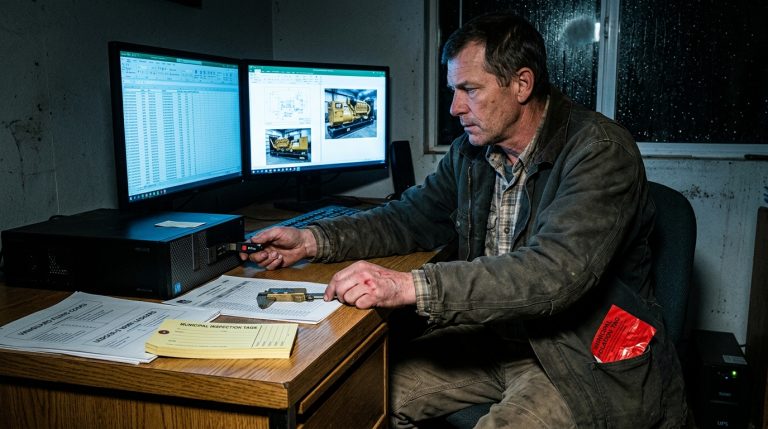
The Iron Line on the Ridge: A Retired Engineer’s Calculated War Against Suburban Tyranny
CHAPTER 1: THE IRON LINE ON THE RIDGE
The mud of the Bridalwood path did not smell like earth. It smelled like wet lime and crushed shale, the sour tang of a 200-year-old trade route being squeezed to death by manicured lawns.
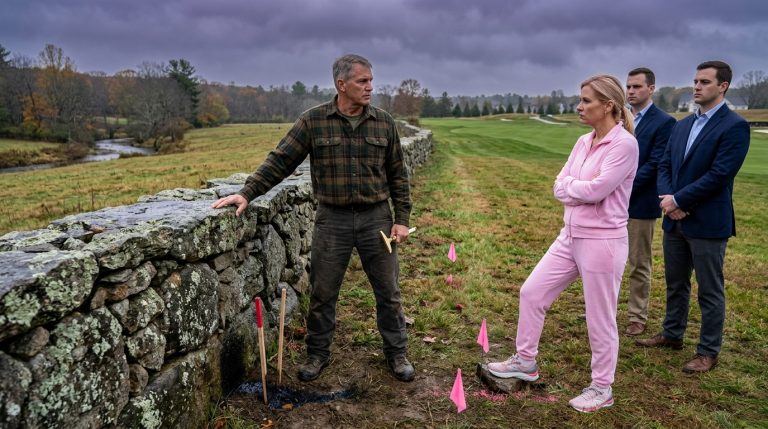
Colonel Jonathan Evans sat his 16-hand quarter horse with the flat, unyielding stillness of a concrete pylon. Below him, Karen Miller’s tracksuit radiated a violent shade of synthetic magenta against the muted browns of the late-autumn oak canopy. Her arms were crossed so tightly the fabric groaned at the seams, a physical manifestation of a mind entirely closed to consequence.
“The vote was unanimous, Mr. Evans,” she said, her voice carrying the practiced resonance of a woman used to presiding over bake sales and municipal compliance hearings. “We start paving on Monday.”
Jonathan did not blink. His gloved fingers rested lightly on the braided leather of the reins, feeling the steady, rhythmic thrum of Valor’s pulse against the palms of his hands—a warm, living counterweight to the cold geometry of the threat. He had looked across conference tables at men holding maps of disputed riverbeds in sectors where paperwork meant the difference between a bridged supply line and a court-martial. This was smaller, but the mechanics were identical. Audacity masking a total lack of logistics.
“There is no vote that rewrites a state conservation easement, Karen,” Jonathan said. His voice was low, pitched to travel exactly the distance between his saddle and her sneering face without an ounce of wasted breath. “My deed is recorded in Book 14 of the county registry. The setback is twenty feet past the split-rail fence. If a single blade of caterpillar tread crosses that line, it isn’t a community improvement. It’s a felony.”
Karen’s upper lip twitched, a hairline fracture in her saccharine facade. She pulled a sheath of thick, cream-colored paper from her side, rattling it like a summons from an imaginary crown. “Our attorney has reviewed your little papers. An implied easement supersedes old ink when a community needs a walkway. You’re standing in the way of progress, Colonel. And the neighborhood has a very long memory for people who obstruct the majority.”
She turned on her heel with a sharp, synchronized pivot, her white sneakers grinding into the gravel before she hauled herself into the electric golf cart bearing the golden plaque of the Lakeside Meadows HOA presidency.
Jonathan watched her go, his eyes tracking the dust plume kicked up by the rear tires. As the cart zipped toward the sterile cul-de-sacs of the subdivision, his gaze dropped to the low, rusted wire fence marking his perimeter. Something was wrong with the east corner post. The steel tension wire—anchored three days ago during his routine boundary check—was slack, the staple pulled clean out of the seasoned oak post by a force that had nothing to do with weather.
CHAPTER 2: THE TACTICAL ASSESSMENT AND THE PAPER SHIELD
The slack wire didn’t yield to a sagging post or a rotted staple. Jonathan knelt in the frost-rimed grass, his heavy-duty work gloves brushing against the weathered grain of the cedar post. The staple lay half-driven into the dirt, curled at the shank like an iron claw pulled free by a crowbar or a heavy boot heel. There was no rust on the exposed white pine grain of the hole. It had been pulled within the last twenty-four hours—right around the time Karen Miller had finished marching her pink tracksuit back to the subdivision asphalt.
He picked up the bent staple, turning it over in his palm. The metal was cold enough to bite through the leather.
“Looking for a ghost, Colonel?”
Jonathan didn’t flinch. He rose smoothly, his knees making no sound against the turf, and turned toward the eastern boundary line. Standing thirty yards away, just inside the tree line where his land met the rear perimeter of Lakeside Meadows, was Bill Peterson. The retired corporate lawyer wore a heavy plaid wool coat that had seen twenty winters and carried an aluminum travel mug that smelled faintly of chicory and black coffee. Bill’s eyes were sharp behind wire-rimmed glasses, taking in the loose wire and Jonathan’s open posture.
“Not a ghost,” Jonathan said, his voice level as he slipped the bent staple into his pocket. “An amateur saboteur with poor wrist control. They tried to shift the anchor post four inches to the west. If they pull the line on the east corner, they narrow my setback just enough to claim the drainage ditch sits outside the private deed.”
Bill took a slow sip from his mug, steam curling past the lenses of his glasses. “Karen’s legal hack—what’s his name, Franklin Pierce?—must be getting desperate. He knows an actual title search kills the ‘implied easement’ argument before it even hits a magistrate’s desk. So they’re manufacturing a physical footprint. If the fence line looks compromised on paper or on the ground, they can argue a ‘disputed boundary’ in front of a sympathetic municipal judge.”
“They’re welcome to try,” Jonathan said, stepping over a fallen oak limb and walking toward the edge of his property line where the manicured turf of Lakeside Meadows met the chaotic, beautiful overgrowth of his fifty acres. “A municipal judge doesn’t override a state conservation easement filed under Title 18. But it creates noise. It delays.”
“Noise is all they want,” Bill muttered, his gaze drifting over the sprawling expanse of the old farmstead. “Karen doesn’t need to win a court case to win her war. She just needs to make holding this land exhausting. Every fine, every notice, every administrative nuisance is designed to wear down your logistics until you hand them the key just to buy quiet.”
CHAPTER 3: THE DELIVERABLE WARNING AT THE EXECUTIVE DOORSTEP
Jonathan did not leave the papers on the oak desk. He gathered the heavy bond pages, slid them into a stiff manila envelope stamped with his property registry seal, and walked out to the driveway where his Ford F-350 sat idling. The diesel engine idled with a heavy, deliberate rumble that shook the steering column—a mechanical pulse that matched the steady, methodical rhythm of his own breathing.
He didn’t rush the gearshift. He backed out of the gravel turn-around with one hand resting on the top of the worn leather steering wheel, his eyes tracking the rearview mirror until the barn doors vanished behind the line of wild sumac. The transition from his own dirt drive onto the pristine asphalt of Lakeside Meadows was marked by a sudden, jarring shift in texture. The road here was too smooth, too black, swept clean of any stray leaf or twig by automated blowers. Every house looked like it had been extruded from the same architectural mold, differing only in the shade of beige paint or the ostentatious display of suburban status symbols.
Karen Miller’s house sat at the corner of Juniper and Crestview. It was larger than the surrounding models, distinguished by an aggressive application of faux-Tuscan pillars and a double-wide driveway that currently hosted a gleaming white golf cart with an HOA president placard strapped to the windshield.
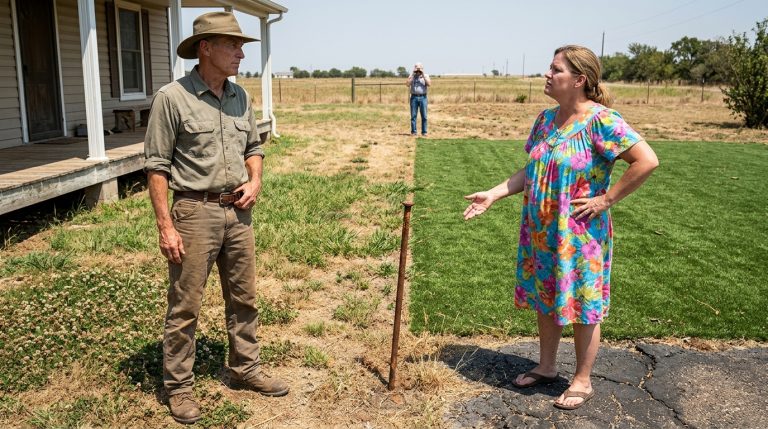
Jonathan cut the engine fifty yards short, letting the heavy truck coast to a silent stop against the curb. He didn’t park in her drive. He stepped down onto the manicured sod, his heavy boots sinking half an inch into grass that had been fertilized into an unnatural, toxic shade of emerald.
The front door of the Executive model was adorned with a massive brass knocker shaped like a roaring lion. Jonathan bypassed it entirely, lifting his knuckles and delivering two flat, hard raps against the solid wood core.
Inside, muffled by insulation and high-end drywall, a television anchor’s voice babbled about local market trends. Then came the scrape of a shoe against tile.
The deadbolt turned with a sharp, metallic click. The door cracked open four inches, restrained by a heavy brass chain. Gary Miller’s pale, narrow face peered out from the narrow gap. His eyes, watery and colorless behind thin wire frames, darted from Jonathan’s face down to the plain manila envelope in his hand like a trapped animal calculating escape vectors.
“Mr. Evans,” Gary stammered, his fingers tightening nervously on the edge of the door frame. “Karen is… she’s in the middle of a conference call with the district architectural committee. You can’t—”
“Open the chain, Gary,” Jonathan said. His voice wasn’t loud, but it carried the absolute, flat weight of an order given across a parade deck. It didn’t invite argument; it simply closed off alternate outcomes.
Before Gary could fumble with the brass links, the door swung inward with sudden violence. Karen filled the threshold, having shrugged into a vibrant purple tracksuit that clashed violently with the earth tones of her foyer. Her face was flushed, the skin around her nose pinched tight with administrative fury.
“What is the meaning of this?” Karen snapped, pushing her husband aside with a sharp sweep of her elbow. “You have no right to come to my private residence, Mr. Evans. This isn’t your logging trail. I’ll have you cited for harassment before you reach your truck.”
Jonathan didn’t step back. He held his ground on the welcome mat, his gaze locking onto hers with cold, unblinking clarity. “This isn’t harassment, Karen. It’s service.”
He lifted the manila envelope and slid it across the polished oak table inside the entryway, letting it come to a stop against a decorative silver bowl filled with potpourri.
“That contains a formal notice of intent under State Statute 18,” Jonathan said, every syllable clipped and precise. “It includes copies of the 2012 survey map, the active conservation easement registry, and a direct warning from the State Historical Preservation Office. If your paving crew drops a single blade of steel onto my property line on Monday morning, your legal counsel won’t be arguing an ‘implied easement.’ He’ll be explaining to a state magistrate why he conspired to commit felony destruction of a protected historical site.”
Karen’s upper lip curled, a tremor of genuine panic briefly fracturing her theatrical arrogance before her default mask slammed back into place. She snatched the envelope off the table, her fingernails tearing viciously at the flap. She pulled out the first page, her eyes scanning the bold-face statutory references.
“More garbage,” she hissed, though her voice lacked its earlier resonance. The paper shook slightly between her fingers. “Our attorney, Mr. Pierce, reviewed the township plats. He said the community’s right to expansion supersedes your private deed restrictions. A judge in the municipal court will throw your paperwork out by noon on Monday.”
“Your cousin is either billing you for bad advice or he’s selling you a fantasy,” Jonathan replied quietly, his eyes narrowing as he observed the subtle twitch in her left eyelid—the physiological marker of a liar realizing her bluff had been called by someone holding a heavier hand. “And if he tries to file an emergency injunction in municipal court based on a falsified boundary, my legal counsel will introduce the state conservation registry directly into the record. That registry doesn’t care about your HOA votes, and it certainly doesn’t care about your cousin’s billable hours.”
She crumpled the first page into a tight, white ball, her face darkening to the color of a bruised plum. “Get off my property. Now.”
“I’m leaving,” Jonathan said, turning slowly on his heel. He didn’t look back as he stepped off the porch and walked back toward the idling diesel.
As he settled into the driver’s seat and put the truck into reverse, a strange visual distortion caught his eye in the side mirror. For a fraction of a second, the reflection of Karen’s house seemed to stretch and warp against the graying autumn sky, the neat angles of the suburban roofline bending like wet cardboard under the weight of an invisible stress. Jonathan blinked, shaking off the optical fatigue, and shifted into drive. The real battle wasn’t on the asphalt of Crestview Drive. It was waiting back at the ridge, where the wires were loose and the paperwork was just beginning to bite.
CHAPTER 4: THE ESCALATION AND THE GATHERING OF ALLIES
Jonathan did not cut the engine the second he rolled back onto his own gravel drive. He let the diesel settle into a low, rhythmic rattle, staring through the windshield at the line of tall, skeletal oaks marking the eastern perimeter. Bill Peterson’s warning about the township secondary registry sat heavy in his mind—a quiet reminder that a localized dictator never fights with just one set of rules. If Karen and her cousin Franklin were pushing the boundaries of municipal compliance, they weren’t just relying on local intimidation; they were engineering a paper trail in the county backrooms.
He stepped down from the cab, the cold autumn wind biting through his canvas jacket. Instead of heading straight inside to his office, he veered toward the eastern fence line where the wire had been tampered with hours earlier.
The bent staple he had pocketed earlier needed context. He knelt by the cedar post again, sliding off his heavy leather glove to run bare fingertips along the grain of the bored hole. Something was missing. A standard boundary marker placed during his initial 2012 survey was anchored by a lead-sealed brass disc hammered flush into the bedrock just beneath the fence line.
He brushed away a thick layer of damp oak leaves and dark loam. The brass disc was exposed, but the lead seal had been scored. A narrow chisel mark—clean and fresh—bitten into the soft metal.
“Looking for a signature?”
Jonathan looked up. Carlos Garcia stood twenty paces away on the other side of the split-rail fence, holding a rusted pair of pruning shears in one hand. The young teacher’s face was tight with a familiar, weary tension, his eyes darting toward the subdivision as if checking for invisible watchers.
“They didn’t just pull a staple, Carlos,” Jonathan said, standing up and wiping his thumb on his trouser leg. “They scored the brass marker. Someone with a standard township survey kit came through here while I was in town.”
Carlos leaned against the rail, his knuckles whitening around the handles of the shears. “That explains why my wife Elena saw a man in a high-visibility vest pacing our property edge yesterday evening. He told her he was with the county drainage board. But he didn’t have an official vehicle. Just an unmarked gray sedan parked down by the retention pond.”
Jonathan’s gaze narrowed. A municipal surveyor doesn’t drive an unmarked sedan unless they’re hiding a conflict of interest from the local tax assessor’s map. Gary Miller’s committee handled secondary public works right alongside minor zoning adjustments.
“They’re building a parallel file,” Jonathan said, his voice flat and hard. “If they can’t force the paving permit through the state conservation easement, they’ll try to reclassify the outer twenty feet of my land as an unmaintained public drainage right-of-way.”
“Can they do that?” Carlos asked, his voice dropping to a cautious murmur.
“Not legally,” Jonathan replied. “Not without a public hearing and an independent environmental impact study. But if they push it through a late-Friday subcommittee vote while everyone’s distracted by the weekend, it becomes an administrative headache that takes six months of legal filings to reverse. Karen doesn’t need to win the argument; she just needs the asphalt down before the injunction hits.”
Carlos tossed the pruning shears into the grass beside his boots, his jaw setting with a sudden, resolute snap. “My father-in-law kept every township meeting record from the last decade in a box in our attic. He was on the original county planning board before the developers bought up the valley. If there’s a loophole they’re exploiting in the secondary registry, the paper trail has to start somewhere.”
“Bring it over tonight,” Jonathan said. “We’re going to need more than state conservation statutes. We need to open the second front.”
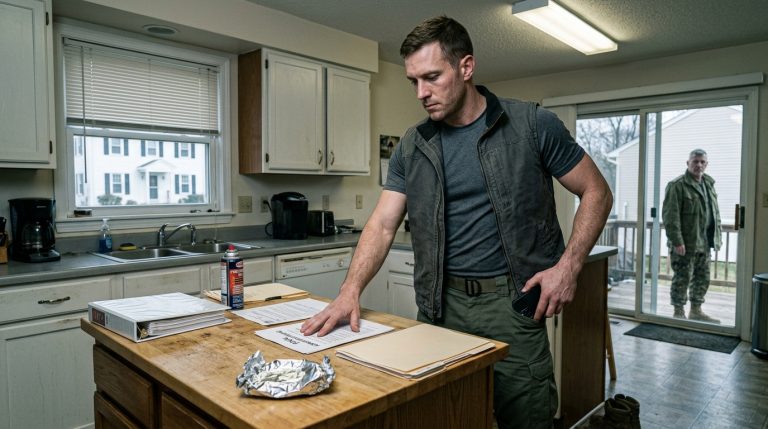
Jonathan turned away from the fence and walked back toward the house, his boots crunching over the frost-hardened gravel. The tactical picture was shifting from a simple local dispute into something structural. Inside the office, the air was warm and smelled of old paper and heavy machine oil. He sat back down at his oak desk, pulling the master survey map toward him under the brass weights.
The phone on the corner of the desk rang—a sharp, single trill that cut through the silence of the room.
Jonathan picked up the receiver on the second ring.
“Colonel Evans,” a sharp, professional voice cut through the line without preamble. It was Sarah, her words carrying the brisk, high-velocity cadence of a paralegal who had spent twelve hours buried under municipal databases. “I pulled the incorporation papers for the Lakeside Meadows maintenance contracts through the state business registry. You aren’t going to like what’s sitting under the surface.”
Jonathan rested his elbow on the desk, his eyes fixed on the scored brass marker symbol he had hastily sketched in his field notebook. “Lay it out, Sarah.”
“The landscaping firm they hired for the community upkeep—Clearcut Paving and its parent shell, Greenscape Solutions—doesn’t list a commercial address in the state tax rolls,” Sarah said, the sound of keyboard clacking rattling softly in the background. “The corporate registration lists a post office box three counties away. And the primary financial officer listed on the corporate filing isn’t an LLC. It’s an individual.”
Jonathan didn’t need to ask. “Gary Miller.”
” Bingo,” Sarah said, her voice dropping into a tight, focused register. “Gary isn’t just a committee member on the township board. He’s the sole registered agent for three separate maintenance subsidiaries that have been billing the HOA six-figure upkeep fees for the last three years. They aren’t just trying to pave your trail, Dad. They’re trying to protect a cash pipeline that runs right through your property line.”
Jonathan hung up the phone slowly, the plastic receiver settling back into its cradle with a heavy, final click. The puzzle pieces locked together with the cold, unyielding precision of a breechblock sliding home. The trail wasn’t a community walkway project. It was the final, untamed barrier hiding a ledger full of fraud.
CHAPTER 5: THE SHOWDOWN AT THE THRESHOLD OF THE PATH
Jonathan did not turn on the desk lamp. He sat in the gathering autumn dusk, watching the shadows lengthen across the oak flat-file cabinet where the master deeds lay locked. The silence of the room was absolute, save for the rhythmic, heavy tick of the grandfather clock in the hallway.
A sudden, sharp memory cut through the quiet—an intrusive flash of a dusty supply depot in another lifetime, where a crooked quartermaster had tried to sign off on phantom concrete shipments while the perimeter bridge cracked under weight. The texture was identical. A small man hiding behind administrative authority, banking on the assumption that nobody would look past the first line of the ledger.
He stood up, his joints popping with dry, mechanical precision, and walked to the front window.
Outside, the first pale smear of Monday dawn was beginning to bleed over the eastern ridge, turning the frosted pasture a cold, metallic gray. It was 5:50 AM. Twenty minutes before the shift change on the township road crews, and ten minutes before Karen Miller’s scheduled arrival.
Jonathan didn’t wait for coffee. He pulled on his heavy canvas field jacket, the canvas stiff against his forearms, and walked out through the back kitchen door. The air outside was sharp enough to sting the nostrils, carrying the damp scent of rotting oak leaves and wet earth.
He didn’t walk toward the barn this time. He headed straight down the main farm track toward the convergence point where the private acreage met the eastern boundary of Lakeside Meadows—the precise spot where the Bridalwood path dipped into the gully before running parallel to the subdivision’s rear fence line.
As he reached the tree line, the low, guttural rumble of a heavy diesel engine broke the morning stillness.
A bright yellow Caterpillar paving tractor, its rotating amber beacon flashing a harsh, mechanical strobe against the gray mist, crawled around the corner of Crestview Drive. Behind it rumbled a dual-axle dump truck loaded with crushed gray gravel. Riding shotgun in the lead vehicle, perched on the edge of the seat with an electric-yellow hard hat strapped incongruously over her purple tracksuit, was Karen Miller.
The convoy came to a halt right where the private gravel met the public asphalt. The driver of the paving tractor hopped down, his boots crunching loudly on the loose stone, and pulled a crumpled work order from his breast pocket.
Jonathan stepped out from the heavy shadow of the twin oaks, his boots making an unhurried, deliberate sound on the frozen roadbed. He didn’t raise his voice. He didn’t need to. The sheer mass of his Ford F-350, which he had left parked square across the mouth of the trail twenty minutes prior, served as an immovable steel barrier between the heavy machinery and the disputed earth.
“Morning, mister,” the paving foreman called out, wiping his palms on a grease-stained rag as he squinted through the dim light. “Got orders to lay two inches of hot mix down this right-of-way. Need you to back your truck off the shoulder.”
From the passenger window of the trailing vehicle, Karen shoved her head out into the cold air, her face flushed a furious, mottled magenta. “Don’t talk to him, Dave! He’s a squatter! Call the county sheriff and have that truck towed off community property right now!”
The foreman looked from Karen’s distorted face back to Jonathan’s calm, slate-gray eyes. He could read the layout of the land better than she could; he saw the steel fence posts, the unbroken line of ancient cedar boundary markers, and the heavy plastic binder tucked firmly under Jonathan’s left arm.
“Look, friend,” the foreman said, lowering his voice into a pragmatic register. “My contract’s with the Lakeside Meadows HOA. They paid fifty percent down. But if this strip sits inside a recorded conservation easement like your sign indicates, my company takes the liability if the state environmental board steps in.”
“It’s worse than a conservation easement,” Jonathan said, his voice cutting through the idling diesel hum with icy clarity. He opened the binder to the state registry page, holding it out where the foreman could read the bold red stamp across the top. “Your client isn’t just ordering an illegal paving job on private deeded land. She’s attempting to bury an active county financial audit under four inches of asphalt. If your company drops a single yard of hot mix on this path today, your corporate registration, your bonding, and your equipment leases will be seized by the state economic crimes unit before noon.”
The foreman went completely still. He looked down at the state seal, then slowly turned his head to stare at Karen, who was now scrambling out of the passenger door of her golf cart, her hard hat wobbling comically on her head.
“He’s lying!” Karen shrieked, marching across the frost-covered grass with her arms flailing. “He forged those papers! My cousin is Franklin Pierce; he’s the association’s legal counsel! We have an implied right of way by community vote!”
“Your cousin’s law firm is currently being audited for three counts of wire fraud and kickback distribution through a shell company called Greenscape Solutions,” Jonathan said, turning his gaze fully onto her for the first time. The words weren’t loud, but they dropped into the cold air like lead weights.
Karen stopped dead in her tracks three paces away. The synthetic magenta of her tracksuit seemed to dull against the gray morning light. Her mouth opened, but no sound came out—only a thin puff of white condensation that vanished instantly into the wind.
For three seconds, the entire gully held its breath. Then, far down the subdivision road, the sharp, authoritative wail of two county sheriff’s cruisers cut through the silence, their red-and-blue light bars spinning twin ribbons of emergency color across the frosted suburban rooftops.
CHAPTER 6: THE UNRAVELING OF THE SUBSIDIARY ACCOUNTS
The cruiser doors opened in absolute synchrony, the heavy thud of metal-on-metal cutting through the idle purr of the paving tractor’s diesel engine. Deputy Miller stepped out first, his boots hitting the frost-covered gravel with a dull, heavy crunch. Beside him, Deputy Chen adjusted his service belt, his eyes flicking past the flashing light bars to take in the precise geometry of the scene: the F-350 blocking the trail, the yellow CAT paver idling uselessly, and Karen Miller standing frozen twenty yards away with her mouth half-open in a soundless snarl.
“Morning, Colonel,” Deputy Miller said, his voice flat and weather-worn as he tipped the brim of his Stetson back. “Dispatch logged a call about an obstruction and a potential breach of a protected right-of-way. Looks like we arrived just in time to catch the initial estimate.”
Before Jonathan could answer, Karen broke her paralysis. She surged forward, her bright purple tracksuit a garish streak against the muted grays of the ridge, her finger shaking as she pointed directly at Jonathan’s chest.
“He’s lying to you, Miller!” she shrieked, her voice cracking at the high end of its register. “He’s an unhinged squatter holding this community hostage! He parked that truck here to block a legally authorized public infrastructure improvement! Arrest him for trespassing and public endangerment right now!”
Deputy Chen didn’t flinch. He didn’t even look at Karen. Instead, he pulled a small, ruggedized tablet from his breast pocket and tapped the screen twice. “Ma’am, step back behind the cruiser line. We’re handling this by the book.”
“The book?” Karen laughed, a frantic, hysterical sound that lacked any real anchor. “I am the president of the Lakeside Meadows Association! My attorney has the township plats right here! We voted on this!”
“Your attorney’s office is currently three counties away getting a visit from the state bar investigators,” Deputy Miller said, his tone dropping into a dangerous, gravelly register that made Karen stall mid-stride. He pulled a folded sheet of heavy bond paper from his inner pocket and let it snap open. “We got a joint directive from the county tax assessor and the state economic crimes division thirty minutes ago. This property line is locked under Title 18. And more importantly, your association’s subsidiary accounts just triggered a red flag at the county treasury.”
The mention of the accounts hit the clearing like a physical blow. Across the road, the paving foreman quietly shut down the diesel engine of the CAT tractor. The sudden drop in ambient noise left only the crunch of gravel as Deputy Chen walked past Karen without a second glance, heading straight toward Jonathan.
“You have the paperwork for the secondary parcel lines, Colonel?” Chen asked quietly.
Jonathan reached into his canvas field jacket, pulling out the clear plastic binder containing the 2012 certified survey maps and the state conservation easement certificates. He handed it over without a word.
Chen flipped through the pages with the practiced efficiency of a man who spent his mornings auditing municipal discrepancies. His finger traced the red-inked boundary line on the map, then moved horizontally to compare it against the physical fence post that had been tampered with twenty-four hours earlier.
“The lead seal on the brass marker down by the ditch was scored yesterday afternoon,” Jonathan said, his voice low and steady. “Someone with a township survey kit tried to alter the setback to match an unrecorded municipal variance.”
Deputy Chen looked up sharply, his eyes narrowing. “An unrecorded variance? That requires a dual-signature sign-off from the county planning commission. The only commissioner authorized for this sector is out of state.” He turned his head slowly, looking past the assembly toward the subdivision entrance where a small, pale man in an oversized brown jacket was standing near the edge of the turf.
It was Gary Miller.
Gary was holding a takeout coffee cup so tightly his knuckles had turned the color of chalk. When he saw Deputy Chen’s eyes lock onto him, he took half a step backward, his boots snagging on the manicured edge of a sprinkler head.
“Deputy,” Jonathan said, stepping slightly to the side to give the officers a clear line of sight toward the subdivision edge. “You might want to ask Mr. Miller how his private consulting firm, Greenscape Solutions, managed to receive eighty thousand dollars in community maintenance fees for a drainage project that was never zoned.”
The air went dead silent. The wind dropped entirely, leaving only the distant, hollow caw of a crow in the upper branches of the oak canopy.
Karen whipped around, her face twisting in sheer horror as she spotted her husband standing by the lawn. “Gary! Don’t you say a word! Get back inside the house!”
Gary didn’t move. He stood frozen under the gray morning sky, the coffee cup slipping from his fingers to shatter against the pristine grass, dark brown liquid pooling like an ink stain over the artificial perfection of the suburban lawn. The paper shield had cracked, and underneath was a ledger that could no longer be hidden by a coat of asphalt.
CHAPTER 7: THE FINAL SUBPOENA IN JUDGE PRICES COURTROOM
The air inside County Courtroom 3B smelled of floor wax, old paper dust, and the stale perspiration of a dozen people waiting for a hammer to drop. The gallery benches were packed tight. Several Lakeside Meadows residents—men and women who had spent years nodding politely at Karen Miller’s committee meetings—sat in stiff, uncomfortable silence, their eyes fixed on the varnished oak table where Franklin Pierce was frantically shuffling a stack of blue-backed legal motions.
Jonathan sat upright at the opposing table, his hands resting flat against the polished wood. Beside him, his daughter Sarah tapped the screen of her laptop, her fingers moving with cold, methodical speed. Bill Peterson occupied the outer aisle seat, a thin, satisfied smile playing across his lips as he watched Franklin sweat through his charcoal-gray lapels.
At the front of the room, Judge Marian Price sat behind a high mahogany bench, her expression as unyielding as a granite lintel. She did not look at the lawyers. She looked down at the single-page preliminary audit report resting beneath her left hand.
“Mr. Pierce,” Judge Price said, her voice cutting through the ambient hum of the overhead fluorescent lights like a scalpel. “Your motion to dismiss this counter-claim rests on the assertion that the plaintiff’s association operated entirely within standard municipal codes and that all contractual expenditures were verified by independent board review. Is that correct?”
Franklin stood up, his collar visibly choking him as he smoothed down his tie with a trembling thumb. “That is correct, Your Honor. The association acted in good faith to secure community property improvements. These allegations of financial impropriety are merely a vindictive sideshow manufactured by a disgruntled property owner attempting to block a public utility project.”
Judge Price did not blink. She lifted the page, turning it slightly so the morning light caught the embossed seal of the state financial crimes division in the corner.
“Good faith,” the judge repeated, the words flat and devoid of warmth. She slid a second document across the desk toward the clerk. “Mr. Pierce, explain to this court how an eighty-thousand-dollar expenditure authorized under a community beautification line item ended up in a corporate account registered to Greenscape Solutions—a shell entity whose sole signatory is Gary Miller, the husband of the association president who awarded the contract without a competitive bidding process.”
The silence in the courtroom dropped several degrees. In the front row of the gallery, Karen Miller let out a sharp, strangled gasp, half-rising from her seat before her defense counsel slammed a heavy hand down on the table to force her back.
Franklin’s face drained of color, his skin turning the texture of old parchment under the courtroom lights. He opened his mouth, stammering a fragmented defense about administrative oversight and preliminary reporting errors, but the words dissolved into thin air against the judge’s steady, unblinking glare.
“The motion to dismiss is denied,” Judge Price said, her gavel coming down once with a sharp, echoing crack that rattled the water pitchers on both tables. “Furthermore, this court exercises its statutory authority to issue an immediate, unsealed subpoena for all personal bank records, corporate filings, and communication logs involving the firm of Pearson Associates and the Lakeside Meadows executive board over the past thirty-six months. Court is adjourned until the special evidentiary hearing tomorrow morning.”
As the judge stood and swept back through the oak chamber doors, Franklin collapsed back into his chair, his hands trembling as he began stuffing papers into his briefcase with desperate, uncoordinated movements. Across the aisle, Jonathan remained seated, watching the collapse of the paper wall with the quiet, unbroken focus of a man observing the final collapse of an indefensible perimeter.
CHAPTER 8: THE FALL OF THE REIGN AND THE RETURN OF THE QUIET
The sunlight striking the oak floorboards of the courthouse corridor was cold and clear, casting long, sharp shadows through the tall institutional windows. Jonathan stood by the double doors, his canvas field jacket zipped against the draft, watching the bailiff lead Franklin Pierce and his clients down the tiled hall toward the municipal holding annex.
Karen Miller did not look back. The synthetic magenta of her tracksuit had been replaced by the dull, colorless reality of an administrative defendant caught in the gears of a machine she had never truly understood. Her husband, Gary, walked two paces behind her, his head bowed, his hands jammed deep into the pockets of an oversized jacket. The paper shield had turned to dust, exposing the hollow center of a system built entirely on intimidation and fabricated debt.
Bill Peterson stepped up beside Jonathan, folding a set of legal notes into his worn leather portfolio. “The interim board is already meeting in the community clubhouse,” Bill said, his voice dry and steady. “They’ve formally voted to rescind the paving order, cancel the fraudulent maintenance contracts, and issue a full public retraction regarding the Bridalwood right-of-way. Your property lines are secure in perpetuity.”
Jonathan nodded slowly, his gaze shifting past the glass doors toward the western horizon where the rolling hills of his fifty-acre parcel met the edge of the sky. “A perimeter only holds if you maintain the posts, Bill. The paperwork was just the tool. The real work was refusing to let them move the line.”
Three days later, the air over the ridge had softened into the quiet stillness of late autumn. The asphalt trucks were gone from Crestview Drive, replaced by the natural, unhurried rhythm of the countryside.
Jonathan walked out to the eastern boundary line where the cedar post had been tampered with a week prior. He carried a heavy-duty ball-peen hammer and a fresh lead seal in his pocket. Kneeling in the damp, fragrant loam, he inspected the scored brass marker embedded in the bedrock. The mark left by the fraudulent survey was still visible—a sharp, aggressive scar across the metal.
With deliberate, measured strokes, Jonathan placed the new lead seal over the brass disc, striking it once, twice, until the heavy metal conformed perfectly to the contours of the stone. It was a small act of repair, quiet and absolute. Every strike echoed softly against the trunk of the nearby oak trees, a steady heartbeat of restoration.
From across the split-rail fence, Carlos Garcia and his young daughter Maria walked up leading the spotted pony, Patches. Maria waved shyly, her breath pluming white in the crisp afternoon air.
“Colonel,” Carlos called out, leaning his arms against the weathered cedar rail. “The new board president just posted the community notice. The historical trail is officially exempt from any future association jurisdiction. They’re even chipping in to help us clear the lower drainage brush this weekend.”
Jonathan stood up, wiping a trace of gray lead dust from his calloused palms. He looked across the fence line toward the houses of Lakeside Meadows. The lights were coming on one by one in the early dusk—not glaring security floodlights or frantic warnings, but steady, ordinary windows glowing in a neighborhood that had finally learned the weight of its own boundaries.
“Tell her she can bring Patches down the trail anytime she likes, Carlos,” Jonathan said, a faint, rare smile touching the corners of his mouth. “The path is clear.”
Later that evening, as twilight settled into a deep, velvety violet across the valley, Jonathan saddled Valor for a final ride. The 16-hand gelding moved with a warm, living power beneath him, his hooves striking the damp earth of the Bridalwood path with a muffled, comforting cadence. There was no noise from the subdivision save for the distant, harmless bark of a neighborhood dog.
The trail wound its way through the dense oak forest, rugged, uneven, and entirely free. It had resisted the asphalt, it had broken the tyrants, and in doing so, it had restored the quiet order of the world. Jonathan gave the reins a soft, familiar tug, turning Valor back toward the warm lights of the barn, knowing the line was held, the ledger was balanced, and the land was whole again.