The Iron Perimeter: A Cold-Blooded Defense of Rusted Earth and Unforgiving Law
CHAPTER 1: THE BOUNDARY LINE
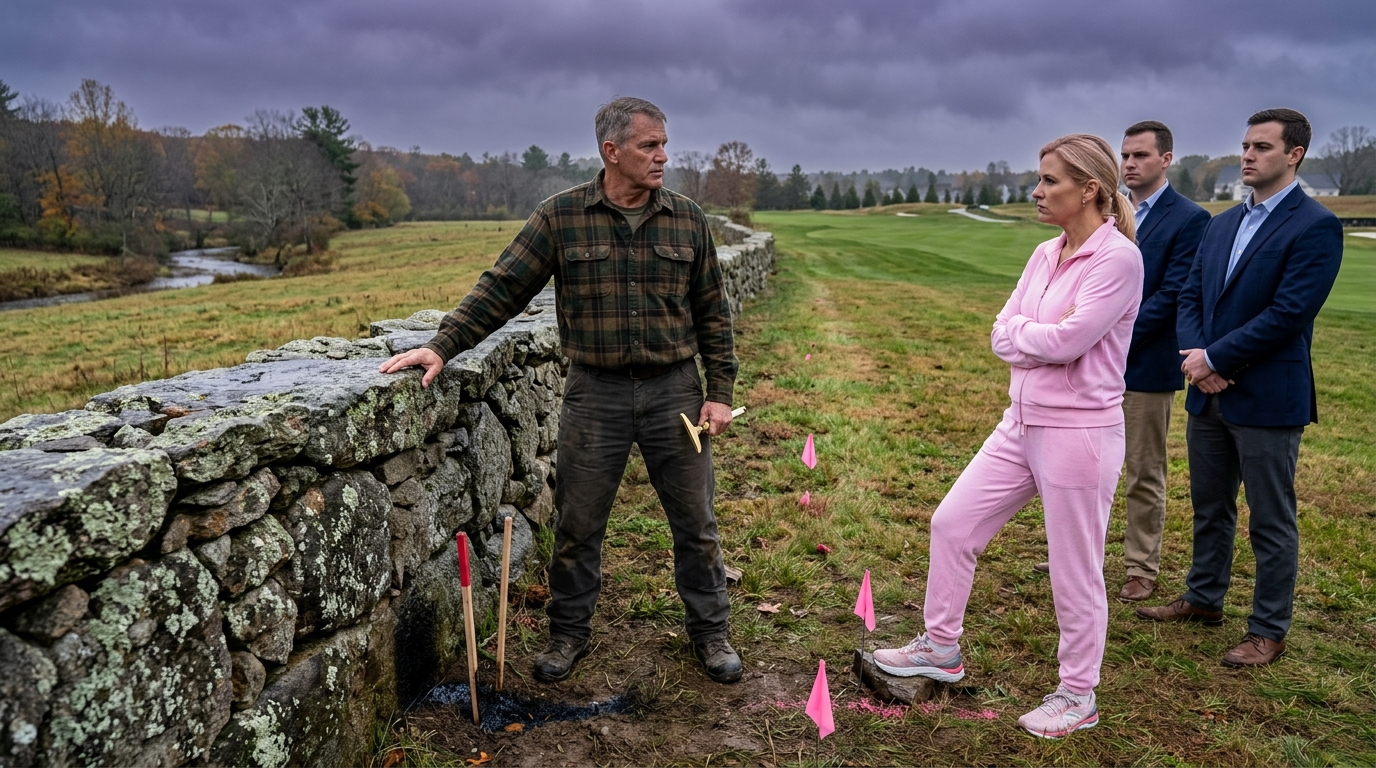
Three pink surveying flags pierced the damp earth directly beside my stone wall. They weren’t there at dawn.
I stopped five feet back, the heavy brass depth micrometer in my right hand cold against my palm. I rolled the knurled thimble with my thumb. Click. Click. Micro-tolerances. The soil around the wooden stakes was fresh, turned over within the last two hours. Across the wall, three figures stood on the manicured turf of Whispering Pines.
Karen Petrov led them. Her pastel pink tracksuit stood out against the pale autumn grass like a flare. Flanked by two men in identical navy blazers, she crossed her arms, her jaw set hard.
“The Whispering Pines Homeowners Association has officially voted to acquire your pasture through eminent domain for community improvement,” Karen said. Her voice carried that flat, syrupy arrogance of a bureaucrat holding an unsigned warrant. “We’ll be sending our appraisers next week. You can’t stop progress, Colonel.”
I didn’t answer right away. I stepped up to the stone wall—two hundred years of granite, slate, and lichen—and rested my thumb on a patch of cold moss.
“Ordinance 74B,” I said. My voice stayed low, clipped, stripped of noise. “That’s municipal water and sewer transit. It doesn’t cover private golf courses.”
Karen’s upper lip twitched. “The board’s legal counsel handles the specifics. You have ten days to accept the pre-appraisal offer of sixty thousand dollars.”
Sixty thousand. Fifty acres of cleared pasture. The land Sarah and I bought twelve years ago, before the McMansions ate the Henderson farm. The three horses—Samson, Delilah, Goliath—grazed near the creek fifty yards behind me. Their tails swished in slow, steady arcs.
“You’re standing on private soil, Karen,” I said, thumbing the micrometer’s steel rod until it locked. “Your appraisers step over this wall, they get processed for criminal trespass.”
“We’ll see what the county sheriff says about that,” the man on her left muttered, adjusting his blazer.
I met his eyes. He looked away, shifting his weight onto his heels.
“The state land trust holds the deed covenants,” I said, looking back at Karen. “You haven’t run a title search. You haven’t checked the county recorder.”
“We checked everything we need to check,” Karen snapped. She stepped closer, her expensive running shoes pressing against the base of my wall. “This pasture is an eyesore. Your tractor is an eyesore. The board is taking it.”
She was lying. Not about wanting the land, but about the math. An HOA doesn’t float a sixty thousand dollar cash buyout without a bank line, and no bank touches a parcel without a clean title search. She was pushing a bluff, waiting for an old man to panic and sign a waiver.
I turned the micrometer dial again. The click was tiny, metallic, lost in the wind.
“Send your paper,” I said.
Karen held my gaze for three seconds, searching for a tremor in my hands or a raise in my tone. She found nothing. She spun on her heel and marched back toward the cul-de-sac, her two blazers trailing behind her like escorts leaving a drop zone.
I stayed at the wall until their golf cart engine faded into the suburban distance. Then I looked down at the base of the stone structure. Beside the fresh survey stake, a dark, oily smudge clung to the damp roots of the grass—thick, foul-smelling, and completely out of place in a pasture that hadn’t seen heavy machinery since spring.
I knelt, wiped a smear of the black residue onto the tip of my brass micrometer, and raised it to the light.
CHAPTER 2: PAPER SCARS
The phone against my ribs vibrated three times before I wiped the micrometer on the tail of my flannel shirt. The dark grease didn’t come off cleanly. It left a stiff, black stain in the weave, smelling faintly of sulfur and scorched hydraulic fluid.
I stood up, my knees cracking in the cold air, and pulled the phone from my jacket.
“Miller,” I said.
“Jack. Maria.” Her voice came through the speaker crisp and dry, stripped of pleasantries. Maria Flores didn’t waste air. “I just pulled the county land registry portal. Whitman, Price and Holloway haven’t filed a condemnation petition with the clerk yet. But they pulled a preliminary survey map two hours ago.”
I looked down at the fresh wooden stake driven into the turf twenty inches on my side of the wall. “Who stamped the survey?”
“A private firm out of the county seat. Vanguard Surveying.”
Vanguard. I noted the name, filing it behind my eyes. “They’re marking lines inside my boundary. Three flags, fresh ink.”
“Don’t pull them,” Maria said immediately. “Leave them exactly where they are. If they step over that wall again to measure or alter those markers, it’s criminal trespass on a documented parcel. I’m drafting a formal cease-and-desist right now, but we need the county recorder’s original easement filing from twelve years ago to slap on the front of the motion.”
“I have the physical copy in the gun safe,” I said. “Signed by the state land trust director, hard seal, stamped in blue ink.”
“Bring it to the office. And Jack—don’t talk to Karen Petrov if she comes back with a crew. Let her dig her own hole.”
“She’s already digging,” I said, looking at the black smear on my thumb. “I’ll be in town in forty minutes.”
I ended the call and walked back toward the farmhouse. Samson, my lead gelding, trotted along the inside of the pasture fence, his nostrils flaring as he caught the scent on my shirt. He snorted, shaking his dark mane, and backed off two paces. Horses know when something in the dirt doesn’t belong.
Inside the mudroom, the house was quiet. The oak floorboards creaked under my boots—the familiar, steady sound of a structure built when timber was dense and honest. I passed Sarah’s desk in the corner of the living room. Her brass reading lamp was still there, polished, unplugged. I didn’t look at it too long. Pining didn’t hold land. Strategy did.
I spun the combination dial on the heavy iron safe in the hall closet. Four turns left, three right, two left. The thick door swung open on oiled hinges. Inside, sitting atop two steel boxes of 12-gauge shells and my retirement papers, was the leather-bound binder from the State Land Trust.
I pulled it out, untied the cloth strap, and opened the first page.
CONSERVATION EASEMENT DEED: PARCEL 404-B.
The blue ink of the county registrar’s stamp was slightly faded at the edges, but the raised seal was crisp—an unbroken circle of state authority asserting that this fifty-acre pasture was permanently bound to agricultural use in perpetuity. The development rights didn’t exist anymore. They had been severed, extinguished, and buried twelve years ago. Karen Petrov wasn’t trying to buy development rights; she was trying to buy a ghost.
I tucked the binder into a canvas briefcase, locked the safe, and headed out to the driveway. My 2008 Ford F-250 turned over on the second crank, the diesel engine rumbling with a heavy, rhythmic thrum that shook the cab.
As I pulled out onto the gravel lane, I looked in the side mirror. A white pickup truck with a magnetic logo on the door was parked two hundred yards down the county road, idling near the entrance to Whispering Pines. The block lettering on the door was visible even through the dust on my mirror: Vanguard Surveying & Environmental.
They weren’t just measuring lot lines. They were watching the farm.
I didn’t slow down. I shifted into third, let the diesel torque carry the truck onto the asphalt, and headed toward the county courthouse, leaving the white pickup behind in a cloud of grey exhaust.
The drive into town took twenty minutes through rolling timber and crumbling tobacco barns that were gradually being choked out by cul-de-sacs and vinyl-siding developments. Maria’s office sat on the second floor of a converted red-brick building two blocks from the county square. The steps groaned underfoot as I walked up.
When I opened her office door, Maria was already standing behind her desk, three yellow legal pads spread out before her, a cold cup of black coffee at her elbow. She was forty-two, dressed in a sharp charcoal suit with her dark hair pulled back into a tight bun.
“Show me,” she said without greeting.
I placed the leather binder on the desk and opened it to the recorded deed.
Maria leaned over, her eyes scanning the legal descriptions, her index finger tracing the surveyor’s coordinates at the bottom of page three. A small, cold smile touched the corner of her mouth.
“It’s ironclad,” she said softly. “The state land trust holds the primary enforcement right. If the HOA tries to condemn this land, they aren’t just suing you, Jack. They’re trying to extinguish a state-sanctioned conservation covenant. The state Attorney General’s environmental division would have to sign off on a taking, and they won’t.”
“They don’t know the easement exists,” I said, leaning against the edge of her oak desk. “Karen thinks this is a standard boundary dispute between a private owner and a neighborhood board.”
“Then we keep it that way for the initial filing,” Maria said, tapping her pen against the pad. “We file a simple motion to dismiss based on lack of standing and improper service under Ordinance 74B. We let them respond. We let their high-priced firm from the city bill the HOA ten or fifteen grand to write a counter-brief. We let Karen commit the board’s money to a fight she can’t win.”
“And when she pushes harder?”
“She will,” Maria said, looking up, her eyes hard. “A woman like that doesn’t retreat when she hits resistance. She escalates because her ego won’t allow a retreat. She’ll try to use county inspectors, code enforcement, environmental health—anything to make living on that farm insufferable.”
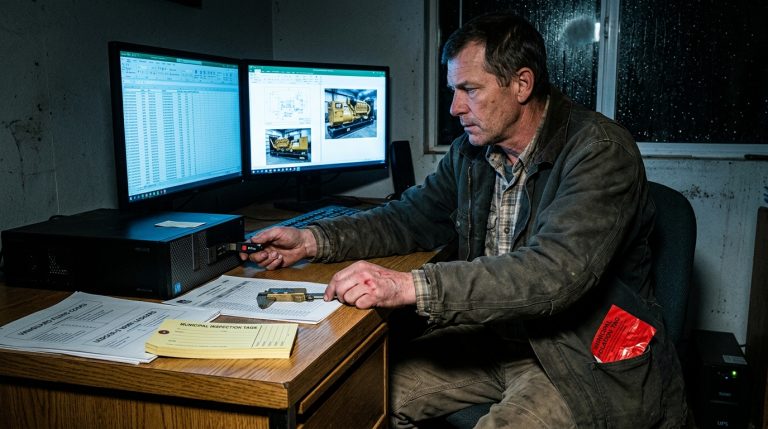
I reached into my pocket, pulled out the brass depth micrometer, and laid it on top of her legal pad. The dark, greasy smear was still clinging to the measuring anvil.
Maria frowned, looking at the tool, then at me. “What’s that?”
“Found it at the base of the stone wall this morning,” I said. “Directly beneath the fresh survey flags Vanguard put down. It’s industrial hydraulic fluid mixed with heavy mineral oil. It didn’t come from my tractor.”
Maria picked up a pen, gently prodded the greasy tip of the micrometer, and sniffed it. Her brow furrowed. “That smells like drill rig lubricant.”
“It is,” I said. “They aren’t just mapping a golf course green, Maria. They’re taking soil core samples along my fence line.”
CHAPTER 3: THE SUBURB INSURGENCY
Maria lowered the micrometer back onto her legal pad, her gaze lingering on the black residue. “Core samples mean soil testing. Soil testing means environmental assessment. Why would an HOA run covert soil tests on a pasture they don’t own?”
“Because they aren’t looking for grass,” I said. “They’re looking for what’s underneath it.”
She rubbed her temples, the sharp legal mind behind her eyes running through the chess board. “If Vanguard is drilling without a county permit on your boundary, they’re stepping out of civil property disputes into regulatory territory. But we need proof before we file for an emergency restraining order. We need eyes inside Whispering Pines.”
“I’ll get them,” I said, reaching down to pocket the micrometer.
“Jack,” Maria warned, her voice dropping an octave into that cold Marine intensity. “No confrontation. No property line standoffs. We win this in court, not on a police report.”
“I don’t waste ammo on skirmishes,” I said.
The drive back from town was quiet. The sky had turned a bruised, heavy purple, spilling a cold rain that flattened the dust on my windshield. The F-250’s wipers beat a steady, mechanical rhythm—thunk-slap, thunk-slap.
Instead of turning up my gravel lane, I bypassed my driveway and pulled into the public visitor cutout at the entrance of Whispering Pines. The subdivision’s gilded brick sign—WHISPERING PINES: LUXURY LIVING IN HARMONY WITH NATURE—sat under a bank of halogen floodlights. Rain dripped off the polished stone letters like sweat on a fevered forehead.
I cut the diesel engine. Silence settled into the cab, cold and thick.
Three minutes passed before a grey minivan pulled up to the curb fifty yards inside the development. A man got out, holding a blue tarp over his head, struggling to drag an aluminum wheelchair up a temporary wooden ramp toward a front porch. A young boy sat in the chair, wrapped in a rain poncho, his small hands clutching the armrests against the bounce of the unlevel plywood.
I opened my truck door and stepped out into the rain. The cold water hit the back of my neck, soaking into my flannel collar, but I kept my stride slow, deliberate.
“Need a hand?” I called out as I reached the edge of the driveway.
The man whirled around, startled, his grip slipping on the aluminum frame. He was in his mid-thirties, wearing a faded navy hoodie soaked through at the shoulders. Miguel Garcia.
“I’m fine,” he said, his tone defensive, automatically bracing for a confrontation. Then he recognized my face from the local paper’s coverage of the land dispute. His shoulders dropped an inch. “You’re… Miller. From across the wall.”
“Jack,” I said. I stepped onto the wet concrete, took the upper handle of the wheelchair, and helped him guide the wheels smoothly over the high lip of the doorway. The boy looked up at me with pale, wide eyes, giving a small nod before his father rolled him safely into the dry hallway.
Miguel closed the front door, stepping back out onto the porch under the narrow overhang. He pulled a wet hand across his face, shaking his head.
“The board gave me forty-eight hours to tear down the permanent ramp we poured,” Miguel said, his voice raw with a mixture of exhaustion and cold anger. He pointed a shaking finger at a wooden crate nearby containing broken concrete chunks. “Karen Petrov said unapproved masonry reduces curb appeal. Fined us two hundred dollars a day until we broke it up.”
“She used the Architectural Review Committee,” I said.
“She is the committee,” Miguel spat. He leaned against the damp siding, his thumb nervously rubbing a raw, bleeding blister on his palm—a micro-action that betrayed the sheer panic behind his angry composure. “We spent our savings on that poured ramp. Now my kid has to bounce over rotting plywood because it doesn’t match her Tuscan color palette.”
“She’s using HOA dues to fund a lawsuit against my pasture,” I said quietly, leaning against the porch railing. “Sixty thousand dollar buyout offer. Whitman, Price and Holloway on retainer.”
Miguel stared at me, his mouth opening slightly. “Sixty grand? She told the annual meeting last month that the land acquisition was budget-neutral—that the county was co-sponsoring the green space.”
“She lied,” I said. “And her husband’s firm, Petrov Built Commercial, is the sole pre-selected contractor for the expanded development.”
Miguel’s face went rigid. The frustration in his eyes hardened into something cold, practical, and dangerous. “Stan Petrov’s company? They’re broke. They laid off twenty guys three months ago. My brother-in-law was one of their equipment operators.”
I reached into my pocket, pulled out a small piece of paper with my landline number written on it, and pressed it into his damp palm.
“Karen thinks she owns this neighborhood because nobody talks to each other,” I said, my voice low against the patter of the rain on the aluminum gutters. “Find out who else is getting squeezed by her fines. The people with the basketball hoops. The people with the unapproved solar panels. Get them in a room.”
Miguel looked down at the slip of paper, his hand slowly curling into a tight fist around it. “And what do we tell them?”
“Tell them their monthly dues are paying off Stan Petrov’s company machinery loans,” I said. “And tell them to check their water bills.”
Miguel looked up sharply. “Water bills? What do you mean?”
“Ask Karen why Vanguard Surveying is pulling core samples along the eastern boundary line near the old town wellhead,” I said. “See if she gives you a straight answer.”
He didn’t speak for four long seconds. The rain poured off the roof edge between us, creating a gray curtain of water.
“I’ll make some calls tonight,” Miguel said softly.
“Do it quietly,” I replied.
I turned and walked back through the downpour toward my truck. Every step felt heavy, my boots sinking slightly into the soft, rain-soaked earth near the boundary line. The suburb wasn’t a solid block of enemy turf—it was a fragile shell of over-leveraged mortgages and suppressed resentment, held together by one woman’s ego and a pile of legal lies.
As I climbed into the cab of the F-250, my phone buzzed in my pocket. A text message from an unknown number:
Vanguard rig just left the staging area behind the cul-de-sac. They dropped a heavy yellow drum marked “Operation Wellhead / Leachate-7” in the brush near your south fence line. – M.
I stared at the screen. The trap was shifting. It wasn’t just a land grab anymore. It was a containment zone.
CHAPTER 4: THE DECOY EXPOSURE
The glowing text on my phone screen didn’t fade until I dropped the device into the cup holder. Operation Wellhead / Leachate-7.
I shifted the Ford into gear, swung the wheel hard, and drove past my front gate, following the perimeter fence line south. The rain had settled into a steady, freezing drizzle that turned the soil along the tree line into gray sludge. Headlights cut through the gloom, reflecting off wet oak leaves and tangled thorn bushes.
Three hundred yards down the south boundary, where my pasture met the overgrown drainage ditch behind the Whispering Pines cul-de-sac, the fence wire sagged. A fresh path had been crushed through the wild blackberries—heavy tread marks from a tracked rig.
I cut the lights, pulled the handbrake, and stepped out into the mud.
The air here didn’t smell like wet grass or farm dirt. It smelled sharp, metallic, like battery acid mixed with burnt rubber. I pulled a heavy iron flashlight from beneath the truck seat and stepped over the fallen wire.
Twenty feet into the brush, half-sunk in a rut filled with standing water, sat a steel fifty-five-gallon drum. The paint was bright industrial yellow, scratched raw along the rim where it had been dragged off a flatbed. Stenciled in black block letters across the top lid was a serial code: VANGUARD SURVEYING / SITE-4 BOREHOLE / LEACHATE-7. Below it, a red hazardous tag warned of volatile organic compounds, stamped with the project title: OPERATION WELLHEAD.
I knelt in the wet weeds, the cold mud soaking straight through the knees of my trousers. I didn’t touch the metal with my bare hand. I pulled out my pocket knife and scraped a flake of yellow paint off the seam. Beneath the fresh coat, weathered red primer showed through, along with an older, corroded plate welded to the steel: PROPERTY OF PETROV BUILT COMMERCIAL – 2018.
They weren’t taking soil samples to build a golf course. Stan Petrov had buried something under the old Henderson farm six years ago when he put up the first phase of McMansions. And now it was migrating through the groundwater toward my wellhead.
My phone rang. The sound was flat in the empty woods.
I flipped it open, keeping my eyes on the yellow drum. “Maria.”
“We just got out of the emergency hearing,” Maria said. Her voice was strained, the noise of court reporters and footsteps echoing in the background. “Jack, we broke their initial filing. Judge Miller threw out Whitman, Price and Holloway’s condemnation suit. The municipal ordinance they cited—Ordinance 74B—was modified in the county portal three weeks ago. Someone forged the easement boundary annex.”
Layer 1 was down. The legal front they had built was paper-thin, crushed the moment a judge looked at the recorded county seal.
“It gets worse,” Maria continued, her tone dropping into a cold, clipped whisper. “When I pressed their lead attorney on who authorized the survey map, he panicked on the record. He threw Vanguard under the bus. He admitted Stan Petrov paid for the survey out of a private escrow account, not HOA funds.”
“I’m standing over the survey,” I said.
Silence on her end for two seconds. “What are you looking at, Jack?”
“A yellow drum,” I said, my thumb tracing the cold steel edge of my pocket knife. “Petrov Built Commercial tags under fresh yellow paint. Serial reads Leachate-7. It’s sitting twenty feet inside my south timber.”
“Don’t breathe it in, and don’t touch the ground water,” Maria snapped, her professional composure vanishing into pure tactical alarm. “Jack, if Petrov buried industrial waste on that lot before he built the subdivision, taking your pasture isn’t about prestige. It’s an environmental containment zone. If the state EPA runs a regional audit on the town wellhead, the plume points directly to his foundation work.”
“And if he acquires my fifty acres,” I said, “he controls the entire drainage basin. He caps it, covers it with a fairways hazard pond, and buries the runoff under five feet of clay.”
“I’m filing an emergency injunction with the state Department of Environmental Protection in twenty minutes,” Maria said. “I’m attaching the forged survey record and your photographs. But Jack—Karen Petrov knows the legal suit failed. She just left the courthouse with her husband. They know they’re out of time.”
“They were out of time the moment they crossed the wall,” I said.
I hung up, raised my iron flashlight, and took three high-resolution photographs of the drum, the serial code, and the corroded Petrov Built asset tag.
As I turned to head back to the truck, the distant rumble of a heavy engine echoed across the pasture from the direction of the subdivision cul-de-sac. Headlights swept across the tops of the oak trees—not a police cruiser, not a surveyor’s pickup. A heavy commercial skid-steer loader, its diesel engine roaring in high gear, was cutting straight through the boundary brush toward my fence line.
Karen Petrov wasn’t waiting for the county inspectors or the environmental court. She was sending her husband’s crew to clear the evidence before the state injunction landed.
I locked my phone into my pocket, grabbed the iron flashlight tight in my fist, and walked directly into the beam of their oncoming lights.
CHAPTER 5: THE BALLROOM CHECKMATE
The heavy tracks of the skid-steer locked, tearing two deep trenches into the mud six feet from where I stood. The engine idle dropped to a wet, metallic chug.
The cab door flew open. Stan Petrov stepped down into the rain, wearing a mud-spattered work jacket over his dress shirt. His face was flushed red, his jaw working hard against his teeth. Behind him, parked in the gravel cutout of the cul-de-sac, Karen’s black SUV sat idling, its headlights piercing the dark brush.
“Get off the machine, Stan,” I said. My voice didn’t rise above the rain, but I held the iron flashlight leveled at his chest like a barrel.
“You don’t know what you’re messing with, Miller,” Stan yelled over the engine rumble. He wiped a hand across his forehead, his wedding ring catching the glare of the halogen work lights. “That drum isn’t on your property! The survey lines—”
“The survey lines were forged,” I said, stepping forward until the iron casing of my flashlight rested against his sternum. The steel was cold, solid, unyielding. “Your lawyer just admitted it in open court. Vanguard Surveying didn’t stamp a boundary—they stamped a toxic spill site.”
Stan froze, his breath hitching in his throat. He looked past me at the yellow steel drum half-sunk in the blackberry brambles. The stenciled letters—LEACHATE-7—gleamed wet under the halogens.
“The state EPA injunction hits in fifteen minutes,” I said. “You move that steel, or touch that soil, and you’re committing a federal felony on camera.” I raised my phone, the screen showing the active video feed uploading directly to Maria’s server.
Stan’s hands slowly lowered to his sides. The arrogance drained out of his posture, leaving behind the hollow, desperate posture of a man who realized the floor under his feet had already collapsed.
“It wasn’t supposed to leak,” he muttered, his voice dropping into a raspy whisper. “Six years ago… during the Phase 1 build. We had thirty drums of industrial solvent from the old textile plant. The disposal fees would have bankrupted Petrov Built before we poured the first foundation. So we capped them under the drainage basin.”
“Under Operation Wellhead,” I said.
Stan flinched at the name. “The plume started migrating last winter. If Vanguard didn’t drill core samples and cap it under a fairway hazard pond, the county health department would test the municipal lines by spring.”
“And you tried to steal my pasture to cover the burial ground,” I said.
From the road, Karen pulled open the door of her SUV and marched into the mud, her pastel jacket ruined by the rain, her eyes wild. “Stan! What are you doing? Tell him to get off our land!”
“Shut up, Karen,” Stan snapped, not looking back at her. His voice was dead. “It’s over.”
The Marriott ballroom two hours later smelled of damp wool, stale coffee, and ozone.
Karen had called the emergency meeting four days ago to force a public vote of confidence, booking the two-hundred-seat hall to display her authority. Over one hundred and fifty residents sat in rows of padded banquet chairs. Karen sat at the long head table draped in white linen, flanked by her two pale board members, Bob and Arthur.
She had just finished her opening speech—a shrill, practiced defense of neighborhood progress—when the heavy double doors at the back of the hall swung open.
I walked down the center aisle. Beside me was Maria Flores, carrying a thick leather accordion file, and Dr. Evelyn Albright, the executive director of the State Land Trust, dressed in a simple wool coat. Behind us came Miguel Garcia, leading thirty residents from the Concerned Homeowners Committee.
The room went dead quiet.
Karen slammed her wooden gavel onto the table. “Colonel Miller, this is a private association meeting! You are not a member, and you are out of order!”
I didn’t answer. I reached the podium, set my iron flashlight on the microphone stand, and stepped aside for Dr. Albright.
Dr. Albright adjusted her glasses, her voice calm, precise, and echoing with absolute institutional authority through the sound system.
“Good evening,” Dr. Albright said. “My name is Dr. Evelyn Albright. I am the executive director of the State Land Trust. Twelve years ago, Jack Miller and his late wife Sarah placed Parcel 404-B—the fifty-acre pasture adjacent to your subdivision—into a perpetual conservation easement.”
She pulled the blue-stamped deed from her folder and held it high.
“This easement extinguished all development rights forever,” Dr. Albright continued, her eyes locking onto Karen’s white face. “The land cannot be subdivided, acquired, or paved. Any vote taken by this board tonight, or any attempt to exercise eminent domain, is legally void and constitutes a willful violation of state environmental law.”
Murmurs rippled through the crowd like wind through dry corn.
Karen stood up, her chair screeching against the parquet floor. “That document is a fake! He’s lying!”
Maria Flores stepped to the microphone. She opened her leather file and pulled out a stack of court-stamped injunctions.
“As of forty minutes ago,” Maria announced, her voice cutting through the room like a blade, “the State Superior Court issued a preliminary injunction against the Whispering Pines HOA and Karen Petrov personally for civil conspiracy, evidence tampering, and reckless environmental endangerment. Furthermore, the State Department of Environmental Protection has seized all site records for Vanguard Surveying and Petrov Built Commercial under Operation Wellhead.”
A loud gasp erupted from the middle rows. Miguel Garcia stood up, holding a stack of audited HOA financial statements.
“Our dues paid for those forged surveys!” Miguel shouted, his voice ringing with fierce vindication. “Karen Petrov spent forty thousand dollars of neighborhood funds to cover up her husband’s illegal chemical dump!”
The front rows shattered. Homeowners stood up, tearing off their progress stickers, shouting over one another, pointing at the head table. Bob the accountant covered his face with both hands, while Arthur the dentist backed away from the microphone, openly hands-raised in surrender.
Karen remained standing in the center of the stage, her mouth open, her face draining to the color of ashes. The microphone before her caught her ragged, shallow breaths. The empire of fines, newsletters, and suburban dominance hadn’t been conquered by a louder voice—it had crumbled against two hundred years of recorded law and the quiet, immovable weight of the truth.
I looked at her across the podium. I didn’t smile. I didn’t raise my fist. I just picked up my iron flashlight, turned, and walked out of the ballroom into the quiet autumn night.
CHAPTER 6: RUSTED SOIL
The double doors of the Marriott clicked shut behind me, muting the roar of raised voices inside the ballroom. Cold autumn air rushed into my lungs, clearing out the lingering tang of hotel carpet cleaner and stale coffee.
I stood under the portico for a moment, weighing the iron flashlight in my hand. Its heavy casing was warm from my grip, the knurled metal worn smooth where my thumb rested. Behind me, through the tinted glass, figures moved frantically—board members scattering, homeowners clustering in tight, angry knots around Miguel Garcia. The structure had collapsed.
I walked to my truck, unlocked the door, and set the flashlight on the passenger seat.
The drive back to the farm was slow. No flashing lights followed me down the county road, no white pickups idling in the pullouts. The rain had finally stopped, leaving the asphalt black and reflective under the moon.
When I turned down my gravel lane, the F-250’s headlights caught the stone wall. The two-hundred-year-old boundary stood solid against the damp earth, slate and granite locked together by weight and time. The three pink survey flags Vanguard Surveying had driven into the turf were gone—pulled up by the roots when the state environmental crew cordoned off the south ditch.
I parked beside the barn and cut the diesel engine.
The silence that settled over the pasture wasn’t the tense, brittle quiet of a siege. It was the deep, heavy stillness of land at rest. Samson nickered softly from the fence line, his dark silhouette moving along the top rail as I stepped out of the cab. I walked over, rested my arm on the damp cedar post, and let him press his cold nose into my palm.
“It’s done,” I said to the horse.
Two weeks passed before the last of the heavy machinery left the south perimeter.
The state Department of Environmental Protection didn’t move fast, but they moved with absolute, grinding authority. Environmental protection officers in yellow high-vis jackets spent seven days extracting thirty rusted steel drums from the drainage basin behind the Whispering Pines cul-de-sac. Each yellow drum, stamped with LEACHATE-7 and marked under OPERATION WELLHEAD, was loaded into sealed containment trucks under federal supervision.
Stan Petrov’s firm didn’t survive the investigation. By the third week, Petrov Built Commercial filed for Chapter 7 bankruptcy under a mountain of environmental fines and pending fraud charges. The bank seized their equipment yard, and the gaudy Tuscan villa at the end of the cul-de-sac went up for public auction.
Karen Petrov didn’t attend the court hearings. The day the moving van pulled up to her house, I watched from my porch. She stood on her driveway in a plain drab tracksuit, directing two workers as they loaded her furniture. When she looked across the stone wall toward my pasture, there was no glare left in her eyes, no demands for covenants or manicured lawns. Just the hollow stare of a person who had built an empire on sand and watched the tide come in.
She climbed into the passenger seat of a rented sedan and drove away. She didn’t look back.
The HOA held a special election on the community green the following Sunday. They didn’t rent a ballroom. Miguel Garcia was elected board president by a unanimous vote. His first official act was to sign a formal withdrawal of all claims against Parcel 404-B, recorded directly into the county land register. His second act was to hire a local carpenter to pour a permanent, reinforced concrete wheelchair ramp for his son—fully approved under the revised neighborhood bylaws.
On a quiet Tuesday afternoon, Maria Flores drove out to the farm. She didn’t carry her leather file or court briefs. She walked up the porch steps carrying a thick paper envelope and sat on the wooden bench beside my workbench.
“The state land trust completed the final boundary audit,” Maria said, handing me the document. “The easement is re-indexed in the state database. The boundary line is permanently anchored to the county benchmark. Nobody touches this pasture, Jack. Not in five years, not in fifty.”
I took the paper, feeling the crisp, heavy stock between my thumb and fingers. “And the water?”
“The EPA plume testing came back clean on your wellhead,” she said softly. “The containment was caught before the solvent reached the deep aquifer. The soil remediation along the ditch is fully funded by the state recovery fund.”
I nodded, setting the envelope on the bench beside my toolbox.
“You did good, Jack,” Maria said, looking out over the rolling green hills where Samson, Delilah, and Goliath grazed near the creek.
“We kept the line,” I said.
After Maria left, I walked out to the workshop behind the farmhouse. The late afternoon sun poured through the high windows, cutting yellow ribbons through the dust floating in the air.
On my work table lay the brass depth micrometer—the tool I had used to measure the micro-tolerances of engine parts, and the same tool that had carried the dark smear of industrial grease from the stone wall on the first day of the fight.
I picked up a rag, dipped it in clean mineral spirits, and gently wiped the steel measuring rod. The dark stain came off, revealing the polished, unpitted surface of the precision steel beneath. I turned the knurled thimble. Click. Click. The mechanism settled into zero alignment, perfectly true.
I placed the micrometer into its velvet-lined wooden box, closed the latch, and walked out into the pasture.
The sun was sinking behind the oak trees, casting long, amber shadows across the grass. Sarah’s favorite spot by the creek was quiet, the water bubbling smoothly over the river stones. I sat on the low stone wall, resting my hands on the damp moss, feeling the steady warmth of the earth holding its place.
The pasture was silent. The stone boundary stood firm. The promise was kept.