The Cold Grid of Pinewood Springs: A Suburban Noir of Survival and Corrupt Power
CHAPTER 1: THE MEASURE OF CONTROL
The red vinyl citation tag flapped against the wet cedar gate latch. It had rained three inches since dawn, but the plastic tag stayed dry under its thick laminate sheath.
I turned the brass caliper between my fingers. The knurled wheel was cold. I slid the jaw down the edge of the fence picket: six inches above the six-foot covenant limit. Not five point nine. Exactly six point six zero.
Patricia Danvers didn’t get out of her white Lexus. She sat with the engine idling, the dark glass rolled down two inches. The metallic hum of her tires on wet gravel was the only sound on the cul-de-sac.
“Section twelve,” she called out. Her voice barely carried over the idle of the Lexus. “Subsection four. External fuel containers exceeding fifty gallons require board approval prior to ground anchor installation.”
I stepped past the drip-line of the porch roof. Water soaked through my canvas work coat instantly. “It’s been there three years, Patricia. Inspected by the county safety marshal every April.”
“The delay in enforcement does not constitute a waiver of compliance, Connor.” She didn’t look at my face. Her eyes remained locked on her clipboard, her pen checking boxes with short, mechanical clicks. “Thirty days to remediate the tank. One hundred dollars per day thereafter. And the fence fence line needs six inches removed.”
“It’s a five-hundred-gallon propane backup,” I said. My thumb pressed into the steel rule of the caliper until the skin turned white. “I handle telecom switching for the west grid. When the line drops, emergency services route through my node.”
“Rules aren’t written for exceptions.” She rolled the window up. The power motor whined, sealed the glass, and the Lexus backed out of my driveway without using a turn signal.
I walked down the side path to the green privacy screen. Behind it, the heavy five-hundred-gallon propane cylinder sat on its concrete pad, dark green, muted, silent. Beside it, the natural gas switch gear waited. The brass valve handle was cold to the touch.
Inside, I pulled up the Pinewood Springs public portal on my dual-monitor setup. The screen cast a sharp blue glare across the kitchen table. I didn’t look at the violation notice. I opened the county tax assessor’s property maps for Sector 4, where the HOA community building sat.
There was no entry for fuel permits on Parcel 882. No recorded variance.
I slid the brass caliper across the edge of the desk, letting the metal click against the oak lip. Outside, the sky turned the color of bruised slate. The barometric pressure was plunging.
On the assessor’s high-resolution satellite overlay from two years back, behind the neat row of boxwoods edging the HOA office, sat a grey rectangle. The shadow line matched a thirty-foot footprint. That wasn’t a fifty-gallon residential unit.
My phone chimed on the desk. A automated text alert from the regional weather service: Severe Supercell Watch. High Wind Warning. Grid Instability Expected.
I looked down at the brass caliper in my palm, then at the red tag sitting on the counter.
CHAPTER 2: THE SHADOW ON THE GRID
The lightning hit the ridge two miles west, a jagged white fracture that turned the dark kitchen blindingly white for a fraction of a second. The blue glow of my dual monitors flickered, the line voltage dropping just enough to make the cooling fans whine in a low, dying pitch before the uninterrupted power supply clicked over with a sharp thunk.
I didn’t move. My hand stayed rested on the oak desk, the brass caliper cold between my index finger and thumb. On the screen, the satellite overlay of Sector 4 remained frozen. The grey rectangle behind the HOA office boxwoods—the thirty-foot shadow line—seemed to burn into the pixels.
A heavy gust of wind slammed into the north side of the house, rattling the wet cedar siding. Out in the yard, the green privacy fence creaked against its posts.
I leaned forward, zooming in on the assessor’s parcel record. The metadata buried in the corner of the PDF carried a filing index code: Vanguard-309-882. It wasn’t standard municipal formatting. Standard county codes used a simple seven-digit tax block. Vanguard was a private asset tag.
My phone on the desk vibrated against the wood. A single text from the utility field ops group.
Grid West: Substation 4 tripped. Primary feeder dead. Est. restoration: Unknown.
Right on cue, the overhead kitchen fixture died. The house went pitch black, save for the twin square glows of my screens running on battery backup. Outside, down the entire length of Pinewood Springs Drive, porch lights vanished one by one like sparks falling into wet grass. Darkness swallowed the neighborhood in five seconds flat.
I stood up, slid the brass caliper into my coat pocket, and walked to the front bay window. The rain was coming down in diagonal sheets now, hammering against the glass. Complete blackout. To the left, the Henderson place was dark. To the right, the Richardson house sat like a silhouette against the storm clouds.
Then I looked down the road toward the crest of the hill where the HOA community center sat.
A steady, amber glow rose above the tree line.
I grabbed my heavy slicker, pulled the hood over my cap, and stepped out onto the porch, locking the deadbolt behind me. The wind hit like a wall of cold iron, carrying the sharp scent of ozone and wet earth. I walked down the driveway, the soles of my work boots crunching on the wet gravel, keeping to the edge of the asphalt where the shadows were deepest.
The HOA building sat on a three-acre lot at the bend of Pinewood Springs Drive. As I rounded the curve, the low, rhythmic thrum reached my ears before I saw the building—a deep, mechanical pulse that vibrated right through the soles of my boots.
The building was lit up like a commercial terminal. Floodlights bathed the paved parking lot in stark white light. The interior lamps behind the floor-to-ceiling office windows cast long, brilliant rectangles onto the manicured lawn.
I cut through the tree line along the southern property boundary, keeping the wet pine trunks between myself and the security cameras mounted on the eaves.
Behind the neat row of boxwood hedges, where the satellite map had marked the anomaly, sat the grey housing. It was a commercial-grade enclosure, eight feet tall, finished in industrial powder-coat steel. The exhaust stack extended four feet above the roof line, venting a thin, wavering plume of heat into the freezing rain.
I crouched beside the hedge, the rain running off the brim of my hat, and inspected the manufacturer’s plate riveted near the emergency shutoff switch.
Model: CAT-D1000. Fuel Capacity: 1,000 Gallons Diesel.
A thousand gallons. Twenty times the legal limit Patricia had cited on my gate four hours ago.
Beside the fuel port, a yellow inspection tag flapped violently in the gale. I reached through the damp branches, grabbed the plastic sleeve, and held it up to the glare of the floodlights.
It wasn’t stamped by the county fire marshal. The field for municipal certification was blank. In its place was a stamped corporate seal, faint but legible under the water drops: Ledger-9 Logistics & Asset Oversight.
I pulled my phone, shielded the lens with my palm, and took three clear, high-contrast photos of the plate, the tank’s fuel gauge—currently sitting at ninety percent—and the blank municipal permit line.
A heavy vehicle door slammed near the front of the building.
I froze. Through the gaps in the boxwoods, I saw Patricia’s white Lexus parked in the reserved space right under the main entrance overhang. The driver’s side door opened, and Patricia stepped out holding a black umbrella, followed by a man in a dark rain slicker carrying a leather briefcase.
“Make sure the telemetry lock stays active,” Patricia said. Her voice was sharp, cutting straight through the roar of the generator and the rain. “If the regional grid stays down, I want this facility operational through the weekend.”
“The fuel logs aren’t filed with the county, Patricia,” the man replied, his voice lower, rushed. “If someone runs an audit on the maintenance line—”
“No one is running an audit,” she cut him off smoothly, stepping toward the keycard scanner by the glass doors. “The residents are in the dark. They’re worried about their basements flooding. They don’t look at maintenance lines.”
The glass door clicked open, and the two of them stepped inside, the heavy door sealing behind them, cutting off their voices.
I stood up slowly from behind the hedge, my fingers tightening inside my pocket around the cold brass frame of my caliper. The thrum of the 1,000-gallon diesel engine vibrated against my ribs.
I turned back toward the dark street, the rain soaking through my trousers, mentally mapping every line of the HOA’s public financial summary I had downloaded three weeks ago.
There was no entry for Ledger-9.
CHAPTER 3: THE PAPER TRAIL
The rain soaked straight through my canvas trousers before I reached the halfway mark on Pinewood Springs Drive. Behind me, the 1,000-gallon engine’s muffled thrum died against the roar of the wind, but the sight of those empty, municipal-less inspection tags remained burned into my retinas.
My boots squelched with every step. I kept my head low, the brim of my hat channeling streams of cold water past my collar.
When I swung my side gate open, the red vinyl violation tag slapped against my knuckle. I tore it off the cedar post with one jerk, the plastic snapping clean, and shoved it into my coat pocket alongside the brass caliper.
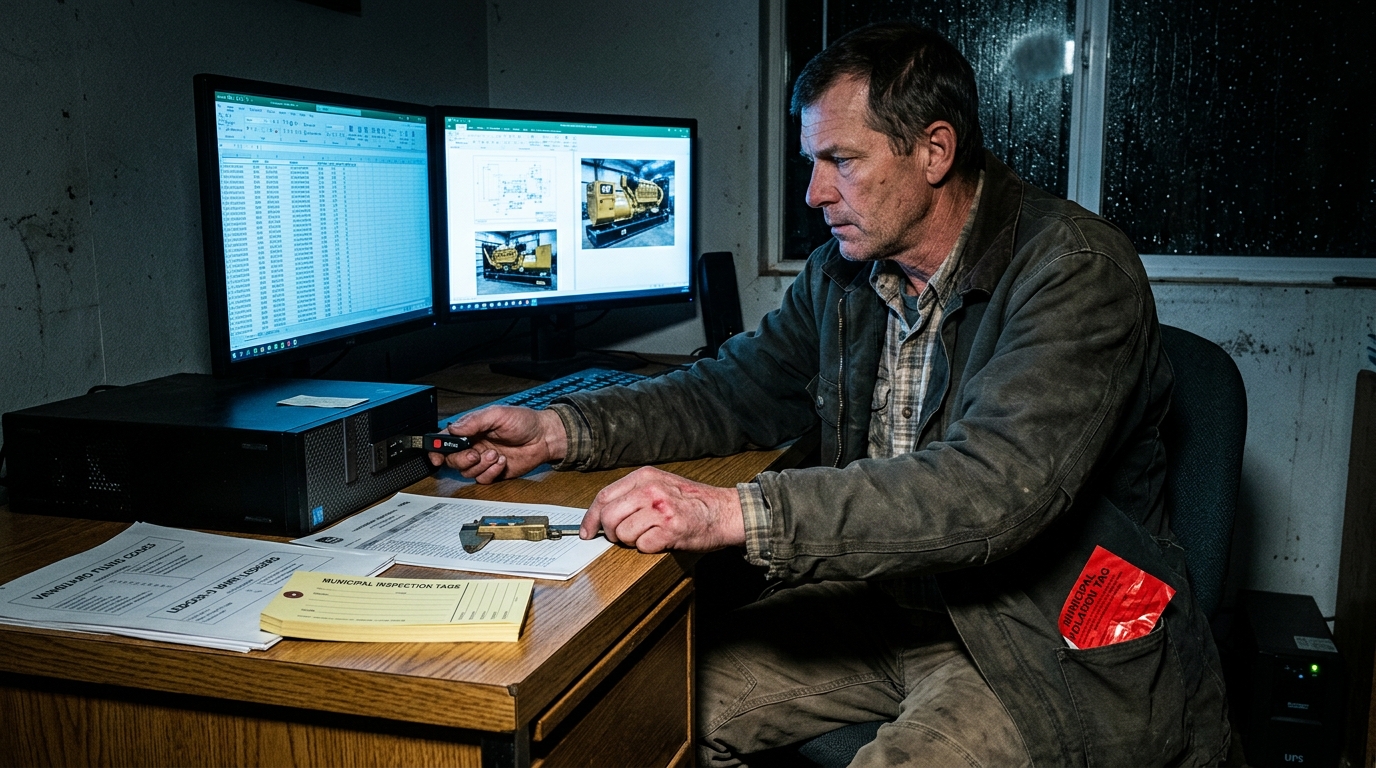
Inside, the house was a tomb of stagnant cold. The air had already turned heavy and sour without the HVAC circulating. I pulled off my dripping boots by the mudroom door, leaving them to drain on the linoleum, and walked straight to the kitchen desk. The UPS battery on my rig was emitting a slow, steady emergency beep—fifteen minutes of charge remaining before total system shutdown.
I opened the county auditor’s public land access portal and pulled up the Pinewood Springs HOA filing archives from five years ago.
My fingers flew across the mechanical keyboard, the keys clacking sharp in the dark room. I bypassed the public summary pages—the sanitized three-page PDFs mailed to residents every January—and targeted the raw tax parcel annexes for Parcel 882.
The first anomaly wasn’t a missing document. It was an extra line item buried in the 2021 municipal infrastructure assessment.
Project Code: Vanguard-309-882. Description: Sub-surface Utility Conduit & Fuel Enclosure.
I cross-referenced the line item with the county clerk’s recorded deeds. The contractor listed wasn’t a local builder or a municipal utility crew. It was a single-member LLC registered out of Delaware: Hollow-Point Infrastructure Management.
My thumb unconsciously rubbed the sharp edge of the brass caliper on the desk. Hollow-Point. The same entity that held the subordinate lien on the HOA’s clubhouse property.
“You’re paying yourself,” I muttered into the empty kitchen.
I dragged a fresh spreadsheet onto the left monitor. I opened every PDF audit summary from the last thirty-six months. To an untrained eye, the budget balanced to the penny. The lawn maintenance, snow removal, and pool chemical accounts were itemized down to the gallon. But when I isolated the maintenance contingency line—the catch-all fund Patricia controlled without requiring a full board vote—the pattern stood out like a thermal spike.
Every quarter, precisely six days before the county tax assessments were finalized, a wire transfer left the contingency account.
Recipient: Ledger-9 Asset Oversight.
Amount: $10,415.00.
Three years. Twelve quarters. $124,980.
The UPS backup let out a high-pitched, continuous whine—one minute of power left.
I shoved a 64-gigabyte thumb drive into the USB port, selected the entire raw directory—the photos of the CAT-D1000 generator, the blank municipal inspection tags, the Vanguard filing codes, and the Ledger-9 wire ledgers—and initiated the local transfer. The green progress bar crawled across the screen.
80%. 90%. 100%.
The moment the drive clicked finished, the UPS died. The screens snapped to black, plunging the kitchen into absolute darkness.
I sat there in the dark, the wind howling against the windowpane, listening to the house settle. My coat was cold on my shoulders, the damp wool smelling of rain and old grease. I pulled the thumb drive from the tower, slipped it into the internal zip pocket of my work shirt, and zipped it tight against my chest.
Five minutes later, I was sitting in my truck in the driveway, the heater blowing lukewarm air over my frozen knees. I didn’t turn on the headlights. I backed out into the street using only the amber fog lamps, the tires cutting through six inches of standing water on the asphalt.
I drove six miles south to the county line, where the local cell towers still had battery backup on the primary microwave link. The signal bar on my dash monitor jumped from a hollow No Service to three solid bars of LTE.
I pulled into the gravel lot of an all-night diner, parked under the buzzing yellow sodium light, and tapped a saved contact on the screen.
David Shun answered on the third ring. His voice sounded thin over the cellular compression, background noise humming with the sound of a late-night office fan.
“Connor? It’s midnight. Did the storm knock out your backup node?”
“The propane tank is gone, David,” I said, my voice flat, tight. “Patricia had the enforcement crew pump it dry yesterday morning.”
David sighed over the line, a dry, lawyerly sound. “We talked about this, Connor. Fighting an HOA over an unapproved fuel storage unit is a losing battle. The covenant language is airtight. You’ll spend thirty thousand in legal fees to save a two-thousand-dollar generator.”
“I’m not calling about my propane tank,” I said. I rested my forearm on the steering wheel, looking at my reflection in the dark windshield. “I’m looking at the tax annexes for Parcel 882. Who owns Hollow-Point Infrastructure?”
The line went silent for four seconds. The only sound was the static of the microwave link.
“Where did you get that name?” David’s tone lost its sleepy edge instantly.
“It’s on the secondary lien for the community center,” I said. “And the generator running their office right now has a Ledger-9 tag with no county fire stamp. Patricia signed twelve transfers to them out of the contingency fund.”
David cleared his throat. I heard the scuff of a chair sliding across linoleum on his end. “Connor, listen to me very carefully. Do not upload those files to the public portal. Do not email the board.”
“Why?”
“Because Hollow-Point isn’t just a management shell,” David said, his voice dropping an octave. “They handle municipal enforcement receiverships for three counties in the district. If you throw this in Patricia’s face at a board meeting, she won’t just fine you. She’ll file an emergency injunction on your property title before sunrise.”
I looked down at my hand. My thumb was still pressing into the brass caliper, the steel rule digging a deep, white indentation into the pad of my skin.
“Let her file it,” I said.
CHAPTER 4: THE MEDIA COLLISION
“Let her file it,” I repeated, my voice dropping below the steady, low idle of the diesel truck engine.
On the other end of the cellular link, David Shun let out a short, sharp exhale through his nose. “You aren’t listening to me, Connor. A temporary injunction locks your property deed. You won’t be able to re-permit a fuel tank, you won’t be able to build a shed, you won’t even be able to sell the house until the municipal hearing clears in six months.”
“Six months is fine,” I said. I released my grip on the brass caliper, leaving a purple indent across my thumb. “Because in forty-eight hours, the county commissioner’s office gets the raw data dump.”
“Don’t do it,” David warned. “Not through official channels. The second a clerk logs an inquiry against Hollow-Point, Patricia gets a notification flag on her administrative dashboard. You’ll give her time to purge the contingency logs.”
“She can’t purge what’s already on a drive in my shirt pocket.”
I cut the call before he could reply, tossing the phone onto the cracked vinyl passenger seat. The sodium lamp above the truck hood flickered once, buzzing like an angry hornet as the regional grid struggled against the wind.
I didn’t head home. I drove straight to the Channel 7 affiliate office on the south strip, the truck tires cutting through standing sheets of runoff on the access road.
By two o’clock the next afternoon, the storm had pushed east toward the plains, leaving Pinewood Springs under a raw, slate-grey sky. The power was still out across ninety percent of the residential grid. Down the main thoroughfare, houses sat dark, their chimneys cold, driveways clogged with fallen pine limbs.
At the crest of the hill, the HOA community building remained a blazing beacon of white light. The 1,000-gallon CAT-D1000 generator behind the boxwoods chugged steadily, its exhaust plume curling into the crisp air.
I stood at the edge of my driveway, my hands shoved deep into my work coat pockets, watching a white news van with a retractable broadcast mast pull up to the curb.
Melissa Porter stepped out onto the damp asphalt, her microphone wrapped in a wind-muff, followed by a cameraman hauling a shoulder-rigged HD deck. She didn’t look like a anchor sitting behind a polished studio desk; she wore mud-stained work boots and a faded canvas parka.
“Mr. Matthews?” she asked, her eyes sweeping over my empty side yard where the concrete pad sat bare and scraped. “You’re the telecommunications engineer who filed the compliance complaint?”
“I am,” I said, stepping past the cedar gate line. I pointed with my chin toward the bare concrete pad. “Three days ago, the board had a commercial pump truck remove a five-hundred-gallon propane backup. Claimed it violated Section 12, Subsection 4. Safety hazard. Aesthetic non-compliance.”
The cameraman swung the lens down, focusing on the dark green ring left on the concrete where the tank feet had rested for three years.
“And the regional grid?” Melissa asked, her voice clipped, professional.
“The grid node for the west valley routes through my basement switch,” I said, pulling the brass caliper from my pocket and tapping the cold steel against the gate latch. “Without backup power, emergency routing drops to secondary copper lines. Higher latency, dropped calls for two thousand residents.”
“Let’s take a walk up the street,” Melissa said.
We walked in silence up the center of Pinewood Springs Drive. Two neighbors—old Frank Patton and Mrs. Henderson—were out on their porches, wrapped in heavy wool blankets, watching us pass. Frank gave me a short, slow nod from behind his frost-rimmed glasses.
When we rounded the curve, the white floodlights of the HOA building hit us full force. The mechanical roar of the 1,000-gallon diesel unit filled the street.
The cameraman immediately raised the deck, panning from the dark, cold houses on the left to the brightly illuminated front windows of the administrative office on the right.
Melissa didn’t hesitate. She walked straight up the paved walkway, the camera operator trailing two paces behind, and pressed the call button beside the heavy glass entrance doors.
Inside, through the clear pane, I saw Patricia Danvers stand up from behind her mahogany desk. She was wearing her usual navy blazer, her pearl earrings catching the bright fluorescent overhead lights. She held a stack of printed violation notices in her left hand.
When her eyes locked onto the camera lens through the glass, her posture went rigid. The color drained from her cheeks, replaced instantly by a dark, mottled flush along her jawline.
She marched to the door, unlocked it with a sharp, metallic click, and shoved it open just wide enough to block the threshold with her body.
“Turn that camera off,” Patricia commanded, her voice trembling with restrained fury. “This is private property belonging to the Pinewood Springs Homeowners Association.”
“Mrs. Danvers,” Melissa said, holding the microphone forward, her voice perfectly level. “We’re live with Channel 7 News. Residents in Sector 4 have been without power for over thirty-six hours. Why is the HOA operating an unpermitted one-thousand-gallon diesel generator while enforcing fuel storage bans on residents trying to power emergency equipment?”
“The community office serves as an operational headquarters during regional emergencies,” Patricia snapped. Her knuckles turned white against the edge of the door frame. Her eyes flicked past Melissa’s shoulder, locking straight onto me standing ten feet back on the sidewalk. “Mr. Matthews is currently under active citation for unauthorized mechanical installations. This is a private administrative matter.”
“Does the operational headquarters have a municipal fire permit for that tank, Mrs. Danvers?” Melissa pressed, stepping closer to the door. “County tax records show no variance filed for Parcel 882.”
Patricia’s jaw worked silently for two seconds. Her gaze dropped to the microphone, then to the glowing red recording tally on the camera deck.
“No comment,” she said.
She slammed the heavy glass door shut. The latch caught with a loud, echoey clack that bounced off the brick facade. A second later, she reached over and pulled the internal fabric blinds down, blocking the view of the lit interior.
Melissa turned back to the camera, her expression unreadable. “Reporting live from Pinewood Springs, where residents sit in the dark while their HOA board operates behind closed doors.”
Beside me on the pavement, my phone began to vibrate. It was a local number I didn’t recognize.
I answered it, holding the phone to my ear as the news crew began packing their gear back into the van.
“Connor,” Patricia’s voice came through the speaker, tight, clipped, and shaking with absolute venom. “You think a television crew gives you leverage? I have two corporate attorneys filing a motion for civil tortious interference and defamation in district court as we speak. By tomorrow morning, your bank accounts will be frozen pending discovery.”
I stood on the wet asphalt, looking at the dark outline of her shadow behind the drawn blinds of the illuminated office.
I reached into my shirt pocket, feeling the hard, square edge of the thumb drive resting against my ribs.
“Filing a motion takes money, Patricia,” I said softly, the brass caliper clicking against my thumbnail. “Which account are you pulling the retainer from? Ledger-9 or Hollow-Point?”
The line went dead so fast the disconnect tone sounded like a slap.
CHAPTER 5: THE AUDIT IN THE DARK
The disconnect tone clicked three times in my ear before the line collapsed into dead static.
I lowered the phone slowly, my thumb still pressing the cold brass caliper against my palm. Across the asphalt, the fabric blinds inside the HOA building remained shut tight, but the white floodlights overhead hummed with an uneven, high-pitched whine.
I didn’t head back to my truck. I walked around the perimeter fence toward the south hedge line.
The CAT-D1000 generator was coughing. It wasn’t the steady, rhythmic pulse from two hours ago. The exhaust pipe vented a thick, dark plume of unburnt fuel into the cold air, the metal housing rattling against its concrete footings. I stepped through the wet pine needles, reached through the damp boxwood branches, and looked at the mechanical sight glass on the primary fuel rail.
Air bubbles were swirling through the diesel line. The gauge was reading empty, the red needle pinned against the stop peg.
They hadn’t filled the main cylinder since the storm hit. Patricia had burned through nine hundred gallons of unpermitted fuel to keep the office lights blazing for an empty building, and the primary feed was choking on sediment at the bottom of the tank.
With a loud, metallic backfire that echoed across the valley, the engine sputtered, coughed twice, and died.
The floodlights overhead flickered out simultaneously. The bright, sterile glow illuminating the paved lot vanished, plunging the entire crest of Pinewood Springs Drive into absolute darkness.
Inside the building, a flashlight beam whipped across the window glass, its white circle bouncing frantically off the drawn blinds.
I turned and walked back down the hill in the dark.
By seven o’clock that evening, the story aired on the Channel 7 dinner broadcast. I sat in my truck in the driveway, watching the feed on my phone screen using the low-bandwidth cellular link. Melissa Porter’s voice cut clearly over the footage of my bare concrete pad, followed immediately by the shot of Patricia slamming the glass entrance door.
Below the video, a red ticker ran along the bottom of the frame: County Attorney Opens Formal Financial Review of Pinewood Springs HOA Management Account.
By eight o’clock, the neighborhood began to move.
Flashlights flickered down the length of Pinewood Springs Drive. Windows opened. Front doors swung wide as neighbors wrapped in coats stepped out onto their porches, comparing notes across lawn fences. Frank Patton walked down his front steps carrying a thick, yellowed binder, his flashlight beam cutting through the damp fog.
“Connor,” Frank called out, his voice rough from the cold air. “Is it true? About the Delaware filing code?”
“It’s on the county annex, Frank,” I said, leaning against my truck fender. “Code Vanguard-309-882. The contingency transfers went to a shell called Ledger-9. It’s tied directly to the management contract Patricia signed three years ago without a general membership vote.”
Frank opened his binder on the hood of my truck, his thick thumb flattening a page of printed monthly HOA expense statements under the flashlight beam. “She billed us forty-two thousand dollars last year for ’emergency infrastructure mitigation.’ I asked her about it at the November meeting. She told me it was proprietary risk insurance.”
“It wasn’t insurance,” I said. “It was a retainer to Hollow-Point Infrastructure to hold a secondary lien against the clubhouse property.”
Mrs. Henderson crossed the street, her heavy wool coat buttoned up to her chin. “She told me my husband’s portable oxygen tank couldn’t be plugged into the clubhouse outlet during the last outage because of liability restrictions.”
More flashlight beams converged on the driveway. Within twenty minutes, nearly forty homeowners stood in a tight circle on the wet asphalt outside my fence.
At eight-thirty, David Shun’s sedan pulled up to the curb. He got out carrying a leather accordion folder, his tie loosened at his collar. He walked over to the hood of my truck, set the folder down, and opened it beside Frank’s binder.
“The county prosecutor’s office just served an administrative hold on the HOA’s operating accounts at First Regional,” David announced, his voice carrying over the low murmur of the crowd. “Patricia Danvers can’t execute wire transfers out of the contingency fund as of twenty minutes ago.”
He pulled out a three-page court filing stamped by the district clerk.
“When we pulled the raw banking logs under the emergency disclosure rule,” David continued, pointing to a column of figures stamped with the Ledger-9 corporate seal, “the money wasn’t going into a reserve account. It was being routed to an offshore account registered in the Cayman Islands under Hollow-Point Asset Management. Over two hundred thousand dollars over the last thirty-six months.”
A heavy silence fell over the crowd. The only sound was the cold wind rustling the pine branches overhead.
“What happens now?” Frank asked softly.
“An emergency board meeting is scheduled for Saturday morning at the county annex,” David said. “A petition with forty percent of resident signatures forces an immediate vote of confidence and a freeze on covenant enforcement.”
Frank pulled a ballpoint pen from his coat pocket, set the paper against my truck hood, and signed his name at the top of the signature block. Mrs. Henderson took the pen next, her hand trembling slightly as she wrote.
I stood back, watching the pen pass from hand to hand under the yellow beam of the flashlight.
Up the street, sitting in the dark at the crest of the hill, the HOA building stood cold and silent, its dead generator smelling of burnt diesel and wet iron.
CHAPTER 6: THE REINSTALLATION
The yellow flashlight beam caught the final stroke of Mrs. Henderson’s signature before David Shun folded the petition into his leather accordion case. Up the street, the dark shape of the HOA community building sat silent under the pine canopy, its dead CAT-D1000 generator smelling of stagnant diesel and cold iron.
Nobody cheered. Nobody made a speech. The thirty-odd neighbors simply turned back to their dark houses, their flashlights cutting small, pale circles through the mountain mist.
The special recall election took four weeks to clear the district clerk’s office. When the final ballots were tallied in early June, sixty-eight percent of Pinewood Springs voted to dissolve the sitting board.
Patricia Danvers didn’t attend the hearing at the municipal annex. Her legal representation—a court-appointed receiver after the freeze locked her shell accounts—entered a formal consent decree. The $200,000 drained through Ledger-9 and Hollow-Point was attached to a restitution order, funded by the forced liquidation of her white Lexus and her primary residence on Sector 4. The public record now carried an administrative ban barring her from holding a fiduciary seat on any Colorado homeowners board for ten years.
By mid-June, the sun was high and clear over the Front Range, drying out the cedar fences and baking the wet clay along the ditch lines.
On a Tuesday morning, the heavy commercial crane truck from Mountain Propane backed into my driveway. The tires crunched over the gravel, coming to a stop beside the bare concrete pad.
The technician, a tall guy named Miller with grease-stained knuckles and a faded ballcap, jumped down from the cab and unhooked the rig chains. He looked at the bare pad, then at the green privacy fence, and shook his head with a short laugh.
“Never thought I’d be setting the exact same five-hundred-gallon tank back down on the exact same pad two months after I pumped it dry,” Miller said, guiding the hydraulic boom arm as it lowered the dark green cylinder.
“Municipal code is funny that way,” I said.
I stood by the post, turning the brass caliper between my thumb and forefinger. The steel rule was smooth, worn bright where my thumb had pressed into it over the winter.
The new board—chaired by Frank Patton—had issued the variance permit on its first day in office. Unanimous vote. No six-page retroactive filing, no two-hundred-fifty-dollar fee, no drone photos. Just a clean stamp from the county fire marshal and a copy filed in the public archive under the parcel’s true municipal code.
Miller tightened the brass coupling on the primary feed line with a heavy crescent wrench, the tool making a sharp, solid clack as the seal locked.
“She’s hooked up,” Miller said, wiping his hands on a shop rag. “Natural gas primary, five hundred gallons of propane backup on the auto-transfer switch. Pressure’s holding at forty-five PSI.”
“Appreciate it, Miller.”
I walked him to the gate, signed the delivery ticket on his clipboard, and watched the crane truck pull out onto Pinewood Springs Drive.
Across the street, Mrs. Henderson was on her porch, watering a box of red geraniums. She gave me a short wave with her gardening shears. Down the road, the HOA building had a new sign on the front door—a plain white sheet listing the board’s open meeting hours and a direct line to the new county auditor.
The CAT-D1000 unit behind their boxwood hedges was still there. But the unpermitted Ledger-9 tags were gone, replaced by a bright yellow municipal inspection plate certified by the county marshal. It ran its weekly ten-minute exercise test every Thursday at noon, quiet, legal, and subject to the exact same standards as every house on the street.
I walked down the side path to my generator pad.
The dark green cylinder sat level on its concrete footing. I pulled my brass caliper from my coat pocket, opened the jaws, and checked the tolerance on the high-pressure brass relief valve. Exactly zero point five zero inches. Perfect margin.
I slid the caliper back into my pocket, shut the heavy steel access panel on the generator housing, and listened to the quiet hum of the grid running smooth through the valley.