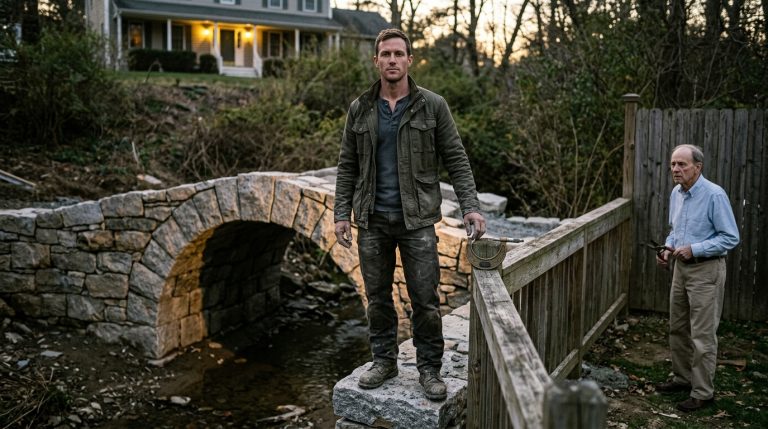
A Seventy-Year-Old Iron Pin in the Tennessee Clay Can Bring Down an Entire Suburban Empire Built on Sand
CHAPTER 1: THE WEIGHT OF THE BARB
The air smelled of dry pine needles and hot galvanized iron. Karen’s floral-print muumuu strained against her ribs as she shifted her weight from one sensible orthopedic shoe to the other, her breath coming in short, damp rasps that sounded like a tractor engine struggling to turn over in winter. She held the clipboard up like a shield, as if the plasticized cover could ward off the eighty years of accumulated sweat and oil embedded in the grain of the old farmhouse porch behind Jack.
“You are currently trespassing on association property, Mr. Henderson,” she said, her voice dropping into the practiced cadence of a woman who spent her Tuesdays presiding over pool gate infractions and mailbox color hearings. “According to our bylaws and the plat map filed with the county, that fence is an illegal encroachment.”
Jack did not look at her face. He looked at her thumbs. They were pale, uncalloused, and gripped the edges of the clipboard with a white-knuckled rigidity that betrayed the thinness of her authority. She was a woman who measured reality in three-ring binders, believing that if a rule was printed on enough sheets of smooth white paper, the physical world would eventually rearrange itself to match the margin alignments.
“That fence was sunk into the earth by a man who spent his war machining tolerances down to the thousandth of an inch,” Jack said. His voice was flat, dry as old straw. “It’s been here since Harry Truman was in office. Your subdivision wasn’t even a greasy spot on a developer’s napkin when those cedar posts went in.”
Karen’s mouth tightened into a hard, pale seam. “Times change, Mr. Henderson. Progress requires standardization. We have a crew scheduled for Friday morning. They will remove the wire, clear the brush, and install proper community-standard fencing along the correct boundary line. You will receive an itemized bill for the removal, the new installation, and thirty days of retroactive fines.”
She turned on her heel—a heavy, deliberate pivot that crunched the dry crabgrass—and marched back toward the manicured, uniform beige sprawl of Whispering Pines, where two hundred identical houses squatted under identical roof pitches like rows of gray teeth.
Jack stood motionless on the slope, his hands thrust deep into the pockets of his canvas work trousers. The rusted barbs of the old wire caught the afternoon light, glinting like dull needles against the green wall of the woods. He could feel the familiar, heavy knot forming behind his ribs—not panic, but the cold, slow-burning geometry of a man calculating windage and distance before squeezing a trigger. She had brought paper to a boundary line. She had no idea how deeply the iron went into the dirt.
CHAPTER 2: THE ARCHIVES OF MARTHA AND THE 1946 DEED
The silence that settled over the ten acres after Karen’s retreat was not peaceful; it was the tense, coiled quiet of a rifle left cocked on a workbench. Jack did not move from the property line for a long, measured minute. His jaw was locked, the muscle ticking rhythmically beneath the stubble of his cheek. He watched the final beige roofline of Whispering Pines vanish behind the screen of kudzu and second-growth pine, registering the exact distance, the slope of the grade, and the way the shadow of the old oak fell across the disputed strip.
He turned on his heel, his work boots grinding against the dry earth with a dry, metallic crunch, and walked toward the barn. Duke trotted alongside him, silent, his amber eyes fixed forward, mirroring his master’s cold focus.
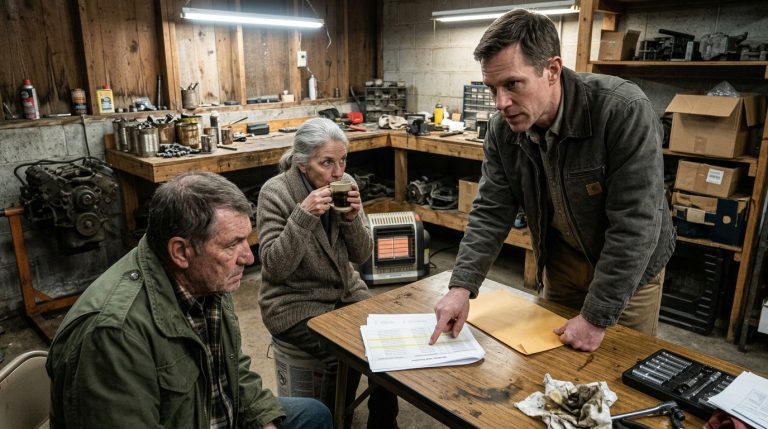
In the cool, dim interior of the workshop, the smell of WD-40, old cedar sawdust, and machine oil hung thick. Jack didn’t reach for a tool. Instead, he reached up to the high wooden shelf above his workbench, his fingers wrapping around the worn leather spine of a heavy, brass-cornered ledger. It was his father’s logbook, and tucked inside its back cover lay the certified copy of the 1946 deed—the foundational document of his family’s survival on this ridge.
He slid the document out, the stiff paper crackling faintly in the quiet gloom. The ink was faded to the color of dried tea, penned in the careful, uniform cursive of a county clerk who had survived the Depression.
Thence north 89 degrees 15 minutes west for a distance of 812.5 feet to an iron pin set at the base of a tri-trunked white oak.
Jack memorized the lines, though he could recite them in his sleep. His grandfather hadn’t just bought dirt; he had bought precision. In a world of shifting values and fast-talking men who built fortunes on swamp water and subdivision promises, his grandfather believed in the absolute law of the plumb bob and the benchmark.
The truck engine roared to life with a heavy, diesel-throated growl that rattled the corrugated tin roof of the barn. Jack shifted into gear, the manual stick-shift sliding into first with mechanical resistance, and pointed the nose of the rusted Ford down the gravel drive toward the county seat.
The drive into town was a study in contrasts. He passed the perimeter of Whispering Pines—the tidy rows of saplings staked to keep them straight, the identical mailboxes standing at rigid attention, the manicured lawns that ended abruptly where the wild, untamed hills began. It was a landscape designed to conceal chaos beneath a veneer of uniformity.
Twenty minutes later, he pulled up behind the red-brick county courthouse, its neoclassical columns stained with decades of coal smoke and mountain rain. The basement repository of the county records office was always cool, smelling of damp paper, leather binding glue, and institutional floor wax.
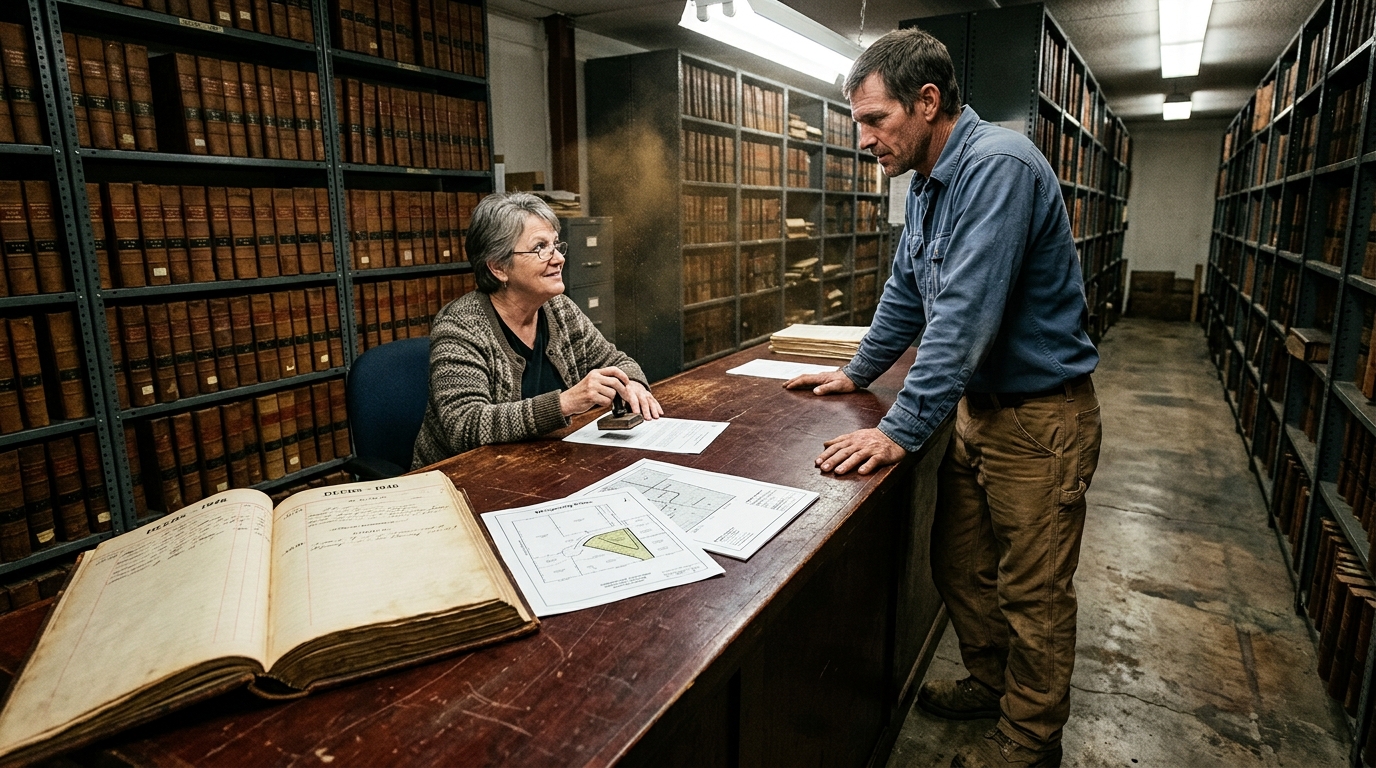
Martha was behind the high wooden counter, her silver hair pulled back into a tight bun, peering through wire-rimmed glasses as she stamped a stack of blue-backed mortgage documents with rhythmic, unyielding thuds. She looked up as the heavy oak door groaned on its hinges, her eyes catching Jack’s reflection in the glass partition. A slow, knowing smile touched the corners of her mouth.
“You smell like pine needles and trouble, Jack Henderson,” she said, setting the stamp aside with a sharp click. “Word travels fast up the ridge. I hear Karen Miller’s been marching her troops out to your pasture with a clipboard and a pocket calculator.”
Jack leaned his palms against the worn mahogany counter, the wood smooth and cold beneath his skin. “She brought a crew for Friday morning. They’re planning to tear out my grandfather’s fence and bill me for the privilege.”
Martha pursed her lips, a sound like dry leaves scraping across concrete escaping her throat. She pushed her glasses up the bridge of her nose. “Whispering Pines. Lord Almighty, we’ve spent three years cleaning up the messes from that development. The county commissioners wanted the tax revenue so badly they let the developer rush the platting process. I told them then—their survey looked half-baked, drawn by someone sitting in an air-conditioned office in Atlanta who couldn’t tell a limestone outcrop from a county road.”
She turned and disappeared into the labyrinth of towering steel shelving that filled the back of the room. The rhythmic clatter of her orthopedic shoes echoed off the stone floor. Moments later, she returned carrying a massive, leather-bound volume stamped DEEDS – 1946 in flaking gold leaf. She heaved it onto the counter with a dull thud that kicked up a faint cloud of golden dust particles in the shaft of fluorescent light overhead.
“Let’s see what your grandfather paid for,” Martha murmured, flipping open the heavy pages with practiced reverence until she found the dog-eared entry.
Jack leaned in closer, his shoulder brushing hers, as she slid a modern, computer-generated plat map of Whispering Pines directly over the 1946 entry. The contrast was startling. The modern map was stark, clean, and rigidly geometric—a grid of blue ink printed four years ago. The old deed was organic, anchored to ancient ridges, stone walls, and living timber.
Right away, the discrepancy wasn’t just a minor variance; it was an aggressive amputation. The developer’s map showed a straight, uncompromising north-south boundary line that sliced a long, widening wedge out of the western edge of Jack’s timberland, pinching down to nothing at the northern corner but swelling to nearly twenty feet of prime pasture and old-growth brush at the southern terminus.
“Look at that,” Martha whispered, her finger tapping sharply against the modern blue line. “They didn’t just straighten your fence line, Jack. They shaved off nearly a quarter of an acre, and they did it right where your grandfather’s cedar posts have stood since the Truman administration.”
Jack stared down at the overlapping lines, his blood running cold and steady through his veins. Karen wasn’t just enforcing a HOA rule; she was executing a quiet, bureaucratic land annexation, betting that an old man living alone on a ridge wouldn’t know how to fight a multi-thousand-dollar legal paper trail.
“She thinks she’s holding a scepter,” Jack said quietly, his voice like iron sliding over stone. “She thinks a three-ring binder is the law of the land.”
Martha looked up at him, her eyes sharp and hard behind her lenses. “Find that iron pin, Jack. Your grandfather’s deed references it explicitly. You find that steel rod buried under the dirt, and you won’t need a lawyer to prove she’s wrong. You’ll have them dead to rights.”
Jack nodded slowly, lifting the photocopy of the deed from the counter and folding it with crisp, precise creases before sliding it into his breast pocket. The archives were quiet around them, the hum of the old radiator the only sound in the room. He turned away from the counter, his mind already calculating the distance, the angle, and the dense thicket of briars waiting for him back on the ridge. The paper trail had just led him straight to the steel.
CHAPTER 3: SWEEPING THE THICKET FOR THE BURIED IRON PIN
The climb up State Route 71 was a slow, mechanical grind. The Ford’s transmission whined in second gear as it hauled itself over the asphalt crest, the tires throwing up a sharp rattle of loose gravel where the paved road gave way to the red-dirt washboard of the upper ridge. Jack kept both hands locked on the worn black plastic of the steering wheel, his eyes scanning the tree line as it gave way to the familiar, overgrown acreage of his family’s property.
When he cut the ignition, the engine block ticked loudly in the heavy afternoon air, cooling down in the shadow of the weathered barn. Duke didn’t wait for the door to creak open; he was already sliding out through the gap, his nose low to the damp earth, smelling for copperheads or the faint, sharp musk of wild turkey moving through the brush.
Jack reached behind the bench seat and pulled out the metal detector he’d bought off a catalog two summers back—a heavy, battery-powered rig with an articulated digital display and a saucer-sized search head. He didn’t plug it in yet. Instead, he walked the perimeter of the disputed zone, his boots sinking two inches into the damp leaf mold of the overgrown cedar thicket where the original corner post ought to be.
The air here was different from the manicured lawns of Whispering Pines. It smelled of rotting oak bark, resin, and stagnant iron water trapped in old limestone hollows. The corner where the 1946 deed anchored its northern run was choked with briars and young, aggressive pine saplings that had crowded out the sky since his father’s time. The giant white oak mentioned in the text—the tri-trunked sentinel that had held the bearing for seventy years—was gone, reduced to a moss-covered cluster of rotting stumps sinking back into the clay like old teeth.
Jack dropped to one knee, ignoring the thorns tearing at the knees of his canvas trousers. He snapped the battery compartment of the detector shut, the plastic click sounding sharp in the stillness of the woods.
V-2 Integration: For a split second, the clicking sound morphed in his memory into the dry, metallic bolt-action of a transit tripod being locked down in a forward operating base outside Kandahar—another lifetime where lines on a map meant the difference between an open field and a kill zone. He shook his head, clearing the phantom heat of the desert dust, and brought his mind back to the damp Tennessee ridge. Precision here was just as unforgiving.
He swept the search head low, hovering it an inch above the matted carpet of pine needles and decaying leaves. The machine hummed with a steady, low-frequency drone.
Hizzz. Hizzz.
Three feet to the left, the tone warbled into a high, frantic shriek. Jack stopped, planted his knee deeper into the mud, and jabbed his hand trowel into the topsoil. It struck something with a dull, ceramic clink—an old Campbell’s soup can, rusted to a thin red wafer, discarded by some hunter back in the seventies. He tossed it aside, the metal flakes dusting his knuckles with orange oxide.
Keep moving, he muttered to himself. Patience is a tolerance.
He widened his sweep, moving in slow, concentric circles outward from the rotting central stump. The humidity rose as the sun slipped lower behind the ridge, casting long, bruised shadows through the canopy. Sweat stung his eyes, mixing with the wood smoke and dust clinging to his brow. He didn’t wipe it away. His shoulders burned from the awkward angle of the search rig, but he maintained the rhythm—sweep, step, listen, repeat.
On the four-hundredth pass, right where the old cedar fence line intersected the southern slope of the property, the detector didn’t shriek. It let out a deep, resonant, sustained hum—a pure, vibrating tone that sounded less like junk and more like a tuning fork struck against anvil iron.
Jack froze. He lowered the detector, switched it off, and dropped the rig into the weeds. He pulled a folding trench shovel from his belt, unfolded it with a sharp snap, and began to dig.
The first six inches were easy—loose topsoil, fibrous root mats of blackberry briars, and black humus. Then the shovel bit into something hard. A metallic thunk vibrated straight up the steel shaft into the palms of his hands.
He dropped the shovel, fell flat onto his stomach in the damp dirt, and began clawing the remaining soil away with his bare fingers. The earth was cool and smelled of ancient iron. His middle finger brushed against a cold, cylindrical shape buried vertically in the hardpan clay. He scraped frantically, clearing the leaf mold and packed silt until his fingers wrapped around the top of a two-inch steel rod.
The top was mushroomed—flat, heavy, and scarred by the blunt, brutal impact of a surveyor’s sledgehammer wielded seven decades ago. It didn’t wobble. It didn’t shift. When Jack tried to turn it, the earth below groaned, holding the anchor fast in the deep geological strata of the ridge.
He sat back on his heels, wiping his filthy hands down the front of his shirt, and stared down at the pin. It was barely visible in the gathering dusk, a gray rusted nub of human intent hammered into the heart of the wilderness.
The developer’s map was a lie. Whispering Pines was built on air, convenience, and stolen square footage.
Jack pulled his phone from his pocket, the screen casting a harsh blue light across his stubbled face, and snapped three high-resolution photos of the pin with a folding six-inch ruler laid flat across its crown for scale. He didn’t pull it out. He left it buried right where his grandfather had watched it go in, camouflaging the raw earth with a flat slab of limestone and a handful of wet leaves.
He stood up, his joints popping in the quiet woods, and shouldered his tools. The paper trail was secured, and the steel had spoken. It was time to draft the reply.
CHAPTER 4: THE SATURDAY MORNING POSTHOLE CONFRONTATION
The weekend sun rose over the Tennessee ridge with a flat, merciless glare, burning away the valley mist before the dew had even dried from the broad leaves of Sarah’s squash patch. Jack was standing by the back porch steps, scraping a crust of dried red clay from the treads of his work boots with a flathead screwdriver, when the low, diesel thrum cut through the morning stillness. It wasn’t the steady, familiar pitch of a farm tractor. It was the heavy, rhythmic vibration of a commercial auger—thump, thump, thump—hitting the limestone-laced earth just beyond the boundary line.
Duke lifted his head from between his paws, a low, structural growl rumbling deep in his chest.
Jack didn’t shout. He didn’t drop his tools and run. He laid the screwdriver carefully across the wooden step, straightened his back, and walked down the gravel path toward the western fence line.
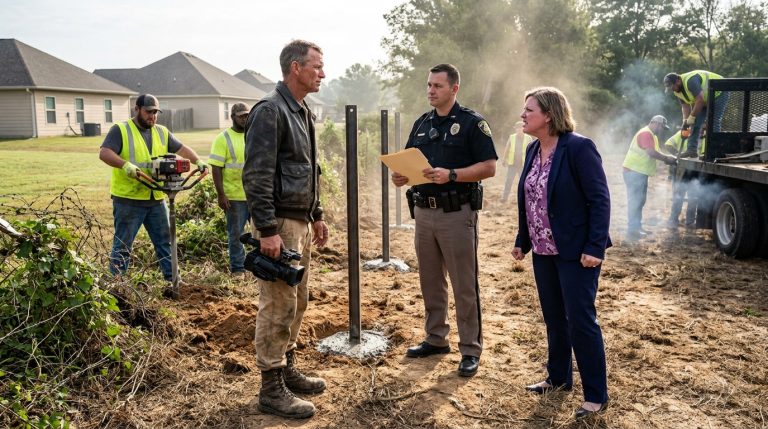
The commercial fencing crew had arrived not in an unmarked pickup, but in a flatbed staked with steel posts and rolls of galvanized chain-link. Two men in canvas utility vests were already operating a gas-powered posthole digger, chewing a jagged line of fresh, dark holes straight through the tangled briars—fifteen feet inside the boundary marked by his grandfather’s cedar posts. And standing right in the center of the destruction, clipboard gripped in her fist like a truncheon, was Karen. Her navy blue polo shirt was damp under the arms, and her expression was one of absolute, vindicated triumph.
V-1 Integration: As Jack drew closer across the grass, he noticed something out of place among the equipment: a deep, fresh tire track cut into the soft sod of the buffer strip—not from the workers’ truck, but from a light utility vehicle that had clearly scouted the line late the previous evening, bypassing the locked gate further down the lane.
Karen spotted him before he reached the wire. She raised her clipboard, stepping over a mound of freshly turned dirt as if she were inspecting troops on a parade ground.
“Too late for letters, Mr. Henderson,” she called out over the barking whine of the auger motor. “The board authorized this shift based on the legal plat map filed with the county. Your rusted wire is coming down, and every inch of this buffer belongs to the association.”
Jack stopped three feet from the sagging wire. He didn’t look at her face; his eyes tracked the alignment of the new post holes, noting with cold satisfaction how cleanly they cut through the exact strip of land dictated by the developer’s faulty coordinates. She was digging her own grave in real-time, four feet of concrete at a time.
“You’re operating outside the legal boundary, Ms. Miller,” Jack said, his voice level, carrying easily over the mechanical din. “And you’re doing it on private property after receiving certified notice.”
Karen let out a sharp, dismissive bark of laughter. “We have the county-approved map right here in this binder. You’re an old man rattling a tin cup against a freight train.” She turned to the foreman, a weathered local in a stained yellow hard hat. “Keep driving that post. Set the concrete heavy.”
Jack did not raise his voice. He didn’t curse. He simply turned his back on her, walked twenty paces toward the edge of his property line where his phone lay resting on a flat stump, and punched three digits into the keypad.
“County Sheriff’s Department,” a dispatcher’s calm voice answered.
“This is Jack Henderson, Route 4, Upper Ridge. I’m reporting an active criminal trespass and malicious destruction of private property. I have a commercial crew tearing up my land and setting concrete structures past a documented seventy-year-old boundary.”
“Copy that, Mr. Henderson. Deputy Miller is dispatching to your location now.”
When the patrol cruiser bounced down the gravel drive ten minutes later with its blue lights flashing silently against the morning leaves, Karen marched straight out to meet it, her face flushed with righteous fury. She didn’t know that the deputy was a local boy who knew the weight of three generations of Hendersons on that ridge, and she certainly didn’t know that the iron pin was waiting quietly beneath its stone six hundred feet away, holding fast against the whole weight of Whispering Pines.