The Iron Pin and the Dust of Whispering Pines: A Veteran’s Battle for Ancestral Ground
CHAPTER 1: THE LINE IN THE DUST
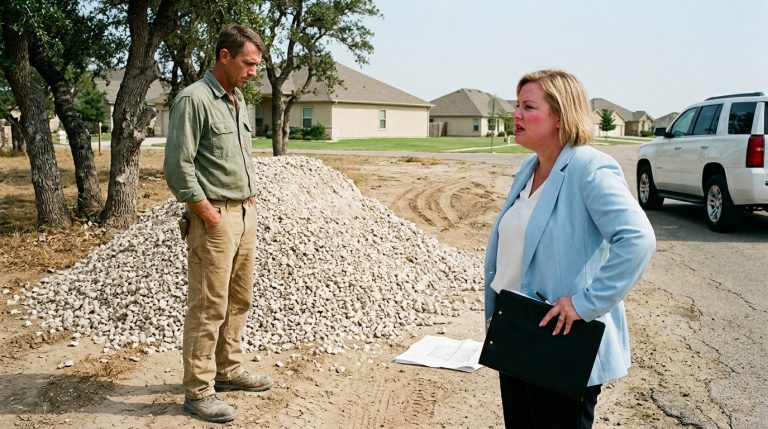
The heat hung low over the rolling hills, thick with the scent of sun-baked kudzu and dry earth. Jack Henderson stood motionless near the boundary line, his boots sinking a fraction of an inch into the dust. Across the rusted strands of barbs, the beige facades of Whispering Pines stood shoulder to shoulder—an invading camp of manicured lawns and identical mailboxes pressed so tightly against his family’s legacy that a man could smell his neighbor’s dinner through a closed window.
“According to our bylaws and the county plat map, you are currently trespassing, Mr. Henderson.”
The voice carried across the grass, heavy and self-important. Karen Miller stood on the trimmed edge of the subdivision’s common ground, her floral-print fabric straining against her frame, clutching a thick plastic clipboard like a scepter of absolute authority. Her small, hard eyes scanned the ten acres of unbroken Tennessee hillside as though she were mentally carving it into manageable fractions, sanitizing the rugged dirt to fit the specifications of a three-ring binder.
Jack did not answer immediately. He let the silence stretch, weighing the distance between her polished shoes and the scarred leather of his own. His German Shepherd, Duke, sat heavy and still at his side, a low, vibration-like breath rumbling deep within the dog’s chest.
“I have a crew scheduled for Friday morning,” Karen continued, her breathing labored from the exertion of her own rhetoric, “to remove this illegal encroachment and install proper community standard fencing along the correct boundary line. You will be billed for every foot of it, along with retroactive fines.”
She turned on her heel, satisfied with her decree, marching back toward the beige labyrinth as if she had just rewritten the geography of the county.
Jack watched her go. He reached down, his calloused fingers brushing against the cold, iron-oxide skin of a weathered cedar post his grandfather had driven into the earth when Harry Truman was in office. The wire was more suggestion than barrier now, a fragile seam stitching the old world to the modern intrusion. But a line was a line. In twenty-five years with the Army Corps of Engineers, Jack had learned that paper could lie, developers could rush, and bureaucrats could shout until their voices cracked, but the ground kept its own counsel.
He turned toward the old farmhouse, his mind already calculating tolerances, bearings, and the exact distance to the county records basement. Karen thought she was wielding law. She did not yet understand the weight of an iron pin buried six inches deep in the dark.
CHAPTER 2: THE IRON IN THE EARTH
Jack did not watch the floral muumuu disappear into the beige maze of Whispering Pines for a second longer than necessary. The moment Karen Miller’s polished soles cleared the gravel shoulder of the county road, he turned back toward the ten acres. Duke remained at his hip, the shepherd’s head level, his ears shifted back just enough to catch the faint metallic click of the gate latch as Jack lifted it.
The anger was there, but it was cold, sitting heavy in his chest like an unexploded charge. Twenty-five years in the Corps of Engineers had taught him that raw temper was a structural flaw; it made a man rush his measurements and miss his benchmarks. Karen wanted a war of paper and threats. She believed that because her binder had printed bylaws, the ground would bend to accommodate them.
“Come on, boy,” Jack murmured, his voice low and flat against the afternoon heat.
He walked past the farmhouse, past the shade of the back porch where Sarah had left two mason jars of cold sun tea to steep on the railing. He didn’t stop for a drink. Instead, he went straight to the barn, the heavy oak doors sliding open with a low, dry groan that disturbed a roosting barn swallow in the rafters. The air inside smelled of diesel fuel, dried timothy hay, and the iron tang of the 1968 John Deere tractor sitting quiet near the back wall.
In the tool room, Jack cleared a space on the workbench, sweeping away a dusting of sawdust to lay out the leather-bound folder he had retrieved from the house. Inside were the copies Martha had pulled for him from the county basement—the 1946 deed, written in the stiff, formal hand of a post-war county clerk, and the modern plat map submitted four years ago by the developer’s engineers.
He laid them side by side under the bare bulb overhead. The developer’s map was clean, generated by computer drafting software, showing clean right angles and sterile lot divisions. The 1946 deed was different. It spoke in the language of the terrain: thence north 89 degrees 15 minutes west for a distance of 812.5 feet to an iron pin set at the base of a tri-trunked white oak.
Jack ran a thick thumb over the copy of the old deed. An iron pin. A two-inch rod driven into the earth by a man who had earned his living in the Oak Ridge machine shops, a man who measured his work in thousandths of an inch. If that pin was still down there, six or eight inches beneath seven decades of leaf litter and decaying white oak roots, it didn’t matter what Karen’s board voted on, and it didn’t matter what a developer’s draftsman had snapped onto a digital grid. The pin was the law.
He retrieved his gear from the peg board near the workbench: a heavy-duty, ground-penetrating metal detector he’d bought years ago for finding buried utility lines around the pasture, a small trenching spade with a sharp, flat edge, and a pair of thick leather work gloves.
By three o’clock, the sun was baking the eastern thicket into an oven. The corner of the property where the deed indicated the tri-trunked oak should sit was no longer open pasture or managed timber. Over forty years, greenbrier, wild blackberry vines, and young loblolly pines had claimed the ravine where his grandfather’s boundary met the southern neighbor’s line. The original white oak had long since succumbed to age or lightning, leaving only moss-covered mounds that suggested ancient wood rotting back into the soil.
Jack stepped into the tangle, the thorns dragging across the canvas of his trousers with a dry, scratching whisper. Duke took up a position on the high ground at the edge of the shade, lying down with his chin rested on his paws, his brown eyes tracking Jack’s every movement.
“First pass,” Jack muttered to himself, flipping the toggle on the detector. The machine hummed to life, a steady, low-frequency tone vibrating through the speaker strapped to his chest.
He began at the edge of the sagged wire fence, stepping off the 812 feet from the eastern fence post using a calibrated surveyor’s tape he’d staked into the ground. The work was slow, painstaking labor. Sweat pooled in the small of his back, stinging his eyes as he swung the search coil low to the earth, inch by inch, clearing away thorny vines with his gloved left hand while sweeping the head with his right.
Every six feet, the machine screamed.
A discarded soup can from the 1950s, rusted down to a red flake.
A tangle of old barbed wire buried under six inches of pine needles.
A bent horseshoe, black with age and packed with red clay.
Each false signal required Jack to drop to his knees, clear the briars, and dig with the flat spade until he verified the source. By five in the afternoon, his shirt was soaked, his hands were stained red with Tennessee clay, and his knees throbbed from kneeling on embedded limestone rocks.
The sun began to dip below the ridge, casting long, sharp shadows through the pine trees. The heat didn’t drop; it just turned dense and humid, holding the smell of crushed vegetation and hot dirt close to the ground.
Jack stopped near three soft, moss-covered humps that formed a rough triangle in the dirt—the decaying remnants of a massive root system. He wiped the back of his forearm across his forehead, leaning heavily on the handle of the spade. His shoulder muscles burned, a dull ache reminding him that he wasn’t thirty-five in a Corps engineering battalion anymore.
“One more sweep, Duke,” Jack said quietly.
He adjusted the sensitivity on the detector, lowering the coil until it brushed the green carpet of moss between the three decayed stumps. He moved it from left to right in a slow, rhythmic arc.
Bzzzt. A low warble.
He reversed the sweep. The detector didn’t warble this time. It locked onto a signal, the tone rising to a sharp, high-pitched whistle that didn’t waver as he moved the head directly over the center of the triangle. The indicator needle pinned itself to the far right of the dial.
Jack turned off the audio feed, letting the silence of the woods fall back over the ravine. He set the detector carefully against a sapling and reached for the trenching spade.
He didn’t jam the spade into the dirt. He used the flat edge to peel back the thick layer of moss and pine needles, laying the topsoil aside like a rug. Beneath the organic material lay six inches of densely packed red clay, laced with fine feeder roots from the surrounding saplings. He switched to a small handheld trowel, scraping the dirt away in thin, even layers.
At seven inches down, the trowel edge struck something solid. It wasn’t the dull, crumbling scrape of limestone or the soft give of a submerged root. It was a clear, ringing clink—metal on metal.
Jack dropped the trowel. He used his gloved fingers to clear the remaining dirt from around the object.
Rising out of the clay, solid and unyielding, was the top of a two-inch thick solid iron rod. Its head was flattened and mushroomed slightly, the unmistakable signature of a heavy sledgehammer driving it deep into the subsoil seventy years ago. The surface was pitted with heavy rust, but the core was cold, dense steel, firmly set into the ancient rock layer beneath the soil.
Jack sat back on his heels, the air coming slowly through his nose. He took off his right glove and laid his bare palm against the top of the iron pin. The metal was cold despite the heat of the day, an unshakeable anchor sunk deep into the earth long before Karen Miller, Whispering Pines, or the HOA had ever been conceived.
He reached into his pocket, pulled out his phone, and turned on the high-resolution camera. He took four photos from varying angles, ensuring the mushroomed top of the iron rod was clearly visible against the measuring tape laid beside it. Then he opened his handheld GPS receiver, waiting three minutes for the unit to lock onto twelve separate satellites overhead, until the coordinates settled with sub-foot accuracy.
He noted the numbers in a small pocket notebook, snapped the book shut, and looked back toward the east. Through the dense pine branches, he could see the back of a newly built two-story house in Whispering Pines, its white vinyl siding gleaming under the fading light.
They thought they owned the grass up to the wire. They had no idea what was buried under their feet.
Jack carefully laid a flat piece of slate over the exposed top of the iron pin, swept the red clay back over the hole, and replaced the moss cover until the ground looked entirely undisturbed. He gathered his tools, slung the metal detector over his shoulder, and whistled once for Duke.
As he walked back up the ridge toward the farmhouse, the first star was appearing over the Tennessee hills. Tomorrow, he would draft his response to Karen Miller. It wouldn’t be an argument. It would be a boundary line drawn in steel.
CHAPTER 3: THE SATURDAY MORNING LINE
The sound did not begin with a knock; it began with a heavy, rhythm-bound concussive thud that rattled the glass in the front windows before the sun had fully cleared the eastern ridge. Thump. Thump. Thump.
Jack rolled out of bed instantly, his body reacting to the low-frequency vibration with the ingrained muscle memory of a twenty-five-year deployment schedule. There was no hesitation, no grogginess. By the time his feet hit the cold hardwood floor, his mind was already indexing variables: diesel torque, hydraulic pressure, and the specific cadence of a commercial earth auger.
He didn’t bother with coffee. He pulled on a pair of heavy canvas work trousers, laced his boots with hard, rapid pulls, and reached for the worn leather jacket hanging on the peg by the back door.
Duke was already up, standing rigid by the screen door, his ears pinned forward and a low, dry rumble vibrating in his throat.
Jack shoved the door open and stepped out into the crisp morning air. The dew was heavy on the grass, soaking the cuffs of his trousers within three steps. He didn’t look toward the pasture; he looked straight past the old cedar line.
There they were.
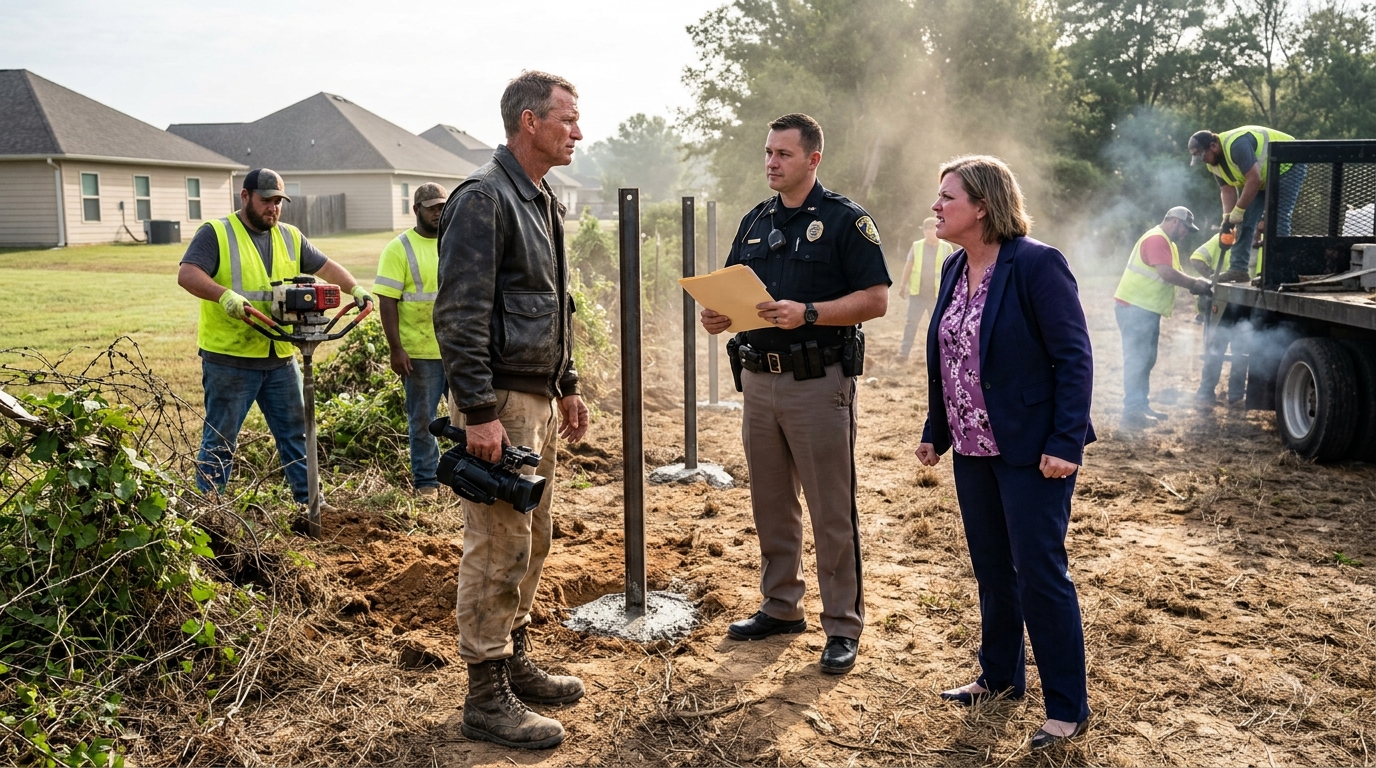
A commercial flatbed truck sat idling fifty yards down the county right-of-way, its exhaust pipe puffing a dirty gray plume into the pale morning sky. Two men in neon safety vests were manning a gas-powered post-hole digger, chewing violently into the dark topsoil. But they weren’t digging along the subdivision’s ragged edge. They were cutting deep, clean circles a full fifteen feet inside Jack’s property line—right along the precise corridor where his handheld GPS had registered the boundary the night before.
And standing in the center of the violation, clutching her plastic clipboard like a general surveying a conquered trench, was Karen Miller. Her navy blue blazer was unbuttoned, and she was barking orders across the noise of the small engine, pointing a manicured finger toward a cedar stump.
Jack didn’t shout. He didn’t sprint across the grass waving his arms. That was what amateurs did when they lost control of a perimeter. He locked his jaw, his eyes narrowing into cold slits as the psychological phantom of a forward operating base under sudden, unauthorized intrusion flickered through his mind. Discipline was a weapon; it kept the blood cool and the reactions precise.
He turned back toward the kitchen, picked up his phone from the counter, and dialed three digits without looking down.
“County Sheriff’s Office,” a dispatcher’s voice crackled. “State your emergency.”
“This is Jack Henderson, 412 County Road 14,” he said, his voice flat, measured, and stripped of all emotional cadence. “I am reporting an active trespass and malicious destruction of private property. A commercial crew and a civilian coordinator are currently operating heavy equipment inside my land line without authorization.”
“Copy that, Mr. Henderson. We have a unit in your sector. Dispatched.”
Jack pocketed the phone, picked up his digital video camera from the hall table, and stepped back out into the morning light.
By the time he reached the edge of the disputed strip, the commercial crew had already dropped four steel posts into wet concrete. Karen was standing over one of the workers, her face mottled a dark, angry crimson from the combination of exertion and self-righteous fury, berating him because a post was out of plumb by half an inch.
The crunch of gravel announced the arrival of the county cruiser before the blue and red lights even began to flash. Deputy Miller—a young local deputy with sharp eyes and a clean uniform—swung his cruiser off the asphalt, nosing the vehicle onto the shoulder near Jack’s gravel drive.
Karen spun around, her expression instantly transforming from corporate tyrant to aggrieved victim. She marched across the torn-up turf toward the cruiser, her clipboard held out like a shield.
“Thank goodness you’re here, officer,” Karen called out, her voice loud and carrying easily over the idling engine of the flatbed. “This individual has been harassing our contractors and illegally encroaching on Whispering Pines common property. We are merely restoring the boundary according to the official county plat map.”
Deputy Miller stepped out of the cruiser, his hand resting casually against his belt. He gave Karen a long, unreadable look, then glanced past her toward Jack, who stood silently fifty feet away, holding the camera steady at his side. The deputy knew these hills; he knew the Henderson name, and he knew the history of the old land grants.
“Ma’am,” Deputy Miller said, his tone measured and patient. “Let’s back up a step. Whose property do you claim this is?”
“It’s community common ground,” Karen insisted, stamping her heel into the fresh concrete slurry near one of the new steel posts. “Our documents prove it.”
“Do you have a signed easement or permission from the deed holder to operate heavy machinery on this side of the old fence line?” the deputy asked.
Karen sputtered, her mouth opening and closing as her internal logic faltered. “We don’t need permission to reclaim what belongs to the association! He’s an obstructionist—”
Jack stepped forward, his boots crunching rhythmically on the dry gravel until he stopped four paces short of the deputy. He didn’t look at Karen. He kept his focus entirely on the law enforcement officer, maintaining a wall of absolute calm.
“Deputy,” Jack said, his voice carrying the steady, rhythmic cadence of command. “That fence line has marked this boundary for seventy years. My deed, filed in 1946, establishes the legal metes and bounds. Furthermore, I sent this individual certified notice—which she signed for—explicitly prohibiting unauthorized entry or structural alteration of this land.”
Jack reached into his breast pocket and handed a heavy manila folder to the deputy. Inside were the certified return receipt and a duplicate of his typewritten warning.
Deputy Miller flipped open the folder, his eyes scanning the legal signatures and the official postmark. He looked from the documents to Karen, then back down at the fresh, gray blobs of concrete bubbling around the unauthorized steel posts.
“Ma’am,” the deputy said, his voice hardening into official authority. “This is a civil property dispute, which means it gets settled with judges and surveyors, not with a post-hole digger on a Saturday morning. But right now, you are standing on undisputed land over the active objection of the property owner.”
He gestured toward the flatbed truck. “I’m going to ask you and your crew to pack up your equipment, pull your truck off this land, and clear the premises immediately. Any further construction here today will result in criminal citations for trespassing and property damage.”
Karen’s jaw dropped, her face flushing a deeper, dangerous shade of purple. “You cannot be serious! I am the president of Whispering Pines! I will have your badge for this—”
“That’s your right, ma’am,” Deputy Miller interrupted smoothly, his hand drifting slightly closer to his belt. “In the meantime, load the truck.”
The workers, young men who were only getting paid hourly wages and had zero stomach for a criminal record, didn’t wait for a second invitation. They dropped their shovels, heaved the heavy auger into the back of the flatbed, and slammed the tailgate shut with a sharp metallic clang.
Karen stood frozen for a long, agonizing moment, her authority dissolving into the morning mist. She shot Jack one final look—a dark, venomous promise of retaliation—before turning and stomping her way back toward the subdivision entrance, her floral patterns rigid with humiliation.
Jack watched them go, his expression remaining entirely neutral. The tactical skirmish was won, but the perimeter was still under threat. He needed a weapon that could not be argued with, dismissed, or ignored by a local board.
He looked down at his phone, unlocked the screen, and placed a direct call to Nashville. It was time to bring in Marcus Thorne.
CHAPTER 4: THE SATELLITE GRID
The dust kicked up by Deputy Miller’s cruiser had barely settled over the gravel lane when Jack turned back toward the pasture, his boots crunching on the dry earth. The confrontation had bought him time, but an administrative bully like Karen Miller did not retreat because of a single deputy’s warning; she would regroup, consult her own retainers, and return with a more aggressive set of papers.
The defense required a heavier grade of steel than local rhetoric. It required mathematics.
Two days later, the state-licensed surveying team arrived precisely at 07:00 hours, keeping to the exact schedule Jack had coordinated through Marcus Thorne. The lead surveyor, an experienced field professional named Art Davies, stepped out of a mud-splattered four-wheel-drive truck carrying a heavy aluminum tripod case that clinked rhythmically against its latches. He didn’t look like a desk-bound draftsman; he had the sun-baked skin and focused squint of a man who spent his life measuring the friction between legal descriptions and stubborn physical reality.
“Morning, Mr. Henderson,” Davies called out, his voice cutting through the crisp morning air as he popped the tailgate. “Heard you had a bit of uninvited landscaping done on this edge last weekend.”
“They tried to set posts inside the boundary,” Jack replied, his voice flat as he walked out to meet them. “I want a line drawn that cannot be erased by a committee vote.”
“That’s why we brought the heavy hardware,” Davies grinned, hauling a sleek, orange-cased satellite receiver from the bed of the truck. “We’re not just running a standard compass-and-chain pass today. We’re tying directly into the state geodetic network. Sub-centimeter accuracy, satellite-linked. If an inch is out of place, this rig will scream.”
The setup was an exercise in pure, methodical precision. Davies and his assistant, a young man with a digital tablet strapped to his forearm, hauled a heavy-duty tripod into the center of Jack’s lower pasture. They extended the telescoping legs, locked the clamps with sharp metallic snaps, and threaded a high-frequency GPS base station onto the crown. Once powered, the unit began communicating directly with an overhead constellation of positioning satellites, locking a fixed, immovable point of reference into its internal memory.
From there, Davies deployed a robotic total station and a pole-mounted rover, walking the perimeter step-by-step while Jack accompanied him, carrying a heavy clearing axe to cut back the briars that choked the old 1946 line.
For four hours, they worked the boundary in silence, broken only by the rhythmic beep of the rover confirming data points. They mapped every weathered cedar post, every twist of rusted wire, and—most crucially—the four fresh blobs of concrete where Karen’s crew had illegally driven their steel posts deep into the soil.
By early afternoon, they reached the dense thicket at the southern corner, where the terrain dropped into a wooded ravine. Jack stepped aside, parting a curtain of greenbrier to reveal the flat slate stone he had placed over the buried metal two days prior.
“Right here,” Jack said, his boot heel stopping inches from the stone.
Davies crouched, lifting the slate away with gloved fingers. He cleared the thin layer of red clay until the mushroomed head of the seventy-year-old iron pin gleamed under the filtered sunlight. The surveyor whistled softly through his teeth.
“Look at that,” Davies murmured, pulling a magnetic locator wand from his belt and passing it over the steel rod. The instrument gave a crisp, sustained tone. “Pitted, rusted, but dead vertical. For the equipment they had back in forty-six, whoever drove this pin was an absolute master craftsman. He missed true modern GPS projection by less than an inch over eight hundred feet.”
Davies pulled out his electronic controller, tapping a sequence of keys to cross-reference the pin’s physical coordinates against the digital data he had downloaded that morning from the county archives—specifically, the developer’s modern plat map for Whispering Pines filed four years ago.
Jack watched the surveyor’s face. The easy, professional confidence on Davies’ features suddenly tightened. The older man stopped tapping. He zoomed in on the digital map grid, switching between two different layers with a sharp frown. He tapped the screen again, wiped a bead of sweat from his forehead with the back of his wrist, and shook his head slowly.
“Mr. Henderson,” Davies said, his voice dropping into a register of profound professional disbelief. “Come here. Look at this.”
Jack stepped over the fallen log, leaning down beside the controller screen.
“What am I looking at?” Jack asked.
“Your grandfather’s pin matches the 1946 deed down to the millimeter,” Davies explained, his finger tracing a bright red line across the digital display. “And your old fence meanders a bit, but it stays comfortably on your side. That’s standard. But look at where the Whispering Pines developer drew their starting point four years ago.”
Davies tapped a separate icon on the screen, bringing up a yellow grid overlay.
“They didn’t start their survey from the official county registered section corner monument,” Davies said, his voice dropping lower still. “They tied into a temporary construction benchmark left behind by a grading crew back when they cleared the timber. A temporary stake that was moved during grading.”
The implication hung heavily in the humid air.
“What does that mean for the boundary?” Jack asked quietly.
“It means,” Davies said, looking up from the screen with wide eyes, “the developer’s error wasn’t just a localized drafting mistake on your fence line. Because they used that bad starting point for their entire master layout, the calculation error carried through every single lot in their subdivision. The entire Whispering Pines development is physically shifted nearly fifteen feet west of where its legal description claims it is.”
Jack stared at the screen. The red line of the subdivision plat wasn’t just cutting off a narrow triangular wedge of his land; it meant that every single backyard, fence line, and patio backing onto his property was resting on ground the developer didn’t actually own.
Davies stood up, brushing the dirt from his knees, a nervous, breathless laugh escaping his throat. “Good grief, Jack. Karen Miller didn’t just pick a fight over a rusted wire fence. In her blind corporate arrogance, she’s been presiding over a neighborhood built entirely on a foundation of shifting sand.”
Jack looked past the surveyor, through the screen of pine trees toward the neat, beige rows of Whispering Pines houses glittering innocently in the afternoon sun. The paper trail had ceased to be a simple defense. It had just transformed into a legal weapon of absolute, unstoppable magnitude.
CHAPTER 5: THE BOARDROOM LEVERAGE
The air in the downtown Nashville conference room smelled of fresh lemon oil and expensive carpet cleaning. A massive mahogany table, polished to a mirror finish, divided the space into two distinct camps. On one side sat Jack and his attorney, Marcus Thorne—a man whose sharp, tailored suit and low-key amusement gave him the look of an apex predator who had arrived early to a feeding ground. On the other side sat the Whispering Pines Homeowners Association board of directors, four nervous mid-level managers and, anchoring the center chair like a thundercloud in a navy blue pantsuit, Karen Miller.
Karen’s clipboard was absent. For the first time since she had marched onto Jack’s Tennessee hillside, she looked stripped of her administrative armor, though her small, hard eyes still radiated a hostile, unyielding defiance.
Marcus didn’t waste time with pleasantries. He opened a thick, leather-bound binder with a decisive thud that echoed off the high ceiling.
“Thank you all for attending,” Marcus began, his voice smooth and hypnotic. “My client, Mr. Henderson, prefers efficiency over escalation. We are here today to review a structural issue regarding the property line separating his family estate from the Whispering Pines subdivision.”
Karen snorted softly, leaning back into her leather chair. “A structural issue. You mean your client’s refusal to respect community standards and his illegal encroachment on common ground.”
Marcus didn’t blink. He simply reached over to the wall-mounted console and tapped a control switch. A high-resolution color-coded map flashed onto the wide projector screen at the head of the table.
“Let’s look at the data, Ms. Miller,” Marcus said softly.
The screen displayed the 1946 deed line mapped against Art Davies’s recent GPS survey. The boundary discrepancy was highlighted in a stark, angry slash of crimson.
For ten minutes, Marcus walked the board through the history of the land, the original iron pin recovered from beneath the rotted oak roots, and the certified physical coordinates. The two male board members on either side of Karen began shifting uncomfortably, their eyes darting back and forth between the screen and the hard numbers printed in the presentation packets laid before them.
Karen, however, waved a dismissive hand, her voice sharp. “Maps can be drawn to say whatever a disgruntled landowner pays a surveyor to say. Our plat map is filed with the county. It’s the official record of this development.”
Marcus paused. He let a slow, predatory smile touch the corners of his mouth. “I am so glad you brought up the official development plat, Ms. Miller. Because that is precisely where the real error lives.”
He clicked the remote. The screen shifted to a wider satellite grid, showing two intersecting regional layers—one blue, one yellow.
“In the course of verifying the legal perimeter,” Marcus continued, his tone dropping into a cool, professional register, “our licensed surveyors discovered a foundational discrepancy. The developer’s engineering firm did not tie their initial boundary points to the official county registered section corner monument. They used a temporary construction benchmark fourteen feet off the true mark.”
The room grew dead silent.
“The practical result,” Marcus concluded, leaning forward over the mahogany table, “is a systemic westward shift across the entire subdivision. The westernmost fourteen feet of every single backyard along Mr. Henderson’s property line—including decks, retaining walls, and sprinkler systems—does not legally belong to the homeowners who paid for them. Furthermore, every title insurance policy in Whispering Pines is currently built on a false foundation.”
One of the board members, a pale man named Albright, went completely chalk-white. He gripped the edge of the table so hard his knuckles turned translucent. “What… what does that mean for our mortgages?”
“It means,” Marcus said plainly, “that your subdivision is standing on legal quicksand. And your HOA president’s unprovoked campaign of harassment against my client is what brought that cataclysm to light.”
Karen surged to her feet, her chair scraping violently against the hardwood floor. “This is an extortion plot! A malicious fabrication designed to steal our community’s land!”
“Sit down, Karen,” Albright hissed, his voice trembling with a sudden, boiling fury as he stared up at her. “He just showed us the math. You’re the one who poked a sleeping bear over a rusted wire fence!”
Karen looked around the table, suddenly realizing she stood entirely alone. The board members weren’t looking at her with respect anymore; they were looking at her like she was the architect of their financial ruin.
Marcus slid a single multi-page settlement document across the polished wood until it rested directly against Karen’s fingertips.
“Here are your options,” Marcus said, his voice like the drop of a guillotine blade. “Option A: We file for quiet title, invalidate your titles, and force a subdivision-wide resurvey at the HOA’s expense, followed by personal liability lawsuits against this board. Option B: You sign this agreement. You pay for the legal and surveying costs, fund the re-platting of the correct boundary, issue a formal written apology, remove your unauthorized concrete posts, and—most importantly—this entire board resigns effective immediately to allow a special election.”
Karen stared down at the paper, her hands trembling. Her empire of rules, bylaws, and petty intimidation had evaporated against the unyielding geometry of the earth.
CHAPTER 6: THE SILVERGRAY FENCE
The final document slid across the polished mahogany of Marcus’s conference table, carrying the weight of an absolute conclusion. Karen Miller did not sign it first; she stared at the signature line as though the ink were venom, her face drained of its color and its bluster. When she finally dragged the pen across the paper, the scratch of the nib was the only sound in the room. Within forty-eight hours, her clipboard was surrendered, her clubhouse key revoked, and her reign over Whispering Pines consigned to the quiet dustbin of history.
Jack did not celebrate the collapse of her authority with noise or triumph. He simply drove back down the highway, turned his truck up the gravel lane, and let the heavy silence of the hills settle back over his shoulders.
The physical restoration began three weeks later. The same commercial crew that had once dragged their post-hole diggers across his pasture returned under a work order issued directly by the new interim board. They brought no threats and no smug young men in embroidered polo shirts. Instead, working under the quiet supervision of Art Davies’s laser-aligned survey markers, they broke up the illegal concrete footings, hauled away the stray steel posts, and filled every scar left in the red clay.
Jack stood on his back porch watching them work, his German Shepherd resting heavy against his boots. The land was healing, returning to its natural contours. But a boundary still needed a definition—not as a weapon of war, but as a mutual understanding between neighbors.
When the excavation trucks finally rolled away down the county road, Jack called a local timber contractor and ordered four-board oak fencing, thick and heavy-grained, built to withstand decades of Tennessee weather.
On a clear Tuesday afternoon, the last section of the new fence went up right along the GPS-perfect, legally certified line where his grandfather’s old barbs had rusted away fifty years ago. It didn’t look like an aggressive perimeter wall; it looked like the clean, solid boundary of a working farm.
As the final post was driven and secured, a figure walked out from the edge of the Whispering Pines subdivision, stepping across the newly smoothed turf. It was Tom, one of the residents whose backyard backed up directly against Jack’s southern pasture. He wore a faded flannel shirt and carried a pair of pruning shears, looking hesitant but sincere.
Tom stopped a few feet from the fresh oak rails, running a weathered hand across the top board.
“That’s a fine-looking fence, Jack,” Tom said, his voice carrying easily over the afternoon breeze. “Sturdy.”
Jack leaned against the railing, his posture relaxed, the hard knot of antagonism that had gripped his chest for three years finally dissolving completely. “A good fence makes good neighbors,” Jack replied, quoting the ancient rural adage.
Tom nodded, his gaze wandering over the rolling pasture toward the distant tree line where the old 1946 iron pin lay buried beneath its protective slate. “You know, we were all terrified of Karen when she ran the board,” Tom admitted quietly, looking down at his boots. “And to be honest, we were scared of you, too—the quiet old veteran up on the hill. Turns out we were looking at the wrong threat all along.”
He stepped closer, extending a bare, calloused hand over the top board of the oak railing. “I’m Tom. It’s good to finally meet you, neighbor.”
Jack reached out and took his hand. The grip was firm, honest, and entirely free of pretense.
“Jack,” he said. “Welcome to the ridge.”
The transformation of Whispering Pines was not instantaneous, but it was absolute. Under the leadership of the new board—comprised of residents who had looked into the abyss of title default and clawed their way back—the draconian rules vanished. The petty fines for unapproved garden plants and mailboxes were scrubbed from the bylaws. The family with the disability ramp received community assistance to build a permanent, beautiful structure. The community had stared at its own reflection during the crisis and chosen common sense over tyranny.
A month after the fence was completed, the developer of the adjacent fifty-acre wooded tract—eager to liquidate his holdings after the legal shockwaves rippled through the county—put the land up for sale. When rumors of another high-density beige subdivision began to circulate, the new HOA board panicked, realizing they had neither the funds nor the leverage to stop the bulldozers.
Jack didn’t hesitate. He called Marcus Thorne, liquidated a portion of his retirement portfolio, and purchased the entire fifty-acre tract himself.
Two weeks later, he met the new HOA board president on a shaded deer trail overlooking the spring-fed pond deep within the newly acquired woods. The afternoon light filtered through the canopy, painting golden patterns across the damp earth.
“I’m placing this entire tract into a permanent conservation easement,” Jack told her, handing over a thick manila envelope containing the legal documentation. “And I’m granting Whispering Pines a perpetual license to access it for hiking, fishing, and community trails. No bulldozers. No houses. Just a green space for everyone.”
The woman stared at the papers, her eyes welling with sudden, unashamed moisture. She looked up at Jack, her voice trembling slightly. “You didn’t have to do this, Jack. You could have turned around and sold it for double.”
“My grandfather taught me that owning land isn’t about hoarding dirt,” Jack said softly, looking out across the quiet surface of the pond where a blue heron was lifting off into the reeds. “It’s about stewardship. And sometimes, good stewardship means sharing the quiet.”
Back at the farmhouse, the evening shadows lengthened across the lawn. Jack walked into his study, his boots clicking softly against the heart-pine floor. On the wall, framed under clean glass next to a sepia photograph of his grandfather standing proudly before the half-built timber frame, hung Art Davies’s certified GPS plat map.
The two images—one born of post-war sweat and iron hammers, the other of modern satellite geometry—told the exact same story. They proved that truth was not something manufactured by committees or enforced by binders; it was something anchored deep in the earth, waiting for someone with the patience to measure it and the courage to stand upon it.
Jack sat down at his oak desk, picked up a dry rag, and carefully wiped a speck of dust from the glass protecting the map. Downstairs, Duke let out a long, contented sigh as he curled up on the braided rug near the hearth. The air was cool, carrying the faint, clean scent of cedar and pine from the hills outside. The boundary was secure, the legacy was whole, and across the silver-gray rails, the valley finally rested in peace.