The Dust and the Deed: How a Retired Firefighter Fought a Suburb’s Paper War and Reclaimed the Ground Beneath His Feet
CHAPTER 1: THE COLD GRAVEL
The frost on the hood of the old red Ford didn’t crack; it splintered under the weight of the morning. Mark Reeves stood barefoot on the frozen gravel of his own drive, an old fire and rescue sweatshirt swallowing his shoulders, the steam from his mug curling into the gray Tulsa air like a dying signal flare.
Thirty yards away, the flashing blue and red LEDs of the cruiser painted the peeling white paint of his leaning barn in epileptic strokes. They didn’t cast warmth. They cast a sterile, clinical light that made the frost look like broken glass.
“Sir,” the younger officer said, his boots crunching a jagged rhythm against the small stones as he lifted a crisp, uncreased notepad. His breath plumed white, trembling slightly around the edges. “We got a report of an active trespass. A squatter refusing to yield common property.”
Mark didn’t blink. Twenty years of running into burning attics and cutting teenagers out of crumpled sedans teaches a man how to lower his pulse while the roof timbers groan overhead. He took a slow sip of the black coffee, feeling the heat sear the roof of his mouth.
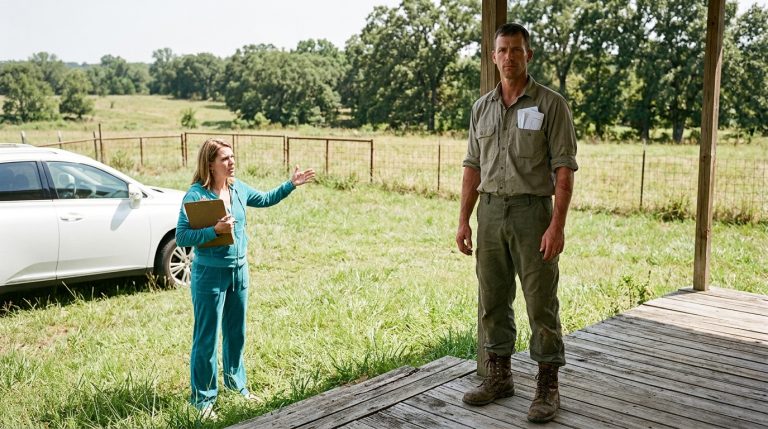
Across the asphalt boundary, standing with her sensible heels planted firmly on municipal concrete, Claudine Mercer held her pastel blazer tight against the wind. Her sunglasses were large enough to swallow half her face, a shield against a world she believed she owned by virtue of a glossy color-printed brochure. When she saw the officers pause, her chin lifted.
“That man is operating heavy machinery without a permit and squatting on Maple Hollow common buffer zone,” Claudine called out, her voice carrying across the dew-soaked grass with the sharp precision of a drill sergeant’s whistle. “He has fourteen days to cure the violation. We started the clock three weeks ago.”
Mark let out a dry, rattling sigh that tasted of chicory and stale tobacco. He set the heavy ceramic mug down on the weathered wood of the porch step. The dew ran down the side of the truck’s fender, dripping off the bumper in slow, heavy drops.
“If this is trespassing,” Mark said, his voice flat, gravelly, and unhurried, “I’ve been breaking the law every morning at six for six months. And let me tell you, officer, the view hasn’t changed much.”
The older cop, a weathered sergeant with graying temples and grease under his fingernails, stepped past his nervous partner. His eyes flicked from Claudine’s rigid stance back to the rusted hinges of Mark’s gate, then down to the worn wooden steps. He had the look of a man who had mediated a thousand property disputes between stubborn landowners and didn’t care for the theatrics of either.
“Let’s see some ID, sir,” the sergeant said, his hand resting casually near his belt, not out of threat, but out of long habit. “And proof of residence.”
Mark didn’t reach for his wallet. Instead, he bent down, his joints popping dryly in the morning chill, and pulled a thick manila folder from beneath the bottom step. The cardboard was warped at the corners from humidity, secured with a rusted brass clasp. He flipped it open with a thumb calloused by decades of heavy tools and synthetic rope.
Inside sat the county clerk’s stamp, crisp and purple beneath layers of official registry creases.
He handed the primary document to the sergeant. The younger cop leaned in, trying to read over his partner’s shoulder as the older man’s thumb traced the embossed seal.
Across the street, Claudine’s posture tightened like a guitar string pulled half a turn too far. The absolute certainty in her stance flickered, replaced by a sudden, rigid stillness. She took half a step forward, her pastel heel catching in the soft earth of the verge, and her fingers clenched around her clipboard so hard the plastic white edges turned pale.
The sergeant looked up from the parchment, his eyes shifting slowly from the paper to Mark’s weathered face, then back out toward the woman in the designer sunglasses. A slow, knowing grimace touched the corner of the officer’s mouth.
“This parcel was deeded in nineteen-eighty-four,” the sergeant murmured, his voice dropping below the level of the wind. “Fourteen years before Maple Hollow was even zoned.”
“That’s right,” Mark said, watching the way the sergeant’s thumb rested over the county clerk’s signature. “And the county road ends ten feet back from that oak tree.”
The sergeant handed the folder back, but as Mark reached to take it, a glint of metal caught his eye near the base of the property marker post three feet inside his gate line—the brass survey pin that had been there since he bought the land had been cleanly sheared off at ground level, leaving a jagged, shiny ring of fresh copper-colored shavings in the dirt.
Mark went entirely still. The map in his folder showed the pin; the ground showed it murdered.
The sergeant noticed it too, his boots shifting in the gravel as he looked down at the freshly disturbed earth. Before the officer could speak, the radio on his shoulder squawked with static, but the silence between Mark and the property line had grown too heavy to hear the dispatch.
CHAPTER 2: THE PAPER TRAIL
The copper shavings gleamed like fresh rust in the morning light, stark against the gray dirt where the survey pin had been for over thirty years. Mark didn’t reach down to touch them. A firefighter learns early that an altered scene is a contaminated scene, and a sheared bolt wasn’t an act of nature; it was an invitation.
The sergeant’s radio crackled again, a low murmur of dispatch codes dissolving into the static of the valley wind. The older cop looked from the severed metal pin to Mark, then cast a long, sidelong glance toward the white Lexus idling thirty yards away.
“That’s destruction of property,” the younger officer muttered, his hand twitching near his utility belt. “We can write up a report—”
“Leave it,” Mark said, his voice flat and unyielding as cast iron. He picked up his ceramic coffee mug, the liquid inside now lukewarm and bitter. “Reports just give them something to edit. Let’s let them keep thinking they cleared the field.”
The sergeant stared at Mark for a long, quiet beat, reading the lines carved around the corners of a retired firefighter’s eyes—the look of a man who had seen too many structural failures to panic when a floor joist groaned. With a slow nod, the sergeant turned his back on the property line. “Keep your gates locked, Mr. Reeves. The county line is a mile that way, but private property lines are getting awfully blurry these days.”
The cruiser crunched backward down the drive, its red and blue lights winking out one by one until only the gray morning remained.
Across the street, Claudine didn’t move. She stood beside her Lexus, her clipboard pressed to her pastel blazer like a shield, her sunglasses reflecting the pale, washed-out sky. She watched the police lights fade with the rigid satisfaction of someone who believed she had just fired the opening salvo in a war of attrition. She thought she was breaking a squatter. She didn’t know she was poking a banked coal.
Mark turned, his boots heavy against the wood of the porch, and walked back inside the dim, quiet interior of the house. The smell of cedar sawdust and old coffee hung in the air, thick and grounding.
He didn’t turn on the overhead lights. Instead, he carried the manila folder over to the heavy oak kitchen table where the sunlight cut a sharp, dusty diagonal across the grain. The house was too quiet now that his wife was gone, but lately, the silence didn’t feel hollow; it felt like a workshop waiting for the first cut of the saw.
A sudden, sharp memory flared behind his eyes—the smell of burning insulation and the slick, aluminum weight of a Halligan bar in his gloved hands during a three-alarm warehouse fire in Tulsa, the way the ceiling tiles used to sag before the whole structure let go. You didn’t fight a collapse by yelling at the smoke; you looked for the load-bearing pillar that had been quietly sawed through from the inside.
He opened the folder, pushing aside the county clerk’s stamped deed to reveal the photocopies Sonia had dropped off during her last visit.
Sonia. Former law student, now a property lawyer whose mother Mark had hauled out of a choking second-story bedroom twelve winters ago. She had looked at the HOA’s bylaws with the cold, hungry eye of an arson investigator picking through ash.
Mark pulled out the neighborhood plat map printed from the Maple Hollow HOA website and laid it side-by-side with the official county surveyor’s record from nineteen-eighty-four.
The discrepancy wasn’t a clerical error. It was geometry painted with malice.
On the county map, his four acres were a clean, independent polygon sitting just outside the municipal district. On the HOA’s digital portal, the boundary lines had been digitally stretched eastward, swallowing his driveway, his leaning barn, and forty feet of his front yard into a shaded blue polygon labeled Common Buffer Zone C.
He reached for a red grease pencil, his fingers calloused and steady, and began tracing the perimeter where the digital lines overlapped the physical reality. Every modification was clean. Too clean. It took administrative access, root permissions, and a deliberate override of historical registry data to shift a boundary by forty feet.
The front gate creaked—not the wind, but the slow, deliberate scrape of iron on latch.
Mark didn’t look up from the table. He didn’t have to. Through the wavy, distortion-heavy glass of the front window, a shadow fell across the porch. A gloved hand dropped a fresh, white, gold-embossed envelope directly onto the center of the welcome mat.
The footsteps retreated, light and hurried, retreating down the gravel drive before the dust could even settle.
Mark waited three full minutes, letting the silence stretch, before he stood up from the table. He walked to the front door, turned the brass knob, and looked down.
The envelope was sealed with heavy wax, stamped with the golden seal of the Maple Hollow Estates Homeowners Association. He slid a thumb under the flap, ripping it open with a dry, tearing sound that echoed off the bare walls of the hallway.
Inside was a single sheet of heavy linen paper, typed in severe, unyielding font:
FINAL NOTICE: Unapproved structural encroachment and unauthorized habitation of Common Buffer Zone C. Failure to vacate and surrender property within seventy-two hours will result in immediate legal attachment, asset seizure, and forcible lien enforcement.
At the bottom, neatly signed in sharp, black fountain pen ink, was a signature that didn’t belong to a zoning inspector or a junior board member. It was signed by Claudine Mercer herself, backed by a corporate seal that listed her not just as president, but as managing director of Maple Hollow Management LLC.
Mark stared at the name, a slow, grim irony settling into the lines of his face. She wasn’t just trying to bully an old firefighter off his land. She was establishing a legal paper trail of default, setting up an administrative seizure for a parcel of land that didn’t belong to her association in the first place.
He folded the letter once, twice, and tucked it neatly inside the manila folder beside the altered plat map.
The fire was catching. All he had to do now was wait for the wind to shift.
CHAPTER 3: THE WAR ROOM
The oak table in the center of the kitchen carried the weight of three decades of accumulated dust and map-folds. Mark didn’t clear away the coffee mug or the grease pencil. When the front gate groaned on its hinges twelve minutes later, he didn’t look up from the blueprints spread beneath his calloused palms. He simply listened to the firm, deliberate click of heels on the porch wood—not the tottering, high-strung pace of Claudine Mercer, but the rhythmic, unhurried cadence of someone carrying a heavy leather briefcase.
The knock was single and sharp, followed immediately by the turning of the brass knob. Sonia didn’t wait for an invitation. She walked into the dim room wearing a structured navy suit that smelled faintly of dry cleaning and wet pavement, her hair pulled back into a severe, practical knot that defied the Tulsa wind.
“Your gate latch is rusted through on the south side, Mark,” she said without preamble, setting her leather case down on the edge of the table with a dull thud. “If you don’t grease those pins before the first heavy freeze, the whole iron frame is going to crack at the weld.”
“It’s held together longer than most things around here,” Mark replied, his voice a low rumble as he slid the HOA’s final notice across the wood toward her. “Take a look at the signature on that bottom line. Tell me if it smells like municipal law to you.”
Sonia didn’t smile. She reached into her coat, pulled out a pair of silver-rimmed reading glasses, and hooked them over her ears. Her eyes scanned the crisp font, tracking the formal corporate designation underneath Claudine’s signature: Maple Hollow Management LLC.
A faint, humorless line formed at the corner of her mouth. She didn’t touch the paper directly; instead, she used the edge of a steel pen to slide it closer to her own side of the table, treating it like evidence recovered from a hazardous spill.
“This isn’t a zoning violation notice,” Sonia murmured, her voice steady and clinical. “This is a pre-foreclosure administrative demand. They aren’t trying to fine you into compliance, Mark. They’re trying to manufacture a default on an asset they claim you share with them.”
“They altered the plat maps,” Mark said, leaning back in his wooden chair, the legs groaning under his weight. “The survey pin by the drive was sheared off this morning before the cops even rolled up. Someone took a hacksaw to the copper marker.”
“Not someone. A registered contractor working under association directive,” Sonia said, opening her briefcase and pulling out a thick, accordion-folded stack of county registry printouts bound with heavy rubber bands. She unspooled them across the table, pinning the curling edges down with a heavy brass paperweight. “I spent yesterday afternoon down at the county clerk’s basement annex. Digging through the microfiche for Maple Hollow’s original incorporation papers from nineteen-ninety-eight.”
Mark watched her hands. They were steady, professional, trained to find the weak points in a legal structure the same way his hands had been trained to feel for the hot spots behind a lath-and-plaster wall.
“What did you find?” Mark asked.
“I found that Maple Hollow Estates was built on a shell game,” Sonia said, tapping a finger against a highlighted paragraph on the yellowed registry sheet. “When the original developer went bankrupt twenty-two years ago, the common buffer zones—your four acres included in their digital imaginations—were never formally deeded to the association. They were left in a legal limbo. A dead trust.”
She pulled out a second folder, this one stuffed with handwritten affidavits and crumpled receipts.
“And while you were minding your own business building furniture and drinking black coffee, half the neighborhood has been quietly bleeding out under Claudine’s thumb,” Sonia continued, her tone dropping into a sharper register. “Look at these. Mrs. Keen, three doors down, fined four thousand dollars because her oak tree dropped leaves onto the municipal sidewalk. The Torres family hit with a lean over an unapproved storage shed that was built during the Carter administration.”
“They pay up?” Mark asked.
“They don’t have a choice,” Sonia said, looking up, her eyes hard behind the silver frames. “Claudine doesn’t use the courts for this stuff. She uses a private arbitration firm owned by her brother-in-law. It’s a closed loop. They issue the fine, they tack on administrative fees, and when the homeowners can’t pay, they threaten a property lien.”
She leaned forward, resting her forearms on the table, the light from the dusty window catching the sharp line of her jaw.
“She’s not protecting property values, Mark. She’s running a toll booth on a public road. And your four acres—because you refused to bow, because your land sits right across the natural drainage easement between the north and south cul-de-sacs—is the missing piece she needs to secure a massive commercial expansion loan from the regional bank.”
Mark stared down at the maps. The Rusted surfaces of his old tools glinted from the workbench in the corner; the dry earth of his yard outside the window seemed to hold its breath against the approaching cold. He thought of the young officer’s nervous notepad, of Claudine’s rigid pastel blazer, of the way the whole neighborhood walked past his fence with their eyes fixed straight ahead, afraid of catching the draft of a manufactured fire.
“A commercial loan,” Mark said slowly. “Against land she doesn’t own.”
“Against an association she controls on paper,” Sonia corrected, pulling a final, single sheet from the bottom of her case. It was a bank routing summary, stamped with a confidential financial audit tag. “And according to these preliminary filings I subpoenaed through an environmental easement challenge… the association’s operating accounts aren’t just empty, Mark. They’re hollowed out.”
The silence in the kitchen grew heavy, thick with the smell of old paper and the realization of what was hidden beneath the pristine, manicured lawns of Maple Hollow Estates.
Mark reached out, his calloused thumb tracing the edge of the survey map where his property line met the asphalt. He didn’t feel anger. Anger burned too fast, consumed its own oxygen, and left nothing behind. What he felt was the cold, steady focus of a man standing outside a burning building, calculating the exact moment the roof trusses would fail.
“She wants a paper war,” Mark said softly, his eyes reflecting the gray Tulsa light. “Let’s see what happens when we open the books.”
CHAPTER 4: THE LEDGER OF SHADOWS
Mark did not look up from the bank routing summaries when the tires crunched onto his drive. The sound was wrong—not the familiar whir of Claudine’s white Lexus, but the heavy, grinding suspension of a commercial delivery van idling right beside his fence line.
Beside him, Sonia froze, her pen hovering over a column of redacted account numbers. She looked toward the wavy window pane where the afternoon glare distorted the view into a gray blur.
“Stay seated,” Mark muttered, his voice a low, gravelly rasp. He pushed his chair back, the wooden legs scraping against the pine floorboards with a sharp friction that set his teeth on edge.
He walked to the front door, his hand resting instinctively on the cold brass of the deadbolt. He didn’t fling it open. A firefighter learns that kicking a door wide without checking the heat behind it is a good way to catch a backdraft. Instead, he pulled the heavy wooden panel back just an inch, peering out into the long shadows of the late-day sun.
Parked directly across his gate, blocking the single-lane approach, was a pristine white utility van with magnetic lettering peeled clean off the side doors, leaving faint, ghost-like rectangles in the dust. Standing by the rear bumper was a man in a corporate polo shirt, holding a digital tablet and a roll of heavy red warning tape.
As Mark watched through the narrow gap, the man reached down and slapped a thick, glossy sticker right over the brass keyhole of Mark’s front gate latch.
EMERGENCY LIEN ENFORCEMENT: PROPERTY SEIZED PURSUANT TO MAPLE HOLLOW ADMINISTRATIVE CODE.
The anger didn’t flare hot; it hardened into something dense and cold, like wet concrete settling in a form. Mark swung the door wide, the hinges groaning in protest against the wind.
“You’re standing on private property,” Mark said, his voice carrying across the gravel with a flat, rhythmic authority that made the man with the tablet flinch and drop his arms.
The man straightened up, adjusting a Bluetooth earpiece with a nervous thumb. “Mr. Reeves? Look, I’m just executing a board-authorized notice. This whole access road and the perimeter buffer have been designated common default territory under Section Four of the association’s emergency charter. You’ve got forty-eight hours to clear your equipment out of the barn before the auctioneers come through.”
Mark didn’t yell. He didn’t reach for a tool or step off the porch. He simply walked down the three wooden steps, his boots striking the earth with measured, heavy impacts, closing the distance between them until the man took an involuntary step back against the van’s bumper.
“Section Four applies to common grounds,” Mark said, his eyes locked onto the man’s nervous, darting pupils. “This land was deeded fourteen years before Maple Hollow was a blue line on a developer’s napkin. You put that sticker on my gate again, and you’ll be spending your evening explaining to a county magistrate why you’re tampering with private boundary locks.”
The man swallowed hard, his thumb tapping frantically against the back of his tablet. “Look, Mrs. Mercer said—”
“I don’t care what Mrs. Mercer said,” Mark interrupted, his voice dropping into a register that brook no argument. “Tell her the books are open. And tell her I’m done reading her mail.”
The man didn’t answer. He scrambled back into the driver’s seat, threw the van into reverse, and kicked up a choking cloud of gray dust that settled heavily over the dry earth and the rusted fenders of Mark’s parked truck.
When Mark walked back up to the porch, he noticed it—a long, vicious streak of white latex paint slashed straight across the driver’s side door of his old red Ford, fresh enough that a drop was still slowly weeping down toward the running board. Someone had sneaked up while they were inside the kitchen mapping the fraud, leaving their mark in the drying sun.
Sonia stood in the doorway, her notebook clutched against her chest, her eyes fixed on the white paint. “That’s criminal mischief. We can call the sheriff right now—”
“No,” Mark said, wiping a calloused thumb across the wet edge of the white paint, leaving a smear of gray on his skin. “That’s not mischief. That’s panic.”
He stepped past her into the house, walked straight to the kitchen table, and picked up the financial audit sheets she had brought from the regional bank’s subpoena filings. He didn’t look at the property liens anymore. His eyes dropped to the bottom line of the association’s operational routing numbers—the exact accounts Claudine had been siphoning from for eighteen months.
“Look here, Sonia,” Mark said, tapping a finger against a series of overlapping wire transfers routed through a shell company in Oklahoma City. “She didn’t just alter plat maps. She used association reserve funds to cover her own commercial real estate development loans down on Highway 75.”
Sonia leaned in, her silver glasses catching the light as her eyes raced across the numbers. A slow, sharp breath caught in her throat. “One hundred and sixty thousand dollars missing from the community maintenance escrow. If the regional bank calls in the master loan on the association’s common holdings…”
“Then the entire HOA goes into immediate bankruptcy,” Mark finished, a grim, steady satisfaction settling into his voice. “And whoever holds the primary debt instrument on the association’s collateral… owns the governing rights to the entire neighborhood.”
He looked out the window toward the manicured lawns of Maple Hollow Estates, where the evening lights were just beginning to flicker on behind perfectly uniform curtains. Claudine thought she was closing a net around a single stubborn firefighter. She didn’t realize she had built a guillotine with her own signature, and the rope was sitting right here on his kitchen table.
CHAPTER 5: THE COURTHOUSE STEPS
The sky above the Tulsa county courthouse hung like a sheet of unpolished zinc, heavy, gray, and spitting a fine, freezing mist that turned the limestone steps slick as glass. Mark stood near the massive ionic pillars, his old canvas jacket zipped to the throat, his hands shoved deep into his pockets to keep his knuckles from stiffening against the wind.
Beside him, Sonia held a heavy leather briefcase close to her chest, her navy coat damp at the shoulders where the mist had settled into the wool.
“The trustee’s auction for the defaulted association note starts in four minutes,” Sonia said, her breath pluming white against the metallic air. She checked her watch, her eyes narrowing as a black sedan pulled up to the curb. “If Caleb’s wire transfer didn’t clear the escrow reserve account by nine o’clock…”
“It cleared,” Mark said, his voice flat and unshakeable. He didn’t look at the sedan; he looked across the plaza where a white Lexus had just parallel parked half on the yellow curb.
The passenger door swung open. Claudine Mercer stepped out, her pastel blazer replaced by a sharp, charcoal-gray trench coat, her sunglasses absent in the gray gloom, revealing eyes that looked like they hadn’t slept in a week. Behind her walked a heavy-set man in a tight polo shirt, carrying a briefcase stuffed with legal briefs and municipal seal stamps.
Claudine spotted Mark instantly. Her stride faltered for a fraction of a second before she locked her jaw, her heels clicking a sharp, furious rhythm against the wet concrete as she marched straight toward the courthouse entrance.
“You’re wasting your time, Reeves,” Claudine snapped as she drew level with the pillars, her voice sharp enough to cut glass. “The association’s emergency board filed an injunction this morning. Whatever game you and your little lawyer friend are playing with expired titles, the court isn’t going to recognize a squatter’s bid on administrative collateral.”
Mark didn’t flinch. He let the silence stretch between them, feeling the heavy, cold weight of the iron keys in his pocket. A firefighter learns that when a roof is about to cave in, the worst thing you can do is scream back at the wind.
“You didn’t file an injunction, Claudine,” Mark said quietly, his eyes fixed on hers with the heavy, unblinking focus of a man watching a flame front shift. “You filed a motion to delay because your operating accounts are hollowed out. One hundred and sixty thousand dollars in missing reserve funds doesn’t disappear into a zoning fee. It disappears into a commercial loan default.”
Claudine’s face went completely bloodless, the practiced authority cracking like dry mortar under a hammer blow. For a single heartbeat, her mouth opened, but no sound came out—only a sharp, shallow intake of cold air.
“That’s a lie,” she hissed, though her voice lacked its earlier military snap. “The board authorized—”
“The board hasn’t seen an audit in three years,” Sonia stepped in, her voice cool and clinical as she unclasped her leather briefcase and pulled out a single, stamped bank default notice. “And the regional bank just transferred the primary debt instrument to our holding entity twenty minutes ago.”
Before Claudine could answer, the heavy oak doors of the courthouse swung inward, and the bailiff stepped out onto the landing, holding a clipboard in his hand.
“Docket four-zero-eight: Maple Hollow Estates master asset foreclosure and trustee auction,” the bailiff called out, his voice echoing off the limestone walls. “All participating parties report to room three-b.”
Claudine spun around, her heels slipping slightly on the wet stone, and marched through the doors. Mark and Sonia followed behind her at a measured, unhurried pace, their boots striking the marble floor with the steady, heavy cadence of a crew moving into position.
The auction room smelled of wet wool, floor wax, and stale coffee. Three men in gray suits sat near the front table, their expressions bored and transactional. The trustee, a tired-looking man with ink-stained fingers, adjusted his glasses and looked down at the ledger.
“Opening bid for the master collateral trust and associated governance rights of Maple Hollow Estates,” the trustee announced, clearing his throat. “Starting at six hundred and eighty thousand dollars.”
Claudine’s lawyer raised a hand, his fingers twitching slightly. “Six hundred and eighty-five thousand, conditioned on pending board review.”
The trustee looked over his glasses, unimpressed. “Conditions require full cash escrow deposit. Do you have the cashier’s check on site?”
The lawyer hesitated, looking sideways at Claudine. Claudine stared straight ahead, her jaw locked, her hands clenched white inside the pockets of her trench coat. The check wasn’t there because the accounts were dry.
Silence stretched across the room, heavy and absolute, save for the hum of the fluorescent lights overhead.
Mark stepped forward, his boots hitting the linoleum with a solid, resonant thud. He pulled a heavy, cream-colored envelope from his canvas jacket and laid it flat on the center of the wooden table.
“Six hundred and ninety-one thousand,” Mark said. “Cash. Verified through county escrow.”
The trustee pulled the check toward him, inspected the stamp, and checked the routing numbers against his ledger. He looked up, his eyebrows lifting slightly as he picked up the wooden gavel.
“Going once… going twice…”
The sharp crack of the gavel struck the wood like a pistol shot, ringing off the walls of the courtroom and settling into the heavy silence.
Mark turned his head slowly. Across the aisle, Claudine stared at the table, her hands trembling slightly against the wool of her coat, the absolute realization of her undoing finally settling into the lines of her face. The paper empire had burned down to the studs, and there wasn’t a single drop of water left in the line.
CHAPTER 6: THE CLEARED GROUND
The gavel had barely finished vibrating against the mahogany bench when Claudine Mercer tried to push past the wooden partition. Her face was drained of color, her fingers clawing against the fabric of her trench coat as her mouth opened and closed without sound.
Two county sheriff’s deputies, summoned by Sonia’s emergency audit filing moments before the gavel fell, stepped out from the doorway behind the bailiff. They didn’t rush. They moved with the unhurried certainty of men who had seen empires built on bad paper collapse the moment the ledger was balanced.
“Mrs. Mercer,” the older deputy said, his voice dropping heavy and flat across the room as he lifted a sealed warrant envelope. “Step back from the table, please. We have a court order regarding the redirection of municipal association funds and corporate fraud.”
Claudine froze, her heel caught on the edge of the linoleum tile. For a second, the absolute control she had wielded over every mailbox, blade of grass, and painted trim in Maple Hollow flickered and died. She looked toward Mark, her eyes wide with a sudden, desperate disbelief.
“You can’t do this,” she whispered, her voice cracking against the quiet of the courtroom. “This is a private community. We built the standards. We maintained the values.”
“You built a toll booth,” Mark said, his voice level and unhurried as he walked toward the aisle, his canvas jacket brushing against the wooden bench. “And you forgot to check who owned the land beneath the gate.”
The silver click of the handcuffs echoing off the high plaster ceiling sounded sharp as a falling wrench. The deputies turned her toward the side exit, her charcoal-gray trench coat rustling against the doorframe as she was led out into the gray Tulsa drizzle.
Mark didn’t watch her go. He turned back to Sonia, who was packing her leather briefcase with calm, deliberate movements, sliding the bank routing sheets and the original nineteen-eighty-four deeds back into their compartments.
“The association assets are formally transferred to the new community trust,” Sonia said, snapping her case shut with a solid, satisfying click. “Which means as the primary debt holder and property owner, you technically hold the steering wheel of Maple Hollow Estates now, Mark. What do you want to do with a hundred and sixty thousand dollars in recovered escrow and a neighborhood full of terrified homeowners?”
“Let them keep their trees,” Mark said quietly.
Forty-eight hours later, the weather broke. The zinc-gray clouds parted over Tulsa, letting a low, pale afternoon sun spill across the leaning barn and the four acres of dry earth.
The white latex paint had been scrubbed clean off the driver’s side door of Mark’s old red Ford, though a faint ghost of the smear still lingered where the metal had weathered. He stood in the open doorway of his barn, a heavy wire brush in one hand and a can of industrial anti-rust primer in the other.
Down the gravel drive, a small group of neighbors had gathered near the property line where the sheared survey pin used to be. Mrs. Keen was there, holding a ceramic pie plate wrapped in a plaid dish towel. Miguel, the landscaper whose truck had been keyed three weeks ago, was leaning against his pickup, talking quietly with Sonia.
There were no clipboards. No white Lexus idling by the oak tree. No gold-embossed envelopes in the mailbox.
Mark walked out to meet them, his boots crunching steadily against the gravel. He set the primer can down on the edge of the porch and reached out to take the pie plate from Mrs. Keen’s hands. The crust was warm, smelling of cinnamon and green apples, heavy and real against his calloused palms.
“We’re holding a meeting tonight at the community pavilion,” Miguel said, offering a slow, crooked grin. “Just to talk about dissolving the old bylaws. Figured the new association president should probably show up, seeing as he owns the gate.”
“I don’t run a gate,” Mark said, looking out over the open fields where the wind rustled through the branches of the old oak. “I just keep the fire lane clear.”
Later that evening, long after the neighbors had gone back to their homes and the quiet had settled back over the dirt road, Mark sat on the edge of his porch with a mug of black coffee cooling between his hands. The air smelled of woodsmoke, wet soil, and fresh sawdust from the workbench behind him.
He reached down and picked up an old iron hinge he had been meaning to weld for weeks. The metal was pitted with orange spots of corrosion, worn down by twenty years of weather and neglect. He set it in the vice by the doorway, picked up his welding torch, and squeezed the ignition trigger.
A bright, blue-white spark flared in the darkness, throwing sharp, dancing shadows against the weathered wood of the barn wall. The heat was fierce, steady, and clean—burning away the old rust, melting the stubborn joints back together, and fusing the metal into something solid enough to hold its ground against whatever wind came next.