The Measured Line: How a Retired Surveyor Weaponized Bureaucracy to Dismantle a Suburban Tyrant’s Empire
CHAPTER 1: THE IRON IN THE EARTH
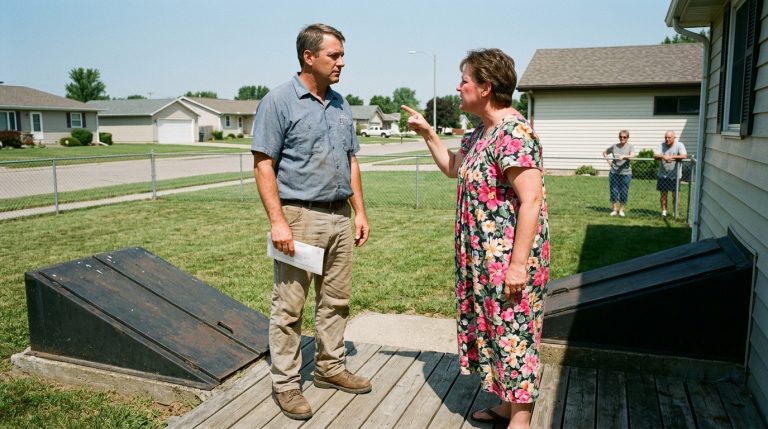
The heat did not rise; it pressed downward, sealing the asphalt and the chemically forced green turf into a single, suffocating weight. Karen stood on the common area side of the rusted pin, her hands planted on her hips with the deliberate, heavy theatricality of someone accustomed to absolute compliance. Her voice carried a low, gravelly vibration that belonged indoors, away from the open sky and the long stretch of the five-acre legacy behind me.
“They are coming out tomorrow, Mr. Thorne,” she said, her gaze fixed on the small, unassuming piece of metal my grandfather had driven into the dirt fifty years ago. “The board voted. Aesthetic standards. This is a community, not a rusted outpost.”
I did not look at her face. I looked at the line of the grass—my grass, slightly longer, uncooperative with the neighborhood’s chemical mandates—and felt the familiar, cold drop of absolute stillness settle behind my ribs. It was the same quiet space I had occupied decades ago when the world dissolved into dust and noise, where the pulse slows down and every variable shrinks to a calculation of leverage and angle. Thirty years in the Army Corps of Engineers leaves certain marks upon a man. You do not argue with a structure when you can measure its foundation.
“The pin stays,” I said. My voice was level, stripped of any friction.
Karen’s chin lifted, a micro-gesture of righteous indignation. She saw a retired man who kept to himself behind an unpainted porch screen. She saw an anomaly in her beige empire, an irritating pixel on a screen she wanted cleared. She had no concept of coordinate geometry, no understanding of county monuments referenced to permanent benchmarks, and certainly no comprehension of what happened when a surveyor’s starting point was shifted by a developer trying to squeeze an extra twenty feet out of a curve.
“You’ll find out what happens when the association maintenance crew handles it,” she snapped, turning back toward her electric chariot.
When she drove away, the silence did not return immediately; it lingered, heavy with the smell of scorched asphalt and dry clover. I turned back toward the house, my boots making no sound on the damp earth near the back porch, where Sarah stood watching from the screen door, her fingers curled tight against the mesh. She didn’t have to ask. The letters had been coming for months, each one a minor escalation, a fifty-dollar paper bullet fired from the administrative office.
Inside, the kitchen was cool, smelling faintly of black coffee and old paper. I walked straight to the wooden drawer, pulled out the heavy legal pad with Karen Harassment Log written across the top in precise block letters, and logged the exact minute of the confrontation. Date. Time. Verbatim dialogue. Physical posturing.
The binder was already three inches thick. Every certified letter, every grainy photograph of a garden hose left fifty feet from the road, every absurd demand about the height of my lawn had been cataloged with the cold discipline of a field report. She thought she was burying me in administrative friction. In reality, she was providing the baseline data for a counter-offensive she could not possibly calculate.
My hand hovered over the phone on the counter, but I did not pick it up yet. The ground outside was quiet now, save for the cicadas ticking against the afternoon heat. I reached into the upper cabinet and pulled down the rolled-up blueprint copies I had brought back from the county records office the previous afternoon—the original 1960 Henderson farm plat, and the 1993 Oak Meadows development map.
Unrolling them on the table required weights at the corners to keep the curling paper flat. I laid a transparent scale ruler across the boundary interface, aligning the coordinates with the permanent county benchmark down the asphalt line. The numbers did not lie. They never did.
The developer’s survey from thirty years ago hadn’t started from my grandfather’s registered pins; they had measured inward from the proposed centerline of the new road to save time, sliding the entire boundary partition over by an aggregate error that defied all local statutes.
I traced the discrepancy with the tip of a sharpened pencil, watching the gap widen from inches to feet, and finally settling at a monstrous, undeniable twenty-two feet. The entire primary artery of the subdivision—the road, the curb, the utility lines, and the manicured decorative trees—was not sitting on association common ground at all.
It was resting entirely on my land.
The front doorbell rang, sharp and institutional, cutting through the quiet hum of the refrigerator. I did not rush. I closed the ledger, capped my pencil, and walked slowly toward the front door, knowing precisely who was standing on the other side, and knowing just how little time she had left before the foundation beneath her feet gave way.
CHAPTER 2: THE AUDIT OF THE PAST RECORDS
The front door clicked shut with a dry, solid finality that sealed out the humid glare of the afternoon. The silence inside the house was dense, layered with the faint smell of roasted coffee beans and the old paper weight of family deeds. I did not move away from the threshold immediately. My fingers remained curled around the wooden knob, feeling the grain of the white oak my grandfather had planed down by hand when he came back from the Pacific.
Outside, the neighborhood hummed with its invisible machinery—the distant, rhythmic whine of a central air compressor kicking on three houses down, the automated whir of a garage door closing on beige aluminum. They lived inside an illusion of engineered perfection, a world where every blade of grass was regulated by committee and every lot line was sanctified by a real estate brochure. But paper was just paper until it met the mathematics of the earth.
I walked back to the dining table. The two plats—the hand-drawn, spidery ink lines of the 1961 Henderson survey and the clean, computer-generated geometry of the 1993 Oak Meadows subdivision plan—still lay pinned beneath brass weights.
The psychological phantom drifted unbidden through my thoughts—the damp canvas smell of a command tent in Al Anbar, the low murmur of junior officers reviewing coordinates over a light table, the absolute, unyielding necessity of getting the grid intersection right before the heavy equipment rolled out. In surveying, as in combat, a fractional error at the point of origin does not remain small. It compounds. By the time a line stretches six hundred feet across a suburban interface, an initial two-degree drift does not just cross a boundary; it swallows a landscape.
I pulled out the small brass scale ruler, its edges worn smooth by decades of thumb-friction. I didn’t need to measure the road again; the math was already burned into my memory cells. The Oak Meadows developer hadn’t merely miscalculated. To avoid cutting through a natural swale where the creek curved near the western ridge, they had shifted the entire centerline of the proposed access road twelve feet to the north during the initial grading phase in the autumn of ninety-two. Twelve feet of roadbed, flanked by four feet of concrete curbing, a three-foot utility easement, and a manicured decorative tree lawn. Twenty-two feet total.
All of it resting comfortably on the southern perimeter of my grandfather’s five-acre tract.
Sarah appeared in the kitchen doorway, her shadow stretching long across the hardwood floor. She didn’t speak. She walked over, set a fresh mug of black coffee beside my hand, and looked down at the overlapping lines of the two maps. Her face was calm, but there was a tight, controlled line to her jaw that I recognized from our early years together, when we were balancing accounts down to the last dollar while building our life from scratch.
“She’s not going to stop with fifty-dollar letters, Jack,” Sarah said quietly, her voice barely louder than the hum of the refrigerator. “If she realizes what those pins actually represent—if she looks at the county index—she’ll try to force a variance or push an eminent domain petition through the county commission.”
“Let her try,” I said, lifting the mug. The coffee was hot, bitter, and sharp on my tongue. “An eminent domain claim requires public utility justification or proven municipal necessity. You can’t invoke public domain to protect a homeowner association’s aesthetic buffer or to cover up a thirty-year municipal oversight. To file for condemnation, they’d have to admit the road is on private property in the first place. And the moment they admit that, they trigger every title insurance liability clause the original developer carried.”
I set the mug down, the ceramic clicking sharply against the polished pine table.
“She thinks this is a dispute over lawn height and mailboxes,” I continued, tracing the black ink of the original boundary line with the blunt tip of my pencil. “She’s treating it like an administrative infraction because she’s never had to look down the barrel of a true baseline audit. But an administrative fine requires jurisdiction. And jurisdiction stops right where our property line begins.”
The phone on the kitchen wall buzzed—a short, abrasive digital chirp.
I didn’t answer it. We both knew it was another certified notice, or perhaps another automated call from the HOA property management portal warning of compounding penalties. By the end of the week, the paper pile on the counter would cross the four-inch mark. Every single one of those letters was a piece of recorded evidence, a signed confession of targeted harassment executed under the color of a nonexistent authority.
“We need more than the old county plats,” I said, looking up at Sarah. “The county records office has the historical maps, but they’re microfilmed copies. If this goes to a formal legal filing, a judge won’t accept a fifty-year-old hand-drawn blueprint as absolute current proof of sub-surface occupation. We need a modern, satellite-referenced boundary survey stamped by a licensed professional whose credentials cannot be dismantled by a corporate real estate lawyer.”
“How much?” Sarah asked. She didn’t flinch. She simply asked for the figure, the way she used to ask for the repair estimates on our old truck when the transmission began to slip on the grade outside of town.
“Eight thousand, maybe ten,” I replied honestly. “Maybe more if we require monument recovery and core drilling to locate the original iron pins buried beneath the asphalt.”
She was silent for a long moment, her eyes fixed on the point where the developer’s computer-drafted line cut straight across our old creek bed like a scar. Then she reached out, tapped the edge of the 1961 plat with her index finger, and nodded once.
“Call him,” she said.
I picked up the receiver, bypassed the local directory assistance entirely, and dialed a private mobile number stored in the back of my old field notebook—the number of a man who spent twenty years untangling federal land disputes for the Bureau of Land Management, a man who didn’t care about HOA aesthetics, Karen’s muumuus, or suburban property values. He cared about iron, satellite coordinates, and the unyielding truth of the earth.
CHAPTER 3: THE CONSTRUCTION OF THE PAPER TRAIL
The receiver settled back into the wall cradle with a dry, plastic snap. The connection to Marcus Cole had lasted less than two minutes—just long enough to confirm a retainer figure, a field start date, and the specific county benchmark numbers required to lock our satellite gear into the local grid. There was no theatrical reassurance, no corporate sales pitch. Just the cold, professional cadence of an engineer who understood that the earth does not negotiate with bylaws.
Sarah remained by the counter, her arms folded over her apron, watching the steady afternoon light shift across the pine floorboards. “He’s taking the job?” she asked.
“Monday morning,” I said, pulling the heavy ledger back toward me and uncapping a black ink pen. “He brings his own equipment, his own base station, and a certified chain of custody for every coordinate he pulls. When he finishes planting those reference stakes, they won’t be painted wood or rusted rebar. They’ll be legally unassailable monuments registered directly with the state land office.”
I opened the logbook to a fresh page, drawing a clean horizontal line beneath the previous entry. Every war of attrition requires a logistics base, and mine was constructed entirely of paper, dates, and photographic proof.
The first certified mail envelope arrived three days after the surveyor’s call, delivered by a postal carrier whose eyes avoided looking directly at our porch, as if the address itself carried an infectious charge. I was out by the tool shed, checking the tension on the wire mesh of our tomato frames, when the white envelope landed in the box with a hollow slap.
I did not rush. I let the metal door swing shut on its own weighted hinge, walked slowly across the gravel path, and retrieved it with two fingers.
Inside was the expected escalation: a formal notice of violation for an unapproved decorative flag—the Stars and Stripes fluttering quietly from the cedar post by our front steps—accompanied by a fifty-dollar fine and a ten-dollar daily compounding penalty. The total accumulated paper debt on Karen’s ledger had now crossed four hundred dollars. On paper, I was drifting toward insolvency in the eyes of an entity that had no more legal jurisdiction over my land than the municipal government of a neighboring county.
I carried the letter inside, slipped it into a clear plastic sheet protector, and slotted it into the third ring of the binder.
Then I picked up my digital camera, walked out to the porch, and took a series of wide-angle and close-up photographs. The flag, clear and undamaged, mounted on private timber. The timestamp on the digital file read 14:14. The shadow of the porch railing fell across the second step at an exact angle, proving the time and orientation without reliance on digital metadata alone.
In the army, we learned that a log is only as good as its cross-references. If an inspector claims you violated a municipal ordinance at noon, you prove you were three miles away or that the ordinance itself does not apply to the terrain. Here, the defense was simpler: the ordinance did not exist for us, because the land beneath our feet had never belonged to the corporation issuing it.
The phone rang again around five, right as the shadows began to stretch long across the gravel drive. This time, I answered it.
It was Arthur Henderson, calling from across the southern fence line. His voice was raspy, carrying the dry rattle of a man who had spent eighty years breathing dust and wood smoke.
“Jack,” he said without preamble. “The dragon lady’s maintenance truck was parked down by the common green about an hour ago. She’s been talking to the property manager about your mailbox. Heard her mention a tow chain and a county ordinance regarding unapproved roadside structures. If they come over here while I’m out on the porch, I’m keeping my binoculars on them.”
“Let them look, Arthur,” I said, leaning my shoulder against the kitchen doorframe. “If they touch the post, they cross the property line. And the moment they cross the line while carrying tools, it ceases to be a civil nuisance. It becomes an intentional trespass under color of harassment.”
“You got your paperwork ready?” he asked, a dry chuckle rattling in his chest.
“The binder is three inches thick, Arthur. Every letter, every date, every photo. We’re just waiting for the survey crew to drop the final pins.”
“Good,” he muttered. “Don’t give ’em an inch of slack. My father sold them this dirt back in the nineties on the promise they’d leave the old homestead alone. They broke that promise the day they put up the first security gate.”
The call clicked off with a soft electronic sigh. I placed the phone back on its hook and walked back to the dining table. The old maps were still there, weighted down by brass, their ink lines waiting for the satellite geometry that would prove what my grandfather had known when he drove that first piece of rebar into the earth half a century ago. The paper army was marching toward its own trap, and every red-inked fine they mailed us was just another rivet in the cage they were building for themselves.
CHAPTER 4: THE GATHERING OF WHISPERS IN THE NEIGHBORHOOD
The digital hum of the wall phone faded into the ambient heat of the late afternoon, leaving only the sound of my own breathing and the faint rustle of the historical plats shifting beneath their brass weights. I did not move away from the table. The conversation with Arthur had reinforced what the logistics of the situation already demanded: a campaign fought entirely through documentation cannot remain a private affair once the perimeter begins to draw pressure.
The psychological phantom surfaced unbidden—the dry, scorching wind of a forward operating base where we mapped supply roads through disputed valleys, knowing that a single misplaced grid square meant sending a convoy straight into a choke point. In civilian life, people treated property lines like suggestions written in crayon. They assumed that because a curb was paved or a manicured lawn stretched smoothly to a mailbox, the underlying reality of the earth conformed to their convenience. They were wrong. The earth kept its own ledger, and it did not care how much money the Oak Meadows Homeowners Association spent on decorative mulch.
I walked over to the kitchen window and looked out across the long stretch of emerald-green grass toward the subdivision boundary.
Two houses down, a young man was kneeling by his driveway, trying to coax a basket-mounted hoop back into alignment while glancing nervously toward the corner where Karen’s electric golf cart usually made its hourly pass. It was Mr. Garcia, the resident Arthur had mentioned weeks ago, though I hadn’t spoken to him face-to-face yet. He was wrestling with a steel bolt that had rusted into its socket, his shoulders tight with the defensive posture of a man constantly waiting for an administrative whistle to blow.
I turned away from the glass, walked to the hall closet, and pulled on my canvas work jacket. If the neighborhood was beginning to feel the tremors of the administrative war, it was time to step outside the perimeter and lay the groundwork for the coalition that would render Karen’s paper notices obsolete.
The walk down the gravel drive was quiet. The afternoon sun cast long, sharp shadows across the property interface where my grandfather’s rusted rebar pin still marked the contested corner. Across the asphalt, the Oak Meadows common area turf looked aggressively uniform—chemical green, sprayed and trimmed to within a millimeter of its life.
As I approached the sidewalk near Garcia’s driveway, he looked up, startled, dropping his wrench with a sharp clatter against the concrete. His eyes flicked from my face to the property line, hesitation warring with frustration in his expression.
“Afternoon,” I said, keeping my voice level, stripped of any theatrical warmth.
Garcia wiped his grease-stained hands on a rag, standing up slowly. “Mr. Thorne, right? I saw you out here when the maintenance truck tried to pull your stakes last week. Bold move. Most people just fold when the association sends out the first certified letter.”
“Rules only hold weight if the authority behind them is legitimate,” I replied, stopping a few feet short of the subdivision curb. “And jurisdiction stops where ownership begins.”
Garcia let out a dry, humorless laugh, glancing back toward his garage where a stack of bright pink and white HOA violation notices sat half-visible on a workbench. “Legitimate? That woman treats the bylaws like a personal feudal charter. Last month she fined me because my youngest left a plastic bat on the grass for twenty minutes. The month before, it was the color of our patio umbrella. You pay your dues, you buy your house, and then you spend half your life asking permission to exist.”
“Then stop asking,” I said quietly.
Garcia narrowed his eyes, studying my expression. He saw a retired man in a canvas jacket, but the discipline of thirty years in the engineering corps tends to anchor a person’s posture. “Easier said than done. She controls the board. Every vendor, every maintenance contract, every committee vote goes through her or her loyalists. If you cross her, she buries you in administrative fees until you’re forced to sell.”
“Paper cuts only bleed if you let them,” I said, reaching into my pocket and pulling out a small, blank notepad and a pen. I didn’t mention the survey, and I didn’t mention the twenty-foot encroachment beneath the asphalt we were standing on. It wasn’t time to drop the core truth yet. The decoy secret—the relentless, weaponized paper harassment—was still doing its job, drawing their focus while my real logistical line was being surveyed. “If she’s issuing fines, she’s logging them. Are you keeping copies of every notice?”
“Every single one,” Garcia muttered, his jaw tightening. “Stuck in a folder in the kitchen.”
“Keep logging them,” I said, handing him nothing, only planting the concept with the precise weight of an order. “Dates, times, specific bylaws cited, photographs of the alleged infractions. When an administrative body steps outside its legal boundaries to target residents arbitrarily, those notices stop being rules. They become a paper trail of malicious prosecution.”
Garcia stared at me for a long moment, the initial wariness in his eyes slowly giving way to a dawning, sharp comprehension. He didn’t know about the twenty-foot shift in the 1993 plat yet, but he understood the utility of a ledger.
“You’re building something, aren’t you?” he asked, his voice dropping to a low murmur.
“Just keeping accurate records,” I said, turning back toward my property line as a distant electric whine began to echo down the subdivision street.
The white golf cart was turning the corner by the common green, Karen’s floral muumuu billowing slightly in the breeze as she steered toward us with the fixed, inevitable momentum of an oncoming tide. I didn’t wait for her to arrive. I turned my back on the common area, stepped cleanly across the rusted rebar pin, and walked back up my own gravel drive, leaving the first bridge of the neighborhood coalition firmly anchored in place.
CHAPTER 5: THE TOTAL STATION AND THE PINK FLAGS
The morning air carried the sharp, metallic bite of an incoming front, the barometric pressure dropping enough to make the old knee joint ache with a dull, predictable throb. I stood on the porch with a cup of black coffee, watching the gravel drive catch the first slant of gray light through the oak branches. Exactly at 08:50, a gleaming white Ford F-250 bearing a federal land management emblem and the stenciled logo of Cole Land Surveying rolled down the asphalt artery, its tires crunching evenly against our private approach.
Marcus Cole stepped out before the engine even settled into a low idle. He wore a faded orange safety vest over a chambray work shirt, his face lean and weathered like cured leather. There was no theatrical greeting, no wasted motion. He unclipped a heavy instrument case from the truck bed with the practiced efficiency of a man who spent his life measuring things that other men tried to hide.
“Morning, Thorne,” Marcus said, his voice cutting through the damp wind. “Let’s find your iron.”
Within minutes, the tripod legs of the total station were driven deep into the turf right over the contentious rebar cap at the edge of the driveway. Across the street, the automated garage doors of Oak Meadows were just beginning to lift like heavy eyelids, revealing the predictable geometry of commuter sedans and manicured lawns. But before the first resident could back out for the morning run, the optical lens of Marcus’s equipment began to hum, emitting a high-frequency pulse that measured angles and distances down to the fraction of a millimeter.
The psychological weight of the operation settled over the terrain instantly. In surveying, as in military engineering, a baseline established with satellite precision is a declaration of sovereign reality. You do not argue with a laser beam linked to a county benchmark.
By 09:30, a small, uninvited audience had gathered along the perimeter. Arthur Henderson had wheeled his folding chair out to the edge of his southern lawn, sitting beneath an oak with a mug of coffee in his hand, watching the transit with quiet satisfaction. A few doors down, Mr. Garcia lingered by his driveway, pretending to inspect the linkage of his garage door while keeping his eyes locked on the tripod.
And then, predictable as gravity, the white electric golf cart rounded the corner of the common green.
Karen sat upright at the steering wheel, her floral muumuu stretched tight across her chest, her jaw set with the desperate rigidity of someone whose small kingdom was suddenly experiencing a localized earthquake. She didn’t stay on the common area this time. She gunned the electric motor straight across the asphalt, bumping unceremoniously over the curb and cutting a tire track directly across the chemical-green turf until the cart skidded to a halt ten feet from Marcus’s equipment.
“What is the meaning of this?” she demanded, her voice shrill enough to carry over the wind. She pointed a trembling finger at the surveyor. “You don’t have permission to operate machinery on association property. This is a private community easement.”
Marcus did not look up from the optical eyepiece. He didn’t blink, didn’t shift his weight, didn’t acknowledge her existence with so much as a twitch of his shoulder. He simply finished logging a coordinate point into his handheld data collector, straightened his spine, and looked past her toward me.
“Mr. Thorne,” Marcus said evenly, his voice carrying the deliberate dryness of a federal deposition. “Is this individual part of our contracted client list?”
“She is not,” I replied, stepping forward from the porch edge, my boots silent on the damp grass.
Marcus turned his head slightly, fixing Karen with a pair of pale, unreadable eyes behind polarized safety glasses. “Then I have no business with you, ma’am. Please step back from the instrument. You are standing inside an active calibration vector.”
“This is common area!” she shrieked, her face flushing a dark, mottled purple as her two board lieutenants pulled up behind her in a second cart. “I have the plat right here in the office! You’re trespassing!”
“That,” Marcus said, tapping the housing of the total station with a gloved finger, “is precisely what this instrument is being paid to verify. The preliminary data suggests your plat missed its reference point by roughly twenty-two feet. Now, move your vehicle before my assistant flags your front bumper as an obstruction.”
The authority in his voice was absolute—not the petty, paper-thin authority of an HOA president backed by fine schedules, but the cold, institutional weight of professional law. Karen sputtered, her mouth opening and closing like a landed fish, searching for a municipal bylaw or an administrative threat that could pierce an engineer who answered only to mathematics and the state board of registration. Finding none, she slammed the cart into reverse, tearing up a patch of her own pristine turf before spinning around and peeling back toward the clubhouse in a cloud of crushed grass and impotent fury.
As her tail-lights vanished down the street, Marcus picked up a bundle of wooden lathe stakes tied with bright pink plastic ribbon. He handed half of them to his assistant.
“Let’s drop the line,” Marcus said quietly. “From the old iron pin to the northern edge of the easement. Every six feet.”
For the next four hours, the pink flags went into the ground in a straight, unbroken march down the manicured parkway. They cut through the decorative crepe myrtles, sliced across the edge of the community sidewalk, and ran straight down the centerline of Oak Meadows Lane. It wasn’t just a survey anymore. It was a visible, undeniable frontier line staked out in broad daylight for every homeowner to see—a physical manifestation of a thirty-year-old error coming home to roost.
Mr. Garcia walked over as the crew drove the final stake near the mailbox. He stared down the long, pink-flagged corridor, his eyes wide with a mixture of shock and dawning realization.
“Jack,” Garcia whispered, his voice barely audible over the wind rustling the pink ribbons. “That’s not just the grass. That’s… that’s the whole road.”
“The whole road,” I agreed, watching the bright ribbons flutter in the gray air. “And the paperwork is just getting started.”
CHAPTER 6: THE PROFESSIONAL CONSULTATION AND THE TRAP SET
The downtown office of David Chen smelled of polished mahogany, old law reports, and the clean, chilled air of an HVAC unit working overtime against the afternoon heat. I did not sit down immediately upon entering. Instead, I placed the heavy, three-inch binder containing the Karen Harassment Log squarely in the center of the polished conference table, followed by the newly sealed roll of plats delivered by Marcus Cole that very morning.
Chen sat across from me, a man with sharp features, iron-gray hair cropped close, and the precise, calculating eyes of someone who spent his professional life dissecting contracts for structural weaknesses. He didn’t touch the binder right away. He looked at the heavy brass cylinder containing the federal survey map, then up at my face.
“Marcus Cole called me an hour ago,” Chen said, his voice smooth and measured. “He tells me you’ve got twenty-two feet of subdivision asphalt resting comfortably on your grandfather’s southern acreage. Is that accurate, Mr. Thorne?”
“It’s accurate to the millimeter,” I said, finally pulling out a chair and sitting down. “Tied directly to the county benchmark grid. The developer in ninety-three didn’t just miscalculate; they shifted the entire roadbed north to avoid a natural creek swale and never filed a corrective deed.”
Chen reached out, pulled the brass cylinder toward him, and carefully slid out the multi-page survey plat. He unrolled it, anchoring the corners with a heavy glass paperweight. For several long minutes, the office was entirely silent save for the muffled hum of traffic coming up from the street below. His finger traced the solid black line of my property boundary, then hopped across the offset gap where the municipal road, sidewalks, and utility lines intruded deep into our ground.
A slow, predatory smile touched the corners of Chen’s mouth. It was the expression of a tactician who had just discovered an unmapped flank in an adversary’s defense line.
“This isn’t just an encroachment,” Chen murmured, almost to himself. “This is a title failure on a commercial scale. Every single homeowner in Oak Meadows holds a deed tied to an association that doesn’t actually own the land beneath their primary access road.”
“Which brings us to the second file,” I said, tapping the spine of the thick binder.
Chen flipped open the cover. His eyes scanned the meticulous rows of data I had compiled over the past several months: dates, timestamps, verbatim quotes, photographs of violation notices for unapproved flags, garden hoses, and lawn heights. He read through the catalog of fifty-dollar fines and daily compounding penalties with an expression that shifted from professional curiosity to cold, clinical appreciation.
“She’s been building a paper trail to justify putting a lien on your house,” Chen observed, turning a page.
“She thought she was creating an administrative trap,” I replied. “Instead, she was documenting a continuous pattern of targeted harassment under the color of a nonexistent jurisdiction. Every single notice she issued assumes she has authority over land she doesn’t even legally touch.”
Chen closed the binder with a soft thud and leaned back in his leather executive chair, interlocking his fingers across his stomach. The transition from defense to offense was complete in his mind.
“Here is how we execute this,” Chen said, his tone dropping into a sharp, tactical cadence. “We don’t file a standard civil suit for neighborly friction. We issue a formal demand package to the HOA board of directors. We present the certified survey as an unassailable fact. Then, we give them two distinct paths forward through a formal settlement offer.”
He pulled a blank legal pad toward him and uncapped a pen.
“Option A: They purchase the twelve thousand square feet of encroaching land from you at fair market lease value, compounded over thirty years of unauthorized commercial use, plus the cost of the survey and legal fees. Total bill: roughly four hundred and eighty-five thousand dollars.”
“And Option B?” I asked.
“Option B,” Chen smiled thinly, “is that they remove the encroachment. They have ninety days to tear up the road, relocate the utility mains, dig up the sidewalks, and restore your acreage to its original grade at their own expense. A project that would bankrupt the association twice over.”
He slid the legal pad across the desk toward me.
“They won’t choose Option B,” I said, looking down at the figures. “It’s logistically impossible.”
“Exactly,” Chen said. “Which means Option A is their only survival route. And because Karen has spent the last year alienating every resident with arbitrary fines and petty dictatorship, the board won’t be able to hide this from the community. When the homeowners find out that her administrative crusade has exposed every single one of them to a massive special assessment, her little empire is going to implode from the inside out.”
I picked up the binder, closed the clasp, and stood up, the weight of the months of disciplined documentation settling firmly into my grip.
“Send the letters,” I said. “Let’s see how her paper army holds up against actual math.”
CHAPTER 7: THE EXECUTION OF THE SETTLEMENT LETTER
The drive back from downtown was quiet, the gray asphalt stretching out beneath a sky that felt heavy with unspent rain. When I pulled the truck into the gravel drive, the house stood silent behind the screen door, its white siding and timber framing anchoring the northern edge of the five acres like an immovable rock. But the silence outside was different now. It was the tense, suspended quiet of a wire pulled to its absolute elastic limit.
Within forty-eight hours of our meeting, David Chen’s office dispatched the demand package. Ten pages of legal text, certified mail receipts, tracking numbers, and state filing references dropped simultaneously into the mailboxes of Karen Johnson and every member of the Oak Meadows board of directors.
I sat at the dining room table on the evening the delivery confirmations cleared, watching the shadows lengthen across the old 1961 plat maps. Sarah stood by the counter, her coffee mug warming her hands, her eyes fixed on the front window that looked out toward the subdivision.
“They’ve all signed for them,” Sarah said softly, checking the tracking log on her tablet. “Every single board member. Delivered by noon.”
“Now the physics take over,” I said, capping my pen. “When you apply pressure to a structure built entirely on a false foundation, you don’t have to push it over. The weight of its own internal contradictions does the work for you.”
For two days, the subdivision street remained unnaturally empty. No electric golf cart cruised the perimeter. No maintenance truck idled by the common area. The absence of activity was more telling than a dozen shouting matches; it was the sound of a panic wave propagating through an administrative machine that realized it had sailed past the edge of the map.
Then came the phone calls. Mr. Garcia called first, his voice crackling with suppressed excitement over the line.
“Jack, you wouldn’t believe what’s happening down on the south block,” Garcia said, his words spilling out in a rapid, kinetic stream. “One of the board members, Frank, lives four houses down from me. His wife was in tears at the mailbox this morning. She said the letter arrived with a half-million-dollar figure attached to it, and the board has been holding emergency conference calls behind closed doors all afternoon. They’re saying Karen lied to them about the boundary dispute from day one.”
“Did they mention the options?” I asked, keeping my voice neutral.
“Option A or Option B,” Garcia laughed, a sharp, vindicated sound. “Pay half a million or tear up the road. Frank is organizing a petition to recall Karen as president by tomorrow morning. They’re throwing her overboard to save themselves from the special assessment.”
The dominoes were falling precisely along the vectors Chen had calculated. Karen had governed through fear, isolation, and paper intimidation, treating the neighborhood like a personal fiefdom while ignoring the fatal flaw beneath her feet. When the bill for her thirty-year illusion finally arrived, her supporters did not rally around her; they distanced themselves with the speed of rats abandoning a sinking hull.
The community notice board at the entrance of the subdivision—usually reserved for bake sale schedules and landscape guidelines—was updated late Friday evening with a stark, typewritten notice announcing an emergency all-residents meeting for the following Tuesday at the community clubhouse. The topic was officially listed as “Unforeseen Municipal Liability and Executive Transition.”
I closed the logbook, ran my hand over the three-inch binder of harassment records that had made it all possible, and looked across the table at Sarah. The paper wall was built. The trap was sprung. All that remained was to watch the structure collapse under its own weight.
CHAPTER 8: THE COLLAPSE OF THE KINGDOM AND THE QUIET EVENING
The heavy double doors of the Oak Meadows community clubhouse pushed open with a dull, echoing click, releasing a wall of humid air, stale coffee, and collective anxiety. Every seat in the hall was jammed. People stood three deep along the paneled walls, a dense sea of faces turned toward the front podium where Karen Johnson stood clutching a wooden gavel like a drowning sailor gripping a spar. Her floral muumuu seemed strangely faded under the harsh glare of the recessed fluorescent ceiling lights, her face flushed with a dark, mottled desperation.
Sarah and I walked down the center aisle. The murmuring crowd parted instinctively, the whispered conversations dying down into a heavy, expectant hush as we took two empty chairs near the front row.
Karen struck the podium twice, the sharp crack of wood echoing through the silent room. “Order! This meeting is called to discuss administrative operations, not—”
“Order nothing, Karen,” interrupted Frank, a senior board member standing up sharply near the side aisle. He didn’t look at her; he looked directly at the packed room. “Let’s dispense with the theater. We’ve all seen the certified demand package delivered by Mr. Thorne’s legal counsel. We’ve all read Marcus Cole’s federal survey report.”
The room erupted into an immediate wave of cross-talk and indignation. Karen tried to bang the gavel again, her voice rising in a frantic shriek. “That survey is a fraudulent shakedown! The association owns this common ground! I have the paperwork right here—”
“You have thirty years of municipal negligence and deliberate concealment,” a sharp, clear voice rang out from the middle rows. It was Mr. Garcia. He stood up, holding a thick file folder high in the air. “For twelve months, this woman has terrorized this neighborhood with arbitrary fines, measuring grass, policing garden hoses, and threatening liens over trivial nonsense. And while she was fining my kids for leaving a basketball hoop out, she was hiding the fact that our entire access road is sitting illegally on private family land.”
The revelation of Layer 2—the absolute final reality that the entire subdivision infrastructure rested entirely on our grandfather’s acreage—unfolded across the room not as a sudden bolt of lightning, but as a slow, crushing realization. Heads turned toward the windows, looking out toward the asphalt road and sidewalks as if seeing them for the first time as foreign territory.
Karen slammed the gavel down one final time, the head splintering loose from the handle with a sharp crack that silenced the hall instantly. Her chest heaved, her eyes darting frantically across the room seeking the familiar nods of compliant lieutenants. But the board members had already slid their chairs back, physically and legally distancing themselves from the wreckage of her administration.
“You can’t do this,” Karen whispered, her voice cracking, the manufactured authority evaporating entirely. “I built this community. I kept the standards high.”
“You built an empire on stolen ground,” Frank said coldly, stepping up to the microphone. “And your administrative crusade just handed every homeowner here a half-million-dollar liability. Effective immediately, the board moves to accept the legal settlement terms presented by Mr. Thorne’s counsel, and we call for an immediate vote on your removal as president.”
The vote didn’t take a minute. A forest of hands shot up across the room, a unanimous sea of rejection. Karen stood alone at the podium, her mouth opening and closing silently, before she turned, dropped the broken gavel onto the wood, and fled through the side exit into the night.
The transition that followed was swift and surgical. Within a month, David Chen finalized the formal settlement documents. The Oak Meadows Homeowners Association formally purchased the 0.28-acre strip of encroaching land for an even five hundred dollars thousand, structured across structured installments funded by a special restructuring assessment. Karen’s file of arbitrary fines was wiped clean by the interim board—led unanimously by Mr. Garcia—and the tyrannical bylaws that had choked the neighborhood were rewritten from the ground up.
A few weeks after the ink dried on the settlement, a professional survey crew hired by the new association arrived to set permanent brass-capped concrete monuments along our true boundary line. They worked quietly, driving the heavy metal markers deep into the earth right where my grandfather’s rusted rebar had held the line for half a century.
That evening, the sun dipped below the western ridge, casting long, golden ribbons of light across the grass. Sarah and I walked out to the northern edge of the property. The new brass monuments gleamed softly in the cooling air, solid and permanent against the fading light. Across the street, children laughed as they tossed a basketball back and forth near an unmolested driveway hoop, the hum of normal life returning to the landscape.
We heard the low rumble of a heavily laden van moving slowly down the subdivision road. Through the windshield, we caught a glimpse of Karen, her boxes piled high against the passenger glass, driving out of the neighborhood for the last time without ever turning her head toward our land. She was an exile from a kingdom built on sand.
I reached down, running my calloused thumb over the cool, smooth surface of the newly driven brass cap, feeling the weight of the earth steady beneath my boots. The campaign was finished. The books were balanced. I looked over at Sarah, her silhouette soft against the evening glow, and slowly put my arm around her shoulder.
My grandfather’s words settled into the quiet space between us, as enduring as the soil itself. We had held the ground.