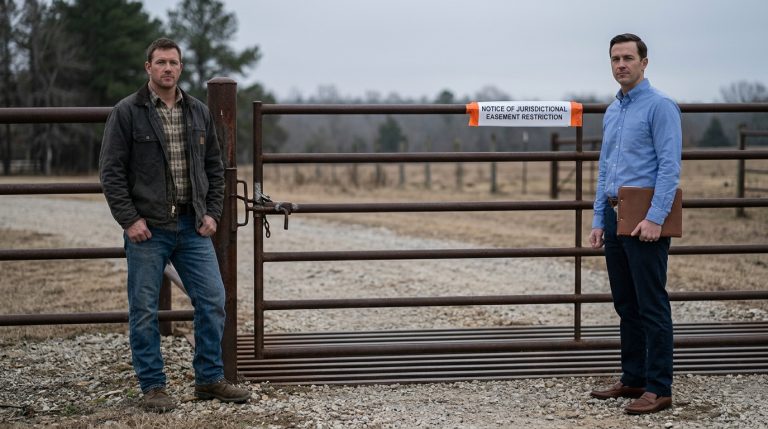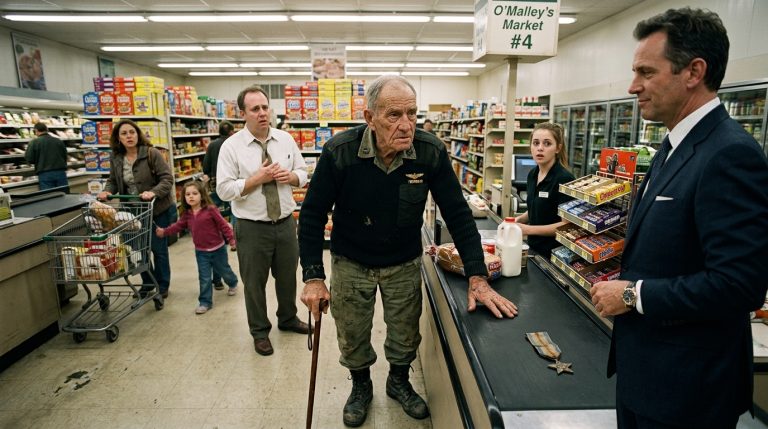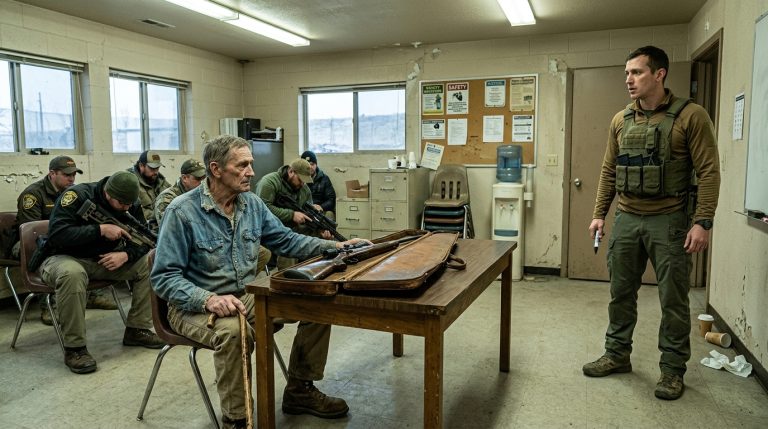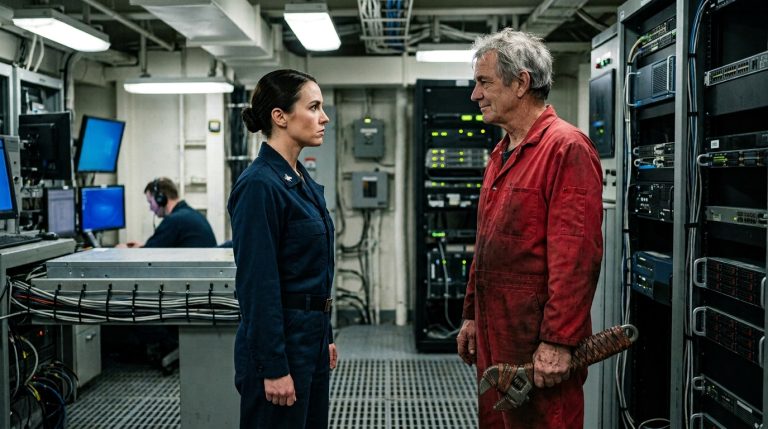
The Concrete Shield: How a Suburban Siege Unraveled a Multi-Million Dollar Extortion Syndicate
CHAPTER 1: LINE OF SIGHT
The grass was cut to precisely two and a half inches.
I knew the exact height because I had maintained the blade on the Honda mower myself three nights ago. So when the yellow heels crunching across the Bermuda lawn left deep, asymmetric divots near the curb, I didn’t look at her face first. I looked at her stride. Short. Heavy on the left heel. Zero control over her center of gravity.
“Your boy is breaking HOA rules,” she screamed.
Her voice hit 80 decibels easily. High, thin, carrying across the cul-de-sac.
“I’ve already called the cops!”
I didn’t answer. I rolled the brass SEAL lapel pin across my knuckles, feeling the sharp, broken backing pin dig into the calloused meat between my thumb and index finger. The pain kept my pulse flat at fifty-four beats a minute.
Beside me on the porch, my sixteen-year-old son, Leo, froze. His knuckles went white against the railing. He looked at the woman, then at the driveway, his chest rising in short, shallow hitches.
“Dad?” he muttered.
“Stay behind the line,” I said. My voice didn’t carry past the porch steps.
Three men stepped out of the front doorway behind us. They didn’t make a sound. Miller took the left corner near the rain gutter. Jackson drifted right, taking the shadow under the garage overhang. Cruz stayed two paces behind my shoulder. No uniforms. Plain gray t-shirts, worn denim, boots with the tread worn flat from years of concrete work.
To the woman on the lawn, they looked like day laborers or oversized uncles. To anyone who had spent twenty minutes in the sandbox, their spacing was a textbook three-point interlocking field of fire.
“He can’t have these people here!” she shrieked, waving a piece of blue paper in her right hand. “Section Four! No commercial vehicles, no unauthorized group gatherings! He’s hosting criminals!”
A white squad car rounded the corner of Maple Street, its lightbar dark, tires grinding slowly against the gravel gutter.
The woman—Karen—smirked. The muscle around her jaw tightened into a rigid, triumph-drunk flex. She didn’t see Miller shift his weight four inches to the left, angling his body to cover the officer’s approach angle. She didn’t see Cruz’s right hand drop into his front pocket, thumb sliding over the corner of a heavy leather credential wallet.
She only saw a teenager in a faded high school track shirt and an old man holding a lawnmower key.
“Officer!” Karen bolted toward the cruiser before the driver’s door even swung open. “Right here! I have the violation notice! They’re trespassing, they’re threatening the neighborhood!”
The deputy stepped out. Young. Mid-twenties. Belt weighed down with too much gear he hadn’t yet learned how to balance. His eyes scanned the lawn, skipping right past the four grown men positioning themselves in plain sight, zeroing in instead on the blue paper Karen slammed against his chest.
“Ma’am, calm down,” the officer said, though his hand rested on his holster strap.
“I won’t calm down! He’s violating community rules! He needs to be removed!”
I walked down the two brick steps, stopping exactly twelve inches inside my property line. I didn’t look at Karen. I looked at the officer’s name tag. Miller. No relation to the man standing by my gutter.
“Officer,” I said flatly. “She’s on private land. I haven’t issued a trespass warning yet, but I’m about to.”
Karen let out a sharp, cackling laugh that vibrated off the aluminum siding of my garage.
“Private land? You don’t own this dirt, mister! The Association owns the covenants! And if you won’t remove them…” She pulled a phone from her purse, her thumb flying across the glass screen with practiced, vicious speed. “…I’ll call my own team to handle it.”
The air on the driveway went cold. Not the weather—July in Virginia was ninety degrees and thick enough to chew—but the atmosphere.
Cruz made a tiny clicking sound with his tongue behind me. Two short bursts. Threat escalation.
“Leo,” I said without turning my head.
“Yeah, Dad?” His voice was barely a squeak.
“Go inside. Turn on the monitor in the den.”
“Dad, I—”
“Inside.”
He ran. The front door clicked shut.
Karen didn’t care about the boy. She was staring at her phone, her smirk widening until the skin around her eyes crinkled.
“Five minutes,” she whispered, leaning over the officer’s hood. “We’ll see how tough your little squad is when real enforcement gets here.”
I pressed the broken pin into my thumb until I felt the skin puncture.
Aegis-3.
I hadn’t seen the logo yet, but I knew the cadence. This wasn’t an HOA dispute. It hadn’t been an HOA dispute since the day I bought the deed out of probate.
“Officer Miller,” I said, my voice dropping an octave into the dry, scraped-iron tone I used when the breach charges were live. “You might want to step back onto the pavement.”
The young cop looked between my eyes and Karen’s phone. He hesitated. That half-second of doubt was all the opening the street needed.
Three black Ford Explorers, doors unbadged, tinted glass dark as coal, rolled around the corner and cut their engines directly across my driveway.
CHAPTER 2: TACTICAL IMPERSONATION
The rumble of the three idling V6 engines traveled through the cold asphalt, vibrating straight up through the worn soles of my boots.
Twelve inches inside my property line, I didn’t move. My right thumb pressed harder against the sharp backing pin of the brass SEAL badge, letting the slow, rhythmic sting keep my breathing steady at six counts in, six counts out. Beside the driver’s hood of his cruiser, Deputy Miller shifted his feet, his belt clinking softly. The boyish confidence on his face had evaporated, replaced by the tight, pale strain of a man realizing he was severely outmatched in numbers.
The doors of the black Explorers swung open in unison.
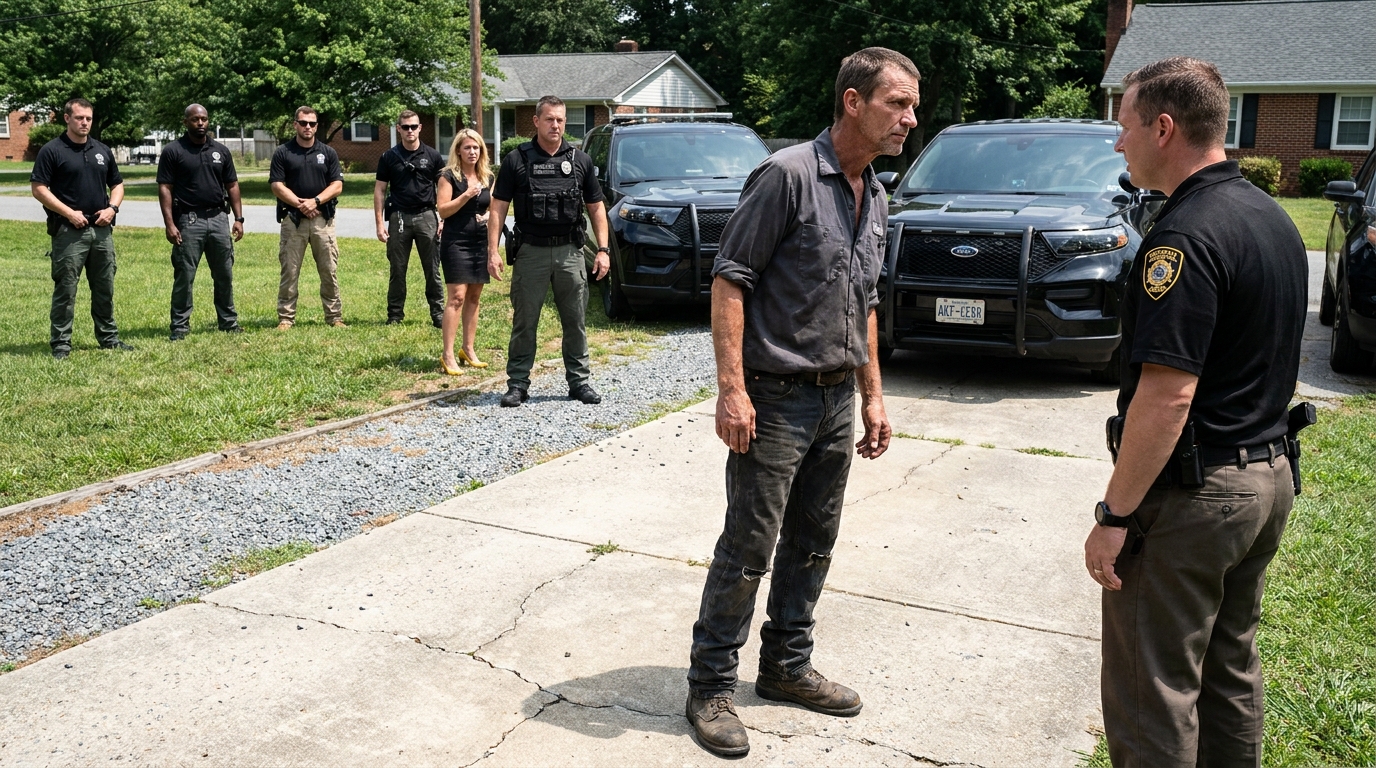
Six men stepped out into the humid July heat. They wore dark gray tactical vests over black polo shirts, cargo pants tucked into combat boots, and heavy duty utility belts. On the left breast of each vest, a Velcro patch bore bold, yellow lettering: HOA CODE ENFORCEMENT & INSPECTIONS.
I scanned them in two seconds flat.
No department patches on the shoulders. No state-issued badges. No name tapes. The stitching on the vest mag-pouches was cheap single-thread—civilian surplus, not military issue. The man leading them walked with a wide, aggressive posture, his hands resting on the front of his vest near an unbadged, blacked-out tactical holster. But the way his eyes darted to Deputy Miller’s lightbar betrayed him.
“Officer!” Karen shrieked, clapping her manicured hands together. The sound was sharp, like a dry branch snapping. “Finally! My enforcement team is here to take control of this property!”
She strutted toward the men, her heels clicking against the pavement. She stood beside the lead contractor, thrusting her chin forward like a drill instructor who had just called in heavy armor.
“These men are trespassing on community property,” Karen barked, pointing a crimson fingernail directly at my chest. “They’re hosting unauthorized personnel and refusing to comply with Section Four notices. Take them down and clear the lot now!”
Behind me, near the garage overhang, Jackson let out a low, barely audible exhale. Miller didn’t move an inch from the rain gutter, his shadow stretching flat across the Bermuda grass.
The lead fake inspector didn’t look at Karen. He kept his eyes locked on me, taking three steps past my mailbox, closing the gap until he stood four feet from where I marked my boundary.
“Step aside, sir,” he said. His voice was coarse, raspy from years of cheap tobacco, pitched to sound authoritative. “We’re executing an administrative code seizure under Aegis-3 Security municipal delegation. Clear the driveway so we can secure the assets.”
Aegis-3 Security. There it was. The first seed noun dropped right on my grass.
I looked down at his chest, zeroing in on a small laminated card clipped to his molle webbing. Printed in small, faded font beneath a barcode was a regional fine routing number: ESCROW FILE 88.
Deputy Miller took a cautious step forward, his hand still hovering over his sidearm strap. “Hold on a second,” Miller said, his voice cracking slightly before he corrected his tone. “Aegis-3? I don’t have an administrative task force logged in dispatch for this sector. Who’s your commanding supervisor?”
“We don’t answer to county dispatch on private HOA covenants, Deputy,” rasped the lead inspector without turning his head. He reached down toward his belt, unsnapping a thick nylon retention strap. “We take our directives directly from municipal civil filings. Now back off and let us work.”
Karen smirked, crossing her arms over her chest. “Don’t just stand there, officer! He told you how it is. Arrest these people!”
My pulse didn’t spike. It dropped.
I took one short step forward, bringing my boots right to the hairline crack in the driveway where my deed met county property.
“You might want to think twice before touching my family,” I said softly.
The lead contractor let out a short, nasal scoff. “What are you going to do, old man? You’re a civilian on a suburban lot. You don’t have jurisdiction here.”
I leaned in, just four inches, close enough that he could smell the stale coffee on my breath and see the zero-expression stillness in my pupils.
“Wrong,” I whispered, keeping my tone below Karen’s hearing. “You have no idea whose yard you just walked into.”
He blinked. A microscopic twitch caught the corner of his left eyelid—the universal sign of a bully realizing his bluff hadn’t triggered panic.
He raised his hand, signaling his five men to advance onto the concrete apron. “Secure the perimeter,” he ordered.
Before the two men on his right could take a second step, Cruz moved.
He didn’t draw a weapon. He didn’t raise his hands. He simply stepped off the porch and placed himself directly in the physical choke point between the lead Explorer’s bumper and my lawnmower. His posture was totally relaxed, hands resting lightly in his pockets, but his shoulders blocked two men simultaneously.
“Identify your unit and jurisdiction,” Cruz said. His voice was flat, deep, carrying the cold, quiet weight of a man who had cleared rooms in Fallujah before this contractor had learned how to strap on a vest. “Now.”
The lead fake inspector hesitated. The men behind him ground to a halt, their eyes shifting from Cruz’s face down to his balanced, rooted stance. They recognized the posture even if they didn’t want to admit it.
“We don’t answer to you,” the lead guy sneered, trying to recover his footing. He puffed his chest out, shoving his shoulder forward. “HOA delegation is enough!”
“It’s not,” Cruz replied gently.
From inside his front pocket, Cruz pulled out a dark leather wallet. With a flick of his wrist, he flipped it open.
The gold emblem inside caught the harsh July sunlight, reflecting a sudden, brilliant flash across the hood of Deputy Miller’s cruiser.
Deputy Miller froze. His eyes widened, scanning the gold seal and the federal credentials beneath the clear plastic sleeve.
Karen’s mouth opened, but no sound came out. The smug line of her jaw slackened instantly.
“Federal credentials,” Cruz said, his tone razor-sharp, cutting through the hum of the idling engines. “And as of thirty seconds ago, you six are actively executing an armed impersonation of law enforcement on a federal officer’s private residence.”
He looked the lead fake inspector dead in the eye, his thumb sliding up to rest lightly on the handle of his sidearm.
“You boys just walked into the wrong yard.”
CHAPTER 3: JURISDICTIONAL SHIELD
The glint off Cruz’s gold badge was sharp enough to make the lead contractor squint.
Nobody moved. The idling V6 engines of the three black Explorers hummed against the concrete, but on the driveway, the silence was absolute. Cruz’s hand stayed steady, his thumb resting flat against the leather spine of his credential case. Three feet away, the lead contractor’s hand remained frozen an inch above his nylon holster, his knuckles pale where the sun hit his skin.
“Federal,” Deputy Miller breathed out. The young cop took a step back, his eyes darting from Cruz’s credential card to the contractor’s unbadged vest. “You’re… you’re on a federal detail?”
“I’m on personal leave,” Cruz said, his voice dropping into a low, rasping register that carried over the engine rumble without rising in volume. “Which means I’m off-duty. But impersonating a federal officer on private residential property during an illegal entry? That’s active jurisdiction, Deputy. You want to run my badge number through county dispatch right now, or should I dial the field office in Richmond myself?”
Karen stepped off the curb, her yellow heels wobbling on the gutter seam. “He’s lying!” she shrieked, her hand swinging wildly through the humid air. “He’s lying, Officer! Look at them! They’re dressed like laborers! They’re squatting in that house!”
“Ma’am, sit down in your car,” Deputy Miller said, his tone shifting abruptly. The hesitation in his posture was gone, replaced by the stiff, protective instinct of a patrol officer who realized he was standing in the middle of a massive legal jurisdictional minefield.
“I will not!” Karen roared, her face flushing a deep, mottled red. “This is HOA property! Section Four gives us the right to clear non-compliant residents! Tell him, Rick!”
She snapped her fingers at the lead fake inspector. But Rick didn’t speak.
His eyes shifted past Cruz, landing on Jackson near the garage and Miller by the rain gutter. Neither of my men had drawn a weapon, but their footing hadn’t changed by a millimeter. They were anchored, covering the flanks of the driveway choke point with the practiced ease of men who had set up vehicle checkpoints under mortar fire.
“We were hired,” Rick muttered, his raspy voice suddenly lacking its previous bite.
“Rick, shut up!” Karen yelled, her phone rattling in her tight grip. “You don’t talk to them!”
“Hired by who?” Deputy Miller asked, stepping between Karen and the lead Explorer. He pulled his official notepad from his breast pocket, clicking a cheap ballpoint pen with a sharp snap. “You claimed you were municipal code enforcement. What municipality?”
Rick didn’t answer. He took half a step backward, his boots scraping against the gravel gutter. The two men behind him exchanged quick, nervous glances, their posture deflating from tactical operators to cheap muscle caught out in the open.
“Aegis-3,” I said, stepping over the hairline crack of my property line. I didn’t look at Rick. I looked at Deputy Miller. “Check his vest tag, Deputy. Escrow File 88. They aren’t code enforcement. They’re a private collection firm using fake municipal titles to execute unlawful civil evictions before the homeowner can file an injunction.”
Deputy Miller looked at the laminated card clipped to Rick’s chest. “Escrow File 88… that’s a court docket code from the district civil circuit.”
“It’s a civil routing number,” I corrected softly. “Used to bypass public land records.”
Karen let out a strangled, high-pitched noise. “You don’t know what you’re talking about! You owe three thousand dollars in unpaid maintenance fees! The lien was filed last month!”
“I don’t have an HOA,” I said flatly. “This lot was carved out of the old Miller farm estate in 1982. My deed is unencumbered. I showed you the title search three weeks ago when you stuck the first fake notice on my mailbox.”
I reached into my back pocket, pulled out my smartphone, and tapped the screen twice. I turned the display around, holding it flat so Deputy Miller could see the live high-definition stream coming from the micro-camera hidden in my porch light housing.
On the screen, four hours old, was crystal-clear, 4K footage of Karen standing on my driveway at 6:15 AM, handing a thick manila envelope to Rick through the window of his Explorer.
“That’s forty-five minutes before she called dispatch to report a disturbance,” I said. “You can hear the audio if you want, Deputy. She paid him two thousand in cash to bring five men with tactical gear to intimidate my son while I was at the hardware store.”
Deputy Miller stared at the screen. The video played in silence—the image of Karen slipping the envelope into Rick’s lap, her face lit by the morning sun, smiling.
“That’s fake!” Karen screamed, her voice cracking as she backed away toward the sidewalk. “That’s an invasion of privacy! You can’t record me on my property!”
“It’s my driveway,” I said. “And the camera is mounted on my house.”
Deputy Miller closed his notepad with a heavy thud. He looked at Rick, then turned fully toward Karen. He unclipped a pair of steel handcuffs from his utility belt.
“Ma’am,” Deputy Miller said, his voice cold and official. “Turn around and put your hands behind your back.”
“What?!” Karen shrieked, taking two frantic steps backward. “Are you insane?! I called you! I’m the president of the neighborhood board!”
“You’re under arrest for filing a false police report, criminal solicitation, and conspiracy to commit illegal trespass,” Miller said, closing the distance in two strides.
Before Karen could run, Miller grabbed her left wrist, pulling it behind her back with a sharp, practiced twist. The steel cuffs clicked locked once, then twice.
“Rick,” Cruz said, his voice flat as a tombstone as he stepped closer to the lead contractor. “You and your boys are going to sit on the curb, keep your hands where my team can see them, and wait for county backup to arrive. If anyone reaches for a pocket, we assume it’s an escalation.”
Rick didn’t argue. He raised his hands slowly, palms open, and sank down onto the hot concrete curb. His five men followed him without a word, their tactical bravado completely stripped away under the steady, unblinking glare of three retired SEALs.
Karen thrashed against Miller’s grip, her yellow heels kicking uselessly against the pavement as he guided her toward the rear door of his cruiser.
“You think this is over?!” she screamed, her eyes bulging as she glared over the roof of the squad car directly at me. “You think you won because you have a badge friend?! You have no idea who signed that Escrow File! Judge Vance owns this county! Aegis-3 will take this house by midnight!”
I didn’t answer. I stood at the edge of my driveway, rolling the brass pin across my thumb, watching her get shoved into the back seat.
Judge Vance. The second seed noun dropped from her own mouth.
Behind me, Cruz lowered his credential case, his jaw set in a hard, grim line. “She’s not bluffing about the judge, John,” he muttered under his breath. “If there’s a judicial officer backing a private seizure crew, they won’t stop at a fake HOA notice. They’ll bring heavy paper next time.”
“Let them bring it,” I said, watching the cruiser’s rear door slam shut. “We still have three hours of daylight to prepare the yard.”
CHAPTER 4: PAPER TRAILS IRON LINES
The metallic thump of the cruiser’s rear door latch echoed across the cul-de-sac like a blank round fired into a narrow alley.
Inside the squad car, Karen slammed her shoulder against the reinforced glass, her muffled shrieks reduced to a faint, pathetic buzz. Deputy Miller didn’t look back at her. He stood near his driver’s door, writing furiously in his pad while two additional county patrol cars pulled onto Maple Street, their lightbars flashing blue and red against the dry pine trees lining the curb.
Rick and his five contractors remained seated on the concrete curb, hands resting flat on their knees under Jackson’s unblinking watch.
“County unit’s taking custody of the fake inspectors,” Cruz murmured, stepping up beside me. He didn’t look at the police. He looked at the dash of the lead black Explorer parked four feet into my driveway choke point. “John. Look through the windshield of the lead truck.”
I walked over to the driver’s side of the idling Explorer. The engine heat radiated off the hood, thick with the smell of scorched power-steering fluid. Through the tinted glass, sitting open on the passenger seat, was a heavy leather binder.
I reached through the open window, hooked the spine of the binder with two fingers, and pulled it out.
“Hey! You can’t touch that!” Rick shouted from the curb, starting to rise.
Jackson didn’t say a word. He simply shifted his left boot two inches forward, blocking Rick’s line of sight and placing his shadow directly over the contractor’s face. Rick sat back down.
I opened the binder on the hood of the Explorer. The top document wasn’t a neighborhood covenant or a cheap HOA notice printed on colored paper. It was a pre-stamped municipal court order, printed on heavy legal bond stock.
At the top of the sheet, embossed in gold foil, was the official seal of the Ninth District Civil Court. Beneath it, the respondent field was blank, but the order was explicit: Emergency Order for Writ of Possession and Asset Seizure.
At the bottom of the page, already signed in dark blue ink, was the signature: Judge Vance.
“It’s a pre-signed blank warrant,” I said, my thumb tracing the raised ink of the judge’s signature. “They don’t even bother filing the motion in court first. They fill in the address when they get to the driveway.”
Cruz leaned over my shoulder, his jaw tightening as he read the boiler-plate text in the margin. “Escrow File 88,” he read aloud, pointing to a small tracking bar code stamped on the left margin. “This isn’t an HOA dispute, John. Aegis-3 is buying up probate properties and unencumbered land for pennies on the dollar by manufacturing fake liens. If the homeowner fights back, Vance issues an emergency seizure writ to clear the lot before a federal judge can review the deed.”
“And if the homeowner doesn’t leave?” I asked.
Cruz looked across the roof of the Explorer toward the tree line at the edge of my property. “Then they bring people who don’t wear cheap surplus vests.”
Deputy Miller walked over, his radio crackling with dispatch chatter. He looked down at the binder on the hood, his brow furrowed as he recognized the judicial seal.
“Is that… Judge Vance’s signature?” Miller asked, his tone dropping into uncertain hesitation. “If there’s an active writ from the circuit court, my supervisor isn’t going to let us hold those men on the curb for long.”
“The writ is blank, Deputy,” I said, turning the binder so he could see the empty respondent line. “It’s a forged civil instrument until an address is filled in. And using a blank judicial warrant to force a entry on an unencumbered deed is a federal racketeering predicate.”
Miller swallowed hard, staring at the blue signature. “Judge Vance has been on the bench in this county for twenty years. No local magistrate is going to touch this.”
“They won’t have to,” I said. “Because by midnight, this isn’t going to be a county matter.”
I closed the binder, tucking it under my arm, and looked toward my house. On the porch, the front door opened two inches. Leo stood in the dark gap of the entryway, holding a thick black laptop case in his hand.
“Dad,” Leo called out, his voice steadier than it had been an hour ago. “The server in the den just logged three new IP addresses pinging our home network from an unlisted server in Richmond.”
I turned back to Cruz and Jackson.
“They know we took their paper,” I said flatly. “They aren’t going to wait for the morning court docket.”
“How long do we have?” Cruz asked, his eyes scanning the quiet street as the last county transport car pulled away with Karen in the back seat.
“They’ll let the sun go down,” I said, rolling the brass pin against my knuckles until the sharp backing bit deep into my flesh. “Then they’ll try to cut the power at the street transformer and take the house by force.”
CHAPTER 5: SHADOWS ON THE GRID
The transformer at the corner of Maple and 4th didn’t just snap. It gave off a deep, mechanical groan, followed by a blue spark that scorched the twilight sky before every streetlamp on the block went dead.
The digital display on the server Leo held in his hands flickered once, then died.
In the sudden, suffocating dark of the porch, the air grew thick with the smell of scorched wire and cooling asphalt. The three black Explorers parked at the edge of my lawn turned into flat, featureless silhouettes against the graying horizon.
“Dad,” Leo whispered. His thumb was hovering over the cold screen of the unpowered laptop. “The street grid just dropped. Emergency power didn’t switch on for the municipal lines.”
“It wasn’t a grid failure,” I said. My voice remained flat, anchored at forty-five beats per minute. “They pulled the fuse at the regional feeder box on 3rd.”
Cruz moved before I finished the sentence. He slipped past the garage door frame, taking two long, silent strides into the shadow of the oak tree near my property line. Jackson vaulted the low brick retaining wall on the east side of the driveway, his boots hitting the mulch with a dull, heavy thud. No orders were given. The perimeter protocol had been locked thirty years ago in the Helmand Valley; the geometry of a suburban lot didn’t change the firing arcs.
“Leo, inside,” I said. “Go to the breaker panel in the utility room. Flip the manual transfer switch to Bank B. Don’t touch the main line.”
“Bank B is the isolated battery bank?” he asked, his voice shaking slightly as he backed through the front door frame.
“It’s the clean line,” I said. “Go.”
The door clicked shut. I stood on the porch, the leather binder with Judge Vance’s blank writs clamped under my left arm. I reached into my right pocket, rolling the brass pin across my knuckles until the backing pin tore open the scab on my thumb, letting the cold sting focus my vision.
Across the street, two sets of headlights cut through the gloom.
They weren’t county squad cars. They didn’t have lightbars. They were dark gray, heavy-duty pickup trucks, their engines idling with the low, throaty rumble of modified turbodiesels. They didn’t turn into the cul-de-sac. They stopped abreast, blocking the entrance to Maple Street, their high beams aimed directly at my front porch.
The white light was blinding. It bounced off the aluminum siding, throwing harsh, elongated shadows behind every porch pillar.
“John,” Jackson’s voice came over the encrypted earbead I had inserted three minutes ago. “Two vehicles at the choke point. Four men per cab. They aren’t wearing Aegis-3 patches. Tactical plate carriers, no identification, heavy tools in the truck beds.”
“They brought the breach team,” I said quietly into my collar mic. “Judge Vance signed the paper, but these aren’t bailiffs.”
A voice boomed through a battery-powered bullhorn from behind the high beams. It wasn’t Rick’s raspy tobacco voice. It was crisp, educated, and completely devoid of emotion.
“John Vance!” the voice shouted, the sound cracking against the quiet suburban roofs. “You are in possession of confidential judicial records stolen from an officer of the Ninth District Court. Step onto the driveway with your hands visible and surrender the binder!”
I stepped down the two brick steps, stopping at the exact twelve-inch line inside my deed boundary. The high beams hit my face, forcing my pupils to contract, but I didn’t shield my eyes.
“You’ve got the wrong name on the bullhorn!” I called back. My voice didn’t rise; it carried through the stillness like a iron bar scraping concrete. “And Judge Vance didn’t leave his binder in an officer’s car! He left it with a hired crew running an illegal extortion racket on Escrow File 88!”
A long pause hung over the street. The diesel engines continued their steady, rhythmic thrum.
Behind the high beams, a car door clicked open. A man stepped out into the glare, wearing a tailored charcoal suit over a bulletproof vest. He didn’t carry a weapon. He held a leather briefcase in his left hand and a satellite phone in his right.
“Mr. Vance,” the man in the suit said, stepping around the truck’s front bumper. He had silver hair cut close to the scalp, and his posture was that of an attorney who spent more time in bank vaults than courtrooms. “I am senior counsel for Aegis-3 Holdings. The paper in your hand is proprietary work product protected under judicial privilege. If you release those files to a federal magistrate, you will not survive the civil litigation.”
“I don’t plan on filing a civil suit,” I said.
The lawyer smiled. It was a cold, surgical movement of his lips that didn’t reach his eyes. “Then you leave us with a administrative necessity. The circuit court has declared this property a public hazard under local ordinance 402. We have authorization to clear the structure.”
He raised his right hand, making a small, downward gesture toward the two trucks.
From the truck beds, six men stepped out into the street. They didn’t yell. They didn’t shout like Karen or swagger like Rick. They carried pneumatic entry rams and heavy bolt cutters, moving in a tight, disciplined wedge toward my property line.
“Cruz,” I whispered into the mic. “Tag the lead truck’s radiator.”
“Done,” Cruz replied from the shadows of the oak tree.
A sharp, metallic clink rang out—not a gunshot, but the pneumatic strike of a spring-loaded steel punch hitting the lower hose connection of the lead diesel truck. A second later, green radiator fluid began spraying across the asphalt, pooling around the tires in a steaming, pungent puddle.
The lawyer’s smile vanished. The six men in the breach wedge froze, their boots hovering an inch above my curb.
“You touch that grass,” I said, pointing the brass pin directly at the lawyer’s chest, “and every camera feed from this lot goes live to the Department of Justice Inspector General’s server in Washington. Escrow File 88 isn’t a secret anymore. It’s a federal evidence file.”
The lawyer took one slow step back toward his truck cab, his eyes shifting down to the green fluid spreading across the road. He looked at my face, then at the dark, silent shadows of the porch behind me where Jackson and Miller held the flanks.
“You think you can protect a teenager with a paper binder, John?” the lawyer asked, his voice dropping into a low, vicious murmur. “Judge Vance owns the title company, the county sheriff, and the probate court. You’ll be homeless by Monday.”
“Monday is four days away,” I said. “And you have ninety seconds before the diesel engine on your lead truck seizes.”
CHAPTER 6: THE CHECKMATE DEED
The steam rising from the lead diesel truck’s punctured lower hose carried the sharp, sweet stench of boiling ethylene glycol directly across the asphalt.
Eighty-two seconds remained.
The senior counsel for Aegis-3 Holdings stood motionless under the blinding glare of his own high beams. The surgical smile he’d worn ten seconds ago had collapsed into a rigid, white-knuckled grimace. He glanced down at the green coolant spreading toward his leather dress shoes, then back at the brass SEAL pin pressed firmly between my bloodied thumb and index finger.
“You think a digital transfer scares Judge Vance?” the lawyer sneered, though his voice had dropped its polished courtroom timbre. “He controls the circuit court records clerk. By eight o’clock tomorrow morning, your deed will be flagged as an invalid probate transfer. The court will recognize Aegis-3 as the primary title holder under Escrow File 88, and no federal inspector general moves on an unverified civil complaint.”
“He doesn’t control the federal land registry in Richmond,” I said softly.
The lawyer froze.
“Leo,” I called out without turning my head toward the dark porch.
From the shadow of the doorway, Leo stepped forward into the edge of the light. He held the black laptop, its screen glowing bright green against his face, powered by the clean DC line from Bank B in the utility room.
“Upload complete, Dad,” Leo said. His voice didn’t wobble. “The encrypted packet containing Judge Vance’s signed blank writs, the cash transfer footage of Karen, and the Aegis-3 municipal tax-evasion ledgers from Escrow File 88 just hit the Department of Justice public corruption portal. The field office in Richmond acknowledged the intake hash three seconds ago.”
A sudden, high-pitched whine rose from the engine bay of the lead truck as its water pump seized without fluid. The serpentine belt shrieked against the stopped pulley, snapping with a loud crack before the V8 engine ground to a violent, metal-on-metal halt.
The six men in the breach wedge took a collective step back, lower tools lowering toward the pavement. They weren’t soldiers; they were private enforcement mercenaries, and they knew the difference between an unregistered suburban eviction and an active federal racketeering investigation.
“This is an unverified filing,” the lawyer rattled off, his fingers twitching against the handle of his briefcase as he tried to construct a legal line of defense on the curb. “It has no standing without a magistrate’s signature—”
“Aegis-3 Security is a shell company registered to Judge Vance’s brother-in-law,” Cruz’s voice cut through the dark from the shadow of the oak tree. He stepped into the light, holding his open federal credential case high. “The land seizure pipeline under Escrow File 88 has been tracked by federal tax investigators for fourteen months. We weren’t waiting for a complaint, Counselor. We were waiting for your team to cross a private boundary with a blank warrant.”
Behind the lawyer’s two idling trucks, three unmarked black sedans pulled quietly into the mouth of the cul-de-sac. Their headlights stayed dark, but the flash of red and blue strobe lights hidden behind their front grilles illuminated the entire street in rhythmic, cold pulses.
Four men in tactical windbreakers bearing federal agent lettering stepped out of the sedans, their boots hitting the street in synchronized, heavy strides.
The corporate lawyer looked left, then right, his briefcase slipping two inches in his grip before his hand went slack. “This… this is an administrative misunderstanding,” he stammered, stepping away from the steaming truck as two federal agents closed the gap, placing him in wrist restraints without a word.
The six breach contractors dropped their pneumatic rams and bolt cutters onto the asphalt. The heavy steel tools clattered against the street, the sound echoing off the quiet, dark houses of Maple Street.
Within ten minutes, the high beams were cut. The diesel trucks were hooked to heavy tow rigs, and the remaining personnel were escorted into the rear seats of the federal sedans.
The street grid didn’t immediately turn back on. The quiet returned—not the eerie, suffocating silence of a neighborhood under siege, but the deep, natural stillness of a hot July night in Virginia. Crickets began to chirp in the high grass near the drainage ditch.
I walked up the two brick steps onto the porch. My knees felt heavy, the physical toll of six hours of cold adrenaline finally settling into the deep muscles of my back.
Miller and Jackson were sitting on the top porch step, wiping sweat from their foreheads with the sleeves of their gray t-shirts. Cruz leaned against the porch pillar, snapping his leather credential case shut with a soft, decisive click.
“The Richmond office says Vance’s home is being secured by federal marshals right now,” Cruz said, looking out over the empty, dark cul-de-sac. “Escrow File 88 is frozen. Every fraudulent lien filed under Aegis-3 in this county will be struck from the land records by noon tomorrow.”
I sat down on the wooden bench near the front door. I looked down at my right hand. The brass SEAL pin was smeared with dry, dark blood from my thumb. The broken backing needle was bent sideways from the pressure I’d exerted on it all evening.
Leo walked out, sitting down on the step beside me. He didn’t look at the street where the tow trucks were pulling away. He looked at my hand.
“You okay, Dad?” he asked softly.
“I’m fine, son,” I said.
I picked up a small pair of needle-nose pliers from the lawnmower toolkit sitting on the bench. Slowly, methodically, I straightened the bent brass pin, pressing the metal back into alignment until it clicked flush against the back of the Trident badge.
I slid the repaired pin into my pocket, leaned back against the house, and looked out over the quiet lawn. The Bermuda grass was still two and a half inches high, dark and undisturbed in the night air.