The Weight of Iron and Cedar: How a Retired Marine Plumber Dismantled a Suburban Empire
CHAPTER 1: THE CEDAR SCREEN
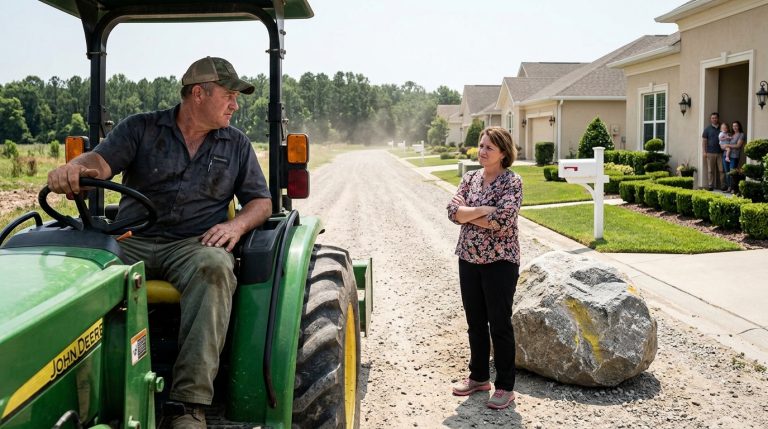
The sun had barely cleared the colonial roofline at the top of the cul-de-sac when the clipboard made contact with my turf.
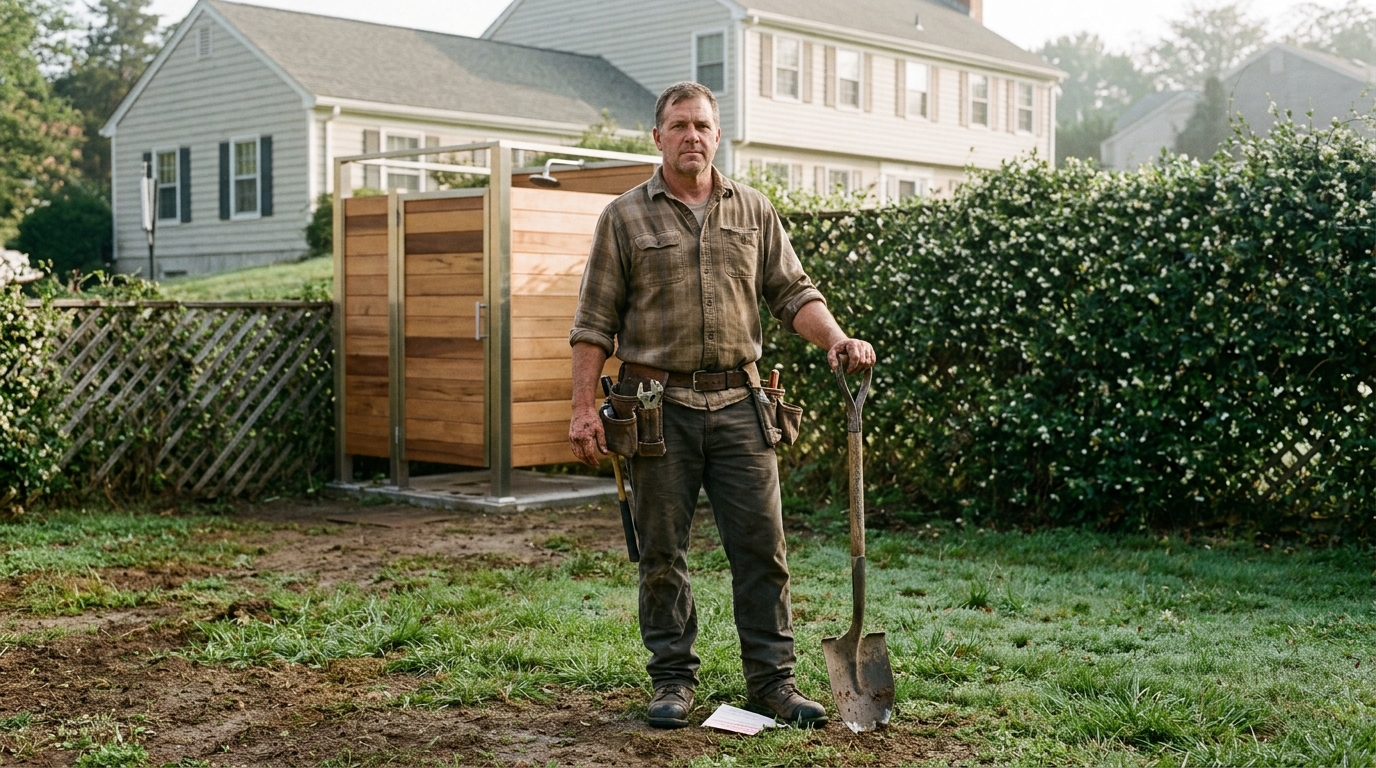
Karen stood there, her caftan billowing like the sails of an over-rigged galleon caught in a crosswind, her breath smelling faintly of morning citrus and untreated self-importance. Three thousand dollars, she said. Payable in fifteen days, or it doubles. She suggested I dismantle the eyesore immediately—the clean lines of cedar and brushed nickel I had spent the previous week fitting together behind a jasmine-laced lattice.
My thumb rested on the handle of the garden spade. The wood was smooth where my palm had polished it over decades of hard labor, but the steel blade was pitted with dry dirt.
“Karen,” I said. My voice didn’t rise. It never rose. A Marine learns early that shouting is just wasted oxygen, and a master plumber knows that pressure only looks for the weakest joint to blow. “There’s a clerical error here. The bylaws protect modifications that stay out of the public right-of-way.”
She offered a short, barking sound that passed for a laugh in her social circle. She tapped a manicured fingernail against the paper. “Section 7, Article B, Paragraph 4, Mr. Davis. You didn’t submit an application. You didn’t get approval. Therefore, you are in violation.”
She turned on her heel, her fabric snapping in the artificial breeze of her own momentum, leaving the violation notice resting on the grass like a dropped glove.
I didn’t reach for it right away. Instead, I let my gaze drift past her shoulder, up the slope of the blacktop toward the grand colonial at the crest of the street. I knew every inch of what sat beneath those floorboards. Fifteen years ago, when this development was just a collection of mud trenches and framing lumber, I had been the one down in the crawl spaces, running the rough-ins while the developer leaned over my shoulder shouting about schedules and budgets. I remembered the exact weight of the shortcuts we were forced to take, and I remembered the hushed, panicked phone call Karen had made to my private cell a few years later—demanding an oversized Jacuzzi and an unpermitted steam shower built off the books, with joists that hadn’t been engineered for the load.
She called it a community standard. I called it a cracked foundation.
I bent down, my knees clicking with the dry pop of old cartilage, and picked up the paper. The figures stared back at me in bold, black ink. Five thousand dollars total if I dragged my feet.
I walked back behind the lattice, turned the quarter-turn ball valve, and let the cold water run over my hands, washing away the dirt of the garden. The garage doors were down at the end of the driveway, waiting. Inside those gray, fireproof filing cabinets, behind drawers that groaned on heavy steel rollers, sat a very particular set of folders bearing her initials and the original developer’s manifests.
She thought she was handing down a sentence. She had no idea she had just handed me the blueprints to her undoing.
I dried my hands on a shop rag, feeling the cold air rolling off the concrete floor, when the sound of a heavy-duty engine braking at the curb cut through the morning silence.
CHAPTER 2: OPENING THE GRAY FILES
The Ford F-150’s exhaust note vibrated through the floorboards of the garage before fading down the blacktop, but the grit it left behind in the air tasted like stale copper. I didn’t rush. Rushing in the Marine Corps got patrols ambushed; rushing in plumbing got basements flooded with sewage. Instead, I let the heavy steel roller of the back filing cabinet drawer settle into its track with a dull, satisfying thud.
The air inside the workshop was thick with the scent of cutting oil, pine sawdust, and the particular, dry musk of paper that hadn’t seen the light of day in a decade and a half. Along the back wall, the gray fireproof cabinets stood like rows of silent infantrymen, bearing the weight of every botched joint, every hurried shortcut, and every signed authorization I had logged since taking off my uniform.
My fingers brushed against the metal tab of the drawer labeled DF. The metal was cold against my skin, carrying the chill of the uninsulated garage wall.
Fifteen years ago, the developer Barry had stood right where my workbench now sat, rolling up a set of blueprints with enough force to snap a hickory handle, telling me that nobody wanted to pay for perfection. “Just get it past the county inspectors, Mark,” he had barked, his breath smelling of stale peppermint and cheap whiskey. “The banks don’t care about extra venting stacks. They care about closing dates.”
I pulled open the thick series of manila folders labeled Developer Oak Hollow Estates. Inside, the blue lines of the original site plans were yellowing at the edges, brittle as autumn leaves. I didn’t need to look at the general schematics for the whole tract; I went straight for the subfolder marked with a single, sharp initial: K. Miller – Private.
The memory of that job five years prior crawled out of the dark. It hadn’t been booked through the company’s main dispatch line. Karen had called my personal cell late on a Tuesday evening, her voice pitched down into that conspiratorial, clipped cadence she used when she didn’t want a paper trail. She wanted a master bathroom suite that defied the physical limits of a standard two-by-ten floor joist system. A hundred-gallon Jacuzzi tub, an unvented steam shower with a manifold large enough to feed a commercial spa, and all of it tucked neatly away from the prying eyes of the city’s tax assessors.
“Just make it work, Mark,” she had insisted then, waving a manicured hand as if physics itself could be amended by an HOA vote. “Who needs their approval when I’m the one who signs off on every exterior alteration in this zip code?”
I had sistered the joists from the crawl space below, adding dead weight to a structure already teetering on marginal engineering, but I hadn’t done it silently. Every deviation from the code, every skipped permit number, every cash transaction receipt was duplicated with carbon paper and tucked safely behind these fireproof seals. I had taken her cash, but I had kept the receipts of her hypocrisy.
A sudden, sharp memory of Sarah sliced through the quiet hum of the workshop. I could almost picture her standing by the drill press, wiping grease from her fingers with a blue shop towel, shaking her head at the sheer audacity of people who thought rules were written only for the people beneath them. They always forget who holds the wrench, Mark, she used to say when some local contractor tried to cut corners on our own kitchen remodel decades ago. The surface looks fine until the pressure builds from underneath.
I pulled the carbon copy of the unitemized invoice from the folder. The ink had faded to a bruised violet, but the total was still legible: a lump sum for “Plumbing services rendered,” completely devoid of line items, permits, or municipal stamps. It was an illegal sanctuary built on top of a legal loophole, and she was using it as a throne to hand out three-thousand-dollar fines for a cedar shower she could only see by breaking her own rules of privacy.
The garage door rattled as a gust of wind caught the aluminum panels outside, sending a shiver of cold air across the concrete floor. My fingers traced the edge of the invoice. The paper was crisp, unforgiving, and completely lethal to a woman whose entire authority rested on the illusion of immaculate compliance.
The first phase of the counter-offensive wasn’t about shouting back across the property line. It was about laying out the pipework so that when the pressure finally hit, every single joint she had neglected would blow at once. I laid the blue plat map flat across the workbench, weighted the corners down with a pair of heavy brass pipe wrenches, and picked up a red grease pencil.
It was time to draft the appeal letter—not because I expected her kangaroo court to listen, but because every proper operation required a clean paper trail before you kicked the door in.
CHAPTER 3: THE FORMAL COUNTERMOVE
The lead snapped with a dry, sharp crack against the edge of the brass straightedge. I didn’t curse. I simply rotated the pencil in my calloused fingers, blew a thin layer of graphite dust off the blue lines of the Oak Hollow development map, and picked up where I left off.
A proper appeal letter in a dispute like this wasn’t an emotional outburst. It was a formal submission of engineering facts wrapped in bureaucratic armor. I had drafted enough municipal variance requests over thirty years of contracting to know that when you hand a hostile board a piece of paper, you want it to feel heavy enough to break a toe if they dropped it.
My workshop was dead quiet except for the low, rhythmic hum of the small space heater under the workbench and the ticking of the wall clock. Outside, the dusk was settling over the cul-de-sac like a sheet of unpolished zinc, turning the manicured lawns into flat gray shapes.
I wrote out the formal citation references line by line. Section 7, Article B, Paragraph 4. I quoted Karen’s exact phrasing back to her, stripping away her oral malice and freezing it in stark, black-and-white ink. Then I systematically dismantled the argument. An exterior modification implies a structural alteration to the permanent footprint of the primary dwelling. A freestanding, cedar-clad enclosure resting on a gravel-lined French drain in the rear courtyard is no more a structural modification than a movable barbecue grill or a child’s portable wading pool.
I attached four photographs taken from four distinct angles—the street, the sidewalk, the neighbor’s property line, and directly overhead from the fence boundary—all proving beyond a shadow of a doubt that the structure was completely invisible from the public right-of-way.
The pen moved steadily across the legal pad, each stroke deliberate. I wasn’t just defending my cedar shower; I was setting the first tripwire in a grid that would stretch all the way back to her front door.
When the draft was complete, I reached for a fresh sheet of paper and began a second document—one that would run in parallel to the official HOA appeal. This one cited the neighborhood covenants regarding the right to quiet enjoyment and peaceful possession of private property. I slipped both documents into heavy manila envelopes, affixed the certified mail stickers with exact precision, and stamped the return receipts.
The physical act of licking the glue strip left a metallic, dry taste on my tongue. I sat back in the metal shop chair, letting out a slow, measured breath. My shoulders were tight, the muscles locked from hunching over the workbench for two solid hours.
The workshop door stood slightly ajar, letting a thin wedge of cold night air bleed across the concrete floor. I stood up, my knees protesting with a dull ache, and walked over to the workbench edge to cap my markers. As I reached for the red grease pencil, a shadow cut across the wedge of light coming from the driveway.
It wasn’t a car engine. There was no hum of tires on asphalt. It was just a silhouette passing silently past the garage window—slow, deliberate, and lingering for a fraction of a second too long near the property line before dissolving into the gloom toward the cul-de-sac.
I didn’t rush to the window. You don’t telegraph your awareness to an observer. Instead, I calmly picked up the brass pipe wrench, adjusted the jaw until it clicked shut with a solid, metallic ring, and set it down on the wood.
The perimeter was being tested. The paperwork was ready for the mail carrier’s satchel in the morning, but the board meeting at the community clubhouse was only days away, and the air in Oak Hollow was turning brittle.
CHAPTER 4: THE CLUB ROOM INQUISITIONS
The community clubhouse smelled precisely of institutional beige—a blend of cheap commercial carpet cleaner, burnt decaf coffee, and the stale perspiration of twenty people forced to sit on uncomfortable metal folding chairs under flickering fluorescent tubes.
I pushed the heavy glass door open just ten minutes before the scheduled start time, my boots clicking rhythmically against the linoleum tile. The room was already half-full, a scattering of homeowners sitting in tight, isolated clusters, avoiding eye contact with the head table. No one nodded as I walked down the center aisle. Fear in a suburban subdivision had a very distinct texture; it made people look down at their shoes or stare intently at the grain of the folding tables as though reading secret instructions written in the formica.
At the head of the room, behind a long folding table skirted in dusty blue polyester, sat Karen. She flanked herself with Gary, whose fingers were working the seam of his tie with nervous twitching motions, and Brenda, who kept her eyes glued to a yellow legal pad like a student waiting for an exam she hadn’t studied for.
Karen wore a cream-colored blazer that caught the harsh glare of the overhead lights, her posture rigid as a iron stake. She didn’t look back as I chose a metal chair near the middle row, leaving an empty seat on either side of me—a quiet, involuntary quarantine enforced by the neighbors’ apprehension.
The clock on the wall hummed past the hour. Karen cleared her throat, a sharp, metallic sound that cut through the low murmur of the room.
“Good evening, residents,” she began, her voice carrying that practiced, brittle cadence designed to project absolute control. “We have a full agenda tonight, beginning with standard treasury updates and moving directly into enforcement reviews. Case number 2023-14, homeowner Mark Davis, twelve-four Willow Creek Lane.”
She didn’t look at my paperwork packet sitting certified in the postal service’s hands across town; she looked straight over our heads toward the back exit, treating the room as an audience rather than a community.
“The board has reviewed the late appeal submitted regarding the unauthorized exterior alteration,” Karen continued, tapping a manicured finger against the edge of her clipboard. “The finding is unanimous. The appeal lacks merit. The original fine of three thousand dollars stands, and due to uncooperative posturing, an additional two thousand has been levied.”
The numbers hung in the sterile air like falling lead. A few heads turned slightly toward me, waiting for an outburst, a shout, a fist slamming onto a table.
I didn’t move a muscle. I kept my hands resting flat on my knees, feeling the stiff denim of my trousers against my palms. A Marine learns early that an enemy shouting across an open field is wasting ammunition; you let them exhaust their clip before you adjust your sights.
“May I ask a question of the board, Madam President?” My voice was low, pitched just enough to carry across the linoleum without straining, flat and devoid of anger.
Karen’s eyes snapped down from the back wall, locking onto me with a sudden, sharp hostility. Her jaw tightened beneath her makeup. “You may ask, Mr. Davis, but the board’s decision is final.”
“The bylaws define a modification as an alteration to the structural integrity of the primary dwelling footprint,” I said, keeping my tone strictly transactional, treating her like a difficult municipal inspector who needed chapter and verse. “Could the board provide the legal interpretation of how a freestanding cedar fixture five feet from my back fence alters the primary dwelling?”
Gary shifted uncomfortably in his seat, his shoulder brushing Karen’s sleeve. He opened his mouth, a faint syllable catching in his throat before Karen’s elbow subtly nudged him back into silence.
“The board interprets its own rules, Mr. Davis,” she snapped, a flush of dark pink creeping up her neck above the cream collar. “We are not here to entertain semantic games from residents who choose to ignore community standards.”
She thought she had cornered me. She thought this was the entirety of the battlefield—a public dressing down on a folding chair in front of twenty quiet witnesses. What she couldn’t see, sitting under her bright blazer, was the quiet grid of data points I had already mapped out behind my garage walls.
I let a slow, heavy silence fill the room, long enough to make the fluorescent lights buzz audibly overhead, before I gave a single, slow nod and leaned back into the hard metal of the chair.
CHAPTER 5: SCOUTING THE INNER CIRCLE
The fluorescent hum of the clubhouse faded the moment my boots crunched onto the gravel path leading away from the parking lot. I didn’t head straight home. When an operation moves from an open forum to a closed theater, you don’t walk the direct line; you check the perimeter to see who else is watching the lights go out.
The houses along Willow Creek Lane sat back behind manicured turf and decorative carriage lamps, glowing with the warm, deceptive amber of domestic peace. But underneath the well-watered lawns, the infrastructure of the subdivision was beginning to hum with a quiet friction.
I kept my hands deep in the pockets of my canvas jacket, feeling the rough texture of the fabric against my knuckles. My path curved naturally past Lot 1—the grand two-story colonial at the crest of the cul-de-sac belonging to Karen. From the street, the front facade looked as immaculate and unyielding as its owner: crisp white trim, symmetrical windows, and a darkened entryway. But my training wasn’t built on looking at front doors.
I took the long route down the concrete easement, skirting the shadowed perimeter where the property lines met the shared utility trench. The moon was a thin, cold sliver behind high gray clouds, casting sharp, slate-colored shadows across the siding.
When I reached the rear boundary alignment behind Karen’s property, I stopped in the shelter of a mature Leland cypress hedge. The scent of dry pine needles and damp earth rose around me. Through the branching lattice of the greenery, the rear addition stood revealed under the pale wash of a security light.
It was a massive structure—a four-hundred-square-foot sunroom extension resting on a poured concrete foundation that clearly encroached past the twenty-foot rear setback line we had mapped out on the plat. The framing timbers were bolted directly into the main load-bearing wall of the colonial, its roofline awkwardly stitched into the original cedar shingles. There was no yellow municipal permit card taped to the double-paned sliding glass doors. No county inspector’s signature stamped into the concrete footing.
It was a physical manifestation of absolute hypocrisy: a massive, unpermitted monolith erected by the woman who had just slapped a three-thousand-dollar fine on my ankles for a cedar-screened shower that didn’t even break the property plane.
A shadow moved behind the frosted glass of the sunroom door.
I didn’t flinch, nor did I duck deeper into the hedge. I stood completely motionless, blending into the dark vertical lines of the cypress trunk, my breathing shallow and controlled. A silhouette paused inside the lit interior—a tall, rigid posture framed against the artificial warmth, turning sharply as if reacting to an imaginary noise outside. It was Karen, pacing her private kingdom, checking her perimeter just as I was checking hers.
She couldn’t see me in the deep dark of the easement, but the proximity was enough to send a cold, sharp thrill through my chest—not of fear, but of absolute tactical clarity. The fortress had walls, but the mortar was made of unrecorded cash and ignored statutes.
I turned away from the hedge without making a sound, my boots finding the dry gravel of the service path. The first layer of the puzzle was laid out in plain sight, waiting for the right bureaucratic key to turn it over. But to break a monopoly, you needed more than one set of blueprints; you needed the people who had been forced to live in the shadow of her rules to realize they weren’t standing alone.
The gravel path led away from the cul-de-sac, winding toward the middle ring of the development where Dave Riley’s house sat near the corner of Elm and Maple—the next designated checkpoint on the grid.
CHAPTER 6: COFFEE AND STRATEGY WITH THE SERGEANT MAJOR
The porch light at Lot 34 was on—a single, amber bulb burning steadily above a door frame free of ornamental wreaths or polite seasonal warnings. Before my knuckles even brushed the wood, the deadbolt clicked and the door swung inward.
Dave Riley didn’t blink. He stood there in a faded thermal shirt and gray work trousers, his shoulders maintaining that ramrod-straight alignment that thirty years in the United States Army refused to iron out of a man. He took one look at my face, stepped back, and pulled the door wide.
“Step in out of the draft, Mark,” he said, his voice dropping into that low, flat register soldiers use when they are done talking about the weather and ready to look at the map.
The interior of Dave’s house smelled of dry wood, gun oil, and strong, freshly brewed black coffee. We didn’t waste time in the hallway. He led me straight back to the kitchen table, where a yellow legal pad lay open alongside two heavy mugs throwing off spirals of steam. He sat down, steepled his fingers, and pushed the fresh mug toward me across the worn laminate surface.
“I saw the way you handled yourself at the clubhouse,” Dave said, watching me over the rim of his ceramic cup. “You didn’t drop your guard. That’s good. But she’s not going to stop at three thousand dollars. A dog backed into a corner doesn’t negotiate; it bites.”
I wrapped my hands around the warm ceramic, letting the heat sink into my calloused skin before taking a slow, bitter sip. “She’s not backed into a corner yet, Dave. Right now, she still thinks she’s holding the lease on the whole kingdom. She thinks a few more punitive fines on paper will make me pack up and tear down my own yard.”
“Then we change the terrain,” Dave said, pulling a folded grid sheet from beneath his legal pad and flattening it out with the side of his palm. He had spent his time well. “You’ve got the plumbing logs and the unpermitted sunroom files. But a rebellion needs a wider front. People won’t move just because one man’s cedar shower got targeted. They’ll move if they realize the water heater sitting in their own utility closets is a ticking legal liability.”
I leaned forward, resting my forearms on the laminate table, the lines of the development plat map coming into sharp focus under the overhead light. “The expansion tanks,” I murmured. “Barry skipped them on all one hundred and fifty homes fifteen years ago to save thirty grand on the buildout. The developer shifted liability to the master covenant, and Karen inherited the administrative chain without ever checking the pressure gauges.”
“Exactly,” Dave grunted, tapping a thick finger against the corner of the map. “Right now, she’s weaponizing the bylaws against people like the Rodriguezes and the Lees for trivial nonsense like a missing flower box or an extra inch of flagpole. But if we pivot the pressure from a personal grievance to a systemic community hazard—backed by your records—the entire foundation of her little board collapses under its own weight.”
The kitchen grew quiet except for the steady, rhythmic hum of the refrigerator in the corner. We spent the next hour mapping out the intersections of discontent across Oak Hollow—listing addresses, compiling dates of petty harassment, and cross-referencing the silent homeowners who had been beaten down by years of administrative intimidation.
Dave wasn’t just venting; he was organizing a platoon out of broken parts. And as I looked down at the handwritten notes accumulating on the yellow legal pad, I knew the paperwork sitting in my garage was no longer just a defensive shield. It was heavy artillery, and the fuse was already lit.
CHAPTER 7: THE FIRST CITY NOTICE LANDING
The transition from Dave’s quiet kitchen back out into the open daylight of Oak Hollow felt like walking back into an active firing zone. The morning sun was beating down hard against the asphalt, turning the manicured lawns into patches of brilliant, over-saturated green that smelled faintly of chemical fertilizer.
I didn’t head back to my workshop immediately. Instead, I kept my pace steady, walking along the public sidewalk toward the upper cul-de-sac where Karen’s colonial sat like an administrative fortress.
The first missile in the bureaucratic exchange had already been loaded into the digital launcher. Three days prior, using the anonymized public terminal at the municipal offices downtown, I had filed a formal, fully documented structural complaint with the city’s code enforcement division regarding the unpermitted four-hundred-square-foot sunroom extension bolted onto the rear of Lot 1. I included the plat map analysis, the specific municipal ordinance violations concerning side and rear setback requirements, and digital satellite imagery proving the total absence of a historical building permit.
Now, the gears of the city were about to turn.
As I rounded the final bend of the cul-de-sac, a sharp flash of white caught my eye near Karen’s driveway. A crisp, government-issue Ford Explorer bearing the municipal seal of Oak Hollow on its side panels was parked directly against the curb, its engine idling with a low, authoritative purash.
A man in a navy uniform shirt and high-visibility vest stepped down from the driver’s side, a black clipboard clutched tightly under his arm. He didn’t waste time looking at the landscaping; he marched straight up the brick-paved front path of Karen’s house and rapped his knuckles against the heavy mahogany door with three sharp, echoing strikes.
I slowed my pace slightly, keeping my hands buried in my jacket pockets, watching the sequence unfold from fifty yards away.
The door swung open. Karen stood in the threshold, her cream-colored blazer replaced by a loose silk blouse, her expression dropping from an automatic hostess smile into a cold, defensive scowl the moment she recognized the uniform. The municipal inspector didn’t smile back. He raised the clipboard, pointed a finger at a printed sheet, and began speaking in a steady, deliberate tone that carried faintly across the silent blacktop.
I couldn’t hear the exact words, but I could read the physical grammar of the interaction perfectly. Karen’s posture stiffened; her hand flew up to grip the edge of the doorframe as if anchoring herself against a sudden tremor. She gestured wildly toward the neighboring lots, her face flushing with indignant color, trying to invoke her executive privilege as the HOA president to wave away a county mandate.
The inspector didn’t flinch. He simply shook his head, pulled a small digital camera from his pocket, stepped past her line of sight toward the side yard to capture the unpermitted sunroom extension, and made a sharp, definitive notation on his official log sheet.
From my vantage point down the sidewalk, a grim, quiet satisfaction settled into my chest. The queen’s castle had just been inspected from the outside, and the notice taped to her window wasn’t going to carry a floral-print letterhead—it carried the cold, unyielding weight of municipal law.
She stood on her porch long after the Explorer pulled away from the curb, the white paper clutched in her fist, her head turning slowly to sweep across the quiet houses of the cul-de-sac. When her eyes scanned across my direction, I didn’t duck or turn away. I met her gaze across the open asphalt, my expression entirely unreadable, before turning smoothly up my own driveway toward the gray filing cabinets waiting in the garage.
CHAPTER 8: ESCALATION AT THE CURB
The metallic scrape of steel jaws biting into the suspension arms of my 1986 Ford F-150 didn’t sound like a standard repo; it sounded like an act of desperation.
I didn’t walk out the side door; I moved with the cold, measured rhythm of a mechanic who knew every bolt on that chassis. By the time I cleared the threshold into the blinding afternoon glare, a young tow-truck driver in a stained reflective vest was already scrambling back toward his cab, his fingers fumbling with the winch controller.
My truck sat level on the asphalt, perfectly legal, its tires parked well clear of any red zone or fire hydrant. Yet tucked firmly beneath the driver-side windshield wiper was a crisp, newly minted notice bearing the official red-and-black letterhead of the Oak Hollow Homeowners Association.
“Hold it right there,” I said. My voice wasn’t raised, but it carried the flat, low resonance that stops heavy equipment operators dead in their tracks.
The kid froze with his hand on the door handle, his eyes darting from my face down to the heavy canvas jacket I wore. “Look, man, I got a dispatch order,” he muttered, shifting his weight uneasily from one boot to the other. “Property management says it’s an abandoned, hazardous vehicle leaking fluids. Said to hook it and haul it.”
I walked slowly around the front fender, knelt down on one knee, and ran my bare palm across the clean, dry asphalt directly beneath the truck’s engine block. There wasn’t a single drop of oil, transmission fluid, or coolant on the gray pavement. It was as bone-dry as a summer creek bed.
“Look at the pavement, son,” I said, keeping my eyes locked on his. “Is there a drop of oil down there?”
The kid swallowed hard, staring at the clean concrete. “Well… the work order stated—”
“The work order is a fraud,” I interrupted, standing back up to my full height. “And if that winch motor turns one more revolution, my next call won’t be to the board—it’ll be to the county sheriff’s department to report a grand theft auto in progress using municipal funds for a personal vendetta.”
The young driver let out a sharp breath, looked from me to the pristine pavement, and made the only logical calculation available to an independent contractor who didn’t want to lose his license over a neighborhood turf war. He let go of the door handle, walked to the back of the flatbed, and threw the winch lever into reverse with a sharp clank.
“Alright, man. I’m unhooking. Take it up with them.”
Within two minutes, the truck was backing down the cul-de-sac with its lift arm raised empty, leaving behind only the smell of hot hydraulic fluid and a fresh piece of paper fluttering against my windshield.
I pulled the notice free. Signed by Karen. Hazardous vehicle violation. Fine: $1,000 plus tow fees. She had completely abandoned the pretense of subtle bureaucracy; she was throwing heavy iron at my front door because her own sunroom was currently under city investigation.
I folded the paper neatly, slid it into my breast pocket alongside my field notes, and turned back toward the garage. The gloves were off, the perimeter had been breached, and the final sequence of the operation was ready to shift from defense to absolute checkmate.
CHAPTER 9: ASSEMBLING THE COALITION
The dining room table looked less like a domestic space and more like a forward operating base. Spread out across the polished wood were three clipboards, a box of ballpoint pens, and a growing stack of lined paper bearing the signatures of homeowners who had spent years hiding behind their locked front doors.
The doorbell rang precisely at seven o’clock—a single, firm chime that carried no hesitation.
I walked down the short hallway, turned the deadbolt, and pulled the door open. Dave Riley stood on the porch, his chin tucked into the collar of his jacket against the evening chill, followed closely by Mr. Rodriguez from down the block and young Mrs. Lee holding a bulging manila folder filled with old violation notices and color-printed emails.
“Evening, Mark,” Dave said, stepping over the threshold without waiting for an invitation, his boots bringing in the scent of damp autumn grass. “We’ve got the southern sector locked down. Every house from Maple to the cul-de-sac has signed the petition for the special meeting.”
“Shut the door behind you,” I said quietly, locking the deadbolt once more before leading them back toward the dining room.
We didn’t sit down immediately. Mr. Rodriguez laid his clipboard flat on the table, his fingers tracing the columns of signatures. “Eighty-four signatures total,” he said, a note of disbelief edging his voice. “More than half the entire development. People aren’t just annoyed anymore, Mark. After seeing that city inspector slap a stop-work order on Karen’s sunroom last week, they realize the throne has cracks all the way through.”
Mrs. Lee opened her manila folder, spilling out a collection of printed correspondence across the wood grain. “She sent another automated warning letter to the Chings today about their child’s playset,” she said, her voice tight with suppressed fury. “Even after the city came out. She’s completely losing her grip, acting like she can write rules out of thin air to cover up her own panic.”
I pulled out my chair and sat down, resting my arms on the edge of the table next to the original development blueprints. The air in the room was dense with purpose. For months, Karen had operated on the assumption that isolation was her greatest weapon—that by picking off homeowners one by one with arbitrary fines and petty threats, she could keep the community too fractured to mount a defense. But isolation only works when people believe they are alone in the dark.
“We don’t need to argue with her anymore,” I said, my voice cutting through the murmurs. “The paperwork is filed. Tom finalized the master demand letter with the personal liability addendums for Gary and Brenda. The board has ten business days to rescind every fine, audit the accounts, and force her resignation, or the lawsuit goes straight to the county clerk’s desk.”
Dave leaned back against the sideboard, crossing his arms over his chest with a grim, satisfied smirk. “And if she tries to use the clubhouse mic to shout everyone down like she did at the last regular meeting?”
“She won’t have the floor,” I replied, tapping a finger against the printed copy of the HOA bylaws. “According to Article Three, Section Four, a special meeting called by petition is presided over by the petition organizers. She won’t be holding the gavel. We will.”
The realization settled over the room like a physical weight, smoothing out the tension in their shoulders. The coalition wasn’t an informal gathering of complainers anymore; it was an organized administrative body ready to reclaim its own turf.
CHAPTER 10: THE PARKING LOT CONFESSION
The ten-day deadline imposed by Tom’s legal notice was drawing to a close, and the pressure inside Oak Hollow was beginning to warp the frame.
It was mid-afternoon when my cell phone buzzed against the work surface of the garage workbench. I didn’t rush to answer it. I finished tightening the packing nut on a quarter-turn brass valve, wiped my greasy thumb on a blue rag, and picked up the handset.
“Mark,” a voice whispered on the other end. It was thin, frayed at the edges, carrying the distinct tremor of a man whose financial foundation was actively dissolving beneath his feet. “It’s Gary. We need to talk. Not on the phone. The Starbucks parking lot off Route 9. Fifteen minutes.”
The line went dead with a sharp click before I could offer a reply.
I didn’t waste time changing out of my work clothes. I dropped the wrench into the toolbox, washed the graphite off my hands at the utility sink, and climbed straight into the cab of the F-150. The engine turned over with a deep, familiar rumble that vibrated through the floorboards as I pulled out of the driveway and headed away from the development.
Route 9 was a strip of asphalt flanked by strip malls and fast-food franchises, far enough away from the pristine, manicured lawns of Oak Hollow to feel like a different country. The Starbucks parking lot was half-empty under the harsh white glare of an afternoon sun that washed the pavement in a flat, unsparing light.
Gary’s sedan was parked in a corner spot near the far dumpster enclosure. He didn’t get out when I pulled my truck up alongside him and cut the ignition. Instead, I saw his silhouette through the tinted driver-side window, hunched over the steering wheel, his hands gripping the plastic rim so tight his knuckles looked bloodless.
I stepped down from the truck cab, the gravel crunching under my work boots, and walked over to his window, tapping twice with my knuckles against the glass.
The window hissed down a few inches. Gary’s face was pale, his eyes red-rimmed and darting nervously toward the passing traffic on the main road as if expecting Karen to materialize from behind a delivery van. He was clutching a thick manila envelope against his chest like a shield.
“I didn’t know about the towing order, Mark,” he blurted out before I could even plant my boot on the threshold. His voice was a ragged whisper. “She told me you were just a disgruntled resident trying to skip out on a standard fee. She said the board had to show strength. But when your son-in-law’s legal letter arrived… personal liability? Suing us for damages? My wife would kill me. I’m a retired accountant, Mark. I don’t have a corporate defense fund.”
I leaned my forearm against the top of his door frame, keeping my expression entirely neutral, letting the silence between us stretch out until he felt the full weight of his own panic.
“You sat at the head table, Gary,” I said quietly. “You raised your hand when she levied the fines. You rubber-stamped the harassment.”
“Because she bullied us!” he snapped, his voice cracking into a high, defensive register. He thrust the manila envelope through the cracked window. “Here. Take it. It’s the internal board meeting logs from the past three years. Every vote she forced through, every time she redirected reserve funds to cover her own legal fees, every record of how she used the HOA account like her own personal slush fund. It’s all in there.”
I didn’t snatch the envelope. I reached down slowly, took it from his trembling fingers, and slipped it under my arm.
“The water heater liability, Gary,” I said, my voice dropping an octave. “You knew about the developer shortcuts from fifteen years ago, didn’t you?”
Gary swallowed hard, his throat working convulsively. “Barry mentioned it casually when we bought in, years back. He said expansion tanks were optional if the inspectors looked the other way. Karen made us swear never to put it in the official minutes because it would trigger a mandatory developer disclosure and tank property values. We just… we just buried it.”
“And now the burial ground is caving in,” I said.
He slumped back against the headrest, closing his eyes as a look of total defeat washed over his face. “What do I need to do?”
“You and Brenda don’t need to fight anymore,” I told him, stepping back from the car. “Just make sure the doors to the clubhouse are unlocked and the lights are on when the ten days run out. Let the people walk in.”
I turned away without another word, leaving him sitting in his sedan in the middle of the asphalt desert, a small man crushed beneath the weight of a kingdom built on bad plumbing and broken rules. The final piece of evidence was in my hand. There was nowhere left for the queen to hide.
CHAPTER 11: THE TRIAL AT THE CLUBHOUSE
The air inside the Oak Hollow community clubhouse was thick, vibrating with the collective weight of over a hundred residents packed shoulder-to-shoulder into a room designed for forty. Folding chairs lined the walls three deep, and the back corridor was choked with people standing in tense, absolute silence.
Gary and Brenda sat at the head folding table, their faces pale and drawn like winter linen. Beside them, Karen occupied the center seat, encased in a severe black pantsuit that functioned like a suit of armor. Her expression was an unyielding mask of imperious disdain. She had not come to negotiate; she had come to execute an administrative purge.
When I walked down the center aisle alongside Dave Riley, the low murmur of the room died instantly.
Karen banged the wooden gavel down once, the sharp crack echoing off the drop-ceiling tiles with the force of a starter pistol. “This special session of the Oak Hollow Board of Directors is called to order,” she announced, her voice pitched high and razor-sharp. “Let the record show that this unauthorized gathering organized by disgruntled individuals is out of order. Any motions presented outside the official executive agenda will be summarily dismissed.”
She expected a shouting match. She expected a messy, emotional brawl where her practiced procedural dominance could crush the opposition under a mountain of parliamentary jargon.
I didn’t shout. I didn’t even raise my voice. I carried the heavy canvas binder containing the original development logs, Gary’s leaked board records, and Tom’s final legal brief straight to the front resident podium.
“The floor is not yours to control, Karen,” I said, my voice cutting through the dead air with the calm weight of a marine drill instructor.
Karen’s face mottled into a dark, angry red. “You are out of order, Mr. Davis! Security—”
“There is no security tonight,” Dave Riley interrupted, stepping forward to flank the podium, his posture rigid and commanding. “According to Article Three, Section Four of the bylaws, a special meeting called and signed by eighty-four verified homeowners is presided over by the petition committee. You no longer hold the gavel.”
Brenda, her hands trembling so violently she could barely keep them flat against her legal pad, leaned into her microphone. “I second the motion to vacate the presidency,” she whispered, her voice cracking across the sound system. “For breach of fiduciary duty, selective enforcement, and gross negligence.”
The room erupted into a deafening roar of affirmation. Karen stood up so fast her metal chair scraped backward with a violent screeching sound against the linoleum. “You cannot do this! I built this community! I protected your property values!”
“You didn’t protect anything except your own hypocrisy,” I said, opening the binder and sliding the first sheet under the overhead projector light.
The glowing projection on the wall behind the head table didn’t show my cedar shower. It showed the blueprint overlay of Karen’s colonial, with the four-hundred-square-foot sunroom extension highlighted in searing red, accompanied by the city’s official stop-work order and daily fine notices.
Gasps rippled through the front rows. Neighbors who had been fined for minor lawn infractions stared at the screen in stunned silence.
“While our president was issuing three-thousand-dollar penalties for unapproved aesthetic fixtures,” I continued, turning the page to reveal the master spreadsheet of developer shortcuts, “she was concealing an unpermitted, setback-violating addition on her own property, built with developer cash and off-the-books labor.”
Karen lunged toward the microphone, her eyes blazing with blind fury, but before she could speak, the heavy glass entrance doors at the back of the clubhouse swung open with a pneumatic hiss.
Two uniformed figures stepped into the room—a senior municipal building inspector and a county fire marshal, both carrying official clipboards. The room parted instantly, the crowd falling into a breathless hush as the inspector walked straight down the center aisle toward the head table.
He placed a heavy, formal packet directly on top of Karen’s pristine paperwork.
“Karen Miller,” the inspector’s voice boomed clearly across the room. “You are formally served with a final municipal lien and stop-work order for the unpermitted structural additions at your residence, retroactive to the date of initial citation, totaling over twenty thousand dollars in municipal fines. Furthermore, the fire marshal’s office has logged a formal review of the neighborhood-wide infrastructure. The master association is hereby placed on notice for one hundred and fifty unmitigated residential water heater code violations.”
Karen froze, her hands hovering inches above the desk, the color draining entirely from her face until she looked like stone. The half-million-dollar liability she had tried to bury fifteen years ago under a mountain of petty turf wars had finally surfaced, blowing out every valve in her empire.
Dave Riley stepped up to the microphone, looking out over the sea of neighbors. “All in favor of removing Karen Miller from the Board of Directors permanently, and initiating a full, independent financial audit of the HOA accounts, say Aye.”
The roar that shook the clubhouse walls was instantaneous, deafening, and absolute.
Karen did not look at the crowd. She did not bang her gavel. She simply turned, grabbed her leather briefcase with stiff, mechanical movements, and pushed her way past the back row of residents into the dark night outside, leaving the kingdom behind her in ruins.
CHAPTER 12: SILENCE ON THE CEDAR DECK
The aftermath of a corrected system doesn’t arrive with fireworks; it arrives with the steady, unhurried dripping of a properly sealed joint.
In the weeks following the clubhouse trial, the transformation across Oak Hollow moved with the quiet efficiency of an overhaul executed by a master craftsman. Karen’s colonial sold at a steep markdown to a buyer fully aware of the unpermitted sunroom, her hasty departure leaving behind a vacuum that the newly elected board filled not with edicts and penalties, but with transparency and common sense. Dave Riley took the president’s chair, Mr. Rodriguez managed the ledger, and the petty fines that had choked the neighborhood for years were officially voided with a single unanimous vote.
My own $5,000 penalty vanished into the administrative ledger as if it had never existed, alongside the bogus citations leveled against the Chings, the Lees, and the Rodriguezes. More importantly, the systemic threat lurking in one hundred and fifty utility closets was finally addressed. Semper Fi Plumbing was formally contracted to run the remediation project, going house by house to install the required thermal expansion tanks using the community’s healthy reserve funds, closing the loop on a fifteen-year-old oversight that could have ruptured the entire subdivision.
It was a Tuesday afternoon when the last expansion tank was bolted into place down on Maple Street, bringing the project to a close. I drove my old Ford truck back into my own driveway, cut the engine, and stepped out into the quiet warmth of the yard.
The cedar panels of my outdoor shower had weathered into a smooth, even shade of silvery gray under the sun. The jasmine vines had climbed higher up the wooden lattice, their white blossoms releasing a clean, sweet fragrance into the air that mingled with the scent of damp garden soil.
I walked past the side gate, turned the brushed nickel handle of the shower valve, and let the cool, clean water run over my calloused hands. The pressure was steady, uninterrupted, and perfectly regulated. Every pipe was sloped correctly; every joint was solid.
My cell phone vibrated against my thigh. I wiped my palm on my trousers and pulled the handset free. It was Jessica.
“Hey, Dad,” her voice came through clear and bright. “How did the final wrap-up go down on Maple?”
“All done,” I said, a slow, genuine smile breaking through the corners of my mouth. “Oak Hollow is officially up-to-date and holding pressure.”
“That’s wonderful,” she laughed on the other end. “By the way, Lily is still asking about that tree house you promised to help her build. Do you think we need permits for a really tall one?”
I looked around the quiet, sunlit perimeter of my yard, taking in the unbroken fence line and the peaceful stretch of green turf where no one was watching from a second-story window.
“I know,” I answered, looking out toward the driveway. “There are rules, sweetheart. And this time, we’re going to follow every single one of them—because we can.”
I hung up the phone, stepped out from under the cedar enclosure, and walked over to the workbench in the garage. The filing cabinets were closed, their heavy steel drawers locked tight. The kingdom was quiet, the water was running clean, and the world was finally, properly aligned.